The Youth’s Instructor, Vol. 67, No. 12.

My Ideal Roommate
Earlier text: My Ideal Roommate

Some Out-of-door Games

Fox and Geese

NOT having time enough for golf, I prefer a game like Fox and Geese—which Minnesota school children know as Cut-the-pie. Snow is best to play it in, but, lacking snow, there is no good reason why one should not mark out a big wheel, with lime or chalk, on the asphalt pavement in front of a city home or on any available space.
Mark out a circle of any convenient diameter—perhaps twenty to fifty feet. Mark the spokes of the wheel—possibly ten or fifteen feet apart at the circumference and meeting at the hub.
Make one player “it.” He pursues the others, but only on the spokes, tire, or hub of the wheel. When he tags another player, that one takes his place in chasing the others. Some play that the big hub is goal and a player safe while he stands there, but I think that makes the game too slow.

Horseshoes

Up among the farms and orchards of northern Maryland, where my youngsters take me nearly every summer, the only game I ever saw played spontaneously by the natives was Pitching Horseshoes—one may say Quoits if he prefers to buy them.
Everybody, old or young, can pitch horseshoes—though the youngest players would better use rope rings.
Two wooden posts about an inch and a half thick are driven into the ground at any convenient distance apart. The posts stick up about four or six inches above the earth. Each of the two or more players, in turn, stands behind one post and pitches two horseshoes, one at a time, at the other post.
When all the players have pitched, the score is counted—perhaps as follows: Nearest the post, one point; if both the horseshoes of one player are nearer the post than any opponent’s horseshoe, two points; a “ringer” (encircling the post), three points. Sometimes you play that the horseshoe farthest from the post subtracts one point from its pitcher’s score.
From behind the post first aimed at, the players pitch next for the other post. The game may be for the largest score or for a definite number of points, say 21. Teams of two or three players may compete, or each may score singly.
In Columbus, Ohio, a resourceful organizer of recreation developed Horseshoe Tournaments into which players were drawn from all over the city. Crack teams fought for the championship of their neighborhood, or city square; and newspapers made much of the scores and personnel and skilful plays of the chief contestants.

Run, Sheep, Run

In small towns or country districts, in my boyhood, we played a kind of I Spy or Hide and Seek, called Run, Sheep, Run.
One player threw a stick as far as possible, shouting, “Run, Sheep, Run.” The player who had previously been chosen “it” must get the stick and lean it against the goal. Meanwhile all the other players ran away and hid themselves.
While the stick was on the goal, if “it” saw any player he called the player’s name, threw the stick as far as possible from the player caught, shouted, “Run, Sheep, Run,” and ran to hide while the new “it” got the stick and leaned it against the goal. Thus the game really began anew as soon as any player was caught.
While “it” was searching in one direction for hidden players any player might run in from another part of the field, throw the stick as far from “it” as possible,—shouting, “Run, Sheep, Run,”—and thus give all the players a chance to run farther from the goal and to hide themselves more securely.

Volley Ball

If a family or a neighborhood group can spare five to ten dollars, they will find that a volley ball and net are a good investment. (A clothes line or any other rope will do instead of the net.) This is the most costly playground equipment I shall suggest, for I believe in “apparatus” and in “playgrounds” far less than in play.
“Experts” disagree somewhat as to the rules for volley ball, but the following may answer:
Use a tennis court, if you have one, or mark off an oblong the size of your back yard or lengthwise of your front street—about fifty feet long and twenty-five feet wide. Stretch the old tennis net, or your wife’s best clothes line, across the middle of the oblong, the twenty-five-foot way. Have the line, or the top of the net, six to eight feet above the ground—its height depending somewhat on the age and skill of your players.
A volley ball is large and light. You and your boys have a preliminary contest as to which can blow it up the tightest and whose “butter fingers” let the most air out in trying to tie up the neck of the inside bladder.
The players are evenly divided, half on either side of the net or rope. Any number of players may play on a side, say three to thirty. One of the players stands behind the back line—the serving line which lies parallel to the net and twenty or twenty-five feet away from it—as the playground space permits. The batter, or server, holds the volley ball on his left palm, tosses it up a little and hits it with his right hand—trying to make the ball go over the net and strike the ground, within lines, on the opposite side of the court.
But the enemy are alert to knock the ball back over the net to make it hit the ground first on the server’s side. No one may catch or hold the ball, but a player may strike it with one or both hands—hands always open. Good players will sometimes bat the ball from one to another on their own side of the net until they can suddenly bat it into a place where no opposing player is ready to keep it from falling to the ground. But no player may touch the ball more than twice in succession until some other player has touched it.
The server’s side scores one when their opponents fail to return the ball. If the ball falls to the ground on the server’s side, no one scores, but the chance to score by serving the ball passes to the other side. Any server continues putting the ball in play until his side fails to score, then the opposing side gets the ball and serves it. On both sides the players take regular turns—a new server each time the team gets the ball.
If the ball touches or passes beneath the net or rope, the play is lost, but if the ball came directly from the server, he has a second trial. Whenever the server fails in any way to get his first ball fairly over the net, he may try again before losing his turn to serve.
In Elgin, Illinois, I saw fifty of the leading men of town—ministers, teachers, doctors, and big business men—dressed in gym suits and shoes; acting and feeling like a crowd of happy boys over their semi-weekly game of volley ball. It has no equal for meeting the recreation needs of all sorts and ages of folks. Boys and girls like it all the better because adults play it, too.
Eyes, head, and chest are all uplifted because the volley ball is constantly flying in the air. The players strike upward. They run, jump, turn about, hit hard, and use all their muscles snappily. More individual skill and greater team organization are called for by this game than by the others I have described, but unskilled youngsters enjoy it, and it draws them on steadily toward greater physical efficiency.—Charles Frederick Weller.

Good from Opposition

OPPOSITION, or even resistance, need prove no real hindrance to the final success of any good enterprise. In fact, resistance may bring results the very opposite from those which one's enemies purpose. Without the nozzle on the lawn hose, for example, the water pours out leisurely at its end. Place your hand over the opening in the endeavor to stop the stream, and the lazy water at once spurts out with force many times its former distance across the lawn.
Often an enemy is of more real benefit to a young man than a friend. The young man is put on his guard, on his mettle, as we sometimes say, and the annoying opposition stirs latent powers within him, resulting in his reaching higher attainments and accomplishing more real good than perhaps he otherwise might have accomplished. While God is not in the opposition or evil design, yet he permits it, and is able to so overrule that good may result to the one who trusts in him, in place of his being defeated by the wickedly designed enmity.
And so it is in the experience of the earth with the awful catastrophe of sin itself. God did not design that sin should exist; yet he was prepared for it when it appeared in his great universe. Lucifer developed into Satan — the enemy of God. And God permitted him to exist, even after a world united with him in rebellion. But even this shall result in placing the redeemed human race above the position accorded in the beginning to Adam, the father of the race. For a wise purpose, evil is still permitted to exist and to come into contact with our lives, but this need prove no disaster to the one who trusts in God.
One day this world of ours, racked and wrecked as it is with the terrible conflict between the good and the evil that has waged through nearly six thousand years as these forces have struggled for the supremacy, shall bear through all eternity the throne of God and the Lamb, and the capital city of the universe shall be settled upon it. This is no credit to sin, nor an argument that it should have existed, but a wonderful commentary on the power and goodness and wisdom of God in turning into a glorious and eternal victory the terrible disaster which otherwise would have brought utter defeat.
It is here that the long-drawn-out conflict in heaven found entrance in Eden. It is here that this conflict is to be fought out to a finish. It is here that the cross of the Prince of life, the Son of God, has been planted. It is here that the originator of sin and all his confederate angels and men, shall meet their doom in that awful second death that shall know no awakening while the years of eternity roll.
God and Christ and the good angels have been resisted all through the ages; but the love of God and his eternal law of righteousness shall shine out and stand out all the more clearly and the more distinctly because of it. T. E. BOWEN.

How Young People May Assist in Missionary Work

THERE are always two phases of missionary endeavor. If a person be nine or ninety these two remain the same. And while they are written as two on paper, and are spoken of as two phases of missionary endeavor, in practice they blend into one, and only thus can the Christian character maintain its true balance. First, the life; second, the work. In the blending of life and work we have genuine character of whatever quality.

Burning and Shining Lights

Jesus says of that “greater than a prophet,” “He was a burning and a shining light.” In John 1:4 we have the definition of this light: “The life was the light of men.” The simplicity and earnestness, the burning zeal and fearless preaching, of John revealed a life of entire devotion to one object.
John was a forerunner of the Messiah. His entire life was given to this. In antitype our own young people are to lead lives of purity and simplicity, of earnestness and moral courage, in a careless, indifferent, pleasure-loving age. The life must be the light. They are forerunners of the King of kings and Lord of lords at his second coming. As John was abstemious, so we must be temperate in all things. This body temple must be so fed and cared for that the gross appetites and passions can be more easily crucified, and the Holy Spirit may find a fit and permanent abiding place therein. Having a definite object before him John made it the business of his life to prepare himself, body, soul, and spirit, for the performance of that object. A simple, nourishing diet, plainness of dress, and earnestness of manner characterized him. There was no indecision about him. He was a burning light.
A candle cannot light the house, and preserve its original dimensions; the very performance of its duty consumes it. We cannot follow our natural inclinations, nor be governed by many of our acquired habits of life, for the call to enlist in this greatest army of the universe is a call to submit to a pruning, shaping, chiseling, purifying of character.
“The light that shines the farthest shines the brightest nearest home.”
Our call to service may begin in the kitchen; it may help a girl to wash dishes with more care and dispatch. It may help a boy to cut weeds out of the fence corners and mend the broken gate. One of our most loved and trusted General Conference brethren began life as an errand boy, but he must have done it in a shining way. A well-known physician began his career washing cooking utensils at a tin sink, but he did it heartily and well. A prominent leader of educational thought among our women worked by the week for her board and clothes to get her start in education.
“No man is born into the world whose work Is not born with him; there is always work, And tools to work withal for those who will; And blessed are the horny hands of toil! The busy world shoves angrily aside The man who stands with arms akimbo set, Until occasion tells him what to do. And he who waits to have his task marked out, Shall die and leave his errand unfulfilled.”

Map of the World Versus Football Field

When we take upon us our baptismal vows, it is not merely to become dying members of a dead church, but we are quickened, made alive, and rise to “walk in newness of life.” Every moment becomes precious to us for what we can accomplish in it to the glory of God. Earnestness alone makes life eternity.
The mind must be nourished in order that it may grow and develop. So a definite course of study must be followed day by day, not only for eight or nine months but throughout the year, the pivotal books being the Scriptures and the spirit of prophecy. Every youth among us should be able to pass easily, the Standard of Attainment examination. The points of our faith should be studied by them until they are understood.
The map of the world is of more importance to us than a football field. We should acquaint ourselves with the topography, customs, languages, and needs of every country.
If we are to evangelize the world, shall we not definitely prepare for that work? The gift of song must be developed. Somewhere, sometime, awaits a discouraged heart that your song of cheer and gladness will lift out of the slough of despond and elevate to the plane of hope. Some poor sick body must be treated, perhaps washed and made clean. But because you understand nothing of the delicate mechanism of the body, and have no knowledge of simple treatments, must that suffering body go down to death? Let us prepare while it is called today, for the opportunity comes to every person, and it does not tarry long after coming.

Definite Aims and Definite Problems

Ours must be no haphazard, half-and-half training. With a definite aim before us, and definite problems to be worked out, a definite object to be achieved, we must work every problem with exactness, make every drawing true, read every paragraph understandingly, spell every word correctly. “Many a little makes a mickle,” say the Scotch. Today’s apparently uneventful happenings help to make up our life.
“Heaven is not reached at a single bound; But we build the ladder by which we rise From the lowly earth to the vaulted skies, And we mount to its summit round by round.”
Young man, you need not feel so unimportant. That temptation you resisted yesterday has put lines of strength into your face, and has added dignity to your bearing. Young woman, those gewgaws of finery you thought so pretty, but laid aside willingly for Jesus’ sake, will soon appear as cheap and tawdry to your maturer eyes as they do now to others’. No man or woman of the humblest sort can really be strong, gentle, pure, and good without the world’s being better for it, without somebody’s being helped and comforted by the very existence of that goodness.

A Broad Field Before Youth

Young people have such a broad field for missionary endeavor. When the life and buoyancy of youth are coupled with Christian courtesy and good cheer the power for good is unending. Louisa M. Alcott once said: “It is a part of my religion to look well after the cheerfulness of life, and let the dismals shift for themselves.” Cultivate this rejoicing spirit, and scatter the sunshine of God’s love wherever you go. Also cultivate the “tract habit.” Think what it will mean to have ten thousand Missionary Volunteers in this country, scattering the truth daily!
Be kind in the home. This is where the proving of conversion takes place. If you would put a character to the severest test, see whether it can bear without faltering the common ills of everyday life.
Work for your associates. Bring them to Christ. But you cannot do this of yourself. He who abides closest to the heart of God, will get nearest to the hearts of men. Be found faithful! Let not your life counteract the influence of your words and teachings. O young people, it is a terrible thought that every act and word of our lives is leaving its indelible impress somewhere! “We are not writing in the sand. The tide does not wash it out. We are not painting our pictures on the canvas, and with a brush, so that we can easily erase the error of yesterday, or overlay it with another color today. We are writing our lives with a chisel on the marble, and every time we strike a blow we leave a mark that is ineffaceable.”
God gave all for us. We must give all for him.
“How shall our lips claim fellowship with thine, And yet be silent when thy cause is scorned? How shall our feet walk in thy steps divine, Yet idle wait, leaving thy world unwarned?”
“Touch thou the silent lips, O God, with fire, Till in thy triumph-song of truth they sing. Lead on the languid feet to struggle higher, On Zion’s mountains, heralding the King.”
“How shall our hands be thine, nor yet unclose, While souls about us faint in need and loss; Our hearts live in thy life, nor turn to those For whom thy heart was rended on the cross?”
“O Christ of God! nerve thou the hands to move As in their touch thy healing might were shown; Quicken the hearts thou claimest, Lord, to love, With that eternal love which is thine own.”
ROSSLYN ELEANOR GALLION.

Cut Grass!

WHAT odds though the rain is falling and the day is all misted up — Cut grass!
Suppose you do have troubles, and everything, mirrored from your mind, looks pale and lifeless — Cut grass!
The rain today puts smiles and fragrance to the flowers tomorrow — Cut grass!
Life’s busy little play is brief yet definite, and every man must act or get off the stage, so — Cut grass!
Never mind how the other fellow works or what his ideas or plans or duties are, you — Cut grass!
Throughout each minute, hour, and day — cut grass. And don’t spend too much time fixing the grass-cutting machine. Oil it up, keep the knives sharp, then get back of it and push. That’s success. Cut grass!—“Take It.”

A Quiz on Current Topics

[Every person sending to the editor of the INSTRUCTOR a neatly written correct list of answers to any set of questions within four weeks after date of the paper containing the questions, becomes a member of the Finding-Out Club. The INSTRUCTOR will present a copy of any book printed by the Review and Herald Publishing Association to the one sending in the largest number of correct lists during the year.]

A Quiz on Current Topics

1. DEFINE: The Monroe Doctrine The League of Nations The Victory Loan Bolsheviki Army of Occupation Peace Conference
2. Identify: Carter Glass A. Mitchell Palmer James R. Mann Walter Hines Champ Clark Samuel Gompers Frederick H. Gillett
3. When and under what circumstances did the 65th Congress adjourn?
4. Mention five distinguishing features of this War Congress.
5. Why is President Wilson now in Europe?

Answers to Questions in “Instructor” of February 25

Part I

Houston B. Teehee, Register of the Treasury.

Part II

1. The Bible says of Enoch and Noah that they “walked with God.” Gen. 5:24; 6:9.
2. Noah was the great-grandson of Enoch.
3. Abraham prayed six times that Sodom might be saved. Gen. 18:24-33.
4. Hagar left Abraham’s house twice on account of Sarai. Gen. 16:8; 21:14.
5. Isaac’s place of secret prayer was “in the field at the eventide.” Gen. 24:63.
6. The Philistines expressed their envy of Isaac’s prosperity by stopping up the wells that his father, Abraham, had dug. Gen. 26:14, 15.
7. Isaac and Rebekah are the first parents of whom it is recorded that they were grieved by their son’s choice of a wife. Gen. 26:34, 35; 27:46.
8. Moses and Aaron walked unharmed through a fearful thunder-and-hail storm when every one else so exposed was killed. Ex. 9:27-33.
9. The Passover lamb was a type of Christ, and since when he should die upon the cross no bone of him was to be broken (John 19:32, 33), the paschal lamb, representing his sacrifice, was slain and served without one bone being broken.
10. The first-born of both man and beast were killed when the children of Israel left Egypt. Since the Egyptians worshiped certain animals, such as the cow, and considered it a sin to kill them, the judgment executed by the angel was “against all the gods of Egypt.” Ex. 12:12.
11. When Moses recounted to the children of Israel the wonderful promises of the Lord, “they hearkened not unto Moses for anguish of spirit, and for cruel bondage.” See Ex. 6:2-9.
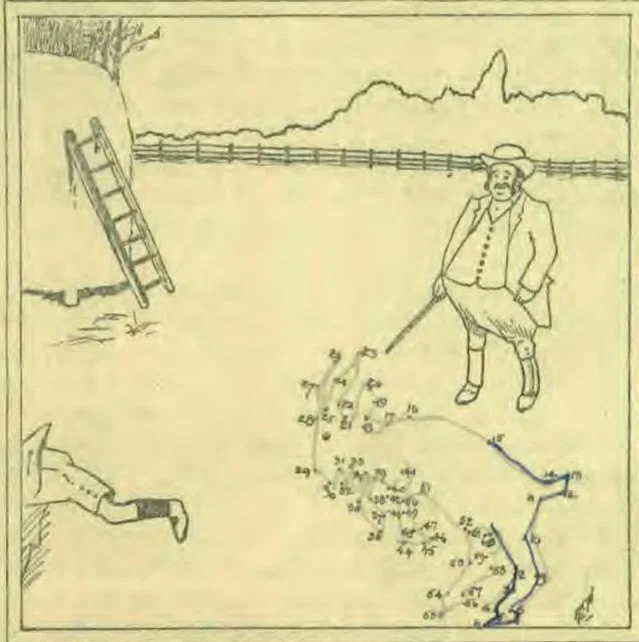
WHY DOES THE LAD RUN?

“What Did You Give for It?”

“Say, but that’s a fine knife, Tom! What did you give for it?”
Jimmy in his short life had begun to see what some men never learn — that there is nothing to be obtained without giving in return a price commensurate with its value.
Young man, you have a college degree. What did you give for it?
I gave twelve years of study and work. I gave up idle habits, worldly pleasures, frivolous companionships. I gave my days to industry and my evenings to thought and books.
But you got it cheap at that price.
Sir, you have a wide reputation for business kindness and integrity. What did you give for it?
I gave the best years of my life to trying to build up a business that would stand. I gave patient study to the needs which my goods supply. I gave up opportunities to make large sums by sharp dealing or undue advantage. I gave up what some would call personal success, for the good of my patrons.
A big price—but you got a bargain.
And you, madam, with that look on your face of peace perfected through suffering, which makes it more beautiful than youth, you have noble sons wielding power for good in the lives of men; you have daughters whose unselfish lives make many call them blessed among women; you have the name of being one of the godly mothers in Israel. What did you give for these?
All I had. The love of my mother heart and the labor of my hands. The cherished dreams and the ambitious hopes of my girlhood—I was to be a great singer, you know. I gave my strength in caring for my children and in visiting the sick and the needy. I gave many anxious days to watching and many long night seasons to prayer.
You paid the heaviest price of all. But the Master will say, when to each one shall be given according as his work has been, that yours shall be the greatest reward.
EUGENE ROWELL.
Hamilton, Bermuda.

A Really, Truly Ghost Story

Grandpa, tell us a really, truly ghost story,” said ten-year-old Marjorie, as she cuddled down in her grandfather’s lap. It was an ideal time for storytelling, for it was a stormy October night; the wind was rustling the bare branches of the trees and whistling a merry tune around the corners of the house.
“All right,” said grandfather, “I know a true one that happened when I was a boy, just a little older than your brother, Donny. I’ll tell it if you will promise not to get frightened until I am through with it. Besides, it is all true.”
“There aren’t any ghosts,” said Donald, with all the positiveness and assurance of the superior wisdom he had garnered in the twelve years of his life. “Father says there aren’t any such things as ghosts.”
With a merry twinkle in his eyes, grandfather continued: “Marjorie wants a truly ghost story: I’ll tell her one that happened to me many years ago.
“I lived in Newport, Kentucky, on Saratoga Street. I remember the circumstance as well as if it all happened yesterday. In the neighborhood there was a very large vacant lot that all the children used for a playground, which was nearly as large as a whole city block. In a back corner of this big lot, farthest removed from the street, was an old abandoned dwelling-house that was shunned and looked upon with fear and dread by all the children, for it was said to be haunted. In those days there was much talk of ghosts and hobgoblins, and even some grown people were foolish enough to believe in them. The old house was both windowless and doorless, the old shingle roof had almost fallen in, and the large brick chimney at one end of the house was almost gone. It was indeed a most forlorn and dilapidated-looking place. That part of the lot near the old house was all grown up with tall Jimson weeds, horseweeds, and dog fennel, but the other part of the lot was kept nearly bare and clean of weeds by the busy feet of children, especially that part where the boys played the old game of town ball, which was in use before the game of baseball was invented. It was a most dreary-looking place even in the brightest sunshine, and there were many weird and fanciful stories told about it among the children.
“I, too, had a wise father, like yours, Donald, who told me there were no ghosts, while mother said that the stories told about the old house and its ghosts were not true, and that I must never be afraid, for even though there should be such things as ghosts, which she didn’t for a moment believe, they couldn’t possibly harm any one.
“One warm and pleasant afternoon mother permitted me to visit my cousins, who lived in a distant part of the town. She told me that I might stay for supper, but to be sure to come home before it became dark. Well, that day we had a jolly good time, and after an early supper we children continued our games upon the lawn. My aunt was busy with her household duties, and we were so absorbed in our play the time slipped by so quickly that it was growing dark before I noticed it. I was only made aware of it by my aunt’s coming to the door and saying: ‘Why, Thomas, are you still here? You had better hurry home right away. I want you to take a basket to mother,’ and going into the house, she returned immediately with a small basket, in which she had stowed a lot of the good cookies which made her famous with all the children.
“Are you afraid to go home alone?” asked auntie. “If you are, I will send some one with you.” “Afraid?” I said, as I swelled out my chest and tried to look my very bravest. “No, indeed! There’s nothing to be afraid of; besides, it won’t take me longer’n twenty minutes to get home.”
“Taking my basket, I started briskly down the road. It had grown dark more rapidly than usual, for the sky was overcast with clouds that threatened a storm. The street lamps were already lighted, but there were not many people on the streets, because it looked like rain.”
“On my way home I had to pass an old graveyard containing great honey locust trees, where the children came in the fall to gather the large, sweet locust pods and play among the old weather worn and tumble-down gravestones. It was all right in the bright daytime with all the boys and girls together, but in the dark it was quite different. It did look gloomy and lonesome when I reached it, and before I knew it little shivers ran up and down my back. ‘Pshaw!’ I said to myself, ‘there’s nothing to be afraid of!’ And I started to whistle most bravely, saying to myself, ‘Ghosts can’t hurt a fellow. Besides, there aren’t any ghosts.’”
“So reasoning, I screwed up my courage and, whistling loudly all the way, hastily passed the long square occupied by the old graveyard, but not without many furtive side glances. When I had passed it, my courage came back in full force. I kept on saying, ‘I’m not afraid of anything; what’s the use of being frightened? I’m not a coward,’ until I had left the graveyard far behind and felt ready and bold enough to enter it in the dark and all alone.”
“By this time I had come to an alley which connected with the extreme back part of the big lot I told you about, and here I again stopped and hesitated. ‘Shall I go through the alley and cut across the lot, and thus save the long way around and get home all the quicker?’ I asked myself. ‘There aren’t any ghosts; what’s the use of being afraid?’ I said, but still I hesitated, for to go through the lot I should have to pass quite near to the old house by the little pathway through the tall weeds. The alley did look so dark, with a tall board fence all down one side of it, and overhung with big trees which made it all the darker. Grasping the basket firmly, with loudly beating heart and a fierce determination to brave the darkness, I started down the alley on a run. It seemed to be miles in length, when in reality it was only about two hundred feet to the corner of the big lot.”},{
“I had but fairly started when a black animal, in my excited imagination as huge as a tiger, flashed across my pathway, and I felt as if my heart wanted to come right up into my mouth. Ere I could turn to flee, another monster rushed across my pathway, and, frightened as I was, I recognized dear old Tip, a large Newfoundland dog which belonged in the neighborhood, who was out following his usual bent in chasing a cat. Tip was a constant playfellow of the children in the lot, and, recognizing him instantly, I loudly called to him, ‘Here, Tip; come here, Tip, old fellow!’ when to my intense delight he came to my side. How relieved I was! I now had a companion who wasn’t afraid of any ghosts that ever were, so petting and keeping him close by my side, I proceeded cautiously down the alley. In a few moments we reached the little pathway through the weeds. The house loomed dark, mysterious, and, to my fevered imagination, as huge as a mountain. What was that?”
“Suddenly my blood seemed to freeze in my veins, I felt a prickly sensation all over my body, I became paralyzed and couldn’t move, and my hair seemed to stand straight up! From the old house issued sighs, groans, grunts, and indescribable noises. The wind had risen, causing the loose clapboards to flap; the thunder of the rapidly approaching storm grew even louder. Suddenly I felt Tip’s cool nose rubbing against my hand; it seemed instantly to set my trembling legs in motion, and with all the speed of which I was capable I rushed down through the weeds, dropping my basket, losing my cap, and pursued by the groans, grunts, wails, and sighs, mingled with the muttering thunder of the coming storm. The weeds scratched my face and hands. I rushed blindly on, with the dog by my side. I imagined ghostly hands were reaching out to clutch me; I stumbled over a rut, causing me to fall headlong, with great force, hitting my head on a stone. Then I became unconscious.”
“When I again became conscious I found myself on the couch in our sitting-room. Mother was bathing my face, while father was chafing my hands. When I had fallen, Tip, of course, had stopped by my side, no doubt taking it for granted that it was all in play; but when he found that I did not move, he commenced barking furiously, keeping it up so persistently that he attracted the attention of some men on the street who had heard my cry, and who went to see why the dog was barking. They found me unconscious. On picking me up and recognizing me, they carried me home. It was fortunate that the men found me when they did, for very soon the great storm broke, and it was with the noise of this storm in my ears that I came back to consciousness. It was a long time before I could coherently tell my parents the story, and I shuddered as I told them of the ghostly groans and sighs I heard coming from the old house. They put me to bed, where I finally went to sleep. I awoke next morning with the sun shining brightly in my room and the birds singing their morning songs in the trees by the open window. I felt refreshed, though bruised and sore from my tumble, and my head ached furiously. As soon as I could dress and go downstairs, I met and greeted my father, who gravely said to me: ‘Thomas, my son, get your hat and come with me: we have ample time before breakfast will be ready, so we will investigate the cause of your fright last night,’ and it seemed I detected a twinkle in his eye as he spoke.
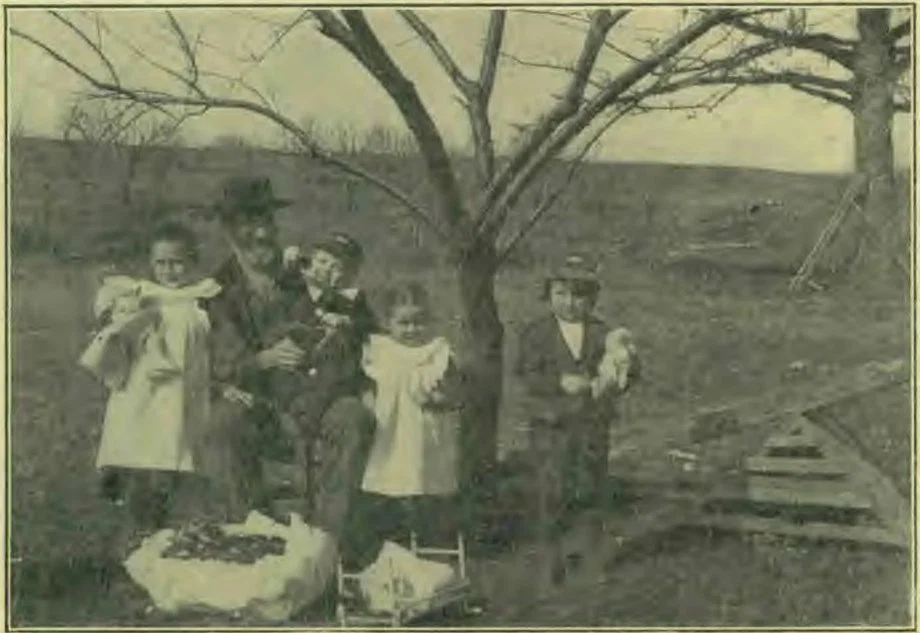
A HAPPY HOUR WITH GRANDFATHER
“How different things looked to me in the bright morning sun! Together we walked up to the open doorway of the old house, and I gazed upon a scene I shall never forget. There, in the very middle of the big room, on the ground, was a huge mother pig nursing a big litter of cute little piggies, with more pigs, probably a dozen of them of all sizes, scattered around, grunting and squealing, as I had heard the ghosts doing the evening before.”
“I hung my head in shame, and my kind father gave me a good lecture then and there which I have never forgotten. He told me how people can actually die of fright, how we all, through the exercise of our will, can and should overcome all tendency to fright.”
As grandfather concluded his story, Marjorie again clasped her arms around his neck and said:
“O grandfather, I’ll always try to remember never to get frightened any more.”
Brother Donny, with his usual bravado, said:
“Huh! I knew all the time it wasn’t ghosts, ’cause daddy said there weren’t any such things; but, grandfather, did you find your cap again, and were all the cookies spoiled by the rain? My, I wish I had some now!”—J. A. Knapp, in the Sunday School Advocate.

Release the Loyal

THE following word from the editor of Our Dumb Animals is of interest, as we know that many conscientious persons are languishing in jail, not because of any disloyal feelings toward the Government, but because they could not do what they were asked to do without violating their conviction of duty toward God. The editor says:
“Nothing has been harder for many an American citizen to bear during this now ended war than the restrictions put upon the freedom of speech and of the press. To do his own thinking, and to be free to utter, without let or hindrance, his sincere convictions, has from the beginning been held by him to be his inalienable right. To see his fellow citizens who, just as honest as he, perhaps far more so, and just as loyal, so far as they can see it, to their country, sentenced to long terms of imprisonment for standing by their consciences, has outraged his sense of justice and of what it means to be a citizen of the United States.
“Now that we hope to be allowed once more to hold our citizenship at its face value, it becomes us to see to it that the men now in prison, and under heavy sentence for refusing to violate their deepest convictions, be released in every case where the evidence can satisfy the court that no crime has been committed, but that the sentence fell upon one honestly loyal to the truth as he could understand it, and who neither by word nor deed wilfully incited his fellows to the violation of law.”

Keep Trying

“No one is beat till he quits, No one is through till he stops; No matter how hard Failure hits, No matter how often he drops, A fellow’s not down till he lies In the dust and refuses to rise.
“Fate can slam him and bang him around, And batter his frame till he’s sore; But she never can say that he’s downed While he bobs up serenely for more. A fellow’s not dead till he dies, Nor beat till no longer he tries.”
Continue reading: Victory and Service