INVESTIGATORS for the British government were recently sent to the North Pacific whaling stations to make a thorough inquiry into the whaling industry and to subject the meat to cold storage and chemical tests to determine if large supplies could be transported to Europe and remain in good condition. It is reported that these tests proved satisfactory, and it is expected that the British government will soon take up the question of importing enormous quantities of whale meat from the United States. Whale meat has long since taken its place beside the beefsteak, the mutton chop, and other meats in the markets of the Pacific Coast. The dealers report that the demand of the consuming public for whale meat is increasing remarkably. Many people declare that they would rather have whale meat than a juicy slice of sirloin of beef. It is estimated that Great Britain has slaughtered approximately 105,000,000 beef cattle since the war began. Canada at the present time has only 6,000,000 head of cattle, while the United States has approximately 30,000,000. Demand for a substitute becomes increasingly urgent with the passing of each month, and indications are that whale meat will solve the food problem.
This has been a banner year for the whaling industry on the Pacific coast. One whaling station alone has made a catch of 200 whales this season, while there are more than a score of stations on the Pacific coast from California to Alaska. The whale weighs on the average a ton to the foot, and the length varies from 50 to 125 feet. A ready market is now found for all8meat available, while a short time ago it was used almost exclusively for fertilizing purposes. Whale meat is coarse-grained and has a taste similar to that of venison, but a distinctive flavor all its own.—Christian Herald.
The World's Great Geyser Country
By Gerrit Verkuyl
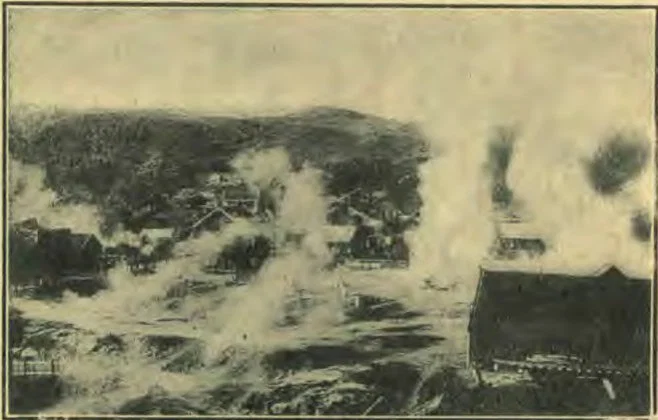
It is natural for Americans to think of Yellowstone National Park as the world's greatest geyser country. The number of geysers to the square hundred miles certainly makes it one of the most remarkable areas in the world. But Yellowstone Park contains neither the most gigantic geyser nor the most obliging. These are both found in New Zealand, a country so full of natural wonders.
WHAKAREWAREWA, HOT SPRING DISTRICT NEAR ROTORUA, NEW ZEALAND
The Greatest Geyser in the World
was born in 1901, so that relatively it would still be somewhat of a baby if it were living today. Unfortunately, the Waimangu died an untimely death on Oct. 26, 1903, when the cold waters of a near-by creek penetrated the heated depths of its basin, and caused a most terrific explosion.
The circumference of the Waimangu geyser contained an area of two and a half acres. When in action, it threw up water, sand, and stones as high as twelve hundred feet. One bowlder weighing one hundred fifty pounds it hurled a quarter of a mile. Usually the eruptions were sideways, but occasionally the triplet geysers, of which the Waimangu was composed, played simultaneously. Then the eruption was directly upward, and much less dangerous. Today its vents are choked with sand to a depth of nearly fifty feet, and it seems very doubtful whether this greatest geyser of the world will ever again become active.
The Most Obliging Geyser in the World
is Lady Knox in the government reserve at Waiotopu, New Zealand. There is nothing that appeals to this geyser more strongly than a cake of soap. She must be a very clean Lady Knox, for it takes a big bag of soap bars to satisfy her. The results are worth the effort, however. Beautiful streams rise upward from fifteen to twenty-five yards in the air, and the wonderful colors that so greatly please the children — and the rest of us — are very much in evidence. Lady Knox blows bubbles on the most gigantic scale in the world.
Another geyser almost as wonderful as the Lady Knox is the Wairoa, at Whaka, which is also a government reservation. This geyser will not play unless it has been soaped, but invariably responds when a sufficient quantity of soap has been applied to it. It is possible, therefore, to appoint the time when the Wairoa shall play, and people from far and near are able to make arrangements to be present.
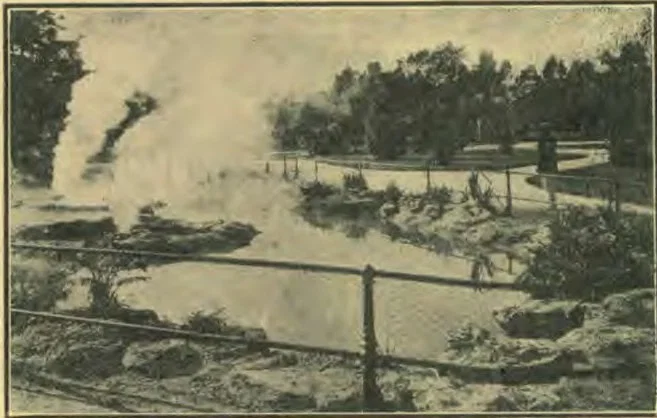
MALFROY GEYSERS, SANATORIUM GROUNDS,
ROTORUA, NEW ZEALAND
On one of these occasions recently, typical of many others, a little girl had been selected to perform the ceremony. She stepped forward, sweet and smiling, while great crowds looked on from the surrounding terraces. The official in charge handed her a white bag full of yellow cakes of soap. “Are you quite ready, Kathleen?” he asked her. “Yes, I am quite ready,” she answered. Then he took two or three handfuls out of the bag and cast them into the deep throat of the Wairoa. Kathleen opened the mouth of the bag and poured out the rest of its contents.
Startlingly Beautiful Results
A few minutes passed before the volume of steam began to increase. The usual time was ten minutes, but after ten minutes there was still no play. Twenty minutes, thirty minutes passed. Then people began to wonder whether this time the faithful geyser would fail to keep the appointment. A few seconds later there was a rumbling sound, followed presently by a stream of water which shot up and up. The spectators who had been gradually crowding near the Wairoa began to edge back. Another, and still another spurt ascended. Then came a hoarse roar and a rush of steam. Presently there arose a beautiful column of water, embellished with clouds of smoke. Fifty feet it reared upward, sixty, seventy feet. Higher and higher it climbed, until its column measured a hundred twenty feet or more.
During all this time there was a loud rumbling in the shaft. For more than a hundred feet around, the earth kept shaking. A hot breath fell upon those who ventured too near. But ten minutes after the play had started, the column suddenly went down. Apparently the soap had finished its work and the geyser refused to perform further.
Law Forbids Frequent Displays
The government of New Zealand has made it a law that the Wairoa and the Lady Knox shall only very rarely be tempted. Frequent play reduces the strength and beauty of these geysers. They have only a certain amount of material, and must not be too greatly impoverished.
In the regions of these geysers there is a basin covering an area of two acres. This is Champagne Pool, the waters of which contain sulphur and selenium to an unusually high degree. The precipitations of these solutions which are constantly renewed have for years added one inch annually to the basin's surface. This pool takes to sand more favorably than to soap. Soon after a good-sized shovel of sand is cast into the pool, the waters begin to simmer. Bubbles appear on the surface, and increase to untold thousands, which start to travel around the pool in circles almost as large as the circumference of the basin.— Gerrit Verkuyl.
“Go to the Ant”
By Mrs. D. A. Fitch
To go to the ant is mandatory counsel found in the Bible with the additional exhortation to “consider her ways, and be wise.” It is usually thought this counsel is given because of the energy and industry of Madam Ant, but it may be there are other characteristics in her nature it might be well to imitate.
I noticed that a troop of ants absolutely refused to pass over some ground pepper that had been spilled on a table. Of course they would not eat that which was so repugnant to their taste that they would turn out of the way and go around it rather than cross it. Our refrigerator has been kept free from their depredations for some time by means of shallow tins on which is a coating of pepper under each caster.
Sometimes these little creatures become so fond of us that they try to occupy the same bed with us. The pepper treatment assisted in giving us freedom from their unwelcome intrusions.
For more than one reason we might well “go to the ant, . . . consider her ways, and be wise.” Not that we must copy all her habits, for to do so would make meddlers of us, and greedy ones at that. Mother Eve meddled, and her act was the cause of all the sin and misery of all time. So let us copy the good traits of the ant and carefully avoid those which will unfit us for the work of the future which lies just before us.
The woman who, on seeing a neighbor approaching her home, is heard to say, “I do wish she would not come so often,” and then greets her neighbor guest very cordially, saying, “I am so glad you ran in today,” should not always be charged with hypocrisy, for any one has a right to change her mind.
MRS. D. A. FITCH.
How We Have Saved Wool
A GREAT deal of cloth now used in making clothes is a sheer luxury. We use more cloth in making coats than is necessary. Most clothes consume cloth in mere ornamentation. The suggestion has been made that we change somewhat the style of our clothing and dispense with those parts that are not essential to comfort. The Commercial Economy Board was not certain at first that it could induce people to change the fashion. But the board went to the manufacturers of men's, women's, boys', and girls' clothing, to the pattern makers and the fashion magazines, and to other people whose work influences styles. The need of saving wool was explained to them. As a result the styles of clothes that take up more cloth than is needed for comfort are no longer made.
Smaller Samples
In order to sell their goods, manufacturers of woolen cloth and clothing have to send to tailors and retailers samples of each kind of cloth. The number of samples which have to be sent out in the course of a year is astonishingly great. The samples sent out last year amounted altogether to several million yards of cloth.
The manufacturer who, of course, wanted to make the strongest possible impression on his customers had fallen into the habit of sending as large a sample as he could afford to send. The samples differed in size and seemed to the Commercial Economy Board to be too generous for the real needs of the trade. Since it could not ask any single manufacturer to act alone in this matter, it invited representatives of the various kinds of tailors of the country to conferences and asked them to cut down the size of the samples of cloth, at least for the period of the war. Practically all of them promised to do this, and large savings of cloth have resulted. For instance, one comparatively small group of tailors agreed not to send out any samples larger than 6 by 9 inches. This meant only an inch or so saved on each sample, but altogether it was a saving of 223,108 yards of cloth during the year.—Government Bulletin.
For the Finding-Out Club
NAME the inventors of the following things:
Burning glass
Electric telegraph
Endless screw
Ocean cable
Reflecting mirror
Process of vulcanizing rubber
Gunpowder
Revolving turret used on battleships
Thermometer
Stereoscope
Movable type
Modern process of preparing steel for many uses
Telescope
Self-binding reaper
Modern battery
Sewing machine
Chronometer
Gatling gun
Lifeboat
Dynamite
Miner's safety lamp
X-ray
Spinning jenny
Air brake
Cotton-gin
Steamboat
Steam locomotive
Modern photography
My Endeavor
By Leigh Mitchell Hodges
To be true — first to myself — and just and merciful.
To be kind and faithful in the little things.
To be brave with the bad; openly grateful for good; always moderate.
To seek the best, content with what I find, placing principles above persons and right above riches.
Of fear none, of pain enough to make my joys stand out, of pity some, of work a plenty, of faith in God and man much, of love all.— Leigh Mitchell Hodges.
Study at Home
IF you cannot attend one of our training schools, why not form the habit of studying at home? The Fireside Correspondence School will teach you how. Elder A. G. Daniells, president of the General Conference says, “I believe your school is conferring an unspeakable benefit upon our people.” Let us tell you more about this matter. Address C. C. Lewis, Principal, Takoma Park, D. C.
A Poor Town to Live In
THERE'S a queer little town,—I wonder if you've seen it.
“Let-some-one-else-do-it,” is the name of the place,
And all of the people, who've lived there for ages,
Their family tree from the Wearies can trace!
The streets of this town, so ill-kept and untidy,
And almost deserted from morning till noon,
Are “In-just-a-minute,”—you'll see on the lamp-post,—
“Oh-well-there's-no-hurry,” and “Yes-pretty-soon.”
The principal work that they do in this hamlet
(There isn't a person who thinks it a crime),
Is loafing and dozing, but most of the people
Are engaged in the traffic of just-killing-time.
I pray you, don't dwell in this town overcrowded;
There are others near by it most wondrous fair.
The roads that lead to them—and each one is open—
Are “Push,” “Pluck,” and “Ready,” “This-minute,” and
“Dare.”
—Sunday School Times.
How the Sabbath Should Be Kept
By Carlyle B. Haynes
Donald Attends His First Sabbath Meeting
CARLYLE B. HAYNES
At every meeting during the fourth week of the services in the tent on the baseball lot, Brother Harris had announced that on the coming Sabbath he would conduct Sabbath services, holding a Sabbath school at ten o’clock and a preaching service at eleven.
Donald Hunter had looked forward to this first Sabbath meeting in the big tent with great interest. More than a week before, he had made up his mind to obey God and keep holy his Sabbath day. He had been wondering ever since just what he ought to do on the Sabbath in order to keep it holy, and what he ought not to do. Brother Harris had promised that in this first Sabbath meeting of the tent effort he would give instructions on the proper way to keep the Sabbath.
Evidently there were many others who were as much concerned about proper Sabbath keeping as was Donald, for at ten o’clock there were about forty persons present in the tent. This was, however, so much smaller than any other audience that had gathered in the tent during the meetings that Donald felt Brother Harris would feel much disappointed. But he wasn’t. When it came time to begin Sabbath school, he rose and told them how glad he was that so many had come. He said he realized that many would be compelled to suffer ridicule for coming, and urged them all to remain loyal to what God led them to do. Among those present, to Donald’s great delight, were his mother and father, as well as his sister Margaret. Mr. Hunter had, the night before, told his family that he had decided to obey the light which had come to them, and observe the Sabbath. There were tears in Mrs. Hunter’s eyes as she told him she was glad he had made this decision, for she, too, had been convinced of the truth.
During the Sabbath school hour Brother Harris explained what the Sabbath school was intended to be,—the church at study,—and urged all present to plan to come each Sabbath. In order that they might thereafter come with their lessons well prepared, he gave to each adult a Sabbath School Quarterly, to the young people copies of the YOUTH’S INSTRUCTOR, and to the younger children the Little Friend, telling them they would find their lessons in these papers. He asked the tent master to take charge of the young people that day, while he taught the grown-ups. For the following Sabbath he appointed teachers for four classes,—two adult classes, one for the young people, and one for the children.
When the offering was taken, Brother Harris explained that all the donations at Sabbath school would be devoted to foreign mission work, in order to carry to all the world the great message of Christ’s coming.
At the close of the Sabbath school the preaching service began with song, and then the preacher said:
“When one first begins the observance of the seventh day as the Sabbath, as I hope those who are here today are doing, they desire to know just how it should be observed in order to please the Lord. The Bible gives very important instruction concerning this point.
“I am glad so many of you this morning heeded my request and brought your Bibles with you. Please turn to Mark 15:42 and Luke 23:54. Here we learn that God has given the day just before the Sabbath a special name. He has named it ‘the preparation day.’
“Friday, then, is a day of preparation. Preparation for what, do you think? Preparation for the Sabbath, of course. Then Friday is to be used in preparing to keep the Sabbath. When we are expecting company we usually make preparations to receive and entertain them properly. So should we do for the Sabbath, for on that day in a special manner God is to visit us. God’s presence is in that day as it is in no other day of the week.
“Hence on Friday we are to do all things which are necessary to be done in order that we may properly observe God’s holy day. The house should be cleaned, and all preparation of food for use on the Sabbath should be made as far as possible. We have special instruction in the Bible regarding this.
“Turn now to Exodus 16:22, 23. Here we find God instructing his ancient people to ‘bake’ and ‘seethe,’ or boil, their food for the Sabbath on Friday. This we are to do. This does not mean that no fire is to be built on the Sabbath, or that food should not be properly heated and made palatable on that day. There is an extreme position in this, in which we should not go. It is possible, you know, for one to stand up so straight as to fall over backward. Do not become fanatics. But every possible preparation of food that can be made on Friday should be made. And then on the Sabbath day this food, which has already been cooked, should be warmed and palatably prepared for the meal.
“Now who will tell me how much of the Sabbath we ought to keep?”
“All of it,” replied Donald.
“Yes, all of it,” said Brother Harris. “Well, now, when does the Sabbath begin?”
“At sunset Friday night,” Mr. Hunter answered.
“And when does it end?”
“At sunset Saturday night,” Donald’s father replied.
“Yes, and this the Bible plainly teaches. If you will turn to Gen. 1:5; Lev. 23:32; Deut. 16:6; and Mark 1:32, you will see that the Bible makes this very clear. Then should we not all begin to keep the Sabbath when it begins, at sunset Friday night? Ought we not all to be ready to begin its observance by the time the sun sets? Would it be right to be engaged in getting ready to keep the Sabbath after the sun had set on Friday night? Of course it would not.
“Then if we are to keep the Sabbath properly our work should be completed by sunset Friday night. Our11baths should be taken before sunset. The clothes which we are to wear on the Sabbath should be brushed and laid out in readiness, and our shoes should be shined.
“Let me tell you of a splendid and helpful custom which has been adopted by Sabbath keepers all over the world. It is this: A few minutes before sunset Friday night the head of the family calls its members together. Their preparations for Sabbath keeping have been made. And then they engage in family worship. They sing a hymn of praise to God, not only for the blessings of the past week, but for the blessings of the Sabbath, so that when the Sabbath comes to them it finds them in worship. Again, on Sabbath evening, the family is called together shortly before sunset, so when the Sabbath leaves them they are in worship.
“What a beautiful custom this! As the great Sabbath day of God travels around the earth, and as God thus visits his people, he finds them in prayer; and as the Sabbath leaves them, again the Lord finds his people in prayer. I earnestly commend this blessed custom to you who are just beginning the observance of God’s holy Sabbath day.
“This custom, as you will see, protects the edges of the Sabbath day from desecration. It acts as a helpful agency in encouraging all to get their preparations for Sabbath keeping out of the way and completed a little time before the Sabbath reaches them, and this is right. When it does come, they are then ready to greet it properly, and enter into its spirit, and partake of its blessings.
“The principle which will serve as a guide to all who may be perplexed as to what to do on the Sabbath, is given in Isaiah 58:13: The Sabbath is to be a delight, not a burden. During its holy, sacred hours we are not to do our own pleasure, speak our own words, or do our own ways. Six days are given to us for our own work. The Sabbath day is God’s day. Our own work is then to be laid aside, our own pleasure forgotten, our own words to remain unspoken. It is a day for worship, for devotion, for prayer, for the study of the Word of God, and for service—God’s service. Work can be done on the Sabbath, providing it is God’s work, to care for the sick or needy, or any other act of necessity or charity. But let us be sure it is work for the Lord, and not for ourselves. It is a day for meditation on the great and precious promises of our God, a day for study and the enjoyment of the handiwork of our Creator, a study which will produce a spirit of reverence and devotion.
“It is a day, too, for attendance at divine service. We have the example of Christ in engaging in public worship on the Sabbath day. Luke 4:16, 31. So ought we to do. I trust that not one who is here today will fail to be in the same place next Sabbath, and that meanwhile you will do all that you can to induce others to come to a similar decision to keep holy God’s blessed Sabbath day.”
Donald enjoyed this Sabbath meeting very much. It seemed to him that the true Sabbath meant so much more to him than the false sabbath ever had. When he was keeping Sunday he had never been conscious of the spirit of holiness which seemed to pervade the Sabbath of the Lord. On their return home from the tent, this same thought was expressed by his father, who said, “I never enjoyed any Sunday I ever kept as I have enjoyed this day.”
That evening, just before sunset, following out the instruction which they had heard that day, the Hunters engaged in a very earnest season of family worship, so that when the first Sabbath day they had ever kept passed away from them it left them bowing before their Maker in praise for his goodness and mercy to them in revealing to them his truth for this time. When they arose from their knees the light of heavenly peace and mutual love beamed from each face. They were a very happy family that night. God’s blessings seemed very great. Do they seem as great to you who may have known the truth always?
Retrospect: Thirty-Five Years of Adventist Work in Europe
By Jean Vuilleumier
Retrospect
[Elder Jean Vuilleumier, who is now teaching in our seminary in Oshawa, Ontario, recently gave the students a synopsis of his experience in connection with our work. Though quite personal the résumé contains items of general interest in connection with the growth of our work, especially in Europe, so we pass it on to INSTRUCTOR readers.—Ed.]
THIRTY-FIVE years ago today, on Jan. 3, 1883, I, a young Swiss watchmaker of eighteen years, reached the old, quaint, and proud city of Basel, to join the four or five workers who composed the personnel of the Central European Publishing Office, founded by Elder J. N. Andrews, the first Seventh-day Adventist foreign missionary.
In July of that year, due to Elder Andrews’s protracted illness, and on his earnest appeal, Elder B. L. Whitney and family, from Rome, New York, reached Switzerland just in time to take up the work before the death of Elder Andrews, which occurred Oct. 21, 1883.
Elder Andrews had reached Neuchâtel, Switzerland, in 1874, accompanied by his son and daughter. He spent two years at the home of Brother Albert Vuilleumier studying French, German, and Italian and organizing the first companies of Seventh-day Adventists in Europe, raised up ten years previously by an ex-Polish priest, Elder M. B. Czechowski. Then he began the publishing of French tracts and of the French Signs of the Times.
In 1882 Elder Andrews and the Swiss believers enjoyed the visit of Elder S. N. Haskell. Never shall I forget the prayer he offered in the schoolhouse at Tramelan, my native place, where the general meeting was held. Although but a few understood it, all present wept, so evident was the Holy Spirit’s witnessing to his appeals.
I had started my work in Basel as mailing boy and typesetter. Two years later I was employed as proof-reader, translator, and assistant editor to Elder Whitney, whose two daughters, then in their teens, are now Mrs. Dr. Morse, of Porto Rico, and Mrs. Homer R. Salisbury.
In 1884 and onward we often saw the two pioneer French preachers, Elders D. T. and A. C. Bourdeau, who had come from America to do evangelistic work among the French in Switzerland, France, and northern Italy. That same year, Elder G. I. Butler, president of the General Conference, visited Europe.
In 1885 there was inaugurated a large and convenient building called the Central European Publishing House12, built under the supervision of Elder Whitney and H. W. Kellogg, of Battle Creek, Michigan. Twenty or thirty young persons were employed in publishing periodicals, tracts, and books in French, German, Italian, and Rumanian, with J. H. Coggeshall, of Battle Creek, as head printer.
The dedication of the building coincided with a European general meeting, at which took part, among many others, Elders M. C. Wilcox, R. F. Andrews, J. H. Durland, and John of England, Elder Matteson of Scandinavia, and Mrs. E. G. White and family from America, with delegates from Switzerland, France, Italy, and Rumania.
Mrs. White’s personal testimony made the meeting a memorable one. She told us that she had, before crossing the ocean, seen many of the young faces before her, and predicted that they, with others who would join them, would in time occupy important positions in the work, a prediction being fulfilled today in at least half a dozen cases.
During her stay of two years in Europe, Mrs. White visited England, France, Italy, Germany, and Scandinavia, encouraging the believers and workers by her earnest testimony and by special views given her of the Lord. I know of about ten persons whom she helped by personal testimonies based on what she had seen of their cases in night visions.
One case was a cousin of mine whom she had never seen and whom she recognized in a night meeting in southern France. She told him how he had been discouraged, cited some facts from his private life that no one but himself had ever known, and pleaded with him to return to God, which he did.
In the winter of 1886, Elder L. R. Conradi arrived in Basel from North America, to labor in the German work. He first raised up churches in Switzerland, and then began to work in Germany, fostering the publishing work, and starting the canvassing, educational, and medical work. He organized conferences and mission fields in Germany, Austria, Hungary, Russia, and the Balkan States.
The following year, our beloved leader, Elder Whitney, had to return to America on account of ill health due to excessive labor in the fulfilment of his many duties as superintendent of the publishing work and president of the Central European Conference, then embracing Germany, France, Switzerland, Italy, and Rumania. He died at the Battle Creek Sanitarium at the early age of forty-three, and was succeeded, in 1888, by Elder H. P. Holser, who also died a premature death consequent upon too great exposure and lack of comfort during his many travels in the Orient and during his imprisonment at Basel under the prosecution against the publishing house for Sunday labor.
In 1889, called to labor in America, I arrived in Battle Creek in October, at the time of the General Conference. During that winter and the next, ministerial institutes were being held at Battle Creek, also a French workers’ institute, in which I had a part as instructor. On a visit to St. Anne, Illinois, in company with Brother Emery Auger, I met Father Chiniquy who lived there among the French people he had led out of the Catholic Church. He told Brother Auger that we were right on the Sabbath question, and that he expected to keep the Sabbath some day. His stock of books, plates, and large residence were burned by an incendiary.
Between 1892 and 1895 I labored in Massachusetts, first as tent master, with Elder O. O. Farnsworth, in New Bedford, the home of old father Joseph Bates. and then as French evangelist in Worcester, where I first met Elder Boisvert, of Racine, Quebec, who was instrumental in raising up the first company of French Sabbath keepers in that province.
In the spring of 1895, the General Conference having given me a call to go to Argentina as French missionary, I was ordained to the ministry at South Lancaster, Massachusetts, and left the States, spending the summer in Switzerland, and sailing from La Rochelle to Buenos Aires. At La Rochelle, the ancient Huguenot stronghold, I met a French Protestant about fifty years of age who actually possessed the whole Bible by heart. I can testify to the fact, as I tested him myself. He could recite any verse from Genesis to Revelation, at the simple indication of book, chapter, and verse.
After spending four years in Argentina and one in Uruguay, laboring principally among the French, while editing the Spanish paper El Faro, I was recalled to Europe by Elder Conradi in 1901, and labored in Paris and Switzerland as preacher and editor of Les Signes des Temps.
On my return to Europe, I was amazed to note the progress which the work had made in Germany and Russian Europe since 1886, when Elder Conradi first reached Switzerland from America. In fourteen years, the work in these countries had reached a magnitude which had no equal except in America.
Owing to prosecution on account of Sunday labor, our Swiss publishing house had been closed and transformed into a sanitarium under the leadership of Dr. P. A. De Forest, an English Canadian, who is still at the head of the institution after a space of twenty-two years.
In 1902, I made a short trip to America. In 1903, in company with Elder B. G. Wilkinson, then president of the Latin Union, I took a trip to Spain to reconnoiter the country as a possible Spanish publishing center. All our movements were carefully watched from place to place by the secret police. It was a treat to visit such medieval and Moorish cities as Sagarossa, Segovia, Valladolid, Burgos, and Bilbao.
In 1905 the General Conference Committee met at Gland, Switzerland, where the Basel Sanitarium had been transferred. A score of American members of the General Conference Committee were present, and more than fifty general workers from all parts of Europe. At that meeting Professor Salisbury, on his way to Syria as a missionary, received a call to Washington to take charge of what eventually became the Washington Missionary College.
In 1911, after serving seven years as teacher and principal in the Gland Training School, while attending the Friedensau general meeting held in connection with a meeting of the General Conference Committee, I received a call to labor in the French work in the province of Quebec. The many American Seventh-day Adventist ministers present at the Friedensau meeting were greatly surprised and rejoiced to see the hundreds of workers and the thousands of believers gathered at that center of our work in Germany, where as many as twenty-five different languages were spoken and sung in a single meeting.
The thirty-five years that have passed since I joined this work record great progress. Our work has jumped from 26 conferences to 130; 680 churches to 3,876; 17,436 communicants to 136,879; 721 members outside of America to 59,144; 280 laborers in the United States to 2,339; 20 laborers outside of the United States to 2,889 (more than in the United States); 300 total laborers to 5,228; 6 publishing houses to 40;1321 periodicals to 120; 9 languages printed and preached to 90; 2 sanitariums to 31; 13 physicians to 131; 3 advanced schools to 67; 38 teachers in advanced schools to 574; 761 students in advanced schools to 7,623.
Truly the work of God moves on with rapid pace. So does the fulfilment of prophecy. But the solemn questions arise in my mind, How have I improved the many privileges which have been showered upon me? Am I keeping pace with the message, and shall I triumph with it in the near future? So help me God.
Sympathy
By Thomas Curtis Clark
“The load is heavy I must bear,”
He groaned as, sad at heart,
He walked his chosen selfish way,
From other men apart.
“How light the burden that He gives!”
She whispered as she trod
The road of life in sympathy
With other souls of God.
—Thomas Curtis Clark, in Christian Herald.
The Wonder
IN France a typical January night in the trenches is thus described by an observer: “It was raining, and the trench contained over three feet of water. The men, therefore, were standing up to their waists in water. They were all wet through and through, with a great deal of their equipment below the water at the bottom of the trench. There they were, taking it all as a necessary part of the great game; not a grumble nor a comment.”
But mud is said to be a worse enemy than rain. The same observer says: “A big shell will make a hole fifteen or twenty feet across and as many deep. Into it pours rain. Other shells fall, churning the ground, until a great lake of mud is formed. The crust that frost forms over it will bear the weight of a man, but not the guns. And even the men fall through sometimes.
“Long after the battle men were still being dug out from the awful cold, clinging, soaking slush. One poor man, recovered two nights later, had sunk right to the neck; many of them were got out with the greatest difficulty, and it is feared that some of the wounded must have been swallowed up before help could arrive; and even a brigade officer, without the fighting man’s load, took twenty minutes to struggle through a hundred yards of that unbelievably stodgy Flanders mud.”
The hardness of the soldier’s lot in the present war is generally understood, and yet men by the thousands willingly give up all to share in the conflict. Their country calls to them and they answer gladly and readily. Such devotion is praiseworthy; but here is the wonder: How is it that some of these same men with many others are slow to align themselves to the cause of Christ, their Creator and Redeemer, even though such an act carries with it no probability of physical or mental discomfort? The Saviour calls to them, but they do not heed. It is as important a call as can be made to a man. Would that none would fail to heed the call!
Should not the heroism of the men in the trenches strongly appeal to us to rally anew around the standard of Prince Immanuel and devote ourselves to the salvation of perishing souls, whatever the cost, as unreservedly as does the soldier to his cause?
Friendship in Times of Distress and Joy
In the hour of distress and misery the eye of every mortal turns to friendship; in the hour of gladness and conviviality, what is our want? It is friendship.— W. S. Landor.
Carrying the Beautiful With Us
THOUGH we travel the world over to find the beautiful, we must carry it with us or we find it not.—Emerson.