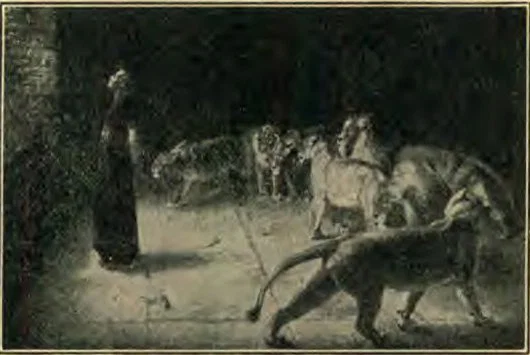
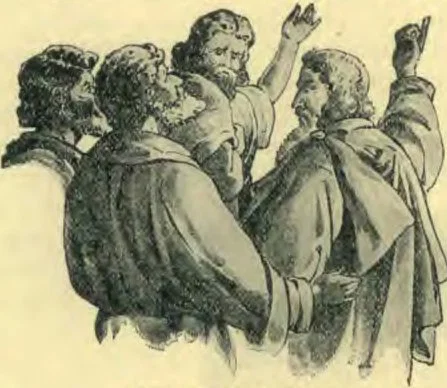
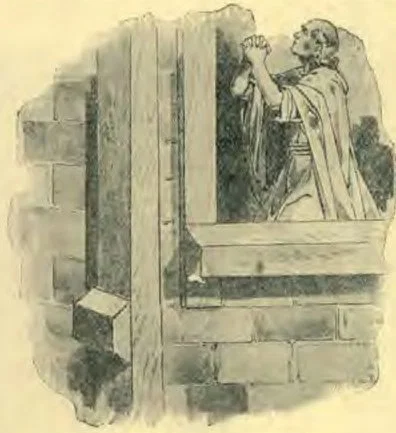
When Daniel and his three associate captives were torn from their childhood environments and taken to Babylon, little did they know of the high destiny to which God had called them. Little did they realize the wonderful work for the church, even until the close of time, that would come as the result of their fidelity to God when surrounded by idolaters in the heathen court of Nebuchadnezzar. Little did they know that they would take part in the affairs of the royal court of him who was king for the first time over all the nations of earth. Yet God foresaw all this when these four young men were carried away at the close of the terrible conquest of the Chaldean army that laid Jerusalem, the beloved city of God, in ashes and ruins.
THE KING RECOGNIZES THE FORM
OF THE FOURTH
The circumstances attending the captivity were counted a calamity to Israel. And so they were. God had borne long with Israel’s perversity. Warning after warning had been given this people by the faithful messengers from God,—Isaiah, Jeremiah, and others,—but many hearts remained impenitent. At last the terrible stroke was allowed to fall, and the kingdom of Israel, whose prosperity and glory under the reign of David and Solomon had become of world-wide renown, came to an end. The diadem was removed, the crown suspended until he should come whose right it should be to wield the scepter—Jesus Christ the Lord.
The four Hebrew captives, Daniel, Hananiah, Mishael, and Azariah, on reaching Babylon were among those sought out by the order of King Nebuchadnezzar, in whom was “no blemish, but well favored, and skilful in all wisdom, and cunning in knowledge, and understanding science, and such as had ability in them to stand in the king’s palace, and whom they might teach the learning and the tongue of the Chaldeans.” In modern terms we might speak of these young men as having a good all-round education, equal at least to the best of our college courses.
DANIEL UNHARMED IN THE LIONS' DEN
It was at this critical point of their matriculation into the highest university course among the Chaldeans that the supreme test came to these young men. Was this by chance?—No. It was at this point God sought to draw a sharp contrast between those who honored the laws of the King of heaven, and those who worshiped false gods.
“At the very outset of their career there came to them a decisive test of character [beyond their test of intellect]. It was provided that they should eat of the food and drink of the wine that came from the king’s table. In this the king thought to give them an expression of his favor and of his solicitude for their welfare. But a portion having been offered to idols, the food from the king’s table was consecrated to idolatry; and one partaking of it would be regarded as offering homage to the gods of Babylon. In such homage, loyalty to Jehovah forbade Daniel and his companions to join. Even a mere pretense of eating the food or drinking the wine would be a denial of their faith. To do this would be to array themselves with heathenism, and to dishonor the principles of the law of God.”—“Prophets and Kings,” p. 481.
In this test, coming at a time when it seemed the most difficult to live up to their cherished principles as Hebrews, who professed to reverence the true God who created heaven and earth, Daniel and his fellows unswervingly took their stand. Even though they had passed their entrance examinations, and had been directly honored by the great monarch of earth in being presented each day with food such as he himself ate, they refused their daily portion from the king’s table, knowing that in honor of the Chaldean gods a portion of all the king’s food had first been offered in sacrifice to idols. They used tact and good sense in making their request for other food; but though it should mean death to them, they purposed not to dishonor the God of their fathers by eating of food that had been dedicated to heathen gods, and thus identifying themselves with heathen worship. And the principle of this scripture, “Them that honor me I will honor,” was wonderfully wrought out in the immediate and later experiences of these noble youth.
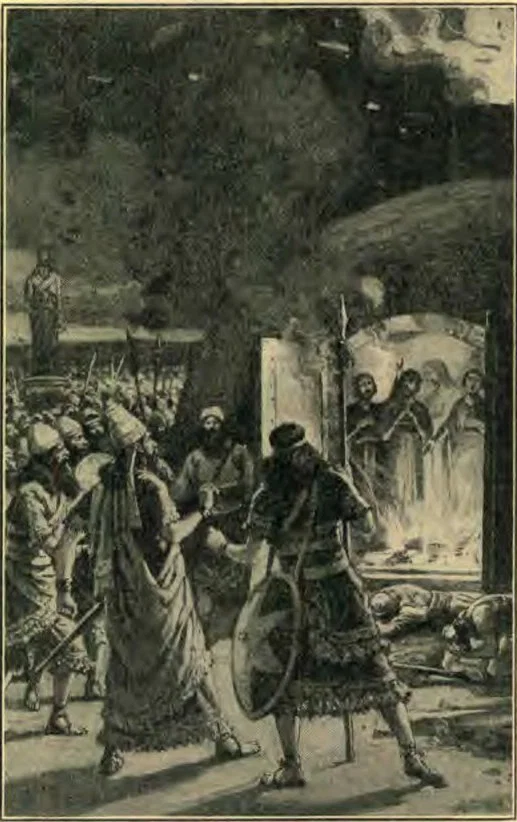
It was through the revelation to Daniel of the king’s dream that all the wise men of Babylon were saved from immediate execution, and these Hebrew young men were promoted above all their university colleagues to the highest posts of honor at the king’s court. Later, through the still greater test of loyalty to God, when all people were commanded by royal decree to bow in worship before the golden image, the three Hebrew rulers stood unmoved, and were honored by Christ in that he himself went in with them into the burning fiery furnace. And they were delivered.
By this deliverance from the power of the flames the knowledge of the true God was spread to the ends of the earth.
As we think of the dear young men today being called away from home, from loved ones, into an altogether8new environment, surrounded largely by influences similar to those encountered by the four Hebrew youth, the study of their loyalty to God when the question of the worship of the true God was at stake, should prove of great help in determining what to do.
It should be very carefully noticed that it was always over the question whether God should be worshiped and obeyed, or whether, in obedience to the decree of the king, false gods should be worshiped, that Daniel and his fellows took their firm stand. In matters where this principle of honoring God by worshiping him and obeying his law was not involved, no record is given us of a refusal on the part of these young men, or in their later years, to follow the laws or decrees of the kingdom into which they were ushered. In this we believe is contained valuable instruction for us in this critical time upon which we have entered. It was by adhering to the principle and command, “Thou shalt have no other gods before me,” that caused the light of truth to shine far out into the heathen darkness of the world in Nebuchadnezzar’s day. Through the providences of God which compelled Israel to leave their native land, thrusting them in among the peoples of the earth, the true God was made known unto the uttermost parts of the earth. In the days of Israel’s prosperity, God had urged his people to carry this same light and truth to the heathen nations.
And who knows but that in the untoward experiences coming upon us at this time many shall be brought into contact with those who know the last warning message who might not otherwise hear it? Anyhow, our part is to manifest that loyalty to God and his truth that was seen in the lives of the four captives at Babylon, and Christ will see to it that that which follows shall result in helping to make known his truth to the honest in heart throughout the earth.
An Answer to Prayer
By W. R. S.
Some years ago a missionary was traveling on foot in a thinly settled part of one of the Western States.
He was weary in spirit and body, and as he tramped along over the prairie road, he lifted up his heart in prayer to God, that he would in his divine providence bring about such a condition that would permit him to ride part of the journey that yet remained before him. On reaching the summit of a high hill he saw a buggy apparently standing still in the road, and headed the same way that he was going.
DANIEL'S ACCUSERS
The preacher soon came up to it, and found a man sitting on the seat, as if waiting for some one. The man spoke to the missionary, saying, “I did not see you the first two times that you called on me to stop, which I did, and looked all around, but seeing no one, I again drove on; but when you called me the third time, I stopped again, and looking back saw you on the top of the hill, and have waited for you.”
“Well,” said the preacher, “I did call, but not on you, but on my heavenly Father, to send me an opportunity to ride, for I was weary. I did not speak above a whisper.” The man said, “That is very strange, for I heard a voice, clear and distinct, calling for me to ‘stop,’ and I did so. Three times this voice spoke to me, saying each time ‘Stop.’ What do you think it meant?” “It means,” replied the missionary, “that the Holy Spirit called on you to help answer my prayer.”
“AS AFORETIME”
The preacher was invited into the buggy, and rode several miles with the man, in whom he found a friend and helper, in sowing the good seed of the kingdom, in these far Western wilds. How true it is that God still often moves in mysterious ways his wonders to perform, and helps his wayworn children when they call to him for aid in time of need. —W. R. S., in Evangelical Visitor.
A Boy’s Thanksgiving
THANKS, dear God, thou art the One
Who hath kept me through the year;
Thanks for the smiling sky and sun,
For the summer’s glorious cheer;
Thanks be to thy precious name,
For life and health and all the good;
Thanks for the lovely flowers that came
Blooming where the snowdrift stood.
Thanks for all the luscious fruit,
Apples red and purple grapes;
Thanks for the vine and tree and root,
Melons of all sorts and shapes;
Thank you for the noisy rain,
Making music down the eaves,
Knocking at the windowpane,
Dancing with the happy leaves.
Thank you for the winter days—
Beautiful with ice and snow,
Merry rides in jingling sleighs,
Coasting, skating to and fro;
Thanks for joyous Christmastide,
And the pretty stories told
By the bright and warm fireside,
Safe from harm and wind and cold.
Thank you for the stars and moon,
For the great, wide ocean, too;
Thank you for the birds’ sweet tune,
Laughing brooks and sparkling dew.
Oh, so many thanks we need
For your kindness, and I say,
Thank you very much indeed
For the gift—Thanksgiving Day.
— Selected.
Modern Warfare in the Air Over Europe
HALF a century or more ago Lord Tennyson wrote these lines:
“Then the air was filled with shouting,
And there rained a ghastly dew
From the nations’ airy navies,
Grappling in the central blue.”
Now every day over the battle fields of Continental Europe, and almost every night over the city of London, such scenes are being enacted. Some of the heavier-than-air machines now in use are capable of carrying half a ton of explosives and three machine guns with the necessary ammunition besides men to drop the bombs and operate the guns.
X-Ray Therapeutics
By John Schuil
TWENTY-TWO years have passed since Professor Roentgen’s discovery of the marvelous radiations known to the world as X-rays. These have long since passed from the novelty stage into a beneficial service of mankind. Their study and application has become a separate branch of science, reaching out constantly into new fields of usefulness.
Every important hospital now has its X-ray department, and private physicians have expensive installations to assist them in their work of surgery and healing. Radiographers have reduced the photographing of the bones in the human body to an exact science, and by this means the surgeon can follow the process of the setting of the bones from week to week, or by means of the fluorescent screen can examine the condition of the heart or the lungs on the spot, and today many cases of lung trouble can be diagnosed by this means before other methods are possible.
And who shall estimate the value of the X-ray outfits in our military hospitals and portable outfits at the front, where hundreds of surgeons are busy extracting bullets and shrapnel from the wounded? It is one of the few bright spots in the terrible conflict now going on.
In all these cases, the rays are used as the revealer of hidden things, helping in the diagnosis and allowing the surgeon or physician to apply his knife or his remedies with greater accuracy.
During the earlier stages of X-ray investigation, and while yet more of a novelty, many demonstrators, including the writer of this article, constantly exposed their limbs and faces to the X-rays while explaining the working of the apparatus.
This constant exposure produced a destruction of the skin and tissues, which in many cases had serious effects and even caused death from X-ray dermatitis. Now the operators are well protected against the destructive influence of the rays, as the tube is fixed in an X-ray proof box, and all the appliances have protective arrangements, screening off the rays except where needed; but too much care can never be taken, as carelessness may mean much suffering and even death.
It was, however, this effect of the X-rays on the tissues, known as X-ray dermatitis, which led to what is now known as X-ray therapeutics, and has become a valuable means of skin treatment.
As is well known, an X-ray tube consists of a glass bulb in which a very high vacuum is produced, the remaining air being about one one-millionth of the original, and when a high tension electric discharge is passed from the one electrode to the other, it takes the form of what is called cathode rays, a stream of electrified particles which when hitting the target produces X-rays. These rays are more or less penetrating, according to the excellence of the vacuum in the tube.
For therapeutic work a high vacuum tube should be used. The vacuum should be made higher as the tissue to be treated lies deeper. There are always, however, a certain amount of softer rays present, which cause the dermatitis, but it is very easy to sift out these softer rays by interposing a sheet of aluminum from one to three milimeters thick.
Special methods have been tried to provide a quantitative measure for X-rays. The one most in use in this country is that known as the Sabouraud pastille,—a small piece of cardboard covered with platinocyanide of barium, having an original light-green color, which under the influence of the X-rays turns to a light brown. Such a pastille wrapped in black paper is by means of a convenient holder placed at a distance half that of the patient to be operated upon, usually six inches. Several trials are made to ascertain the length of time in minutes necessary to turn the pastille to the required color, and this is called a dose. With one milliampere passing through the tube this may average seven to fifteen minutes.
When the operator is sure of his tube, he may begin giving treatments, but he has to work by faith, as it takes from three to four weeks before the result of the treatment becomes visible.
Notwithstanding this drawback, the treatment by means of X-rays in skilful hands has become successful; especially in cases of ringworm and lupus are favorable results quite certain.
There is, however, too much danger attached to the work for any novice to experiment with it, and even a doctor should not make use of it without days of practical work in a large hospital.
The patient is placed in as comfortable a position as possible, and the part exposed is protected with sheet lead except the very spot where the rays have to do their work. In some cases only half a dose is given at one time and the treatment repeated after two or three weeks; in others a whole dose is given at once, and sometimes a double dose, depending on the complaint.10
It is unwise in an article of this kind to attempt definite information, as various doctors have their own methods which have been found preferable by experience, and as also the personal element has to be carefully considered. It would also be futile to name all the diseases for which X-ray treatment has proved successful, but it may be said that almost any skin disease or malignant growth can be benefited by this branch of therapeutics.
Eczema in its various forms, acne vulgaris, and psoriasis are usually lightly treated with two or three doses. Lupus of various kinds, leprosy, and glanders respond to similar treatment, but with slightly softer rays and given in two half doses.
A third group is usually treated with one dose with a higher vacuum tube. To this group belongs ringworm, favus, keloid, warts, rodent ulcer, and Paget’s disease.
Carcinoma (cancer) may be successfully treated, especially after an operation has been performed, and should be repeated at intervals of three to six months or so, but it can only be done by a specialist.
In the effect of the X-rays upon the tissues, small doses seem to stimulate the vitality, while larger doses cause a cellular degeneration of the epithelium of the surface and the glands, and still larger doses a destruction of the tissue en masse. This is probably caused by the swelling up of the blood vessels which are dilated with migration of leucocytes and red corpuscles; with long X-ray exposures the blood vessels become so blocked up that the pure blood cannot circulate any more, therefore the portion affected becomes dead. This also explains why X-ray dermatitis in its acute stage is so dangerous.
One more application of X-ray therapeutics may be mentioned, namely, that of uterine fibroids. In this it has proved almost universally successful, and now practically takes the place of operations. Very high vacuum tubes are used to give the penetration required for these deep-lying parts.
In many cases neuralgia is cured in the same way.
Those interested in this subject should read Dr. E. R. Norton’s book on Radialogy.
JOHN SCHUIL.
Typhoid Fever
It should be borne in mind that typhoid fever is a disease which is received through one route only—that is, through the mouth. Typhoid is a disease peculiar to man. It does not occur in the lower animals. It is caused by a minute vegetable organism known as the typhoid bacillus. This bacillus leaves the bodies of the infected persons in their excretions, and is taken into the bodies of well persons in polluted water and infected food. Sometimes persons who have had the disease continue to excrete the bacilli for a considerable period of time after recovery. Flies, by reason of their filthy habits, are great distributors of the germs of typhoid fever. They act usually by infecting foodstuffs. Typhoid fever is a preventable disease. Massachusetts has a splendid record of achievement in reducing her typhoid death rate.—North Carolina Health Bulletin.
The View from My Window
By C. P. Bollman
THE view from my window's surpassingly grand,
As autumn comes on in our own Maryland.
Old Sol is an artist without any peer,
And he uses high colors in the fall of the year.
There're red and bright yellow and beautiful brown,
There're green and rich crimson in country and town;
There are shades and odd mixtures too many to tell,
They adorn all the woodside from hilltop to dell.
Do I hear some one say, “But autumn's so sad”?
Say, how can that be when our hearts are all glad?
The squirrels and blue jays rejoice in a feast,
And pumpkins are ripe all through the old East,
While out on the prairies the cornstalks all brown
Are bringing new wealth to country and town.
Our garners and cellars are full of good cheer—
Sure, autumn's the best of the whole blessed year.
The trees are not dying, they only would rest,
And next spring with new life all things shall be blest.
Yes, autumn's the gladdest of all our glad times,
So its praises I sing in this series of rhymes.
C. P. BOLLMAN.
Was It Injustice?
MARIAN’S color was high and her eyes were dark with excitement. Clearly something had happened.
“What’s up, sis?” Roger asked, looking at her curiously.
“Up? Injustice, prejudice, favoritism, and everything else that’s unfair and dishonest is up. I’ve been in that office three years, and Letitia Banks has been there less than two. I no more doubted I’d get Miss Roberts’s place than I doubted I’d come home to dinner—and then if Letitia Banks didn’t walk off with it without a word! Oh, I’d like never to put my foot in that office again. What’s the use of doing good work when this is what you get for it—a little, pink-cheeked baby walking off with a promotion under your very nose! It’s the injustice of it that makes me blaze!”
There was a moment of uncomfortable silence. Mother was all sympathy, Virginia was all indignation; only Roger looked at his sister gravely.
“But there must have been some reason—business men don’t usually promote against their own interests.”
“They promote the one that flatters them—that’s what they do!” Marian retorted bitterly. “That’s what Letitia Banks has done from the first. To hear her gush over it you’d think there wasn’t a firm in the universe like Pembroke & Easton! Well, if they’re her ideal, she’s welcome to them. I’m going to look for another place, that’s all.”
There was no use in saying anything when Marian felt like that. The family went in to dinner, but in spite of Roger’s efforts it was not a cheerful meal. Even mother—though she would not have confessed it even to herself—drew a breath of relief when Marian started for her boys’ club. That at least roused Marian’s enthusiasm.
A square below the club a small figure was lying in wait for her; under the street light he lifted a glowing, freckled face.
“Hello, Miss Marian! Say, did you know I’m in business?”
Marian’s tense face relaxed. She never could resist her boys.
“Why, no, Billy,” she replied. “What are you doing?”
“Office boy—Parker & Cone’s. Say, we’re some firm all right! Did you know we got a five-thousand-dollar contract yesterday? And sent out seven new bids, and I bet we’ll pull down some of ’em, too! Mr. Parker, he’s a hustler, and Mr. Cone—say, Miss Marian, you’d jest orter hear him! I bet there ain’t anything about buildings he don’t know. I learned the different sizes of fireproofing tile today. Ted Bailey taught me. He was office boy but got promoted. He says I’ll get my chance all right because I’m interested. He says they care more for that than most anything. You bet your life I’m interested! Say, what’s the matter, Miss Marian?”
Marian had stopped short and was looking down at him as if she were seeing something for the first time in her life. Perhaps she was.— Selected.
Fifteen Rules for Right Living for Country People
VENTILATE every room you occupy.
Wear light, loose clothes.
Spend time in the open air in winter as well as in summer.
Have much fresh air where you sleep, or sleep out if you can.
Breathe deeply.
Avoid eating too much.
Do not eat heavily of meat and eggs.
Eat various kinds of food.
Eat slowly.
Have your bowels move at least once each day.
Stand, sit, and walk erect.
Avoid poisonous drugs.
Keep clean, and avoid contagious diseases.
Work hard, but play, sleep, and rest, too.
Be cheerful, and learn not to worry.— North Carolina Health Bulletin.
Physical Shock and Religious Conviction
“PHYSICAL shock, religious conviction, an energized will-power — these are three keys able to touch the springs of that hidden strength which we call second wind.”
Truth, Success, and the Voice of God
“TRUTH is the voice of God, and success is its natural echo. Fallacy is Satan’s speech, and failure is its legitimate harvest.”
The First Thanksgiving
Up they came by river and bay—
The guests of that November day;
Ninety guests when all were told,
Sturdy and stalwart, cunning and bold.
Up they came with confident tread,
A kingly leader at their head,
A mighty chief of a mighty race,
A ruler of men by nature’s grace.
Up they came by river and bay
To meet on that November day
Their welcoming hosts—a little band
Of new-come pilgrims to the land.
Bradford and Brewster, the brave and good,
Winslow and Standish, there they stood.
Smiles of greeting upon each face,
Hands outstretched with a cordial grace.
Hand and smile the seal and token
Of the cordial words so cordially spoken,
When Standish of Standish led the way
To the feast of that November day.
Side by side they stood together,
Side by side in the autumn weather;
They feasted there with heartfelt zest,
The pale-faced host and the dusky guest.
And over the board what prayers were said,
What thanks were given for more than bread, What friendship and peace began to flower
’Tween host and guest in that wonderful hour!
And O, the plenty where once was dearth,
That bountiful yield of heaven and earth,
That boon and blessing of friend for foe,
In that wonderful hour of long ago.
Nearly three hundred years since then,
Since Massasoit and his ninety men
Over the headlands took their way
On the morn of that November day.
Nearly three hundred years ago,
And still when November winds do blow
We keep the Pilgrim tryst begun
In sixteen hundred and twenty-one.
Not ours, indeed, the ardent zeal,
The high-wrought joy that they did feel,
Who saw the sunlight through their tears
Of glad relief from anxious fears.
But ours the flowering and the fruit
That sprang from out that Pilgrim root,
The deathless root that firm and fast
Still binds us to the Pilgrim’s past,
And brings us back year after year
To keep the day that they made dear,
Made dear and sacred with their plan
Of peace on earth, good will to man.
— The Congregationalist.
The Secret of True Happiness
By Anna Nielson
THE president of the American Storage Company leaned back in his chair and frowned as he ran his fingers through his heavy iron-gray hair. He was a big man, and his very appearance showed strength and ability.
The room was silent but for the click of the typewriter. Without changing his position he said, “You may go, Miss Brandon.”
She quietly closed the typewriter, and taking her wraps turned to go. “Hope you have a pleasant day tomorrow, Mr. Burton, it’s Thanksgiving Day.”
“Thanksgiving? Humph!” But Miss Brandon was already gone.
The big man remained silent at his desk; the frown deepened and his steel-colored eyes grew sad. The room began to grow dark, but he made no effort to turn on the light. He stepped to the window and looked out over the lighted city, where happiness and sorrow mingled. “Yes,” he murmured to himself, “tomorrow is Thanksgiving Day.”
The entire city seemed to be preparing for the great day on the morrow. Families would be united. Friends would meet and talk over bygone days. Joy would be increased. The city was alive with joy and happiness; the darkness shut out the sorrow. The lights and gayety seemed to mock him in his loneliness. “Yes, Thanksgiving! I wish there wasn’t such a day.” He drew from his pocket a handful of money, and smiled bitterly to himself as he looked at it. “That won’t buy me happiness,” and he put it back.
He left his office, and as he gained the street, waved aside the driver who was waiting for him in his big car. “No, James, guess I’ll walk home tonight. I need the exercise.”
He walked up the street and was accosted from time to time by newsboys. “Say, Mister, want a paper?” He turned them all aside and went on. When he passed the brilliantly lighted show window of a downtown department store, the arrangement of the various articles and combination of colors caught his eye, and he stopped a moment. A book entitled, “Be Happy in Making Others Happy,” was in the window.
“Queer title for a book,” he said, and went on home. He ate dinner in the stately dining-room, and the sentence, “Be Happy in Making Others Happy,” kept ringing in his ears. He left for his club, but could not get away from the title on the book, “Be Happy in Making Others Happy.”
At an early hour he left his club, and as he was stepping into his car, he noticed two newsboys on the corner, engaged in a heated discussion. He started toward them, but before he reached them, the larger boy grabbed something from the other and ran up the street.
“What’s the matter, my boy?” But the boy could not answer. He was a little fellow, not more than12ten or twelve years old. His clothes were ragged and torn and the shoes he had on were several sizes too large for him. Choking back his sobs, he looked at Mr. Burton, with his big blue eyes filling with tears which he wiped away with the sleeve of his ragged coat, and said, “Mister, I’ve tried awfully hard all week to get money ahead so I could buy stuff and take home to mamma, so she can make baby sister and me a big dinner tomorrow. You know it’s Thanksgiving Day. I sold all of Joe’s papers for him, and he said he’d give me half the money, but now he took it all and ran away.”
“Don’t cry, my boy.” “Be Happy in Making Others Happy” came to Mr. Burton’s mind. “We’ll see that your mamma and baby sister get a big dinner tomorrow. Come with me.”
Together they went from place to place. He bought so much that the boy’s eyes shone with eagerness and delight. He piled all the bundles in the car, and helping the boy in beside him started off for the district in which the boy lived. He helped carry the bundles into the humble house, had a pleasant visit with the boy’s mother, and as he left, told the boy to come and see him the day after Thanksgiving, and he would help him get a better job than selling papers.
When he reached home that night, he was happier than he had thought it possible for him to be. He at once called up his stenographer. “I forgot to tell you that I meant to pay your way home and back here again for the extra work you did for me this month. Will you go?” The answer must have been “yes,” for he smiled and said, “That’s good. Go home and make the old folks happy. Surprise them. Stay a couple of days. I’ll not need you until Monday.”
The hard look had left his face. He seemed a younger man.
“Tomorrow will be the best Thanksgiving Day that I have had in years.” Again he pulled a handful of money out of his pocket and smiled as he looked at it. “I’m thankful I have the money.”
As he fell asleep that night his last words were: “I must get that book. Since its title, ‘Be Happy in Making Others Happy,’ has done so much for me, I must see what’s inside. That sentence from henceforth shall be my motto.”
When Miss Brandon returned the next Monday, she saw in a gilt frame over the president’s desk, the motto, “Be Happy in Making Others Happy.”—Anna Nielson, in Educational Messenger.