The Youth’s Instructor, Vol. 65, No. 46.

What Shall Be the Character of Our Associates?
Earlier text: Enduring the Test

How to Be a Man

Not long ago a youth of seventeen years called on a merchant doing a large business in New York. The merchant being busily employed at the time, the youth had to wait a little before getting an opportunity for the interview. Occasionally the merchant cast a glance at him as he stood respectfully at a short distance. He was poorly clad and showed the evidences of hard work; but his face indicated honesty and common sense, with a firm and energetic manliness, under a somewhat rude exterior. A practical business man requires but brief examination of a boy to declare as to his weight and worth of character.
When at liberty, the merchant said:
“Well, my young friend, what can I do for you?”
“I called, sir,” he replied, “to ask you for a situation as an engineer. I was told you were having a new engine built, and I want you to give me the place. I’d like to run it for you.”
“Are you an engineer?” asked the gentleman.
“No, sir; but I can be,” he answered, setting his lips firmly together, standing squarely before the gentleman, and looking him full in the face. “I don’t understand the business well; I know something of it though. But I can be an engineer, and I wish you would give me a chance.”
His modest, but determined manner pleased the merchant. He was having a new engine built for a certain department of his business, and could have as many experienced operators as he desired. It was no object for him to take up an inexperienced boy and attempt to train him,—no object except to help the boy. Such deeds he was noted for; a fact which had no doubt encouraged the boy to make this application.
“What are you doing now?” he inquired.
“Working in a machine shop in Brooklyn. I have been fireman, and I often worked the engine. I think I could get along with one pretty well now, if anybody would have a little patience with me.”
“What wages do you get?”
“Five dollars a week, sir.”
“What do you do with your money?”
“Give it to mother, sir.”
“Give it to your mother! humph! humph! What does your mother do with it?”
“Well, you see there are three of us, mother, sister, and me; and mother takes in sewing. But it goes pretty hard you know. They don’t give much for sewing; and it’s hard work, too. And then with the other work she has to do, you know she cannot get along very fast at that rate. So I do all I can. If I could get an engineer’s place I could get more wages, and it would make it easier for mother.”
“How do you spend your evenings?” asked the gentleman.
“I attend the free school at Cooper Institute, studying mechanics,” he replied. “I spend all the time I can get studying. I know I can be an engineer.”
“Do you ever drink liquor?”
He looked up with an expression of astonishment on his countenance that such a question should be asked, but answered firmly: “No, sir.”
“Do you chew, or smoke, or go to the theater?”
“Never—can’t afford it. Mother needs the money. And if she didn’t, I could make better use of it. I’d like to have some books if I could only spare the money to get them.”
“Do you go to church or Sunday school?”
He held down his head, pretending to brush the dust of the floor with his boot, and replied: “No, sir.”
“Why not?” asked the merchant a little sharply.
“I haven’t any clothes fit to wear,” he replied. “It takes all the money I can get for us to live; and I can’t have any clothes.” He looked down at his coarse and well-worn suit. “It wasn’t so when father was living. I was brought up to go to church and to Sunday school. If I can get to be an engineer, I shall go again. I know I can run an engine.”
Telling him to call at a certain time, when the merchant expected his engine would be in use, and he would talk further with him, he dismissed the young man. “But, he must have that engine,” said the merchant to a friend to whom he related the circumstance.
“He will make a man, that boy will. A boy who is determined to do something; who gives his mother all his money to lighten her burdens; who does not use tobacco, and does not go to the theaters; who spends his evenings in study after working all day, such a boy will make a man, and deserves to be helped. I have not told him so, but I shall take him and put him under one of my engineers until he is fully capable of taking charge, then let him have the engine. He will get twenty dollars a week then instead of five, and be able to lighten a mother’s burdens, have clothes to wear to church, and buy books to aid in his business.”
A noble boy, though hidden among hard conditions and under unattractive garb, will work out and show his manhood. He may not always find friends to appreciate him; but determined, virtuous, and willing to endure, he will in time conquer.—The Herald of Light.

Chipmunks as Pets

SEVERAL years ago I caught two chipmunks in a box trap. In removing them from the trap, I was careful not to let them bite me, and after placing them in a cage I put my hand on them and found that I could pick them up without being bitten. Since then I have caught fifteen or sixteen, some in the trap and some by chasing into a hole with a dog, and taking them from the hole with my hands. Of all these only two bit me. If I gave them a nut, they would sit in my hand and eat it.
One of the two chipmunks first mentioned we named Major, the other Colonel. Major took exercise by running and jumping in the cage, while Colonel would sit still all day in a corner; but as soon as I made a wheel for them, Colonel took possession and would not allow Major to run it. If Major did manage to get in, Colonel would catch hold of him and pull and scold until he ran out. If Colonel wanted to take a nap in the daytime, he would curl up in the opening between the cage and the wheel so that Major could not go in.
In the morning, as it began to get light, Colonel would start to run the wheel and keep it going almost all the time until afternoon, when he would only run it occasionally. In the summer he would get up and take a few turns at night.
We had our pets only a short time before they would run all over us and the dog, jumping from one to the other. They did not like to stay out for any great length of time; they soon would try to return to the cage. If anything frightened them, they went into the cage, as they felt safer there.
A box, with a hole in one side and partly filled with strips of white rags, served for their bed. When winter came I put in more rags, some of which were black. By morning they had pulled out all the black rags!
Every fall the chipmunks would save part of their food to store in their bed. As we took the box out of doors in the day and brought it back at night, they would bury the food in the gravel on the bottom of the cage until night. They ate shelled nuts, sunflower seeds, apples, peaches, and apple seeds. In the spring they liked to eat the maple blossoms and the new leaf buds as they began to burst.
One morning Major tried to go into the wheel while Colonel was running it, and received a blow on his nose that killed him.
We had an old cat, Ted, that liked to have Colonel run over him. If Ted was lying on the couch when we had Colonel out, he would beg us to put Colonel on him, and would then roll over on his side and lift his foot like an old mother cat with kittens, and Colonel would run over him and pull fur for his nest. Ted did not exactly like to lose his fur, as the depilation was often painful, but he would only mew and turn over.
We had Colonel for five years, when he met with an accident.—H. F. Van Hise, in Guide to Nature.

The Hills of Strength

(Texts for November 18 to 24)
We were spending a few hours at one of our sanitariums; and while my friends strolled about the ground, I sat on the front veranda gazing at the beautiful mountains around us. Presently two young women—evidently patients—came out, and taking seats near me began to talk earnestly.
Unconsciously I let a few words drift in upon my meditations. The strong, courageous voice of the speaker attracted my attention. It showed clearly that this young woman had become strangely familiar with the thought of dying, and was facing the enemy of us all regretfully but fearlessly. “My trouble,” said she, “is very serious; the doctor does not give me much hope, and I really do not care to live if I cannot get well.”
This was practically all I heard. My ears were too full for more, and my eyes too dim to see the beautiful mountains nestling so close to the veranda where we sat; so lifting my heart in silent gratitude, I closed my eyes and gazed at the hills “whence cometh our strength” to meet all the vicissitudes of life.
“To the hills I lift mine eyes: Whence shall help for me arise? From the Lord shall come my aid, Who the earth and heaven has made. He will guide through dangers all, Will not suffer thee to fall; He who his people saves and keeps, Slumbers not and never sleeps.
“Thy protector is the Lord, Shade for thee he will afford; Neither sun nor moon shall smite; God shall guard by day and night. He will ever keep thy soul— What would harm if he control? In the home and by the way, He will keep thee day by day.”
Our never-sleeping Guardian is stronger than any earthly foe. His eyes are ever upon us for our good. He never sleeps. He is always nearer than disease, danger, or trouble of any kind can come. We can trust him at all times. Yes, we really, truly can. But we must know this for ourselves. We must prove him to be all that the psalmist declares that he is. This we must do in order to be prepared to meet life’s crises courageously and successfully.
There is nothing that a young person needs more than to look continuously “to the hills whence cometh” our strength. Some look to their money for deliverance from trouble; some trust in their education to bring them success; some look to friends to administer to their needs; some expect their positions, their influence, or other sources of help to carry them through the world on flowery beds of ease. But alas! They will not always stand the test. There is only one source of Help that never fails.
Young friend, are you acquainted with your never-sleeping Guardian? Do not let the day pass without getting in touch with him. Does your heart ache? Tell him about it. Is your courage ebbing away? Tell him it is. Is the road before you hidden so that you know not where to step? Tell him. Tell him everything, and then when night comes see if you cannot find at least one point where he helped you. Of course you cannot know all the dangers from which he shields you. You do not even dream how often he turns your feet into the path of deliverance, of joy, of happiness. He is ever doing “impossible” things to protect you, to make you happy, to give you success.
Then shall we not earnestly try to let him guide and guard us day by day? There are many things which our Almighty Guardian cannot do for us unless we surrender ourselves fully and unreservedly to him. This surrender sweeps away impossibilities; it enables one to know him and understand his guidance, and makes life a continuous demonstration of his power to live and serve in human flesh today. Then shall we not say to our hearts this morning: “My most important business is to get acquainted with my Guardian; and I am resolved to know him better today than I did yesterday, that when he comes, I shall be like him, for I shall see him as he is.”
MEDITATION.—It does not seem possible that God can care for each one of us; but I am grateful indeed that with him impossibilities vanish. All that comes to me today must pass under his strict censorship. Since he loves me with an everlasting love, I know he will let nothing come that will not be good for me to meet; so I go forward trusting him to teach me how to receive all that comes to his glory.
SPECIAL PRAYER.—O Father, teach me how to keep my eyes on the hills whence cometh my strength, until thy skilful hand shall have cleansed my heart from all sin, and until my feet have passed the last bypath that leads to sin, until I have gone where my hand can no more reach out to save another. Until then, Father, keep me looking unto thee.
M. E.

Missionary Volunteer Society Programs for Week Ending November 24

THE programs for this date, with notes, illustrations, and other helpful material, will be found in the Church Officers’ Gazette for November.

The Bible Year

Senior Assignment

For notes on this assignment, see Review for November 15.

Junior Assignment

  • November 18. Acts 10: Cornelius and his household baptized.
  • November 19. Acts 11: Peter at Jerusalem.
  • November 20. Acts 12: Peter delivered from prison.
  • November 21. Acts 13: The gospel to the Gentiles.
  • November 22. Acts 14: Paul stoned and cast out as dead.
  • November 23. Acts 16: Singing in prison.
  • November 24. Acts 17: Paul at Athens.

A Servant of Jesus

This week, do you not think it would be interesting to say nothing about the name of our hero, but just to tell some special facts about him, and leave it to you to guess who he is?
In the first place, he had two names, one Jewish and one Roman. The Roman name meant “the little one.” His parents must have been fine people, for they trained their little son very carefully in the law of God.
It was in a beautiful city of Asia Minor, twelve miles from the Mediterranean Sea, that our hero first saw the light of day. Can you name the city?
When he became a young man, he learned the tent-maker’s trade, after having completed his education under the training of one of the most famous rabbis in the land. And how well he could make tents! Whatever he undertook, I imagine he would say to himself, “I must do my very best;” then he would put his whole heart into the work, and of course, the result was that he made a real success of it.
This servant of Jesus had a favorite expression that I hardly dare mention, lest you at once guess his name. It was, “This one thing I do.” You may think this a strange motto for a man who was an author, a philosopher, an orator, tentmaker, a scholar, a sage, and a statesman. “If he could do all those things, why did he say, ‘This one thing I do’?” you are asking. It was because the chief business of his life was to win people to Jesus Christ, and he made everything else that he did, bend toward that one aim.
During his lifetime this great man wrote at least thirteen letters, which are the most wonderful ever written, for they have been the means of bringing many thousands to the feet of Jesus. Every year eight million copies of these letters are sold. Think of it!
And what a host of remarkable experiences came to our hero. He was a prisoner for five years; at one time he was shipwrecked; on another occasion he was let down over a city wall in a basket, to escape his enemies; he was stoned, he was beaten, yet through it all he worked for God.
He was a man of contradictions, as he was ardently loved by some, and furiously hated by others. He was tender and loving, yet stern; humble as a little child, yet self-confident; weak in body, yet tremendously strong in faith. His very weakness made him depend all the more wholly on Jesus.
At about fifty-five years of age, when weary and worn with a life of service for others, he was beheaded by a cruel emperor, because of his faithful preaching of the Lord Jesus.
You boys and girls who are taking the Bible Year will surely know his name. What was it?
ELLA IDEN.

Philippine Missionary Volunteer Society Reports Strong Progress

From Across the Sea

SOME of our Missionary Volunteer Societies in lands over the ocean are doing so well in carrying forward the work and plans for our young people, that if we are not careful they will put to shame many of our societies in the homeland. Listen to the encouraging news which comes to us from the Philippine Islands, in a recent letter from Brother Sevrens:
“We have about forty members in our society. Our meeting is held every Sabbath afternoon in the academy. Our exercises are in English, and it is a joy to present the program, for every one wishes to have a part. They even come and ask for some part. Usually we take a program from the Gazette. We have found very good programs in it. Our members are taking hold of the Morning Watch, too. In dormitory worship we take up the verse for the day. The boys do very well in memorizing the English, which is by no means easy for them. Sabbath I spend fifteen minutes on denominational history. Today we studied the ‘second disappointment.’ About twenty wish to try for the Standard of Attainment examination next February.
“We have a number of bands. Our ministerial band has about twenty-five members. Brother Panis, our leading evangelist, is leader of this band. He is giving the boys valuable aid. The drill in speaking is done in Tagalog. The majority of our boys are of that tongue. Corrections and suggestions are in English, so that the few boys we have from other provinces, receive some instruction too. Several of our boys will enter field work when this year is over.
“The Christian help band furnishes flowers on Sabbath for the services, meets and looks after visitors, and visits the General Hospital every week, visiting and giving literature. We tried to get permission to visit the great prison, Bilibid, here, but for good reasons we are restricted. We can send literature for distribution, and speak Sunday mornings by arrangement. So we are planning to have one of our evangelists go there soon and speak. Surely these are among our duties,—to visit the sick and those in prison. Then, too, we have a correspondence band, which carries on work pertaining to such a band.
“We have two assistant leaders, who take turns in leading and planning the program, with some help, of course, from the leader. Our aim is to make leaders, if possible, so they may help in the needy churches, for truly the laborers are few.” M. V. D.

A Worthy Example

The officers of the Southern Oregon Conference found that only forty-three per cent of the families in the conference took the Review,—the good old Review,—really an essential for every Seventh-day Adventist. A campaign was instituted to put the Review in every family. To whom should the church turn when it has big things to do, but to our Missionary Volunteers? They have the energy and enthusiasm which it takes to make a campaign a success. One of the Missionary Volunteers in each church was asked to act as recruiting officer for the campaign, and a house-to-house canvass was taken up. The subscription list began at once to increase. We have not yet learned the final results, but we are sure that our regiment of Volunteers in southern Oregon will not stop until the work is thoroughly done.
Here is an extract from one of the letters written by the conference Missionary Volunteer secretary to a “Volunteer Review campaigner:”
“It is of the utmost importance that our people have the Review at this time. I know of no better missionary work than you are doing, giving our people an opportunity to subscribe for the Review. Every family who belongs to your church should be approached in regard to this matter now. We are depending on you to do it.”
Dear Missionary Volunteers, even though your conference may not have organized a campaign, will you not look into this matter of how many families in your church get the Review? And will you not organize a little campaign all your own and send in a good list of subscribers?
As the Southern Oregon Conference secretary said:
“Even the Review itself can scarcely keep stride with the rapid movements of today, and where will we be in the onward march if we do not have the privilege of reading the Review?”
Whether our young people realize it or not, the days in which we now live are tragic in the extreme. All the currents of human life are moving swiftly. Aside from the raging torrents of political commotion and social unrest, new currents of religious activity and interest have set in. The advent message is moving on. Surely our people cannot do without the Review. Our young men and women cannot develop into good Seventh-day Adventists without it.
Let conference Missionary Volunteer secretaries, Missionary Volunteer Societies, and isolated Missionary Volunteers everywhere take hold of this work in earnest. M. E. KERN.

VIII — The Tenth Is the Lord’s

(November 24)
MEMORY VERSE: “Honor the Lord with thy substance, and with the first fruits of all thine increase.” Prov. 3:9.

Questions

1. What part of one’s income has the Lord especially claimed as his? Lev. 27:30.
2. For whose support was the tithe given in the days of Israel? Num. 18:31.
3. Upon what basis does our obligation to pay tithe rest? Ps. 24:1.
4. What statement further emphasizes the extent of the ownership of the Lord? Haggai 2:8.
5. What else is mentioned as belonging to the Lord? Ps. 50:10–12.
6. By what means is man enabled to get wealth? Deut. 8:18.
7. What parable is given to illustrate our relation to the things we call “mine”? Matt. 25:14, 15. Note 1.
8. What is said concerning those who will be rich? 1 Tim. 6:9. Note 2.
9. What is the love of money said to be? Verse 10. Note 3.
10. How early in the history of the world do we read of tithe paying? Heb. 7:1, 2; Gen. 14:17–20.
11. What vow did Jacob make at Bethel? Gen. 28:20–22.
12. How did Jesus express his approval of tithe paying in even very small items? Matt. 23:23.
13. Of what is one guilty who withholds the tithe and free-will offerings? Mal. 3:8.
14. Concerning what does the Lord ask us to prove him? Verses 10, 11.

Notes

1. Through the Spirit of prophecy is revealed an important occasion when Satan gave counsel to his angels. Said he: “Go, make the possessors of lands and money drunk with the cares of this life. Present the world before them in its most attractive light, that they may lay up their treasure here, and fix their affections on earthly things. We must do our utmost to prevent those who labor in God’s cause from obtaining means to use against us. . . . Make them care more for money than for the building up of Christ’s kingdom, and the spread of the truths we hate, and we need not fear their influence; for we know that every selfish, covetous person will fall under our power, and will be separated finally from God’s people.”—Mrs. E. G. White, in 1911 Week of Prayer Readings.
2. Those who are determined to be rich will use dishonest means to obtain wealth. They wrong others to enrich themselves. They rob God of that which is his alone. They covet that which is not their own. They love money more than they love God.
3. One may love money even when one possesses little of it. It is not money itself, but the love of it that is the “root of all evil.” Money may be a great blessing when used for others and for God.

Princeton Students’ Meeting

SOME of the residents of the famous old university town of Princeton, New Jersey, were surprised on a July evening to notice a company of young men and women, with a few older men, making preparations for a meeting at the main crossroads of the town. One young man was sketching something with white chalk on the asphalt street. Those who remained to watch saw three crosses taking shape, the one in the center larger than the others; over the crosses was printed, “Saved by Grace;” between them, “John 3:16;” and at the bottom, “Jesus Saves.” When the design was completed, a cornet spoke out loud and clear and the company began singing gospel hymns. There followed very brief but very direct and pointed messages on salvation through Christ, and on the meaning of John 3:16, which was contained in the little Gospel that was offered as a gift to any one who would promise to read it.
At that street meeting was a group of six or eight young men who belonged to a National Guard company that was in training near by. None of these young men responded to the public invitation to accept Christ. Besides the four short public talks at this street meeting there were dozens of personal talks going on, and more than one aftermeeting was held. In one of these little side groups the National Guard boys were listening intently to a manly young fellow of their own age who was telling how he had found Christ and how God had lifted him out of a life of sin. As one outcome of this after-meeting a group of the Princeton Conference boys—for it was they who were holding this gospel service—were invited to have a meeting in the armory on the next Sunday morning.
At the time set on Sunday morning half a dozen young men from the conference were on hand, with a supply of hymn books and Gospels, and a cornet. Only a dozen or so of the National Guard boys were present, many of them having gone home over Sunday. Three of them were plainly under the influence of drink, some were smoking cigarettes, and altogether it was quite an informal meeting. One of the company was a lad of about sixteen or seventeen, with a clean, handsome face, offering quite a contrast to most of the others, who were deeper in the experience of evil. This lad had joined the National Guard only eight weeks before, and up to that time he had not known the taste of liquor. Probably a mother’s heart anxiously followed that boy into his new experience. He soon learned to drink. He was present at one of the street meetings held by Princeton Conference delegates, and in boy fashion he made fun of the performance. During the meeting in the armory, after one of the talks, he left the room with another lad, who tried to persuade him to stay away. But he returned after they had gotten what they went for, a drink of liquor.
When the invitation to accept Christ was given, this handsome young lad was the first on his feet. Then others rose, but evidently some did not know the full meaning of the step. It was after the meeting was over, when one or two stayed to talk personally with the boys, that the real triumph was won. Four were radiantly clear in their acceptance of salvation in Christ; cigarettes disappeared and their faces lighted up with joy. They took a supply of Gospels to give to their fellows.—Sunday School Times.

Every Soul That Touches Mine

“May every soul that touches mine— Be it the slightest contact—get therefrom some good, Some little grace, one kindly thought, One inspiration yet unfelt, one bit of courage For the darkening sky, one gleam of faith To brave the thickening ills of life, One glimpse of brighter skies beyond the gathering mists, To make this life worth while, And heaven a surer heritage.”

Daniel's Example

WHAT did Daniel do when he and his companions were tested on the diet question?
“But Daniel purposed”—i. e., “decided” (Fenton), “determined” (Sawyer), “resolved” (Leeser), and “laid it upon his heart” (Rotherham)—“that he would not defile himself with the portion of the king’s meat, nor with the wine which he drank.” Dan. 1:8.
Having made this determination, what did Daniel then do?
“Therefore he requested”—i. e., “asked” (Sawyer), “sought” (Rotherham), and “intreated” (Septuagint)—“of the prince of the eunuchs that he might not defile himself.” Same verse.
What kind of food did Daniel ask for himself and companions?
“Then said Daniel, . . . Prove thy servants, I beseech thee, ten days; and let them give us pulse”—i. e., “herbs” (margin), “vegetable food” (Rotherham), “seeds” (Sawyer), and “grain” (Fenton)—“to eat, and water to drink.” Dan. 1:11, 12.
The Lord regarded with approval the firmness and courtesy with which these four young men determined to stand for the right, and his blessings were with them, as is manifest in the royal examination: “In all matters of wisdom and understanding, that the king inquired of them, he found them ten times better than all the magicians and astrologers that were in all his realm.” See Dan. 1:17-20.
“Them that honor me,” saith the Lord, “I will honor.” 1 Sam. 2:30.
See also “Captivity and Restoration,” by the late Mrs. E. G. White, chapter 39.
ARTHUR L. MANOUS.

The Friendship of a Good Book

To fall in love with a good book is one of the greatest events that can befall us. No one can become the friend of even one good book without being made wiser and better.—Henry Drummond.

An Appeal to Our Young People

You will be interested to read the article on page four entitled, “An Appeal to Our Young People.” The author is a self-supporting missionary in China.
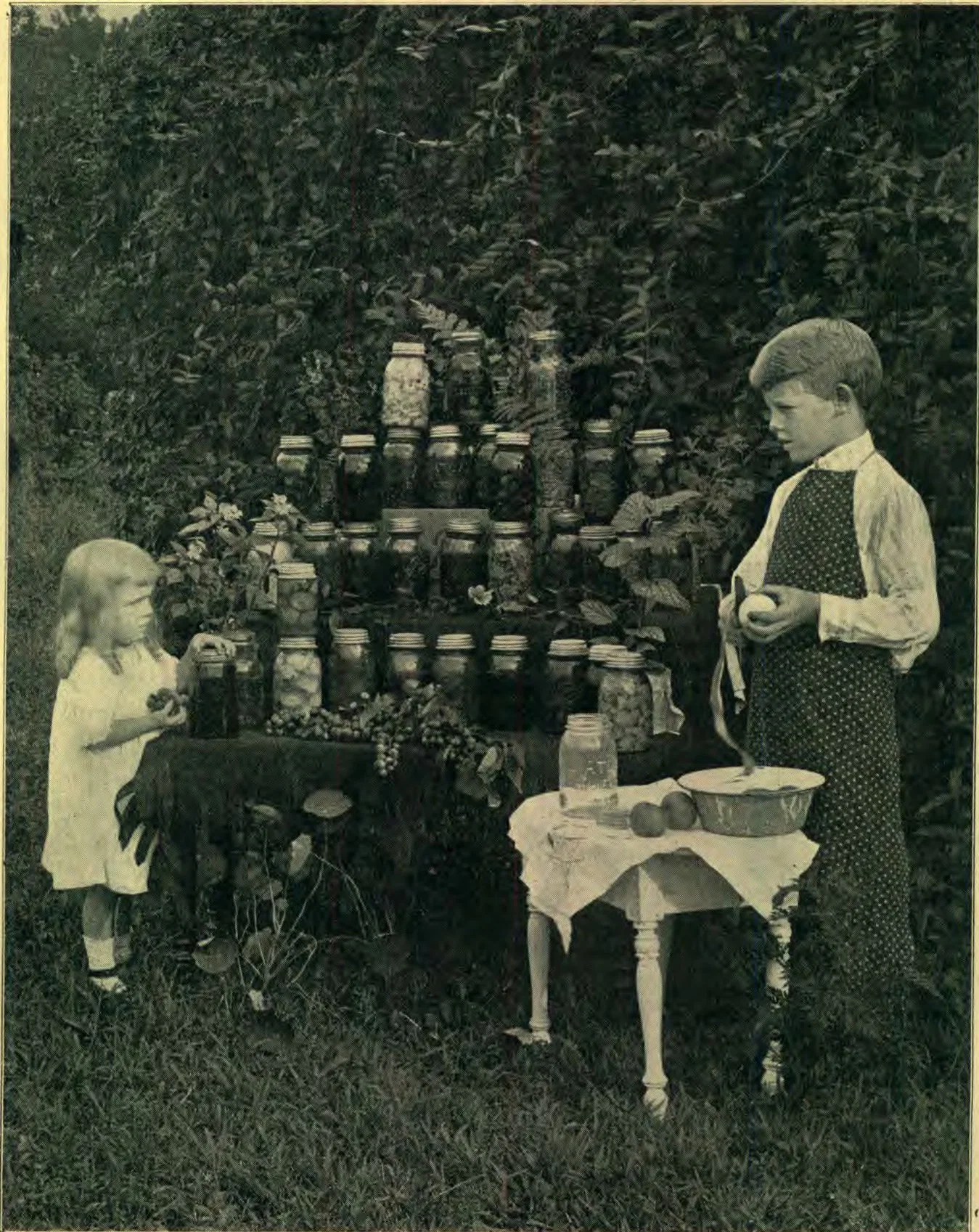
WINFRED SPAULDING, OF REEVES, GEORGIA, WITH THE PRODUCTS OF HIS CANNING SKILL AND EFFORT
Winfred is the first member of the "Instructor" Canning Club to win a premium.
WINFRED SPAULDING, OF REEVES, GEORGIA, WITH THE PRODUCTS OF HIS CANNING SKILL AND EFFORT Winfred is the first member of the "Instructor" Canning Club to win a premium.

You have reached the end of this edition.

The Youth’s Instructor · Nov 13, 1917