The Youth’s Instructor, Vol. 51, No. 14.

The Children of Africa
Earlier text: The Children of Africa

THE WEEKLY STUDY

The Disappointment and Meaning of the Movement

(April 12-18)
TRULY it was amid trial that the Lord glorified the believers who ventured their all upon the confidence that the end was to come in 1844. But he did glorify those who held fast that which they had, by revealing glorious light, and showing that the proclamation of the hour of God's judgment was indeed of the Lord. The opening of an earthly court is formally proclaimed by the court crier. When the great judgment court of heaven was to open, nothing less than a worldwide movement, calling men to face the judgment hour, could answer the requirements. We have most instructive material for studying the topic for this week.
Book Portions.—“Great Controversy,” latter part of chapter XXII, and chapter XXIV, “In the Holy of Holies;” “Rise and Progress,” chapter VIII; “Early Writings,” pages 113-116.
One must be ready to bear ridicule and scoffing without flinching, for the sake of Jesus, and to wait for God to vindicate the truth. Scoffers will multiply; and as we come day by day nearer to the coming of Jesus, we shall need to remember the lesson of God’s comforting and sustaining grace in apparent defeat. When heaven is a real place to us, and the hope of quickly going there is a reality to our faith, we shall not so much mind “earth’s scoffs and scorns.” Isa. 50: 5-10.
Remember that those who could not bear disappointment were not ready to meet the Lord. The whole experience, to the believers, was a process of refining to prepare them to enter by faith into the heavenly sanctuary with Jesus at the opening of the judgment hour. That is where every soul of us must abide by faith until Christ’s ministry as our high priest is done. As the sanctuary service in the courts above is the key to the whole scheme of the advent truth, we will review that subject next week. W. A. S.

Question Hints

(To be given to different members, and answered in the meeting.)
WHAT will be the experiences of those who are glorified with Christ? Cite scriptures. What event on earth marked the beginning of the judgment in heaven? Where are we to abide during Christ’s work in the sanctuary?
What are the believers now, as in 1844, in danger of doing? When we do not understand God’s dealings with us, what are we to do?
What is meant by eating the bitter book? How was the mistake made in the time?
What was the attitude of the Protestant churches toward the advent movement? How did the believers relate themselves to the churches?

How the Fashion Started

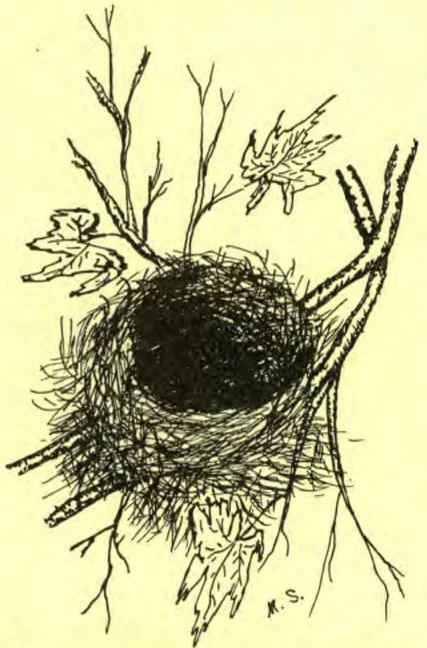
After a summer of hard service, most of the dwellings of Birdtown had arrived at a state where repairs must be made if they continued to be inhabited, although the majority of the owners held the opinion that it is always better to build a new house than to repair an old one. The young birds proudly dressed their lately grown plumage, and practised their newly acquired accomplishments of flying and chirping, holding themselves in readiness for whatever might come next, without troubling over the condition of the dwellings; but as summer was nearly over in Birdtown, the state of affairs made it very necessary that all its inhabitants make their plans for the winter.
“AFTER A SUMMER OF HARD SERVICE.”
One night a chilling wind blew from the north, making all Birdtown feel the change from summer mildness. Next morning as the birds warmed themselves in the sunshine, most of them decided to escape the coming cold. They knew a land never reached by nipping winds, where trees were green and flowers bright in winter as well as summer. It was within flying distance, too, and the birds made up their minds that, when the weather began to grow too cold to be agreeable, they would abandon their summer homes, and take a few days’ journey south, to remain for the winter.
The Thrushes and Warblers, who lived in strict seclusion in a retired portion of Birdtown, were among the first to leave, in company with their less aristocratic if more showy neighbors, the Orioles, Bluebirds, and Finches. Being delicate little creatures, they shrank from the least suggestion of cold, and to avoid it, flew away as soon as their summer work was done, and in a few days were enjoying themselves, each in the summer resort most popular with his family.
The Jays seemed loth to leave their native clime at all, and many of them stayed all winter long, screaming from the tops of the naked trees, as if remonstrating with frost and famine.
Unlike the Jays, the Wrens said nothing of their intentions in the matter, nor expressed their views upon it. Swift and silent as the winter wind, these cautious little fellows came and went as they saw fit, without taking all Birdtown into their confidence. All at once they disappeared, and if they were glad or sorry to go, no one ever knew. And it was the same way when they returned in the spring. In this respect they set a good example for some people I know, who are always telling their plans, and airing their opinions. Indeed, the Wren’s motto, “Act, not talk,” is a good one for many a community besides Birdtown.
Robin Redbreast did not enjoy travel. Like many persons of real worth, he loved home better than any other place, and at first seemed determined to remain there in spite of winter’s cold, cheerful and happy as ever while he lingered. To be sure, he knew that most of Birdtown’s population had sought their southern homes, and to be strictly in fashion, he should follow suit; but Robin does not care a chirp for fashion, unless one that suits his tastes and inclinations. In this he differs from many human beings who would grow indignant at the mere suggestion of a comparison between them and Robin Redbreast in the qualities of common sense and personal independence.
But finally every unsheltered insect had perished from cold, and the snow covered the seeds and berries with a thick blanket. With untiring energy, Robin found it hard to pick up a square meal, while the snow chilled his feet, and hampered his movements; so hunger, doing what mere cold could not, forced Robin also into southern exile for a time.
More than any of the others, the Blackbirds seemed to enjoy the prospect of a southern trip, and made great preparations for it. As soon as summer duties were over, they gathered their children together, and went to meet their kindred in cornfield and meadow. Here they assembled till the ground and fences were black with them, all chattering and calling to one another in great excitement. And when at last their preparations were complete, away they went, in great, merry, social, family parties, bent on having a good time, and enjoying every foot of the journey as well as the delights succeeding it.
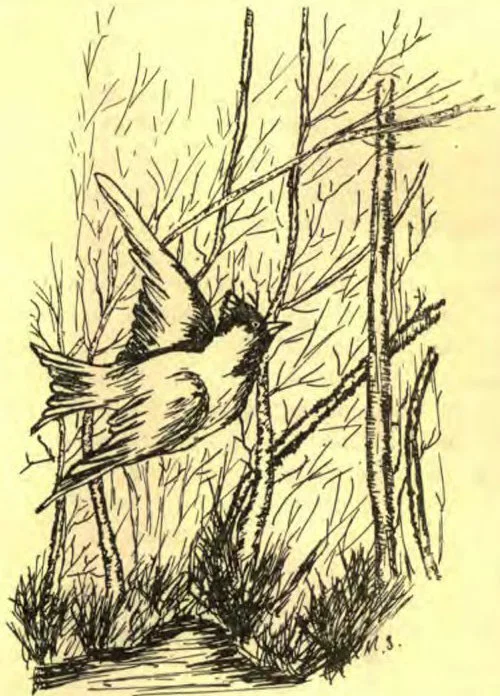
IN THE MARSHY PLACES A REDBIRD DARTING
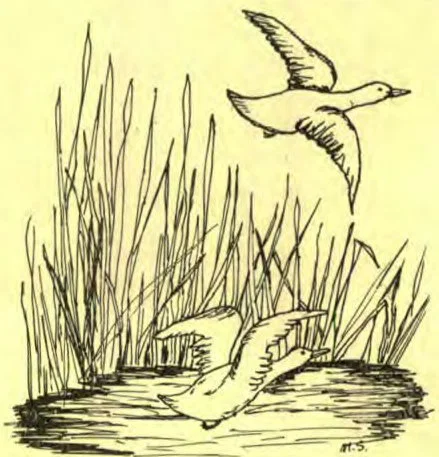
The Ducks and Wild Geese, who lived on the lake-shore in Birdtown, getting their living from the lake, loved the cold, and were dressed to endure it. Their thick down cloaks and hoods were all they needed for protection in the severest weather. But as the season advanced, ice began to show on the surface of the lake in the mornings. At first it was so thin it caused no trouble, but day by day it grew more and more substantial until at last one November morning, there was so firm a crust all over the water that no flapping of wings nor strokes from yellow bills could break it through; so, in order to find a breakfast, the Wild Geese and Ducks were obliged to fly away to warmer regions, where streams and lakes were still unfrozen. In small groups they set out, though half reluctantly it appeared, and as they winged their way across the sky, they kept up a dismal “Konk! konk! konk!” “Quack! quack! quack!” as much as to say, “We shall come back! we shall come back!”
And sure enough, whenever the weather grows warm in winter, so that the ice thaws in the northerly watercourses, the Wild Geese and Ducks fly back toward their homes; and when it turns cold again, they return to the south while it lasts. Consequently we in Missouri are in the habit of saying, whenever the waterfowl are flying, “It will be warm to-morrow; for the geese are flying north;” or, “It will be cold; for ducks are going south,” as the case may be.
And as the fashion of going south in the autumn prevails with most of the Birds, when mid-winter arrives, the number of feathered folk remaining with us is small. A few English Sparrows and Chickadees pick up seeds and crumbs around house and barn; a few sky visitors from still more northern climes flit through the evergreens now and then; a lonely crow sometimes happens along for a few days, alighting on the stubble or in the feed lot; while in the marshy places, on gray, dreary days, one can occasionally catch a glimpse of a Redbird darting among the bare twigs, like a bit of fire bright enough to warm even the chilly landscape.
But for the most part the birds are absent until the approach of spring brings them flocking back. We always look for them with perfect confidence. We know they are as certain to return as the spring itself, while some of them even come a little in advance of it. They never disappoint us, nor make a mistake in calculating the proper time to repopulate Birdtown, but come and go year after year, with unvarying regularity, following their universal fashion of spending their summers in the north and their winters in the south.
When next you happen in a community inclined to boast of its travels; when you hear any one talk of “my northern summers” and “southern winters;” where, as often occurs, traveling is made a popular fad, as if, as in most earthly fashions, its mission were only to answer the whims of vanity and pleasure,—then remember the birds as they come and go, spring and fall, and know that such travel originated in no human caprice, as a measure for frivolous enjoyment, but, founded on the motives of comfort and necessity, is a fashion set by God himself in the minds of the little birds.
“WE SHALL COME BACK.”

A Shaggy Newsboy

THE railroad ran along one side of a beautiful valley in the central part of the great State of New York. I stood at the rear end of the train, looking out of the door, when the engineer gave two short, sharp blasts of the steam whistle. The conductor, who had been reading a newspaper in a seat near me, arose, and, touching my shoulder, asked if I wanted to see a real country newsboy. Of course I answered “Yes.” So we stepped out on the platform of the car.
The conductor had folded up his paper in a tight roll, which he held in his right hand, while he stood on a lower step of the car, holding on by his left.
I saw him begin to wave the paper just as he swung around a curve in the track, and a neat farmhouse came into view, way off across some open fields.
Suddenly the conductor flung the paper off toward the fence by the side of the railroad, and I saw a black, shaggy form leap over the fence from the meadow beyond it, and alight just where the newspaper, after bouncing along in the grass, had fallen beside a tall mullein stalk in an angle of the fence.
It was a big, black dog. He stood beside the paper, wagging his tail and watching us as the train moved swiftly away from him, when he snatched the paper from the ground in his teeth, and, leaping over the fence again, away he went across the fields toward the farmhouse.
When we last saw him, he was a mere black speck moving over the meadows, and then the train rushed through a deep cleft in the hillside, and the whole scene passed from our view.
“What will he do with the paper?” I asked of the tall young conductor by my side.
“Carry it to the folks at the house,” he answered.
“Is that your home?” I inquired.
“Yes,” he responded. “My father lives there, and I send him an afternoon paper by Carlo every day, in the way you have seen.”
“Then they always send the dog when it is time for your train to pass?”
“No,” said he, “they never send him. He knows when it is train time, and comes over here to meet it of his own accord, rain or shine, summer or winter.”
“But does not Carlo go to the wrong train sometimes?” I asked, with considerable curiosity.
“Never, sir. He pays no attention to any train but this.”
“How can a dog tell what time it is, so as to know when to go to meet the train?” I asked again.
“That is more than I can tell,” answered the conductor. “But he is always there, and the engineer whistles to call my attention, for fear I should not get out on the platform till we had passed Carlo.”
“So Carlo keeps watch of the time better than the conductor himself,” I remarked, “for the dog does not need to be reminded.”
The conductor laughed, and I wondered as he walked away who of your friends would be as faithful and watchful all the year round as Carlo, who never missed the train, though he could not “tell the time by the clock.”— Our Dumb Animals.

For Honor's Sake

AN American economist recently visited a flower manufactory in Brussels, and found thirty girls at work, with no overseer in sight. Their employer was teaching them to do every bit of work perfectly for honor’s sake. The early history of the factory throws light on his success. Before engaging his employees, the proprietor ascertained that other factories paid girls twenty cents a day, and that a woman could not live decently on less than fifty. Very well; in his establishment no lower wage than fifty cents should be paid. Such principles are not the beginning of wisdom alone, but of financial success as well. The proprietor affirms that the loyal devotion and faithful work of his employees more than compensate for the increased expenditure in wages.— Youth’s Companion.

A Wake-Up Song for Summer

“Wake up! wake up!” chirps the sparrow, “Don’t you know it is to-morrow?” “I see you!” pipes robin bright, “Sleeping in the morning light!” Up! all lazy boys and girls, Straighten out your tumbled curls! Open eyes and brighten faces, Don your smiles and pretty graces! All the birds are long awake, All the flowers an airing take; And before they see your eyes, They have calls from butterflies! While the fairy-winged sweet peas Invite the golden-belted bees To their breakfast in the shade, Playing pretty waiter maid! The cows are eating clover tops, The farmer tending to his crops; Cocks are crowing, hens are feeding, Flocks of fluffy chickens leading. Listen! how the brooklet babbles, Washing smooth its shining pebbles, Taking pictures of the sky, Talking with the dragon-fly! Everything is wide-awake— Hear the crickets in the brake! Grasshoppers, down in the grass, Say, “Has it come to such a pass That the children sleep so late, As we heard the robin state?” O, who would be a sleepy head, Lying in a stuffy bed?
— Youth’s Companion.

Don't Do It “Just for Now”

MANY young people form habits which cripple and handicap them for life by doing things “just for now.” They let things drop wherever they happen to be “just for now,” thinking they will put the book, the tool, the letter, or the article of clothing, later, where it belongs.
It takes no more time nor effort to put a thing where it belongs in the first place, than it does later,—perhaps less,— and the chances are that if you do not do it at the proper time, you never will.
Even if it costs you a little inconvenience, at the moment, to put everything in its proper place, to do everything at the proper time, the orderly and methodical habits which you cultivate in this way will increase your power and usefulness a hundredfold, and may save you much trouble and vexation in the future.— Selected.

Next Year Generosity

“No, Helen didn't come,” said Lizzie's gentle voice. “We couldn't both be away at once, and I want her to go where she can have a longer rest. I do so want her to go to the seashore, or make a tour of the lakes. How Helen would enjoy such a trip! We can't manage it this year, but I keep hoping it may be possible another summer. It would do her a world of good.”
“What a generous, warm-hearted girl Lizzie is!” said an admiring acquaintance, a little later. “She seems so intent on arranging delightful plans for her sister, without a selfish thought about being unable to have a share in them.”
“Yes, she is very generous with next year's pleasures,” answered Aunt Patience, dryly. “The beautiful things that will probably be as impossible then as now, she is always willing to give to Helen, but whatever little enjoyments are within grasp she secures for herself. Just as she came out here this week, and hopes Helen can have a grander outing some other time, so she will take the new ingrain carpet for her room this winter, and hope Helen can have a velvet art-rug later. Giving the pot of gold at the end of the rainbow to another, while one uses the money at hand for self, is cheap benevolence.”— Forward.

Mother

There came a day when cattle died, And every crop had failed beside, And not a dollar left to show. Then Father said the place must go, And all of us, we hated so To go tell Mother.
Behind the barn, there we three stood, And wondered which one of us could Spare her the most. ’Tis easily said, But we just looked and looked in dread At one another.
I spoke: “I’ll trust to Brother’s tongue.” But Father said, “No, he’s too young; I reckon I —” He gave a groan: “To know we’ve not a stick nor stone Will just kill Mother!”
“Maybe a mortgage can be raised. Here all her father’s cattle grazed; She loves each flower and leaf and bird— I’ll mortgage, ere I’ll say a word To Mother!”
Upon his hands he bowed his head. And then a voice behind us said: “Mortgage? And always got to pay? Now, Father, I’ve a better way!”— And there, between the ricks of hay, Stood Mother.
“I have been thinking, ’most a year, We’d sell this place, and somewhere near Just rent a cottage small and neat, And raise enough for us to eat,” Said Mother.
“There’s trouble worse than loss of lands, We’ve honest hearts and willing hands, And not till earth and roof and door Can rob of peace, shall I be poor!” She smiled. “And, it seems to me, You all had better come to tea,” Said Mother.
As through the sunset field astir, We three went following after her, The thrushes, they sang everywhere; Something had banished all our care, And we felt strong enough to bear All things with Mother.
And listen: Once there came a day When troops returned from far away, And every one went up to meet His own, within the village street. But ere he reached our old mile-stone, I knew that Father came alone— And not with Brother.
Then through the twilight, dense and gray, All that our choking sobs could say Was—“Who’ll tell Mother?”
But waiting for us by the wood, Pale in the dusk, again she stood. And then her arms round Father prest, And drew his head upon her breast:
“The worst that comes is never death, For honor lived while he drew breath!” Said Mother.
Often when some great deed is cried Of one, by flood or flame, who died; Of men who sought and won their fame; While all the land rings with some name Or other,
I think me of one warfare long, Of Marah’s water, bitter, strong, Of sword and fire that pierced the heart, Of all the dumb, unuttered part, And say, with eyes grown misty, wet (Love’s vision, that can not forget). “All heroes are not counted yet— There’s Mother.”
— Virginia Woodward Cloud.

INTERMEDIATE LESSON

III—The Tabernacle Finished

(April 18)
LESSON SCRIPTURE: Exodus 40.
MEMORY VERSE: “Behold the Lamb of God, which taketh away the sin of the world.” John 1:29.
The Lord had made very plain to Moses all the details of the building of the tabernacle. Everything had been done as he directed, and now, after a period of almost six months of labor, everything was completed, and the tabernacle was set up.
Before the building of the tabernacle, every man was the priest of his own household. In the days of Abraham this privilege was regarded as the birthright of the oldest son. But this order was now changed. The Lord had told them how to build a tabernacle for him, and then he chose the tribe of Levi to perform the duties in connection with his sanctuary. The family of Aaron were appointed to the priesthood, the other members of the tribe of Levi caring for the tabernacle and furniture, and attending upon the priests. They were to offer sacrifices or burn incense.
The Lord had told them how everything should be made, even to the garments of the priests. Around the skirt of one of the robes of the high priest were ornaments of golden bells and pomegranates of blue, purple, and scarlet. When he went into the most holy place to minister before the Lord, as long as the people could hear the music of these bells, they knew that his service was accepted of the Lord, and that he had not been destroyed by the Lord’s presence.
The most sacred of the priestly garments was the breastplate, made of precious stones, twelve in number, upon which were engraved the names of the twelve tribes of Israel. In wearing this, Aaron always bore the names of the children of Israel before the Lord. In like manner, our High Priest, Jesus, tells us that he has graven us upon the palms of his hands. He will not forget us. On each side of the breastplate was a stone of great brilliancy. These were called the Urim and Thummin. When questions were brought before the Lord, “a halo of light encircling the precious stone at the right was a token of the divine consent or approval, while a cloud shadowing the stone at the left was an evidence of denial or disapprobation.”
Every morning and evening a lamb was offered on the altar outside of the tabernacle, and its blood was brought within and sprinkled before the mercy-seat. When any one sinned, he brought a sheep or a goat for an offering, and, laying his hand on its head, confessed his sin, and then took its life because of that sin. Thus the people were taught of “the Lamb of God, which taketh away the sin of the world.” Besides the daily service there was the yearly service, which taught the people by figures that all the sins they had thus confessed and put away would through the blood of Christ be blotted out, and remembered no more forever.
Do not forget that all these things were made according to the pattern which the Lord showed Moses on the mount. The true tabernacle, like which this one was made, is in heaven, and Jesus, our Saviour, is the High Priest. Here he pleads his own blood in our behalf when we repent of our sins and seek his pardon, just as the priest in the earthly sanctuary sprinkled the blood of the sacrifices in the holy place in behalf of the sinner who repented. Now is the time for even the children to seek him, that their sins may be blotted out by his blood; for in a little while his work in the heavenly sanctuary will cease, and he will come to gather those who have accepted his sacrifice.

Questions

  1. Name the different pieces of furniture that were set up in the tabernacle.
  2. What pieces were placed in the holy place? In the most holy place?
  3. Who was appointed to the services of the tabernacle?
  4. What family alone served as priests?
  5. What kind of garments did the priests wear?
  6. How long after they left Egypt was the tabernacle set up?
  7. How did the Lord show the people that he accepted the work of their hands? Verse 34.
  8. What did the people understand by the movements of the cloud?
  9. Describe the breastplate. Ex. 28:15–21. Compare these verses with Revelation 21, and note the similarity of the stones used.
  10. Who is our High Priest? Where does he bear our names?
  11. What does he offer for our sins?
  12. When is the best time to seek him to take away our sins?

III — The Manner of the Preacher

(April 18)
LESSON SCRIPTURE: 1 Thess. 2: 1-12.
MEMORY VERSE: “That ye would walk worthy of God, who hath called you unto his kingdom and glory.” Verse 12.
For yourselves, brethren, know our entering in unto you, that it hath not been found in vain: but having suffered before and been shamefully treated, as ye know, at Philippi, we waxed bold in our God to speak unto you the gospel of God in much conflict. For our exhortation is not of error, nor of uncleanness, nor in guile: but even as we have been approved of God to be intrusted with the gospel, so we speak; not as pleasing men, but God, who proveth our hearts. For neither at any time were we found using words of flattery, as ye know, nor a cloak of covetousness, God is witness; nor seeking glory of men, neither from you nor from others, when we might have claimed authority as apostles of Christ. But we were gentle in the midst of you, as when a nurse cherisheth her own children: even so, being affectionately desirous of you, we were well pleased to impart unto you, not the gospel of God only, but also our own souls, because ye were become very dear to us. For ye remember, brethren, our labor and travail: working night and day, that we might not burden any of you, we preached unto you the gospel of God. Ye are witnesses, and God also, how holily and righteously and unblamably we behaved ourselves toward you that believe: as ye know how we dealt with each one of you, as a father with his own children, exhorting you, and encouraging you, and testifying, to the end that ye should walk worthily of God, who calleth you into his own kingdom and glory.—American Standard Revised Version.

Questions

1. With what result had Paul preached to the Thessalonians? Verse 1; chap. 1:5, 9.
2. How had the apostle been treated at Philippi? Verse 2; Acts 16:20-25.
3. What effect did this treatment have upon his preaching at Thessalonica?
4. What unholy characteristics were kept out of his message?
5. How does he speak of the privilege of preaching the gospel? How did he fulfil his trust?
6. Whom alone did he please? How does God differ from man? Verse 4; Prov. 17:3; 1 Sam. 16:7.
7. What other unholy practises were kept out of the apostle’s work? How positive was he that this was true? Verse 5.
8. In whom did he glory? Gal. 6:14.
9. What was his manner toward the Thessalonians?
10. How dear were they to the apostle? Why?
11. How earnestly had he labored for them?
12. What could he say of his own life while in their midst? How does such a life compare with the character of those who will meet Jesus when he comes? Rev. 14:5.
13. How tenderly had Paul dealt with these people?
14. What was his one object in all this? Unto what has God called all who will follow him? See also 1 Cor. 1:9.

Notes

When the grace of the gospel of God came to the apostle Paul, it came “not in vain.” It was revealed not only to him, but in him. Gal. 1:16. The proof that it was not in vain was the service he rendered for God. “I labored more abundantly than they all: yet not I, but the grace of God which was with me.” 1 Cor. 15:10.—Lesson Pamphlet.
The thoughts brought out in verse 10 are worthy of study. What a consciousness of the abiding presence of God and his own trust in him every moment, must Paul have had, to utter such words as these. None who are false to the trust committed to them, or who do the Lord’s work carelessly, could make such an appeal both to God and to those with whom he associated daily. Of those who are living when Christ comes, these same facts will be true. Now is the time to seek the preparation to stand in that day.

Weeding the Strawberry Patch

One day grandpa said, “Little one, if you will help me weed that strawberry bed, I’ll give you a quarter.”
Robert readily assented, delighted at the thought of earning something. Grandpa smiled rather knowingly. He had pulled weeds before. Robert found that many of the weeds were as tall as he, and that they had extraordinary roots. Before an hour had passed, he had learned many more things. Among others, that sometimes the sun is very hot; that if you work hard, you get tired; that it takes a long time to reach the end of a row.
In spite of all this, he worked on bravely, and soon discovered quite an effective method of rooting out the weeds. He would sit down, grasp the weed firmly in both hands, and then pull back with all his strength. Suddenly the roots would give way; and, deprived of any support, Robbie would sprawl backward. However, he was soon able to pull the weeds in this way so quickly that speedy progress was made; and the work was finished by noon of the second day. The patch was no longer “picturesque;” but grandpa and Robert enjoyed its prim, neat look. Even the dog, apparently, shared their pride, and picked his way carefully between the rows, as they returned to the house.
Robert received his quarter; and when, years afterward, some of his relatives rather doubted his ability to do certain things, grandpa said, “The boy has good material in him, and plenty of grit. Don’t you remember, mother, how he helped me pull those weeds in the strawberry bed?”
MASON MERRITT.

Setting New Good Consequences Against Bad Ones

“WE never can evade or break the law of consequences. But there is one thing we can do, which is like setting a back-fire on a burning prairie—we can always set in operation a new train of good consequences, which will fight against, and finally neutralize and overcome, the bad consequences that threatened to destroy us.”
Continue reading: New Lights for Lighthouses