The Virginian law books still maintain that “any one who makes fun of a minister, or who fires a gun on Sunday except at an Indian, shall be fined ten pounds of tobacco;” also, “that any man who makes love to two women at the same time shall be tied to a whipping post and receive twenty lashes.”
Quakers used to be arrested for the most trivial offenses—the colonists having it in for Quakers generally. Here is a strange kind of lawbreaking found in the Massachusetts archives: “Late one Saturday night the married daughter of Mistress Mary Fay was suddenly taken ill. Next morning Mary hastened to her daughter on horseback. She was arrested, and convicted of traveling on the Lord’s Day, and compelled to pay the court a fortune of $300.”
“Any one who shall utter profane words concerning the Holy Trinity, or any person thereof, shall be bored through the tongue.” This law still exists in Washington, D. C.—Truth Seeker.
Is It Worth While?
By Ethyle Coberly
Pobai was a little Korean girl, only twelve years old, barefooted, dirty faced, and clad in rags; but she was not plain, nor was she wholly unhappy. She had to work very hard, but she loved her mother and her grandfather and the fat baby brother she carried on her back. As for her father, she saw little of him. She would have been contented to stay at home always, run errands, and help mother from morning till night. But as to getting married,—the thought was terrible, and to some one she had never seen!
The price had been paid, the gifts from the bridegroom's family had already arrived, also the gorgeous silks and brocades to be made into wedding garments. For three days after the night they came, Pobai lay on the floor with her face to the wall, feigning sickness, and eating little. The fourth day, when her mother persuaded her it was no use to resist, what must come would come, and she must resign herself, she arose with a heavy heart to assist in the preparations for the great event.
The six weeks flew by, and the fatal day came. The nuptial knot was tied, and the poor child went out from her parental roof to her unknown future.
The next six years were one long nightmare of slavery, misery, and suffering. Pobai was the household drudge in her mother-in-law's family, and many a midnight found her ironing her husband's shirts, or doing the family washing, perhaps breaking the ice to do it.
When she was eighteen, the baby came, and—oh, shameful misfortune!—it was a girl. But in spite of sneers and scorn, in Pobai's heart sprang up the tenderest, purest, truest love she had ever known. She named it Kwehi,—Precious,—and loved it with the love of both father and mother.
A few months later, her husband died, and she was sold a slave to another man, and with her sick baby was dragged one wintry morning to his home, and set at once to work. All day Pobai carried her babe on her back,—it had been nearly frozen that morning,—hoping the warmth of her body would restore it; but no,—the little mite of humanity grew colder and colder, and when the shades of night had fallen, and the rest of the household had retired, she took a sharp-pointed hoe from its peg, and out on the frozen plain, away from the group of houses, she scooped out a hole, laid the body in it, and raked together the icy clods and rocks to cover it.
And then back to wretchedness! The years that had preceded were all pleasant ones compared to the misery which she now endured. Many, many times she looked into the dark, swift-flowing river, and longed to be hid under its silent waves, but something held her back.
One day from old Sim Sssi, the sorceress, Pobai learned of the missionaries and their strange doings, and their religion. One thing that was said she could not forget: “They seem to get a lot of comfort out it.” Comfort! That was the thing she craved. So alone, after nightfall, the poor wretched heathen woman walked the six miles to the church, and there learned the good news of salvation. Oh! what peace, what richness of joy! Again and again she went. Though she was beaten by Mansiki, her husband, and forbidden to go, still she kept the wonderful light shining in her heart, and prayed that Mansiki, too, might find Jesus.
And he did. He had been watching his patient, gentle wife much lately. One day while in a neighboring town, Mansiki heard the gospel and accepted it, and his wicked heart found peace. Humbled and repentant, he returned to Pobai to make amends for the past.
He found her lying on the floor, praying, but the usual kick and curse did not accompany his coming in. Instead, laying his hand gently on her shoulder, he said, “Pobai, I have found your Saviour, and I will never again lay my hand upon you except in love.” Pobai felt her heart thrill with rapture.
Together these two dark-skinned Koreans erected their family altar, began for the first time to love each other, and a real Christian home was born.
What did it?—The love of Jesus Christ, the Man of Calvary. Does it pay? Is it worth while?
ETHYLE COBERLY.
Prayer for Missionaries
A MISSIONARY from Labrador was the guest of a family in London. He told the children much about his missionary life, and when he went away asked them to pray for him. So every night one little boy would always finish his prayer with the petition, “Lord Jesus, bless the dear missionary, and keep the polar bears from hurting him.” Day after day for a year he offered the same prayer. The father wrote to his friend and told him, inquiring if he had any adventures with polar bears. The missionary answered, saying he had been mercifully kept, and he hoped his little friend would continue to pray. Not long after, the missionary was appointed to preach many miles away. He went on board a small ship with two natives who were to row him to the place. As they came near a narrow arm of the sea, they saw on the steep precipice overhanging the water a bear ready to spring upon them. The natives wanted to turn back, for they said the monster would jump and overturn their boat, and plunge them all into the greatest danger. But the missionary said, “No, we will go on. There is a little boy in England who has been praying for a year that God would protect me from the bears. God will do it!” They went on.9The bear sprang into the water, and came swimming toward them. One of his men fired his pistol. The bear was wounded, and started away from the ship to the shore. As he reached the bank, another shot killed him. They rowed to the shore, and the missionary cut off a paw of the bear and dressed it, and sent it with a kind letter to the faithful boy in London who had prayed for him. The boy is a man now, but he treasures his bear paw, and loves to tell the story of how he obtained it.—Selected.
No Baby Carriages in Japan
By Maynard Owen Williams
ONE'S first impression on reaching Tokio is that it is exceedingly well provided with means of transportation. Up through the middle of the city runs the elevated trestle, under which scores of warehouses and shops utilize the covered space, and on this four-track trestle, electric and steam trains enter and leave in steady streams. The streets are filled with automobiles, motor trucks, bicycles, man-drawn carts—every type of vehicle except the baby carriage. The baby carriage of Japan is the mother's back or the daddy's shoulder, and I have no doubt that this closeness of mother and child throughout months and years has much to do with the excellent behavior of the bright little babies. Street cars pass a given point every minute or two, and at a crossing there are always a half-dozen big trams in sight.—Maynard Owen Williams, in the Christian Herald.
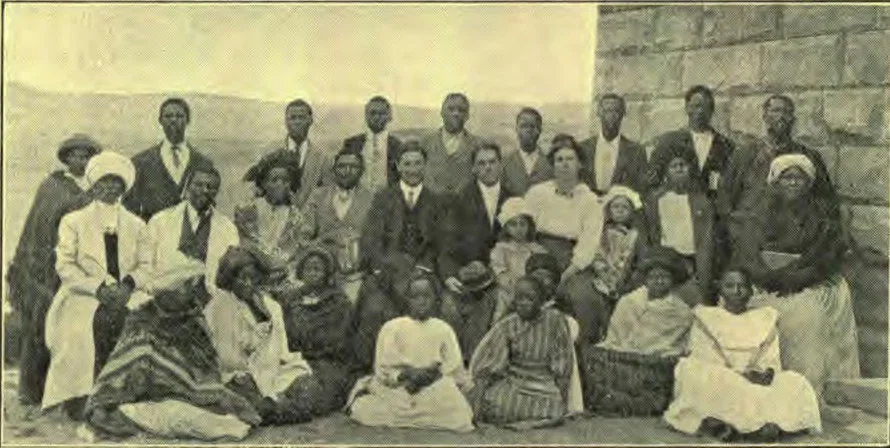
Missionary Volunteers in Basutoland, South Africa
By G. H. Clark
A SOCIETY was organized on Emmanuel Mission about a year ago by Brother H. C. Olmstead, but until now the writer has not had the opportunity of visiting it.
In company with Pastor White, our Union Conference president, I went to the mission station to attend a Bible school, which lasted one week and was enjoyed by all present. Several services were devoted to the interests of the Missionary Volunteer work, which, I believe, proved a blessing and help to the members. Instruction along lines of practical missionary effort, as well as reports from the field, was given; new officers were chosen; twenty-seven persons joined the Standard of Attainment course; and plans for more aggressive work were laid. Two leaders of bands were chosen to visit the near-by huts, and hold meetings and Bible studies with the people.
OFFICERS AND MEMBERS OF THE BASUTOLAND MISSIONARY VOLUNTEER SOCIETY
This society is not large in numbers, but has done, and is now doing, good work for the Master. Now that it is better organized and instructed, we hope to see it enlarge its sphere of influence, and be the means of carrying the light of present truth to many needy ones. G. H. CLARK.
Cape Town, South Africa.
“If Haply They Might Feel After Him”
By C. C. Crisler
PLINY testifies that at the time of Nero,—in Paul’s day,—Athens “contained over three thousand public statues, besides a countless number of lesser images within the walls of private houses. Of this number the great majority were statues of gods, demigods, or heroes. In one street there stood before every house a square pillar carrying upon it a bust of the god Hermes. Every gateway and porch carried its protecting god. Every street, every square, nay, every purlieu, had its sanctuaries; and a Roman poet bitterly remarked that it was easier in Athens to find gods than men.”—“St. Paul in Greece,” G. S. Davies.
Among the magnificent representations of heathen deities in the Grecian capital, was Phidias’s statue of Athena (Minerva), “with the face, hands, and feet of pure ivory, and the figure draped in coverings of pure gold, worth more than half a million dollars.” This statue, seventy-five feet high, and standing as it did on the Acropolis, five hundred feet above the sea level, served as a notable landmark. The materials from which it was made, had been drawn from the rich spoils taken from the Persians following the Grecian triumph on the plains of Marathon, B. C. 490.
Religious as were the Athenians, and splendid as were their representations of the gods, and solemn as were their frequent festivals, yet, “underlying all the splendor and artistic beauty, forming the very soul and spirit of the scene in all its wonderful richness, was the demon of idolatry.”—“Paul the Orator,” Maurice Jones. And the gods of the Grecians, “vindictive, passionate, intriguing, mendacious,” had in them no power to satisfy the longings of the human soul.
The heart of man, sinful and defiled, can be purified and set at rest with God only as it is brought into touch with the Saviour, and thus into touch with God. Continually the Holy Spirit is striving with the hearts of men, to turn them from sin to righteousness; and those who desire to do right and to be set free from the power of evil, are thus led, while yet in the darkness of error and superstition, to feel after God.
The prophet Isaiah has made this very plain. In his bold characterization of the heathen reaching out after God, he makes them say: “We wait for light, but behold obscurity; for brightness, but we walk in darkness. We grope for the wall like the blind, and we grope as if we had no eyes: we stumble at noonday as in the night; we are in desolate places as dead men. . . . For our transgressions are multiplied before thee, and our sins testify against us.” Isa. 59: 9-12. This picture, seemingly dark, is nevertheless bright with hope; for the benighted souls are represented as actually groping after God, and there is always hope for those who are feeling after their Maker and Lord.
Jesus, our Saviour, was sent into this dark world as “a light of the Gentiles; to open the blind eyes, to bring out the prisoners from the prison, and them that sit in darkness out of the prison house;” and he declares: “I will bring the blind by a way that they knew not; I will lead them in paths that they have not known: I will make darkness light before them, and crooked things straight. These things will I do unto them, and not forsake them.” Isa. 42: 6, 7, 16.
Tennyson has visioned the universal longing after God, the heart hunger of those who are reaching out after something that satisfies; and he has represented the seeker after God as saying:—
“I falter where I firmly trod,
And falling with my weight of cares
Upon the great world’s altar stairs,
That slope through darkness up to God,
“I stretch lame hands of faith, and grope,
And gather dust and chaff, and call
To what I feel is Lord of all,
And faintly trust the larger hope.”10
“But what am I?
An infant crying in the night;
An infant crying for the light,
And with no language but a cry.”
Yet God’s ear is open to the cry of every such one. He is never far from those who are seeking him thus earnestly. He whom the apostle Paul set before the idolatrous Athenians as the Creator,—as the one who “giveth to all life, and breath, and all things,”—is ever close to those who have eyes to see and ears to hear and hearts to feel; and he will grant to all such the assurance of his presence and blessing.
C. C. CRISLER.
The Gigantic Serpent
The Rev. Jacob Chamberlain, an American missionary for thirty-seven years among the Telugus of India, gives an exciting account of an encounter he had with one of India’s immense serpents. The account follows, and is taken from Mr. Chamberlain’s book, “In the Tiger Jungle:” —
“We were in the great teakwood forest, with trees towering one hundred and fifty feet above the woodman’s path, up which we were wending our way to the great Godaveri River, and along which path, or rough cart track, were clearings every few miles, and villages and cultivation. We had that morning taken a long march, preaching and disposing of Gospels and tracts in every village and hamlet that we passed. At ten o’clock, learning from our guide that about a mile ahead was a large village or town, I rode on in advance to find a place in which to pitch our tent.
“As I came near, I saw the elders of the city coming out of the city gates—for it was an old walled town—to meet me. Passing the salutations of the day, I asked them where there was a shady place where I could pitch my tent for the day and night.
“‘You need not pitch your tent,’ they replied; ‘here is a new thatched building just erected for a shelter for our cattle. That will be fully as comfortable as your tent, and will save the trouble of pitching; please accept the use of that.’
“Close by us, just outside the gates of the town, was this new building, with roof and walls made of palm leaves, and with an open doorway, but no door. The floor was the virgin sod, still green, for it had not been used.
“I accepted their hospitality, and as soon as my cart came up I took out my camp cot, put it in the middle of the hut, and threw myself down to rest while my servant was preparing my breakfast. My native assistants had not yet come up, as they had found another little hamlet after I left them, and had stopped to preach in that.
“I was lying on my back on my cot, reading my Greek Testament, which had been my daily companion from a boy. I was holding it up over me, reading a little, and shutting my eyes and thinking a little. This continued for near half an hour. At length the passage I was reading was finished, and I let the arm that was holding the book fall.
“Then, and not until then, did I become aware that a huge serpent was coiled around one of the bamboo rafters, with some four feet of his body hanging down directly over my head, with his eyes flashing and his tongue darting out, just above where my book had been and had concealed him. He had evidently been asleep in the roof: the putting in of my cot had awakened him. While I was reading he had let down one third of his body or more, and was looking to see what this leprous-looking white man was about, for he had probably never seen a white man before.
“His darting tongue was almost within arm’s length of my face when I caught sight of him. I remembered that during my course at the medical college, in the skylight dissecting-room of the old College of Physicians and Surgeons in New York, I once looked attentively over the muscles of the human frame, and wondered whether a person lying down could jump horizontally without first erecting himself. I found it could be done with proper incentives, for off that cot I came at one bound, to my feet, without first raising my head, for that serpent was too near it.
“Running to the door, I seized an iron spit some five or six feet long, with a sharp point, used for roasting purposes in the jungle, and which was in the cart. Coming back and using that as a spear, I was successful at the first thrust in piercing the body of the serpent where it coiled around the rafter.
“But then I found myself in another difficulty. I caught hold of the spear to keep it from falling out and releasing the serpent; but the serpent would draw back, and with a tremendous hiss, strike at my hand that held the spear, and come suspiciously near hitting it with his tremendous extended fangs. If I should let go, the spit would fall out and the serpent would get away, and he and I could not sleep in that hut together that night, especially after he had been wounded by me. If I held on, his body might slide down the spit until he could reach my hand, which might be fatal to me instead of to him.
“However, in answer to my lusty calls, my servant soon appeared with a bamboo club. Holding the spit with my left hand and taking the club in my right, I administered to the serpent a headache, from which he died. As I took him down and held him up by the middle, on the spit, to the level of my shoulder, both head and tail touched the floor, showing that he was about ten feet long.
“Just as I was holding him in this position, one of the village watchmen passed the door of the hut, going into the village, and saw what I had done. It occurred to me at once that now I should find myself in a ‘bad box,’ for the people revere serpents as demigods. They dare not kill them or harm them, and will always beg for the life of a serpent if they see any one else killing one. They think that if you harm one of these deadly serpents, it or its kin will wage war on you and your kin and descendants until your kin are exterminated. I, a missionary, had come there to preach; how would they hear me when I had killed one of their gods?
“Knowing that the news had gone into the town to the elders, I began to prepare my line of defense, for I thought that they would soon come out to call me to account. I remembered a verse of one of their Telugu poets commending the killing of venomous reptiles, and having a copy of that poet with me, I opened my book box and took it out, but had not found the verse when I saw the chief men of the place coming out toward the hut.
“To my astonishment, they had native brass trays in their hands, with sweetmeats, coconuts, limes, and burning incense sticks on them; and as they came to the door of the hut, they prostrated themselves before me, and then presented these offerings; for they said I had rid them of their most dangerous enemy, that that serpent had been the bane of that village for several years. It had bitten and killed some of11their kine, and, I think, also a child. They had made every effort to drive it away from the village by burning straw closer and closer to it to make it go farther and farther away, but it would always return. They had tried to coax it away by putting little cups, each holding half a teaspoonful of milk, every two yards or so out into the jungle; but as soon as it had drunk all the milk it wanted, it would turn round and crawl back into the village and into some house, and then the people of that house would have to vacate until it chose to leave. It had become the terror of the village.
“But now I, a stranger and foreigner, had killed it without their knowledge or consent. That was their safety; for if they had seen me doing it they would have begged for its life, lest they be taken as accomplices. Now it was dead, and they were guiltless, and it could harm them and theirs no more. Would I please accept these sweets? They had sent to the flock in the fields to have a fat sheep brought me as an offering, and would I please accept the sheep? Now whatever I had to say they would listen to me gladly, for was not I their deliverer? . . . The serpent was not a cobra,—cobras never grow so large,—but it was said to be equally venomous.
“When the heat of the day was over, we all went into the town to preach. At the gate was the village crier with his tom-tom, or small drum; and as soon as we appeared, he went through all the streets beating the tom-tom and crying, ‘Come, all ye people; come and hear what the serpent destroyer has to say to us.’ A royal audience we had, while we spoke to them of the ‘old serpent’ and his deeds, and Christ, who bruised the serpent’s head. The killing of the serpent, instead of proving a bar, had opened a door of access to the gospel.”
For the Finding-Out Club
[Every one who sends in a correct list of answers to this or any future set of questions will be entered as a member of the 1917 Finding-Out Club, if the list is received within three weeks after the date of the paper containing the list. Membership lists of answers to be accepted must follow the rules given below:—
The list must be written neatly.
Pen and ink must be used.
Writing must appear upon only one side of the sheet of paper.
The answers must reach the editor’s desk within three weeks after the date of the paper containing the questions answered.
All lists must be folded and not rolled.
The questions must not be repeated in the list of answers.
Each answer must bear the same number as the question it is intended to answer.
Every list must give the date of the INSTRUCTOR containing the list of questions being answered; for example, “Answers to questions in INSTRUCTOR of December 8.”
Every list must bear at the bottom the name of the one sending the list.
The number of lists that one has successfully answered is indicated by the small figure at the upper right-hand corner of the name.
Failure to heed any one of these rules is sufficient to bar one from membership in the Finding-Out Club. Let us watch the 1917 membership grow.—ED.]
I. What is the Crescent City? What river is known as the “Father of Waters”?
2. On what island are more foreigners landed than at any other port in the United States?
3. What provision has our government made for caring for immigrants when they land at this port?
4. What are some of the requirements made of immigrants before allowing them to settle in this country?
5. Why did President Wilson recently veto the immigration bill that had been voted on favorably by both houses of Congress?
Answers to Questions in “Instructor” of January 16
First Part
I. Meriwether Lewis, private secretary to President Jefferson, who caused his selection as one of the leaders, with Lieut. William Clark, led what has become known as the “Lewis and Clark Expedition” across the continent (1804-06) to explore the region acquired in the Louisiana Purchase. The exploring party left St. Louis in May, 1804, and reached the Pacific Ocean at the mouth of the Columbia in November, 1805. A vast amount of valuable data was gathered concerning the country traversed. As a reward for his services Lewis received from Congress a grant of 1,500 acres of land.
2. Detroit was founded in 1701 by Antoine de la Mothe Cadillac, who had pointed out the importance of the place as a strategic point for determining the control of the fur trade.
3. The Society of the Cincinnati, so called after Lucius Quinctius Cincinnatus, was founded, with Washington as president-general, in May, 1783, at the close of the Revolution, by the officers of the American army. All officers of the Continental army who had served for three years, or who had been disabled and honorably discharged, and all French officers who had ranked as high as colonel in the French army serving in America, or who had commanded a French war vessel or fleet, were eligible for membership in the society. The object of the society was to promote friendship and to aid members in want.
4. The first Western President was Ulysses S. Grant, born in Point Pleasant, Ohio, April 27, 1822.
5. Eight presidents were born in the State of Virginia.
6. St. Augustine, Florida, is the oldest city in the United States.
7. The “Battle Above the Clouds” is a name popularly given to that part of the Battle of Chattanooga which resulted (Nov. 24, 1863) in the capture of Lookout Mountain by the Federals under the immediate command of General Hooker, who charged up the mountain through a heavy mist.
Second Part
I. Matthias was chosen by lot to take the place of Judas.
2. Paul lodged with Aquila while preaching at Corinth.
3. Rhoda answered Peter’s knock at the gate, and then before opening the gate, ran to give the news of his return.
4. Ishmael, Hagar’s son.
5. Orpah, sister-in-law of Ruth, who married Boaz.
6. Nebajoth was Ishmael’s first-born son.
Turkey Declares Independence
TURKEY has declared her independence of the European powers, through a note addressed to Germany and Austria-Hungary and communicated to the neutral nations. In this note the Ottoman government announces that it regards the conventions of Paris and Berlin as no longer binding upon Turkey.
The Treaty of Paris was signed in 1856 at the close of the Crimean War, in which France, England, and Italy fought Russia to protect Turkey. The Treaty of Berlin, in 1878, was the result of the joint intervention of England, France, and Germany to prevent Russia from taking Constantinople, after she had, with the aid of Roumania, defeated Turkey.
The six powers whose control over Turkey is thus shaken off are Great Britain, France, Russia, Italy, Germany, and Austria-Hungary.
Percy — A Monkey
By Mrs. A. E. Robinson
Percy is a black Brazilian ring-tailed monkey, with a smooth white face; bright, beady black eyes, and a little patch of black hair on his head that gives him the appearance of a very weazened old man with a skullcap. He has long limbs, and hands very much like a human baby’s hands.
I purchased Percy in Los Angeles, from a man whose brother captured him in Brazil, and brought him all the way to California. He was about six months old when I got him. This man was very cruel to Percy and used to beat him unmercifully, trying to tame him, and I bought him because I hated to see him so abused.
Percy was so wild when I bought him that we could hardly go near him; but he immediately took up with my cousin, who has always been very kind to animals of all kinds, and went up on her shoulder and kissed her all over her cheek. Although he has only seen this woman once in three years, when he did see her he immediately went to her and loved her in the same way, and would hardly go back to his window.
Percy is very fond of peppermint candy, and one day, while sitting on this woman’s shoulder eating a peppermint, the thought seemed to strike him that she might like candy too, and quick as a flash he took the mint out of his own mouth and popped it into hers, as she opened it to say something.
When I receive a letter from this cousin, Percy always wants the envelope and smells it all over, and finally chews the stamp, but will not destroy the envelope, as he seems to know that it is different from other envelopes. Sometimes he will play with it all day, and at other times he will take a pencil and mark all over the envelope, when we tell him to “write to Ella.” He never wants to write to any one else.
He is very intelligent and seems to understand everything one is speaking about. If you give him anything, he never forgets it, and always expects the same thing when he sees you. For instance, one man let him go through his pockets and take out something he had brought for him one day, and ever since, when this man comes, Percy has to go into his pockets immediately and search until he finds something. Another man let Percy knock off his hat the first time he came to see him, and now when he comes, Percy immediately knocks off his hat.
Percy lives in a store where he has an opportunity to see many people. Very quickly he picks out his friends and makes up his mind that he dislikes some people. He is always glad to see his friends, but if any one whom he dislikes comes in, he makes faces at him, and acts very much like a badly spoiled child.
He is not very fond of children, as a rule, and does not seem to notice them much, unless they are very nicely dressed, when he shows a preference for little girls with bright-colored ribbons. There is, however, one little boy named Bobbie who comes to see Percy, that seems to be an exception to this rule, as Percy immediately comes down from his cage and wants to run and play with him.
Sometimes when things have gone wrong and Percy is crying, I say, “Here comes Bobbie.” He immediately stops crying and begins to look for Bobbie. We believe the reason he likes Bobbie better than other little boys is because Bobbie is gentle with him.
We had Percy in the window of the store, and crowds of people used to stand outside to watch his antics when he was performing on his trapeze. The louder they laughed the harder he would perform, seemingly trying to show off still more.
We have to watch Percy very closely, as he is mischievous. He seems to realize when he is being watched, and will wait until he thinks the coast is clear before attempting his mischief. When caught at any mischief, he cries very hard and seems to be very angry at the person who has discovered him. The only way to stop his crying is to pretend to whip that person.
He is very industrious and likes to do what others around him are doing. For instance, if I am sewing, Percy has to have a needle and thread and piece of cloth, and sew too. He pushes the needle into the cloth with his hands and pulls it out with his teeth. He likes to try to mend his playthings when they are broken, and will work hard trying to fix them.
He eats nearly everything that we eat, but has an especial preference for grapes, and when eating them he holds his head back so that he will not lose any of the juice. He is also very fond of raw eggs, and will hold one in his hand, make a small hole in one end, and suck out the inside without spilling a drop. He can drink from a cup or glass just as a person drinks, and can use a spoon very nicely.
When his master goes away, he grieves for him and will hardly eat. The moment he sees his master coming, he says, “Ah-hah,” which seems to be an expression of enjoyment.
In the mornings he is quite talkative, when he wants his breakfast, and says, “Ah-hah, ah-hah.” When his master says, “You must say it three times,” he does say, “Ah-hah, ah-hah, ah-hah,” emphasizing the last one very strongly.
When bath time comes, we give Percy a pan of water, and he gets right into the pan and washes himself, using his tail for a wash rag. He washes his feet like a person, washing between his toes very carefully, then after he has dried himself he holds out his feet to his master to have his toenails manicured.
When Percy gets sleepy, he wraps himself up in his little blanket, curls up into a little furry ball, and goes to sleep. He used to have a white rat for a pet, and13he always wanted it when he got sleepy. He would hold and rock and love that rat, just like a mother with her baby, then curl up for the night, with it in his arms. When his rat died one day, he grieved for it and would not be comforted for a long time.
I have been offered large sums of money for Percy, but we have become so attached to him that it would seem almost like selling one of the family, and we would not think of accepting any price. I believe that the little monkey would very soon grieve himself to death if he were separated from us.
The cute things that he has done would fill a book.
— Mrs. A. E. Robinson, in Our Dumb Animals.
God’s Other Book
By M. E.
(Texts for February 25 to March 3)
DAVID had learned to love the Bible as well as nature; and when he has sung of the one in this psalm, he turns abruptly to declare his delight in the other. His meditations are of the law; and notice that verses seven to eleven are constructed on a uniform plan. Each is an outburst of his exuberant delight in the law; each gives an attribute of it and one of the effects of keeping it.
David must have meditated often, long, and devoutly on the law of God, or there never could have issued from his lips such a flood of beautiful synonyms descriptive of the heavenly code. He had found it his best guidebook in character building; from it he had learned what God was and what he himself ought to be. The law spoils the coarse gratifications of the disobedient, and becomes a prison wall to them, but David had learned that submission to the law meant joy and peace and an enriched life.
As he pondered on the law, it must have expanded and enlarged till he could read between its lines the whole gospel story. What a wonderful law it is! It is a perfect rule for conduct. It is sure; no part of it shall fail; nor can we afford to ignore one jot or tittle of it; it contains no empty phrases, and should be followed in every detail. It is right; there are no false statements sandwiched in; it prescribes the course which they must take who would attain the true goal of life. It is pure, like the rays of the sun; so our hearts can safely take it in in its entirety. It is clean. What a contrast to the rules of idol worship with its many loathsome rites! It is true and righteous; its commands are in full harmony with “the justice that abides in the bosom of God.”
Not only to David, but to all who love God’s will and do it as expressed in the law, comes refreshing and restoring power. Do you recall how the disciples left Jesus tired and hungry, and when they came back and found him refreshed, he explained, “I have meat to eat that you know not of”? Judson loved God’s law, and it enlightened his eyes, till he could look beyond his dismal surroundings, and see that “prospects are as bright as the promises of God.”
Sometimes the law of God stands between a young person and an enviable position. It is a hard test. Satan does all in his power to make the law appear a nonessential, a grievous burden, a barrier to success; and it is only in the school of meditation, prayer, and obedience that the young people can learn that the law is sweeter than honey, and that keeping it brings a greater reward than all the fine gold in the world can buy.
In the closing verses of this psalm, David’s petition arises to God. Contemplation of God’s law has led to self-examination; and one cannot long look within without feeling the need of help from above. Shall we not make the psalmist’s prayer our own? Let us obtain complete deliverance—deliverance from the sins14that are lurking in the dark, unexplored regions of our hearts, and springing out every now and then to mortify and wound us. And then there are the presumptuous sins,—the habit of doing things that we know are not in accordance with the Master’s will. Just as the white ants eat the inside of wood, leaving only the shell intact till a gentle breeze or touch crushes it, so small, insignificant sins gnaw away at the substance of life till the will is completely enslaved and the open, palpable sins break out. There is safety only in complete deliverance. Complete deliverance is the only thing that will satisfy the heart of God and our own deepest desires.
And now go back to the first of this psalm and glance over it as a whole. How sweetly David sings of nature and nature’s God! But his song of nature is only a prelude to the deeper music of God’s law. Then as a fitting climax to this Hebrew classic, he confesses that he must have upon the throne of his heart, the God who rules the heavens. And how overwhelmingly sweet is the thought that we may have the Ruler of the universe enthroned in our own hearts!
MEDITATION.—How grateful I am for God’s two great books. Through prayerful study of them I may become acquainted with the Creator of the universe; and to know him means “life eternal.” To know him will change my life so “that those who know me and do not know him, will want to know him because they know me.”
SPECIAL PRAYER.—Faithfulness in tithe paying is our subject this week. As we pray earnestly let us not forget to do our part in answering this prayer.
M. E.
The Instructor Literature Series
THIS is a series of booklets comprising the very best of supplementary readers and classics for all grades. They can be obtained for five cents a copy and postage of one cent. It is a remarkable series covering history, biography, literature, nature, industry, geography, and stories of the States. The titles of some of the booklets are:—
Buds, Stems, and Fruits, Mayne
Story of Flax, Mayne
Story of Glass, Hanson
Adventures of a Little Water Drop, Mayne
Story of De Soto, Hatfield
Story of Daniel Boone, Reiter
Story of Printing, McCabe
Story of David Crockett, Reiter
Story of Patrick Henry, Littlefield
Famous Artists (III, Millet), Cranston
Story of the Cabots, McBride
Story of the Norsemen, Hanson
Story of Nathan Hale, McCabe
Story of Florence Nightingale, McFee
Four Little Discoverers in Panama, Bush
Life in Colonial Days, Tillinghast
Whittier’s Poems, Selected
Poems Worth Knowing (Book II, Intermediate), Faxon
Four Great Musicians, Bush
Later English Heroes (Cromwell, Wellington, Gladstone), Bush
Heroes of the Revolution
Stories of Courage, Bush
Story of Slavery, Booker T. Washington
Evangeline, Longfellow
Snowbound, Whittier
The Great Stone Face; Rill from the Town Pump, Hawthorne
One can obtain besides these, any of the common great poems, biographies of almost all of the great historical characters; stories of battles, flax, glass, water drops, wool, silk, sugar, time, birds, coffee, tea, salt, rice, currants, honey, coal, wheat, and the stars. Order of your tract society, or of the Review and Herald Publishing Association, Takoma Park, D. C.