The Youth’s Instructor, Vol. LII, No. 39

The Acadians

The Youth’s Instructor

September 27, 1904

Review and Herald Publishing Assn. · Washington, D. C. · September 27, 1904

The Acadians
Before beginning a trip over the Southern Pacific Railroad, a traveler should take down his volume of Longfellow’s poems, and read carefully the beautiful and pathetic tale of Evangeline; for he will pass through the same country of Louisiana in which the Acadian exiles found refuge.
It was in the year 1713 that the country of Nova Scotia, or Acadia, was ceded to the English. At that time it had only about three thousand inhabitants, but during the next forty years their numbers increased to sixteen thousand, and they were all, with few exceptions, French peasants who had come to make for themselves homes where they would not be disturbed by the wars which were constantly racking the peace of the homeland. They had succeeded, in spite of the bitterly cold winters, in making homes that were pleasant and happy. Little villages and hamlets like Grand Pre, Evangeline’s home, were scattered over the peninsula, and the happy people worshiped God as they chose, and had that freedom that goes so far in making life a luxury. Then came that dark page in American history with which we are all familiar, and which gave us our Acadian farmers in Louisiana.
The English governor seems to have had a heart as hard as that of the Pharaoh who made such miserable slaves of the Israelites. His name was Laurence, and he pretended to fear an insurrection, so an oath of allegiance was drawn up for the people to take. They were all good Catholics, and the oath was such that no honest Catholic could take it, so they refused, but declared their loyalty to the king. The English then accused them of treason, and demanded that they surrender all their firearms and boats. They submitted to this indignity also, and some now offered to take the oath, but were told by the governor that it was too late, and they must take the consequences. It had already been determined in the minds of the English what the consequences were to be. The home-loving Acadians were to be banished and scattered, and the atrocious work was soon begun. The touching picture given by Mr. Longfellow of the destruction of Grand Pre, and the distress of its people, was reproduced in all the little hamlets along the coast. Thousands were driven from homes and forced to embark on the English ships, which carried them southward, and there, in a country unknown to them, they were scattered, friendless and homeless, and the peaceful Acadian villages were given to the flames.
The country was almost depopulated, yet there is no record of resistance on the part of the sufferers. Surely they deserve the name of Christians, and an honored place in history.
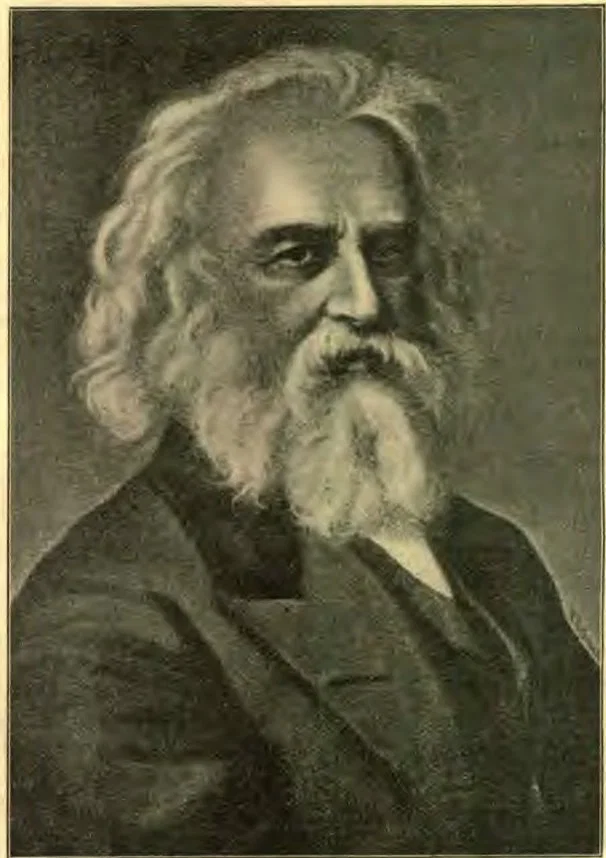
AUTHOR OF ACADIANS’ STORY IN VERSE
But what became of these people who were scattered from Massachusetts to Georgia among a people who hated them for their religion and nationality? History tells us that very few of them remained among these inhospitable surroundings. Between the years 1764 and 1788 four thousand of them found their way to their countrymen in southern Louisiana, and the descendants of these Acadians are the ones who to-day attract the attention of the traveler through the Southland. As one journeys westward from New Orleans, he first passes through great fields of sugar-cane. As far as can be seen, there is nothing but cane, and occasionally a refinery, and the homes of those who care for the cane. Hundreds of men are required to care for these great plantations, and as one passes through, he sees many dusky, contented-looking plowboys driving their little mules back and forth through the long rows.
All this rich sugar country is said to belong to nine men, and their wealth is increasing with their cane. Some day perhaps we shall visit them, and learn more about the refining process, and cane culture in general; for they are very interesting pursuits.
As one passes out of the cane country, he enters a typical Louisiana swamp. The solitude of these swamps seems to have a depressing influence on some travelers, while others enjoy it. This cypress swamp extends for miles on both sides of the railroad, and the gray, Spanish moss hanging like emblems of mourning from the slender branches of the cypress trees, adds to the weird influence felt by all. With the black cypress trees and the gray moss above, and slimy water below, one finds himself looking about for alligators, but none are to be seen. It takes fully two hours to pass through this swamp, and then one comes out upon pretty, green prairie land, which seems far more home-like; for instead of Spanish moss, cypress-knees, and stagnant water, are seen beautiful level prairies extending for miles, until lost in the oak woods along the banks of some bayou.
Only a short distance from the track, a herd of small creole ponies are grazing, and as one passes by, they raise their heads for a moment to look at the traveler, who imagines, from their patronizing expression, that they are pitying him for the hard life he leads, while they are free to enjoy as they wish their native pastures; for we are told by a man sitting near that they have probably never had a rope on them. He also said, “They are extremely hard to catch, and after being caught are equally hard to tame.” We have learned that they are much used, however, and are very serviceable on the Gulf Coast.
A herd of cattle now attracts the attention. They are not such large animals as our farmers raise in the North, but they have long horns, and also appear to be quite wild. There are many herds of such cattle scattered over the prairies, and one wonders where are the owners of these ponies and of the vast herds of cattle. Upon inquiring, he learns that he is but a short distance from the homes of the owners. A few moments more will bring him upon a pretty strip of timber land, where, nestled in the edge, among the China trees, are the homes of the owners,—the Acadians. As the writer himself came suddenly upon those quiet homes, he thought of the Louisiana home of Basil, the Acadian blacksmith, and the picture was so real that he wondered whether Longfellow saw it.
AN ACADIAN HOME IN LOUISIANA
The homes of the Acadians are, with few exceptions, built in the edge of the strips of timber bordering and separating the different prairies, and are simple, and built very much alike. In front a deep porch extends the whole length of the house, and the house is always built on blocks two or three feet from the ground. Windows are rather scarce, and in some of the poorer houses wooden shutters take the place of glass. At the rear of most of the houses are small peach orchards, and usually some fig-trees. Farther south are orange groves, but the oranges are a very sour variety. There are evidences of a garden plot, but the weeds have taken it now, and at one side is a corn field, which is a very important part of every Acadian farm. Not far away, in a low piece of land, can be seen a few acres of rice, which looks almost like wheat.
The Acadian farmer is an independent person, and his wants are so simple, and his land so productive, that he does not need to spend much time worrying about whence his living is coming. It comes someway, and he worries very little about anything. He makes meal of the home-grown corn; and his rice, until the last few years, was hulled at home in a manner worthy of the aborigines; now it is cleaned by the large rice mills which are becoming numerous. A few years ago the Acadian mothers and daughters could be seen out in the shade of some tree, hulling their rice in the hollowed end of a log, where the hulls were beaten from it with a heavy stick, much like the pestle used by the Indians. Besides his rice and corn-meal the Acadian has his garden, butter, and milk, for they all own cattle; and his swine run wild in the timber land along the bayous.
On this simple fare he rears large families, and as one passes through some of the smaller stations, he sees many boys and a few girls. The Acadians have dark hair and eyes generally, and are well formed. The girls are rather small, and are usually pretty; they wear earrings whether they are in style or not. The changing styles of Paris do not affect the Acadian dames very much, and they are just as happy as the most stylish ladies of New York City.
French is the prevailing language, although nearly all can speak English; for since the Southern Pacific Railway was laid, English-speaking people are coming in rapidly from the North, and the strictly Acadian traits are blending with those of the English-speaking Americans, and it will soon be difficult to distinguish them.
As in the days of the gentle Evangeline, so now nearly all are zealous Catholics, and the priest is the honored person of every community. Dancing is still the Acadians’ way of whiling away the long summer evenings; but often the evening changes to night, and night to morning, before the merry dancers feel the need of rest.
Contentment seems to be a characteristic of the descendants of the old Acadians, but people from the Northern States are coming by thousands every year, and the old Acadian habits and manner of living are fast disappearing, more modern customs taking their place. The wealth of the country is increasing rapidly, for the rice industry is growing, and is another interesting feature of this interesting country. The Acadians as a people may disappear, but their memory will remain. J. W. Peabody.

Extract from Longfellow’s “Evangeline”

So passed the morning away. And lo! with summons sonorous Sounded the bell from its tower, and over the meadows a drum beat. Thronged erelong was the church with men. Without, in the churchyard, Waited the women. They stood by the graves, and hung on the headstones Garlands of autumn-leaves and evergreens fresh from the forest. Then came the guard from the ships, and marching proudly among them Entered the sacred portal. With loud and dissonant clangor Echoed the sound of their brazen drums from ceiling and casement,— Echoed a moment only, and slowly the ponderous portal Closed, and in silence the crowd awaited the will of the soldiers. Then uprose their commander, and spake from the steps of the altar, Holding aloft in his hands, with its seals, the royal commission. “You are convened this day,” he said, “by his Majesty’s orders. Clement and kind has he been; but how you have answered his kindness, Let your own hearts reply! To my natural make and my temper Painful the task is I do, which to you I know must be grievous. Yet must I bow and obey, and deliver the will of our monarch; Namely, that all your lands, and dwellings, and cattle of all kinds Forfeited be to the crown; and that you yourselves from this province Be transported to other lands. God grant that you may dwell there Ever as faithful subjects, a happy and peaceable people! Prisoners now I declare you; for such is his Majesty’s pleasure!” As, when the air is serene in the sultry solstice of summer, Suddenly gathers a storm, and the deadly sling of the hailstones Beats down the farmer’s corn in the field and shatters his windows, Hiding the sun, and strewing the ground with thatch from the house-roofs, Bellowing fly the herds, and seek to break their enclosures; So on the hearts of the people descended the words of the speaker. Silent a moment they stood in speechless wonder, and then rose Louder and ever louder a wail of sorrow and anger, And, by one impulse moved, they madly rushed to the door-way. Vain was the hope of escape; and cries and fierce imprecations Rang through the house of prayer; and high o’er the heads of the others Rose, with his arms uplifted, the figure of Basil the blacksmith, As, on a stormy sea, a spar is tossed by the billows, Flushed was his face and distorted with passion; and wildly he shouted,— “Down with the tyrants of England! we never have sworn them allegiance! Death to these foreign soldiers, who seize on our homes and our harvests!” More he fain would have said, but the merciless hand of a soldier Smote him upon the mouth, and dragged him down to the pavement. In the midst of the strife and tumult of angry contention, Lo! the door of the chancel opened, and Father Felician Entered, with serious mien, and ascended the steps of the altar. Raising his reverend hand, with a gesture he awed into silence All that clamorous throng; and thus he spake to his people; Deep were his tones and solemn; in accents measured and mournful Spake he, as, after the tocsin’s alarum, distinctly the clock strikes. “What is this that ye do, my children? what madness has seized you? Forty years of my life have I labored among you, and taught you, Not in word alone, but in deed, to love one another! Is this the fruit of my toils, of my vigils and prayers and privations? Have you so soon forgotten all lessons of love and forgiveness? This is the house of the Prince of Peace, and would you profane it Thus with violent deeds and hearts overflowing with hatred? Lo! where the crucified Christ from his cross is gazing upon you! See! in those sorrowful eyes what meekness and holy compassion! Hark! how those lips still repeat the prayer, ‘O Father, forgive them!’ Let us repeat that prayer in the hour when the wicked assail us, Let us repeat it now, and say, ‘O Father, forgive them!’ Few were his words of rebuke, but deep in the hearts of his people Sank they, and sobs of contrition succeeded the passionate outbreak, While they repeated his prayer, and said, “O Father, forgive them!”
. . . . .
Meanwhile had spread in the village the tidings of ill, and on all sides Wandered, wailing, from house to house the women and children.
. . . . .
Four times the sun had risen and set; and now on the fifth day Cheerily called the cock to the sleeping maids of the farm-house. Soon o’er the yellow fields, in silent and mournful procession, Came from the neighboring hamlets and farms the Acadian women, Driving in ponderous wains their household goods to the seashore, Pausing and looking back to gaze once more on their dwellings, Ere they were shut from sight by the winding road and the woodland. Close at their sides their children ran, and urged on the oxen, While in their little hands they clasped some fragments of playthings. Thus to the Gaspereau’s mouth they hurried; and there on the sea-beach Piled in confusion lay the household goods of the peasants. All day long between the shore and the ships did the boats ply; All day long the wains came laboring down from the village. Late in the afternoon, when the sun was near to his setting, Echoed far o’er the fields came the roll of drums from the churchyard. Thither the women and children thronged. On a sudden the church doors Opened, and forth came the guard, and marching in gloomy procession Followed the long-imprisoned, but patient, Acadian farmers. Even as pilgrims, who journey afar from their homes and their country, Sing as they go, and in singing forget they are weary and wayworn, So with songs on their lips the Acadian peasants descended Down from the church to the shore, amid their wives and their daughters. Foremost the young men came; and, raising together their voices, Sang with tremulous lips a chant of the Catholic Missions:— “Sacred heart of the Saviour! O inexhaustible fountain! Fill our hearts this day with strength and submission and patience!” Then the old men, as they marched, and the women that stood by the wayside Joined in the sacred psalm, and the birds in the sunshine above them Mingled their notes therewith, like voices of spirits departed.
There disorder prevailed, and the tumult and stir of embarking. Busily plied the freighted boats; and in the confusion Wives were torn from their husbands, and mothers, too late, saw their children Left on the land, extending their arms, with wildest entreaties. So unto separate ships were Basil and Gabriel carried. While in despair on the shore Evangeline stood with her father. Half the task was not done when the sun went down.

In the Home

(Concluded)
Boys and girls who rightly appreciate good manners, will be polite and courteous in the home, and will share cheerfully in all the little duties of the household. Some one has said that idleness is “the chief author of all mischief.” And surely any individual who chooses to be idle rather than to be usefully employed, is exceedingly ill-bred. Children should be taught the nobility of labor, and to respect those who faithfully perform the humblest duties of life, just as much as those who accomplish the more difficult tasks. There is pointed truth in the assertion that there is gospel in a loaf of good bread; but it is a sad comment on the home training of the present day that so few of our young people recognize this fact. It is to be deplored that the children nowadays receive so little training in the ins and outs of good housekeeping. For no young lady should ever consider herself accomplished until she has acquired the art of making good bread, and of knowing how to prepare healthful and palatable meals. Even if it never should be her privilege to become the queen of a kitchen, there are always ample opportunities to impart such valuable knowledge to others. The world is in direful need of practical boys and girls, practical young men and young women, who are not afraid to perform faithfully even the smallest duties that lie in the pathway of life, and who are willing to tax their thinking powers in order that their work may be done in the best possible manner. How much more in keeping with Christian manners that the son of the household should share in the burden of keeping the domestic machinery running smoothly, rather than misemploy his time, and grow up unacquainted with the practical duties of life. How much more appropriate that the daughter should assist the mother in performing the various household duties, rather than occupy a hammock or an easy chair, and spend her time in reading cheap books. Many a weary mother would appreciate such kindness on the part of her children more than words can express, and the children themselves would be the happier because of such thoughtful service.
That boy or girl who grows up in the belief that honorable labor in any direction is a God-given privilege, will realize that housework is not without its fascinations, and that manual training in the school is an important part of the daily curriculum. Such a child will realize that even an empty water pail or a vacant woodbox presents a golden opportunity for usefulness which should not be slighted. He will not appropriate for himself the last pint of cold water from the pail, or the last cup of hot water from the teakettle, and complacently leave them for some one else to fill. That child (even though he be grown up) who sees nothing in these little opportunities for usefulness, will let greater ones pass by with the same lack of appreciation.
Laziness is a deadly enemy to all success; and the child who is indolent in the home, is likely to bring up the rear in the race of life. Laziness is no kin to true happiness. The lazy child is not the truly happy child. He lies in bed until late in the morning, is often careless about his personal appearance, is late to breakfast, late to school, and his name is entirely wanting when the highest credits are awarded. Such a child may be sometimes recognized by the neglected appearance of his teeth and finger nails, the “high-water marks” about his neck and wrists, the dust on his clothing and shoes, his untidy hair, etc. In fact, he seems to have adopted as his life motto the paraphrase, “There is no excellence about great labor.”
A trite story is told of a man who was to be executed because of his persistent laziness. While being driven to the scaffold, he was given one more chance for his life by a kind-hearted individual who offered him a quantity of corn with which to make a new start. Upon hearing the suggestion, the condemned man slowly raised himself up, and rather dubiously inquired, “I-s i-t s-h-e-l-l-e-d?” Being informed to the contrary, he slowly settled down again with the remark, “W-e-l-l, then, drive on.”
Now, boys and girls, you will find many occasions in life when it will be necessary for you to put forth an extra effort in order to succeed. But when some golden opportunity presents the corn to you, don’t stop to inquire, “Is it shelled?” Learn to shell your own corn. Use your muscle as well as your brain, ever bearing in mind that increased strength, both physical and mental, comes as the result of the proper use of that which you now possess. Be workers, be thinkers, in the great world about you. The old saying that it is better to wear out than to rust out is not without a forceful meaning.
In accordance with heaven-born manners, “let all things be done decently and in order.” All things include even the little chores which may be done by the members of the home kindergarten; it also includes the greatest task of which man is capable. If we would learn how particular Heaven is in regard to neatness and order, we should become familiar with God’s instructions to ancient Israel. The arrangement of the camp of Israel, and the whole round of tabernacle service, present a systematic demonstration of order and neatness such as Heaven approves. And the sad fate of Uzzah, Korah, Dathan, and Abiram attests to how particular God is in regard to perfect order.
If systematic order and neatness are to be maintained in the home, the members of the household must be united in putting forth the necessary efforts. And blessed is that family who make of home “a little heaven to go to heaven in.”
But let me repeat that “true refinement and gentleness of manners can never be found in a home where selfishness reigns.” And how many temptations to selfishness there are in the home life! Every day brings the choice between selfishness and self-sacrifice. Shall I take for myself the choicest apple, the most comfortable seat, the easiest task? or shall I share in that which is not so agreeable? These may appear to be very insignificant questions. But, boys and girls, do you know that the habitual decisions at which you arrive in childhood, determine largely whether or not you will live by principle later on. “As the twig is bent, so the tree inclines.” But the lesson of always giving cheerfully to others that which the natural heart would selfishly appropriate as its own, can be learned only in the school of Christ. And blessed is that parent or teacher who rightly appreciates the privilege of becoming an assistant in that school. Blessed is that pupil who realizes what it means to become such a devoted learner that he can find joy in denying self that he may minister to the comfort of others whenever an opportunity is afforded, recognizing that every heaven-appointed task is a part of the great cause of truth,—the giving of the “gospel to all the world in this generation.” Every kindness shown to others, if done in the right spirit, is counted in the records of heaven as done to Christ himself. Even the cup of cold water given in his name, is never forgotten.
Kind words and loving deeds are as pebbles cast upon the great sea of humanity, the ever-widening circle of whose influence extends beyond the limited vision of him who projects them; and the eternal ages alone will reveal how many souls have been saved, and saved forever, as the grand result. How many boys and girls are watching every opportunity to share in this blessed work? MRS. M. A. LOPER.

A Prayer on a Night Train

We were a round dozen of the gloomiest passengers that ever got together in a Pullman car one warm June night. The weather was clammy and uncomfortable, while to open the window was to invite a coat of soot and a shower of cinders. The only party who did not openly evince any evidence of discontent was a group of a sad-faced man, a woman of subdued countenance, a tiny tot of five, apparently the daughter of the man and a niece of the lady. We all knew well enough why they were quiet. In the baggage-car was a rough box, and the little girl clutched tightly a bouquet of the same tuberoses we had seen with the coffin.
By and by there were sounds of a slight disturbance from the back part of the car, which caused every one to turn his eyes thither. In the middle of the aisle stood a little fairy form, clad in a snowy dress, her golden curls shaking over her shoulder by the rocking of the car, while her blue eyes were afloat in tears.
The little thing was saying in a baby voice, which opposition had caused to rise to its highest pitch, distinguishable above the rumble of the train:—
“Papa and auntie, I must. Mama told me to before she went to sleep.”
Seeing the attention of the other passengers drawn toward them, the father flushed and made no further remonstrance, and the lady also drew back.
The little tot got down reverently upon her knees by the side of the berth, clasped her tiny hands, and began:—
“Now I lay me down to sleep; I pray the Lord my soul to keep,”
and so on through it until the final amen, adding, “God b’ss papa and auntie and poor ’ittle Anne, whose mama has gone away.”
Then, unresisting, they tucked her into the berth. There was no more story-telling, no more growling that night. The train rumbled on with the sleeping mother in the baggage-car and the sleeping orphan in the berth.—Our Young Folks.

Young Ladies, Take Heed

Do, sometimes, at least, allow your mother to know better than you do; she was educated before you were born.
Do sign your full name to your letters.
Do learn to say “No.”
Do, if you have brothers, try to gain their confidence, to be interested in their sports, to cultivate their manners, not by censure, but by the force of your own example.
Do laugh, girls, not boisterously, not constantly, but clearly and pleasantly, but don’t giggle. If girls from fourteen to eighteen could only understand the vulgarity of continually putting their heads together and giggling, as if the whole world was a supremely ridiculous affair, about which they must chuckle and whisper, when, in truth, their own actions are the one thing ridiculous, they would refrain from such unmitigated nonsense.
Do be exquisitely neat in your attire. Beware of the lawn dress, the light kids, the collar, laces, and ribbons that are worn once too often.
Do be careful about giving away your photographs, especially to men. You would hardly like to hear the comments that are sometimes passed upon them. If you can not learn to say “No,” refrain from displaying them to your gentleman friends.—Maud C. Cooke, in “Twentieth Century Culture.”

THE WEEKLY STUDY

Paul's First Missionary Journey (Continued)

LESSON SCRIPTURE: Acts 13:13-52.
WHO ARE CALLED: Mark 13:34.
OUR MESSAGE: Rev. 14:6-14.
REFERENCE STUDY: “Sketches from the Life of Paul,” pages 46-52.
OUTLINE OF TOPICS:—
Leave Cyprus.
Arrive at Perga.
Mark returns home.
Apostles depart for Antioch in Pisidia.
Preach in synagogue.
Gentiles request more light.
Preach again following Sabbath.
Rulers envious.
Paul and Barnabas depart for Iconium.

Notes

“Paul and his company now continued their journey, going into Perga, in Pamphylia. Their way was toilsome, they encountered hardships and privations, and were beset by dangers on every side, which intimidated Mark, who was unused to hardships. As still greater difficulties were apprehended, he became disheartened, and refused to go farther, just at the time when his services were most needed. He accordingly returned to Jerusalem, and to the peace and comfort of home.”—“Sketches from the Life of Paul.”
“Mark did not apostatize from the faith of Christianity, but, like many young ministers, he shrank from hardships, and preferred the comfort and safety of home to the labors and dangers of the missionary field. The desertion caused Paul to judge him unfavorably and severely for a long time.”—Id.
“At a later period there was a sharp contention between Paul and Barnabas concerning Mark, who was still anxious to devote himself to the work of the ministry. This contention caused Paul and Barnabas to separate, the latter following out his convictions, and taking Mark with him.”—Id.
“Paul was afterward reconciled to Mark, and received him as a fellow laborer. He also recommended him to the Colossians as one who was a ‘fellow worker unto the kingdom of God,’ and a personal comfort to him, Paul. Again, not long prior to his own death, he spoke of Mark as profitable to him in the ministry.”—Id.
“The unbelief and malice of the Jews did not turn aside the purpose of God; for a new Israel was grafted into the old olive-tree. The synagogues were closed against the apostles; but private houses were thrown open for their use, and public buildings of the Gentiles were also used in which to preach the word of God.”—Id.
Paul’s address in the synagogue at Antioch holds a place somewhat similar to that of Peter on the day of Pentecost. Antioch was a strategic center for missionary operations, being on the main thoroughfare from Syria to Ephesus.
“On the journey of a hundred miles from Perga to Antioch, through the wild ranges of the Taurus, Paul may well have met some of those ‘perils of rivers’ and ‘robbers’ which he associates in 2 Cor. 11:26.”—Bible Dictionary.
“Iconium has obtained a place in history far more distinguished than that of the Pisidian Antioch. It is famous as the cradle of the rising power of the conquering Turks.”—Conybeare and Howson.
Like Stephen, Paul begins his discourse with the early history of the Jewish people, and step by step leads them by means of the narrative to the birth of Christ, and shows him to be the Redeemer of men, offering salvation from sin, not to the Jew only, but also to the Gentile. Study the discourse. Note his familiarity with the Scriptures.
Barnabas seems to have had the gift of encouraging laborers to enter the work. It was he who sent to Tarsus for Paul to come and labor at Antioch. He recognized in Mark the ability to become a successful laborer, and though he had made a failure in his first attempt to enter the ministry, contrary to the judgment of Paul he took him with him in the work. G. B. T.

Read, Think, Act

Discouraged hearts are all about. Are all who love the Saviour careful to look diligently about lest any man fail because of a kind word or letter that a friend might send to him? The following letter is from a young woman who once enjoyed a bright experience, but who, through continued opposition of friends and relatives, had given up her hold upon the truth, at least as far as the outward act indicated. A friend wrote her a Christian letter inquiring into the cause of her present condition. Doubtless there are many other persons longing and wishing for friendly, Christian counsel.
DEAR FRIEND: You see from my address that I am not at home, but in the country with my sister. My health has been so poor that I thought a change might be well. Now, my friend, I enjoyed your lovely letter; I read and reread it, while every word stung me to the bottom of my heart. You asked me to tell you just how I felt, and I will. I am sorry you have heard rumors about me, but they are true. I have not kept my mind stayed on my Saviour. I have looked away from him and have stumbled. Where I shall land I know not. Not one happy moment have I spent since I let go of God's dear hand that guided me all the way. Oh, no one knows what a sad, heart-broken girl I am? I am not living the “truth,” but it is the truth just the same.
Many, many hours do I lie awake and think of the days that are gone, of the wasted hours that I can never recall, and wonder whether the Lord has not left me wholly to myself. My heart aches when I think of his people gathered together for service, and I am not with them,—what used to be the chief pleasure of my life.
Now you know the reason of my physical condition. I have never told any one before. Oh, that I had the courage to come back and walk hand in hand with my Lord as I once did! You must pray for me, or I shall be lost, eternally lost. Write to me soon.

Guarding Against Gossip Through Useful Work

“The best defense against gossip is to fill the mind with higher and better things; to keep the brain and hands busied with useful and ennobling work.”

The World's Need

Go down where other lives are sad, With a touch of tender grace; Carry with you a heart and feeling, And a smile upon your face; Leave the little helps which brighten, And the little acts which lighten The life less blessed than thine. — The Baptist Union.

“The Holy City”

THIRTY men, red-eyed and disheveled, lined up before a judge of the San Francisco police court. It was the regular morning company of “drunks and disorderlies.” Some were old and hardened, others hung their heads in shame. Just as the momentary disorder attending the bringing in of the prisoners quieted down, a strange thing happened. A strong, clear voice from below began singing:—
“Last night as I lay sleeping, There came a dream so fair.”
Last night! It had been for them all a nightmare or a drunken stupor. The song was such a contrast to the horrible fact that no one could fail of a sudden shock at the thought the song suggested.
“I stood in old Jerusalem, Beside the temple there,” the song went on. The judge had paused. He made a quiet inquiry. A former member of a famous opera company, known all over the country, was awaiting trial for forgery. It was he who was singing in his cell.
Meantime the song went on, and every man in the line showed emotion. One or two dropped on their knees; one boy at the end of the line, after a desperate effort at self-control, leaned against the wall, buried his face against his folded arms, and sobbed, “O mother, mother!”
The sobs, cutting to the very heart the men who heard, and the song, still welling its way through the court room, blended in the hush. At length one man protested.
“Judge,” said he, “have we got to submit to this? We’re here to take our punishment, but this—” He, too, began to sob.
It was impossible to proceed with the business of the court, yet the judge gave no order to stop the song. The police sergeant, after an effort to keep the men in line, stepped back and waited with the rest. The song moved on to its climax:—
“Jerusalem, Jerusalem! Sing, for the night is o’er! Hosanna in the highest! hosanna forevermore!”
In an ecstasy of melody the last words rang out, and then there was silence.
The judge looked into the faces of the men before him. There was not one who was not touched by the song; not one in whom some better impulse was not stirred. He did not call the cases singly—a kind word of advice, and he dismissed them all. No man was fined or sentenced to the workhouse that morning. The song had done more good than punishment could have accomplished.—Youth’s Companion.

Be as Neat as a Pin, and as Brisk as a Bee

“Be as neat as a pin, and as brisk as a bee.”
Continue reading: Nettie's Asters