NETTIE HARLOWE was a happy little girl when, one morning in March, the postman handed her a small, neat package bearing the postmark of “New York.” A few weeks before, Nettie had read an advertisement in a magazine which said that in order to increase his trade, a certain reputable seedsman would send to any one five packets of choice aster seeds for twenty-five cents. Nettie was very fond of flowers, and easily secured permission from her mother to invest a quarter in the coveted asters. When the seeds arrived, Nettie was more than delighted, for the dealer had generously given her an extra packet. It was labeled “yellow asters—choice,” and these were something for which all the family had been longing. The others were “selected purple, crimson, and lavender Victoria,” “selected white comet,” and “selected light pink, branching.” Nettie saw visions of a beautiful garden, not far distant.
Mrs. Harlowe had saved a generous box of prepared and sifted earth from her last autumn’s bulb planting, and Nettie knew that this was exactly the right soil in which to sow her seeds. So she got three shallow cigar boxes from the grocer, and three small tin basins from her mother, and filled them with the nice, mellow soil. But first she aired and cleaned the boxes, and with a nail punched several holes in the bottoms of the basins. This was to allow the surplus water to escape. She also put a layer of rather coarse, lumpy dirt in the bottom of each receptacle, for drainage, and over this a thin covering of decayed leaves. Nettie knew that this was not always necessary, but she wanted this time to give her flowers every advantage.
After pressing the soil gently into the boxes and basins, the little girl sowed the seeds evenly over the surface, then watered them thoroughly with her mother’s plant sprayer (a whisk-broom could have been used). Each variety occupied a dish by itself, and its name was plainly written on the side of its receptacle. Nettie’s father constructed a neat shelf, half way up the length of a sunny, South window, and on this the dishes of seeds were placed. Nettie cut a large sheet of blotting-paper into pieces that fitted nicely over the tops of the dishes, and these were kept moistened, so the soil did not require to be watered in a long time. The aster seeds were very prompt, for within ten days most of them had sprouted. The whole family became interested in watching their progress. When the sun shone brightly, Nettie was particular to keep a newspaper pinned next to the glass. She knew that strong sunlight, beating on the soil when moist on top but dry underneath, was liable to make the seedlings decay at the base. However, the soil was nicely wet all the way down. The blotters were, after a time, removed, and the little asters stretched and grew in search of light. Moisture was given now by setting the dishes in some slightly warm water, removing as soon as the surface soil grew wet. Along in May, Nettie set the young plants out on a sunny porch, covering them at night, or bringing them into the house. In this way they grew strong and stocky. By the tenth of June, danger from frost was past, and Nettie planted the seedlings in a fine large bed that her father had made for her. Each variety occupied a section of the plat by itself, and each specimen was planted a foot apart from its neighbor.
Nettie took first-rate care of the bed. The plants were well tended, and the flowers, in consequence, were all that could be desired. The yellow asters and the purple ones blossomed first, each coming into flower at about the same time. They received unbounded admiration. The white and pink varieties were somewhat later than the others, and did not bloom until several weeks after the lavender ones had gone to seed. And just as they were beginning to unfold, Nettie was horrified, one morning, to see a neighbor’s cow calmly chewing the tops off the pink ones. She drove the animal away, and was sorry to find that the only asters she had left were white comets. However, they were extra large, beautiful and “feathery,” and received even more admiration than the lauded yellow ones.
On her way to and from school, Nettie had to pass the home of an invalid woman who lived alone, and who was obliged to call on passers-by for errands. Nettie was one of the lady’s special friends, and often called to see her. Auntie Bridges, as the woman was called, dearly loved flowers, and received many a choice bouquet from the little girl’s garden. “O auntie, I’ve got some perfectly beautiful comet asters in blossom now,” said Nettie, as, one September evening, she sat down on her friend’s door-step. “You know you said you liked asters better than any other flowers, and I’m going to pick every one of mine and give them to you—except just one to go to seed.” Generous Nettie was kindly thanked for her thoughtfulness, and went home with a happy heart.
The next day the news spread round the village that an important man of affairs had died; and very soon every one began to wonder what he should do for flowers to take to the funeral. The local greenhouse had recently burned, and the plants in the few gardens around town had been sadly neglected during the hot, dry weather. Nettie’s asters were almost the only flourishing flowers in the little community. “But I just can’t let them go,” Nettie replied, both to her conscience and to her father, each speaking at the same time. “I’ve promised to take them to Mrs. Bridges, and I just can’t break my word.” However, when Mr. Spencer, a rich bachelor, who lived across the street from Nettie, and who was a personal friend of the deceased man, offered her three dollars for her asters, the little girl was sorely tempted.
“Just see,” he said, counting the flowers, “there are only two dozen, and I am allowing you over ten cents apiece for them. Three dollars does not grow on every bush.” Nettie thought hard, but soon dismissed from her mind every thought of the new school-books that she needed, and of the new jacket that she wanted. “No,” she said, “I can’t do it. I’ve promised to give them to Mrs. Bridges, and what would she think if I didn’t keep my word? I’m sorry to disappoint you, Mr. Spencer, but I don’t see how I can help it.” Mr. Spencer gave a half-amused, half-annoyed chuckle, and without further argument, walked out of the yard. The next day Nettie cut the asters, and took them to Mrs. Bridges. The invalid was worse, and she thanked Nettie with a new note of tenderness in her voice. Three days after that, the little old lady passed quietly away, and Nettie was very glad to think that she had made her last moments more pleasant.
A few weeks later, while Nettie was gathering some verbenas, Mr. Spencer strolled into the yard and seated himself on the back steps. “Nettie,” he said, after watching her for a moment, “what is your very dearest wish?” Now Nettie had a dearest wish, and she did not appear surprised at his question. “Why,” she said, straightening up and looking meditatively into his face, “I’d rather have a piano and take music lessons than anything else in the world. But why?” Mr. Spencer nodded his head thoughtfully two or three times, and when Nettie inquired again why he asked her such a strange question, he said, “Oh, nothing much; I just wanted to know, that’s all.”
However, on her fourteenth birthday, exactly one month later, Nettie received a much more satisfactory reply. Coming home from school, she noticed that every one looked happy and excited, and when her mother said, “Go into the parlor, dear, and see what is there for you,” Nettie obeyed with alacrity. The object that met her gaze was a beautiful, new upright piano, and on the keyboard reposed a large square of white paper, with these words printed upon it: “To the girl with a conscience. From her friend, Mr. Spencer.” What Nettie did then was to sit down on the piano stool and burst into tears. “Oh, I just love Mr. Spencer,” she wailed, then added, “but I’ve never done a single thing to deserve this dear, beautiful piano.”
“O, yes, you have, too,” said Mr. Spencer, appearing from behind a pair of portieres. “You wouldn’t let me bribe you to part with those asters when you had promised them to Mrs. Bridges. You set me to thinking, my little friend, and I’ve decided to see you through with your music studies. No! no! don’t thank me!” he expostulated, as every one began to talk at once. “I can do it as well as not, and I’m going to. Nettie has natural ability, and should be encouraged. I say, ‘God bless the girl with a conscience.’”
Five Things to Observe Before Speaking
“If your lips you'd keep from slips,
Five things observe with care:
Of whom you speak, to whom you speak,
And how and when and where.”
Cherishing Christ's Unfailing Presence Against All Foes
“CHERISH the unfailing conviction that Jesus stands forevermore between thee and thy foes.”
The Blessings of a Well-Ordered Home
“THE blessing of a house is goodness. The honor of a house is hospitality. The ornament of a house is cleanliness. The happiness of a house is contentment.”
Little Water Folk
By Margaret W. Leighton
Beneath the ripples of the brook that winds its way through my wild garden live a host of curious folk. We are well acquainted with the trout, the turtles, snails, and frogs. Would you like to know some of the strange creatures who seldom come up to the top of the water, but lead a jolly, rollicking life below? Let us go to a performance given by the water sprites, for most of them are born actors.
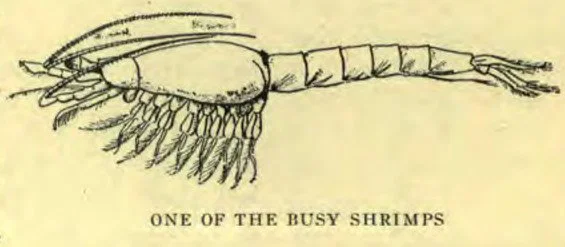
The easiest way to do this is to dip up some of the brook water into a shallow dish. If there is a good glass handy, so much the better; but if not, there is much we can enjoy without it. This is the liveliest kind of a variety show, and the performers follow one another in quick succession. First comes a band of Shrimps with their curled bodies and their feathered feet. They jerk themselves across the stage. See their clumsy efforts to scamper away when they think a hungry trout is coming along. The Shrimps are some of the busiest of the water folk. They are always hunting for bits of decaying animals or plants which they devour with great gusto.
ONE OF THE BUSY SHRIMPS
The Nematoid Acrobatic Company follow the Shrimps. They are tiny whitish worms no thicker than a cambric needle and about a quarter as long. The stage is covered with them. A half dozen are turning somersaults so fast that you can hardly see them; others are swimming. It is pretty hard work to swim when one has neither fins, arms, legs, nor tail, but they manage it in first-class style by their wonderful little wriggles. Suddenly every Nematoid stops what he is doing. What can be the matter? Has an electric current shot through the water and killed them?
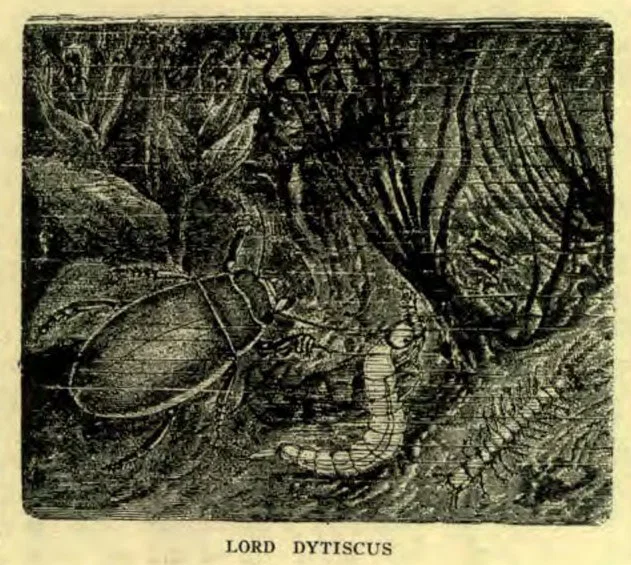
Ah! a dark shadow appears to the right of the stage. As it comes nearer, the Nematoids seem to become reanimated, and they all tumble off at the left as the shadow develops into a fierce “Water Tiger,” who is followed by a splendid great beetle, Lord Dytiscus. The “Tiger” has a pair of strong pincers, and he would enjoy nipping our fingers. Each nipper is a hollow tube. Here comes a poor little polly-wog; the “Tiger” grabs him with his pincers, and sucks all the blood from his body through the hollow tubes. There is nothing else he enjoys so much as seizing little worms, fishes, and snails in his terrible nippers. After a while the “Tiger” will turn into a beetle like Lord Dytiscus. This young lord is an athlete, and his greatest pleasure is diving. If you understand the dead languages, you will know that Dytiscus means “fond of diving.”
Now comes the jolliest band of all — the Water Skaters. See them play tag, leaping from stones half a foot high, and always alighting on their six feet, right side up. How gracefully they skate up stream against the strong current! Watch this little leaf hopper that has just fallen into the water. How the clan gathers to feast on him! Poor fellow, it was surely an ill wind that blew him into the brook.
The Skaters wear a natty uniform of black velvet and silver. When they are leaping and diving, we can see the silver on their under sides. They never get wet, though they live in and under the water, because they are covered closely with downy hairs that shed the water. They are a hardy race, and when almost all the other water folk are taking their long winter’s nap, the Skaters come out on sunny days, even when the brook is fringed with ice, to practise for their spring skating matches. One of their favorite games is to skate up stream as fast and as hard as they can, and drift down with the current. Even the babies have their little velvet waterproofs which keep them always dry.
LORD DYTISCUS
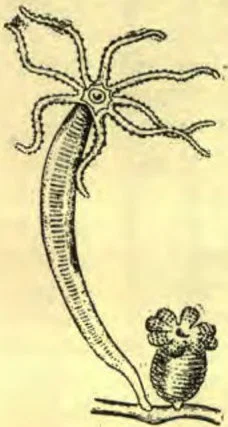
Here comes the Emerald Hydra Troupe — expert lassoists. They are more wonderful than any of the performers that have preceded them, but so tiny that you will need a good glass to watch them. The slide of a microscope is the best stage for them to play upon. As the curtain rises, we see a row of queer little green things shaped like bean pods, with six- and eight-rayed stars for covers. They begin to rise, the bean pods turn into tall, slender stems, and the little stars shoot out their rays into long tentacles. “This is truly magic!” you exclaim. But wait; these tentacles are the Hydra’s arms; each one is covered with knobs, and in each knob there is a lasso coiled up with a sting at its end. Hydra’s mouth is in the middle of the circle of arms. A tiny shrimp comes jerking along through the water. Hydra throws out some of his lassos with a steady hand and a sure aim; he never misses. Suddenly the shrimp stops and tries to turn back — too late; the cruel arms gather him in and poke him down Hydra’s throat. To-morrow he will come out again looking quite like his little green-grey self, but this is only an empty shell. The Hydra has eaten all that was within.
When the Hydrae wish for a change of scene or water, each loosens his stem, and then some of them drop into the stream and float down till they come to a spot where they wish to stop awhile. Some prefer not to trust themselves to the freaks of wind and wave; so they creep along like the inch worms, using their arms for feet, and stretching out one or two in front to see if the footing is safe before venturing their whole bodies.
Here comes a night lover. A very giant he is compared with the tiny Hydra. He has a golden stripe down his back, and a pair of the brightest eyes you ever saw, and oh, such cunning little hands! He is a Newt, and looks very much like his cousins — the lizards. He hides himself away under the stones in the daytime, but at night he wriggles forth in search of a good supper. His chief accomplishment is fancy swimming, which he performs by the help of his tail. This member is quite as long as the Newt himself, and has two filmy fins, one above and the other below.
The Waterboatmen come rowing along on their backs, propelling themselves swiftly by their fringed legs, perfect little oars. The blue-back Whirligig Beetle, though not half the size of the Boatman, comes spinning down on him, whirling round and round, “like a tiny dervish of the waters,” captures and devours the poor bewildered Boatman.
The curtain goes up for the last act. We clasp our hands in rapture. The stage is covered with troops of winged creatures, Dragon-flies, Stone-flies May-flies, and a hundred others. Every color of the rainbow glistens in their gowns,—black and orange, bronze and white, pale pink, baby blue, black with green, ruby red, every shade of brown, quaker grey with cream trimmings. They have crept up from the muddy brook bottom, where they left their houses of stone and wood, their cracks in the rock, and their old larval skins, to fly about in the bright sunshine, all decked in shining robes.—Margaret W. Leighton, in Young Americans.
A True Story
By Anna Fern Franklin
EARLY last spring a pair of redbirds were seen every morning, hopping around in our back yard, picking up crumbs which were intended for them. They were very tame, and would allow one to walk very close to them. Later we learned that they had built their nest on a neighbor's front veranda, and they were very happy over two little baby birds.
The birds were watched with interest. It was still cold, winter not being entirely over. The neighbors put the nest of little birds in a cage, and took them to the kitchen at night. They made a hole in the top of the cage, so the old birds could get in and out. Sometimes the mother bird would accompany her babes. If she did not, early next morning she and the papa-bird would sit on the branch of a tree over the kitchen door, anxiously waiting for their young ones to be brought out. Then they would fly around to the veranda where the cage was kept in the daytime, and utter tones of gladness when their babes were resigned to them.
When the little birds were large enough to fly, Mr. Jacobs opened one of the doors of the cage; the old birds, seeming to understand, coaxed the young ones out at once. Instead of going back to their nest in the cage, they roosted on the veranda. All the time they seemed perfectly happy and contented. Mr. Jacobs had not intended from the first to keep the birds in bondage, but put them in the cage so cats could not get them, and so they could be taken in at night out of the cold.
For many weeks after they learned to fly, the little family of four stayed closely about the veranda and lawn. The old birds still occasionally pay them a visit. ANNA FERN FRANKLIN.
Feathered Gluttons
CAREFUL field and laboratory study by the Department of Agriculture has led to some remarkable disclosures in regard to the amount of insects required to satisfy the appetites of nestlings.
Little wrens, cuckoos, robins, shrikes, scarlet tanagers, and other birds whose stomachs are not much more than a mere membranous sac, will consume in a day twice their own weight in foods. They begin dining before sunrise, and continue an almost uninterrupted repast until7after sunset.
Their food is served to them on an average every other minute by the vigilant and provident mother bird. During a day nestlings sometimes gain nearly fifty per cent in weight.
Dr. Sylvester D. Judd, of the Biological Survey, has made observations on a farm near Washington, and has discovered that from two hundred to four hundred insects a day, such as grasshoppers, green caterpillars, white grubs, and bugs constitute the diet of an ordinary nestling bird. And as the insects chosen for the diet of the nestlings are in the main injurious to agriculture, the prodigious supply required by the nest birds is a matter of great interest to the farming industry.
The amazing diet of nestlings is of special interest, inasmuch as the nesting season comes at a time when agricultural pests are most active, and when they can do the greatest amount of damage. The department therefore recommends that birds be encouraged to build their nests in the vicinity of growing crops.—Selected.
MEMORY VERSE: “Oh that my people had harkened unto me, and Israel had walked in my ways! I should soon have subdued their enemies, and turned my hand against their adversaries.” Ps. 81: 13, 14.
When Josiah had reigned thirty-one years in Jerusalem, Pharaoh-nechoh, the king of Egypt, passed through Palestine with an army on his way to fight with the king of Assyria. Josiah went out against him, and was slain at Megiddo. His servants brought him back to Jerusalem, and buried him with honor, and all the people mourned for him.
Jehoahaz, the son of Josiah, was the next king; but he reigned only three months. Then Pharaoh-nechoh, who was returning to his country, stopped at Jerusalem, took Jehoahaz captive, and made his brother Eliakim king in his place. Eliakim’s name was changed to Jehoiakim, and Jehoahaz he carried to Egypt, where he died. Before Pharaoh went away, he laid a heavy tribute on the land, and this Jehoiakim raised by taxing the people.
“In the third year of the reign of Jehoiakim, . . . came Nebuchadnezzar king of Babylon unto Jerusalem, and besieged it.” He bound the king in fetters, to take him to Babylon, but afterward set him free, and put him under tribute. At this time King Nebuchadnezzar took away some of the vessels from the house of the Lord, and put them in the temple of his god at Babylon. He also brought away captive certain of the children of Israel, and of the king’s children, and of the princes. These captives were chosen for their beauty, their skill, and their wisdom. Among them was Daniel, whom the Lord afterward used to his honor in Babylon.
Jehoiakim reigned eleven years. At his death his son Jehoiachin was made king; but he had reigned only three months when Nebuchadnezzar besieged Jerusalem the second time. Jehoiachin and all his family were taken to Babylon, and with them all the men of might, and all the skilful workmen, and all who were strong and apt for war.
Before Nebuchadnezzar went away this time, he made Zedekiah king in Jerusalem. Zedekiah was a very wicked king, and both he and the people did evil in the sight of the Lord, and polluted his house. “They mocked the messengers of God, and despised his words, and misused his prophets, until the wrath of the Lord arose against his people, till there was no remedy.”
Zedekiah had pledged to serve the king of Babylon; but he broke his pledge, and rebelled against him. Therefore in the ninth year of the reign of Zedekiah, Nebuchadnezzar came against Jerusalem the third time and besieged it. This was a long and hard siege, but in the end the city was taken. Then the sons of the king were slain before him, his eyes were put out, and he was bound with fetters of brass, and carried to Babylon. The walls of the city were broken down, and the king’s palaces and all the best of the houses were burned. The temple also was robbed of its treasures; its vessels of gold and silver and brass were all taken away; its brass pillars and brazen sea were broken in pieces; and all the rest that would burn was destroyed by fire.
Thus was fulfilled the word of the Lord, sent so often to Israel, that if they would not serve the Lord, but turned to false gods, he would set over them a king whom neither they nor their fathers had known. As we study the history of God’s ancient people, and see how surely his word is fulfilled, should we not learn to take heed to ourselves? We live in a time when the prophecies of the Lord are fast fulfilling; and it is of importance that we serve the Lord with a perfect heart.
Questions
1. Tell how King Josiah met his death. Where was he buried?
2. Who was the next king? Tell how his reign came to an end. Who was made king in his place? What name was given to him? What was done with Jehoahaz?
3. Who came against Jerusalem in the third year of Jehoiakim? What did he do to the king? What did he take away from the house of the Lord? Describe the captives that he took back with him. Who was among these?
4. Who was made king at the death of Jehoiakim? When he had been on the throne for three months, what happened again? What became of Jehoiachin? Who were taken captive to Babylon at this time?
5. What man did Nebuchadnezzar leave as king in Jerusalem? What kind of king was he? What did both the king and the people do?
6. What caused Nebuchadnezzar to besiege Jerusalem the third time? When the city was taken, what was done with the king and his sons?
7. What was done to the walls of the city? How were its palaces and fine houses destroyed? Tell what was done to the temple and its treasures.
8. In thus allowing Jerusalem to be destroyed, and his people to be carried away captive, what word of the Lord was fulfilled? How could Israel have saved themselves from this great sorrow? What does the Lord say that he would have done, if they had walked in his ways? Memory Verse. What should we learn from this sad history?
II—Some Will Be Looking for the Lord's Return
(October 8)
MEMORY VERSE: “Unto them that look for him shall he appear the second time without sin unto salvation.” Heb. 9: 28.
Questions
1. What are God’s people exhorted to do? Titus 2: 11-13.
2. Who only will be saved at the second appearing of the Lord? Heb. 9: 28.
3. What evidence have we that there will be a class of people who are looking for the Saviour? Isa. 25: 9.
4. What is said of those servants whom the Lord when he comes finds watching? Luke 12: 37.
5. Will these know just the hour of his coming? Verses 39, 40.
6. What will they be doing? Verse 38.
7. What experience in ancient times illustrates the condition of the world at the second coming of Christ? Matt. 24: 37-39.
9. Will every one be looking for the second coming of Christ? 1 Thess. 5: 1, 2.
10. What evidence have we that all will have heard that the advent is at hand? Matt. 24: 14: 2 Peter 3: 3, 4; note .
11. What message will some be giving just when the promise of his coming is fulfilled? 1 Thess. 5: 3; note .
12. How do God’s people differ from this class? Verse 4.
13. What are we exhorted to do in view of this? Verse 6.
14. How will the Lord’s own people greet him? Isa. 25: 9.
15. Seeing we look for these things, what should characterize our lives? 2 Peter 3: 14.
Notes
Skim Milk for Paint
A USE to which skim-milk, sour milk, buttermilk, or even whole sweet milk is often put is paint-making, yet this product of the dairy, says the Scientific American, makes possible one of the most enduring and inexpensive paints for barns and outbuildings. It costs little more than whitewash, provided no great value is attached to the milk, and it is a question whether for all kinds of rough work it does not serve all the purposes of the ready-mixed paint, or even prime lead and paint mixed in the best linseed oil.
It is made as follows, and no more should be mixed than is to be used that day: Stir into one gallon of milk about three pounds of Portland cement, and add sufficient Venetian red paint powder to impart a good color. Any other colored paint powder may be used as well. The milk will hold the paint in suspension, but the cement, being heavy, will sink to the bottom, so that it becomes necessary to keep the mixture well stirred with a paddle.—Farm News.
Lessons in New Testament History Endorsed by Educators
Announcement
THE life of Christ contains the very essence of the truths of salvation. He is “the way, the truth, and the life.” A diligent and prayerful study of the Saviour’s life will produce marvelous results in the lives of those who pursue it. To stimulate such careful study has been the aim of the “Lessons in New Testament History,” prepared by M. E. Kern, the second volume of which is just out. The letters received from fellow teachers in various parts of the field indicate that there is a general desire for some systematic guide to Bible study for the youth—something that will show them how to study and gain the “celestial gold,—that wisdom which will make them wise unto salvation.”
Professor Giddings, president of the Fernando College, writes:—
I like the course, and feel that it fills a want that I have felt for several years in Bible work.
Professor Irwin writes from Avondale:—
I am glad to know that you are doing something along this line, and I hope the plan will be tried in all our schools.
Professor Hughes, principal of Keene Industrial Academy, says:—
I am teaching New Testament history, and must say that I am well pleased with the book. I am sure it will enable the student to do more effective work than he could do if he did not have the book.
The following encouraging words are from Prof. C. C. Lewis, president of Union College:—
I am delighted with your lessons, and believe that they will prove to be valuable as an addition to our list of text-books for our intermediate schools and colleges.
Professor Nicola writes from the South:—
I am really pleased with the outline you have arranged, and believe it will fill a useful place in our schools.
The constructive method is followed, and the work carefully outlined for the purpose of constant review.
PRICES
Volumes I and II ............ 60 cents
Volume III ................... 30 cents
Price of the set ............. 90 cents
Volumes I and II are not sold separately. Personal checks not received. Order of Union College Press, College View, Neb.
Used to Such Things
A German clergyman, who was traveling, stopped at a hotel much frequented by wags and jokers. The host, not being used to having a clergyman at his table, looked at him with surprise; the guests used all their raillery of wit upon him without eliciting a remark.
The clergyman ate his dinner quietly, apparently without observing the gibes and sneers of neighbors.
One of them, at last, in despair at his forbearance, said to him: “Well, I wonder at your patience. Have you not heard all that has been said to you?”
“O, yes, but I am used to it. Do you know who I am?”
“No, sir.”
“Well, I will inform you. I am chaplain of a lunatic asylum; such remarks have no effect upon me.”—Selected.
Invention of Cotton Thread
MARTHA WASHINGTON could not have asked her husband to stop at the store on his way home and get six spools of sewing cotton for her, as there was no sewing cotton made in the days of the Revolution. It was another and later war that brought about the revolution in the manufacture of thread. How it happened was recently described at a political meeting in Paisley, Scotland, by Mr. Clark, former provost of the town. He said that when Napoleon occupied north Germany in 1803, the supply of silk from Hamburg, which was used in making heddles, or the loom harness in Paisley, was cut off. Unless some substitute could be found, Paisley's weaving industry would be ruined. Peter Clark experimented with cotton-warp yarn, and succeeded in making thread like the six-cord sewing thread used to-day. It took the place of silk in the heddles, and the weaving business went on, uninterrupted by the war. Then it occurred to another man to use the cotton thread in place of linen for sewing, and he recommended it to the women of the town. It was so much smoother than the linen that the women liked it. The thread was sold in hanks, and wound by the purchaser into little balls, but the merchant soon decided to wind the hank on a bobbin or spool for his customers, as an added inducement to purchase it instead of the linen. From this beginning the cotton-thread trade has grown, and now silk and linen are used only for special work.—Youth's Companion.
Bookkeeping, Penmanship, and Shorthand Taught by Mail
Bookkeeping, Penmanship, or Shorthand successfully taught by mail. A number of persons have been qualified for greater usefulness by taking work with us. You can do the same. Write for particulars. Fireside Accounting Institute, Battle Creek, Mich.
LETTER BOX
OGDEN, UTAH, Aug. 13, 1904. DEAR EDITOR: I enjoy reading the YOUTH’S INSTRUCTOR. There are many nice pieces in it. I am a little girl, eleven years old, from Colorado. I go to Sabbath-school, where I get the INSTRUCTOR. I enjoyed the story about the “Corner Grocery,” by Mr. Keech. I go to school in the winter, and am in the fifth grade. I like to go to school. We have been in Ogden, Utah, for four months. NELLIE BACON.
OGDEN, UTAH, Aug. 13, 1904. DEAR EDITOR: I like to read the stories in the YOUTH’S INSTRUCTOR. I go to Sabbath-school and get the INSTRUCTOR every Sabbath. I liked the story of the “Big Red A,” and wish there were more like it. I am twelve years old. I am in the youth’s class at Sabbath-school, and enjoy the lessons very much. I wish some of the readers of the INSTRUCTOR would write to me. My mother and father, sister and brother, are attending camp-meeting, which is held at Provo, Utah. I want to be ready to meet Jesus when he comes, and I hope to meet the YOUTH’S INSTRUCTOR readers in the earth made new. HELEN D. JEFFERRIES.
ST. CLAIR, NEVADA, Aug. 13, 1904. DEAR EDITOR: I get the YOUTH’S INSTRUCTOR every Sabbath. I like the stories in it very much. I attend church each week. We have Young People’s meetings every other Sabbath. I live on a farm with my one brother, father, and mother. I am trying to be a good girl. I am thirteen years old. I would like to correspond with some of the readers. HELEN M. CUSHMAN.