The Youth’s Instructor, Vol. 49, No. 7.

BONACCA

The Youth’s Instructor

Feb 14, 1901

Review and Herald Publishing Company · Battle Creek, Mich. · Feb 14, 1901

BONACCA
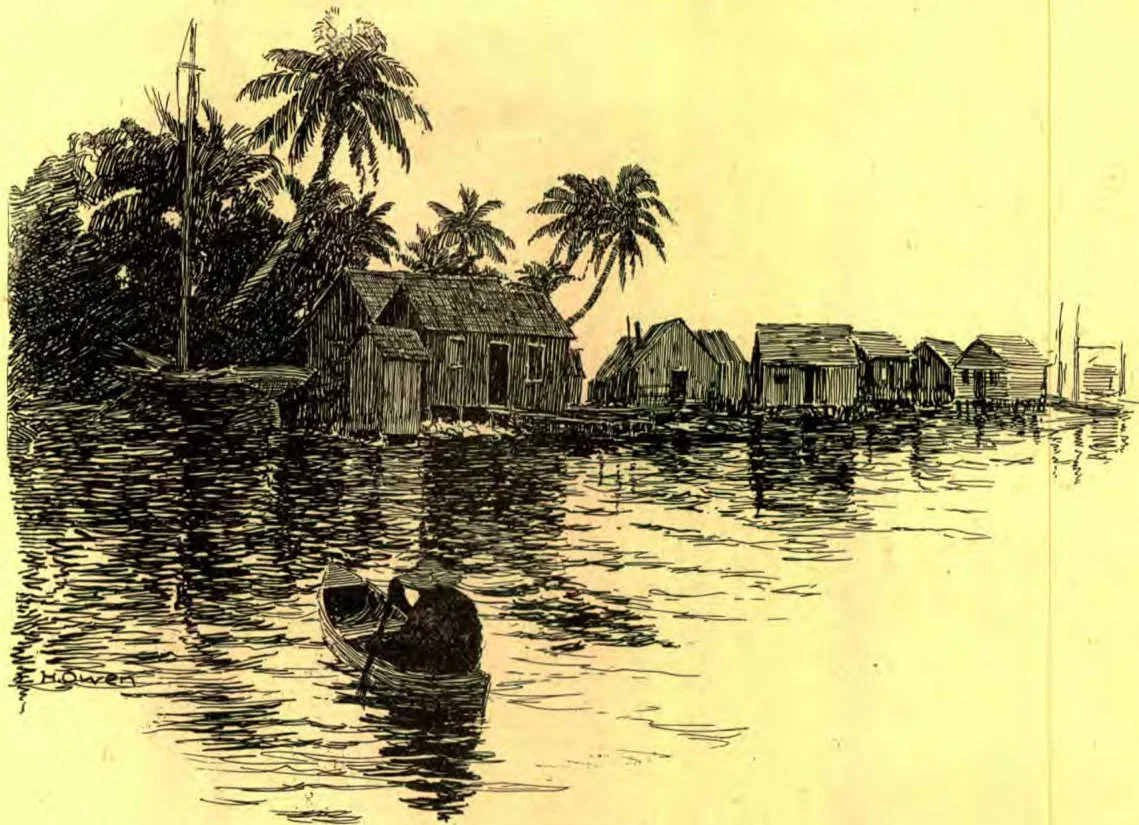
Many years ago some English sailors who had married Creole wives came to Bonacca, and settled upon the reefs that fringe its southern shore. Sheen Cay was more favorably situated than other reefs, being nearer the island and to a bountiful supply of fresh water, which, opposite the Cay, poured over the rocks into the sea.
Plantations of bananas, plantain, and yucca were made on this island, and cocoanuts were planted in the flats near salt water. Children and grandchildren have built their homes around the old homestead. Strangers from Belize, Grand Cayman, and the coast have built over the shallow water that surrounds the reef until quite a community has grown up—a veritable modern Venice.
That first house, built by “Grandpa Haylock,” as every one calls him, is still standing. Its frame was of native pine. The upright siding of inch boards came from the States. Pillars of wood raise the floor three feet from the ground. The windows are closed in heavy weather with wooden shutters.
These early settlers of the Bay Islands could tell many thrilling tales of their experiences in the days gone by. They point to a large Carib canoe that is used now in carrying wood,—a use that is made of canoes about ready to go to pieces,—and tell how that was the largest boat Bonacca owned twenty years ago, and of storms encountered, in which the canoe would be half full of water, and the passengers save themselves by constant bailing, while every sea threatened to swamp them.
IN THE LAGOONS OF A MODERN VENICE
In those days, cattle ran wild in the hills, and the few families who lived on the reef were plentifully supplied with game and fish. Vessels came for fruit and cocoanuts, and left whisky and cloth. Money came easily; for the soil of the island yielded results with little labor, and fruit was in demand. The conditions of a prosperous lumber camp prevailed: there was plenty of fighting, boat-racing, and gambling.
The men of Savannah Bight,—a little Spanish community that had settled at the east end of the island,—becoming incensed for some cause against the Creoles on Sheen and Dog Cays, came down in their canoes one Sunday afternoon, and after drinking “plenty” at the Stanco, sallied out on the Creoles, whose men were mostly away at the time. The Creoles took refuge in one or two houses, and the women armed themselves with clubs. The Spaniards began chopping at the doors with their machetes. Shots were fired, one or two of the Spaniards being killed, and others badly bruised, before they retreated to the boats. This was “fun” that ended unpleasantly.
Their boat-races were more harmless, and must have been most exciting. The racing canoes were slender dugouts of graceful lines, carrying a cloud of sail. Each canoe was guided by one man, who sat on a weather-board, leaning far out to windward to balance the canoe, which tipped with the force of the wind until the water reached the gunwale, and fairly leaped from the crest of one wave to another.
We have vegetable oysters in the Northern States. At Bonacca, oysters grow on bushes.
Fringing the lagoons and bays, there are quantities of mangrove bushes—trees, some of them are. They send their shoots down from the branches, after the manner of the banyan tree; and on these shoots, which take root on the salt-water bottom, the young oysters fasten themselves when the tide is high. They grow to a considerable size, and are very convenient for gathering at low tide.
When the slave-trade began to languish because of the strict laws enforced against it in the United States and England, and before the present inhabitants came to Bonacca, a rendezvous for slavers was established in this island. Ship-loads of slaves were brought to this place, and recuperated sufficiently to market well in New Orleans. Here they could learn enough English to enhance their value one half.
Utilla, the westernmost island of the group of the Bay Islands, was a haven for pirates in the days of buccaneering. Silver-mounted swords, drinking-cups, stirrups of solid silver, and other relics have been found in caves on the island. Its harbor is excellent, and the town that stretches along its sandy beach in the shade of mango and cocoanut trees is the most thriving in the islands. It was at Utilla that we first met Elder F. J. Hutchins and the missionary schooner “Herald,” though we did not step foot on the boat until reaching Ceiba the next day.
The schooner appeared small from the deck of the steamer, but after more experience in the islands, her dimensions seemed relatively greater; for we soon left the region of steamers, and did not see anything larger than a two-masted schooner for months. Captain Hutchins has spent about nine years in the Caribbean Sea, cruising in all sorts of boats, and suffering many hardships in small crafts. Mrs. Hutchins has become quite a navigator, and is as familiar with the chronometer and sextant as women ordinarily are with the needle and crochet-hook.
A good work has been done, and is still in progress, among the English-speaking people of the Bay Islands; but the great mass of the inhabitants of Central America speak Spanish, and are yet without the gospel. H. A. OWEN.

REST AND WORK

Where is rest? In what isles of the summer-glad seas? In what gardens of balm? ’Neath what sleep-dropping trees? By what still-flowing waters, what lily-fringed streams? In what meadows of silence, what valley of dreams? ’Neath what thunderless skies, by what hillsides of sleep? On what moon-lighted mountain or star-lighted deep? Yes, where on the earth’s or the ocean’s wide breast Is the home of release and the harbor of rest?
Why, here in the cornfield—and take up your hoe! Right here in this mill—make the paddle-wheel go! Right here with your engine—up steam, and away! Right here with your sewing-machine every day. Where there’s work, there is rest, and ’tis nowhere beside. Though you travel all lands, and you sail every tide. Where is rest? Go to work, and your spirit renew; For no man can rest who has nothing to do.
— Sam Walter Foss.

MINISTERING SPIRITS

God has recorded many narratives in his inspired word to teach us that the human family is the object of the special care of heavenly angels. Man is not left to become the sport of Satan’s temptations. All heaven is actively engaged in the work of communicating light to the inhabitants of the world, that they may not be left without spiritual guidance. An eye that never slumbers nor sleeps is guarding the camp of Israel. Ten thousand times ten thousand, and thousands of thousands of angels are ministering to the needs of the children of men. Voices inspired by God are crying, This is the way, walk ye in it. If men will hear the voice of warning, if they will trust to God’s guidance and not to finite judgment, they will be safe.
The experience of Paul shows that the Lord will open up ways before those who will put their trust in him. Paul was on his way to Damascus to persecute the believers in Christ. Full of zeal, he determined to take all, both men and women, and punish them with imprisonment and death. The record declares that he was “exceeding mad” against them. But the Commander of heaven beheld the suffering brought upon his church, and he made his voice heard to arrest the bold persecutor. As Paul journeyed, “suddenly there shined round about him a light from heaven: and he fell to the earth, and heard a voice saying unto him, Saul, Saul, why persecutest thou me? And he said, Who art thou, Lord? And the Lord said, I am Jesus whom thou persecutest.”
Again, in the case of Cornelius we are taught that God is interested in every human being. Cornelius was following on to know the Lord, and this won for him the salvation of all his house. He “feared God with all his house,” and “gave much alms to the people, and prayed to God alway. He saw in a vision, evidently about the ninth hour of the day an angel of God coming in to him, and saying unto him, Cornelius. And when he looked on him, he was afraid, and said, What is it, Lord? And he said unto him, Thy prayers and thine alms are come up for a memorial before God. And now send men to Joppa, and call for one Simon, whose surname is Peter: he lodgeth with one Simon a tanner, whose house is by the seaside: he shall tell thee what thou oughtest to do.”
The Lord knows every child of his by name. When we truly believe this, we shall have courage, faith, and patience to work out our own salvation with fear and trembling; for we shall know that it is God who worketh in us. With fear and trembling we shall co-operate with God.
Heavenly angels watch those who are seeking for enlightenment, and co-operate with those who try to win souls to Christ. This is shown in the experience of Philip and the Ethiopian.
A heavenly messenger was sent to Philip to show him his work for the Ethiopian. The evangelist was directed to “arise, and go toward the south unto the way that goeth down from Jerusalem unto Gaza, which is desert. And he arose and went: and, behold, a man of Ethiopia, a eunuch of great authority under Candace, queen of the Ethiopians, who had charge of all her treasure, and had come to Jerusalem for to worship, was returning, and sitting in his chariot read Esaias the prophet.”
Angels of God were taking notice of this seeker for light. The Ethiopian could not understand the prophecy that he read: and the Spirit directed Philip to go and teach him, saying, “Go near, and join thyself to this chariot.” This man of high authority was being drawn to the Saviour, and he did not resist the drawing. He did not make his position an excuse for refusing to accept the crucified One. The evangelist asked him: “Understandest thou what thou readest? And he said, How can I, except some man should guide me? And he desired Philip that he would come up and sit with him,” and explain to him the word of God.
To-day, as then, angels are leading and guiding those who will be led and guided. The angel sent to Philip could himself have done the work for the Ethiopian, but this was not God’s way of working. As God’s instruments, men must work for others.
When God pointed out to Philip his work, the disciple did not say, as many are saying to-day, God does not mean that. I will not be too confident, or I shall make a mistake. Philip that day learned a lesson of conformity to God’s will that was worth everything to him. He learned that every soul is precious in the sight of God, and that angels will bring light to those who are in need of it. Through the ministration of angels, God sends light to his people, and through his people this light is to be given to the world. The Holy Spirit will guide and instruct men and women if they will show themselves willing to be guided, by placing themselves in a position where they can communicate the light received.
While angels from heaven are doing their work, evil angels are seeking to draw the mind to something else. Satan is interposing obstacles, so that the mind that would understand the word of God shall become confused. Thus he worked with Christ in the wilderness of temptation. Had Philip left the eunuch with his case hanging in the balance, he might never have accepted the Saviour. Evil angels were waiting for an opportunity to press in their falsehoods, and divert the Ethiopian from seeking after truth. The Lord’s agencies must be wholly consecrated to his service, that they may be quick to understand their work. As wise stewards, they must take advantage of every circumstance to draw men to Christ.
Satan is ever on the alert to deceive and mislead. He is using every enchantment to allure men into the broad road of disobedience. Because evil agencies are striving to eclipse every ray of light, heavenly beings are appointed to do their work of ministry,—to guide, guard, and control those who shall be heirs of salvation. None need despair because of inherited tendencies to evil. When the Holy Spirit convicts of sin, the wrongdoer must repent, and confess and forsake the evil. Faithful sentinels are on guard, to direct souls in right paths.
Mrs. E. G. WHITE.

THE LITTLE CAPTIVES

Many years ago a young Jewish couple were married at Lodz, Poland. The bridegroom belonged to the noble rabbinical family of Gurah, of Warsaw; the bride was the daughter of wealthy orthodox Jews. After his marriage Mr. W. served often in a beautiful synagogue, built in the house of his father-in-law, either lecturing or teaching; and much of his time was spent in study or in fasting and prayer. He wished to know the truth; and God led him, step by step, into the light. By and by he came fully to believe in the atoning blood of Christ. Of course his new relatives did not agree with him; and when he openly declared, at a Passover gathering in the synagogue, that as for him, his hope and belief were in the Messiah of Israel, of whom the prophets spoke as suffering for our transgressions and bearing our sins, there was a wild uproar, which broke up the meeting. A few days later, when the young man was seen in the company of a Christian minister, his wife’s people drove him from their house, not even permitting him to say farewell to his family. Not long afterward he was publicly baptized.
Then Mrs. W. began searching the Scriptures, at the same time carrying on a secret correspondence with her husband. Soon she became convinced that “the Lord Jesus was her personal Saviour,” and confessed as much to her parents. How angry they were! They even made her believe that her husband was lost at sea. A letter from him showed that he was still alive, and she determined at all hazards to join him in his exile. She had reached the station with her luggage and her two little daughters, and was purchasing her tickets, when she was overtaken, her luggage was seized, and her children were torn from her arms, her friends thinking that she would not go and leave them behind. She pleaded for them, she wept, and for a while she knew not what to do; but at last the words of Jesus concerning those who forsake “houses, or brethren, or sisters, or father, or mother, or wife, or children, or lands” for his sake and the gospel’s came into her mind; and she thought that if ever she was to get nearer the truth as it is in Jesus, she must go. Not long afterward she joined her husband in England, and in time confessed Christ, the pair, later on, coming to New York City to work in the Jewish Christian Bible Mission.
For seven long years the children were held captives by their grandparents. They were taught to believe that they were orphans, and knew no better until a letter from Mrs. W. was in some way conveyed to Helen, the elder girl. Surprise and indignation filled her heart. She answered the letter. A plan was laid for the escape of the children, and was successfully carried out until they reached the frontier of Poland, when they were captured by the police, and made to travel the long distance—a three-days’ journey—back to Lodz on foot. There they were locked up by their grandfather. Another effort was made, and Helen escaped. When mother and daughter met on the pier, they fainted.
We who are called to follow Christ in this land, sometimes talk of our trials and sacrifices, but how little we bear in comparison with those who must suffer such persecution for years and years. To come down from immense wealth to the lowest depths of poverty, to give up the love and respect of all associates and friends, to be cast out as apostates and infidels, to forsake all relations, to break all ties, to bear all manner of persecution—that is what it means for the Jews to follow Christ. S. Roxana Wince.

A SUNSET THOUGHT

The glory of the sunset fills The joyous earth, the spreading sky; The red bars flame behind the hills, The glowing clouds above them lie,— Light, beauty, radiance, everywhere, A wide-flung splendor past compare.
And yet ’tis not alone the sun That makes the wondrous sight we see; Without the clouds he shines upon Where would these sunset glories be? In empty skies, serene and clear, Could such rich splendors e’er appear?
Ah, no! our skies of life must hold Earth’s clouds, if we would see, at last, Transfiguring grayest depths to gold, Heaven’s richest radiance on them cast. Not through life’s joy, but ’neath its woes, The soul’s horizon brightest glows.
—Priscilla Leonard.

WISH AND WORK

The boy who's always wishing That this or that might be, But never tries his mettle, Is the boy that's bound to see His plans all come to failure, His hopes end in defeat; For that's what comes when wishing And working fail to meet.
The boy who wishes this thing Or that thing with a will That spurs him on to action, And keeps him trying still When effort meets with failure, Will some day surely win; For he works out what he wishes, And that's where “luck” comes in.
The “luck” that I believe in Is that which comes with work, And no one ever finds it Who's content to wish and shirk; The men the world calls “lucky” Will tell you, every one, That success comes not by wishing, But by hard work bravely done. —Eben E. Rexford.

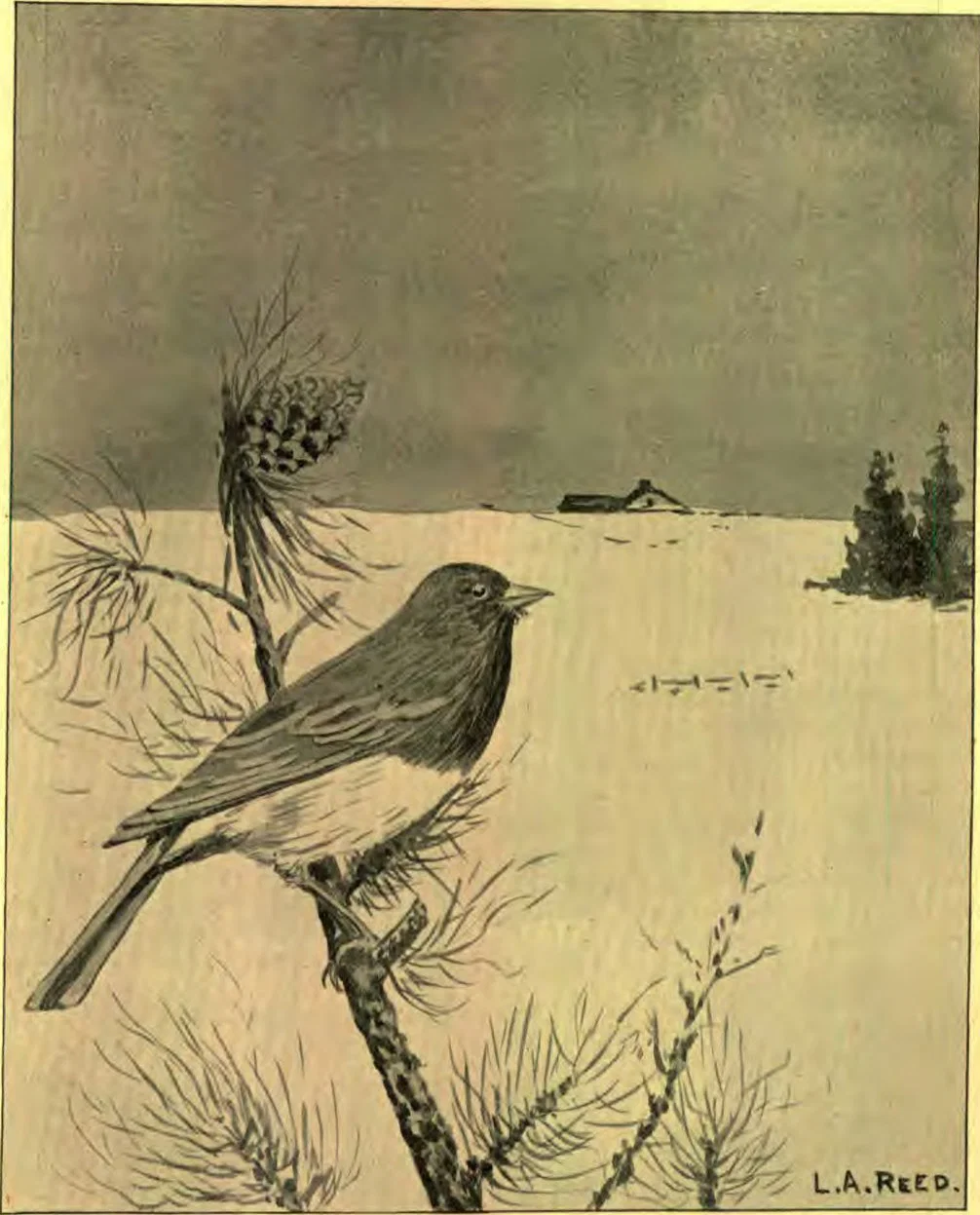
THE SLATE-COLORED JUNCO

THE Junco is a bird that may be found in the north central States almost any day in winter, and along into the spring until about the first of May. In the spring, especially, you will find flocks of Juncoes feeding on the ground, always avoiding the sunny spots, and keeping well within the shadows of the trees.
THE SLATE-COLORED JUNCO
The upper parts, throat, and breast of the Junco are of a grayish slate-color, with the upper parts washed slightly with grayish-brown. One Junco, a resident of the mountains of Virginia and North and South Carolina, does not have this brownish wash upon the upper parts. Another, a Western species, has the back and sides browner. There are no wing-bars, but the two outer feathers of the tail are white; an abrupt line on the breast, where the gray ends, and the white begins, is one of the most striking marks on the bird. The bill is flesh-color.
The nest is made of grass, moss, and rootlets, and is lined with fine grasses and long hairs; it is always found on or near the ground. The eggs, usually four or five in a nest, are white or bluish-white, speckled, spotted, or blotched at the larger end with light-brown.
It is extremely difficult to catch the bird singing; nevertheless he has a very sweet and unpretentious song. The 'tsip is frequently heard, and is so characteristic that, once learned, it will always inform you of the bird's presence.
One of the characters in that excellent book of birds, “Citizen Bird,” relates the following interesting experience:—
“When I was a boy here at the farm, these white-vested Juncoes were my winter pets. A flock was always sure to come in October, and stay until the last of April, or even into May if the season was cold. One winter, when the snow came at Thanksgiving, and did not leave the ground until March, the birds had a hard time of it. The Robins and Bluebirds soon grew discouraged, and left, one by one. The Chickadees retreated to the shelter of some hemlock woods; and I thought the Winter Wrens were frozen into the woodpile, for I did not see any for weeks. The only cannibal birds that seemed to be about were a pair of cat owls, which spent most of the time in our hay-barn, where they paid for their lodgings by catching rats and mice.
“But my flock of Juncoes were determined to brave all weathers. First they ate the seeds of all the weeds and tall grasses that reached above the snow; then they cleaned the honeysuckles of their watery black berries. When these were nearly gone, I began to feed them every day with crumbs, and they soon grew very tame. At Christmas an ice-storm came, and after that the cold was bitter indeed. For two days I did not see my birds; but in the afternoon of the third day, when I was feeding the hens in the barn-yard, a party of feeble, half-starved Juncoes, hardly able to fly, settled down around me, and began to pick at the chicken food.”
“I knew at a glance that after a few hours’ more exposure, all the poor little birds would be dead. So I shut up the hens, opened the door of the straw-barn very wide, scattered a quantity of meal and cracked corn in a line on the floor, and crept behind the door to watch. First one bird hopped in and tasted the food; he found it very good, and evidently called his brothers, for in a minute they all went in, and I closed the door upon them. And I slept better that night because I knew that my birds were comfortable.”
“They may go in once, but you will never catch them so again,” said my father, when he heard about it. I had an idea, however, that the birds trusted me; for though they flew out very gladly the next morning, they did not seem afraid.
“Sure enough, in the afternoon they came back again! I kept them at night in this way for several weeks, and one afternoon several Snowflakes came in with them. Later on, this same winter, five thin, starving Quails came to the barn-yard, and fed with the hens. I tried several times to lure or drive them into the barn with the Juncoes, but they would not go. Finally, one evening when I shut the chickens up, what did these Quails do but run into the hen-house with our good-natured Cochins, and remain as their guests until spring!
“I well remember how happy I was when grandmother gave me half a dollar, and told me to go over to the mill and buy a bag of grain sweepings for my ‘boarders;’ how angry I was with the miller when he said, ‘Those Quails’ll be good eatin’ when they’re fat;’ and how he laughed when I shouted, ‘It’s only cannibals that eat up their visitors!’”
In the winter and early spring the Junco travels in flocks of considerable size. He is most often seen by the roadsides; but in severe weather, hunger makes him more bold, and he feeds about barns, or even dwellings. It is only in the spring, just before he leaves us for the colder north, that we catch anything of his song. L. A. REED.

Consecration: Verses by Margaret E. Sangster

LET my feet be swift to run for Thee; My hands essay thy lowliest work to do; My heart be warm with love; my gladness be To hear thy voice, and know its accents true. And still where thou shalt summon, may I go, O Friend divine! twice blest to serve thee so. —Margaret E. Sangster.

AT TOO GREAT COST

It is a pathetically common thing to see parents depriving themselves of luxuries, in order to give to their children the advantages and pleasures that never brightened their own youthful days.
The farm work which father staggered under as a boy, and which he could not drop, for the sake of the little brothers and sisters, lost him the school education he had longed for. And its lack, which he has felt all the later years, has made him anxious that his children shall be given “a fair chance;” so hard-earned dollars are devoted to that end, and father cheerfully goes without many things that would make his own life pleasanter.
All sorts of girlish luxuries passed mother by when she was in her teens; and the memory of the pretty gowns and crisp ribbons she could not have, makes her strain her eyes now over dainty sewing for the pretty daughter.
The other day at a social gathering, a plainly dressed woman hesitated in naming her choice of refreshments. “Don’t be so particular!” her niece said, in an impatient and supposed undertone. She was a girl with cheeks tinted like a peach blossom; and a moment before had seemed, in her pretty summer gown, the embodiment of young graces.
“That sentence told a volume,” one who had overheard it remarked, a little later, with withering emphasis. “No, I don’t know her very well, and don’t care to—now. I do know that Miss Blank has made a slave of herself for years to mother that girl, going without luxuries till I suppose it really was a question of importance to her which refreshment was chosen.”
It was a hasty condemnation of the girl, and, perhaps, a little too severe, as hasty judgments are apt to be. “When she is older, she will be more considerate,” we say, excusingly; but in the meantime, harm is being done that no later tears can undo. If the young things would only insist upon dividing up the good times with the dear older ones who so willingly efface themselves, if they only would resolutely take their share of the “going without,” what a load of remorse they would be saved from by and by!—Selected.

The Joy of Generous Giving

“No one is really rich till he has learned to give generously. The right to share is the best part of having.”

FIRST STEPS IN BACKSLIDING

II
4. Stops Praying.—One of the first acts that preceded the darkness into which this soul strayed, was the omission of morning prayer. Before long the evening prayer was also discontinued, and erelong the spirit of prayer had taken its flight; and that heart that had been so often in communion with its Maker, that tongue that had so often implored help from the Creator and praised the Redeemer, now became engaged in the enemy’s work of criticising, surmising, and faultfinding. The result of all this was the development of a spirit of unrest, and dissatisfaction with his appointed place in God’s work, which, but a few years ago, he had coveted as among the best gifts. Notice how the enemy worked all the way along; how cunningly his plans were laid; how carefully and securely the trap was set; and, sad to note, how successful was his work in leading and alluring this soul on to ruin, weaving, thread by thread, the destroying web about him.
5. Ceased Working for Others.—At some point in his experience up to this time, the disposition to help others had taken its flight. The heart that was once tender to humanity’s woes, the ear that was once quick to hear the cries of either physical or spiritual suffering, the eye that was once ever ready to recognize the need of a fellow creature,—all these had undergone a change. In place of these noble traits of character, he seemed to have a heart almost unfeeling, ears well-nigh deaf to human cries, and eyes nearly blind to mortal suffering. What did all this mean? No wonder his answer to the question, “How did all this come about?” was, “I don’t know.”
6. The “Don’t-Care” Spirit.—Thus far a spirit of indifference, followed by carelessness, has controlled our brother; but now the enemy of the soul sees that these have about completed their work, and so another spirit is sent to join them,—the “don’t-care spirit.” It is now that friends, relatives, and Christian brethren discover the peril of this soul. The “little foxes” that had been long nibbling the vines of Christian experience, had been unrecognized by a large majority of his associates. Now all are thoroughly aroused. Something must be done. They talk to him, pray with him, labor for him; but apparently all to no avail.
7. The “Give-up-Everything” Spirit.—As the “don’t-care” spirit followed that of carelessness and indifference, it, in turn, was followed by the “giving-up” spirit. And on the afternoon of which I am writing, this discouraged soul had reached the giving-up point. Sabbath, light, truth, principles,—none of these had any weight or influence. With one sweeping decision of the mind, all these seemed to have been forever cast away; and this useful soul, with its talents and experience, was in a few hours to join itself to the beggarly elements of the world. He recognized that he was going into the wide-open jaws of destruction, but this knowledge appeared not to affect him in the slightest.
Dear reader, are you losing ground? Are you drifting backward? May God help you to examine the “vines” of your experience, and learn if any “little foxes” are at work upon them. Do you know of a youth whose light is going out in darkness? Then get down on your knees, and earnestly ask God to give you the wisdom and the grace to save that soul from drifting into the perils of moral darkness.

NO PERMANENT RELIEF FOUND UNTIL THE CAUSES OF THE BACKSLIDING WERE DISCOVERED

Three hours had been spent in a careful and thorough examination of the causes of this soul’s backsliding, and it was not until then that rays of light began to penetrate the moral darkness that enshrouded him. One by one these causes were recognized and acknowledged; and then, with a sense of utter helplessness, unworthiness, and weakness, our brother sought God for mercy, grace, and wisdom. Then, like Job, the captivity of his soul was turned. There appeared a rift in the clouds; and the rays of the Sun of Righteousness, so long excluded by the transgression into which this soul had been led by the deceitfulness of sin, began to shine once more into his heart.
Round by round he now seeks to mount up to his lost estate; but oh, how sad those lost days, weeks, and months! Almost lost; and yet, like the experience of the children of Israel, there is in them a lesson for us all. They are here written for the admonition of every young man and woman whom Providence shall permit to read these lines.
W. S. SADLER.
1926 Wabash Ave., Chicago.

SEVEN “MINDS”

1. MIND your tongue! Don’t let it speak hasty, cruel, unkind, or wicked words. Mind!
2. Mind your eyes! Don’t permit them to look on wicked books, pictures, or objects. Mind!
3. Mind your ears! Don’t suffer them to listen to wicked speeches, songs, or words. Mind!
4. Mind your lips! Don’t let tobacco foul them. Don’t let strong drink pass them. Don’t let the food of the glutton enter between them. Mind!
5. Mind your hands! Don’t let them steal or fight, or write any evil words. Mind!
6. Mind your feet! Don’t let them walk in the steps of the wicked. Mind!
7. Mind your heart! Don’t let the love of sin dwell in it. Don’t give it to Satan, but ask Jesus to make it his throne. Mind!—Selected.

“SOULS thrive best in the field of duty.”

Common Names Among Government Employees

THERE are five thousand two hundred and eighty-two Smiths employed by the government; one thousand five hundred and twenty-three Joneses; one thousand one hundred and two Browns; and one thousand and four Johnsons. There are eighteen George Washingtons, two William McKinleys, three William Bryans, and two Grover Clevelands.

GRIM PLACES FOR NESTS

If you will note where the English sparrow builds his nest, you will often be surprised. I once saw a nest built by some sparrows in the mouth of a cannon in the Old Fort on Governor's Island, just off the battery in New York City. I hope that the pair had the good fortune to raise their brood unmolested, and that the family are now flitting about Greater New York, notwithstanding their grim, warlike home.
On the corner of Forty-fourth Street and Lexington Avenue, New York City, high above the pavement, there is a carved lion's head, in the mouth of which a pair of sparrows recently built their nest.—The American Boy.

TELEPHONES AS ALARM CLOCKS

SOME users of telephones in Indianapolis, Ind., have found a new method whereby they may sleep late in the morning, and yet not be late to work. They have, says Popular Science, “made arrangements with the central office to have their telephone bell act as an alarm-clock. Orders have been left there for the purpose, and the manager has a regular schedule of calls from 4:30 to 7:30 A. M. Persons who wish to take early trains out of town, leave orders with the manager. It has also frequently happened that a subscriber has left word to be called at one-hour or two-hour intervals during the night, when he had to take medicine.” Truly, man is fast becoming a helpless being.
AUGUSTIN J. BOURDEAU.

BOOK SIGNATURES

No doubt many INSTRUCTOR readers have often noticed at the foot of pages in books a letter, generally accompanied by a figure, and wondered why it was placed there.
These letters and figures are called “signatures,” and are used as a guide to tell when the sheets are correctly folded, and to assist the binder in “gathering,” or collecting, the sheets of a book in proper numerical order.
In printing a book a certain number of pages are placed in each “form;” that is, are collected in proper order, inclosed in an iron frame, and all in that frame are printed in one sheet. When the sheet is correctly folded, the leaves follow each other in order; and each sheet having as signature one letter of the alphabet in rotation, the binder, in order to have the book properly arranged, has merely to gather the sheets according to the rotation of the letters.
As the signature is always placed at the bottom of the first page of the sheet, the first signature would be the letter A; but this letter, as it would come on the very first page of the book, is omitted, and so the first sheet has no signature. The second sheet has the letter B for a signature, and at regular intervals other signatures appear, as B, B2, C, C2, etc. Sometimes figures are used instead of letters, usually in very large works. Also, when the alphabet is exhausted, the printer often begins again with 2B, 2C, etc. The letters J, V, and W are not used, being too much like I and U in form.
W. S. CHAPMAN.

TEMPERANCE SONG

O, TELL me, roses white and red, And daisies all around me spread, And tall trees towering overhead, What drink is it you choose? “‘Tis water, cold water, This is the drink we choose; The rains that fall Upon us all, And gentle evening dews.”
O little bird of brightest hue, Whose song I’ve heard the summer through, One thing I’d like to ask of you: “What drink do you love best?” “‘Tis water, cold water, The drink I love the best; So in a nook Beside the brook I built my dainty nest.”
O little lamb with nimble feet, Across the meadows racing fleet, If I should offer you a treat, What drink is it you’d take? “‘Tis water, cold water, The drink I always take; No drink for me Can sweeter be Than that from yonder lake.”
Then why should I, a little child, Who should be always pure and mild, Allow my lips to be defiled With wine, or rum, or beer? ’Tis water, cold water, Not wine, nor rum, nor beer, Shall ever be The drink for me,— Cold water, pure and clear.
ELIZABETH ROSSER.
Continue reading: HEDGED IN