The Youth’s Instructor, Vol. 49, No. 7.

BONACCA
Earlier text: BONACCA

HEDGED IN

“Just come here, cousin, and see how mama has fenced us in!” called two little voices from the trundle-bed where Jack and Earle slept, close by their mother’s side.
I stepped to the door, and looking down at the dear little fellows, who were so unconsciously preaching me a sermon, tears filled my eyes.
Sure enough, the children were fenced in. Mama had built a strong fence around the crib, so that it would be quite impossible for them to fall out as they slept.
Do you know of any one that the Bible tells us about, whom the Lord hedged in?
If you will read carefully the book of Job, I think you can answer me correctly. Must it not be a wonderful thing for the great God so to interest himself in a poor, weak man?
We are assured that the angel of the Lord encampeth round about his people; and that as the mountains are round about Jerusalem, so the Lord is round about them that fear him. So, though we are weak and poor and sinful, we may always remember that as long as we have a desire and a determination to do right, the kind, tender Lord will not leave us.
I did not tell the dear little boys what a train of thought they had started, for it was quite late, and time for them to be sleeping; but I said to myself, “I will tell other little boys and girls all about it, and that will do as well.”
Jack and Earle were good boys, very obedient and kind; and though they were scarcely six years old, they declared themselves to be Christians, and I do not doubt that they were. A Christian, as you know, is a follower of Christ; and even very little children may be kind and gentle and helpful, and so imitate the dear Master, whose every deed and word was unselfish and loving. And when you remember how tenderly he loved the children when here upon earth, can you doubt his love for them still?
Almost the first question these little boys asked of any one who came to call on their mother was, “Are you a Christian?”
I have no doubt that this question was rather hard for some to answer, but the children never rested until it was settled. They seemed to think it the saddest thing in the world for one not to be a Christian. Do you not think so, too?
Did you ever try to count the blessings that the Lord gives you every day? Can you think of anything you have that the Lord did not give you? Even the lovely tints of the clouds at sunset the Lord has placed in the heavens so that when we see them, we may think of him and his love.
One Sabbath morning I was ill in bed, and could not go to church, but I listened to a most eloquent sermon. A kind friend brought me a dainty bouquet—a gorgeous geranium in full bloom. “How could a simple blossom preach a sermon?” you ask. I will tell you. It spoke to me of the love of the great God who made it—and me. How beautifully the rich, waxy petals were tinted! and all for me. He knew the comfort I would get from this beautiful flower. He knew I would think of him, and so he sent it to me. It seemed to me almost like a loving message right from the Father’s hand.
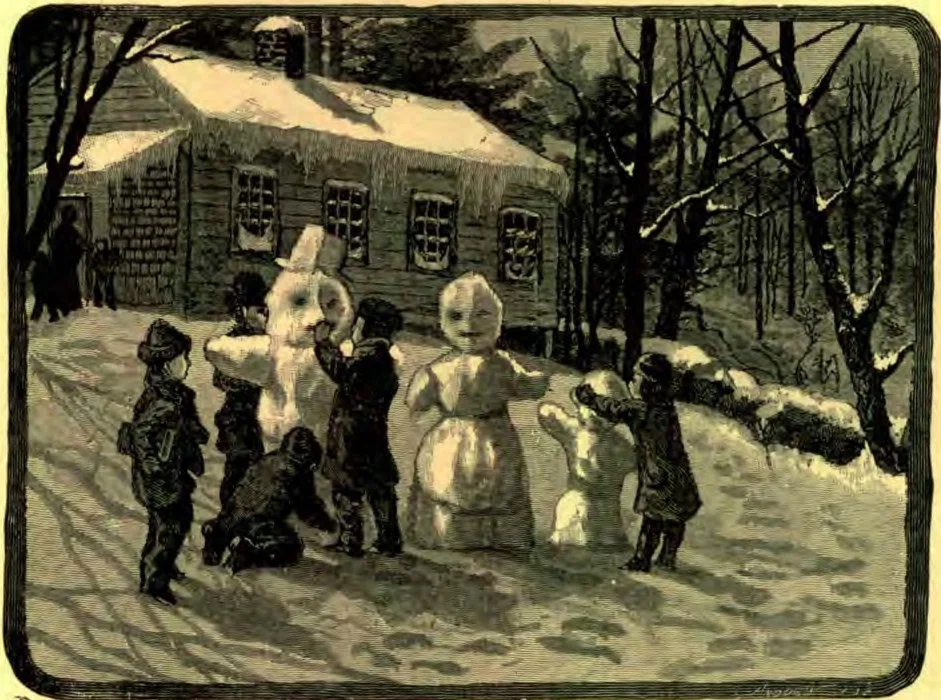
WINTER FUN AT SCHOOL
He thinks about us every day! Every hour we are in the mind of the great God. The psalmist says, “I am poor and needy, yet the Lord thinketh upon me.” Then shall we not be careful lest we grieve so kind a Friend?
MRS. L. D. AVERY-STUTTLE.

NATURE'S WONDER STORIES

The Soliloquy of Mr. Longleap

MR. LONGLEAP was comfortably seated on a thick lily-pad, blinking and winking, and occasionally making a dart at the flies buzzing near his nose. When he chanced to catch one, he swallowed it at once, thus getting his dinner and disposing of a tormentor at the same time. He did not like to have his nose tickled by a small fly's feet, but he did not object to having his palate tickled by the taste of that same fly; this is why he stayed on the lily-pad, instead of plunging into the cool, green waters of Horseshoe Pond.
Mr. Longleap liked to feel cool, and his home in Horseshoe Pond was delightfully suited to his tastes. As he looked about, he felt entirely satisfied with himself, and with a home so to his liking. Scores of lily-pads dotted the water near the shore, with here and there a golden-hearted flower among the leaves; tall cat-tails on the bank held their furry brown heads above the blossoms; while all about were the still waters of the pond. Mr. Longleap loved the cat-tails and the lily-pads and the lilies, but he loved the water best of all; indeed, he would scarcely have remained a day in the place if it had not been for the swimming facilities it afforded.
Presently Mr. Longleap's hunger was satisfied, and he turned slowly around on his green cushion, and settled himself for a cozy rest. He looked very solemn and wise as he sat seemingly in deep meditation, gazing into the clear depths of the water-world before him. If he was thinking as hard as he appeared to be, his thoughts may have been something like this:—
“Here I sit, with everything cool and lovely about me. I am no longer young, but I have every comfort of life, and can truly say that I am glad to be through with the trials of youth, and to enjoy peace and quiet at last. Each day I sit in the sunshine as long as I like, but the time was when I could not do this.
“Once I did not have long, green legs, and could not leap along the shore or into the water, as I chose; at that time I had a tail and gills, like a fish, and lived altogether in the water. There was one dreadful time when I even had no mouth, and could do nothing but swim, swim, swim, among the lily-stems.
“Having no mouth, of course, I could not eat, and oh, how hungry I was. After a while my mouth opened, and then what a dinner I ate! At that time my food was made up of tender water-plants growing all about; but since then my tastes have completely changed. I no longer care for water-plants, but much prefer a fat bug or fly. Even my name is changed; for at that time I was known as Master Tadpole.
“For a while I had a fine time darting about in the cool water, with nothing to do but eat and play. I grew fast, and by and by four tiny feet appeared on the sides of my body; but just as I began to think I should soon be quite grown, I fell suddenly ill. I lost my appetite entirely, and for days ate nothing whatever. My feet continued to grow, but my beautiful tail, that had helped me so much in my water-games, began to waste away, and the longer I fasted, the smaller it became. At last it disappeared entirely; and finding swimming rather awkward with only my new legs to help me, I left the water, and hopped out on shore.
“Here, of course, everything was strange—not a thing could I see with which I had been familiar in the water-world. Giving my legs a fair trial, I soon discovered that I could leap quite a distance; and when tired, I found a pleasant, sunny spot to rest.
“I soon became acquainted with the cat-tails, the blue iris, and many other plants; I also learned the taste of flies and slugs, and never since then have I cared for water-plants as food. I liked the land very much; but whenever I wished a change of scene, I plunged into Horseshoe Pond for a swim among my old haunts.
“For a long time I kept on growing, and through many hard lessons gained the experience necessary to protect a frog in this unfriendly world. Often I have narrowly escaped being eaten by catfish; and once I came near being caught in a dip-net by a band of noisy boys; again, when I was comfortably dozing in the pond, a great white duck floated slowly over me, and suddenly diving, seized one of my legs in her yellow bill. I thought I should surely be swallowed; but with a desperate kick, I managed to get loose, and quickly hid in the mud near the shore.
“But those times are all over. I have gained wisdom with age, and now I know better how to avoid my enemies. In cold weather I cozily doze the time away in my snug home under the bank; while in the warm summer days I enjoy myself on shore or in the water. I like to sing, especially in damp weather or on summer evenings. The next time you sit at the window, and listen to a shrill ker-r-k! ker-r-k! ker-r-k! from the swamp or river-bank, you may say to yourself, ‘Mr. Longleap is singing to me.’”
MINNIE ROSILLA STEVENS.

BEREAN LIBRARY STUDY

Revelation 14:1-8; “Thoughts on the Revelation,”
Pages 582–626
(February 17-23)
The Hundred and Forty-Four Thousand.— The Father's name is written in the foreheads of this company. When the Lord proclaimed his name before Moses, he described the holy character of God. Ex. 34:5-7. This company have the character of God; they have crucified self, and Christ has lived in them. Of the wicked the Lord says: “The show of their countenance doth witness against them; and they declare their sin as Sodom, they hide it not.” Isa. 3:9. In like manner the righteous character of the hundred and forty-four thousand can not be hidden; their countenances proclaim the character of their Heavenly Father. They sing a new song of victory over the beast and his image. All heaven listens in wonder; none can learn that song. Picture the scene: Adam, Enoch, Abraham, and faithful Elijah stand in silence as they listen to the wonderful strains, and are unable to join in the song. Heavenly singing is not repeating words in a meaningless fashion; no heavenly being engages in a song that does not express his own experience. Heavenly songs are from the heart; they are living experiences, expressed in heavenly melody. When the singing in religious gatherings is largely done by worldly persons, well paid for the occasion, or by giddy, thoughtless persons, who think more of their appearance or the tone of the voice than of the words they are singing, it must pain the ears of the heavenly listeners. How different is the sound when, in a social meeting where the Lord is truly in the midst of his people, some weak voice begins, “Nearer, My God, to Thee,” and all join in with prayerful minds. There is melody that touches souls; for each one sings out the longings of his own heart.
Not Defiled.— “These are they which were not defiled with women.” A woman is a symbol of a church. A corrupt woman represents a corrupt church. In the eighteenth chapter of Revelation the call is given, “Come out of her [Babylon], my people, that ye be not partakers of her sins.” The one hundred and forty-four thousand have heeded the call. They are not defiled with women: they have left Babylon, with all her allurements, and have taken their stand on the “commandments of God and the faith of Jesus.” In the fourth chapter of Isaiah a vivid word-picture of this time is given. The first verse mentions seven women, symbolizing the whole church, seven denoting completeness. They all take hold of one man, and only ask to be called by his name; they eat their own bread, and wear their own apparel. This is the condition of modern Babylon. They all take hold of one man,—the man Christ Jesus,—and are called by his name, Christian. They are content with simply the name. They eat their own bread, and wear their own apparel: they disregard entirely the God-given directions that would regulate their eating, both as to quantity and quality. Luke 21:34. The plain instruction given in regard to the apparel that should be worn by those who name the name of Christ (1 Tim. 2:9, 10; 1 Peter 3:3-5) is treated with disdain. They dress and eat like the world, while they wear the name of Christ. They are defiled with women. Unless they forsake these things, this class will never be among the one hundred and forty-four thousand. In the seventh chapter of Joshua is the record of a family that took the name of God's people, and yet coveted the garments of Babylon. Those who take the name “Christian” are to be clothed with the robes the Master gives to all his loyal ones,—“the garments of salvation,” “the robe of righteousness.” Study carefully what it means not to be “defiled with women.” None who eat their own bread and wear their own apparel, content with simply the name of “Christian,” will ever be among the company over which the covering described in Isa. 4:4-6, margin, is drawn. Those who eat the bread and wear the apparel of Babylon will be counted as of Babylon, even if they have taken the name of “Christian.”
Without Fault.— “In their mouth was found no guile; for they are without fault before the throne of God.” “Out of the abundance of the heart the mouth speaketh.” A pure heart and a mouth without guile go together. It is impossible for a pure-hearted person to have a mouth full of guile. “The remnant of Israel shall not do iniquity, nor speak lies; neither shall a deceitful tongue be found in their mouth.” Zeph. 3:13. They will be “Israelites indeed, in whom is no guile.” John 1:47. Those who take the name of “Christian” while they speak their own words, and have their mouths filled with guile, will be left with those other so-called “Christians” who eat their own bread and wear their own apparel. “If any man among you seem to be religious, and brid le th not his tongue, but deceiveth his own heart, this man's religion is vain.” James 1:26. The motto of every Christian should be, “I will take heed to my ways, that I sin not with my tongue: I will keep my mouth with a bridle;” and to this end we should constantly pray: “Set a watch, O Lord, before my mouth; keep the door of my lips.”

THE BLACK SQUIRREL

Mrs. Black Squirrel sat in the top of a tree. “I believe in the habit of saving,” said she; “If it were not for that, in the cold winter weather, I should starve, and my young ones, I know, all together; But I’m teaching my children to quickly lay up Every acorn as soon as it drops from its cup, And to get out the corn from the shocks in the field— There’s a nice hollow tree where I keep it concealed. We have laid up some wheat, and some barley and rye, And some very nice pumpkin seeds I have put by. Best of all, we have gathered in all that we could Of beechnuts and butternuts grown in the wood; For cold days and hard times winter surely will bring, And a habit of saving’s an excellent thing.
“But my children—you know how young squirrels like play— ‘We have plenty, great plenty, already,’ they’ll say. ‘We are tired of bringing in food for our store; Let us all have a frolic, and gather no more.’ But I tell them ’tis pleasant, when winter is rough, If we know both to use and to give we’ve enough; And they’ll find, ere the butternuts bloom in the spring, That a habit of saving’s an excellent thing.” —Selected.

Religion as the One Thing Needful

MANY Christians live and do in this world as if religion was but a by-business, and this world the one thing necessary; when, indeed, all the things of the world are but things by the by, and religion only the one thing needful.—John Bunyan.

TWO MODERN INSTANCES

It is the fashion in many circles to sneer at missionary work among the poor of the world, with hair-splitting distinctions between home and foreign philanthropy. Two of many incidents will detain, if not refute, such critics. Mr. Frank Bullen, who has won a name in literature of the sea, recently told in an English paper the story of his childhood.
Early left an orphan, he lived as a street arab, and then as fag to petty officers in the merchant marine. Friendless, half-starved, beaten, the poor child took refuge one night under a sea-drenched life-boat on a wind-swept deck. A negro lad found him there; and amid the storm and darkness, the older boy, of a despised race, told the other the story of salvation, which a missionary had imparted to him in a Jamaica Sunday-school.
From such an unpromising source the little fellow got the inspiration that gradually lifted him out of his degradation into a noble Christian manhood.
Cross the sea and the American plains to a corner of Nebraska, where a tribe of Indians have in large measure accepted the teachings of the missionaries who first went out under the “foreign boards.” The members of this tribe have for several years refused to accept free rations from the government, but provide for themselves, with commendable self-respect. A year or two ago one of their well-wishers heard with regret that they were again drawing rations, and asked an explanation.
“Oh,” was the reply, “owing to severe droughts, many of our white neighbors lost their entire harvest, and are suffering great need. We had been more fortunate. So we held council, and decided that by drawing some government rations we could give our own stores to the whites, who are less inured than ourselves to hunger and cold.”
Thus spake the red man to his white critic. All honor to these Santee Sioux!—Selected.

THE FIERY SERPENTS

(February 23)
Memory Verses.—John 3: 14, 15.
1. After removing from Mount Hor, what route did the children of Israel take? What were their feelings as they went? Num. 21: 4; note 1.
2. Against whom did they murmur at this time? What were their words of complaint? V. 5; note 2.
3. What did the Lord send among them? With what result? V. 6.
4. What confession were the people led to make? What did they ask of Moses? V. 7; note 3.
5. When Moses prayed, what did the Lord tell him to do? What promise was given? V. 8; note 4.
6. How did Moses carry out the Lord’s instructions? What was the result? V. 9.
7. Soon after this, to what king did Israel send a message? V. 21.
8. What request did they make of him? How did they promise to behave as they passed through his land? V. 22.
9. What did the king do in answer to the message? V. 23.
10. How did the battle result? Vs. 24, 25.
11. When they had conquered the Amorites, what other place was taken? Vs. 31, 32.
12. As Moses led the people on toward Canaan, who went out against them? Where? V. 33. What is said of this man? Deut. 3: 11.
13. What did the Lord say to Moses concerning this new enemy? V. 34; note 5.
14. How completely did they overcome him and his people? V. 35.

NOTES

1. Without doubt the children of Israel had a hard journey. They had to suffer many things; for they were in a strange country, enemies were all around them, and they were obliged to go without many of the comforts of life. And they became discouraged. It looked to them as if they would never get out of the wilderness. But no matter what their trials were, they had no cause for discouragement. It was natural to feel discouraged, but God did not want them to act out their natural feelings. He desired them to live by faith. If they had believed God, they would have seen that the things they suffered were given them of God simply to test them, and fit them to trust him anywhere. Let us learn the lesson, too; for we are all doing just what they did, though it may not appear to us quite so bad.
2. The more they murmured against Moses, the more deeply rooted the habit of faultfinding became. Finally they not only murmured against Moses, but they dared to murmur against God himself. “The people spake against God.” It is a terrible thing to become so blind and hard-hearted. The only safe way to take to avoid such an end is never to murmur at all.
3. Sometimes God finds it necessary, when we begin complaining, to give us real trouble, in order to bring us to our senses. The Israelites had been kept by God’s power throughout all their long journey. They had been given refreshing water, bread from heaven, and protection from all kinds of enemies. There had not been a feeble one among them, and God had kept them from wild beasts and poisonous reptiles. But they had not appreciated all this goodness, and had constantly declared that they should die in the wilderness. Their troubles had not been so great as they thought. Now the Lord allowed real evils to come upon them. He removed his protection, and immediately death from serpents was upon them. When this real trouble came, and the dead and dying were all around them, they saw their sin, and asked for forgiveness. (See “Patriarchs and Prophets,” page 429.) How much better it would have been if they had learned the lesson without the chastisement!
4. The brazen serpent made by Moses was a type of Jesus. “As Moses lifted up the serpent in the wilderness, even so must the Son of man be lifted up.” The people of Israel were not asked to do more than to look; he who obeyed and looked lived. The healing was not in the serpent of brass, but in the faith that led them to look. God has told us to look to the cross of Calvary, and be healed from our sin. He does not tell how we can thus be rid of sin; but if we do what we are told, and trust in him who was lifted up, we shall live.
5. What the Lord promised Moses is for us. Our greatest enemies are our sins. They are many and strong. But we are not to be afraid of them. God has delivered them into our hand. Oh, let us trust in the blessed promise, and fight manfully the good fight of faith!

Easy Steps — In the— Bible Story

By Adelaide Bee Cooper, Editor of the
Youth’s Instructor
Introduction by Elder S. N. Haskell,
Contains the Bible stories from Creation to the Giving of the Law. It is the first of a series of books for children, to cover the entire Bible narrative. The second Book of the series is now in preparation.
The early Bible stories never lose their beauty, freshness, and charm. They bring new inspiration to those advanced in years, and are read with pleasure and eager delight by youth and children. The principles revealed in the lives of the early Bible characters will, if instilled into the minds of the young, make an indelible impression for good, that neither time nor later associations can erase. Mothers, read them to your children.

WILL BEAR READING MORE THAN ONCE

That best of all Bible books for children—“Easy Steps in the Bible Story”—gains the unqualified approval of the children themselves; and that is the best possible testimony in its favor. They are glad to read it more than once. And the book will bear reading more than once; that is its strength.—Elder A. T. Jones, in Review and Herald, Jan. 8, 1901.
OAKLAND, CAL., Jan. 17, 1901. REVIEW AND HERALD PUB. CO., BATTLE CREEK, MICH.
Gentlemen: I am pleased with the author’s success in briefly touching the salient points in the long period covered by “Easy Steps in the Bible Story,” and connecting them in such a way as to lead the minds of the little folks along with increasing interest. I hope thousands of children will be provided with this book.
ELDER A. G. DANIELLS.
The book contains 160 pages, table of contents, and list of illustrations. Our artist has prepared 150 beautiful pen-drawings, illustrating the text of the book. It also contains many full-page illustrations. Beautiful cover design. Two styles of binding.
PAPER COVERS, - 25 CENTS CLOTH, - 50 CENTS
Order of your Tract Society; the
Review and Herald Pub. Co., Battle Creek, Mich., or the Pacific Press Pub. Co., Oakland, Cal.

The Mental Arithmetic for Home and School

By Prof. E. A. Sutherland.
It is with pleasure that we announce the publication of the “Mental Arithmetic,” because we believe this treatise on arithmetic will meet with the approval and appreciation of all. It is new, original, practical; in harmony with arithmetical principles, and greatly simplifies them.
While the child is learning addition, subtraction, multiplication, division, common and decimal fractions, etc., he is also receiving practical examples in astronomy, botany, physiology, natural history, carpentry, masonry, farming, and other useful subjects.
“The Mental Arithmetic” eliminates the objectionable features found in other arithmetics, which contain problems dealing in liquor, tobacco, drugs, tea, coffee, candles, false weights and measures, and other items of commercial value which have a tendency to poison young minds.
PRICE, 65 CENTS, POSTPAID
Order of your Tract Society; the Review and Herald Pub. Co., Battle Creek, Mich., or the Pacific Press Pub. Co., Oakland, Cal.

“THE BIBLE READER,”

By PROF. E. A. SUTHERLAND.
Second edition now ready. Three new illustrations have been added, and the book has been revised by the author.
“The Bible Reader” is a word builder, primer, and first reader. It teaches how to read and write the Roman script, and contains the first lessons in number work. It is designed for use in the home and church school. The lessons are drawn from the open scenes of nature, and thus the mind of the child is directed to the God of nature, and to Bible truth.

A BLESSING IN THE SCHOOLROOM.

BATTLE CREEK, MICH., Nov. 1, 1900.
REVIEW AND HERALD PUB. CO.,
DEAR BRETHREN: We have carefully read the new “Bible Reader” by Prof. E. A. Sutherland. It is an excellent work, weaving the Bible story and the light given in the Spirit of Prophecy together in an interesting manner. Mothers will find it a valuable help in the home. It will prove a blessing in the schoolroom. It gives a vocabulary which, when mastered by the child, will enable him to read the Bible at an early age, and thus fill his mind with Bible truth.
ELDER AND MRS. S. N. HASKELL.
Price, 35 cents.
Place your orders with your tract society, or with the Review and Herald Pub. Co., Battle Creek, Mich.

GRAND TRUNK RY. SYSTEM.

Taking Effect Dec. 16, 1900.
Trains leave Battle Creek.

WEST-BOUND.

No. 9, Mail and Express, to Chicago 12.15 P. M.
No. 1, Chicago Express, to Chicago 8.30 A. M.
No. 3, Lehigh Valley Express, to Chicago 3.50 P. M.
No. 5, International Express 2.17 A. M.
No. 75, Mixed, to South Bend 8.30 A. M.
Nos. 9 and 75, daily, except Sunday.
Nos. 1, 3, and 5, daily.

EAST-BOUND.

No. 8, Mail and Express, East and Detroit 3.45 P. M.
No. 4, Lehigh Express, East and Canada 8.22 P. M.
No. 6, Atlantic Express, East and Detroit 2.10 A. M.
No. 2, Express, East and Detroit 6.50 A. M.
No. 74, Mixed starts from Nichols yard 7.15 A. M.
Nos. 8 and 74, daily, except Sunday.
Nos. 4, 6 and 2, daily.
W. C. CUNLIFFE, Agent, BATTLE CREEK.

FOR EVERY DAY OF THE WEEK

Sunday:

“If our hearts were hungrier, our ears would be keener.”

Monday:

By taking revenge a man is but even with his enemy; but by passing over it he is superior.—Bacon.

Tuesday:

There are two ways of taking a thing easy: You can take and leave it alone—or you can take and do it!—Mrs. A. D. T. Whitney.

Wednesday:

“One who has looked long into the face of God does not need a magnifying-glass to discover that there are duties that need doing everywhere about him.”

Thursday:

Briers beset my every path, Which call for patient care; There is a cross in every lot, An earnest need for prayer; But a lowly heart that leans on Thee, Is happy everywhere. —Anna L. Waring.

Friday:

We wish to make some mark in life. We turn to the distant and far-away, we believe in the things that lie like mountain peaks under the horizon, when, indeed, the things to make our mark upon,—the things to do with, grow by, to let us into heaven,—are the little ones lying about our daily path, the overlooked things next to us.—J. F. W. Ware.

Sabbath:

“Whence then cometh wisdom? and where is the place of understanding? God understandeth the way thereof, and he knoweth the place thereof.” Job 28: 20, 23.
Do not worry over what people say about you; no one can hurt you but yourself. This truth has been often repeated in different words; and yet to every one the time comes, sooner or later, when it appeals to him in the light of a discovery. With the illumination gained by experience, the old truth flashes upon his mind with new force. He has learned for himself that as long as he keeps his escutcheon clean, malice has no real power to hurt him. Only when he departed from the strait pathway of honor, and made himself a party to some transaction that he would be ashamed to have known, has his character received an injury—and that by himself.
Remember, boys and girls, that no one but yourself can rob you of your honor and your self-respect. These treasures are given into your own keeping; it is yours alone to say how they shall be given back to Him who has lent them to you.

ANOTHER NEW BOOK

By Professor E. A. Sutherland, president of the Battle Creek College,—“The Mental Arithmetic for the Home and the School,”—has come to our table. This book was not written because there is any lack of arithmetics, but because, notwithstanding great advancement in recent years, there is a noticeable lack in most of them in dealing with the science of numbers in a practical way. In this arithmetic particular effort is made to remedy this defect, and the problems given are, from the first, of a practical nature; so that while the pupil is becoming thoroughly familiar with the science of numbers, he is at the same time acquiring information that will be useful to him not only in the succeeding years of his school training, but after he has left the schoolroom, and taken up the real work of life. To illustrate, problems are given on nature: liquid, dry, linear, square, and cubic measures; Bible measures; physiology; breathing; weight; papering; areas; chronology; fruit-planting; science; nutritive value of food; etc., etc.
The “Mental Arithmetic for the Home and the School” is published by the Review and Herald Pub. Co., Battle Creek, Mich. Price, sixty-five cents, postpaid.

“NO TIME”

In telling of a certain injustice received when a friendless lad,—and the story is not related in a spirit of personal bitterness, but simply as an incident in his early struggles for an education,—a prominent educator says: “I did not have time to cherish any bitterness toward the hotel-keeper.”
“No time”! None of us has any time for harboring petty spite, grieving over real or fancied slights, or cherishing any feeling of rancor, jealousy, malice, or revenge. “No time,” indeed! God has given us time enough for everything He wants us to do. This is a good thing to remember when the feeling of hurry and worry and anxious fret takes possession of the soul—to stop a moment, and look about to find what it is that is adding the “last straw,” to see what it is that may be wisely let go. It may be that down in a hidden place we shall discover some root of bitterness that is spreading its poisonous growth through all the life, and springing into fruitfulness in a hundred places. We are given time sufficient for our “reasonable service;” let us use no part of it unworthily.

A NEW DEPARTMENT

For some time we have been wondering how the younger readers of the INSTRUCTOR would like to have a column of the paper all their own—not a column written for them by older people, but a column written by themselves. We are going to have such a department, and it will be called “From Our Sharp-Eyed Boys and Girls.” All readers of the INSTRUCTOR who are under sixteen years of age, and who have something to tell, or some question to ask, are invited to write for this new department. (This does not shut out those who are over that age; but their contributions, if acceptable, will be given a place elsewhere.)
Remember, boys and girls, that this is your department—that you are to make it yourselves, and in no case to depend on older people to do your seeing, or thinking, or telling for you. “Sharp-eyed boys and girls” are all the time observing things that will interest others who have the habit of keeping their eyes open; and we would like to have letters from these young people, telling, in their own words and in their own way, what they themselves have seen. A letter, though lacking in many ways, will always be welcome if it bears the marks of originality; but we shall have to bar out all those—if there should be any—whose facts are gathered from books, or which are written by older members of the family.
If you have observed something of interest in your walks to and from school, in your work and play about the farm, in your excursions to the woods, or in visiting some noted place of natural or historic interest,—something that would interest you if some other boy or girl had seen it, and had told it so plainly that you could almost see it too,—then write it out, and send it to this new department.
Continue reading: A Young Bird Lover's Chickadee Observations