(b) The mission of John the Baptist. Matt. 3:1-12.
(c) The reform in Israel during the reign of King Josiah. 2 Kings 22:8-20.
Parallel Reading:—
“Great Controversy,” Chapter Five.
“Facts for the Times,” Chapter One.
Notes
Mark well the keynote of this lesson—personal reformation. And let this be the keynote each week while we study the history of the Reformation which followed the Dark Ages. We may receive much good from this study simply as a history. The events are stirring; the characters are noble and brave; the hand of God in the work is evident; and we may be inspired and admonished by the study of the characters and times; but we may reap a far greater good, and the study of these lessons may mark the beginning of days of power in our work, if we discover in this study the need of personal reformation, with the word of God as the active agent, as the basis of the great and best reformation, which is now long overdue.
John Wycliffe found the Bible locked up in the dead languages, where only the educated could read it. He translated it into the English tongue, and it wrought a mighty reformation in England. Luther found the Bible “chained.” He broke its fetters, translated it into the German, and sent it running through Europe; and that mighty word revolutionized Germany, discomforted the popes, and shook the pillars of their ancient throne.
But now the word is free, and is being published in all tongues and in all lands. The New Testament can be purchased for one penny, and it is distributed freely to those unable to buy. Why does it not work the great reform which is due? Has it lost any of its power?—Certainly not. It is the same mighty, loving word; but Satan, in these last evil days of conflict, has turned the hearts of the people away from the Bible, and they have been turned unto fables—scientific, philosophic lies, which, like thorns in a field of wheat, choke the word, and make it unfruitful.
Where do the young people of this denomination stand relative to this question?
Is the Bible loved and studied daily? or are you among the careless ones who, unintentionally and almost unconsciously, are neglecting it?
Are you making your Society meetings occasions for earnest, sober Bible study and prayer? or are they drifting into light social gatherings, chiefly for entertainment.
Are you expecting and preparing to give the Bible to the world?
Will you be one of the mighty, Spirit-filled heroes in this last and greatest of all reformations?
To the Leader
Study to avoid sameness and form in your meetings. Let the Spirit lead in his own free way. These outlines are suggestive only. Do not try to follow them arbitrarily. One mind can not meet all the local needs. Arrange your program as may seem best for the interest of your band of young people.
This Bible study may be presented by one good leader, and he can make it an interesting general exercise by arranging for several persons to read the Scriptures, and present the vital points in them. If time will admit of it, two persons may be selected to present the strongest points in the parallel readings.
These lessons cover much ground for the reading and study of the week. Do not feel that all must be presented in your meeting. Organize carefully; encourage all to present their points definitely and concisely. Sharp, quick blows count best and most. E. R. P.
A Crafty Old Thief
By Letta Sterling Lewis
THERE'S a crafty old thief, of nuisances chief,
Who goes prowling around day by day.
She subsists on the hours which she slyly devours—
Look out! for she's coming your way.
This crafty old thief may bring you to grief;
She's robbing you more than you think.
If you say, “wait a minute,” she's sure to fit in it
An hour or more yet in a wink.
Just say, “By and by that problem I'll try,”
And she comes with her trap slyly set,
To grapple your hours, which by mites she devours,
And not one word of thanks will you get.
When I hear a boy whine, “I haven't had time
To do this hard lesson,” I've found
That this crafty old thief, with her well sharpened teeth,
Has always been prowling around.
What! asking her name? Have you not guessed the same
Ere this from the tale I have told?
This thief of low station is Procrasti-Nation,
A sinner the universe old.
LETTA STERLING LEWIS.
How the Parsonage Was Papered
THE little parsonage stood bleak and cheerless in the wintry sunlight. A window was open, and the February wind, sweeping through the empty rooms, rattled a torn shade that had been left there by the last tenants. Deacon Cummings and the Sabbath-school superintendent stood viewing the cottage with speculative eyes.
“There's the salary to raise,” the deacon was saying, “and the extra expense of the new furnace must be met. No, we'll have to let the parsonage go. I know it does need papering, but we've our hands more than full already.”
The superintendent looked disappointed.
“I think we could manage it,” he suggested mildly, “if—”
“No, we can't!” put in the deacon, decidedly. “The parsonage'll have to go as it is.”
“But his wife's an invalid,” persisted the superintendent, still more mildly, for, like all the rest of the church-members, he stood greatly in awe of the determined deacon.
“Yes, she is,” the deacon assented, a little reluctantly. “Hasn't been able to do a thing for over a year, I understand. Lung trouble, you know. That's why they're coming West. Well, it's hard for a pastor on a small salary to have a sick wife. Hard for him and the children. I should like to see the parsonage papered, but it's quite out of the question. The sun comes in finely at the windows; that's one consolation, and soap and water is another. They'll have to put up with things as they find 'em. It's all we can do to raise the salary.”
A moment later the two men walked away, leaving Lily Maude standing by her scrub pail. Lily Maude was washing the floor. She had been hired by the committee for that purpose. The last minister had been unmarried, and the parsonage had been rented. But with his departure a new order of things was being brought about. A new pastor was coming, and with him an invalid wife and three small children. And Lily Maude was to scrub, wash windows and woodwork, to make ready for the new occupants.
Lily Maude was pale and small and stoop-shouldered. Her hair was colorless, and her blue eyes, her only beauty, looked out upon a world that had never been an easy one to her, for Lily Maude's mother was dead and her father a cripple. Lily Maude made the living now for both. She was only sixteen, yet her small hands were already calloused and toil-hardened.
“And the new minister's wife hasn't been able to do a thing for over a year.” Lily Maude had heard what the deacon had said, and she knew something of what it meant. She had been used to sickness all her life. Was not her father helpless now, and had not her mother been an invalid for three years?
She looked up at the grimy walls regretfully; then, taking her broom, she walked into the small bedroom. Here the walls looked worse than ever. There were soiled finger-marks upon them, and some one had torn from them strips of paper, laying bare the plastering.
“And she hasn't been able to do a thing for over a year, and will have to lie here in a room like this,” thought Lily Maude. “It's too bad! I'm afraid it'll make her worse instead of better.”
She leaned on her broom-handle meditatively. “If I could only do something,” she whispered, slowly. “I believe,” she added, “I believe I'll try. This room has to be fixed some way.”
By noon the next day Lily Maude's work was done. The floors were clean, the windows shining, the woodwork spotless. She had done her best. As she turned the key upon the house, her thin face was full of purpose. She hurried down the walk, a shabby little figure in her worn skirt and jacket. Her hands were bare, and the sharp winter wind had already made them blue. But Lily Maude was not thinking of anything so small as her own discomfort. She was used to facing cold winds; used to scanty fare and shabby clothes; used to hard work and poverty and deprivations.
She walked rapidly until she turned into the principal business street; then she slackened her pace, halting at a certain shop door. Here samples of wall-paper were displayed in the windows, together with a number of cans of paint and a few picture-frames. Lily Maude entered. In the rear of the shop some one was busily working. It was Horatio Robinson, the proprietor.
He looked up at Lily Maude. “How do you do?” he said, cordially. “What can I do for you?”
Lily Maude flushed a little. “I came to see you about papering a bedroom,” she replied, shyly, “but I haven't any money. It's a room at the parsonage,” she added. “The minister's wife is coming there to live, and she's sick. I heard them talking about it. The church don't feel able to do anything, and I—I just can't stand it to think of her going in a room like that!”
She looked up, with the flush still on her face. “I can scrub, Mr. Robinson, and I can wash,” she went on, shyly, “and I thought—for I studied it all out—that perhaps you might let me work for your wife to pay for it. Will it cost very much?”
Horatio Robinson looked down into the small face.
“That depends upon the quality of the paper,” he answered, kindly. “If it's cheap—”
“But it must not be cheap,” broke in Lily Maude, hastily. “It must be pretty and bright; not too bright, you know, but something that will be nice to look at.”
“How's this, then?” said Mr. Robinson, taking down a roll of paper from a shelf above him. “You'll have to wash a good many days, though, to pay for this,” he added, shrewdly. “Perhaps you wouldn't like that.”
But Lily Maude's hands were clasped. She was looking at the paper. “Oh, I shouldn't mind that at all!” she answered, quickly. “I'm used to washing, and that paper—it's beautiful, Mr. Robinson. Will you really paper the room and let me work for you?”
Horatio Robinson looked at her kindly. He was a sharp business man, but he had a good heart, nevertheless.
“I don't see how I can refuse you,” he said, smiling. “When people show a disposition to do their part, I like to do mine. So you like the paper, do you? Well, your taste is good; for it's the handsomest thing I have.”
“It's lovely,” said Lily Maude, dreamily, still gazing at it. “Oh, I hope she'll be pleased!”
Mr. Robinson was touched. He looked at the slight figure, and something rose in his throat.
“I'll do the work for you to-morrow,” he said. “It isn't every one I'd do it for, but you're a brave girl.”
Lily Maude grew radiant. “Thank you! thank you!” she cried, gratefully. “And I'll work my very best for your wife!” she added quickly.
“I'm not afraid of that,” was the answer. “You can go up to see her this afternoon and talk it over. She won't work you hard,” he added. “She's not that kind.”
“I don't mind work,” replied Lily Maude, blithely, “as long as I can please folks. Here's the key, Mr. Robinson. It's the bedroom off the sitting-room. That's to be her room. I heard the ladies talking about it.” Lily Maude smiled again, and then hurried out.
The man looked after her thoughtfully. “Well,” he said, as he turned to his work, “I like a spirit like that. There's some promise to a girl of that kind, and some Christianity. Willing to scrub and wash to pay for papering a room for somebody that's sick. That's religion. Such a frail little creature as she is, too! I think I'll go to hear that new preacher when he comes. I'm interested in his family already, and I'll do my best work on that papering, as sure as my name is Horatio Robinson!”
The room was finished, and Lily Maude stood by it in awed admiring silence. Mr. Robinson had himself added a handsome border. The unsightly walls were hidden, and Lily Maude's heart was full of joy.
“Isn't it beautiful?” she cried, ecstatically. “And oh, I'm glad, so glad to think I could do it.”
The door opened. Lily Maude looked up and saw Deacon Cummings. “Well, Lily,” he began, pleasantly, “you did your work well, I see. Everything is as clean as a new pin.”
Just then his eyes fell on the newly papered walls. “Whose work is this?” he demanded.
Lily Maude turned pale.
“Mr. Robinson's, sir,” she faltered.
“Yes, yes, but who is to pay for it?”
Lily Maude looked up bravely. “I am, sir,” she answered. “I'm going to scrub and wash for Mrs. Robinson until it's all cleared up. You see, sir,” she went on, timidly, “I heard them tell about the minister's wife being so sick, and not able to do anything, and all that, and these walls looked so bad I was afraid when she saw them, she'd get worse. Things like that trouble sick people a good deal. I know, for I've been with them all my life. I hope you don't mind my doing it, sir?”
The deacon looked down upon Lily Maude in her worn and shabby dress. Then, like Horatio Robinson, he felt something rise in his throat.
“No, no, Lily,” he said huskily, “you did right, quite right.” He went out into the next room.
The whole parsonage was papered, and out of the deacon's own pocket, at that. Then somehow the story of what Lily Maude had done crept out, and others went to work. A carpet was put down that matched the bedroom walls. Rich old Mrs. Janes, hitherto not noted for her liberality, opening her heart and her purse-strings, sent over a beautiful brass bed. Some one6else added the coverings, and kindly hands hung dimity curtains at the windows and spread a rug on the floor. Easy chairs and pictures completed the pretty room, an ideal resting-place for an invalid, so fresh was it and so attractive.
“Tired, Margaret?”
“A little, dearest.”
The minister's wife tried to smile, but the effort was a failure. The jolting of the train jarred on the tired nerves, and through the car window the prospect was not alluring. Long stretches of buffalo-grass flashed by, interspersed with white patches of alkali; and every turn of the car-wheels was taking her farther from her old home. Still, if she could only get well! And wonderful recoveries were made in the pure, invigorating climate to which they were hurrying.
Yet how she dreaded it all! New scenes, strange faces, and perhaps the new friends would not be like the old ones she was leaving so far behind.
“Cheer up, dear,” the minister was saying. “We'll soon be there.”
“I wish we could go straight to the parsonage,” she answered. “Somehow I dread hotels—and strangers.”
“Never mind,” was the cheerful answer. “We'll soon be settled, and your room shall be first, Margaret. I'll make it as easy and comfortable for you as I can.”
“You always do that,” was the grateful answer. “I'm ashamed to murmur when I have the children and you.”
“Gray Rock!” shouted the conductor, and the minister rose.
“Home, Margaret,” he said, tremulously. “Come children.”
It was a little station, and only two or three were standing on the platform. Among them was a tall man with a weather-beaten face. It was Deacon Cummings, who came forward hurriedly to meet them. He took the minister's hand, shaking it warmly. Then he turned to the woman.
“I've a carriage right here,” he said, anxious at the sight of her pale, worn face. “Let me help you.”
She sank upon the cushions, exhausted. The children sat quietly together, wide-eyed and wondering.
“We are in your hands,” the minister said, smiling. “What will you do with us?”
“You'll see,” was the genial answer.
In a few moments the carriage stopped. Deacon Cummings alighted. “This is the parsonage,” he said. “We thought it would be pleasanter for you to come straight home, so we did what we could. Some time I'll tell you the story of how it was all brought about. Your wife's room is ready for her, and the ladies have spread a supper for you in the dining-room. Welcome to Gray Rock, dear friends, and may the new home bring you health and happiness.”
“I am sure it will,” said the minister's wife, taking the deacon's hand.
“I am sure, too,” said the minister.
The tears were in his eyes as he half-led, half-carried his wife across the threshold into the pretty room awaiting her. Gently, very gently, he laid her upon the pillows of the soft bed, with all its snow-white draperies. She put both arms about his neck and murmured:
“He maketh me to lie down in green pastures; he leadeth me beside the still waters.”—Youth's Companion.
How to Make an Oscillating Cylinder Engine
By Eli Carlsen
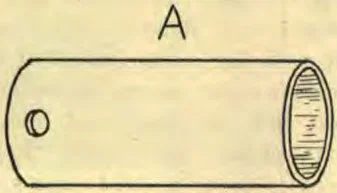
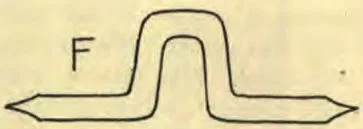
THE cylinder (a) is a brass (or any material that can be soldered onto) tube about one and three eighths inches long, and about five eighths of an inch in diameter, and must be perfectly smooth inside. The hole, which is in the end, is about one eighth of an inch in diameter, and must be the only one in the cylinder; make it just as the figure shows.
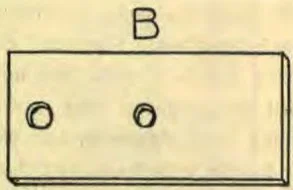
The plate (b) is made of brass, copper, or any metal that is soft, yet does not bend too easily. This plate should be about the same length and breadth as the cylinder. Drill a hole in it corresponding to the one in the cylinder, as shown in the illustration.
Drill another, not necessarily the same size, but exactly in the center of the plate. This hole is for the pivot (g) to be put through, and must fit perfectly.
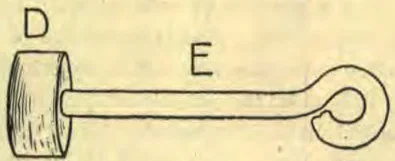
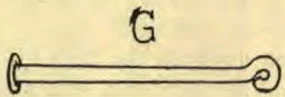
The pivot, which may be made of a nail, should have a small and flat head on one end, for the purpose of keeping the pivot from slipping through the hole, and an eye on the other. (Don't make the eye until the engine is nearly complete.)
After the holes are drilled into the plate (b), polish one side of it on an oilstone until it is perfectly smooth. Put the pivot through the center hole, with the head on the unpolished side. Solder the plate with the pivot in it onto the side of the cylinder, so that the hole in the end of the plate will be exactly over the hole in the cylinder. Put a wooden plug through the hole in the end of the cylinder and plate, so as to keep them directly over each other, and also to keep them from filling with solder. Be sure that the plate and cylinder are parallel when they are soldered together. After the plate (b) and the cylinder are soldered together, the pivot should be solid.
The piston rod (e) is made from a small wire about one eighth of an inch thick and about two inches long. Fasten one end in the center of the piston head (d). The piston head is made of Babbit metal mixed with a little solder. Fill the cylinder with damp sand until it is about a quarter of an inch from the edge of the end that has no hole in it. Make a few notches in one end of the piston rod on the center of this sand; be careful to hold it parallel with the cylinder. Pour the melted Babbit metal in this space until it is filled, and hold it steady while it cools. Be sure the piston head fits snugly in the cylinder.
The cylinder head (h) is a round piece of tin just a trifle larger than the end of the cylinder; make two like this, and in one make a hole in the center, just the size of the piston rod. About one fourth of an inch from this hole make another, to allow the air to pass out and in easily. Solder the cylinder head that has no hole in it, to the end of the cylinder where the hole is. Solder the other one on the other end after you have put the piston rod through the center hole, and push the piston head to the other end of the cylinder. Leave it this way while you solder the piston head on, be sure and have the center hole in the cylinder head exactly in the center of the end of the cylinder.
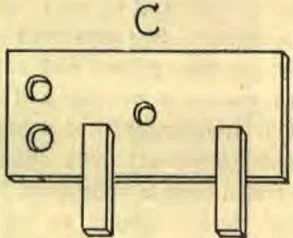
The plate (c) is just the same as the plate (b), with the exception of the position of the two holes on the end. These two holes are as far apart as the diameter of the hole in the end of the other plate. Put the pivot (g) which has been soldered on to the side of the cylinder with the plate (b) through the center hole with the polished sides facing the polished side of the other plate. Be sure that these plates fit perfectly together. The two holes must be at the same end as the hole in the plate (b).
The next thing to do is to make the eye on the end of the pivot about an inch from the back of the plate (c). Take a spring like the ones in the stoppers of a window, and put over the pivot. Put a cross piece of wire through the eye of the pivot to keep the spring in place. The spring must be longer than the pivot (after the eye is made on the end of it) so that it will keep the two plates snugly together.
The boiler can be made from a baking-powder can (a round one) about seven inches long and three inches in diameter. Solder the lid on, and resolder all the seams.
The shaft (f) may be made of a copper wire about one eighth of an inch thick. The fly-wheel should weigh about six ounces, and be about one and three fourths inches in diameter. Fasten the fly-wheel on the shaft about half-way between the crank and the end of the shaft.
Get two strips of brass about one and one half inches long, one half inch wide, and one eighth of an inch thick. Make an indentation near the end of each, in the middle, with a center punch. Solder them on one side of the boiler, facing each other, about the same distance apart as the shaft (f) is long. The shaft, which is made pointed at each end, should be placed between the two, with its ends resting in the indentations.
Solder the two strips of brass onto the plate (c), as shown in the picture. These strips must be just long enough to bring the piston rod in line with the shaft and the crank when it is horizontal.
Make an eye on the end of the piston rod and fasten it to the crank. The eye and the crank must be so made that when it is turned to its highest point up, the hole in the plate (b) will be exactly under the lower hole of plate (c). Turn the crank to the farthest point out or the nearest point, the hole in the plate (b) can not be seen through either hole of plate (c). Turn it again to its lower point, and the hole in the plate7(b) will be exactly under the upper hole in plate (c). (The crank should be about as long as the distance between the pivot and the holes in the plates.)
Solder the strips, which are fastened to plate (c) on the boiler, at the place where the cylinder oscillates correctly, as described above. Solder a small tube over one of the holes in plate (c), and the other end of the tube over a hole in the top of the boiler. This is the steam pipe. Make another hole in the top to pour the water into the boiler. Fix a cork for this hole, so it can be pulled out without burning your fingers when there is steam in the boiler.
Now the engine is complete. Dig a hole in the ground, lay the boiler in the top of the hole. Plaster it all around with mud, leaving a hole at one end for a smoke stack. Fill the boiler nearly full of water, get up steam, and the engine will run.
ELI CARLSEN.
H
Abilities Doubled When Dedicated to Christ
ABILITIES are doubled when dedicated to Christ. It has often been found true that the effect of real consecration on mere mental development has been obvious and surprising to all around. Yet it is only a confirmation of what we believe to be a great principle, that the Lord makes the most of whatever is universally surrendered to him,— Leaves of Light.
MEMORY VERSE: “The Lord is with you, while ye be with him; and if ye seek him, he will be found of you; but if ye forsake him, he will forsake you.” 2 Chron. 15:2.
Our Lesson Scripture gives an outline of that part of the history of the children of Israel that we have been studying this quarter—the time when they were ruled by the judges. You will see that the story is one of the constant backsliding of the Israelites, and of God's great mercy and love for them. Every time that they cried unto the Lord in the trouble that their sins had brought, “he saved them out of their distresses.” “Oh that men would praise the Lord for his goodness, and for his wonderful works to the children of men!”
Questions
1. How can you sum up the history of Israel in the times of the judges? What did the Israelites frequently do?
2. What was the effect of their idolatry? What did God do for them every time they cried to him?
3. Who was the first judge of Israel after Moses? What was his first great victory? Tell how the city of Jericho was taken.
4. What sad thing happened just after the taking of Jericho? Who was the cause of the trouble? What had he done? What was his punishment? What were the people taught by this object lesson?
5. Tell what led to the battle of Gibeon. What special thing was done at that time that was never done before or since? What gave Joshua power to command the sun and moon? Mark 11:22-24. How did God further help the battle? What was done with the kings?
6. What was done with the land before the death of Joshua? What tribe had no inheritance among their brethren? How many cities were given to the Levites? For what were six of these cities set apart?
7. How long did the Israelites serve God after Joshua's death? When they departed from him, who took them captive?
8. Tell the names of some of the nations that oppressed them. In what way were they oppressed by the Midianites? What man was chosen by God to deliver them? How did God make this known to him? What signs were given to him? Describe the way in which Gideon overthrew the Midianites.
9. Who was the deliverer of Israel from the Philistines? Where did Samson get his great strength? What was he from his birth? What is meant by a Nazarite?
10. How did Samson first show his great strength? Tell of some of his victories over the Philistines. How did he escape when he was shut up in Gaza?
11. How was Samson taken captive? What was done to him? What revenge did he take for the loss of his eyes?
12. What came upon the land of Israel in the time of the judges, that drove some of the people into other countries? What family are we told of in the book of Ruth? Whom did the two sons marry?
13. Who only was left to return to the land of Israel? Who went with her? What did Ruth say to her mother-in-law when she told her to return home?
14. What did Ruth do to get food for herself and Naomi? In whose field did she glean? What did Boaz do for Naomi? When he bought Naomi's land, whom did he take to be his wife? What son was born to Ruth? Of whom was Obed the grandfather? Who came, hundreds of years later, in David's line?
15. What was the name of the son born to Hannah? Why did she give him this name? Where did she take him as soon as he was old enough to leave her? Why did she do this?
16. What did Samuel do in the Lord's house? How often did his mother visit him? What did she bring with her?
17. What was the character of Eli's sons? Through whom did God warn Eli about them? Tell how God first spoke to Samuel. What mistake did Samuel at first make? What did Eli tell him to say to the Lord? What message did God give him? What did all the people know about Samuel?