Your ShelfYour Projects

Signs of the Times, Vol. 57, No. 43.

Will California Go Blue?
Earlier text: Will California Go Blue?

The “SIGNS” QUESTION CORNER

Conducted by WILLIAM G. WIRTH, 5447 EL VERANO AVENUE, EAGLE ROCK, CALIFORNIA
If you have a question regarding Bible doctrine and Christian living, or on other subjects apropos to the field of the “Signs of the Times,” write out your question and send it in, preferably direct to Dr. Wirth. Anonymous questions will not be answered. Do not become impatient if your question is not answered immediately, for Dr. Wirth has scores of questions in waiting, and yours will be answered in order.

THE NEW BIRTH AND THE VICTORIOUS LIFE

Miss Ruby Alborley of Alabama asks for knowledge concerning the “new birth” and the “victorious life.”
To be “born again” (John 3:3) does not mean that the one who experiences this cannot sin, and that one would “have to be born again” should he sin, as the questioner states. We must remember the words of John: “If we say that we have no sin, we deceive ourselves, and the truth is not in us.” “If we say that we have not sinned, we make Him a liar, and His word is not in us.” 1 John 1:8, 10.
What the new birth does mean is that the base of our lives is heavenly, that we are “born from above” (A. R. V., margin); that we are no longer directed by the evil one but by the Holy Spirit; that the tenor of our ways is toward loving righteousness and hating iniquity. “But ye did not so learn Christ; if so be that ye heard Him, and were taught in Him, even as truth is in Jesus: that ye put away, as concerning your former manner of life, the old man, that waxeth corrupt after the lusts of deceit; and that ye be renewed in the spirit of your mind, and put on the new man, that after God hath been created in righteousness and holiness of truth.” Ephesians 4:20-24. If, in our inherited sinfulness, we at times err from the path of divine rectitude, let us find comfort in the words: “If we confess our sins, He is faithful and righteous to forgive us our sins, and to cleanse us from all unrighteousness.” 1 John 1:9.
Mrs. Jessie Deason of Utah is perplexed concerning certain statements in Isaiah 29 and Ezekiel 37. She also asks other questions.
In Isaiah 29:9-12 we have a graphic picture of the inability of those who profess to be God’s people to understand the prophecies of the word because of their sins. The context of this section of Isaiah makes this plain. See Isaiah 28:7ff.; 30:8ff. The “book that is sealed” has no reference whatever to the “sealed book of the angel Moroni.”
Ezekiel 37 gives a beautiful description of the reunion of the restored Israel of God into the coming glorious Messianic kingdom to be ruled over by Christ as “My servant David.” Hence, it is fantastic and bizarre to apply the two sticks of this chapter, one for Judah and the other, “Ephraim,” for Israel, representing this restoration of spiritual Israel, to the Book of Mormon and the Bible combined as one. Ezekiel 37 has no fulfillment this side of the second advent of Christ.
In a spiritual sense it is true that those who will be redeemed in God’s everlasting kingdom will belong to the twelve tribes of Israel. See Romans 2:28, 29; Galatians 3:29; Revelation 21:9-12.
Ministers of the gospel, or “elders,” as the Bible terms them, are ordained to this sacred service after they have been duly appointed by church leaders, by prayer and the laying on of hands. (Acts 13:3; 14:23; 1 Timothy 4:14.) They must be of irreproachable Christian character and satisfy the consecration criteria named in 1 Timothy 3:1-7 and Titus 1:5-9. Seventh-day Adventist ministers are ordained according to this Scriptural plan. This denomination has no “apostles” or “seventies” in its organization.
Seventh-day Adventists do most certainly believe in divine healing, for it is a Scriptural teaching. See Mark 16:17, 18; James 5:15. They do not, however, believe in the sensational, spectacularly popular, wholesale, advertising type of so-called “divine healing,” so prevalent in these days of deception, and so often, unfortunately, connected with evangelistic movements. The Gospels do not reveal that our Lord did His divine healing in any such way. The enemy of all righteousness delights to counterfeit the true workings of God, and Biblical prediction plainly declares that such will be particularly true of these last days, days just before the return of our Lord. (Matthew 24:23, 24.)
If the questioner will add the 1810 years to A. D. 34, the time that she admits marks the close of the 490 years, and which years do not form a part of the 490 years but are to be added to them, she will arrive at 1844. Her confusion comes from taking 1810 as a date, whereas it a sum of the years after the period of 490 years.

THE APPEARING OF ELIJAH; THE “IMAGE OF THE BEAST”

C. W. Sadler of Connecticut asks for an understanding of the appearing of Elijah, foretold in prophecy; also an explanation of the “image of the beast.”
I cannot tell “how long before the second coming of Christ Elijah will appear.” As M. C. Wilcox gives a clear exposition of this prophecy of Malachi 4:4-6, I shall quote him:
“The prophecy of Malachi is of twofold application. One of these applications was met in John the Baptist. The angel said of John, in Luke 1:17, ‘He shall go before His [Christ’s] face in the spirit and power of Elijah, to turn the hearts of the fathers to the children, and the disobedient to walk in the wisdom of the just; to make ready for the Lord a people prepared for Him.’ In Matthew 11:14, Jesus expressly says of John, ‘And if ye are willing to receive it, this is Elijah, that is to come.’ Yet John was not the actual Elijah, as he expressly tells us in John 1:21, but he was Elijah in the sense of the fulfillment of that prophecy at the first advent of our Lord.”
“But that which was fulfilled in a single individual then, takes a great deal wider scope in the last days. One individual could go to the Jewish nation and bring before all the people of that nation God’s message concerning Christ’s first coming. But there is to go to the world a message concerning His second coming. (Revelation 14:6, 7.) No one man can bear that message to the world; and so Elijah and John the Baptist are types of the people whom the Lord calls to bear His last message to the world.”
“Conditions in the world will be the same as Elijah and John the Baptist found. For instance, there was the strongest kind of union of church and state, contrary to God and His truth, in the days of Elijah. We have Jezebel, the corrupt, idolatrous, sun-worshiping queen, urging on Ahab to the persecution of the Lord’s people. We have, in the days of John the Baptist, Herod, influenced by Herodias, the wicked woman whom he had married. In Elijah’s day, we have the backsliding of Israel and their turning away from the true God to sun worship. So it was in the days of John the Baptist; God’s people had departed from Him, and were sunken in cold, dead formalism, making void the commandments of God by their traditions.”
“Those are the conditions that exist to-day; and God is asking His faithful people to give to the world the great threefold message of Revelation 14:6-12. That message meets all the conditions that are in the world, and that message will go and is going with ‘the spirit and power of Elijah,’ just as John the Baptist went. Consequently the antitype of Elijah is not some man who may call himself Elijah; it is not vested in one individual, but in the whole people that will carry God’s message to the world.”
“Another thought: the important thing is not the messenger, but the message. This has been true in all ages. The important thing was not Elijah—the mere man; it was the message from Jehovah which he bore to Ahab. John the Baptist, as a man, was not the important thing; and when the Jews asked him who he was, he declared, I am not this, and I am not that! but when they demanded who he was, he said, ‘I am the voice of one crying in the wilderness.’ The important thing was to be the voice of God. And so in the last message that shall go to the world, the important thing is the message, and not the persons that give it; but it will be given by an entire people, in the spirit and power of Elijah.”—Questions and Answers, vol. 2, pages 154-156.

IMAGE OF THE BEAST

In the final stage of apostasy, just before the return of our Lord, there will be in the New World, according to Revelation 13:11ff., an oppressive union of church and state, similar to and an “image” of, the persecutional ecclesiastico-political system of the papacy in the Old World. This New World counterpart of the Old World apostasy is termed, prophetically, the “image of the beast.” [The subject is more fully treated in The Pope King Again, and Daniel and the Revelation, published at this office.—EDITORS.]

Evolution Is Utterly Destitute of Proof

EVOLUTION is utterly destitute of proof.—Sir J. W. Dawson.

Man in the Mass Does Not Think

Man in the mass does not think, but only feels.—Herbert Hoover.

Girls’ Education and Marriage

Nothing in the education of our girls prepares them for marriage.—Kathleen Norris.

The Secret of Success

THIS is the secret of success: Set your goal and never deviate.—Sir Charles Higham.

Wealth Has Climbed Since Prohibition

Every figure of wealth that we know has steadily climbed since Prohibition.—Samuel Crowther.

Justice Free from Emotion

THERE can be no even justice where emotion, either of hate or sympathy, prevails.—Lewis E. Lawes.

Changing the Face of the World

It is easy to say one is going to change the face of the world; it is more difficult to do it.—Guglielmo Ferrero.

Evangelizing the Sources of Our Teacher Supply

UNLESS we evangelize the sources of our teacher supply, there are dark days ahead for human society.—G. W. Dunham.

The Dangers of Armaments

ARMAMENTS always have caused in all times apprehension, suspicion, a state of insecurity, and a spirit of war.—Dino Grandi.

Prayer in a Storm at Sea

No man is an atheist in a storm at sea; that experience is a great teacher of orthodoxy and a call to prayer as well.—Thomas H. Nelson.

Spiritual Eagerness in the Modern World

THE person who asserts that spiritual eagerness is absent from the modern world is a hopelessly biased or superficial observer.—Dorr Diefendorf.

The Devil as the World's Chief Politician

THE fact that the devil boasted that he was the world's chief politician should make honest men a little wary about seeking political positions.—Thomas H. Nelson.

The Bible Is God’s Message

THE Bible is the message of God to the minds and hearts of all men, and is inexpressibly profitable, for time and eternity, to all who receive it, and obey it.—Don O. Shelton.

The Necessity of Evil in Possibility

A NECESSITY for the existence of evil in possibility as a moral educational agency in no way makes it imperative to yield to and commit that evil, either by Adam or us.— Thomas H. Nelson.

The Cost of Luxuries and War

DEAN INGE, citing what he characterizes as the wastefulness of the French, English, and Americans, says the last spend enough for luxuries in two years to pay the British war debt. Maybe there is a hint therein that people would rather pay for luxuries than for wars.—San Francisco Chronicle.

Modernism’s Threat to Christianity

MODERNISM is just infidelity in a new dress, advancing with a friendly air, as if to help a worn-out Christendom to regain its prestige. . . . Modernism has betrayed the written word. . . . It has sapped the spiritual life of the church of God; it has destroyed evangelistic effort; it has emasculated Christian living; it has increased the flood of worldliness which is swamping the Christian profession on every hand.—A. J. Pollock.

Love’s Divining Rod

If we are to gain the inside view of our brother’s life, it will be through the instrumentality of a very sensitive and refined imagination, which is itself the child of a truly fervent love. Love carries the finest divining rod. She can get within another’s life, and she is sensitive to movements where others only find the torpor of desolation and death.—J. H. Jowett.

The Majesty of Obedience

THERE is no creature on earth of whom obedience is not required, none whom it does not grace, none whom it does not inform with a majesty of contentment which nothing else supplies.—Frances Greenwood.

Isolation Breeds Fear and Hatred

MUCH of our trouble in human relations is due to isolation. We know too little, and our ignorance breeds fears; and our unfounded fears lead to hate, sometimes even as far as intergroup violence.—Governor Caulfield.

Unemployment

UNEMPLOYMENT is a promoter of charity which affects disadvantageously both those who give and those who receive.—Owen D. Young.

Christianity as Divine Dynamic

CHRISTIANITY is not merely historical truth; it is also divine dynamic, a redemptive activity in the world.—D. S. Kennedy.

Politics and Economics Are Servants

AFTER all, we must remember that politics and economics are not the masters of men—they are their servants.—Owen D. Young.

Prohibition Rightly Observed

PROHIBITION rightly observed has its best impetus through individual obedience.—San Francisco Chronicle.

The Church’s Major Business

The major business of the church still is to save lost souls.—Bishop Joseph F. Berry.

Government Needs More Businessmen

THE government needs more business men and fewer politicians.—Thomas A. Edison.

Difficulty and Success

EVERYTHING I've succeeded in has been difficult.—Aristide Briand.

Jazz and Modern Conversation

Jazz is like the chitchat of modern conversation.—Abbe Ernest Dimnet.

The Essence of Pleasure

The essence of pleasure does not lie in what it costs.—Stephen Gwynn.

Frown and Smile

Who can say the frown is more the sign of ability than the smile?—James J. Walker.

Prosperity and Civilization

It is so much easier to be prosperous than it is to be civilized.—Nicholas Murray Butler.

Evolution and the Bible

WHEN evolution comes in, the Bible goes out, and with it Jesus Christ and all hope for the future.—Bible Champion.

The Modern Idea of Home

THE modern idea of home has been well expressed as the place one goes to from the garage.—George W. Wickersham.

Naval Treaty Advances Disarmament

THE recent naval treaty is a valuable contribution to the cause of disarmament by agreement.—Ramsay MacDonald.

Fear God, Fear Nothing Else

HE who fears God need fear nothing else, and he who fears not God needs to fear everything else.—Thomas H. Nelson.

The Bible Among All Peoples

THE Bible walks the ways of all the world with familiar feet, and enters land after land to find its own everywhere.—Henry van Dyke.

Modernism and Bible Truth

WITH modernism there is the constant denial of basic Bible truths, truths divinely essential to human redemption.—G. L. Young.

Spiritual Growth in the Home

WE must aim for spiritual growth in the home which will keep abreast of mechanical progress. We will have to get back to the idea of “being” instead of “doing.”—Mrs. Franklin D. Roosevelt.

The Noble Character of Western Education

WE are really paying the West the highest compliment, for in the very act of striving for liberty we acknowledged the noble character of the Western education which has roused us.—Rabindranath Tagore, India's poet.

Personal Bias in Seeking Truth

We fondly imagine that we are impartial seekers after truth, but with few exceptions, to which I know I do not belong, we are influenced and sometimes strongly, by our personal bias, and we give our best thoughts to those ideas which we have to defend.—Prof. August Krogh.

Keeping Sight of Heaven

THERE is no narrowing so deadly as that of man’s horizon of spiritual things, nor can any worse evil befall him in his course on earth than to lose sight of heaven. And it is not civilization that can prevent this, or compensate for it. No widening of science, no possession of abstract truth, can compensate a man or indemnify him for an enfeebled hold on the highest and central truths of humanity. What shall a man give in exchange for his soul?—Verbum Sapienti. (One of the legends on the wall of the Memorial Chapel of Stanford University.)

London’s LAMBETH Conference

A few weeks ago several hundred bishops representing the Established Church of Great Britain and the independent Episcopal Churches of the Colonies and Dominions, as well as representatives from the United States, met in a great church council in London. We are giving our readers a close-up of that epochal conclave through the eyes of who was present at the sessions, and who had the unusual privilege of an interview with the Archbishop of Canterbury, the head of the Anglican communion.
Arthur S. Maxwell Our London Correspondent
NO ONE can look with indifference upon the recent great gathering of bishops of the Church of England at Lambeth Palace. It marks another epoch in the life of a great Christian body. From it will emanate influences that will profoundly affect the thought of our time and the lives of millions of our fellow men throughout the entire world.
This conference, convened at Lambeth Palace, the ancient manor where for seven centuries the Archbishops of Canterbury have made their home, is the seventh in a series dating back to 1867. Others were held in 1878, 1888, 1897, 1908, and 1920.

INCREASE IN SIZE AND USEFULNESS

As the years have passed, the Conferences have increased both in size and in usefulness. With the expansion of the church’s activities and the multiplying of dioceses the number of bishops attending has increased. Whereas in 1867 the number was only 76, out of a possible 144, this year 310 gathered at Lambeth out of a total of 400 bishops. They came from the ends of the earth. Twelve traveled from India, 15 from South Africa, 24 from Canada, 9 from the West Indies, 22 from Australia, 6 from New Zealand, 6 from Japan, 9 from China, and 64 from the United States. On this occasion, for the first time, a native Chinese bishop (the Right Reverend P. L. Tsen) was present, also a Japanese bishop, the Bishop of Tokyo (Dr. Matsui), an Indian bishop, the Bishop of Dornakal (Dr. Azariah), and an African bishop (Dr. Howells), Assistant Bishop on the Niger.
It is of no small importance that the Protestant Episcopal Church of America, though legally separate entirely from the Anglican communion, still recognizes its historic derivation from the older body, and continues to send its bishops as honored members of the Conference.
This year, also, important delegations have been received and welcomed from the Eastern Orthodox Church—including representatives from Jerusalem, Antioch, Alexandria, and Thyateira, and the churches of Greece, Cyprus, Bulgaria, Poland, and Armenia—together with Archbishop Kenninck of Utrecht (Old Catholics), the Bishop of Lund (the Church of Sweden), and prominent leaders of the Church of Scotland and of the English Free Churches.
All these delegations attended chiefly to discuss the thorny problem of reunion. Whatever the result, it was certainly no small triumph to bring such a heterogeneous company together.

NOT A LEGISLATIVE BODY

It should be pointed out that the Lambeth Conference is not a legislative body. It is not the Vatican Council of the Anglican Church. It may act in an advisory capacity, but the various sections of the church are absolutely free to receive or reject its counsel. The resolutions passed have no legislative force whatever. They bind no one. For this reason many think that the Conference is futile. To-day, however, counsel is more efficacious than edicts, and universal benefit of some kind must surely accrue from the prolonged, prayerful study of modern problems by the leaders of a great Christian body. The considered opinion of three hundred bishops is of no small importance, and the church and the world should be better for their labors.

THE AGENDA

The agenda chosen for this year’s conference revealed both courage and vision. Those who prepared it certainly did not omit the difficult subjects.
“The Faith and Witness of the Church in This Generation” was the noble title chosen to head the long list of subjects. This main theme was considered under six headings:
  1. The Christian Doctrine of God.
  2. The Life and Witness of the Christian Community.
  3. The Unity of the Church.
  4. The Anglican Communion.
  5. The Ministry.
  6. Youth and Its Vocation.
Things ancient and modern were curiously commingled at the opening ceremony of the great Conference in Canterbury Cathedral. The Archbishop sat in the historic patriarchal chair of Augustine, but his voice was carried to the assembly by Marconi loud speakers.
Impressed with the solemnity of the occasion and the responsibility of leadership, the Primate delivered an address memorable for its breadth of vision and its deep spiritual insight.
After speaking words of welcome to the delegates, he proceeded at once courageously to envision the day when “the Church of England” throughout the world would resolve itself into a community of free, self-governing churches. Even the missionary dioceses now directly responsible to the See of Canterbury are, he pointed out, fast developing their own local organizations which must soon lead to new autonomous churches like those of the United States, Canada, Australia, New Zealand, South America, the West Indies, and India.

WORLD NEEDS

Referring to the 1920 Conference, the Primate reminded his audience of the opening words of the late Archbishop Davidson when he impressed upon those present that they were “set at this unparalleled time in a bewildered world to do their part in repairing the vastest cataclysm which the human race has known.” Then, with solemn emphasis, he showed how conditions are but little different to-day. *“Brothers,” he said, “the world of our generation is still bewildered and restless. The wounds of war are not yet healed. New difficulties and perplexities—industrial, social, political—beset almost every nation. The need of a spiritual fellowship is more clamant than ever.”*
How shall this need be met? To some extent at least, thought the archbishop, by unifying the church. He saw signs that this desirable objective was slowly being achieved.
Then, having dwelt briefly on the main points of the Conference agenda, he proceeded to make a closing appeal which, we do not hesitate to say, deserves the reverent consideration of every Christian believer. No matter what one’s denominational affiliation may be, none can resist such a message as this. However much one may be led at times to find fault with the church for its failures or apostasies, here, surely, is sincerity beyond question. It is deep calling unto deep. It strikes at once through all artificial barriers straight to the innermost heart.

THE DOCTRINE OF GOD

‘Suffer me as I close,’ said Archbishop Lang, ‘to say a word about the first, the deepest, the greatest, of all subjects to which we are bidden to give our thoughts—the doctrine of God.
‘We have to speak to our own generation. Yet after all, in every generation, in every part of the world, and for every race there is one supreme purpose of all human life. It is that it should find its way to God. If this purpose is to be fulfilled, it is not enough that men should know that He is; they must know in some measure what He is. The main reason why at this and at every time the ways along which men seek God are so devious and disappointing, lead so often away from Him rather than toward Him, is that men set out with imperfect, unworthy conceptions of Him. Materialism, beyond doubt the greatest menace of our time, flourishes on these partial, antiquated, unworthy conceptions. It cannot be combated till they are corrected.

DEEPER CONCEPTION NEEDED

‘Thus it has been borne in upon many of us that while we have been discussing, never more busily than in this questioning generation, the proofs of God, the purposes of God, the laws of God, the kingdom of God, we have been apt, so to say, to take the doctrine of God Himself for granted. We have not put God Himself before our eyes in His eternal nature as infinite wisdom, power, beauty, goodness. We have not rethought our conception of Him in the light of fresh revelations which He has been giving of Himself in nature, in the spirit of man, in new apprehensions of the significance of Christ.
‘This lack of a true and rich doctrine of God, evoking alike awe and praise and trust, makes religious life either cold or sentimental, makes our teaching so often meager and partial, makes our worship so mechanical, or else turns it into channels unworthy of the glory and majesty of God, above all makes ecclesiastical controversy so barren and unlovely. We have to recover for ourselves, for our clergy, for our people, for our generation, a deeper, richer conception of God. Deeper—yes, and more simple also. We have need to recover the profound simplicity of that conception of God which filled the soul of Jesus, which through Him brought new life and hope and strength into a weary world. A scholar has recently described that old world into which He came—its exhaustion, its loss of nerve, its want of faith, its manifold disillusionment. Is it not a picture of our world also? It is for the Christian community to renew, to reinterpret, Jesus’ own fresh, invigorating conception of God as One real and near and sure, One in whom for life and death men can absolutely trust.’
(To be continued)

Our Only Ground of Hope

“We have nothing in ourselves of which to boast. We have no ground for self-exaltation. Our only ground of hope is in the righteousness of Christ imputed to us, and in that wrought by His Spirit working in and through us.”

To What CHURCH Would PETER

Would Peter be as lax and cold as the majority of the church-going laity, or would he stand out from the crowd and with fiery zeal condemn the world for the glaring inconsistencies that are so indicative of the times in which we are living?
VARNER J. JOHNS
He came unto His own, and His own received Him not.' For long, weary centuries Israel had waited for the fruition of her hopes in the coming of the Redeemer. Now He had come. Light divine shone upon the darkened plains of old Judea. The wonderful life that He lived, the marvelous miracles that He performed, the saving truths that He proclaimed, gave unmistakable evidence of His Messiahship. But the people loved darkness rather than light. They expected a conqueror; He came as a servant. They longed for a deliverer from the hated Roman yoke; He came to deliver them from the heavy yoke of sin. They would have welcomed a Jewish Cæsar, but they rejected the lowly Jesus, the world's Saviour.
“Whom do men say that I . . . am?” Jesus was talking now to the twelve disciples. His name was on everybody's lips. Some called Him the prophet Elias; others, the prophet Jeremiah. Some said He was John the Baptist restored to life. They gloried in His miracles and marveled at His teachings, but they bitterly resented His direct appeal for the renunciation of hidden sin. “But whom say ye that I am?” Jesus was now searching the hearts of the disciples themselves. Quick as a flash, from the lips of impetuous, great-hearted Peter, came the declaration: “Thou art the Christ, the Son of the living God,” to which Jesus replied: “I say also unto thee, That thou art Peter, and upon this rock I will build My church; and the gates of hell shall not prevail against it. And I will give unto thee the keys of the kingdom of heaven: and whatsoever thou shalt bind on earth shall be bound in heaven: and whatsoever thou shalt loose on earth shall be loosed in heaven.” Matthew 16:13-19.

CENTER OF THEOLOGICAL BATTLE

Around these words has centered many a theological battle. Twenty millions of people in our land believe that Peter was the first pope. As many more believe that Peter, if here to-day, would be a Methodist or a Baptist or an Episcopalian. What church would Peter join if he should come to your town to-day?
I wish to state briefly six propositions as evidence that Peter was never considered a pope, that he never had the preeminence among the disciples.
1. Before leaving the disciples Jesus told them that it was expedient for Him to go away in order that His representative might come. And the representative of Christ, the One who was commissioned to guide people into all truth, is clearly stated to be the Holy Spirit. (John 16:7-13.)
2. The church of the living God is built upon the foundation of all the prophets and apostles. Not Peter alone, but all were lively stones in that magnificent structure, the church. (Ephesians 2:19, 20.)
3. The chief corner stone of the church is the Lord Jesus. The testimony of this verse is so clear that it cannot be misunderstood. Peter himself called Jesus “the head of the corner.” 1 Peter 2:7, 8.

CHRIST IS THE ROCK

4. In all the Bible—and there are thirty-five instances in the Old Testament alone—Christ is called the rock. Not Peter, but Jesus the Son of God, is the rock, the tried stone, the corner stone of the church.
Using the words of the original Greek, the verse in Matthew would read, “Thou art Petros, and upon this petra I will build My church.” The words petros and petra have different meanings. Liddell and Scott’s Greek-English Lexicon says: “Petros, a piece of rock, a stone, and thus distinguished from petra . . . a ledge, or shelf, of rock. . . . Petrai [a variation of petra] are not loose stones, but masses of living rock.” Jesus is the living rock upon which His church is founded. Peter was but a fragment of stone and, like us, had life only in Christ.
5. The other apostles were given the same authority and power as was given to Peter. (Matthew 18:18; John 20:21-23.) The keys of gold that unlock the gates of heaven to the sin-bound soul are the Old and New Testaments of God's wondrous Book. The acts of the church in opening the word of God to men, thus opening to them the way to life eternal, are ratified in heaven. If Peter was a pope, then we are all popes, for we are all disciples of Christ.
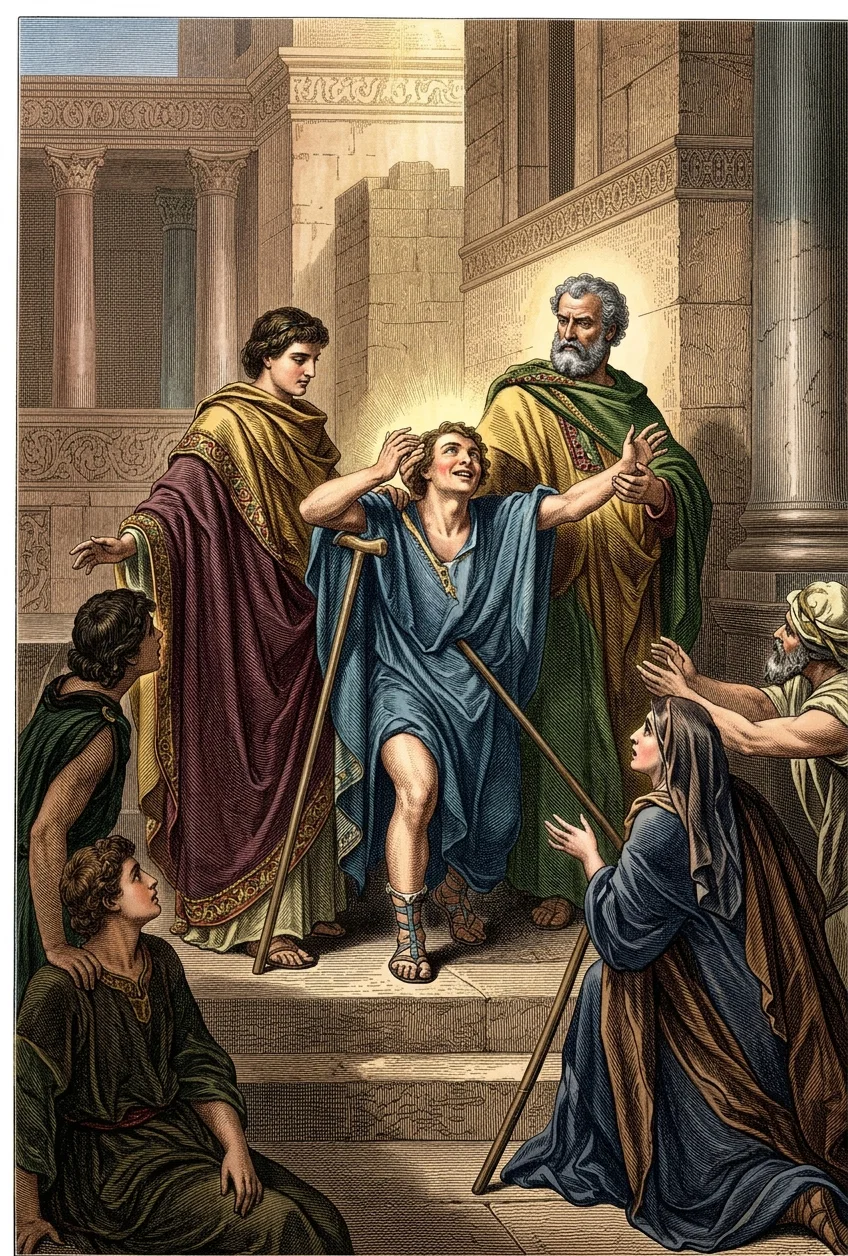
Peter and John heal the lame man at the entrance to the temple.
6. Peter himself acknowledged that he was on a par with his fellow disciples. (Acts 10:25, 26.) In the great council at Jerusalem it was not Peter but James who presided. If there were a preeminence, it belonged to the apostle James.
If Peter were in your town to-day, he would be a Protestant—but I scarcely utter the word before I seek to qualify it. O Protestantism, what absurdities and inconsistencies are taught in your sacred name! The Protestantism of Reformation days exalted the Bible as the voice of God speaking to man. “The Bible and the Bible only” as a rule of faith was the platform upon which Protestantism was built. Upon this platform the apostle Peter could stand. But the Protestantism of to-day is no longer a protest against traditional error and a proclamation of eternal truth. These shorter bibles and lesser christs, these travesties on truth that would pervert the meaning of Christ’s redemptive program, scrap the Ten Commandments, and substitute a message of social service for the gospel of salvation—these are no part of Protestantism. These wild fanaticisms, with their jazz hymns, their senseless jargon of “unknown” tongues, their “hip-hip-hoorah” preaching and praying—these religious tragedies that cover a multitude of sins with loud hallelujahs—are no part of Protestantism. These stately creeds, cold, formal, and lifeless, mimicking Rome and mocking apostolic Christianity, multiplying holydays and ritualistic services while dividing the truth of the Bible—these are no part of Protestantism.

SCRIPTURES DIVINELY INSPIRED

The Scriptures were read by the apostle Peter as the sacred oracles of God. “Holy men of God spake as they were moved by the Holy Ghost,” was his testimony as to the worth of Old Testament prophecy. The inspired and inspiring messages from the books of the Old Testament were living truths in the estimate of Peter. And why should they not have been since they testified of Jesus, the One who had lifted Peter from the miry clay and placed his feet upon the solid rock? Peter could never fellowship with a church that repudiates the writings of Old Testament scripture; with a church that denies the divinity of Jesus, His Sonship, His miraculous birth, His glorious resurrection, His saving power; or with a church that rejects any one of the Ten Words that were spoken by Jesus upon Mt. Sinai.
A church that exalts the Bible and the Christ of the Bible; a church that repudiates the God-dishonoring doctrine of evolution; a church that preaches salvation through the blood of Christ, a new birth, regeneration, growth in grace, and a triumphant experience in Christ; a church that upholds the majesty of the Ten Commandments; a church that carries into all the world the gospel of the kingdom; a church that is Spirit-filled and Spirit-led in its program of world evangelization,—for such a church would Peter seek if in your town to-day. Could he find it?
Continue reading: BELONG *Were He* ALIVE *To-day?