The Youth’s Instructor, Vol. 67, No. 11.

Army Strength at Armistice and Other War Department News
Earlier text: It Is Not the Correct Thing

The Teacher’s Vow

THE following epitome of professional ethics for teachers was written by Prof. Lyman C. Newell, of Boston University for students of the Lowell Normal School. He calls it “The Teacher’s Vow.”
I will see the good in all pupils and lead them on to higher attainments.
I will be patient and forbearing, confident in the belief that kindness and generosity will ultimately triumph.
I will scorn error, deceit, and all forms of falsehood, persistently foregoing sarcasm and injustice.
I will claim all nature as my heritage, and spend a portion of each day quietly in God’s open air.
I will hold daily communion with my own soul.
I will accept my remuneration, however small, without envy, complaint, or discouragement, never forgetting that a teacher is a leader into the higher life, and not merely a wage-earner.
I will work each day in unshaken assurance that peace and power come in full measure to all who are ready for the truth.

Missionary Volunteer News Notes

THE Morning Watch Calendar is the best ever, and its circulation has already gone above any previous year,— nearly 75,000.
The foreign mission goal of the ninety-two Maritime Conference Missionary Volunteers was $150, and they raised $980.83 by the Harvest Ingathering plan alone, or $10.66 per member. Other parts of the Eastern Canadian Union have done well also. The Missionary Volunteers of London, Ontario, secured $15.14 per member; Brantford, Ontario, $10.50; and Ottawa, $12.50.
The Greater New York Missionary Volunteers averaged $10.69 per capita in the Harvest Ingathering. One society averaged $27.64.
The Missionary Volunteer secretary for the Negro young people of the Southeastern Union writes: “Yes, thank you, we were able to push the Harvest Ingathering, and the young people did splendidly. One member of the Atlanta society raised $50, another raised $16.41, and another $7.05. In Savannah one gathered $37.75, and others received good amounts. The society there raised more than $80. The Atlanta society received more than $122 in the Harvest Ingathering work, and contributed $54 for missions. Their goal was only $115, so they passed it by a good margin. My people are doing a good work.”
The Junior society of Reading, Pennsylvania, secured more than $100 Harvest Ingathering money.
The Missionary Volunteers of Australia received upward of $5,000 in the Harvest Ingathering campaign. This was two ninths of the entire amount raised in Australia.
Our Missionary Volunteers have done splendid work in raising money for Armenian and Syrian relief. The Northern Illinois secretary writes: “In three months we raised $640 for Armenia, and also went over the top for India.” Several societies in different conferences have adopted two orphans, others have adopted more.
One girl writes about the Reading Course book, “The Days of June;” “What I have read has given me a longing to have a part in the work, and to live a beautiful life as did June Nicholson. Her testimony, ‘To live is Christ, to die is gain,’ impressed me greatly.”
The spirit of our Missionary Volunteers is well represented in one Missouri society which wrote to the conference secretary asking that its goal be doubled.
The assistant secretary and treasurer of the General Conference for South America writes that Professor Crager, the Missionary Volunteer secretary for the Austral Union, “has been doing good work in organizing the young people’s department, and we have been greatly encouraged by the way the young people are taking hold of the sale of periodicals in some of our mission fields.”
Professor Crager writes of the young people at the Pua, Chile, school: “They have a strong working society there, and are doing much in spite of the fact that they are in the country and it is hard to get to where they can work, and also the fact that it rains there the larger part of the school year. They are monthly selling six hundred copies of our missionary paper.”
The Missionary Volunteer work is making progress in Brazil. Brother Max Rohde writes: “We send out every month one hundred fifty programs and lessons in Portuguese to our young people’s societies, who are studying ‘The Coming King.’”
Should you like to see other interesting notes of what our Missionary Volunteers are doing everywhere? Write, or have your conference Missionary Volunteer secretary write, to the General Conference Missionary Volunteer Department some of your interesting experiences. M. E. K.

My Dolly Dear and I

HER name is Mary Clarabelle. I know you'd love her, too, If you could see how good she is— And sweet and pretty, too; For when I leave her by herself, She doesn't even cry! And, oh, we have such lovely times, My dolly dear and I.
But once, when we were playing house, The wind came whirling round And tipped her carriage till she 'most Fell out upon the ground. She didn't scream at all, she just Held out her arms, and my! But we did hug each other tight, My dolly dear and I.
And when the dark has grown so black You cannot see outside, And all the great big bogy things Come out from where they hide, And creep behind us—still—as still— We used almost to cry For fear they'd grab us in the back— My dolly dear and I.
But mother says that when the wind Had frightened dolly so, I ran to take her in my arms As fast as I could go. And just like that, through all the dark, More close than she can tell— God's holding out his arms, she says, To me and Clarabelle.
So now, when all the shiny stars Have lighted up the night, And mother tucks me up in bed, All soft and warm and white, We aren't a single bit afraid Of bogy things. 'Cause why? We snuggle safely in God's arms, My dolly dear and I.
— Kathryn C. Wheeler, in the Continent.

— Daisy D. Stephenson

Wishing

I wish that every single day I'd wake already dressed; The little chicks must like that way, And birdies in the nest. They never have to comb and brush, And button everything Before they get their breakfast mush, Or fly around and sing.
There's too much soap and water stuff; You scrub from ear to toe, Until you're plenty clean enough— And then first thing you know, Just when you're having pecks of fun, You find you're in disgrace! “How did you get so dirty, son? Come in and wash your face.”
Just give me mud and overalls, And I'm as pleased as Punch! But right away somebody calls, And then I get a hunch It's soap and starchy things for me; Right then I wish and wish That I wore feathers, or could be A lucky little fish.

— Daisy D. Stephenson

Missionary Volunteer Work in Nyasaland

The superintendent of the Rhodesian-Nyasaland Mission Field, Prof. W. E. Straw, was one of our Missionary Volunteer workers in the United States before going to Africa. He writes concerning the young people and the young people's work in Nyasaland:
“While I was in Nyasaland we organized our people there for Missionary Volunteer work. It seems to me the principles of Missionary Volunteer work are just what are needed for our natives in this field. Mrs. C. Robinson was elected Missionary Volunteer secretary for Nyasaland, with two native assistants to act as field secretaries. These will go out to the different schools, and organize a society for Missionary Volunteer work wherever a school is conducted. So I suppose within a short time there will be thirty-five or forty societies in Nyasaland.
“However, our great need is literature for them. I do not think there is a scrap of Seventh-day Adventist literature, other than school books, for them to use. So when I was there the workers asked me to write a few little tracts to use in their missionary work. We must have more literature for these natives. The New Testament is the only literature we find in the greater part of our Rhodesian field. When I see the opportunities, or lack of opportunities, these natives have, I wonder that they make the progress they do. But we believe better days are before us. We hope to have some literature that these people can use for their own benefit and also distribute among their friends. On the whole the work here in Rhodesia is moving along very encouragingly.”
Surely our young people who have so many advantages and so much to help them, and with which to help others, will pray for the Missionary Volunteers of Nyasaland. Several years ago the young people of the College View, Nebraska, church supported for a few years Brother and Sister J. C. Rogers, who were our missionaries in Nyasaland. Those who gave of their means then will be glad to know of the fruit which is there now.
Brother Straw reports 731 in attendance at their last camp-meeting. There were 113 baptisms, making 125 for the year. There are now 512 church members and 500 others in Bible classes studying the message in preparation for baptism. The five weeks’ institute which Brother Straw conducted was attended by 53 teachers. M. E. K.

Seventh-day Adventists and Membership in the W. C. T. U

Do you think it all right for our people to be members of the W. C. T. U.? I think the organization is doing some very good work, but am not well enough acquainted with it to know whether it would be best for our people to be members. E. H.
Seventh-day Adventists are a temperance people, discarding not only liquor, but tobacco, tea, and coffee. We can heartily co-operate with any organization which has for its purpose the abolition of the liquor traffic, unless such co-operation should lead us into violation of other principles of truth. In recent years the temperance organizations have kept themselves comparatively free from religious legislation activities. What they will do in the future we cannot tell. Many regard the recent victory in the adoption of the prohibition amendment to the United States Constitution as the beginning of “welfare legislation,” which, in their minds, doubtless includes Sunday laws. If we have capable women in the W. C. T. U., when these issues arise they will have an opportunity to show how such legislation is contrary to the spirit of the Master.
While we heartily believe in and work for prohibition, we should always remember that the only sure hope of this sin-cursed earth is the gospel of Christ. Prohibition laws are quite ineffective unless the majority of the people believe in and practice temperance; and the best way to save men and women from intemperance is to lead them to accept the gospel which is “the power of God unto salvation.” So while we are interested in, and co-operate in every possible way with, temperance organizations, let us remember that the giving of the gospel message is our main business.
The W. C. T. U. was organized for a noble purpose, and is doing a great work. While it would seem best for our girls to give their spare time to our Missionary Volunteer activities, it surely seems right that our women of experience should help the W. C. T. U. in its great work, as long as they can do so without compromising principle. Many of our sisters are doing this with excellent results. M. E. K.

To Our Missionary Volunteers

THERE is one line of missionary work in which many of our students and other young people may have a part. It is that of getting in touch with many interested persons who desire literature. Some of these have been visited by canvassing students during the summer, and others have come in touch with our evangelists.
By distributing the cost of a club of Signs of the Times, a few cents from each one will pay for fifty papers, and in this way hundreds who have actually shown an interest in present truth can be reached week after week. This suggests one line of work for every Missionary Volunteer Society. In this way papers may be sent to hundreds of families who will accept and read them.
Fifty copies for six months in a club cost $30—only 30 cents a quarter for each one in a society of fifty members. For $35 the names may be sent to the tract society, whence they will go to the publishers, and the papers will be mailed direct each week, leaving simply the work of correspondence with the society. This is a method of missionary endeavor that will bring results, and give the participants a good experience. The truth of this statement has been proved again and again. Do not neglect this opportunity for service.

XIII — The Review

(March 29)
LESSON SCRIPTURE: Joshua 5 to 1 Samuel 3.
MEMORY VERSE: Review the memory verses for the quarter.
TIME: From the beginning of the conquest of Canaan by the children of Israel, through the period of the Judges, to the call of Samuel as the prophet of the Lord.
PRINCIPAL PERSONS: Joshua, Deborah and Barak, Gideon, Samson, Ruth, Samuel.

Questions

The Fall of Jericho

In what peculiar manner was the city of Jericho taken by the Israelites?
Who only of the people living in Jericho were saved alive? Why was this exception made?

The Taking of Ai

What was the result of the first attempt to take the city of Ai?
What caused the defeat?
How was the guilty one discovered and punished?
Describe the second battle of Ai.

The Battle of Gibeon

By what means did the Gibeonites become associated with the children of Israel?
What remarkable thing took place in the battle which Joshua fought in their defense?

Dividing the Land: Cities of Refuge

How many kings did Joshua defeat in battle?
How did Joshua learn which portion of the land to give to each tribe of Israel?
For what purpose were cities of refuge provided?

Deborah and Barak Deliver Israel

What took place among the children of Israel after Joshua’s generation passed away?
What distress came upon them because of this?
What king greatly oppressed Israel for twenty years?
How was deliverance wrought through Deborah and Barak?

The Call of Gideon and His Work

In what remarkable way was Gideon called to deliver Israel from the Midianites?
What miracles were wrought as proof of his call?
What tests reduced his army to three hundred men?
With what weapons did they overcome the enemy?

The Story of Samson

What was remarkable about Samson, son of Manoah?
What exhibitions of his strength are recorded?
How did he lose his great strength?
With what tragedy did his life close?

The Story of Ruth

Book of Ruth
Through what events did Ruth become associated with the people of God?
In what eloquent words was her decision made known?
How did she become acquainted with Boaz?
What great honor became hers?

The Child Samuel

In what remarkable way was Samuel dedicated to God?
Where was he taken when yet a child?
What experience came to him when he was about twelve years old?
How is his faithfulness to duty shown?

Memory Test

By whom and under what circumstances were each of the following quotations spoken?
“Come, and I will show thee the man whom thou seekest.”
“The Lord is with thee, thou mighty man of valor.”
“Thy people shall be my people, and thy God my God.”
“Speak; for thy servant heareth.”
“I will do a thing in Israel, at which both the ears of every one that heareth it shall tingle.”
“Out of the eater came forth meat, and out of the strong came forth sweetness.”
“The sword of the Lord, and of Gideon.”
“If thou wilt go with me, then I will go: but if thou wilt not go with me, then I will not go.”
“This our bread we took for our provision out of our houses on the day we came forth to go unto you; but now, behold, it is dry, and it is moldy.”
“I coveted them, and took them; and, behold, they are hid in the earth in the midst of my tent.”
“As captain of the host of the Lord am I now come.”

Memory Verses for the Quarter

  1. Through God we shall do valiantly: for he it is that shall tread down our enemies. Ps. 60:12.
  2. Behold, ye have sinned against the Lord: and be sure your sin will find you out. Num. 32:23.
  3. I am the Lord thy God which teacheth thee to profit, which leadeth thee by the way that thou shouldst go. Isa. 48:17.
  4. Call upon me in the day of trouble: I will deliver thee, and thou shalt glorify me. Ps. 50:15.
  5. There failed not aught of any good thing which the Lord had spoken unto the house of Israel; all came to pass. Joshua 21:45.
  6. The face of the Lord is against them that do evil, to cut off the remembrance of them from the earth. Ps. 34:16.
  7. The angel of the Lord appeared unto him, and said unto him, The Lord is with thee, thou mighty man of valor. Judges 6:12.
  8. There is no restraint to the Lord to save by many or by few. 1 Sam. 14:6.
  9. Let not the wise man glory in his wisdom, neither let the mighty man glory in his might. Jer. 9:23.
  10. Beauty is vain: but a woman that feareth the Lord, she shall be praised. Prov. 31:30.
  11. Even a child is known by his doings, whether his work be pure, and whether it be right. Prov. 20:11.
  12. Speak, Lord; for thy servant heareth. 1 Sam. 3:9.

The Widow's Meal

I REMEMBER being much struck years ago by an incident related to me by a Highland shepherd on my uncle's estate of Ardilly, the facts of which he, a good Christian man, was quite prepared to vouch for.
Up on a lone hillside there lived, about the middle of the century, a poor lone widow, who for many a long year had learned to rest, in every difficulty and in all her need, upon Him who has somewhere said, “Let thy widows trust in me.” It was in the depth of winter when the incident I am going to relate occurred, and the poor woman's stock, never very abundant, was, I suppose, reduced to its lowest by the difficulty of finding any employment at that season of the year. Unlike the widow in the Hebrew story, she actually found her barrel of meal fail, and when she had finished the last handful she went to bed, possibly with the hope that she might be more successful in earning a few pence on the morrow.
But when the morrow came a terrible snowstorm swept over the land, and the lane leading to her little cot was almost blocked with snow. It was quite beyond her slender powers to battle with the raging storm and make her way to some neighbor's house, where at least she would be made welcome to a dish of porridge. There was only one Friend to whom she could apply, and in him she had the most perfect confidence.
Accordingly she filled her pan with water, and put it upon the fire, and actually put the salt in the water. “Noo,” she said to herself, “I'll jist gang ben, and ask the Loord for the meal.” So she retired into her inner chamber, and there with thanksgiving and praise she made her wants known to the Lord. She had not long been on her knees when there was a loud knock on the door. “Na, na, Loord,” she said, “thou canst na hae sent the answer sae soon.”
But the knocking continued, and on her opening the door, a buxom farmer's lass, who lived some little distance off, flung down a sack of meal on the floor, exclaiming, “Father sent ye that; and I think ye may be very grateful to me for bringing it here through all this terrible storm. Whatever possessed my father I don't know, but all the morning he has been dinning into me about that sack of meal, and, snow or no snow, I must be sure and fetch it up to you; but it's been a pretty hard job getting through the storm, I can tell you.”
So she was rattling on, when a glance at the old woman fairly overawed and silenced her. There she stood with uplifted hands and eyes bedimmed with grateful praise, as she exclaimed, “He's aye the same, Jeanie! He's aye the same! Mony a lang year hae I trusted him, and I ne'er found him fail; and he's nae failed me noo. I put on the water, and I put in the salt, and ne'er a grain o' meal had I in the hoose. Sae I was jist asking the Loord to send me the meal, when I heard ye knock at the door, and noo here comes the meal jist while I was asking for it.”—Selected.

Applied Mathematics

I SOMETIMES wonder what's the use Of squaring the hypotenuse; Or why, unless it be to tease, Things must be called isosceles. Of course I know that mathematics Are mental stunts and acrobatics, To give the brain a drill gymnastic And make gray matter more elastic. Is that why Euclid has employed Trapezium and trapezoid, I wonder? — yet it seems to me That all the plain geometry One needs is just this simple feat: Whate’er your line, make both ends meet!
— Anne W. Young, in Harper’s Magazine.

Found Nourishment in Crumbs

MR. WILLIAMS, the apostle to the South Seas, once had his attention arrested by seeing a man arise from some stones and walk on his knees to meet him. “Welcome, servant of God, who brought light into this dark island,” shouted the man. Then the two engaged in a conversation concerning the man’s experience.
Mr. Williams said: “Buteve, where did you obtain all this knowledge? I do not remember ever having seen you at the settlements where I have spoken; and besides this, your hands and feet are eaten off by disease, and you have to walk upon your knees.”
Buteve answered: “As the people return from the service, I sit by the wayside, and beg from them, as they pass by, a bit of the Word. One gives me one piece, and another another, and I gather them together in my heart; and thinking over what I thus obtain, and praying to God to make me know, I get to understand.”—A. T. Pierson.

Breaquing It Gently

WE begin the publication of The Roccay Mountain Cyclone with some phew diphphiculties in the way. The type phounders phrom whom we bought our outphit phor this printing ophphice phailed to supply us with any ephs or cays, and it will be phour or phive weex bephore we can get any. We have ordered the missing letters, and will have to get along without them until they come. We don't lique the loox ov this variety ov spelling any better than our readers, but mistax will happen in the best regulated phamilies, and iph the ph's and the c's and x's and q's hold out, we shall ceep (sound the c hard) “The Cyclone” whirling apnter a phashion till the sorts arrive. It is no joque to us — it's a serious aphphair.” — Selected.

“Powder Mill”

A YOUNG woman whom her friends recognize as having a very sweet disposition says that as a child she was possessed of a very high temper, a legacy left her by her father, and she so often exhibited this unbecoming trait of character that a young man boarding in their home nicknamed her “Powder Mill.”
The mother tactfully used this fact to shame the child into an effort to overcome the unbecoming trait of character, and it had a more salutary effect than anything that had been done to correct the evil.
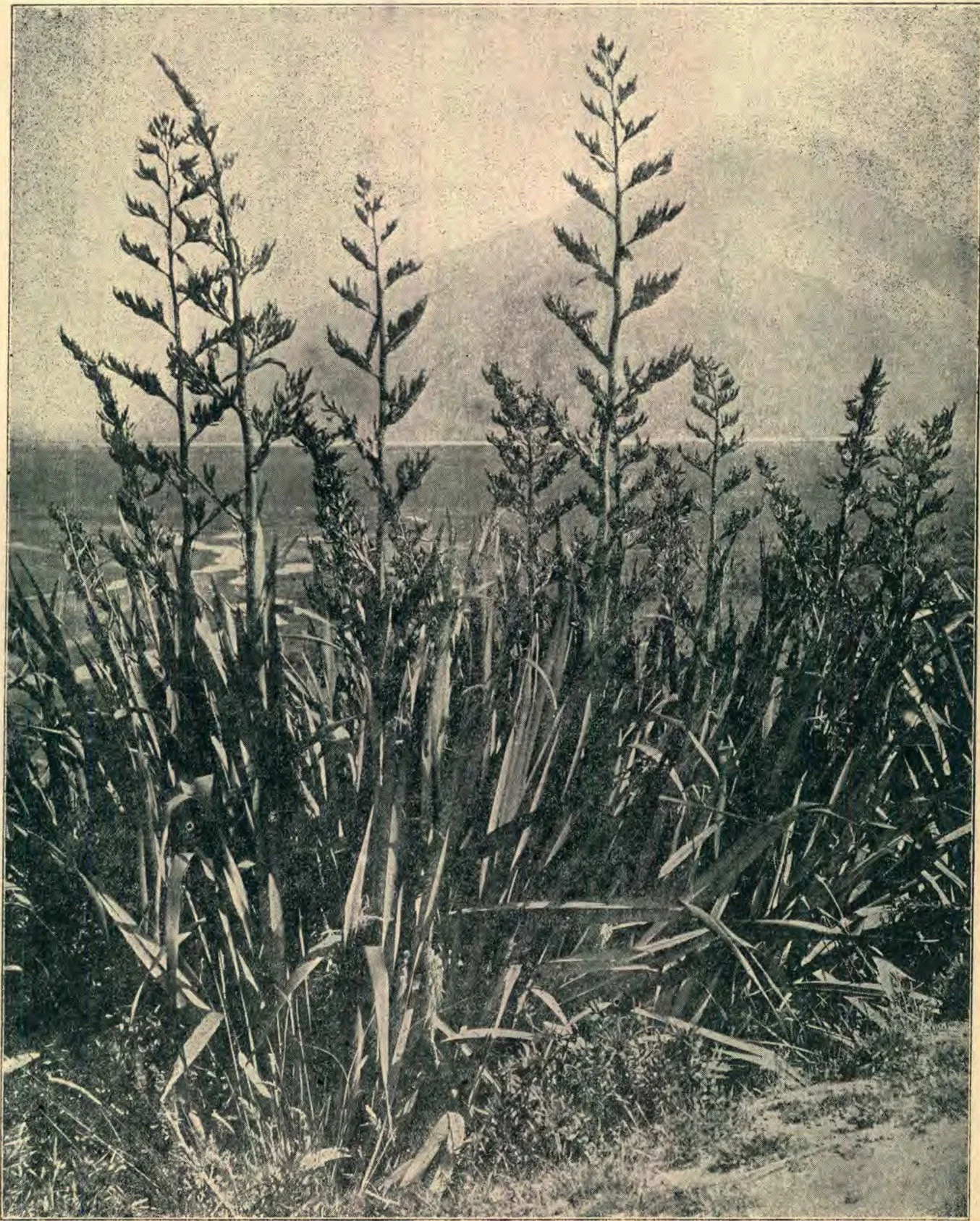
A NEW ZEALAND SCENE
A NEW ZEALAND SCENE

You have reached the end of this edition.

The Youth’s Instructor · Mar 18, 1919