The Youth’s Instructor, Vol. 49, No. 28.

THE LOG JAM ON THE SANTIAM
Earlier text: THE LOG JAM ON THE SANTIAM

ONE LITTLE LABORER WITH GOD

“Once upon a time” there was a little girl named Sarah, and she worked in a great factory. She was a plain, pale, still little girl; and it was a dingy, noisy, ugly factory. They made toys and “notions” there.
When she walked through the door for the first time, she felt as if she were being swallowed by a huge, fire-eating dragon out of a story-book. For she was an imaginative little girl, and full of fancies. She gave a little gasp as the dragon’s jaws closed behind her with a bang and a click, and did not quite realize where she was until she was seated at a long table with many other girls, most of them older and larger than herself, and a sharp-voiced, sharp-featured woman was showing her how to put the bows on dolls’ slippers. Yes, that was her work. Each girl was provided with a box of slippers, a heap of bows, and a bottle of glue. And they were paid by the hundred. Sarah was sure she could do as many as any of the girls, after a little practice, even if they were older and larger. She shut her lips tightly, and determined to do it, anyway; for had not Grandma Hall always said, “Sarah’s master spry with her hands”? (That was long ago, so long,—a whole month,—before Sarah’s father died, and the farm and the dear old house had been sold, and they had come to the great, bustling city, where Sarah’s mother could “do tailoring,” as she used to when a girl, and Sarah could help pay the rent for their two small rooms by working in the factory.)
So Sarah set to work very energetically. Sometimes the glue brush would get nearly dry; but if there was enough to make the bow barely stick, she did not stop to dip it again. The more bows she could fasten on with one dipping, the better: it saved time. And she was determined to keep up with the others. That was the way they did, she discovered by a swift glance or two down the long table.
Presently her back ached a little, and she straightened up for a moment. In front of her, across the room, was a window, closed to keep the dust and din without from adding to the dust and din within. But through its specky panes she saw something that made her heart leap with joy, while the glad tears came to her eyes. It was the blue-white crest of old “White-cap,” the mountain whose slowly wheeling shadow she had measured all the happy days of her short life. It was not, then, so very far from home! She almost smelled the cool, fragrant breath from the thickets that clothed its shaggy sides. She almost heard the songs of the birds that built their happy homes and sang their joyous hymns there. Then she remembered some lines from a calendar left by a city boarder at the old farmhouse:—
“The inevitable morning Finds them that in cellars be, And be sure the all-loving nature Will smile in a factory.”
Why, it had come true! The all-loving nature had smiled in the factory, and—
A sharp voice recalled her from her dreaming, reminding her that girls who “loafed” could not expect to keep their places, even if they did work “by the piece” instead of “on time.”
So her fingers flew faster than ever; but when she started to put on a bow with too little glue, she stopped, blushing hotly. With the sight of the sturdy old mountain had come a vision of the beloved home life, the morning prayers, the Scripture reading; and one verse shone between her eyes and the dingy table: “For we are laborers together with God.”
“But that means grown people, and more important things than sticking bows on dolls’ slippers!” Sarah argued. But she knew better.
“I am a laborer with God!” whispered the honest little soul—softly, so that no one else heard. “I am; and I will labor his way.”
And as her fingers flew, other verses came to be with the first—about “doing all to the glory of God,” and “in the name of the Lord Jesus,” and working “faithfully, as unto the Lord.” So she was very happy as she worked; and the tired, disheartened mother was happy, too, that night, when Sarah told her all about it.
Sometimes the girls laughed at Sarah; for it was not long before they noticed how particular she was about the bows.
“What’s the odds?” they scoffed, “when we’re paid by the piece, and not half paid at that, and nobody’ll know how it’s done, so long as it looks well?”
“I would know,” said Sarah.
And I do not doubt that many a little girl was saved a great deal of sorrow over lost doll-slipper bows, just because they were glued on faithfully, “as unto the Lord.” And though the other girls laughed, Sarah noticed that many of them grew more careful as the days went by.
The years flew swiftly, in spite of hard work and many cares. By and by Grandma Hall went to rest with the dear ones, whom she had “loved long since, and lost a while.” Not long afterward, the dear mother fell asleep, too; and Sarah was left alone.
Perhaps you thought this story of faithful service would end in her having a fortune fall to her; or that some kind friend would take her away from the drudgery which she glorified. No; Sarah still works in the factory—weary often, very quiet sometimes; but she has much love given her freely; and in every room where she has worked, as finer parts of the work have been assigned her, more faithful service has been done. And when some girl, tired and disheartened, longs for a friendly hand, or the love and tenderness of the dear mother (perhaps hundred of miles away in a quiet country home), she turns naturally to the little, plain woman, with the sweet, firm mouth and steady eyes. And those who know best believe that no so-called “good fortune,” though richly deserved, could add to the fullness and happiness of the life lived amid the turmoil of a great factory by one little laborer with God.—Epworth Herald.

THE SAME DUTIES

Over and over, and over and over, The rains come down, and the grasses grow; Thistle and bracken, and milkweed and clover, On hill and meadow-way come and go.
Over and over, the robins remember The paths they traveled the year before; Over and over, from May to December, The fishes hurry from shore to shore.
These are the ways nature has of explaining How duties come, and how duties go. So, little friend, where’s the use of complaining, When birds and seasons content them so?
FRANK WALCOTT HUTT.

BLUEBIRD'S CASTLE

Poor Prince Bluebird's castle is empty and desolate. With a sad heart he has left what was once a happy home, but is now fast falling into ruin under the ravages of wind and rain. Whenever you hear the rain patter, and the wind sigh, remember the sad story of Prince Bluebird and his ruined castle.
Bluebird was a right royal little fellow, and dressed as became his station. He wore a satiny coat of rich blue, with a cardinal waistcoat of equal elegance. He was handsome, cheerful, and loved by every one, never doing a thing in his whole sweet little life to deserve the sorrow that broke his tender heart.
One day in early spring, when Bluebird was yet young, though quite “grown up,” there was a happy little wedding in the forest where he lived, and afterward he and his more soberly dressed, but still beautiful, little bird bride flew far away to the North, looking for a suitable place to spend the early summer.
After much searching, Prince Bluebird found a spot that he thought would make a nice home for the Princess: It was on an elevation, surrounded on all sides by a bright, green expanse called the Sea of Green Leaves; and here the castle was finally built. Though apparently frail, the foundation of the tiny home was yet so firm that even when the wind tossed the Sea of Green Leaves very roughly, Bluebird's castle stood unharmed. Can you wonder that he thought it safe from every foe?
For a time Prince Bluebird and his wife lived very happily in their charming home. The Princess had a great deal to do about the castle, and in caring for the little birdlings, which filled it to overflowing with love and happiness. The Prince sometimes helped in finding food for the children; but most of his time was spent in flitting back and forth about their pretty home, or, perched on a near-by twig, singing to his little family.
The rest of the story is sad to tell. One day a dreadful creature made its way cautiously up among the green billows of the Sea of Green Leaves, and slowly neared Bluebird's castle. This creature had hard, cruel hooks on each of its four feet; and where the light was dim, its green eyes glowed like fiery coals.
NOW LET ME SET THEE FREE AGAIN
The Princess screamed in frantic terror, and trembled pitifully; while the courageous Prince, though his heart was beating fast with fright, did his brave best to prevent the monster's approach. But every effort was vain. Heedless alike of the cries of the poor Princess mother and the brave resistance of the Prince, the beast entered the castle, seized the baby bluebirds in its great mouth, and then slunk away.
Poor Bluebirds! they never saw their babies again. The Princess sadly mourned for them; and though his own heart was aching, the Prince tried to comfort her. After a time their love for each other helped to lessen their grief, and Prince Bluebird began to hope that some day they might again be as happy as when their home was new.
But the worst was yet to come. One summer morning, when the Prince returned from a short trip, the Princess was nowhere to be seen. He called, but she did not answer; he sang one of his sweetest songs, but heard no gentle chirp in reply; he searched, but he could not find her. Then he waited and waited, but she did not come; and all the love, and loneliness, and grief of his sweet voice could not bring her to his side.
Prince Bluebird's sorrow was deep, but it would have been still greater had he known the fate of his little helpmate. Struck by a stone from a sling-shot in the hands of a cruel boy, she lay in the sweet white clover and velvet grass below her home, with a crimson stain on her red breast.
At last even Prince Bluebird's hopeful heart gave up in despair, and he felt that he could bear his loneliness no longer. So one beautiful day he took a farewell look at the little castle where he had been so happy, and then went away, never to return.
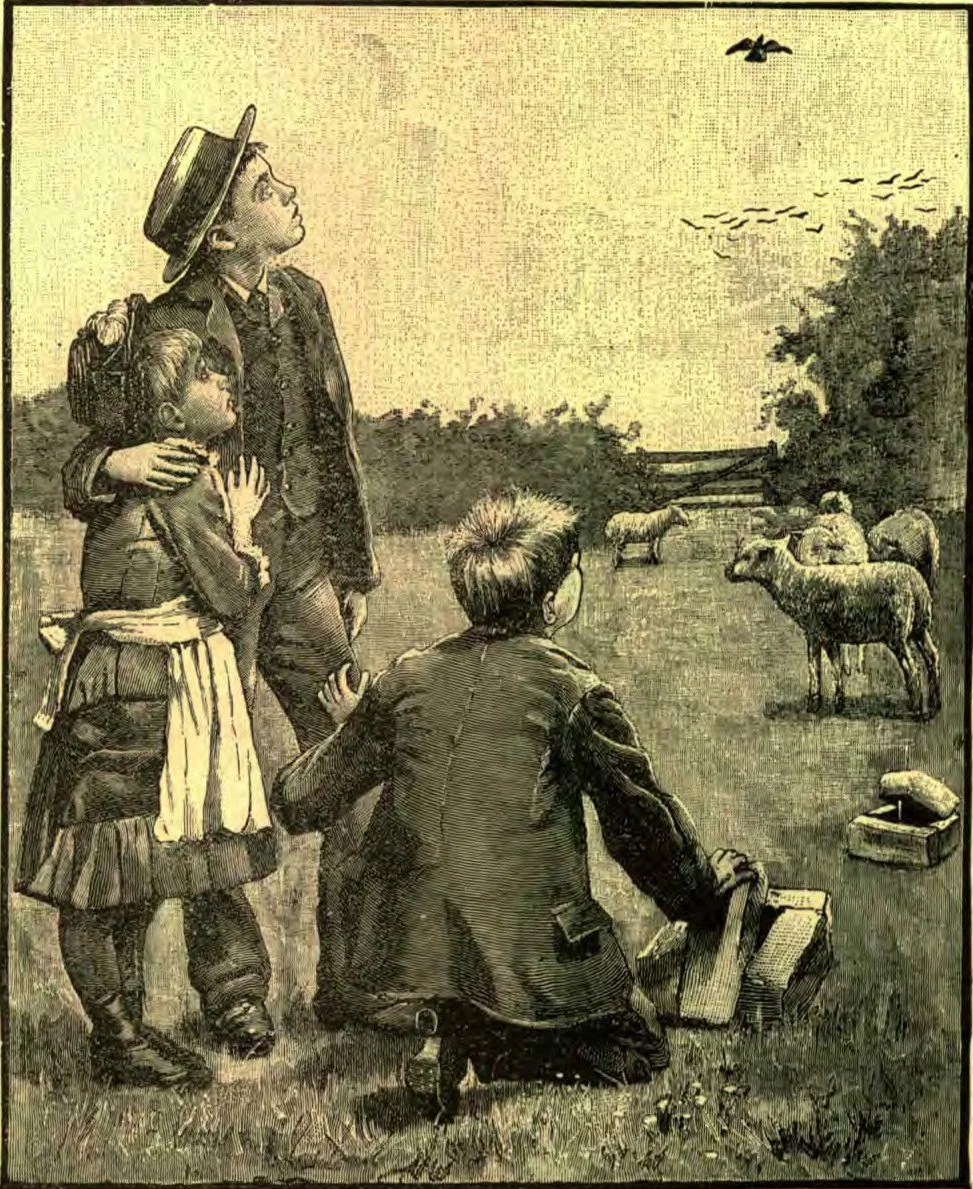
The forsaken castle still stands, shaken by winds and pelted by rains, but finally its walls will crumble and disappear. Perhaps some day the cruel boy with the sling-shot will chance to see the deserted castle falling to ruin in the winter wind; and his own heart may tell him that it was he who helped to make that little home desolate, and stilled the happy songs of poor Prince Bluebird.
MINNIE ROSILLA STEVENS.

REPENTANT

Ah! little bird, I laid this snare To rob thee of thy liberty; I thought there was no one to care If thou shouldst captive be, or free.
But I have found, upon a tree, A nest of birdlings, cold and dead, And I believe that thou art she Whose love those birdlings warmed and fed.
Now let me set thee free again, With joyful throat to greet the morn; But O, I can not ease thy pain When thou shalt find thy nest forlorn.
ELIZABETH ROSSER.

THE VISION OF DANIEL IN CHAPTERS 8 AND 9

(July 20)
Memory Verse.—Dan. 8:14.
1. At what time did Daniel have the vision recorded in the eighth chapter? Dan. 8:1; note 1.
2. What different things were seen in this vision? Vs. 3, 5, 9.
3. In this same vision, what wonderful statement did the prophet hear? V. 14; note 2.
4. What did Daniel at once do after seeing the vision? V. 15.
5. Who was sent to explain the meaning of what he had seen and heard? V. 16.
6. What did the angel say the ram represented? V. 20.
7. What did the goat represent? V. 21.
8. What was pointed out by the “little horn” of verse 9? V. 23, last part.
9. What were the last words of the angel to Daniel at that time? V. 26.
10. Was the last part of the vision explained? V. 27; note 3.
11. Afterward what did Daniel begin to study? What did he learn? Dan. 9:2; note 4.
12. In his prayer what special request did Daniel make? V. 17; note 4.
13. While he thus prayed, who appeared to him? V. 21.
14. What did the angel say? Vs. 22, 23; note 5.

NOTES

1. “In the third year of the reign of king Belshazzar.” This was just a little while, a few months, before Babylon was taken by the Medes and Persians. Daniel had now been in Babylon nearly sixty-eight years. At the end of seventy years, God had promised to take his people out of captivity (Jer. 25:11, 12), and therefore it was but a short time before the promise was to be fulfilled. This vision was to prepare Daniel and his people for what the Lord had in store for them.
2. We must not forget that verses 13 and 14 are a part of the vision, and the most important part. The first part was given that we might understand the last part. Thus the vision contains four parts: first, the ram; second, the he goat; third, the little horn; fourth, the time of cleansing the sanctuary. In the margin of Dan. 8:14 we read, in place of days, “evening, morning;” that is, twenty-three hundred evening-mornings. This part of the vision is therefore the “evening-morning” part.
3. All of the first three parts were fully explained. The ram was a figure of Medo-Persia, the he goat of Grecia, and the little horn of “a king of fierce countenance,”—the Romans. Only one part was left unexplained, that of the promise to cleanse the sanctuary. All that Gabriel said about this was, “The vision of the evening and the morning which was told is true; wherefore shut thou up the vision; for it shall be for many days.” The “evening-morning” part was left for Daniel to study over.
4. Daniel tells us that he did the very studying which was left for him to do. The part of the vision about the sanctuary was the part over which he studied, meditated, and prayed. As he studied, he found that in a short time the seventy years’ captivity would end, and then his people would go back to Jerusalem, where the sanctuary had stood. He understood that the sanctuary of which the angel had spoken in the vision was the sanctuary at Jerusalem, now all broken down, and so he began to pray the Lord concerning it. But that was a mistake; and so the Lord sent his angel to give Daniel light, and to cause him to know the truth. We may learn from this that when we study earnestly to know the truth, and are in danger of making mistakes, the Lord will send angels to correct us.
5. Without doubt Gabriel had come to explain the part of the vision which Daniel did not understand,—the part concerning the sanctuary,—the “evening-morning” part. This was a question of time—of “two thousand and three hundred days.” The first words of the angel are about time. See verse 24.

A FRIENDLY FIELD-MOUSE

Many stories have been told in the past, tending to show that wild animals, when in trouble, will display surprising confidence in man; in fact, will often seek his assistance when sore beset. The writer, when a boy upon a farm in Minnesota, had an experience with a field-mouse which prettily illustrates this trait in wild creatures. It was stacking time, and the men were all busy in the fields lifting the shocks of cured grain and stacking them in hive-shaped stacks in the barn-yard. The writer, a barefoot boy at that time, had been following the wagons in the field all the morning in a vain endeavor to capture some field-mice to take home as pets. He had seen a number of the little drab creatures, with their short tails, but had failed to lay his hands upon any of them, owing to the thick stubble and the nimbleness of the mice. At last, as a particularly large shock was lifted, a broken nest was disclosed, and the youthful mouser was put upon the qui vive by the faint squeaks of seven or eight hairless little beings that were so young as not to have opened their eyes yet. The mother disappeared with a whisk, whereupon the young hunter sat down in a critical attitude beside the nest, and began to examine his find. He had already put one of the young mice in his pocket when the mother reappeared out of the stubble beside the nest. The boy held his breath, and awaited developments. Much to his surprise, the mouse-mother, after carefully examining the ruined nest, entered his pocket, which, as he sat, opened very near the nest. She seemed to come to the conclusion that her lost little one had found a good home, and in about two minutes had transferred the remainder of her offspring from the nest to the pocket, carrying them one at a time in her mouth.
The writer has had many and varied experiences with wild animals, but none which impressed him so strongly as the episode of the mouse-mother in the wheat stubble.—Selected.

THE FIRST MIRACULOUS DRAFT OF FISHES

I

INTRODUCTORY

Preceding Events.—The following important events occurred between the working of the second miracle at Cana and this, the third miracle:—
  1. First rejection at Nazareth. Luke 4: 16-30.
  2. Christ’s removal to Capernaum. Matt. 4: 13-16.
  3. The final call of the four. Luke 5: 1-11. (NOTE: The working of this miracle was immediately associated with the final calling of the four.)
Main Reference.—Luke 5: 4-11.
Other References.—None.
The Bible Story of the Miracle.—“Now when he had left speaking, he said unto Simon, Launch out into the deep, and let down your nets for a draft. And Simon answering said unto him, Master, we have toiled all the night, and have taken nothing: nevertheless at thy word, I will let down the net. And when they had this done, they inclosed a great multitude of fishes: and their net brake. And they beckoned unto their partners, which were in the other ship, that they should come and help them. And they came, and filled both the ships, so that they began to sink. When Simon Peter saw it, he fell down at Jesus’ knees, saying, Depart from me; for I am a sinful man, O Lord. For he was astonished, and all that were with him, at the draft of the fishes which they had taken: and so was also James, and John, the sons of Zebedee, which were partners with Simon. And Jesus said unto Simon, Fear not; from henceforth thou shalt catch men. And when they had brought their ships to land, they forsook all, and followed him.” Luke 5: 4-11.
Place.—Near Capernaum, by the sea of Galilee.
Circumstances.—This miracle was worked without the request of those who benefited by it. It appeared as a result of obeying Christ’s command, “Launch out into the deep, and let down your nets.” The disciple-fishermen had already spent the night, the best time for fishing, in fruitless toil. The working of this miracle immediately precedes the final calling of Peter, Andrew, James, and John, from their work as fishermen, into the great and glorious work of becoming fishers of men. The miracle was worked under the personal supervision of Christ.
Great Lesson.—One of the great lessons taught by this remarkable miracle is that we should persevere under difficulties, obey in the face of obstacles, close our eyes to apparent failures in the great task of fishing for souls, and recognize divine foresight and providential leadings in every experience connected with the great work of catching men. The pathway of success to-day sometimes carries us by the scenes of yesterday’s failures.

STUDY OF THE MIRACLE

He said unto Simon, Launch out into the Deep.—Christ had been teaching the multitude, but now he addressed one of his disciples personally. It is sometimes easy to accept truth which is spoken to a large audience, but now comes the personal test to Simon,—“Launch out into the deep, and let down the net.” To obey this command would greatly test the faith of Peter and his associates. The disciples, it would seem, had been fishing in shallow water, and were fearful of getting out far from shore; perhaps they were afraid of storms and contrary winds. But the Saviour said, “Launch out into the deep,” and then, “Let down your net.” Let us not fear to launch out into the deep waters to fish for souls when the Master has spoken. We may learn a spiritual lesson from this circumstance. Sometimes we go about our work of soul-saving in fear and hesitation, afraid to risk much in our efforts to catch men; but we must go out into the deep waters before we can expect great things, or be able to do a great work. The Christian worker must move forward in confidence, expecting great things from God.
Let Down Your Nets.—Often we toil all day and far into the night, and meet with little success. It may be for the purpose of developing patience and perseverance, and again it may be because it was not his word that directed us to the place where our nets were lowered. If this be the difficulty, let us listen and receive the message from above, and obediently make such changes in our methods of work and field of labor as may be required. In enabling the disciples to secure a draft of fishes after they had toiled all night, and failed, the Master gives us a beautiful illustration both of his willingness and of his ability to qualify us for the great and sacred work of catching men. He stands ready to help us even after apparent defeat, and upon the very verge of despair. Another lesson to be learned from this miracle is to labor on, when the Lord has spoken, in spite of disappointments and unfavorable circumstances. When his Spirit directs, let not adverse conditions and unfavorable surroundings deter us. This miracle teaches us the necessity of employing every means at hand in connection with soul-saving work. Christ did not cause the fish to be miraculously washed ashore, or to jump into the boats. The disciples must first cast the net, and this act represented all they were able to do. Divine Providence arranged the rest. In this miraculous draft of fishes, the Lord employed the nets and boats, to catch the fish and bring them ashore. He used the usual manner of catching fish, simply adding his special blessing. So let us adhere to the old way of catching men,—fishing for them individually, casting out the gospel net; only we must have the divine blessing attend our efforts if we would achieve lasting success. However essential is human instrumentality to the work of saving sinners, we must remember that of ourselves we are utterly insufficient, however skillful or experienced as soul-winners we may be. Were not these apostles experienced fishermen? Had they not followed that vocation for their livelihood? And yet they toiled all night, and took nothing. If we are deceived into depending upon our own sagacity, or relying upon our own experience, we shall meet with certain defeat in every effort to rescue the perishing and uplift the fallen.
W. S. SADLER.
(To be continued.)

Half Truths More Calumnious Than Falsehoods

HALF truths are often more calumnious than whole falsehoods. It is not even necessary that a word should be distinctly uttered; a dropped lip, an arched eyebrow, a shrugged shoulder, a significant look, an incredulous expression of countenance, nay, even an emphatic silence, may do the work; and when the light and trifling thing which has done the mischief, has fluttered off, the venom is left behind to work and rankle, to inflame hearts, to fever human existence, and to poison human society at the fountain springs of life.—F. W. Robertson.

Peace, Grace, and Glory: A Moody Quotation

PEACE for the past, grace for the present, and glory for the future. Yes, there is a glory for the future; nothing before the true believer that isn’t glory. I think it would take the wrinkles out of your brow if you would just look into the future instead of into the past.—D. L. Moody.

GRAND TRUNK R'Y. SYSTEM.

Taking Effect June 2, 1901.
Trains leave Battle Creek.

WEST-BOUND.

Train Destination or description Time
No. 9 Mail and Express, to Chicago 12.15 P. M.
No. 7 Limited Express, to Chicago 7.00 A. M.
No. 1 Chicago Express, to Chicago 9.23 A. M.
No. 3 Lehigh Valley Express, to Chicago 3.50 P. M.
No. 5 International Express 2.17 A. M.
No. 75 Mixed, to South Bend 7.30 A. M.
Nos. 9 and 75, daily, except Sunday.
Nos. 1, 3, 5, and 7, daily.

EAST-BOUND.

Train Destination or description Time
No. 10 Mail and Express, East and Detroit 3.45 P. M.
No. 8 Limited Express, East and Detroit 4.50 P. M.
No. 4 Lehigh Express, East and Canada 8.22 P. M.
No. 6 Atlantic Express, East and Detroit 2.10 A. M.
No. 2 Express, East and Detroit 7.00 A. M.
No. 74 Mixed (starts from Nichols yard) 7.15 A. M.
Nos. 10 and 74, daily, except Sunday.
Nos. 4, 6, 8, and 2, daily.
W. C. CUNLIFFE, Agent, BATTLE CREEK.

SELF-PRONOUNCING S.S. Teachers’ Reference Bible

Contains the Celebrated Teachers’ Helps,
Comprising nearly 400 pages. Also a complete series of fifteen new maps.

DESCRIPTION

IMPERIAL SEAL BINDING, TUCK EDGES, known as “DIVINITY CIRCUIT,” ROUNDED CORNERS, FULL RED UNDER GILT EDGES.
We offer this Bible, postpaid, for only six new yearly subscriptions at 75 cents; or twelve new six months’ subscriptions at 40 cents.
We will also send it, postpaid, with the INSTRUCTOR one year for $2.25. For 20 cents extra we will stamp your name in gold upon the cover. Address—
THE YOUTH’S INSTRUCTOR, Battle Creek, Mich.

MOMENT BY MOMENT

Dying with Jesus, thy death reckoned mine, Living with Jesus, a new life divine; Looking to Jesus till glory doth shine, Moment by moment, O Lord! I am thine.
Never a trial that he is not there, Never a burden that he doth not bear, Never a sorrow that he doth not share, Moment by moment I'm under his care.
Never a heartache, and never a groan, Never a teardrop, and never a moan; Never a danger, but there on the throne, Moment by moment, he thinks of his own.
Never a weakness that he doth not feel, Never a sickness that he can not heal; Moment by moment, in woe or in weal, Jesus, my Saviour, abides with me still.
— D. W. Whittle.

Growth of a Venerable Yew-Tree in Selborne

One hundred and twenty years ago, Gilbert White, whose “Natural History of Selburne” has been a delight to nature-lovers for more than a century, measured the trunk of a large yew-tree in the church-yard of the village of Selburne. He found that the trunk was twenty-three feet in circumference, and estimated its age at several centuries. Not long ago the tree was measured again, and was found to have gained two and one-half feet in circumference, or nine and one-half inches in diameter, since White’s measurement.

A Reputation for Honesty Is Worth More

A REPUTATION for honesty is worth more than an inheritance of money to any young person. And it is a possession for which he alone is responsible: no one can give it to him; he must win it for himself if he would have it. It used to be said of a certain business man that “his check was worth a million, but his word was not worth a bean.” Make your word worth millions, boys and girls; make it absolutely trustworthy, even if other things have to go. Do not allow yourself to stumble about in the fogs of falsehood and prevarication; but keep in the clear light of truth, remembering that “he that walketh uprightly walketh surely.”

SCRAMBLED FACTS

Such is the not very happy caption given to a column devoted to certain items in an exchange. Scrambled facts are not the kind with which one likes to burden his mental digestive apparatus, nor are they productive of any sort of mental strength. There are too many scrambly thinkers in the world; too many who do not take pains with the facts they learn—to keep them separate, distinct, and ready for use at an instant’s notice. Even facts that are good in themselves, or at worst, not capable of very extensive harm, may become an actual menace when scrambled together, seasoned with suspicion, toughened over the fierce fire of personal prejudice, and so passed out to the world. A slighting word, scrambled with an unwise decision, a hasty act—and what mischief may not the whole work?
Take care that the things that are told you for “facts” are not scrambled; and that when they are related by you to some one else, you do not begin the process.

THE SMALLEST REPUBLICS

How many can tell what they are, and where they are situated? According to the Literary Era, the smallest republic, in point of area, is Goust, in the Lower Pyrenees, which occupies less than one square mile of territory on the side of a mountain. The republic consists of about one hundred and fifty persons, who elect their president every seven years. Its independence has been recognized by both France and Spain for more than two hundred and fifty years.
But in point of population there is a still smaller republic — Tavolara, a small island a few miles north of Sardinia. This island is five miles long by five eighths of a mile in width, and has a population of about fifty souls. Sixty-five years ago the king of Sardinia conferred the absolute dominion of the island upon a prominent native family, whose head immediately took the title of King Paul I. He was the first and last king of the little island; for at his death he requested that the monarchy be transformed into a republic.
This was done. A constitution was adopted which confers the right of suffrage upon men and women alike, and by which a president, with a council of six, is elected every six years. No salary is paid either to the president or to the members of his council.
Neither Goust nor Tavolara is mentioned by the gazetteers.

FOR EVERY DAY OF THE WEEK

Sunday:

A good conscience, like the eye, is troubled by any speck of defilement and wrong that falls into it.—Dr. H. Bushnell.

Monday:

“He who does not respect himself, can not long hold the respect of his fellows; and he who truly respects himself, can not long be deprived of the respect of his fellows.”

Tuesday:

“Go make thy garden fair as thou canst, Thou workest never alone, Perchance he whose plot is next to thine Will see it, and mend his own.”

Wednesday:

“We are not writing in the sand. The tide does not wash it out. We are not painting our pictures on the canvas, and with a brush, so that we can erase the error of yesterday, or overlay it with another color to-day. We are writing our lives with a chisel on marble; and every time we strike a blow, we leave a mark that is indelible.”

Thursday:

But if my lot be sand where nothing grows! Nay, who hath said it? Tune a thankful psalm, For though thy desert bloom not as the rose, It yet can rear thy palm. —Christina G. Rossetti.

Friday:

“Place a guard over your strong points! Thrift may run into niggardliness, generosity into prodigality or shiftlessness. Gentleness may become pusillanimity, tact become insincerity, power become oppression. Characters need sentries at their points of weakness, true enough, but often the points of greatest strength are, paradoxically, really points of weakness.”

Sabbath:

“They shall not hurt nor destroy in all my holy mountain: for the earth shall be full of the knowledge of the Lord, as the waters cover the sea.” Isa. II: 9.

Go Work To-Day, Says the Master

Go work to-day, says the Master. To-morrow is uncertain; he asks your service now.

The Far-Reaching Effects of Explosive Tempers

SOMETIMES in reading of an explosion of dynamite or gunpowder, we are told that “it was felt ten miles away,” or more, as the case may be, and of the damage it did at this distance. There are other explosions besides those mentioned whose shock is felt far beyond the scene of the disaster. Explosions of various sorts—of temper, ill feeling, fretfulness—how far-reaching are their effects, and how disastrous! The best way to avoid their results is to avoid the cause itself—or to keep such guard over ourselves that there shall be no cause.
Continue reading: Preserving Pressed Flowers and Natural Color