The Youth’s Instructor, Vol. 49, No. 28.

THE LOG JAM ON THE SANTIAM

The Youth’s Instructor

Jul 11, 1901

Review and Herald Publishing Company · Battle Creek, Mich. · Jul 11, 1901

THE LOG JAM ON THE SANTIAM
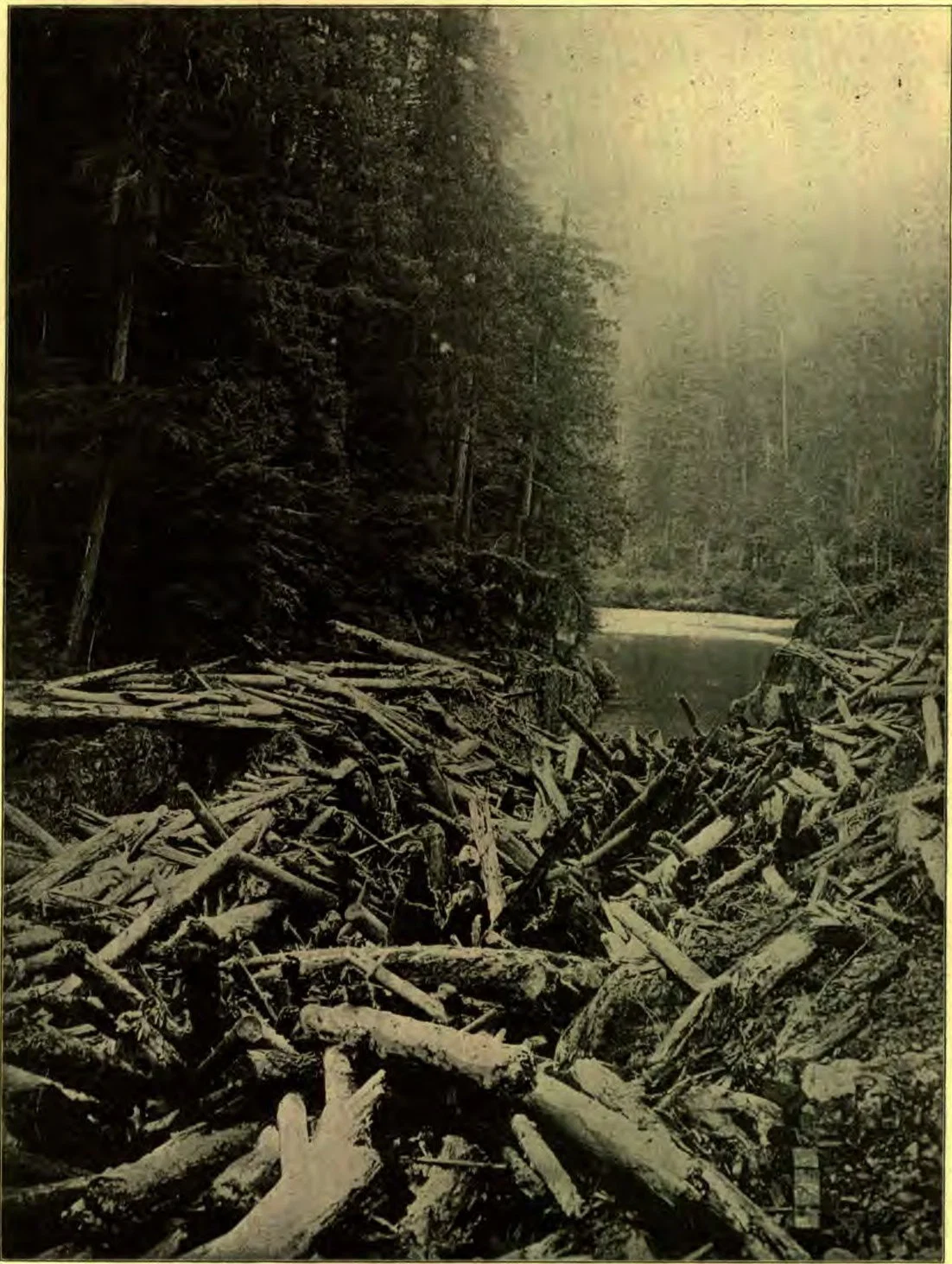
At its normal height, the Santiam River flows over a bed of smooth, round cobblestones on the greater part of its journey from the mountains to the sea. Sometimes an immense boulder lies in its way; but the stream parts, and moves around the obstruction with a ripple and a laugh. At other places a wall of basalt lies across the path the stream would fain follow. Against this the water splashes; then, murmuring out a protest, it turns aside, and follows some other course. Again, two walls of rock may, for a short distance, confine it to a narrow channel. Through this the water rushes with a discontented roar, to spread out again upon its wide, cobblestone bed, or rest for a moment in some deep, dark pool.
But the river is up now. The boulders are covered so deeply that they cause scarcely a ripple on the surface of the water. The willows that used to line its banks, caught drifting reeds and rushes and twigs until they were no longer able to bear the strain; then they bent down before the rushing water, and now lie prone along the muddy bottom of the swollen stream. And there they will lie until the flood subsides, and the danger is past. Then they will slowly lift their heads; and when a shower washes the mud from their bright leaves, they will be none the worse for their experience.
THE GREAT JAM ON THE SANTIAM
Some of the trees that used to stand far up on the river-banks are now surrounded with water. Most of them stand unmoved, but some are torn up by the roots, and swept down the stream by the powerful current. Among the former is a great hemlock. At low water it stood near the river-bank, but now it is almost in the middle of the stream. That tree has stood through many a flood like this; and now from its great height it looks down with disdain at the water surging at its feet. Now and again the angry flood hurls against it a drifting stump or log. Its bark is scarred; its branches quiver; but the proud old hemlock does not give an inch. But down the stream drifts a great fir-log, which the angry river has stolen from the lumbermen above. One of its sawn ends is pointed down the stream, and it strikes the hemlock with terrific force. A shower of needles and twigs falls upon the water; there is a muffled snap among the roots of the noble tree; then the drifting log swings past, and continues its course down the stream.
But the hemlock no longer stands erect. One of its roots was broken, and, deprived of that support, it now leans slightly down the stream. Still it may stand, we think. But as we watch it closely, we see it slowly sinking. So slowly at first that the motion is scarcely perceptible, but it goes faster and faster until there is another muffled snap. Then, with a great splash, it falls, and is swept down by the current. Not far below stands one of those walls of basalt. Against this the tree is hurled, top first.
The top is broken off, the branches are shattered and split; and when the hemlock swings clear of the wall, it is no longer a noble tree, but only a drifting log.
We hear a sullen roar; and as we hurry down the stream, we see the log swept into a narrow cañon with race-horse speed. Now at the mercy of the flood, it is dashed against one wall; then as the end swings out, it is hurled against the other, until the remaining stumps of its disfigured branches are crushed and broken off close to the trunk. Just before it reaches the foot of the cañon, and the smooth water beyond, one end is caught in a niche in the rocks, the other end is dashed against the opposite wall; and there the log lodges. It is only a log; but it is a giant still, and all the mad waters of the flood are powerless to move it now.
Another drifting log is thrown against the hemlock; but it lodges alongside, and helps bear the strain. Still another is dashed against these two; but it glides under, strikes the rocks just below, catches the hemlock in the crotch of one of its broken limbs, and serves as a brace. Again and again the surging waters carry trees, and logs, and stumps into the cañon, and hurl them with terrific force against the jam; but there they lodge, and serve only to make the jam more firm.
All this happened years ago. The hemlock, and many of the other logs that helped begin the jam, have long since fallen into decay, and their remains have been washed away by succeeding floods. But each year more driftwood has been added to the jam; and now it fills the whole cañon. So firmly are the logs lodged, that it would require tons of dynamite to move them; and so tightly are they packed together, that when one stands on the top of the jam, he can scarcely hear the ripple of the water underneath.
J. EDGAR ROSS.

THE COUNTRY ROAD

From the busy fields of farmer-folk, It starts on its winding way, Goes over the hill, and across the brook, Where the minnows love to play; Then past the mill with its water-wheel, And the pond that shows the sky; And up to the bridge by the village store, And the church with its spire so high.
You would never think that the country road, From the hill to the store, could be So long to a boy with an errand to do And another boy to see. You can never dream how short it is From the farm to the frozen pond, Nor how very much farther it always is To the schoolhouse just beyond.
Oh, the country road! at the farther end It runs up hill and down, Away from the woods and the rippling brook, To the toiling, rushing town; But, best of it all, when you're tired and sick Of the noisy haunts of men, If you follow it back, it will lead you home To the woods and fields again.
— St. Nicholas.

THE RESCUED VILLAGE

It was in 1879 when circumstances overthrew all my well-laid plans for the future, and compelled me to abandon my studies, and look for practical employment.
Nobody could have been more pleased than I when a college chum informed me that his father was connected with a railroad concern that wanted a qualified young man as surveyor's assistant to go to Upper Hungary, where they had a short line under construction. His father knew me well, and so, for the asking, I could have the place. Four days later I was at work.
It was while thus employed that I passed through an experience that I shall never forget.
One day the foreman of a gang of laborers working on the road-bed, reported that the stakes driven during the definite survey did not correspond with the specified plan of that particular section. As these stakes had been verified by the surveyor only a few days before work was begun, not much importance was attached to the complaint, and it was deemed sufficient to send me to find the cause of the difficulty.
The tripod with surveying compass on my shoulder, I accompanied the foreman to where work was in progress.
Along a steep incline on the southern slope of the Carpathian Mountains, the road was staked out nearly sharp from west to east; a seemingly prosperous village in the valley below. The slope was almost bare; small, grassy spots, and a very few poor-looking bushes scattered at long intervals; no trees to break the monotony.
At first glance, I was sure that some stakes must have changed their relative positions since our surveyor, with me as his assistant, had gone over the line a few days before. But close examination convinced me that nobody had touched them in the meantime. While stooping down to look at one of the stakes that was remarkably far from what must have been its original place, some pebbles came rolling down; I looked around to discover the cause of this, but no animal was in sight, and our laborers were standing a few feet below. Thinking of an earthquake, I pressed my ear against the ground: there was not the slightest disturbance.
Discussing the features of the case, the foreman and I were slowly walking around to inspect the ground more thoroughly when, being thirsty, I remembered that close by I had seen a spring bubbling from the mountain-side, its water flowing into a brook near the village.
This spring had ceased to flow: its place was covered with earth and stones! Then the terrible truth dawned upon me that the upper stratum had become separated from the solid rock, and was pressing toward the valley, so slowly now as to be quite imperceptible, but surely to end as a landslide within a few hours.
Being in a subordinate position, I could only order the laborers away, and send for the chief surveyor, while I warned the villagers.
It was just in time: through well-calculated blasting, the final movement was started at the extreme left of the affected area, and thereby the downward rush of the immense mass diverted from the village, which otherwise must inevitably have been destroyed.
To this day, I firmly believe that God in his grace used me to protect the villagers as well as our laborers from serious harm. Miracles happen in our days just as frequently as they happened in olden times; it is merely the worldliness of the present generation that accepts them as a matter of fact.
Much credit was given to the surveyor and to me for the “successful management” of the affair; but the Lord's timely warning, which alone prevented a disaster, was apparently forgotten.
GUSTAVE S. ZEIGLER.

THE DEATH OF A GREAT FIJIAN

The king of Fiji is dead. Of course all understand that Fiji has had no authorized king since Cakabau, the great cannibal; but his son has held a government position under the British, and by the Fijians he was looked upon as the greatest Fijian, and was treated with more respect than any other man in Fiji, white or brown. On approaching him all inferiors made the shout of respect, “Muduo! wo!” This shout is also given to other high chiefs, being the recognized title of respect.
The burial of this chief is in great contrast to the burial of a Fiji chief fifty years ago. At that time the polygamous wives of a dead ruler were always strangled, and buried with him. He was specially dressed for burial, his body being blackened to his waist, and in his hand a war club was placed, with which to fight his way to the spirit world. Not only were his wives murdered, but often a large number of other persons were killed for the burial feast. Fiji was a terrible, cannibal land, and cannibalism was also a part of the ancient religion.
Now cannibalism has passed away, and these horrid rites are seen no more. Formerly the dead were rolled up in mats, and buried. Now many are buried in coffins. In one respect the modern burial is similar to those of former days,—the burial-feast is always celebrated, not only for the high, but for the low as well. To you feasting does not seem to go well with thoughts of the dead, but the poor Fijian is not so refined.
Several feasts are held after the death of a person in Fiji. It is said that about three hundred hogs will be slaughtered for this chief’s burial-feast. Besides, there will be enormous quantities of all native vegetables and fruits gathered from all parts of the islands.
J. E. FULTON.

PLEASANT SURPRISES

When Elijah sent his servant up to the top of Mount Carmel to look for the coming of rain, he came back, and said, “There is nothing.” He went up six times, and came back with the same report. After six journeys to the top of the hill to look out over the Mediterranean, to find the sky each time bare and cloudless, the servant had dismissed all hope. He would still climb the steeps and look out, because his master told him to do so. But what was the use?
Imagine the servant’s surprise when he went up the seventh time, and discovered a cloud—yes, a cloud! He had been saying, over and over again, “There is nothing,” and now all at once, “There is something.” This is how pleasant surprises often come to us. We have been saying, like the servant, “There is nothing,” when all of a sudden we have had to take it back, for we have met a pleasant surprise. To be sure, there are very many hardships, but there is hardly a life that has not now and then some pleasant surprise.
How often, for instance, we have looked for something, and when we have found it, it was even better than we expected. Or if we did not find what we wished, we have often found a substitute that was vastly better.
Saul the son of Kish went out to find his father’s asses. He did not find them, but he found a kingdom, and returned with the oil of anointing on his head. Columbus, the explorer, sailed westward to find a southwest passage to the Indies. He found, instead, this vast and rich continent. The disciples of Christ toiled all the night, and “took nothing;” but in the morning, when it was light, they saw Jesus on the shore.
Have you had no pleasant surprises such as these, when you found that the substitutes were better than the first things you sought?
The story of discovery and invention is often a story of pleasant surprises. Thoughtful men—the world’s discoverers and inventors—have stood unconsciously in the presence of some great truth, sometimes in despair because they could go no further, when of a sudden the door of some new field of knowledge flew open at their feet.
Sir Samuel Brown, it is said, meditating upon the construction of a bridge over the River Tweed, walked in his garden, and was taught by a spider, which had flung the cables of her delicate bridge-work across his path.
Another inventor, studying the problem of tunneling the Thames, was surprised into his discovery by watching the ship-worm, which, perforating one way and then another, formed an archway, which was then daubed with slime.
In lesser ways many of us have had this same experience. God’s storehouse is never exhausted. There is always something more beyond. How you have been surprised in your own thinking! You have had some ordinary thought, or you have read some commonplace sentence in a book, suddenly to find your thought opening out into something richer and better than you dreamed.
There are those who have been surprised about the use of their own material. They never knew it would go so far. What a life lesson in that pot of oil which the prophet replenished! “Not anything in the house, save a pot of oil.” Can you imagine the widow’s surprise when even the borrowed vessels overflowed? I have known young men to be very much dissatisfied with their positions. They have said, rather bitterly, “There is nothing in this for me.”
I have sometimes thought that the trouble was not in the position, but in themselves. They have undervalued their resources, and have made too little of their surroundings. The thing to do is to put yourself into your position, and to use what you have to the best advantage. Make everything count,—time, habits, diligence, study, politeness, skill. Reach out and use everything. Make meal out of every grain of corn you can find. There will be many pleasant surprises for those who, ceasing to despair, arise and lay hold skillfully of what they have, determined to achieve the best results possible.
It is astonishing what great results have been obtained from meager materials.
A pan of water and two thermometers were all that Dr. Black used for the discovery of latent heat.
A caller came to see Dr. Wollaston, and asked to be shown the laboratory where so many famous discoveries had been made. The student showed his visitor a tea-tray on a table, containing a few watch-glasses, some test-papers, a balance, and a blow-pipe, remarking, quietly, “There is all the laboratory I have.”
We often grow discouraged about ourselves and say, like the servant, “There is nothing. There is no ability, no capacity, no promise in me.” Surprises come here also. Have you never been surprised at your own success when you have put your strength to a task? Read the account of the call of Moses. Moses made four excuses before he consented. At length the Lord said, “What is that in thine hand?” It was only a shepherd’s stick. What a wonderful agent that common rod became when Moses was willing. Your talent may be very ordinary, but use it—use it! God has given each of us some capacity. You have no right to say, “There is nothing.” Go up seven times, and see if the cloud of promise is not there.—Selected.

A DAY OF SUNSHINE

O GIFT of God! O perfect day! Whereon shall no man work, but play; Whereon it is enough for me, Not to be doing, but to be!
Through every fiber of my brain, Through every nerve, through every vein, I feel the electric thrill, the touch Of life, that seems almost too much.
I hear the winds among the trees Playing celestial symphonies; I see the branches downward bent, Like keys of some great instrument.
Blow, winds! and waft through all the rooms These snowflakes of the cherry blooms! Blow, winds! and bend within my reach The fiery blossoms of the peach!
O heart of man! canst thou not be Blithe as the air is, and as free? — Longfellow.

COMETS

As much has been said of late in the popular press regarding the sudden and unexpected disappearance of the three-tailed comet that so lately visited our solar system, it may be of interest to our INSTRUCTOR class to give some time to the study of these strange visitants, which so frequently emblazon our field of vision, and then as strangely take their hurried departure, many of them to the unknown realms of space, never again to return; at least, if they ever do come our way again, their whole form and conduct are so changed that we fail to recognize them.
We had hoped to have many a pleasant study with our INSTRUCTOR friends during the spring and early summer; but General Conference plans, like the comets we are about to study, often come unexpectedly across our pathways, and change all our prearranged ideas. We are glad to find ourselves pleasantly situated here in the sunny South, and thankful to have a part in the Lord’s great work of saving precious souls; and while these new arrangements bring to us many added cares and responsibilities, yet we hope to find time to spend an occasional evening with our friends, studying some of the many wonderful lessons God has so graciously placed within the reach of our mortal vision. As we do so, let us all look forward to that glad day when we shall see face to face, behold the land of “far distances,” and sing with the inhabitants thereof the praises of God.
Probably many of our readers felt disappointed when the comet that so lately flashed upon us, suddenly turned his tails in the opposite direction, and sped to—nobody knows where. Comets as a rule, are only visitors. They come unheralded; behave, while with us, in a most unaccountable manner, and leave just as mysteriously as they come. We know as little about them as any of the celestial phenomena. Personally, however, I am thankful for comets; for they prove most unmistakably the utter falsehood of that great foundation rock of infidel science,—the nebular hypothesis.
As we said, most of these comets are only visitors; yet there are quite a number which live in, and belong to, our solar system. These make, with some degree of regularity, periodic visits to the region of our sun; then retire, in a hurried manner, to the outer portions of our solar neighborhood. The accompanying illustration gives a general idea of the appearance of a single-tailed comet, as seen some distance from the sun.
The mind becomes bewildered when we try to grasp the immense size and fearful velocity attained by many of these bodies. It will be remembered that our earth is but a trifle less than eight thousand miles in diameter, and we think it quite a good-sized little ball; yet a comet no larger than our earth could hardly hope to be discovered by any one living here. The head of a comet—that which shows as a ball in the engraving—usually ranges from forty thousand to one hundred and fifty thousand miles in diameter. The comet that appeared in 1811 had a diameter of one million two hundred thousand miles, being forty per cent larger than our sun. The comet of 1680 was six hundred thousand miles in diameter. Imagine one of these tremendous bodies of light, followed by a hair-like coma, or tail, extending from it for a distance of from five million to fifty million miles. Several cases are cited where this stream of light exceeded one hundred million miles in length.
Now as to their rapidity: Our earth moves onward in its yearly journey around the sun at the speed of eighteen and one-half miles a second, or sixty-six thousand six hundred miles an hour; while the comet of 1680, mentioned above, traveled at the rate of eight hundred eighty thousand miles an hour; and one that was seen in 1843 moved at the rate of one million two hundred and sixty thousand miles each hour, or three hundred and fifty miles a second. The density of these bodies is exceedingly rare. Were it not so, they would produce general havoc in any system of worlds that they chanced to visit.
Even at the present day, comets are regarded by many as objects of superstitious reverence or abject terror. In 1456 one appeared whose size seemed equal to that of the full moon, its tail reaching from the horizon to the zenith. Such consternation was caused among the masses of Europe, that Pope Calixtus taught the people to pray that the Lord would save them from the devil, the Turk, and the comet.
DR. O. C. GODSMARK.
2005 Magazine St., Louisville, Ky.

WHAT YOU CAN DO NOW

A WOMAN having an abundance of curly-leaved lettuce, picked and washed some of it, and tastefully arranged it on a platter, with red and white radishes, also washed clean and bright, and took it to a neighbor as a remembrance of her birthday. The gift, with the kindly remark, “Such as I have give I unto you,” gave as much pleasure as would a choice bouquet.
This was a very little thing to do, but “little things” make a vast difference in lives. Can not you think of some one whom you may cheer in some such simple way? Do not put off the carrying out of your kindly impulse till another time, but do what you can to-day.
PHEBE UNDERHILL.

What True Success Means for Young People

“‘Success’ is a sadly mishandled word in these days. Neither prominence nor ‘a pile’ is success. Many a miserable failure dies with his name on everybody’s lips, or with his gold pile so big that he has not been able to count it. Success which is not more than mere notoriety or money is not worthy the serious consideration of sensible young people.”

THE COMFORT OF THE STARS

WHEN I am overmatched by petty cares, And things of earth loom large, and look to be Of moment, how it soothes and comforts me To step into the night, and feel the airs Of heaven fan my cheek; and, best of all, Gaze up into those all-uncharted seas Where swim the stately planets; such as these Make mortal fret seem slight and temporal.
I muse on what of Life may stir among Those spaces knowing naught of metes or bars,— Undreamed-of dreams played in the outmost stars, And lyrics by archangels grandly sung. I grow familiar with the solar runes, And comprehend of worlds the mystic birth,— Ringed Saturn; Mars, whose fashion apes the earth; And Jupiter, the giant, with his moons.
Then dizzy with the unspeakable sights above, Rebuked by Vast on Vast, my puny heart Is greatened for its transitory part, My trouble merged in wonder and in love.
— Richard Burton.

THE WORK IN OKLAHOMA

I AM deeply interested in the young people's work, and have been doing whatever I could for its advancement wherever I have labored. Last fall, with the help of others, I organized a company of young people at Oklahoma City for the spread of the third angel's message. Special attention has been devoted to those who had become indifferent, and in work for the unconverted. We meet once a week to study the doctrinal points of our faith, and for devotional service. We have had some excellent meetings during the last six months, and I think their influence has largely aided some in giving their hearts to the Lord. We realize that the work has not made the advancement that it should, but we hope for better things in the future, as we learn what others are doing, and come into closer harmony with one another. I know of no better way to unify this work and place it upon a proper basis, than to make, as has been decided, the INSTRUCTOR its official organ. I am sure it will be the means of great help to all. Oh, if our young people could only realize the importance of working for their associates and friends, what a harvest of souls would be gathered into the garner of the Lord! The young, who are strong and active, might become the instruments of doing a work that would be a joy throughout eternity.
Remember the work at Oklahoma City, that the Lord may bless us, and make each one a worker for him. HARRY A. PHILLIPS.

STUDIES IN THE CHRISTIAN LIFE

Analysis of Chapter III—Repentance

(July 14-20)
I. NATURE of true repentance. Notice what Paul says of it in 2 Corinthians 7.
2. Men who had a false repentance. Name four.
3. Prayer of David in Psalms 51—illustrates what?
4. Power to repent—where obtained?
5. How to repent:—
Behold the Lamb of God upon the cross.
The conscience is quickened.
Sin is revealed.
The heart longs for something better.
Ask God for repentance.
6. A glance at the heart through the Spirit:—
Daniel: My comeliness is turned into corruption.
Paul: Sin revived, and I died.
God's estimate of sin: (1) All sins are not equal; (2) No sin is small; (3) Pride and drunkenness.
Publican—in great need.
Pharisee—felt no need.
7. Exhortation of the chapter:—
Do not wait to make yourself better.
The sins and defects of others do not excuse any one.
Beware of procrastination.
Let us not regard sin as a trivial thing. Even one evil trait of character, persistently cherished, will eventually neutralize all the power of the gospel.
Christ does not force the will. Go to him with your soul all stained as it is.
Study God's word prayerfully.
Do not give up in despair as you see yourself as you really are.
When Satan tells you that you are a great sinner, look up to Christ, and talk of his merits.
Those to whom God has forgiven most, will love him most.
It is necessary that we become intelligent about the subject of repentance. There is a sin that can not be repented of, and because of a lack of knowledge concerning this, many become deeply distressed, and sometimes insane. This is as Satan would have it. He likes to confuse people about the plan of salvation.
Our lesson teaches us the nature of true repentance, the source of it, and the way to get it. The process requires a look into the heart by the aid of God's Spirit. Thus the conscience is quickened, and sin is revealed. At this point many become disheartened and give up, but this is the very time to ask God for help. As we look to Christ, our own hearts appear exceedingly sinful. This was Daniel's experience and also Paul's. The publican felt himself so great a sinner that he could not even lift up his eyes to heaven; the Pharisee, on the other hand, thanked God that he was not “even as this publican.” But which one was justified? The Saviour said, “I tell you that this man went down to his house justified rather than the other;” and “this man” was the publican.
One very encouraging thought in this chapter is that the sinner need not wait until he has repented before he can come to Jesus. There were to be no steps to the altar of atonement, as we read in Exodus 20. Not even so necessary a step as repentance is to come between us and Christ. One need not ascend to bring him down: he is already here by his Spirit, and “nigh thee, . . . in thy heart.”
In studying the lesson, sum up the important points, and trace them back to the Scriptures, whereon they are founded. The seventh of Romans contains Paul's experience in repenting. 2 Cor. 7:9-11 shows what true repentance includes. Heb. 12:16, 17, is a helpful commentary on the case of Esau. A most excellent study would be to trace the life and example of Esau down through the history of his descendants, the Edomites, ending up with the Herods. There is no record that one of them ever repented! Mal. 2:13 mentions a repentance that the Lord does not regard. Ezra 10 gives an illustration of this.
There are many other scriptures bearing on this subject. Seek them out, and more than all else, learn to make the Bible answer every doubt and question that may arise. G. E. A.

Battle Creek Society Elects Workers and Counsel Committees

FROM THE BATTLE CREEK SOCIETY

At the close of the regular meeting Sabbath afternoon, June 29, a short business session was held. The nominating committee appointed the preceding Sabbath, submitted the names for two committees, consisting of seven members each. The first, or Workers’ Committee, was drawn from the ranks of the young people themselves; and the second, or Committee of Counsel, was made up of the two church pastors, and others who have had experience in young people’s work, or are interested in it. Both committees were unanimously elected.
In presenting the report, the chairman of the nominating committee brought out the thought that as this is a young people’s society, and one of its objects is the development of latent talent among the younger members of the church, much of the benefit to be derived from this experience would be lost if the conduct of the work were placed entirely in the hands of those who are already well fitted to carry it forward. On the other hand, these younger workers would be glad to profit by the experience of those who had been longer in the work, and to receive their advice and counsel.
During the week the two committees will meet to choose officers, and to lay plans for the work.

NO HUMAN SOUL OVERLOOKED

“CHRIST is the source of every right impulse.”—“Steps to Christ,” page 30. There is not a soul on earth, Christian or heathen, whom the Spirit of God is not prompting and stimulating to reach a higher level than the one he is at present camping upon. Christ is “the true Light, which lighteth every man that cometh into the world.” “Whenever they make an effort to reform, from a sincere desire to do right, it is the power of Christ that is drawing them. An influence of which they are unconscious works upon the soul, and the conscience is quickened, and the outward life is amended.”—“Steps to Christ,” page 31.
This is just as true of the heathen in darkest lands as it is of the Sabbath-school pupil in the most enlightened Christian community. The Spirit of God, which keeps the heart of the heathen pumping the blood to all parts of the body, and looks after the activities of every cell in his system, the same as it does in the Christian, is also prompting and inspiring his darkened mind; and if he yields to it, he receives a blessing, and will not be lost, even though he has not heard those wonderful words, “Christ Jesus came into the world to save sinners; of whom I am chief.”
Christ has placed a divine light in the heart of every man, which is sufficient virtually to say to him, “This is the way; walk ye in it.” If he willfully extinguishes that light, and deliberately smothers that voice, he will be lost. If he harbors and cherishes it, he will one day hear, to his astonishment and delight, these melodious words from the lips of the Master, whose name he may never have heard, whose history he may never have read, and whom he has never seen: “Inasmuch as ye have done it unto one of the least of these my brethren, ye have done it unto me.”
There will no soul appear in the Judgment that will be able to give a satisfactory excuse for being lost. On the contrary, every one who has carried out the promptings of that divine life which dwells within him will be saved, and will help to swell the multitude that will finally stand around the great white throne.
DAVID PAULSON, M. D.

No Condemnation for Those in Christ

THERE is no condemnation to him that is in Christ Jesus. You may pile up your sins till they rise up like a dark mountain, and then multiply them by ten thousand for those you can not think of; and after you have tried to enumerate all the sins you have ever committed, just let me bring one verse in, and then that mountain will melt away: “The blood of Jesus Christ his Son cleanseth us from all sin.”—Moody.

Keep the Childlike Heart: A Poem on Youth

“God gives thee youth but once. Keep thou The childlike heart that will his kingdom be; The soul, pure-eyed that, wisdom-led, even now His blessed face shall see.”

REMEMBER

THAT any question that may arise in your mind as you study these lessons will be gladly answered, either by personal letter or in the Question Box on this page.
THAT we shall be glad to receive a short, live report of the work you are doing as a company of young people. To read of what you are doing may be the very thing that will help some other company, or some who do not have the privilege of working in companies, to see some of the opportunities for labor that lie close at hand.
Continue reading: ONE LITTLE LABORER WITH GOD