Your ShelfYour Projects

Signs of the Times, Vol. 36, No. 45.

When the Lord Shall Come

Signs of the Times

Nov 17, 1909

Pacific Press Publishing Association · Mountain View, California · Nov 17, 1909

When the Lord Shall Come

(Isa. 33:10-22, Lowth’s Translation).
Now will I arise, saith Jehovah; Now will I lift Myself up on high; now will I be exalted.
Ye shall conceive chaff; ye shall bring forth stubble; And My Spirit like fire shall consume you.
And the peoples shall be burned, as the lime is burned; As the thorns are cut up, and consumed in the fire.
Hear, O ye that are afar off, My doings; And acknowledge, O ye that are near, My power.
The sinners in Zion are struck with dread; Terror hath seized the hypocrites: Who among us can abide this consuming fire? Who among us can abide these continued burnings?
He who walketh in perfect righteousness, and speaketh right things; Who detesteth the lucre of oppression; Who shaketh his hands from bribery; Who stoppeth his ears to the proposal of bloodshed; Who shutteth his eyes against the appearance of evil:
His dwelling shall be in the high places; The strongholds of the rocks shall be his lofty fortress: His bread shall be duly furnished; his waters shall not fail.
Thine eyes shall see the King in His beauty; They shall see thine own land far extended.
  • *
For Jehovah is our Judge; Jehovah is our Lawgiver; Jehovah is our King: He shall save us.

OUR BIBLE BAND

Schedule for the Week Ending November 27

Morning Evening
Su. Nov. 21 Eze. 16, 17 Jas. 3
Mo. " 22 " 18, 19 " 4
Tu. " 23 " 20, 21 " 5
We. " 24 " 22, 23 1 Peter 1
Th. " 25 " 24, 25, 26 " 2
Fr. " 26 " 27, 28, 29 " 3
Sa. " 27 " 30, 31, 32 " 4

Suggestive Notes

Our Old Testament lessons begin with the 16th chapter of Ezekiel and close with the 32nd. The 16th is a very strong parable concerning the apostasy of Judah and Israel; the 17th continues the same lesson under another parable, in which Judah is represented as turning to Babylon and to Egypt instead of to God. Sin in its awful wickedness is rebuked, and God earnestly pleads with His children to turn to Him. The importance of the Sabbath is set forth in the 20th chapter. The nature of man is also clearly set forth in the 18th chapter, in the solemn declaration that “the soul that sinneth, it shall die.”
Prophecies of other nations are given us in chapters 25 to 31, in which Ammon, Moab, Tyre, and Egypt pass under the vision of the prophet; remarkable prophecies—the fulfilment of which is evident to-day. Chapter 28 is a prophecy concerning Satan under the title of the King of Tyre, of whom the Prince of Tyre, the earthly king, was a servant. Chapters 29 to 32 are prophecies of Egypt and the certain fate which shall come to Pharaoh and his host.
Our New Testament lessons close the book of James and give us the first four chapters of 1 Peter, written by the apostle whose name it bears; full of practical instruction for the church of God throughout the Christian age.

Eight Thousand New Readers

EIGHT THOUSAND NEW READERS for the SIGNS OF THE TIMES have been added since the beginning of Home Bible Study Series, October 1. Subscriptions “to begin with the first in the special series” continue to come.
The liberal stock of the first numbers printed to meet this demand, is so nearly exhausted that it is absolutely necessary to do something to give new readers the benefit of the entire series.
To meet this situation, either a supply of back numbers must be printed, which is unsatisfactory to new subscribers at this late date, or a review of the series must appear in a current number.
A SYNOPSIS NUMBER will therefore be issued, under date of November 24, which will clearly review the subjects, particularly the points of our faith, presented in the first seven numbers of the series.
This gives special opportunity for home workers to furnish subscriptions they would have liked to send earlier, to interest those near who have not as yet been reached, and to follow up interests which may have been created in the Review campaign.
The same special prices continue.
In clubs of five or more to one name and address, each . . . . . . . . . . . . . . . . . . . . . . . . One year $1.00; Six mo. $0.50
Single subscriptions, five or more furnished at one time by one person, each . . . . . . . . . . . . . . . . . . . . . . 1.00; .60
Just as far as possible, send all orders to your Tract Society.
SIGNS OF THE TIMES, Mountain View, Cal.

Question Corner

2975.— Renderings and Doctrine

If the different English versions, the three different renderings, are accepted, how can we longer sustain points of truth which depend largely upon the exact wording and construction of the text for their support? Paul in Gal. 3:16 rests an important point not only upon a particular word, but upon the particular form of the word.
C. J. C.
Let us take that text for examination. The Common Version reads: “Now to Abraham and his seed were the promises made. He saith not, And to seeds, as of many; but as of one, And to thy seed, which is Christ.”
The Revised Version reads: “Now to Abraham were the promises spoken, and to his seed. He saith not, And to seeds, as of many; but as of one, And to thy seed, which is Christ.”
The American Standard Version reads: “Now to Abraham were the promises spoken, and to his seed. He saith not, And to seeds, as of many; but as of one, And to thy seed, which is Christ.”
Can our inquirer tell us any difference in the teaching of these three renderings? We think that he will find it invariably the case that there is no change in the doctrines of the Word. If we have been using some text in the support of a doctrine which does not really belong to it, it is better certainly for us to know it. If the doctrine is not truly sustained by a right translation, then we ought to question the doctrine. There is one great principle in the translation of the Bible, that ought to give comfort and consolation to those who believe it; and that is this: Whatever may be the theology of men, of learned men, that have ambitions to be considered good scholars, we think it is so invariably true that it may be stated as axiomatic, that where their theology and their scholarship are in question, the genuine scholar will sacrifice his theology to his scholarship; because he knows that scholarship will be criticized by thousands of others. It is not these three versions alone which confirm the original, but there are many others.

2976.— Versions and Verbal Inspiration

If the English Revised Version, the American Revised Version, and the so-called Authorized Version are all accepted as reliable, how can the claim of verbal inspiration be reconciled with their different renderings of the same passage?
We know of no one who holds to verbal inspiration of translations. The only claim to verbal inspiration is on behalf of the original, the languages in which the Scriptures were themselves written, the Old Testament in Hebrew and Chaldaic, the New Testament in Greek. These words were the words inspired by the Spirit of God. But no one claims inspiration for the translations, unless it be the translation and adaptation of Old Testament Scriptures by the New Testament writers.

2977.— The Seventh Day

You claim that God rested on our Saturday instead of our Sunday. According to that there were only five days in the first week of the creation of the world, but the Bible gives us six besides God’s rest day. Please explain this.
A.
We do not see why an explanation is in any wise needed. As our querist says, the first chapter of Genesis tells us this: the Lord wrought six days and rested the seventh day, and that seventh day constituted His Sabbath. “Sabbath” means “rest.” The Lord rested upon one day of the seven, consequently that made the Lord’s rest day, or Sabbath. The commandment teaches the same thing. Ex. 20:8-11. Whatever man may conclude, surmise, or imagine, does not affect the truth. He who gave us the inspired Word certainly knew the truth concerning the Sabbath, and He placed that Sabbath in the seventh day. He also made it clear to us as to when that seventh day comes. In Matt. 28:1, in Mark 16:1, 2, in Luke 23:56 and 24:1, He has clearly shown us that that Sabbath day came just before the first day of the week. Therefore there were six days and then the Sabbath, not five days and then the Sabbath. That first day of the week was the day on which Jesus rose from the dead. All are agreed that that was the day we now call Sunday. According to the Bible the day just before the day we now call Sunday was “the Sabbath according to the commandment.” Therefore it is the seventh day of the week which we now have, or the day that is commonly called Saturday. Of course, the Bible day begins at sunset and ends at sunset. The Bible day is not exactly synchronous with the civil day. The civil day begins at midnight and closes at midnight. God’s seventh day began at sunset, what we would call Friday night, ending at sunset, what we would call Saturday night. That is the Lord’s Sabbath, and that came after six days of work; and that day, as before stated, was the day just before the day we now call Sunday.

2978.— Instruction to Women

Should women of our time take heed to Paul’s instruction as given to Timothy in chapter 2:9-15 of the first epistle? F.
We know no reason why they should not. We think that women should give heed to the instruction which God has given them, just as men should give heed to the instruction which God has given them. The Bible deals with great principles, and these principles ought to be living motive powers in our daily life.

As a Man Thinketh in His Heart, So Is He
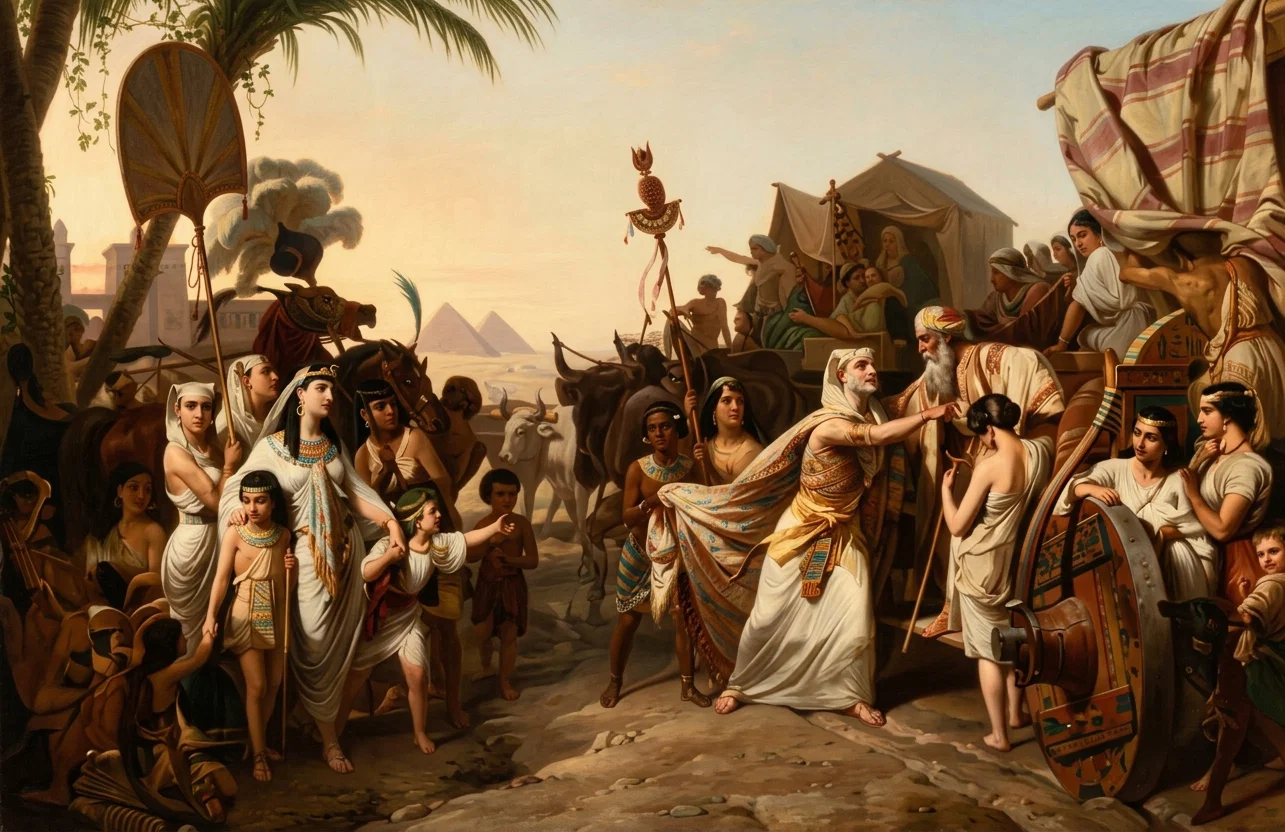
By Mrs. E. G. White
JACOB GOING TO MEET JOSEPH IN EGYPT

Among the fruits of Jacob’s transgression may be counted his unfortunate double marriage, the jealousy of his sons, and his long separation from Joseph. Our picture refers to the beginning of better days.
JACOB GOING TO MEET JOSEPH IN EGYPT Among the fruits of Jacob’s transgression may be counted his unfortunate double marriage, the jealousy of his sons, and his long separation from Joseph. Our picture refers to the beginning of better days.
No truth does the Bible more clearly teach than that what we do is the result of what we are. To a great degree the experiences of life are the fruition of our own thoughts and deeds.
“The curse causeless shall not come.”
“Say ye to the righteous, that it shall be well with him: . . . for the reward of his hands shall be given him.”
“Hear, O earth: behold, I will bring evil upon this people, even the fruit of their thoughts.”
Terrible is this truth, and deeply should it be impressed. Every deed reacts upon the doer. Never a human being but may recognize, in the evils that curse his life, fruitage of his own sowing. Yet even thus we are not without hope.

In Jacob’s Life

To gain the birthright that was his already by God’s promise, Jacob resorted to fraud, and he reaped the harvest in his brother’s hatred. Through twenty years of exile he was himself wronged and defrauded, and was at last forced to find safety in flight; and he reaped a second harvest, as the evils of his own character were seen to crop out in his sons,—all but too true a picture of the retributions of human life.
But God says: “I will not contend forever, neither will I be always wroth: for the spirit should fail before me, and the souls which I have made. For the iniquity of his covetousness was I wroth, . . . and he went on frowardly in the way of his heart. I have seen his ways, and will heal him; I will lead him also, and restore comforts unto him and to his mourners. . . . Peace, peace to him that is far off, and to him that is near, saith the Lord; and I will heal him.”
Jacob in his distress was not overwhelmed. He had repented, he had endeavored to atone for the wrong to his brother. And when threatened with death through the wrath of Esau, he sought help from God. “Yea, he had power over the Angel, and prevailed; he wept, and made supplication.” “And He blessed him there.” In the power of His might the forgiven one stood up, no longer the supplanter, but a prince with God. He had gained not merely deliverance from his outraged brother, but deliverance from himself. The power of evil in his own nature was broken; his character was transformed.
“At eventide there shall be light.” Jacob, reviewing his life history, recognized the sustaining power of God,—“the God which fed me all my life long unto this day, the Angel which redeemed me from all evil.”
The same experience is repeated in the history of Jacob’s sons,—sin working retribution and repentance bearing fruit of righteousness unto life.
God does not annul His laws. He does not work contrary to them. The work of sin He does not undo. But He transforms. Through His grace the curse works out a blessing.

Sowing to Righteousness

Of the sons of Jacob, Levi was one of the most cruel and vindictive, one of the two most guilty in the treacherous murder of the Shechemites. Levi’s characteristics, reflected in his descendants, incurred for them the decree from God, “I will divide them in Jacob, and scatter them in Israel.” But repentance wrought reformation; and by their faithful ness to God amidst the apostasy of other tribes, the curse was transformed into a token of highest honor.
“The Lord separated the tribe of Levi, to bear the ark of the covenant of the Lord, to stand before the Lord to minister unto Him, and to bless His name.” “My covenant was with him of life and peace; and I gave them to him for the fear wherewith he feared Me, and was afraid before My name. . . . He walked with Me in peace and equity, and did turn many away from iniquity.”
The appointed ministers of the sanctuary, the Levites, received no landed inheritance; they dwelt together in cities set apart for their use, and received their support from the tithes and the gifts and offerings devoted to God’s service. They were the teachers of the people, guests at all their festivities, and everywhere honored as servants and representatives of God. To the whole nation was given the command, “Take heed to thyself that thou forsake not the Levite as long as thou livest upon the earth.” “Levi hath no part nor inheritance with his brethren; the Lord is his inheritance.”

Fruitage of Doubt and Fear

The truth that as a man “thinketh in his heart, so is he,” finds another illustration in Israel’s experience. On the borders of Canaan the spies, returned from searching the country, made their report. The beauty and fruitfulness of the land were lost sight of, through fear of the difficulties in the way of its occupation. The cities walled up to heaven, the giant warriors, the iron chariots, daunted their faith. Leaving God out of the question, the multitude echoed the decision of the unbelieving spies, “We be not able to go up against the people; for they are stronger than we.” Their words proved true. They were not able to go up, and they wore out their lives in the desert.
Two, however, of the twelve that had viewed the land, reasoned otherwise. “We are well able to overcome it,” they urged, counting God’s promise superior to giants, walled cities, or chariots of iron. For them their word was true. Tho they shared with their brethren the forty years’ wandering, Caleb and Joshua entered the land of promise. As courageous of heart as when with the Lord of hosts he set out from Egypt, Caleb asked for and received as his portion the stronghold of the giants. In God’s strength he drove out the Canaanites. The vineyards and olive-groves where his feet had trodden became his possession. Tho the cowards and rebels perished in the wilderness, the men of faith ate of the grapes of Eschol.
OLD GRANARY BURYING GROUND, BOSTON
One of the millions of places where the dead sleep
OLD GRANARY BURYING GROUND, BOSTON One of the millions of places where the dead sleep
No truth does the Bible set forth in clearer light than the peril of even one departure from right—peril both to the wrong-doer and to all whom his influence shall reach. Example has wonderful power; and when cast on the side of the evil tendencies of our nature, it becomes well-nigh irresistible.

The Strongest Bulwark of Vice in Our World

is not the iniquitous life of the abandoned sinner or the degraded outcast; it is that life which otherwise appears virtuous, honorable, noble, but in which one sin is fostered, one vice indulged. To the soul that is struggling in secret against some giant temptation, trembling on the very verge of the precipice, such an example is one of the most powerful enticements to sin. He who, endowed with high conceptions of life and truth, does yet wilfully transgress one precept of God’s holy law, has perverted his noble gifts into a lure to sin. Genius, talent, sympathy, even generous and kindly deeds, may thus become decoys of Satan to entice souls over the precipice of ruin.
This is why God has given so many examples showing the result of even one wrong act. From the sad story of that one sin which “brought death into the world, and all our wo, with loss of Eden,” to the record of him who for thirty pieces of silver sold the Lord of glory, Bible biography abounds in these examples, set up as beacons of warning at the byways leading from the path of life.
There is warning also in noting the results that have followed from even once yielding to human weakness and error, the fruit of the letting go of faith. By one failure of his faith, Elijah cut short his life-work. Heavy was the burden that he had borne in behalf of Israel; faithful had been his warnings against the national idolatry; and deep was his solicitude as during three years and a half of famine he watched and waited for some token of repentance. Alone he stood for God upon Mt. Carmel. Through the power of faith, idolatry was cast down, and the blessed rain testified to the showers of blessing waiting to be poured upon Israel. Then in his weakness and weariness he fled before the threats of Jezebel, and alone in the desert prayed that he might die. His faith had failed. The work he had begun, he was not to complete. God bade him anoint another to be prophet in his stead.
But God had marked the heart-service of His servant. Elijah was not to perish in discouragement and solitude in the wilderness. Not for him the descent to the tomb, but the ascent with God’s angels to the presence of His glory.
These life records declare what every human being will one day understand,—that sin can bring only shame and loss; that unbelief means failure; but that God’s mercy reaches to the deepest depths; that faith lifts up the repenting soul to share the adoption of the sons of God.

The Sabbath Through the Ages

XI. The Change of the Sabbath As Indicated in Prophecy

By Charles L. Taylor
According to the inspired record of the blessed Bible, and by the unimpeachable substantiating testimony of profane history, certain great facts regarding the Sabbath of Jehovah have been made known. Briefly stated those facts are,—
1. That the Sabbath was made for and given to mankind as a memorial of God's creative power before sin entered the world. Mark 2:27, 28; Gen. 2:1-3; Ex. 20:8-11.
2. That practically all the great nations of antiquity, as well as those of to-day, bear witness to the fact that the order of the days of the week is the same now as from the very beginning; that our seventh day—the Sabbath—is identical with the seventh day which was originally set apart for man.
3. That time has never been lost, nor its reckoning brought into confusion.
4. That the Edenic Sabbath was kept by the patriarchs in their faithfulness to God's commandments. Gen. 26:5.
5. That it was the test of deliverance from Egyptian bondage. Ex. 5:4, 5.
6. That by three distinct miracles each week during the forty years of the falling manna, the seventh day was specifically and absolutely pointed out as God's holy day. Ex. 16:4-31, 35.
7. That the Sabbath, as God's memorial of creation, was the one part of the law given at Sinai to be specially explained, revealed, “made known” to the people. Ex. 20:8-11; Neh. 9:13, 14.
8. That again and again it was brought home to men's hearts as a test of loyalty to God. Isa. 58:13; Jer. 17:19-27; Eze. 20:19, 20.
9. That it was habitually kept by the Son of God. Luke 4:16.
10. That the day observed by the Lord Jesus was the same day that was kept by the Jewish people—the seventh day.
11. That Jesus clearly showed Himself to be Lord of the Sabbath day first given to man, the day which He Himself sacredly observed. Mark 2:27, 28.
12. That that same Sabbath day was purposely honored by many of His greatest miracles. Matt. 12:9-13; Luke 13:11-16; John 5:5-9, etc.
13. That the Sabbath of the fourth commandment was kept by Jesus' followers after the crucifixion, showing that it had not been abrogated or changed by His death. Luke 23:54-56.
14. That Paul and other apostles and workers followed the Master's example in the keeping of the Sabbath, and in proclaiming the perpetuity of the law of which the Sabbath is an inseparable part. Acts 13:14; 16:13; 17:2; 18:4, 11; Rom. 3:31; James 2:8-12.
These and other like facts stand forth prominently, and by all the force of their wonderful logic prove the sacred, unchangeable, and eternal claims of the seventh day. Absolutely, without any doubt whatever, the Sabbath given to man in the garden is the Sabbath of A.D. 1909. Why, then, is not the seventh day observed?

A “Reason” Not Sufficient

To him who has not carefully and candidly studied the Word of God this question may seem unanswerable. To the great majority of people, the fact that the first day of the week is almost universally recognized as holy, is sufficient reason for believing it to be holy. But the lover of truth is not satisfied with such argument; and when he comes to investigate, he finds that the Bible long ago actually foretold the rise of a power which should attack the law of Jehovah, and specifically and definitely set aside the Sabbath in favor of another day, and that this change would be recognized throughout Christendom.

Apostasy Foretold

Turning, therefore, to the Scriptures, let the reader first note carefully the prophetic announcements of the apostle Paul. Just before taking his final departure from among the churches which by his own labors had been brought to Christ, the great missionary called together the elders, and to them gave this solemn warning: “For I know this, that after my departing shall grievous wolves enter in among you, not sparing the flock. Also of your own selves shall men arise, speaking perverse things, to draw away disciples after them.” Acts 20:29, 30. Here is brought to view an apostasy among the ministry, and a consequent turning away of the people from the truth.
How completely this was fulfilled may be learned from the sad story of the church after the apostles had passed away. This history will receive attention later. Suffice it now to say that when such true shepherds as Paul and John had been removed by death, there came into the church many whose hearts had never been touched by divine grace, men who were Christians only in name, and whose religion was nothing more than pagan philosophy and “science falsely so called.” Col. 2:8; 1 Tim. 6:20. By these men, who had drunk deep from the fountains of worldly knowledge, the Bible was mischievously set aside, and all manner of speculations, superstitions, and unconsecrated customs and practices were introduced.

Rapid Retrogression

This transformation, which had already begun its work in Paul's day (2 Thess. 2:7), went rapidly forward until, within the comparatively short space of little more than a century, the fabric of the church and its teachings and life had been almost entirely changed. Worldliness, pride, and officialism among the ministry, and ignorance and corruption among the membership, stamped the world mark upon the church as a whole and paved the way to that final apostasy, when the so-called people of God joined hands with the Roman Empire and effected that combination of church and state, the persecuting Papacy.

The One Predicted

Without question, it was to the Papacy and its long train of baptized worldliness, corruption, and persecution, that the apostle looked forward. The picture he drew was complete. That power did oppose itself to God, it did exalt itself above God. And, as we shall see, this opposition and exaltation had to do with the law of God's government.
Before turning to another prophecy which shows the truth of what has been said, read the following excellent comment regarding this matter of opposing God and exalting self above Him, taken from “The Lord's Day, the Test of the Ages,” a pamphlet written by the editor of the Signs: “The great Head of the church is the Lord Jesus Christ; and the law of the church is the law of God, which came through Christ. Now the only way that a power can oppose God is to enact laws contrary to God's law, and demand obedience thereto. The only way in which it can exalt itself above God is to demand that its law shall be obeyed in preference to God's law.” Both these things the Papacy did.

“He Shall Think to Change”

Speaking of this same Papacy, the prophet Daniel declared (Dan. 7:25): “He shall speak great words against the Most High, and shall wear out the saints of the Most High, and think to change times and laws; and they shall be given into his hands until a time and times and the dividing of time.” The Douay Bible gives the rendering, “He shall think himself able” to change. And one other very excellent translation gives it, “Shall presume to change the appointed times and the law,” evidently referring to the moral law of the Most High. It is a power which wages war against the name of the Most High, the saints of the Most High, and the law of the Most High.
Ask yourself, dear friend, Did the Papacyever speak blasphemies, and wear out the saints of God? To find answer, you have only to go to history and trace the records of its blasphemous assumptions and titles, and of the horrible and relentless persecutions which sent millions down into martyrs' graves.

Admission of the Papacy

Ask again, Did it really attack the law of the Most High? Why, dear reader, it is one of the fundamental teachings of the Roman Church that the pope, in the plenitude of his power, and speaking for the church, has the right to set aside the Word of God and put in its place the commands of the church. And that church has given us living illustrations of what she means. Has she not generally in her catechisms taken the second commandment entirely out of the law? Has she not divided the tenth? Turn to her own published doctrinal works, and you find this to be so.
But, further than this, it was she who changed the fourth commandment, and who now openly and proudly points to her record of the change, and challenges the world to show that her claim is not well founded. To the very letter that church answers to the prophetic description, “shall think himself able” to change the law.

Testimony of Catholics

Compare two statements which have come officially from Baltimore, the home of Cardinal Gibbons, the head of the American Catholic Church under the Papacy. First: “You may read the Bible from Genesis to Revelation, and you will not find a single line authorizing the Sunday. The Scriptures enforce the religious observance of Saturday.”—Gibbons' “Faith of Our Fathers.” Second: “The Catholic Church changed the day from Saturday to Sunday.”—Catholic Mirror. This is a flat claim to be able to change the Sabbath of the law of God, and therefore is from the very wrong-doer himself a straightforward (the unwitting) confession that he is the one described by the prophecy.
Now the Word says that this power which changes the law (described in Revelation as “the beast,” Rev. 13:1-8) would one day be acknowledged by the entire world in this very matter of changing the law. And so far has this already come to pass, that the Roman Church, without fear of successful contradiction, declares, “The Christian Sabbath [meaning Sunday] is therefore to this day the acknowledged offspring of the Catholic Church, without a word of remonstrance from the Protestant world.”
Why should not such statements cause us to ponder? Are we still Protestants? If so, then what must be our personal relation to this mighty question? Shall we follow the multitude, or shall we still stand faithfully for what God has bidden? The church may succeed in leading the great masses to follow tradition instead of the Scriptures, even as was done in the days of Christ (Matt. 15:9); but it still remains that God's eternal law is our rule of life (Eccl. 12:13, 14; James 2:12), and that only those who are true to its claims will finally enter the city of God. Matt. 7:21; Rev. 22:14.
Again I ask, Are we Protestants?

MRS. M. SOLLARS

Thanksgiving

I THANK Thee, my Father, For all of Thy care, And offer this tribute In praises and prayer.
I thank Thee for all That is lovely and dear, For things that are helpful, And words of good cheer;
For crosses which keep My eyes turning away Toward the beautiful land Of the glorified day.
O, make me most truly A sower of seed, Guided ever, and on, As Thy Spirit may lead.
And this for my service Will richly repay: Thy blessed “Well done” At the close of the day.
And the rapturous greeting On yonder bright shore, From the saved and redeemed, Will be joy evermore.

MRS. M. SOLLARS

What Faith Will Do

WHEN I first went to America, thirty-one years ago, I crossed the Atlantic with the captain of a steamer who was one of the most devoted men I ever knew; and when we were off the banks of Newfoundland, he told me this story:
Mr. Inglis, the last time I crossed here, five weeks ago, one of the most extraordinary things happened, and it has completely revolutionized the whole of my Christian life. Up to that time I was one of your ordinary Christians.
We had a man of God on board, George Muller, of Bristol. I had been on the bridge for twenty-two hours, and never left it, when I was startled by some one tapping me on the shoulder. It was George Muller. “Captain,” he said, “I have come to tell you that I must be in Quebec on Saturday afternoon.”
This was Wednesday.
“It is impossible,” I said.
“Very well, if your ship can’t take me, God will find some other means of locomotion to take me. I have never broken an engagement for fifty-seven years.”
“I would willingly help you. How can I? I am helpless.”
“Let us go down to the chart-room and pray.”
I looked at the man of God, and I thought to myself, What lunatic asylum could the man have come from? I never heard of such a thing. “Mr. Muller,” I said, “do you know how dense this fog is?”
“No,” he replied, “my eye is not on the density of the fog, but on the living God, who controls every circumstance of my life.”
He went down on his knees, and prayed one of the most simple prayers. I muttered to myself, “That would suit a children’s class, where the children were not more than eight or nine years of age.” The burden of his prayer was something like this: “O Lord, if it is consistent with Thy will, please remove this fog in five minutes. Thou knowest the engagement Thou madest for me in Quebec for Saturday. I believe it is Thy will.”
When he had finished, I was going to pray; but he put his hand on my shoulder and told me not to pray. “First, you do not believe He will; and second, I believe He has, and there is no need whatever for you to pray about it.” I looked at him, and George Muller said this: “Captain, I have known my Lord for fifty-seven years, and there has never been a single day that I have failed to gain an audience with the King. Get up, captain, and open the door, and you will find the fog is gone.” I got up and the fog was gone!—Rev. C. Inglis.

Jesus Indorsed the Old Testament

ONE of the difficulties which the rationalist has to encounter is the attitude of Jesus to the Bible. He gave unqualified assent to the inspiration and authority of the Old Testament. “This is the most striking thing about Christ, that He, the wisest and best on earth, the most sympathetic teacher of men, the best fitted by wisdom, by character, and by experience to write a book for religious guidance, wrote no Bible, but gave His full acceptance and unqualified indorsement to the Bible already written.”—Christian Work.

Earth's Funeral

IMPOSING is the disked Sun's funeral, As far away across the western wave He sinks to rest within his wat'ry grave, And Darkness comes and spreads her pall o'er all. Both gorgeous, sumptuous, yet too sad the sight; For I must think of other days,—in flight Thoughts seem like birds, that in the night Do flutter, quite uncertain where to light. A sight more tragic, solemn, comes to view, A time when sinful earth, so crimson-stained, Will purify within consuming flame, And other worlds will know—the faithful true, Where Sin has never had his realm and reigned— That God is just, and hallowed His name.
DELWIN R. BUCKNER.
Ambato, Ecuador.

The First Consignment of Welsh Testaments

The story told in the Christian Observer for July, 1810, of the rejoicings at Bala on the arrival of the first consignment of Scriptures from the Bible Society, has often been retold, but has never, hitherto, been given its proper setting. As soon as the Welsh New Testament was bound in London, Thomas Smith was ordered to see that 500 copies were despatched to Mr. Charles with all speed. The order was executed in two lots of 250, and the first consignment reached Chester; but when the carrier went to load them—at Mr. Hugh Lloyd’s, the chemist—he found that the packing-cases had given way, and refused to become responsible for their contents until properly packed and protected. When he reached Bala, on the evening of Thursday, Sept. 18, 1806, he informed Mrs. Charles of the mishap to the packages, and that same evening the news of the Testaments being actually ready was in everybody’s mouth.
By the Thursday week, the whole country was wild with excitement, and people began to pour into Bala from the neighboring villages and hill-slopes at an early hour. When the time came for the carrier to be at no great distance from the town, the people went out in crowds to meet him; the old mare, which had ever before been obliged to struggle with her load as best she could, was now relieved of it, and muscular farm-servants pushed themselves for the first into the shafts. Ropes were adjusted and manned and maidened, and the cart was literally swarmed on all sides; then the joyful procession proceeded toward the town, where they were hailed by crowds which blocked up the streets.—Life of the Rev. Thomas Charles.

No Truth May Be Sacrificed

How much truth may I sacrifice in order to save some little Zoar in which God has given me being? How much silencing of the truth is permitted us here by God, in order that we may help Him govern the world?—NONE!—Wendell Phillips.
Continue reading: What Is Death?