To this question various answers are returned by different creeds; but what the believer in the divine inspiration of the Word of God wants to know is, What does the Bible mean by death as applied to man?
The first mention of death in the Bible is in Gen. 2:17. “In the day that thou eatest thereof thou shalt surely die,” said the Creator to our first parents. There is certainly no room for question as to the meaning of the word “die” in this text, for in chapter 3:19 the Lord Himself tells just what He meant by it: “In the sweat of thy face shalt thou eat bread, TILL THOU RETURN UNTO THE GROUND.”
To die, then, as applied to man in the Bible, means to return to the original elements from which man was created; and this process commenced with Adam the very day he sinned, and continued until death was finished in him, at the age of 930 years. The human body is constantly dying. The excretory organs are kept busy throwing off dead matter; and that this is part of the sentence of death pronounced upon man in the beginning is evident from the expression, “In the sweat of thy face shalt thou eat bread, TILL THOU RETURN UNTO THE GROUND.”
Following the sentence of death, which, as we have seen, was explained by the Lord Himself to mean that man should turn again to dust, we read of Adam and his immediate descendants: “And all the days that Adam lived were nine hundred and thirty years: and he died.” “And all the days of Seth were nine hundred and twelve years: and he died.” “And all the days of Enos were nine hundred and five years: and he died.” And from the days of Adam to the present time death, with only two exceptions, has been the lot of all mankind. Every man’s record ends with the words, “And he died.”
Does the Body Alone Die?
It may be said, however, and it is so said by some, that only the body dies. But let us see how this view harmonizes with the Word of God. What was the sentence?—“Thou shalt surely die.” To whom was this spoken?—To man. Then MAN was to die. “And all the days that Adam [the MAN, for that is the meaning of “Adam”] lived were nine hundred and thirty years: and he died.” Gen. 5:5. Then the MAN died; not simply a part of him, but the whole man, for so saith the Scriptures: “Man dieth, and wasteth away: yea, MAN giveth up the ghost; and where is he?” Job 14:10.
We find, then, that death is something which is asserted, not of a part of man, but of MAN; and that this death is not a spiritual change that takes place when man sins, but a physical change which is completed at the close of his earthly pilgrimage; for it is written of antediluvians, patriarchs, and prophets, that they lived so many years and then died.
But it may be said that the death which Adam and his descendants died is not the wages of sin; that this death is still future, and differs from what we call “natural death” in that it is a “death that never dies;” that7it is not like the death that comes alike to all, the return of man to the original elements from which he was made in the beginning, but is, in fact, eternal existence in misery.
The Second Death
It is indeed true that “natural death” is not the wages of sin; for it is written, “As in Adam all die, even so in Christ shall all be made alive.” All lose physical life in Adam, and all are raised again to physical life through Christ; for the Scriptures plainly teach a resurrection both of the just and of the unjust. So then what would be otherwise the wages of sin, becomes a temporary instead of an eternal cessation of existence, described in the Scriptures as a “sleep.” But to those who are out of Christ, and who so remain until their probation closes, death comes the second time, for thus saith the Scriptures: “The soul that sinneth, it shall die.” “When a righteous man turneth away from his righteousness, and committeth iniquity, AND DIETH IN THEM; for his iniquity that he hath done SHALL HE DIE.” Eze. 18:20, 26.
Here is a plain reference to the two deaths; namely, the first or “natural” death, and the second death, the wages of sin. We have seen that the first death, the death that comes to all alike, is, because of the resurrection, only temporary cessation of existence, a return for a time only to the original elements from which man was made in the beginning. Let us now inquire what is the nature of the second death.
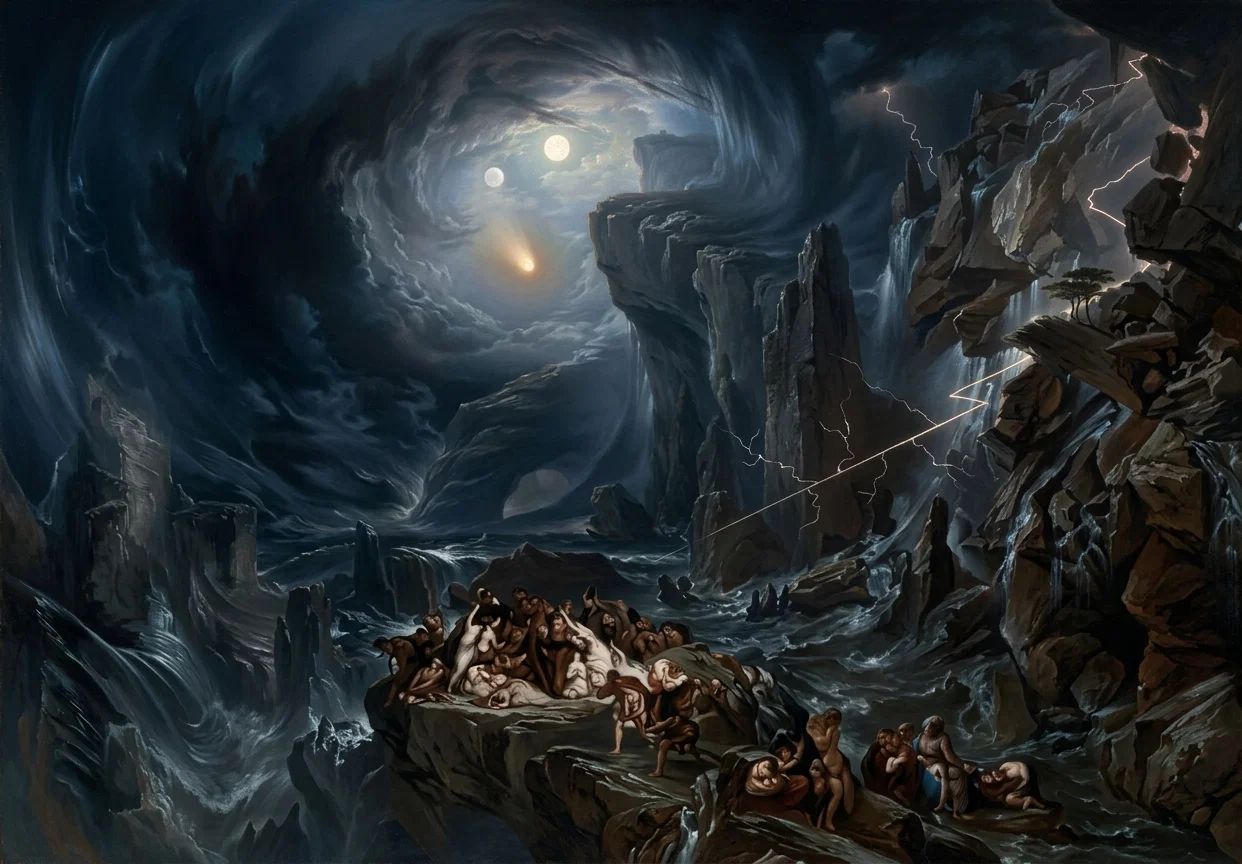
THE DELUGE
The Flood, the apostle Peter tells us, with its destruction of those who had identified themselves with sin, was one of the great object lessons to “those that after should live ungodly.” See 2 Peter 2:4-6; 3:5, 6
The use of the expression “second death” implies a similarity between the two deaths. Indeed, we shall find that the second death differs from the first death only in the fact that in general the death which we call “natural” comes from a gradual wearing out of the vital forces by disease or exhaustion, while the second death comes as a visible manifestation of the wrath of God against sin. But that the result will be the same, namely, a return to the original elements from which man was made in the beginning, is made very clear in the Scriptures.
What the Word Declares
In Obadiah 16 we read of the heathen that “they shall be as tho they had not been;” and in Mal. 4:1 it is declared that “the day cometh, that shall burn as an oven; and all the proud, yea, and all that do wickedly, shall be stubble: and the day that cometh shall burn them up, saith the Lord of hosts, that it shall leave them neither root nor branch.”
The New Testament is equally clear upon this important subject. Says our Saviour: “Fear not them which kill the body, but are not able to kill the soul: but rather fear Him which is able to destroy both soul and body in hell.” Matt. 10:28. The necessary inference is that He will thus destroy the finally impenitent.
The apostle Paul testifies that “the wages of sin is death” (Rom. 6:23); and again, as touching the nature of this death, he says of the wicked that they “shall be punished with everlasting destruction.” Everlasting destruction is destruction from which there is no return, no recovery. A city may be destroyed and rebuilt; and man is destroyed by the first death, but in the resurrection he is “rebuilt;” but the destruction of the second death is final, or everlasting.
Many other texts might be cited, all testifying the same thing, namely, that the second death results in the utter and everlasting destruction of those who are its unhappy subjects; but one more must suffice, Rev. 20:9, where of the wicked it is said prophetically, “And they went up on the breadth of the earth, and compassed the camp of the saints about, and the beloved city: and fire came down from God out of heaven, and devoured them.”
Truly, “blessed and holy is he that hath part in the first resurrection: on such the second death hath no power.”
The Narrow Way
By Bishop Hall
The way to heaven is like that which Jonathan and his armor-bearer passed, betwixt two rocks, one Bozez, the other Seneh; that is, foul and thorny: whereto we must make shift to climb, on our hands and knees; but when we are come up, there is victory and triumph. God's children have three suits of apparel; whereof two are worn daily on earth, the third laid up for them in the wardrobe of heaven: they are ever either in black, mourning; in red, persecuted; or in white, glorious. Any way shall be pleasant to me, that leads unto such an end. It matters not what rags or what colors I wear with men, so I may walk with my Saviour in white, and reign with Him in glory.—Bishop Hall.
Preach the Word
“I charge thee therefore before God, and the Lord Jesus Christ, who shall judge the quick and the dead at His appearing and His kingdom: Preach the Word; be instant in season, out of season: reprove, rebuke, exhort with all long-suffering and doctrine.”
Christ Our Life
By William Covert
By William Covert
Conditions of Life
MAN formed from the dust of the ground was told that perpetuity of life depended on obedience to his Creator. If his conduct harmonized with the law that governed his life, he would continue to live; but if he took a contrary course, he would separate himself from life and die. He was permitted to choose for himself, and the choice he made brought him death. Having taken the evil course, the Lord pronounced penalty upon him, saying, “Cursed is the ground for thy sake; . . . thorns . . . and thistles shall it bring forth to thee; . . . for out of it wast thou taken: for dust thou art, and unto dust shalt thou return.” Gen. 3:17-19.
Following Satan in transgression darkened man's understanding, and in so doing he was alienated from the life of God through ignorance and blindness of heart. Eph. 4:18. Having been
Alienated from the Life of God
he can not live. Thus situated, the apostle declares he has “no hope,” and is “without God in the world.”
This is a lamentable state for one to reach, who, a little while before, was created in the image of his Maker, and crowned ruler of the world. But he could rightly reproach none but himself for bringing about the sad change. Through open transgression he connected himself with the father of lies, the author of corruption, the rebel against God, and the source of death. If he still abides in such connection he will most certainly be consumed root and branch, with all other refuse of the earth and the universe, in the fires of Gehenna, which are prepared for the devil and his angels. Matt. 25:41; Rev. 20:9. The immutable law that governs sowing and reaping calls upon man to gather his harvest.8“Whatsoever a man soweth, that shall he also reap. For he that soweth to his flesh shall of the flesh reap corruption.” Gal. 6: 7, 8.
A Way of Escape
But notwithstanding the deep, dark gulf into which fallen man has been plunged, a way to escape from the horrible pit has been provided. God through His love created man, and God’s love is the greatest and the strongest power in the universe. The sinning and the dying of deluded men can not satisfy that love, therefore man must be given another opportunity for life. The working of this love in providing this way of life is made known in that wonderful announcement of Jesus, where He said, “God so loved the world, that He gave His only-begotten Son, that whosoever believeth in Him should not perish, but have everlasting life.” John 3:16.
Since man failed to comprehend fully and to carry out the Father’s purpose in the creation of man, it became necessary to make substitutionary provision for him. To accomplish this, the Son of God came to our world, and in human form and in human flesh took man’s place, and in that relation lived a life perfectly conformed to the will of God. When He had accomplished this most fully, He gave His life an offering to pay the penalty of man’s transgression. Thus, through the living and the dying of Jesus, atonement was provided for the sinner.
The obedience rendered in humanity by Jesus is imputed to all who believe in Him. Not this only, but the blood of the Son of God, upon whom no condemnation rested, can atone for the forfeited life of the transgressor who trustingly accepts of the reconciliation.
The apostle tells how the Father hath set forth Christ, “to be a propitiation through faith in His blood, to declare His righteousness for the remission of sins that are past, through the forbearance of God; . . . that He might be just, and the Justifier of him which believeth in Jesus.” Rom. 3:25, 26.
The Son of God, having lived for man, and having also died for man, has the right to impart His life to all who are willing to be transformed into His image.
The sinner can by faith unite with Christ in His crucifixion, and thus pass through the ordeal of death. He is then buried with Him in baptism. By faith a new man comes forth to live with Him. No condemnation rests upon the new man. The penalty of death which held the old man was met in Christ, and in his stead is a free man living through the life of his Lord. Gal. 2: 20.
Christ Our Life, Our All
Because he died with Christ, he can and does live with Christ. By letting go of his old sinful life, he can and does take hold upon the life of Christ and live by and through Him. He has passed from the state of death where sin placed him, into a state of life where Christ’s righteousness has raised him.
There is no other name under heaven by which the sinner can be saved except the name of Jesus. There is no other road by which heaven can be reached than by the way of the cross. The sinner’s own name will not do. The name of no friend except that of Jesus, who is the sinner’s true Friend, will avail to save. No plea will be potent save the plea that Christ is the Way, the Truth, and the Life. Fear not to make the plea, for Jesus Himself will present it to the Father in His own name for you. He is your life. Because He lives, you can live also. Claim your life in Him.
The End of Sin
1. What is sin?
“Sin is the TRANSGRESSION OF THE LAW.” 1 John 3: 4.
“Nay, I had NOT known sin, but by the LAW: for I had NOT known LUST, EXCEPT the LAW had said, THOU SHALT NOT COVET.” Rom. 7: 7.
2. What comes in consequence of sin?
“Sin, when it is finished, BRINGETH FORTH DEATH.” James 1:15.
3. How many have sinned?
“For ALL have SINNED, and come short of the glory of God.” Rom. 3: 23.
4. How many, then, are subject to death?
“And so DEATH passed upon ALL MEN, for that all have sinned.” Rom. 5:12.
5. As the race is not responsible for Adam’s sin, who saves all, irrespective of character, from its consequences?
“For as in Adam all die, even so in Christ shall ALL BE MADE ALIVE.” 1 Cor. 15: 22.
6. But what does God offer to those who believe in Jesus Christ?
“For God so loved the world, that He gave His only-begotten Son, that WHOSOEVER BELIEVETH IN HIM should NOT PERISH, but have EVERLASTING LIFE.” John 3:16.
7. What does He do to meet our sinful natures inherited from Adam?
“Where SIN ABOUNDED, GRACE DID MUCH MORE ABOUND: that as sin hath reigned unto death; even so might GRACE REIGN THROUGH RIGHTEOUSNESS UNTO ETERNAL LIFE by Jesus Christ our Lord.” Rom. 5: 20, 21.
8. But what if we reject the light which comes by faith in Christ?
“He that believeth NOT the Son shall NOT see LIFE; but the WRATH OF GOD ABIDETH ON HIM.” John 3: 36.
9. What compensation will he then receive for his service in sin?
“And these shall go away into EVERLASTING PUNISHMENT.” Matt. 25:46.
NOTE.—Not everlasting punishING, but punishMENT, a completed process; literally, “everlasting cutting off” from life.
11. What will be the last great test of character?
“The FIRE SHALL TRY EVERY MAN’S WORK of what sort it is.” 1 Cor. 3:13.
12. How extensive shall be this fire?
“The ELEMENTS shall MELT WITH FERVENT HEAT, the earth also, and the WORKS THAT ARE THEREIN SHALL BE BURNED UP.” 2 Peter 3:10.
13. When the children of Israel had laid all their sins upon the altar in the sacrifice, how did the brightness of God’s presence affect them?
“There came a FIRE OUT FROM BEFORE THE Lord, and CONSUMED upon the altar the burnt offering and the fat: which when all the people saw, they shouted, and fell on their faces” (for joy in worship; see 2 Chron. 7: 3). Lev. 9:24.
14. When Aaron’s sons identified themselves with sin by offering strange fire before God, how did the shining forth of God’s presence affect them?
“And there went out FIRE FROM THE LORD, AND DEVOURED THEM, and they died before the Lord.” Lev. 10:1, 2.
15. Who only can endure the fire, the light, the glory, of God’s presence?
“Who among us shall dwell with the devouring fire? [“Our God is a consuming fire.” Heb. 12: 29; Ex. 24:17.] who among us shall dwell with everlasting burnings? He that WALKETH RIGHTEOUSLY, and speaketh uprightly; he that despiseth the gain of oppressions, that shaketh his hands from holding of bribes, that stoppeth his ears from hearing of blood, and shutteth his eyes from seeing evil; he shall dwell on high.” Isa. 33:14-16.
16. What is this destruction of the wicked called?
“He that committeth sin is of the devil; for the devil sinneth from the beginning. For this purpose the Son of God was manifested, that He might DESTROY THE WORKS OF THE DEVIL.” 1 John 3: 8.
“That through death He might DESTROY HIM that had the power of death, that is, THE DEVIL.” Heb. 2:14.
18. What other testimony is given concerning Satan and those identified with him?
“For, behold, the day cometh, that shall burn as an oven; and all the proud, yea, and all that do wickedly, shall be stubble: and the day that cometh shall BURN THEM UP, saith the Lord of hosts, that it shall leave them NEITHER ROOT [Satan] NOR BRANCH [the wicked].” Mal. 4:1.
“Therefore will I bring forth a fire from the midst of thee, it shall DEVOUR THEE, and I will bring thee to ashes upon the earth in the sight of all them that behold thee. . . . And NEVER SHALT THOU BE ANY MORE.” Eze. 28:18, 19.
NOTE.—It is impossible for us to give the many, many scriptures which deal with the end of those who reject God’s plan of salvation, who refuse the remedy which would save them from death. Read Psalm 37, where the contrast is sharply drawn between the future life of God’s children and the destruction of the finally impenitent. Read Obadiah 16; read Matt. 3:10-12, where the wicked are likened to chaff. And so they are likened in many scriptures to the most inflammable materials—wood, grass, hay, stubble, chaff, tow, etc. Every seeming text against these plain, positive ones can be shown to be in harmony with them. The eternal misery of the wicked would never have been taught if men had not believed the unscriptural doctrine of the immortality of the soul.
19. What question does an apostle ask in 1 Peter 4:17?
“What shall the END be of them that obey not the Gospel of God?”
“Behold, the righteous shall be recompensed IN THE EARTH; much more the WICKED AND THE SINNER.” Prov. 11: 31.
22. When all sin and its effects, and all who have identified themselves with sin, have passed away, what shall be said of this earth and all places cursed by sin?
“Say unto them, As I live, saith the Lord God, I have NO PLEASURE IN THE DEATH OF THE WICKED; but that THE WICKED TURN FROM HIS WAY AND LIVE: TURN YE, TURN YE FROM YOUR EVIL WAYS; FOR WHY WILL YE DIE!” Eze. 33:11.
His Glorious Appearing
HIS earth belongs to God. He created it, and it is His. “The earth is the Lord’s, and the fulness thereof; the world, and they that dwell therein.”
Yet we do not see Him in His glorious presence. From a world which He pronounced “very good,” He has withdrawn His glory or veiled it in material forms. His power and wisdom are revealed in the shining stars by night, and the glorious sun by day, in the mighty mountain and the flowing river, in the sea and the land, in the forest tree, in the tiny floweret. Despite the ravaging marks of sin, we still see constant evidences of the Creator’s wisdom, skill, and power.
His love is to some extent revealed in the changing seasons, in the beneficent gifts of earth to the children of men, in the common sunshine, common air, and other great common blessings of life; and yet these are marred more or less by sin, until men question the goodness and love of God. But to leave the questioner forever without doubt, “God so loved the world, that He gave His only-begotten Son.” He veiled His glorious presence and divinity in humanity in order that man might not fear, but might be won to God by the everlasting goodness of His glory. Through all these ages since God withdrew His glory from the earth, which His own creature yielded to the usurper, God has been pleading with man to receive Him,—His character; and to know by experience that God is righteous, that He is all-wise, all-merciful, that God is love; and throughout all the ages there have been witnesses to the effectiveness of His plan for saving men. He has longed to bring men to that condition where they would receive Him through His Son, through His Word, through all the various means by which He has appealed to the children of men. He has wanted not only some men to receive Him, but all men to receive Him. He has pleaded, “Look unto Me, and be ye saved, all the ends of the earth: for I am God, and there is none else.”
His great heart of love and pity has been grieved with the sin-blot upon His universe. He would have sin removed forever; He longs for that time which He has predicted by His own prophet when “there shall be no more curse,” when death shall be no more, neither shall there be any more pain. His own presence would bring just that condition, but it would also result in the destruction of all those who have identified themselves with sin; “for our God is a consuming fire,” and His presence consumes sin.
For all these centuries the children of earth could not look upon the face of the great loving Father of the universe. He has longed that they should see Him; but in man’s sinful condition, He Himself declared to His meekest prophet, “Thou canst not see My face; for there shall no man see Me, and live.” Yet the Lord Jesus promises, “Blessed are the pure in heart: for they SHALL SEE GOD.” And the last prophet of His Book declares, “THEY SHALL SEE HIS FACE.”
But in order that they may endure that glorious presence, that forth-shining of His character in all its majesty, that light which is absolutely unendurable to mortal gaze, they must be filled with His presence; and that filling must be the voluntary filling by faith. There must be that choice on their part to receive Him for all that He is, so that Christ shall be in them “the hope of glory.” He surely will come into His own; He has the right to come into His own; it belongs to Him. But when He does so come, those who have identified themselves with sin will perish with the sin.
So the apostle Paul writes that they “shall be punished with everlasting destruction from the presence of the Lord, and from the glory of His power; when He shall come to be glorified in His saints.” 2 Thess. 1: 9, 10. And in the very next chapter we are told that “that wicked,” the strongest of all wicked aggregations in this world, shall come to naught by the forth-shining of His presence.
And yet that very coming is in God’s goodness. It is only the revelation of His righteous character; it will not affect those who are in harmony with Him, only to change them from mortality to immortality, from the corruptible to the incorruptible. Such shall shout for joy, “Lo, this is our God; we have waited for Him, and He will save us; this is Jehovah; we have waited for Him, we will be glad and rejoice in His salvation.” They have admitted His presence into their hearts, and it has transformed their lives. The same creative power which was manifest when the earth was called into existence, has been revealed in their own lives, and will be revealed in its fulness when Christ shall come again. Therefore, “our citizenship is in heaven; whence also we wait for a Saviour, the Lord Jesus Christ: who shall fashion anew the body of our humiliation, that it may be conformed to the body of His glory, according to the working whereby He is able even to subject all things unto Himself.” Phil. 3: 20, 21.
The true children of Christ know that working in their own lives. They are ready for its last glorious development, the change to immortality when Christ shall come. How is it, reader? Do you know the presence of the Lord? Are you willing to meet Him when He comes in His glory? Do you really love Him? If you do, you love His personal presence.
Christian Science and Pantheism
No. 2
Again, in tracing the likeness between pantheism and Christian Science, we see that both reject the Christian idea of the personality of God. Pantheists reject the doctrine of God's personality on the ground that it makes God finite. Fichte says, “You make the divine Being a limited being like yourselves by ascribing to Him that attribute” [personality].—Fichte's Works, page 157. Similarly says Christian Science, as might be quoted in many forms from “Science and Health,” but this from the chapter on “Science of Being” is sufficient: “A personal sense of God . . . necessarily limits faith and hinders spiritual understanding.” And in the paragraph preceding this the author shows what she thinks the Christian belief in the personality of God really is in contrast with Christian Science: “Mortals believe in a FINITE personal God, while God is infinite love, which must be unlimited.”
And thus again Christian Science can not rid itself of the charge of being pantheistic. It teaches the personality of God exactly as pantheism teaches it. By both pantheism and Christian Science, man's intellectual love of God is simply God's love of Himself; and as God loves Himself only in man, it is on man's part simply the enjoyment of his own existence as a rational being. This last is plainly involved in the first, that real man is part of God.
And so just to the extent that man ceases, God ceases. That is to say God has no existence save in man. This is pantheism, but, too, it is Christian Science. Taking two sentences from the chapter “Science of Being” in the reverse order we get this idea a trifle more clearly yet, and it is easily seen by any one as the sentences stand: “Spiritual man is the image or idea of God.” “God without the image or likeness of Himself would be a non-entity, or mind unexpressed. He would be without a witness or proof of His own nature.” That is to say, putting the two together, “God without spiritual man as the image or likeness of Himself would be a non-entity, or mind unexpressed. He would be without a witness or proof of His own nature.”
Now, the person who can not see that this is pantheism, does not know what pantheism is; for the statement of God's representation as here given is purely pantheism. All the personality God has is the personality of spiritual man. All the existence God has is His existence in spiritual man. Without spiritual man God is a nonentity. Without spiritual man God is mind unexpressed. Without spiritual man God would be without a witness of His own nature. Without spiritual man God would be without a proof of His own nature. All these statements are included in the one made above by Mrs. Eddy.
Then when Christian Scientists talk about the personality of God, we know they mean only the personality of spiritual man without which God would be a nonentity. And when we are admonished by them to love God, we will know that at heart it is merely man's love of his own existence without which God would be a mind unexpressed, and a nonentity. Thus by Christian Science is God drowned in the manifestation of Himself, merged into the existence of spiritual man, and dependent upon him for existence, for expression, for witness and proof of His own nature.
And now see how clearly this is all in accord with the definition of pantheism as given in the Standard Dictionary: “The form of monism that identifies mind and matter, the finite and the infinite, making them manifestations of one universal or absolute being.” And under “idealistic pantheism” we have this definition, which is exactly to the point: “Idealistic pantheism, which ascribes to it [the universal being] only the attributes of mind.” “The last . . . may be regarded as sinking all . . . in man.” “Thus God is all, and all is God.”
This is enough to prove the pantheistic nature of Christian Science. It is not by any means all that might be said, but the point is clearly apparent, and that is all that we designed. Christian Science is pantheistic.
Hiding from God
God never hides from man when man is in trouble. When Adam sinned, it was not God who hid from Adam, but Adam tried to hide from God. Of course, the attempt was vain, but sin-blinded Adam could not see it. God saw it and knew it all. Adam HID himself, but God SOUGHT him. The sheep flees from the wise shepherd; the shepherd follows, that he may save the sheep.
Thus it was with the first sinner; thus it has been with every sinner since. It is man ever trying to hide his sins by self-justification or hypocrisy or hiding; it is God in tender love ever seeking the sinner to save him.
Even so, sinner, it is with us. We may think ourselves hidden from God, but He knows all about us, and He is “not far from every one of us.” Acts 17: 27. If we love the sin more than God, we will hide with the sin, and turn from God. With the sin will we at last be destroyed; for “the end of those things is death.” But if we turn to God, show Him our sins, He will look upon them, and the glory of His presence will consume the sin. Then we may hide in God.
Put It to the Test
By Editor
Several times within the past few years we have referred to the stir created in English theological circles by what is known as the “new theology,” which was a veneering of the old pantheism, has proved deficient in that it lacks dynamic.
City Temple (London) and Rev. R. J. Campbell
When put to the test, it has failed. Mr. Campbell in its defense declared that he would put it to the test in the slums of London. An urgent appeal was made for funds to enable this to be done. As yet nothing has happened. The new cult seems to have been unable even to get to the people it was going to uplift. To quote the Rev. John Henry Jowett, Dr. Dale’s successor at Birmingham: “It is not sufficiently inspirational to make people benevolent.”
A similar inadequacy manifests itself in regard to foreign missions. When Mr. Campbell entered upon his pastorate at the City Temple he declared again and again that he was determined to urge his people to make a greater effort in working for foreign missions. This he has entirely failed to do. Any effort he may have made has met with dismal failure.
In the two directions where preeminently religion is required to show its power, the “new theology” has completely failed. These failures are an eloquent comment on the tendency and potency of this new cult.
We would respectfully suggest that all new “isms” be tried out in the same way. There are plenty of these quackeries in our midst. “Eddyism” and the “New Thought” and the “new anything” can easily be tried out. Let them engage in either of the two enterprises we have mentioned, and their absolute inadequacy will speedily be manifest. “By their fruits ye shall know them,” said One who claimed to know. We will unhesitatingly abide by the results of the experiment, but we certainly sympathize and stand ready to succor those on whom it is tried. —Episcopal Recorder, R. E., Philadelphia.
Eating and Strength
A RECENT issue of the Detroit News-Tribune has an instructive and interesting article by Gilman Low, who contends that men eat altogether too much, that living expenses are altogether too high. He declares: “I could eat $10.00 worth of food a day, but I would not be so foolish. I can live comfortably on less than 50 cents’ worth every twenty-four hours, and I have just put myself in prime physical condition on an allowance of food which costs exactly thirteen cents a day. That condition isn’t in just feeling well, but it is the condition that the prize-fighter would consider tip-top; in fact, I am in a better condition to-day than the average prize-fighter.”
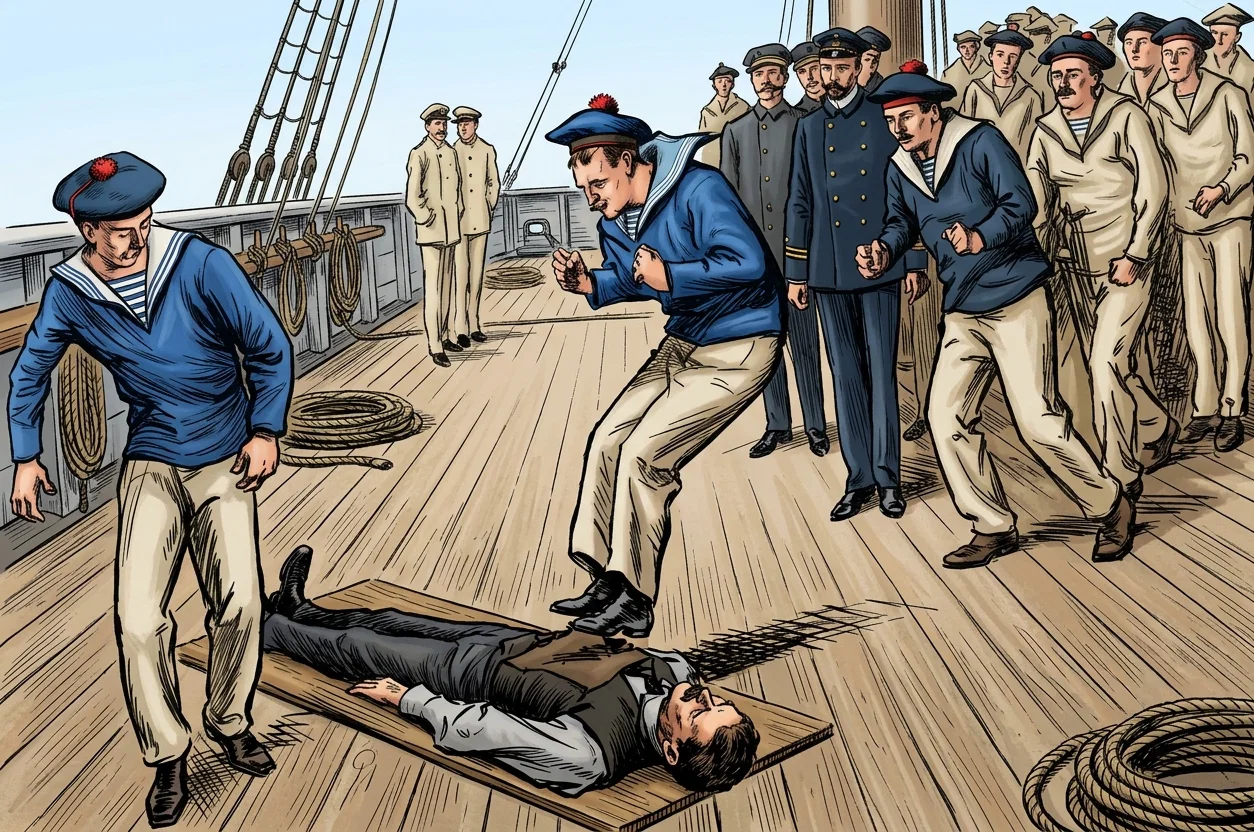
Then he goes on to tell of an experiment that he conducted on the French ship of war Perite, where in two different days 615 men jumped on his stomach—or as he puts it, “solar plexus”—one after the other, without any injury to him at all. It took him some time to get the captain of the ship to consent to the experiment, but after a while he did it in the interests of science.
Several other experiments that were of nearly equal interest were also conducted, which showed the tremendous strength and endurance of Mr. Low.
The first day 250 sailors jumped on him, one following the other in a running jump; and the next day 365. More would have followed, but a boat on the river capsized, and the men rushed to relieve the people in the water. He wished them to continue the experiment, but they refused. Forty-five of the crew signed a certificate testifying to the genuineness of his exhibition, and the chief officer of the ship drew up a paper with the ship’s seal and signed it, giving an account of the tests.
Mr. Low declares that people make the following mistakes: “1. Too many meals daily, and too much food. Too much meat; too much water with meals. “2. Too little oxygen in business offices. “3. Too little exercise daily.
(Continued on next page.)11
Eating and Strength
(Continued from previous page.)
“4. Too many cigars daily; too many cigarets, and too much whisky. “5. Too much work, too little rest, and too little sleep.”
He goes on to say that even the hard, simple prison fare has cured severe chronic cases of stomach trouble. He also tells us that fasting has worked beneficially with him. He has fasted fifteen days at a time, taking nothing but water. At the end of that time he had as much physical strength and more mental power, as his muscular power was more responsive to his mind. One time he subsisted on 67 cents’ worth of food for a week without losing an ounce in weight.
He trained especially for the test that he passed through on the battle-ship, eating on the thirteen-cents-a-day plan, his food consisting of the following:
Three eggs, one lemon, quarter of a pound of sugar, one apple, and less than a quart of milk daily; alternating with white bread, graham bread, and rye bread, less than a loaf each day. “My expenses for the whole eight weeks, or fifty-six days,” he says, “were $7.28, and on the last day I had fourteen cents’ worth of food on hand.” Comparing himself after this eight weeks’ dieting with his condition before, he declares that he was much stronger. He says: “I was stronger organically because I was getting all there was to be had out of my food, masticating carefully and with enjoyment—not eating for bulk of consumption, but for nutrition.” He does not recommend any such a diet as a permanent diet however. But during this time, he declares: “I had all the food that is to be had from the air. Deep, slow breathing is a physical duty producing wonderful results. We get a large proportion of our regular food from the air, and we should have fresh air just as we should have fresh food.”
He has no hobby over the food question. He says: “I do not say that the diet I followed is the best for every person. It was best for me, but a variation might be an advantage to another. To me it sufficiently proved that meat is not the necessity that it is commonly believed to be.”
All of which goes to show that the vegetarian diet is not a starvation diet, as those can testify who have followed it for years. One of the great difficulties with vegetarians is that they eat too much. It is better to stop eating while hungry. The appetite usually calls for more than the system demands.