IN addition to the study on “The Privilege of Prayer” and the social service, ten minutes might profitably be spent in a consideration of the subject, “The Work before Us and Our Relation to It as Young People.” One or two persons might be appointed to present the subject. We append a suggestive outline for such a talk:—
What this work means.
Fields at home and abroad already entered.
Their greatest need.
Unentered fields.
Preparation needed.
What the young people may do.
For “helps” see W. W. Prescott’s articles, and the letters and reports from the fields, in the July, August, and September numbers of the Missionary Magazine, also the Missionary Map of the World.
Sample copies of the July, August, and September numbers of the Missionary Magazine will be furnished free upon application. Send postal card to Mission Board, 267 West Main St., Battle Creek, Mich.
1. Find in the lesson, and in the corresponding chapter in “Steps to Christ,” answers to the following statements so often heard from the lips of the inexperienced:—
“I do not feel that the Lord hears my prayers.”
“My prayers are never answered.”
“I am afraid to pray.”
“I have no opportunity to pray.”
“The Lord knows my heart, and I do not need to pray.”
2. Note also the following points:—
The effect of prayer upon the one who prays.
The strength there is in prayer to enable one to overcome sin.
The value of prayer in bringing us into harmony with the will of God.
The necessity for perseverance in prayer.
The power of prevailing prayer.
THE DEPENDABLE BOY
The boy who is bright and witty,
The boy who longs for fame,
The brilliant boy, his teacher’s joy,
And the boy who leads each game,—
Right cordially I greet them,
And wish them every joy;
But the warmest part of my boy-loving heart
I give the dependable boy.
If he says he’ll come at seven,
Ere the clock strikes he’ll appear
At a fine, brisk pace, with a glowing face,
And a greeting good to hear.
If he says he’ll mail your letter,
It will be mailed, don’t doubt it;
He will not tuck it in some dark pocket,
And then forget about it!
He may be bright and witty;
He may be brilliant, too;
He may lead in the race with his manly face;
He may plan great things to do;
He may have all gifts and graces;
But naught can make such joy
And pride in me, as to know that he
Is a stanch, dependable boy.
— Selected.
TRYING TO SAVE THEMSELVES
By Mrs. A. F. Harrison
“WELL, Walter,” said his mother one day, “you have now finished the first week of school; I wish you would come and tell me about it.”
“O mama, it is splendid! The new professor is fine, and Miss Hall is just as kind and pleasant as ever. You know how hard grammar always was for me, and how it seemed as if I never could learn it. Sometimes I have even felt as if I did not much care if I didn’t. Now it seems so easy that I can go right on from the place where I left off. It is almost as if I had been studying it all summer, but you know I have not looked at it.”
“I am glad you are getting along so well. This shows that while you have been tending your chickens, and working in your little garden, your mind has been resting, and growing, too. It is a great blessing to have a strong, healthy body and a good mind. I am glad to see you grow in both these ways; but there is another way in which I am also anxious to see you develop. You can easily tell what it is, I know.”
“Yes, mama—the spiritual part. I do not get on so well that way. I try hard not to get angry, but I have been overcome in that way more than once this week.”
“I know,” said his mother, gently; “and I have been thinking of a little story that has done me good, and I believe will help you.” Then as Walter seated himself comfortably to listen, she continued:—
“You remember that Jesus often taught the people by the beautiful shores of the sea of Galilee. We find him here in the beginning of our story. It is a lovely evening. The sun is sinking, and already the little birds are twittering their sweet good-night songs. But it has been a hard day for Jesus. From early morning he has been teaching the people, as well as for several days before this. Now he is very weary. A number of fishers’ boats are fastened to the shore near by, and he tells the disciples that he will dismiss the people, and then they will take a boat, and cross to the other side, and find a quiet place to rest.”
“While his disciples were getting the boat ready, Jesus went in, and lay down ‘in the hinder part of the boat,’ and soon fell asleep. Not often did he sleep in a comfortable bed as we do: only that very day he had told the people that he had ‘not where to lay his head.’”
“At last the disciples are ready to start, the cord that fastens the little boat to the shore is untied, and they push off. But hark! what is that? The waves begin to rise, the wind comes sweeping down, and their boat rocks a little. Quickly they gather their oars, and start; but not alone. The people wish to hear more from the lips of this wonderful Teacher, and they have filled the other little boats, and follow him.”
“It is very dark; the wind rises, and the angry waves roll higher and higher, often dashing over the boat. These strong men, who have spent most of their lives on the sea, can do nothing now. The water comes in faster than they can dip it out, and every moment they fear they will be overturned.”
“But while trying so hard to save themselves, they forget that Jesus is on board. Now they cry to him, ‘Master! Master!’ But the roar of the storm drowns their voices. Apparently, he does not hear. Can it be possible that he is not with them? There is a bright flash of lightning, and they see him lying peacefully asleep. In a moment they go to him, and cry out, in despair, ‘Lord, save us: we perish!’”
“Never did any one cry thus to the Lord, and he not hear. Instantly he rises, and standing in his place, stretches out his hands, and says, ‘Peace; be still.’ And at once there is ‘a great calm.’ The waves subside, the clouds roll away, and the stars shine peacefully down on the little ships and those who are in them. The disciples are too astonished to speak; but Jesus says, in gentlest rebuke, ‘Why are ye so fearful, O ye of little faith?’”
“Those who were in the other boats were as much astonished as were the disciples; and when they saw the miracle, they whispered among themselves, ‘What manner of man is this, that even the winds and the sea obey him!’”
“Mama,” said Walter, “that story sounds sweeter to me than it ever did before. I do know that in trying to save myself from losing my temper, I forget that Jesus is on board, and that I must look to him for help.”
MRS. A. F. HARRISON.
PETER'S STORY
“If there’s anything I hate to do, it is to work!” wailed Peter, one bright morning early in August.
Mama Rust looked stern.
“You must pick those berries before noon,” she said. “And you must get your pail, and go directly!”
“It’s always pick berries!” said the boy, as he went to find his hat. “It’s work, work, work! An’ nobody has to work but me!”
As he walked slowly down the narrow lane, his cross and discontented face was not a pleasant sight.
It was an attractive place, this berry-pasture back of the house, where the birds sang as they got their babies’ breakfast, and the big yellow bumblebees buzzed cheerfully as they hurried from flower to flower.
The ants were busy, too, running back and forth, laying up food in the sandy ant-hills, and a great berry spider was spinning his web as fast as ever he could.
Peter noticed all these things as he walked along, and it made him think a great deal.
“I wonder if bugs an’ birds an’ fishes an’ snakes have to work,” he thought, as he looked at his bright tin pail.
It didn’t seem nearly so large now, and he saw the blueberries peeping out from beneath their green leaves everywhere, all over the pasture.
Peter knew away down in his heart that he could pick two quarts of berries in less than an hour—in a small half-hour, if he only tried.278
“I wonder if everything has to work!” he exclaimed, soberly, as he began to pick the berries with a will.
Tumety-tum they went, faster and faster into his pail. The shining bottom was covered in a hurry. Very soon the pail was half-full; and almost before Peter realized that he had been picking at all, it was full to overflowing.
Back he trudged to the house. Up over the stairs he hurried to mama’s room, and then he sat down.
“I’m going to tell you a story, mama,” he said, happily.
“Once upon a time there was a boy, an’ he was lazy. He ’most believed that nobody had to work, only just himself. One day he went to pick some berries, an’ he didn’t want to one bit. When he got to the field, he saw that birds were working, an’ the ants were working, an’ the spiders were spinning, an’ he was so s’prised that he forgot all about being lazy, an’ picked his berries just ever so fast!”
Peter stopped, and looked up into mama’s face with his big, brown eyes.
“An’ he’s never going to be lazy again,” he said, solemnly, “‘cause all those bugs an’ things taught him a lesson. An’ he was happy ever after,” he continued, slowly, “‘cause that’s the way nice stories always end. Do you know who that lazy boy was in my story?” he asked, eagerly.
“I shouldn’t wonder if his name was Peter,” answered mama, smiling.
“I shouldn’t wonder if it was, too,” said Peter.
— Youth’s Companion.
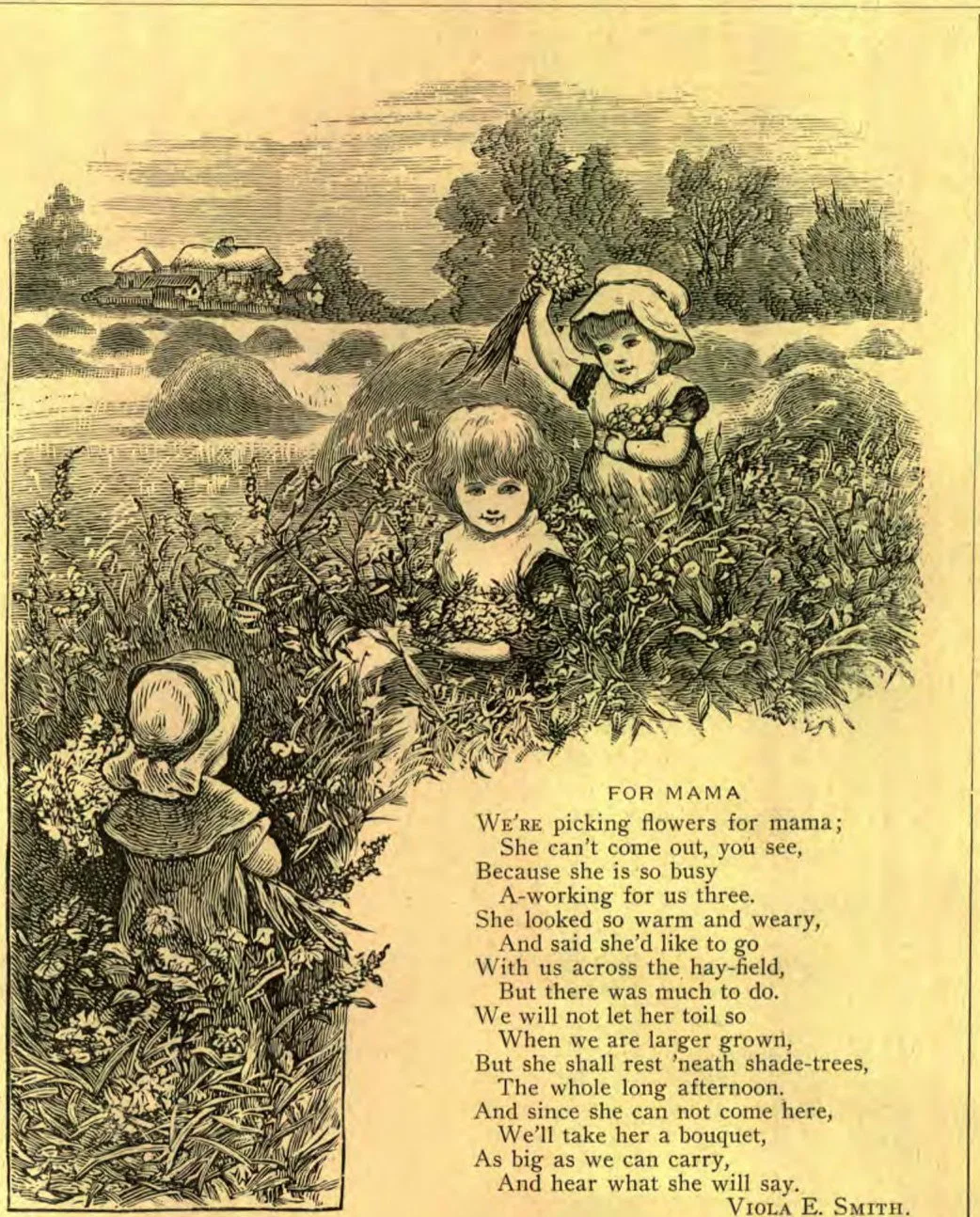
FOR MAMA
By Viola E. Smith
WE’RE picking flowers for mama;
She can’t come out, you see,
Because she is so busy
A-working for us three.
She looked so warm and weary,
And said she’d like to go
With us across the hay-field,
But there was much to do.
We will not let her toil so
When we are larger grown,
But she shall rest ’neath shade-trees,
The whole long afternoon.
And since she can not come here,
We’ll take her a bouquet,
As big as we can carry,
And hear what she will say.
VIOLA E. SMITH.
FOR MAMA
THE JANET-LOUISE LETTERS
By Louise
Dear Cousin Janet: Your last letter I greatly enjoyed reading, and now I must tell you how a few children and myself, with one of the mothers, spent last Sabbath afternoon.
We walked out to a piece of woods through which a small brook was flowing. This was a great temptation to the boys, who wanted to wade in the water; but we did not think it would be right to spend the Sabbath in a frolic, and still we did not like to say, “Don’t” all the time. Finally I hit on a plan to engage their attention. I called the boys to me, and told them I had a favor to ask. I wanted them to bring me a branch of every kind of tree and shrub that grew about here. As I was familiar with only a few of the trees, I wanted to learn the names of the others. I said, “Bring only one at a time, and show me the tree it grew on.” They quickly grasped the idea, and seemed glad to busy themselves in this way.
As they brought each branch, we talked about it, examining its peculiarities, and noting the bark of the tree, or its size, and how it grew. Robert, who had always lived in this part of the country, and knew all the trees, felt much pleased to be able to give me the desired information, and I gratified him by paying good attention, and asking questions that he could readily answer. Then I encouraged him never to give up learning everything good and useful, and not to become discouraged when he found things in books that were harder to master than those he saw in nature.
We spent a pleasant hour or two, and returned with thirteen varieties of branches, whose names I will give you just as they were given to me: Poplar, chestnut, oak, sassafras, maple, sarvis, sourwood, black gum, ivy bush, wild plum, black oak, soft maple, hard maple.
Affectionately your cousin,
LOUISE.
HEALING THE MAN WITH AN UNCLEAN SPIRIT IN THE SYNAGOGUE
By W. S. Saddler
(Concluded) *
What Have We to Do with Thee?—The impure spirit that possessed this unfortunate man confessed to having nothing in common with Christ. He cried out, “What have we to do with thee, thou Jesus of Nazareth, . . . the Holy One of God?” To-day this is the cry of many when truth is brought to them. They say, “Away with it; what have we to do with things divine?” In rejecting truth to-day, we turn our backs upon Jesus, just as literally as if he were here in person. Evidently the evil spirit anticipated his future punishment in the question, “Art thou come to destroy us?” It would seem from this that the evil spirits expect some day to be brought into the destroying presence of the Prince of Life. As mentioned in another place, the evil one asks, “Art thou come to destroy us before the time?”—“the time” undoubtedly referring to the final end, to the destruction which awaits these hosts of evil, now held in chains of darkness. Jude 6.
I Know Thee, Who Thou Art.—The demons know of Christ,—his great power and his sinless character. It is written that they even believe and tremble. But this knowledge is not a saving knowledge. We must know God aright, in order to make this knowledge life-giving to us. They know him as their once-beloved Commander, against whom they rebelled. They know him as one who offered his life a ransom for their redemption, which they were deceived by Lucifer into rejecting. They know him as the one who afterward yielded his life for the saving of the guilty pair in Eden, and who, to carry out the purpose of his saving plan, is now come to earth to wrest from the hand of the arch-demon his usurped dominion, “to seek and to save that which was lost.”
And Jesus Rebuked Him.—Although evil spirits made confession of Christ, the children of Israel did not recognize him, because of the humble way in which he came. The Holy Spirit and angels had acknowledged him at his baptism; and now the spirits of demons offered the same acknowledgment. But Christ did not propose to have the kingdom of darkness bear witness to the kingdom of light, so he hushed the evil spirit that spoke within the man. It was no doubt Satan’s purpose in leading this man into the synagogue to have him cast reproach upon Christ and his cause by this apparent acknowledgment of the divine mission of the Saviour. Christ did not permit the evil spirit to tell the truth concerning him, lest, as on another occasion, the people should claim that he was in league with the prince of devils. Satan is most to be feared when he seeks to speak the truth, disguising himself as an angel of light, and approaching one with words of flattery and commendation.
Hold Thy Peace and Come Out of Him.—Angels who once refused to yield willing obedience to heaven’s Commander must now obey his word, whether they will or not. Jesus spoke to the demon, saying, “Hold thy peace,” and the command of the Creator and Redeemer must be obeyed. The demon is silent. Not only has the Saviour authority to hush the insincere confessions of the spirit of devils, but he also has authority from the Father to command them to “come out.” This he did. He who is with us is greater than all they that are against us. By his life of unselfish devotion, by his death and matchless love, he has won the right, in the eyes of heaven and earth, to speak with authority to the spirits of demons who seek to possess the souls of sinful men and women.
When the Unclean Spirit Had Torn Him.—The evil spirit was commanded to be silent, and to depart out of the man; and, with another cry, tearing the man, he left. The spirit that possessed him sought to do as much damage as possible before he left. Just as an ejected tenant will sometimes tear up the premises before he leaves the house, we find the devil seeking in every way possible to destroy the soul he is about to lose. When Satan is compelled to leave the sinner, he seeks to do all the harm he can, as Pharaoh increased the burdens of the Israelites before they were delivered.
He Came Out of Him.—After uttering one last cry of obstinate disobedience, the unclean spirit, who thought himself so securely entrenched within the soul of this unfortunate man, was compelled to come out of him,—to leave him a new trophy to the power of God and the love of Christ. I am so thankful that even the devils are subject to the word of the Captain of our salvation. Nothing is too hard for him, nor anything too great. When the evil spirits of impurity, deceit, or pride have begun to fasten themselves upon our experience, let us humbly lay ourselves at the foot of the cross, and beseech Jesus to cast forth the spirits of evil from our hearts. When we thus go in sincerity, with a willing mind, he will send them away.
W. S. SADDLER.
WHAT THE BIRDS AND FLOWERS THOUGHT
“Wake up! Wake up! Ver-y, ver-y beautiful!” sang Mr. Robin one morning in spring, as he first looked toward the ground, and then up, at the blue sky above.
“Here I am!” answered a Daffy-down-dilly, as she playfully poked her yellow head up through the ground, so near Mr. Robin that it almost made him jump.
“I’m here, too,” said a lavender crocus.
“So am I,” said a sleepy violet.
“Look! look! look over under that tree!” sang a little song-sparrow. And, sure enough, under an old oak-tree was a baby fern, with some of its fronds still tightly curled up, fast asleep, while a few of them were waking up, and gently unfolding.
“Ver-y, ver-y beautiful!” sang Mr. Robin again.
“It is a beautiful world to live in,” continued the little crocus.
“And to work in,” added Mr. Robin, as he thought of the busy summer ahead of him.
“And to play in,” said Daffy-down-dilly, as she swayed and nodded in the breeze.
“And to love in,” sighed the little sleepy violet.
“And to grow in,” said the baby fern.
“And to sing in,” sang a little bluebird near by.
“And to trust in,” said a tiny blade of grass.
And so they thought. And each one tried its best to be all that God meant it to be.
The little flowers did not try to sing, the little birds did not try to bloom, and the tiny blade of grass did not try to fly; but they each did their part, and the world was more beautiful than ever because they lived.—Selected.
THE FIRST TWENTY YEARS
Live as long as you may, the first twenty years form the larger part of your life. They appear so when they are passing; they seem so when you look back on them; and they take up more room in the memory than all the years that come after them.
Take good care of the first twenty years of your life. On the use which you make of them, your happiness and usefulness in after-years will very largely depend. See that they are spent in forming right habits and cultivating right tastes. — Selected.
Daughters Sharing the Burdens of Home
It is easier to be good in church and in doing church work than it is to be good at home and do the work there. To wear the cross means to do the work next to you. It is much easier for girls to dress up and go out to engage in some charitable work than it is to help their mothers keep the house in proper order, and relieve their tired hearts and maybe their tired feet. All over this land the need is for daughters to be charitable to their mothers, and bear the burdens their mothers will have to bear unless they take them. No amount of outside work can compensate for the neglect of work that the mothers must do if the daughters do not share the home burdens with her. The priceless wealth of character is made by willingness to wash and sweep rooms, which the mother must do if her daughters do not.—Margaret Bottome.
LADY AGENTS wanted for my fast-selling Health Garments. I have some new articles that are big sellers. I pay charges. My Victoria recommended by every lady. Catalogue free. Address W. S. Dann, 1916 Cuming St., Omaha, Neb.
10. As the wicked suffer the awful effects of God’s wrath, what will they do? Rev. 16: 9, 11; note 4.
11. What will they seek to do to God’s people? Rev. 13: 14–17; note 5.
12. To what places will the children of God flee for protection? Isa. 33: 16.
13. What promises has God specially given for that time? Ps. 91: 3–10.
14. Can we know when we shall enter that terrible time? Note 6.
NOTES
1. When Jesus completes his work as our High Priest, and the investigative judgment comes to an end, he will “stand up.” That is, he will no longer sit upon the throne of the Father as priest, but will begin to reign as “King of kings, and Lord of lords.” To “stand up” means to reign.
2. Those who come to the time of trouble unprepared, and still living in sin, will not be able to find any help in that day. Jesus is no longer there to plead for them. He is now standing before the Father as our Advocate (1 John 2: 1), and by faith we can enter into the sanctuary, the temple of God in heaven, and find forgiveness. Heb. 6: 19, 20. But when he leaves the temple, we can no longer enter there; for it is only in Jesus Christ that any one can come into God’s presence. When Jesus leaves his Father, the temple will be “filled with smoke from the glory of God,” and then, says the Lord, “no man was able to enter into the temple, till the seven plagues of the seven angels were fulfilled.” It will be a terrible experience for all of whom the prophet speaks. Dear young man or young woman, earnestly seek God now, that you may not discover, when it is too late, that you are not saved. “Now is the accepted time.”
3. “Her plagues come in one day.” This is a prophetic day, and is equivalent to one literal year. The plagues will be visited upon the earth during, or within, one year.
4. When the plagues begin to fall, the day of probation has closed. The wicked have all fully made up their minds that they will not serve God. They have taken “counsel together, against the Lord, and against his anointed, saying, Let us break their bands asunder, and cast away their cords from us.” Ps. 2: 2, 3. They have all sinned against the Holy Spirit, and it has forever left them. There is no more that God can do to help them. So when the troubles from God come upon them, they do not repent, but only grow more wicked. It is God’s plan and desire to lead men to repentance by bringing trouble upon them (see Isa. 26: 9, last part); and when, instead of repenting, they only curse and blaspheme, it is plain that he can do no more to help them. The seven last plagues will show men and women to be beyond all change, and that God is just when he destroys them from off the earth. “God is love;” and even in the seven last plagues he is doing only that which is best for all, that which he must do to put sin away so that it will never come up again.
5. As the plagues fall, one after another, the wicked come to think that the people who keep the true Sabbath are the cause of all the trouble. They say that as long as Sunday is not kept, the trouble will continue; that God is punishing the world for Sunday-breaking. They therefore, in their terrible suffering, gnash with their teeth upon God’s people, and seek to put them to death. Before the plagues began, they had passed laws to keep Sabbath observers from buying and selling, and had sought to force them to keep the Sunday. But they did not succeed; and now, as a last step, they think to put them all to death. But God cares for his people, who are hidden in different places of the earth; and when the time comes for them to be destroyed, he begins to deliver them.
6. We know not when Jesus will close his work in the heavenly sanctuary, but we do know that the time is near at hand. Jesus has said that the close of our probation and the plagues of God’s wrath will come as did the flood in the days of Noah. They “knew not until the flood came, and took them all away.” When the judgment closes, the sun will rise and set as usual, men will be going about their business as always, and pleasure-seekers will have no thought of anything but to eat and drink, saying, “To-morrow shall be as this day, and much more abundant.” Not until the plagues begin to fall, will many come to see that the door is shut, and that they are lost. Will any who study these blessed lessons be among the number of the young who will “wander from sea to sea, and from the north even to the east, . . . to seek the word of the Lord, and shall not find it”?
“There is a line by us unseen,
That crosses every path,—
The hidden boundary between
God’s patience and his wrath.”
“O! where is this mysterious bourne
By which our path is crossed,—
Beyond which God himself hath sworn
That he who goes is lost?”
“How far may we go on in sin?
How long will God forbear?
Where does hope end? And where begin
The confines of despair?”
“An answer from the skies is sent:
‘Ye that from God depart,
While it is called to-day, repent,
And harden not your heart.’”
GRAND TRUNK R'Y. SYSTEM.
Taking Effect June 2, 1901.
Trains leave Battle Creek.
WEST-BOUND.
No. 9, Mail and Express, to Chicago — 12.15 P. M.
No. 7, Limited Express, to Chicago — 7.00 A. M.
No. 1, Chicago Express, to Chicago — 9.25 A. M.
No. 3, Lehigh Valley Express, to Chicago — 3.50 P. M.
No. 5, International Express — 2.17 A. M.
No. 75, Mixed, to South Bend — 7.30 A. M.
Nos. 9 and 75, daily, except Sunday.
Nos. 1, 3, 5, and 7, daily.
EAST-BOUND.
No. 10, Mail and Express, East and Detroit — 3.45 P. M.
No. 8, Limited Express, East and Detroit — 4.50 P. M.
No. 4, Lehigh Express, East and Canada — 8.32 P. M.
No. 6, Atlantic Express, East and Detroit — 2.10 A. M.
No. 2, Express, East and Detroit — 7.00 A. M.
No. 74, Mixed (starts from Nichols yard) — 7.15 A. M.
Nos. 10 and 74, daily, except Sunday.
Nos. 4, 6, 8, and 2, daily.