The Youth’s Instructor, Vol. XLIX, No. 35

A VISIT TO THE ISLAND OF BAU

The Youth’s Instructor

Sep 5, 1901

Review and Herald Publishing Company · Battle Creek, Mich. · Sep 5, 1901

A VISIT TO THE ISLAND OF BAU
Mr. Fulton and myself, with our little son George, recently took a trip to the famous island of Bau. Although one of the smallest of the group, Bau is the most historic island of Fiji. More people have been killed and eaten on it than on all the other islands of the group combined. The Wesleyans have had a mission there for many years, and a white missionary resides there permanently.
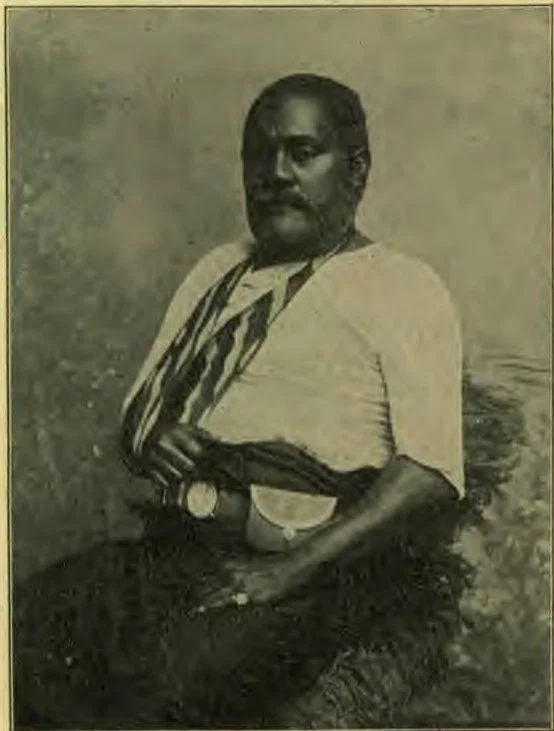
Bau is also the home of the high native chiefs. Ratu Able, of Bau, the greatest chief in Fiji, died last February; and according to Fiji custom, a great feast was held in Bau this month of May in honor of his death. As many natives expected to be present from all the surrounding islands, Mr. Fulton thought it would be an excellent opportunity to distribute tracts and papers among them.
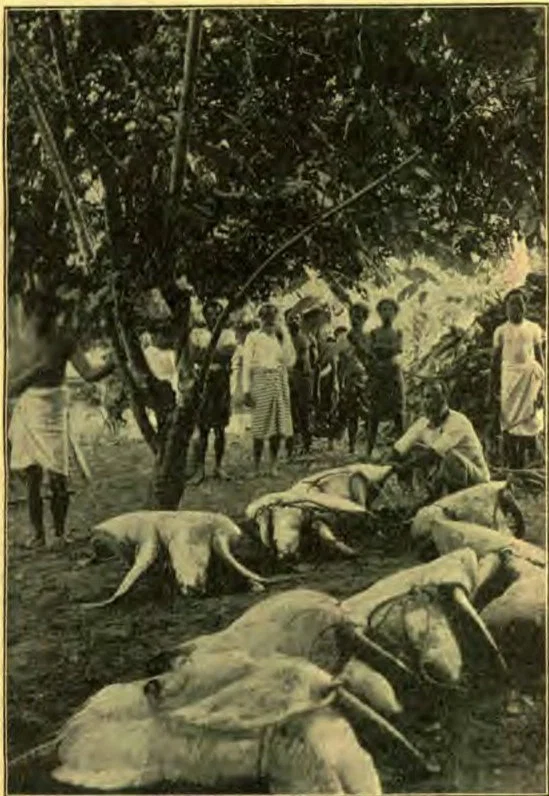
TURTLES FOR THE FEAST
Ratu Ambrose, a high chief, and his wife, who is also of royal birth, and who are now earnest Sabbath-keepers, went to Bau with us. We went up the Rewa River in a little steamer, having our own small boat in tow. The first stop was made at Nukulau, a small island used as a quarantine station. Here we found eight hundred Indians, who had just arrived in a large ship from India, and were awaiting inspection. They were a dirty but happy-looking crowd; and judging from appearances, their clothes had not been changed since leaving their native land. At Wainibokasi we left the steamer, and walked a mile or more through rice-fields and sugar plantations to the native village of Drobutu. Here we were met by our three natives with the boat. To show their respect for Ratu Ambrose and his wife, several women of the town came down to the river's bank, and gave us five or six vakalolos. These are native puddings made of taro, sugar-cane juice, and cocoanut milk, and baked until they are of the consistency of an English plum pudding, then tied up in large leaves. They are very nice, and will keep for several days.
Leaving the main river, we set sail, reaching Bau just at dark. A large number of canoes, small boats, and cutters lay anchored along or near the beach, whose occupants had come to attend the feast. We anchored our boat near the house of the “Buli”—a title given to one of the native officers having charge over the different districts into which Fiji is divided. The Buli’s wife came out, gave us a cordial greeting, and urged us to enter her home.
We went into a large room, forty-five feet long, twenty-five feet wide, and thirty feet high in the loftiest part. Three immense doors and four large windows furnished ample ventilation. The entire floor was covered with native mats, many of which were several yards in length and width. In two corners of this room were two elevations about two feet high, ten feet long, and six feet wide, covered with several layers of mats. These are the family beds; but according to Fiji custom, the family usually sleep anywhere but on the beds, which are as a rule reserved for visitors. A table and a chair, used only by the Buli for writing purposes, a large deck chair, several trunks and boxes, some biscuit tins, and other odds and ends useful only to Fijians, completed the furniture. The kitchen was a short distance from the house.
After resting for a few minutes, Ratu Ambrose, who had spent his boyhood in Bau, conducted us to the center of the town, where the feast was in progress. We found most of the food all cooked, much to our disappointment, as we wished to see the cooking process; but we had the satisfaction of seeing it before it was all devoured by the hungry multitude. As the night was dark and cloudy, we could see only by the light of our lantern, and a few other lights scattered here and there among the vast crowd. Hundreds and hundreds of Fijians were sitting cross-legged on the grass, waiting to be served. Great quiet prevailed, except for the occasional low hum of voices. We passed around among the crowd, who looked up at us, wondering where we had come from at that late hour of the night.
The first thing that attracted our attention was the great number of large swine roasted whole. (The entrails had been taken out, cleaned, and replaced in the carcasses before roasting.) There were immense baskets containing hundreds of baked taro and yams. Two of these baskets were specially large, each containing one thousand yams. Upon measuring one of them, we found it to be six feet high and thirty feet in circumference. As I am rather short in stature, Mr. Fulton had to lift me up so I could look into the basket. The yams used at a feast are usually quite large, measuring from one to four feet in length, and from five to twelve inches in diameter. There were vakalolos by the dozen; and scores of huge turtles lay on their hard backs, waiting to be devoured. Immense bundles of yangona root were lying about, which were to be chewed by the young men, then placed in a bowl, and mixed with water for the favorite native beverage, commonly known in the South Seas as “kava.”
RATU TANOA — KAKEBAU'S FATHER
There were preaching services that evening in the large native church near by, at which a newly arrived minister from Australia was to speak. Those interested in spiritual things repaired thither, when the lali (a hollow log) was beaten; and the building, which is about forty by one hundred feet, was filled to its utmost capacity, the people sitting, according to Fiji custom, on the floor. The chiefs, however, did not attend, as they were more interested in the feast. The food was at last apportioned, those from different towns receiving a certain amount, which they took and ate by themselves, or else took to their boats and carried home. The eating and drinking continued till late in the night, and as morning dawned, the greater number of the feasters boarded their cutters, boats, and canoes, and sailed for their respective towns.
The next morning the chiefs came to Mr. Fulton, and requested him to preach in the evening. He accepted the invitation, but did not preach in the native church, as the white missionaries have commanded the natives not to allow us to preach in any of their churches. A large building belonging to the natives, and used for business meetings and councils, was obtained, however, and was crowded. All the chiefs were present. The subject presented was “Christ the Light of the World,” to which excellent attention was given. After the meeting, privilege was given to ask questions, and the people responded freely.
The following day we distributed hundreds of tracts and papers, which were eagerly received.
We slept at the Buli’s house, and the following morning started out to look at the famous historic places of Bau. The first man we met was old Mr. Berrick, an American negro, commonly known as Black Bill. He is eighty-four years old, but does not appear to be over sixty, and jocularly claims to be one of the first white men in Fiji. He has scarcely a white hair in his wool. He told us many interesting things about the history of Bau, having himself been King Kakebau’s advisor in cannibal times.
We saw the famous stone against which the heads of victims were smashed before being roasted. This stone is now kept inside the Wesleyan church. Ratu Ambrose pointed out to us a large, heart-shaped hole, which was formerly used as a vat for dead bodies.
We passed a large, rusty anchor of a ship, leaning against the foundation of an old heathen priest’s temple, which Mr. Berrick told us had belonged to a ship from Manila, that came to Bau years and years ago for a cargo of sea-slugs for the Chinese trade. The crew got into trouble with the natives, who killed and ate all but one man, and brought the anchor to shore as a trophy. In former times, when Rewa (the second town in importance in Fiji) and Bau were at peace, this anchor would be taken to Rewa; but as soon as a quarrel sprang up, the Bau men would go for the anchor, the Rewa people of course refusing to hand it over. Then war would follow, and the victorious party would seize the anchor. Many hundreds of natives thus lost their lives.
RATU EPEH
RATU EPEH
We also saw a native oven made, and a huge turtle, five feet long and four feet broad, cleaned and roasted, with a lot of yams, in the oven. These ovens are circular pits in the ground, filled with wood, on top of which stones are heaped. The wood is ignited; and when the rocks are red-hot, the burning wood is removed. Then the rocks are leveled, and native vegetables, such as taro, yams, breadfruit, and sweet potatoes, are thrown upon them, and covered with a thick layer of leaves. The turtle was placed, stomach down, on the leaves, and covered with earth till nothing could be seen but a huge mound of dirt.
It was interesting to watch the turtle being prepared for roasting; for even after he was dead, and his entrails had been removed, he kicked vigorously with his paddles, or legs, when touched. After his intestines had been cleaned, they were broiled on the hot rocks, and rolled up in a ball. These, with all the fat taken from the entrails and also broiled, were taken to the houses of the chiefs and served as a special dainty. The men who were doing the cooking, broiled the liver, and ate it themselves before putting the turtle in to bake. Turtle flesh is a kingly dish in Fiji; none but the chiefs are supposed to eat of it without special permission. A man of low rank can not eat a turtle that he captures, but must first present it to his chief, who disposes of it according to his will. The present government still recognizes this old native law, and fines all transgressors.
Taking leave of our native friends, we left Bau feeling that we had been profited as well as interested by our visit. And we hope that the word spoken and the literature distributed will prove as seed sown in good ground.
Mrs. J. E. Fulton.

DIVISION I—CHAPTER II

The Week of Creation

§17. “In the beginning God created the heaven and the earth.” Gen. 1:1. The first definition given by Webster of the word “create” is, “To bring into being; to form out of nothing; to cause to exist; produce; generate.” A more comprehensive statement of the origin of our earth is nowhere to be found.
§18. God did not cause it to grow by the accretion of meteoric dust, requiring millions of years to attain its present size; neither did he cause it to evolve from a nebula, or cloud of fire-mist; for we are plainly told, in Heb. 11:3, that those “things which are seen, were not made from things which do appear.” We are simply informed that God caused them to exist out of nothing. Right here science must stop. Here is reached the boundary line. The profoundest wisdom of man can never reveal the mystery of creative power. “The secret things belong unto the Lord our God; but those things which are revealed belong unto us and to our children forever.” Deut. 29:29. By simple faith we are to grasp the great truths of creation.
§19. “Through faith we understand that the worlds [plural] were framed by the word of God.” Heb. 11:3. Not only this one world of ours, but the systems of worlds that comprise our starry heavens, and all their inhabitants, were spoken into existence by the creative power of God. “By the word of the Lord were the heavens made, and all the host of them by the breath of his mouth. For he spake, and it was done; he commanded, and it stood fast.” Ps. 33:6, 9. And again, “For by him were all things created, that are in heaven, and that are in earth, visible and invisible, whether they be thrones, or dominions, or principalities, or powers: all things were created by him, and for him.” Col. 1:16.
§20. Let us, by faith, accept these statements of Holy Writ, and in believing, we shall be blessed. “By faith we understand,” says the inspired writer. How true this is! Every one of us accepts by faith, every day we live, things equally as hard to grasp. The most skeptical accepts, by faith, in spite of his boasted infidelity, the fact that by the process of digestion and assimilation the very food he eats becomes actual brains, bone, and muscle in his body. Many profess not to accept nor believe anything they do not understand; but let us look for a moment at the most common things in nature, and see if this is so. For instance, here is a field of grass. The cow eats of that grass, and it becomes changed into hair on her back. Sheep pasture in the same field, and with them the grass becomes wool. A herd of swine eat of the same grass; does it become hair or wool on their backs?—No, but rather, stiff bristles. With the rabbit it becomes down; with the hedgehog, quills; and with the goose, feathers. Can we explain, or even comprehend, this matter of every-day occurrence?—No; we can understand it only as we accept it by faith; then let us accept the statements of God’s word concerning the creation in the same way.
NOTE.—These lessons, comprising a brief study of Geology, Philosophy, Meteorology, and Astronomy have been prepared in response to the many calls that have come for a simple treatise on these subjects, that shall be free from the many infidel theories and deductions that are unscriptural and untrue. They have been written with special reference to the fireside, and the home- and church-school. The author would be pleased to receive, by correspondence, any criticisms or suggestions that will help to make them better adapted to this field of usefulness.
§21. “And the earth was without form, and void; and darkness was upon the face of the deep. And the Spirit of God moved upon the face of the waters.” Gen. 1:2. Not “without form” as we now use that word; but rather, in an unsettled, unestablished condition. “And God said, Let there be light: and there was light.” V. 3. Light was, because God commanded it to be. God spoke to the empty space; and, lo! the world stood forth, obedient to its Maker’s will. Let us hear the same voice speaking to our empty souls, and so let a new creation be formed within each of us: then we, too, shall be obedient to his will. Then God will likewise say to us, Let there be light; and no matter how empty, or dark, or void may have been our past experience, our souls will be filled with light. “And the Spirit of God moved upon,” or brooded over, “the face of the waters.” The same Holy Spirit is moving upon souls to-day.
§22. The time occupied by the Creator in bringing into existence and beautifying this earth of ours is briefly stated in Ex. 20:8–11 to have been six literal days. “For in six days the Lord made heaven and earth, the sea, and all that in them is, and rested the seventh day: wherefore the Lord blessed the Sabbath day, and hallowed it.” In Gen. 1:5 we read that “the evening and the morning were the first day;” in verse 8, that “the evening and the morning were the second day;” and so on during the complete cycle of the first week of our earth’s existence. Those were twenty-four-hour days, ruled by the sun; for the sun was made to rule the day. They were not long, indefinite periods of time.
Adam was created on the sixth day (Gen. 1:26, 31), or long, indefinite epoch or time (?), as is so commonly urged. He lived the remainder of that immense (?) period; then survived the long, unnumbered years of the seventh period (?); after which he was driven from the garden of Eden, lived to see his sons, Cain and Abel, who were born after leaving Eden, grow to maturity; and yet the Bible says that “all the days that Adam lived were nine hundred and thirty years, and he died.” Gen. 5:5.
§23. But do not the strata of rock and imbedded fossil remains prove the great antiquity of this earth’s existence, as is urged by our friends, the geologists? Let the fossils and rock remain where God has buried them, and in the proper time and place, in this course of study, we will dig them up, and read from their records the same unerring history of this planet that Moses wrote under the guidance of the Holy Spirit.

QUESTIONS

Define the word “create.” Describe the manner of this world’s creation. Describe the two popular theories mentioned. What text shows the incorrectness of these theories? By what means did the Lord create other worlds and their inhabitants? How long was the Lord in creating this earth? Give proofs that they were not long periods of time. Dr. O. C. Godsmark.

Enduring Trials Like a Soldier's Shield

“Do not be downcast at your continual trials and struggles. Rather take them as matters of course. Regard them as dints on a soldier’s shield, who has been fighting all day to maintain his ground.”

THE LOG-CABIN BOY

Once, in a clearing of the wood, The pioneer’s log-cabin stood,— The first brave foothold to create The might and order of a state,— And there were born the boys whose names The nation’s honor-list acclaims.
Log-cabin days have passed away, But in the forum of to-day Log-cabin boys have surely placed A work that can not be effaced. America is proud to own Her present greatness humbly sown. Americans are proud to know That, as Americans, they owe A nation’s peace, a nation’s joys, To lowly-born log-cabin boys.
FRANK WALCOTT HUTT.

AGATE

AGATE is a form of the common mineral quartz. From other forms of that mineral it differs in being made up of minute layers, and in being variegated in color. The colors may appear in the form of bands or clouds. The banded agates appear to be made up of parallel layers, sometimes straight, but more often wavy or curved in outline. These layers or bands differ in color from one another, exhibiting shades of white, gray, blue, yellow, red, brown, or black. To the naked eye they appear to vary in width from the finest lines to a width of a quarter of an inch or more. In reality, all the bands visible to the naked eye are made up of finer ones, to be seen only with the microscope. Thus in a single inch of thickness of agate Sir David Brewster, using the microscope, counted seventeen thousand and fifty layers.
On account of their beauty of color and outline, agates have been prized from the earliest times. They are mentioned by many of the ancient Greek writers, and the name “agate” is a corruption of the name “Achates,” a river in Sicily, whence the first stones of this kind used by the Greeks were obtained. This and neighboring localities continued to be the source of supply until the fifteenth century, when agates were found to occur in large quantities near Oberstein and Idar on the banks of the River Nahe, in the duchy of Oldenburg.
The industry of cutting and polishing agates on a large scale was soon established there, and these places are to this day the center of the agate industry. The agates used most extensively at the present time are not, however, those found about Oberstein, but come from a region about one hundred miles in length, extending from the province of Rio Grande do Sul, of southern Brazil, into northern Uruguay.
The agates in this region, first discovered in 1827, so surpass in size and beauty those from any other known locality, that they form at the present time almost the only source of supply. They are shipped in large quantities as ballast to both Oberstein and Idar, where the work of cutting, polishing, and coloring them is performed.
The discovery that the attractiveness of agates could be enhanced by artificial coloring was made about the beginning of the nineteenth century. The natural colors are rarely of a high order, being often only variations of white and gray or dull yellows and reds. Through the difference of porosity of the different layers, however, and the consequent different absorption of coloring ingredients, methods of artificial coloring can be employed, which produce lasting and pleasing effects. Most agate used for ornamental purposes at the present time is therefore artificially colored.
Agates of considerable beauty, though not of great size, are found in many places in the United States. Those of Agate Bay, Lake Superior, have rich colors, and make attractive charms and other ornaments. Agates are found in the beds of many streams in Colorado, Montana, and other regions of the Rocky Mountains. They occur all along the Mississippi River, especially in Minnesota, also along the Fox River, Illinois, in the trap rocks along the Connecticut River, and on the coast of California. While many of these agates are of great beauty, their use and sale is not likely to be anything more than local, since the Brazilian agates can be supplied so cheaply from Germany. The moss-agates of Colorado and other localities in the Rocky Mountains are, however, equal to anything in the world.
The beautiful moss-like inclusions seen in moss-agates are due to a partial crystallization of oxide of manganese or iron contained in the waters. The particles of oxide in these cases arrange themselves much as the particles of frost crystallize on a window pane.
A LITTLE FIJIAN MAID
Agates are not used as much as they once were for jewelry, though largely used for ornamental purposes, such as pen-holders, knife-handles, and vases. Their use for large marbles was once quite common, but glass marbles of the same size, and still called “agates,” are now generally substituted. In fine mechanical work, such as bearings for delicate instruments, and in tools for polishing and grinding, agate is still extensively employed.—Selected.

CHARACTER IS POWER

“If there is any one power in the world that will make itself felt, it is character. There may be little culture, slender abilities, no property, no position in society; yet if there be character of sterling excellence, it will demand influence and secure respect.”
My soul was stirred as my eyes rested upon these inspiring words. Should we covet a good character for the influence and respect it would bring us, to consume upon ourselves?—Ah, no! This is too low a motive ever to make a character of sterling excellence.
But what is character?—It is strongly marked traits, those which largely control our actions. It is not our reputation. People often appear to be what they are not, and sometimes are more than what they appear to be.
Reputation is what people think we are, but character is what we really are in the sight of God, who does not look upon the outward appearance but upon the heart.
A truly noble character can be obtained only by steady, persevering effort, and the surrender of our wills to Christ. Through him we become “partakers of the divine nature.” He is the only source from which every would-be noble character must derive its power; for from him comes all good. Such a character, once developed, can never be taken from its possessor.
“During the Revolutionary War, Richard Jackson was accused of an intention to join the British army, and admitted the truth of the charge. He was committed to the rude county jail, from which he could have escaped easily; but he considered himself held by due process of law, and his sense of duty forbade flight under such circumstances.
“He asked leave of the sheriff to go out and work by day, promising to return each night. Consent was given readily, as his character for simple honesty was well known, and for eight months he went out each morning, and returned at evening. At length the sheriff prepared to take him to Springfield, to be tried for high treason. Jackson said this would be needless trouble and expense; for he could go just as well alone. Again his word was taken, and he set off alone. On the way he was overtaken by Mr. Edwards, of the council of Massachusetts, who asked whither he was going. ‘To Springfield, sir,’ was the reply, ‘to be tried for my life.’
“The proof was complete, and Jackson was condemned to death. When the president of the council asked that a pardon be granted, member after member opposed, until Mr. Edwards told the story of his meeting Jackson in the woods. By common consent a pardon was at once made out. The childlike simplicity and integrity of the man had saved his life. Character is power.”
Such characters will win the confidence of all, and the power of such influence will magnify the name of our God, and hasten the day when the earth will be inhabited by those who are not only loyal and true on one point, but who have perfectly rounded characters, complete in Christ.
KATHRINA BLOSSOM WILCOX.

THE NATION'S UNOCCUPIED LANDS

It is often asserted, and as often unthinkingly believed, that our national landed possessions, with the exception of the Indian reservations and those tracts set aside for government parks, are practically occupied; and that, as a consequence, the opportunities and incentives which once moved pioneers to establish homes for themselves in untried fields are gone forever.
The fallacy of this assumption, however, is shown in recent investigations and compilations of the Land Office at Washington.
From these it appears that of the 2,270,557,440 acres once constituting the nation's domains, considerably more than one third are still unappropriated; and with the exception of Alaska, our new possessions — the Philippines, the Hawaiian Islands, Porto Rico, and Guam — are not included in the estimate.
It will, perhaps, surprise many to learn that even in some of the older States, as in those more recently settled, immense tracts of unoccupied land still form portions of the nation's possessions. Thus there are 428,883 acres in Alabama, 593,000 in Louisiana, 285,000 in Mississippi, 473,000 in Michigan, more than 5,627,394 in Minnesota, and 69,073,490 in Montana.
Government possessions, aggregating more than twice the area of Pennsylvania, exist in Nevada; and in New Mexico, Arizona, and Idaho the extent of its ownership is, approximately, as great.
It is not, of course, to be understood that all these lands are susceptible of cultivation, but many of them are, or can be rendered so. It is therefore obvious that within the original boundaries of the nation there is yet a wide field for agricultural development, in which the enterprising and industrious may reap deserved rewards.
— Youth's Companion.

WHAT CAN OUR YOUNG PEOPLE DO?

They can pray,— “Keep my lips, that they may be / Filled with messages for Thee,” and see the effect of that prayer wrought out in their lives.
“And let him that heareth say, Come.” Have you heard the message? If you have, you are now called to be the Lord’s messenger; and day by day, as he gives you opportunity, you are to tell the message to others. It means personal work for souls. So many seem to think that if they are polite, pleasant, friendly, and agreeable to others, they will thus create a good impression in favor of the religion they profess, and that no more direct effort is needed. But is that saying, Come? The question of Eliphaz (Job 15:3) has considerable force when applied to one who professes to be a servant of God: “Should he reason with unprofitable talk? or with speeches wherewith he can do no good?” The world is full of people who can pleasantly entertain, but souls are in need of something which merely intelligent talk upon general subjects can not give.
I was reading to-day an incident in the life of a woman who has had a most active Christian experience. She says: “One sorrowful lesson I can never forget; and I will tell the story in hope that it may save others from causes of similar regret. During a summer visit just after I had left school, a class of girls about my own age came to me a few times for an hour’s singing. It was very pleasant indeed, and the girls were delighted with the hymns. They listened to all I had to say about time and expression, and not with less attention to the more shyly-ventured remarks about the words. Sometimes I accompanied them afterward down the avenue; and whenever I met any of them, I had smiles and plenty of kindly words for each, which they seemed to appreciate immensely.
“A few years afterward I sat by the bedside of one of those girls—the most gifted of them all with both heart and head. She had been led by a wonderful way, and through long and deep sufferings, into far clearer light than I enjoyed, and had witnessed for Christ in more ways than one, and far more brightly than I had ever done. She told me how sorrowfully and eagerly she was seeking Jesus at the time of those singing classes. And I never knew it, because I never asked, and she was too shy to speak first. But she told me more, and every word was a pang to me,—how she used to linger in the avenue on those summer evenings, longing that I would speak to her about the Saviour; how she hoped, week after week, that I would just stretch out a hand to help her, just say one little word that might be God’s message of peace to her, instead of the pleasant, general remarks about the nice hymns and tunes. And I never did! And she went on for months, I think for years, after, without the light and gladness which it might have been my privilege to bring to her life. . . . But she said, and the words often ring in my ears when I am tempted to let an opportunity slip, ‘Ah, Miss —, I ought to have been yours!’”
How many times we have offered chaff to those who were hungering for the bread of life, we do not know. The longer we continue to do so, the greater the peril to our own souls, as well as to the souls of others. The words of Isa. 50:4 will be fulfilled to each one who seeks the Lord earnestly and constantly: “The Lord God hath given me the tongue of the learned, that I should know how to speak a word in season to him that is weary: he wakeneth morning by morning, he wakeneth mine ear to hear as the learned.”
MRS. L. FLORA PLUMMER.

CALLS FOR MISSIONARIES

(Concluded)
THERE is no record that Jesus knew who he was until the voice of God was heard at his baptism, proclaiming his Messiahship. Up to this time, faith in God’s word had been his only means of knowing that fact. Before this, the preaching of John, and his declaration of the coming Messiah, had stirred the land. “Tidings of the wilderness prophet, and his wonderful announcement, spread throughout Galilee. . . . In Nazareth it was told in the carpenter shop, . . . and One recognized the call.”—“Desire of Ages,” page 109.
We have noticed the different steps by which Christ became acquainted with his mission—his call. Now apply the same principles to yourself, to your own life:—
He was studying out a great problem,—the mystery of his mission. Just as surely as you are a Christian, you have a mission, a calling, a definite work in the world; and that is the great problem you should study. How many solid hours’ study have you ever given this subject? It is of much more importance than all the problems in philosophy and mathematics; for in its solution lies the science of eternity for yourself and others.
Suppose you are a young man or woman having constantly pressed upon your mind by the Spirit of God that you ought to be working to save souls. You may be in school, and could prepare for your life-work to much better advantage if you had some definite aim. God is just as willing to speak to you by his Spirit as he was to speak to Moses at the burning bush (but remember, Moses took pains to turn aside); to Jeremiah at Anathoth; to Paul as he prayed (Acts 22:17, 21); or to Jesus while in his father’s shop. If you are in earnest about this matter, take your Bible, and search out the different classes of laborers mentioned, and make a list of them. You will find it somewhat as follows: Apostles, prophets, teachers, workers of miracles, healers (doctors and nurses), helpers, governors (managers), interpreters, translators, evangelists. Then take some set time each day to study the circumstances of your life, your early training and surroundings, your tastes, aptitudes, talents, and experience, asking God to guide you constantly. If you do this faithfully, not merely for a day or two, but for months, if necessary, I believe your mission will open up to you, and you will see where you belong in God’s vineyard. By careful thought you can fill into your list the chief qualifications of these callings. Then if you have determined your own talents and qualifications, why should you not see and understand the mission of your life? “He has appointed us our work, and has endowed us with faculties and means for that work.” When the Spirit shows you what your calling is, you will be filled with an “intense purpose” to carry out God’s design in your life, to make you the light of the world in that particular calling. In worldly things, intensive work is being done; and God wants intensive service in soul-saving. “We must be more decidedly in earnest. We must talk the truth in private and in public.” Day by day, as you study and work, God will unfold his plans before you.
You need not expect a miracle to be wrought in calling you to any duty which has already been made plain. God calls through his word, and by the agency of his Spirit. His plain charge is, “Go ye into all the world, and preach the gospel to every creature.” No repeal of this charge has ever been spoken. You know that multitudes of God’s creatures are perishing without hope. The knowledge of this, in view of his charge, should call you with a mighty voice to take Christ to them. What greater call do you expect? What more touching call can God send you than the knowledge of hopeless souls? Dare you meet him, having done nothing to help them?
There are most urgent calls for missionaries wherever any soul lives who has not a saving knowledge of our Lord. And when you meet the Master, he may ask you, “Why did you not go to the heathen to tell them my saving love?”
Examine yourself now to see if there is any good reason why you should not make personal the command, “Go, work to-day in my vineyard.”
JOEL C. ROGERS.

Daily Companionship With Christ Changes the Day

FIVE minutes spent in the companionship of Christ every morning,—ay, two minutes, if it is face to face and heart to heart,—will change the whole day, and make every thought and feeling different.—Drummond.
Continue reading: A SUGGESTION