The founders of this republic believed that that State was governed best which was governed least. They taught that a government was simply an association of individuals designed to preserve order and administer justice. Aside from this, the individual was to be left to work out his destiny unchecked by the hindrances of governmental regulation, or the weakening influence of paternalism. The men who framed our Constitution were thoroughly acquainted with, and had suffered much from, the evils of despotism and over-government, and fully realized that all things were subsidiary to, and dependent upon, the blessing of liberty. So long as this spirit dominated our politics, America made great strides in every department of human activity. Inspired by every natural incentive to human energy, men wrung from savage conditions all the necessary elements of a great civilization.
But a change has come over the spirit of our dream. Our ideas of life and governmental function have become emasculated. Individual responsibility seems odious to the people. People have ceased to rely upon their own efforts, and are now always clamoring for the government to do something for them. It is plain that national stamina has deteriorated, that there is less energy and thrift, and that, in our weakened condition, we are peculiarly exposed to the temptations held out by paternalism and State socialism.
There is but one choice in this life for a man. This choice lies between individual ownership of self, with all the powers, privileges, and responsibilities which such ownership implies, or the being owned by a power which may be capricious, oppressive, despotic at will. We can not have both freedom and paternalism. If we fly from the surface hardships of individual responsibility to the deceitful rest of a paternalistic or socialistic government, we barter our glorious birthright of freedom for the rule of ignorant, prejudiced, and short-sighted politicians.
All tyranny is one in its essence, whether it be a tyranny of the minority or of the majority. Any government is destructive and subversive of the best interests of society, which aims to level and protect humanity. Society is not a crystallized institution. It is progressive, constantly impelled on by the vis a tergo of necessity. A paternalistic government, or State socialism, would deprive society of this impelling force, and render aspiring effort flat, stale, and unprofitable. No amount of government regulation can annihilate the thousand and one natural causes which produce differences in the abilities of men; and to promote the growth of civilization, these abilities must be given free scope. There must be justice for the strong and the fruitful, as well as for the weak and unproductive. . . .
We must return to the political views of Hamilton, Washington, and Jefferson. We must understand that it is not the business of a government to meddle with the private rights of individuals under any pretense whatsoever; the prerogative of government is to defend and maintain them only. We must do all we can through our schools, our press, our lecture halls, pulpits, clubs, and political organizations, to encourage the growth of individualism—that power upon which all civilization and progress hinge. If we do not adopt this course, if we continue to dream of a governmental Utopia, we shall eventually fall a prey to a tyranny beside which the despotisms of the Old World pale into insignificance, and our forefathers will have suffered and struggled in vain.—Medical Brief.
“CATHOLIC AMERICA.”
By Editor
A RECENT Catholic Mirror has the following from Archbishop Ireland. Is it the close relations between the archbishop and the administration which inspires this apostrophe?
“Catholic America! It is a word at the sound of which the hearts must throb and pledges must issue forth from the soul for loyalty to the duties and inspirations coming from that word. All people love their country, as it is their duty to do; but the love for one’s country must be the stronger and the more fervent in proportion as that country has claims upon her children; and what country has such claims upon the allegiance of its sons as America? The word ‘America’ sums up the highest gifts of civilization; it sums up the sweetest gifts of providence to human society—civil and political liberty without stain.”
We would remind our readers again that not thus did the Catholic Church talk a few years ago. In the Catholic World for September, 1871, a leading article thus refers to the Constitution of the United States:—
“As it is interpreted [in 1871] by the liberal and sectarian journals that are doing their best to revolutionize it, and is beginning to be interpreted by no small portion of the American people, or is interpreted by the Protestant principle, so widely diffused among us, . . . we do not accept it, or hold it to be any government at all, or as capable of performing any of the proper functions of government; and if it continues to be interpreted by the revolutionary principles of Protestantism, it is sure to fail. . . . Hence it is we so often say that if the American republic is to be sustained and preserved at all, it must be by the rejection of the principle of the Reformation, and the acceptance of the Catholic principle by the American people.”—P. 736.
But now there is a change, not in the Catholic Church in respect to its attitude toward the Constitution, as interpreted in 1871, but in the present interpretation of that Constitution as regards Catholicism. These things are worthy of profound consideration but the great mass will lie supinely until bound hand and foot, crying all the time, “Liberty.” The form of words remains in the Constitution; the life is gone.
No Wonder Europeans Pray for Peace
No wonder that Europeans pray for peace. The number of men in the armies and cost of the respective armies for 1897 is given by the N. Y. World as follows: Germany, 607,308 men, $130,000,000; France, 559,260 men, $125,000,000; Italy, 216,235 men, $42,000,000; Austria-Hungary, 277,192 men, $70,000,000; Great Britain, 220,199 men, $91,349,000; Russia, 1,743,244 men, $213,000,000. The navy expenditures are thus given: Germany, $15,000,000; France, $51,000,000; Italy, $20,000,000; Austria-Hungary, $7,250,000; Great Britain, $110,850,000; Russia, $45,000,000. The whole aggregates the enormous sum of $920,449,000, wrung from the soil and brain and brawn and blood of Europe in a single year for warlike purposes among professedly Christian nations! And, per capita, this country will soon have a heavier war burden in expenditures and pensions. Qui bono?
Deaths in Military Camps
It is a sad thing in these days of sanitary and hygienic enlightenment to find that peace is slaying in camps more of the very flower of the country, physically, in less time than did the ravages of war. There were a little over 1,400 Americans killed and wounded in the Spanish-American war; but over 3,000 at last reports have died in camp. Something is the matter somewhere. In the investigation to be conducted, may justice fall where it should.
NOBODY’S CHILD.
By Phila A. Case
ALONE in the dreary, pitiless street,
With my torn old dress and bare, cold feet,
All day I’ve wandered to and fro,
Hungering and shivering and nowhere to go;
The night’s coming on in darkness and dread,
And the chill sleet beating upon my bare head;
O, why does the wind blow upon me so wild?
Is it because I’m nobody’s child?
Just over the way there’s a flood of light,
And warmth and beauty, and all things bright;
Beautiful children, in robes so fair,
Are caroling songs in rapture there.
I wonder if they, in their blissful glee,
Would pity a poor little beggar like me,
Wandering alone in the merciless street,
Naked and shivering and nothing to eat.
O, what shall I do when the night comes down
In its terrible blackness all over the town?
Shall I lay me down ’neath the angry sky,
On the cold, hard pavements alone to die,
When the beautiful children their prayers have said,
And mamas have tucked them up snugly in bed?
No dear mother ever upon me smiled—
Why is it, I wonder, that I’m nobody’s child!
HOME OF THE FRIENDLESS, ALAMEDA, CAL.
No father, no mother, no sister, not one
In all the world loves me; e’en the little dogs run
When I wander too near them; ’tis wondrous to see
How everything shrinks from a beggar like me!
Perhaps ’tis a dream; but, sometimes, when I lie
Gazing far up in the dark blue sky,
Watching for hours some large, bright star,
I fancy the beautiful gates are ajar,
And a host of white-robed, nameless things
Come fluttering o’er me in gilded wings;
A hand that is strangely soft and fair
Caresses gently my tangled hair,
And a voice like the carol of some wild bird—
The sweetest voice that was ever heard—
Calls me many a dear, pet name,
Till my heart and spirits are all aflame;
And tells me of such unbounded love,
And bids me come up to their home above;
And then, with such pitiful, sad surprise,
They look at me with their sweet blue eyes,
And it seems to me out of the dreary night
I am going up to the world of light,
And away from the hunger and storms so wild—
I am sure I shall then be somebody’s child.
—Phila A. Case.
“THE HOME OF THE FRIENDLESS.”
By ALBERTA L. LITTLE
[From a Visitor.]
“Heaven’s gate is closed to him who comes alone;
Save thou a soul and it shall save thine own.”
—Whittier.
“Is you my mama?” a bright-faced little fellow—hardly more than a baby—paused in his play with a group of other children to ask the question of a lady who rang the bell at the Home of the Friendless. So many of the children at the Home receive visits from those who wish to adopt them that little Genie is all the time looking for some “mama” to come and claim him. So day after day he repeats to each newcomer, with childish insistence, his pathetic query, “Is you my mama?”
Poor little Genie! How his question calls to mind the scores and hundreds of little waifs and strays who by their helplessness, if not in words, are asking for a mother’s care! Hardly a day passes but what one or more of them is left motherless by death or desertion in the city of Oakland alone; and it is estimated that there are six thousand homeless children in California, and from seventy to one hundred thousand in the United States. But for every homeless child there is somewhere a childless home, waiting for the light and love and blessing that a little one will bring to it. To place these homeless children in the childless homes, where they may be educated and trained for usefulness, is the work undertaken by the Home of the Friendless.
The enterprise was started about three years ago by a few interested persons in the Oakland S. D. A. Church, who felt that the Lord had laid upon them this burden; and the work increased so rapidly that a year later it was placed on a more permanent basis, with a broader field. It is yet in its infancy, but it has already provided homes for fifty-three children, and has as many more under observation.
It is necessary to have a temporary shelter for the children while arrangements are being made for conveying them to permanent homes. Several different houses have been rented and occupied successively, but soon outgrown, and at present the Home family, numbering twenty-one, occupies a thirteen-room house in Alameda, just across a branch of the bay from Oakland. The location is beautiful, the house comfortably furnished, the large yard furnishes ample room for the children’s playground, and altogether it seems that a more desirable place could hardly be found. Most of the children are for adoption, but a few half orphans are simply boarded and cared for in the Home.
But not until one visits the Home can he understand and appreciate the blessing it is to the children who are sheltered there. The present matron, Mrs. E. Dunn, has been in charge for over a year. That she is a true home-maker, and gives the children the genuine “mothering” for which their hearts long, is evidenced by the way they scramble to see who shall sit next to her at prayers, and beg for good-night kisses. One almost forgets the pitiful stories of the want and misery from which many of them have been rescued, as he sees how happy and light-hearted they are now.
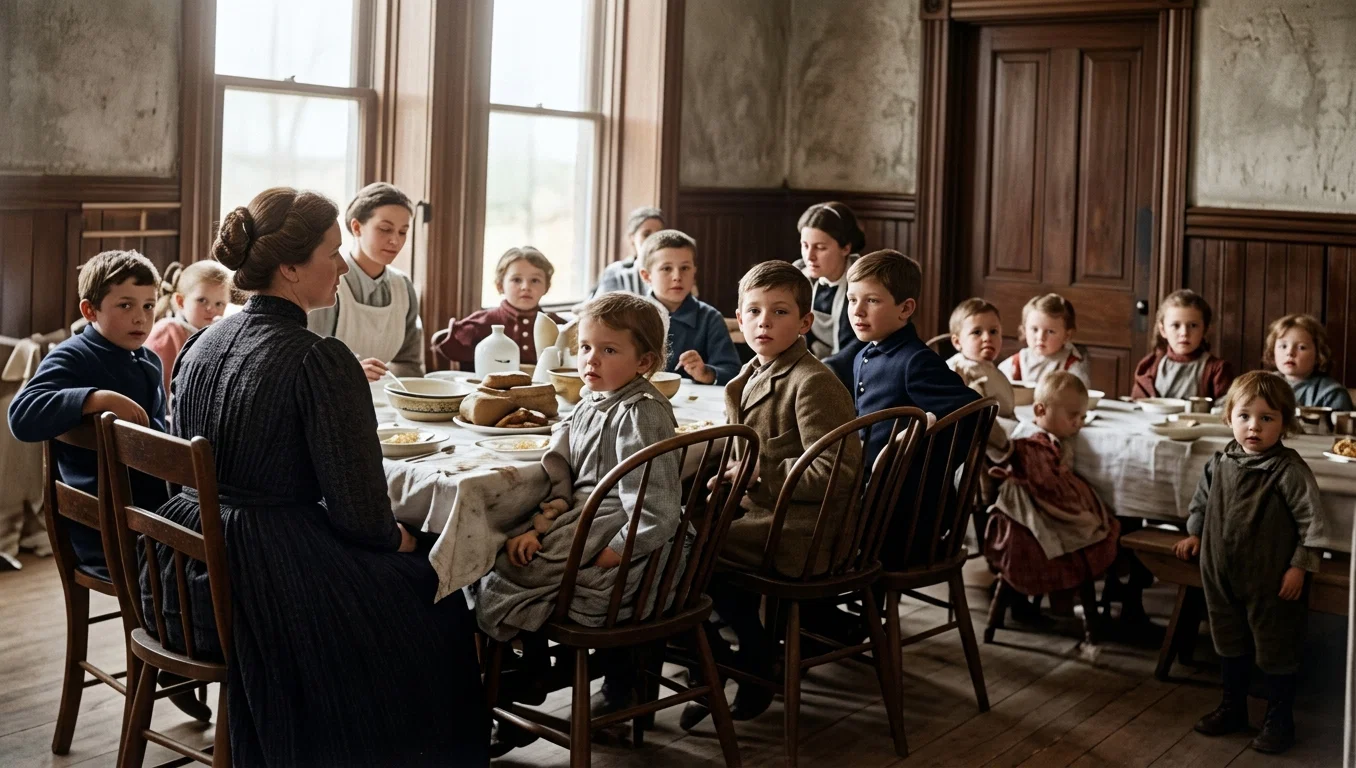
A Peep into the Dining-room.
Eight of the children, the oldest eleven years of age, attend school just across the street from the Home. Three others that have graduated from the nursery, but are still too young for school, play contentedly with their dolls. One little tot whose only recollections of home seem to be memories of whisky and police stations, follows the matron around, saying occasionally: “I love you. I like to stay here.”
The nursery is worthy of more than a passing notice. We found two large, sunny rooms devoted to the seven babies of the house, four of whom are still in long dresses, under the care of a sweet-faced nurse, Miss Ella Kemp, who has volunteered her services for a month. We feel sure the babies will have good care when we note her gentle ways and understand that she is there simply because she loves children. Surely, “love is the greatest thing in the world.” Just how she has managed to train them so that they all go to sleep at the same time and all wake up at once is a mystery we will not attempt to explain. One tiny little thing has been sick all its short life, but the others are as plump and happy-looking as anybody’s babies. All the children in the Home seem to be remarkably healthy.
The nursery babies are all boys except one. I am informed that as a general thing there are more calls for girls for adoption than boys, almost ten to one. But all adopted boys do not turn out bad. The great general W. T. Sherman, Vice-president Henry Wilson, the great explorer Henry M. Stanley, the renowned orator Bishop Simpson, the undaunted explorer John C. Fremont, and the great journalist and philanthropist G. W. Childs, were all homeless boys. All were reared by foster parents, the last named being a door-step waif, hence called Child or Childs, the name of the father of his country supplying the rest.
There seems to be an unwritten law about the Home that every one must be a helper and have the missionary spirit, and so the older children help with the ironing, make the beds, wipe the dishes, and feed the chickens; and the little ones feel it is a privilege to be allowed to sweep the walks and bring in the kindling-wood. A new church building is about to be erected in Alameda, and the children are anxious to help in the enterprise; so all who are10old enough to do so have planned to sell enough copies of the SIGNS to enable them to each give twenty-five cents.
Family prayers, morning and evening, form an interesting part of the program for the day at the Home. At the hour of evening worship the children are divided into two classes, and half an hour is usually spent in Bible study, but occasionally varied by a health talk. “Say, let’s keep right on with this. I’m ready to sit up all night an’ listen,” said one of the boys at the close of their study, which shows that it is anything but tiresome to them. Some time is then spent in singing, either to the accompaniment of the banjo or organ, just as the children prefer; and this exercise is also greatly enjoyed. The children all attend Sabbath-school regularly; and when it is noticed that they have better lessons than many others in the school, it speaks well for the faithfulness of their caretakers.
“The quality of mercy . . .
is twice bless’d;
It blesseth him that gives, and him that takes.”
And so this home is not more of a blessing to the children who are gathered into its loving embrace, than it is to the friends who have so generously made it a possibility. For you must know that the Home is supported entirely by voluntary contributions. Two collections are taken up each year in the churches in California, one in April and one in October, and the rest is donated by individuals. From the neat, cozy parlor, with its organ and tempting array of books, through the bedrooms, with their little “two-story beds,” the dining-room, whose low table and little chairs remind us of a kindergarten, to the storeroom, with its shelves filled to overflowing with well-made, comfortable garments, quilts, and gifts of fruit and other substantials, of which time and space forbid a detailed report, everywhere were evidences of the loving interest taken in “our orphans.”
The children throughout the State have taken a special delight in the work, and many daintily-embroidered bibs, also dolls, scrap-books, etc., witness to their patient hands and loving hearts. One little boy nine years old sent a quilt which he pieced himself, and he picked grapes to pay for the lining, so that it is entirely his own gift. When we saw all these tokens, it almost seemed to us the name “Home of the Friendless” is a misnomer, for surely the orphan children have no lack of warm, true-hearted friends, who are glad to have the privilege of caring for “Christ’s little ones.”
ALBERTA L. LITTLE.
OUR WORK AND WORKERS.
FIVE converts are reported at Tulsa, O. T., by Brother R. W. Parmelee.
ON the 28th ult. a church of ten members was organized at North Enid, O. T., by Brother E. T. Russell.
A BROOM factory is one of the new features of Healdsburg (Cal.) College.
A UNION meeting is to be held at Willow Hill, Jasper County, Ill., September 22 to October 2.
FROM the Keystone Gleaner we learn that Brother A. E. Place, of New York Conference, has been chosen president of Atlantic Conference.
IMMEDIATELY after the session of the European Union Conference, which was held at Hamburg in July, the German field was organized into a conference.
THE West Australian Tract Society has been organized at West Perth, with Mrs. Hindson as secretary and treasurer. The address is 265 Newcastle Street.
AT the recent session of the New South Wales Conference, the N. S. W. Medical Missionary and Benevolent Association was organized and put into operation.
BROTHER S. THURSTON reports the organization of a church of seventeen members at Susanville, Cal., August 5. The church and tract society were both started on a good financial basis.
UNDER date of the 8th inst., Brother J. O. Corliss writes from Ottawa, Ont., that he had a large interest on hand. “About thirty have taken their stand for the truth, and there are twice that number who are seriously investigating.”
THE pastor of the Baptist Church at Storm Lake, Iowa, attended our recent camp-meeting at Smithland. The Workers’ Bulletin says, “His presence and assistance at the meeting were greatly enjoyed both by the people and laborers.”
ON the 3d inst. Brother J. V. Willson, with his family, sailed from New York en route to Cape Town, S. Africa, to labor in the medical missionary work. Both Brother and Sister Willson are graduates of the Battle Creek (Mich.) Training School.
UNDER the labors of Brethren S. M. Cobb and W. A. Westworth, a church of twenty-seven members has been organized at Rochester, N. Y. The tent-meetings were closed in order to prepare for the camp-meeting in that place, which it is expected will add more to the new company, as several others are deeply interested.
UPPER COLUMBIA CONFERENCE is making a record this year in book sales. Brother G. W. Reaser, president of the conference, in a report to the Reaper says: “As we compare the reports of our canvassers with those that come in from other conferences, we find that not only are our agents aggregating more money from their book sales than agents in any other conference in the world, but the average amount of sales to the agent is greater than in any other field. A number of conferences have more agents than there are in the Upper Columbia Conference, but none equal us in the total value of books sold.” In addition to this, it may be said that, from the standpoint of physical geography, there are few more difficult fields to work.
PROF. C. C. LEWIS, principal of Keene (Texas) Academy recently made a tour of Oklahoma and Indian Territories, in the interest of the academy. From his report in the Academy News we take the following reference to Indian Territory:—
“Indian Territory is not the ‘wild and woolly’ country that people often imagine. It is a land of broad prairies, well wooded and watered, with abundant coal fields near the surface, and with towns as well built as typical Western and Southern towns. Vinita has two or three thousand inhabitants. It has bricks as large and numerous as those in Cleburne. It has two railroads, an academy, and a college. One sees a few Indians, and does not always know them as such when he sees them. They and the negroes whom they formerly held in bondage are the only ‘citizens,’ and every man, woman, and child among them is entitled to 160 acres of land. This land is to be allotted to them this fall, and if any is left it will be for sale. Some of the Indians work their farms and are wealthy, but more lease or rent their farms to the whites, and live near the rivers. When the Curtiss Bill goes into effect, a more stable government is inaugurated, free schools established, and titles to property become secure, this country will quickly take its place as one of the finest of the West. There are many openings for good schools. Medical missionary and missionary teachers would find ready employment at reasonable wages. Our principles of education and caring for the sick are so much superior to those in operation there that persons well prepared to represent these principles will be welcomed, and will find a good support. But it is no place for poorly-prepared workmen. Their worthlessness will be seen at once. The whites comprise some of the most vigorous and intelligent from the population of the surrounding States, and are not to be deceived by mere pretense.”
W. N. G
By W. N. G.
The Ladrone Islands, which have been made prominent through their seizure by the United States, are a group of fifteen islands in the Pacific Ocean, north of the Caroline group. A missionary writing from that field says the name signifies “the island of thieves,” the official name being Mariana Islands. The name is in honor of Maria Anna, wife of Philip IV., of Spain. The group has been a Spanish possession since 1668. At that time the population was estimated at 40,000 to 60,000; now, however, the estimate ranges from 8,000 to 12,000. It is said that the inhabitants are nearly all on four principal islands, the largest being Guahan, on which the American flag was raised by the Manila expedition. This island is the most southerly of the group. There is a mixed population, most of whom are poor and lacking in energy. Very little has been done for their intellectual improvement, and nothing that has elevated them in a spiritual way. The few schools that were once in operation have fallen into decay.
W. N. G
CHINESE AND AMERICAN CUSTOMS IN CONTRAST.
By Rev. Jee Gam
ON meeting or leaving a friend the Chinese shakes his own hands, while the American shakes the hand of his friend.
The Chinese does not raise his hat when saluting a friend, while the American does.
The Chinese magistrate keeps his hat on while sitting on the bench; the American judge takes his off.
The former is clothed with his official robes, while the latter only wears his every-day clothes.
The Chinese seat of honor is the one on the left side of the host, while that of the American is on the right.
The Chinese do not let their mustaches and beard grow until they are past fifty years of age, while the Americans let them grow when they are young, and after fifty often shave them off.
The Chinese invitation is red, while that of the American is white.
The Chinese have white and blue for mourning, while the Americans have white and black.
In decorating a grave the Chinese use white, while the Americans use all colors.
The Chinese bridal robe is red, while the dress of the American bride is white.
The Chinese read and write from the right side of the book and downward, while the Americans read and write from the left side of a book and horizontally.
The Chinese surname is placed before the given name, while the American is mentioned last.
The cardinal point of the Chinese compass is south, while that of the American is north.
The national emblem of the Chinese is the dragon, while that of the American is the eagle.
Sons are more desirable to the Chinese, while daughters are favorites of the Americans.
In general the Chinese do not think the education of girls a necessity, while the Americans give them equal advantages with the boys.
A Chinese young man becomes of age at his eighteenth summer, an American young man at his twenty-first.
The Chinese have no courtship at all, while the Americans seem to have too much.
Those betrothed in China never see each other until they are married, while the American contracting parties visit each other as much as they please.
The betrothal of a Chinese couple is never made without the consent of the parents or guardians, even after they have become of age, while that of the Americans depends upon the preference of the parties themselves.
The Chinese young ladies all get married; there are no aged unmarried ladies in China, while nearly one-third of the American ladies remain single.
The Chinese strongly believe that marriage belongs to God, and they do not believe in divorces, while many of the Americans believe that marriage belongs to man only, and, therefore, divorce is so prevalent in the United States.
The Chinese do not have honeymoon trips like Americans.
A Chinese newly-married lady very seldom goes out visiting, and never goes out shopping, while the American lady does as much visiting and shopping as she pleases.—Rev. Jee Gam.
1 “And Jehoshaphat his son reigned in his stead, and 2 strengthened himself against Israel. And he placed forces in all the fenced cities of Judah, and set garrisons in the land of Judah, and in the cities of Ephraim, which Asa his father had 3 taken. And the Lord was with Jehoshaphat, because he walked in the first ways of his father David, and sought not 4 unto the Baalim; but sought to the God of his father, and walked in His commandments, and not after the doings of Israel. Therefore the Lord stablished the kingdom in his hand; 5 and all Judah brought to Jehoshaphat presents; and he had riches and honor in abundance. And his heart was lifted up 6 in the ways of the Lord; and furthermore he took away the high places and the Asherim out of Judah. Also in the third 7 year of his reign he sent his princes, even Benhail, and Obadiah, and Zechariah, and Nethanel, and Micaiah, to teach in 8 the cities of Judah; and with them the Levites, even Shemaiah, and Nethaniah, and Zebadiah, and Asahel, and Shemiramoth, and Jehonathan, and Adonijah, and Tobijah, and Tob-adonijah, the Levites; and with them Elishama and Jehoram, 9 the priests. And they taught in Judah, having the book of the law of the Lord with them; and they went about throughout all the cities of Judah, and taught among the people. And the 10 fear of the Lord fell upon all the kingdoms of the lands that were round about Judah, so that they made no war against Jehoshaphat.”
Golden Text: “In all thy ways acknowledge Him, and He shall direct thy paths.”Prov. 3:6.
Suggestive Questions.
(1) What did Jehoshaphat do on coming to the throne of Judah? V. 1. (2) Who had preceded him on the throne? How long did he reign? What is said of his administration? Note 1. (3) What precautions did he take for the defense of his kingdom? V. 2. Note 2. (4) How did the Lord regard him? Why? V. 3. Note 3. (5) What was a marked characteristic of his life? V. 4. (6) What was the result of this close relationship to God? V. 5. (7) How did his prosperity affect him? V. 6. Note 4. (8) By what means did he seek to turn the people to God? Vs. 7, 8. Note 5. (9) In what region did they teach? What text-book did they use? V. 9. (10) How was Jehoshaphat’s kingdom protected from the surrounding enemies? V. 10. Note 6.
Notes.
1. Jehoshaphat, the son of Asa, succeeded his father on the throne. He began to reign when he was thirty-five years old, and reigned twenty-five years. His was one of the most prosperous reigns in all the history of Judah.
2. His defenses.—Jehoshaphat’s father had taken from the king of Israel some cities in the hill country of Ephraim, and these he took the precaution to fortify, as well as to erect new fortifications in Judah. The Holy Scriptures were indited by the Holy Spirit, hence the lessons are spiritual. So this example of Jehoshaphat is to teach the necessity of fortifying against loss the points in which victories have been gained over sin. This can be done only by standing steadfast in the truth (Gal. 6:1), by watching unto prayer (1 Peter 4:7), and opening the heart to Him that is knocking at its door (Rev. 3:20).
3. “The first ways of David.”—The ways of David until he committed the grave crimes in the matter of Uriah the Hittite. The margin reads, “of his father and of David.” His own father Asa did right in the sight of God until toward the last of his reign, when he sought aid of the king of Syria instead of the Lord; and when he was afflicted with a sore disease he sought relief from the physicians instead of from God. See 2 Chron. 16:7, 8, 12.
4. “His heart was lifted up.”—Not with pride, as was the heart of Amaziah (2 Kings 14:10), or the heart of Uzziah (2 Chron. 26:16), or the heart of Nebuchadnezzar (Dan. 5:20); but he took courage and was emboldened to continue his good work. He set a good example in faithfulness, and used his best energies to put down idolatry.
5. Teachers.—While Jehoshaphat used force to destroy the idols and other implements and material tokens of idolatry, he did not attempt to compel the worship of God. The commandments of God, which he sought and in which he walked, would not admit of that. But he sent teachers among the people to show them the right way, from “the book of the law of the Lord.” This is the only true Gospel principle in any age. See John 12:47, 48; 2 Cor. 5:11, 20.
6. The true source of protection.—It is folly for the professed people of God to seek the protection of any human power. God can at any time put His fear upon their enemies, and it does Him honor to trust Him under all circumstances. “The angel of the Lord encampeth round about them that fear Him, and delivereth them.” Ps. 34:7. “Many are the afflictions of the righteous; but the Lord delivereth him out of them all.” Verse 19.