Your ShelfYour Projects

Review and Herald, Vol. 79, No. 1.

TILL SHILOH COME
Earlier text: MAKING PIE CRUST WITH KO-NUT

EARLY RECOLLECTIONS IN THE THIRD ANGEL'S MESSAGE.
I was born in the spring of 1848 near Jackson, Mich. My parents were members of the Methodist Episcopal Church. In the spring of 1852 my father, and an uncle by the name of Nichols, left home for California. Not long after their departure my aunt became interested in the truth, and began the observance of the Sabbath. My mother, who was a Methodist, did not take kindly to such a change.
I frequently listened to their conversation, which made quite an impression on my mind, although I was only a little over four years of age. From my earliest recollections my mother had taught me to pray, and I had the greatest reverence for the Bible as the word of God. As I listened to my aunt when she read the Bible and explained about the Sabbath, it worried me much, and frequently I would leave my play, go behind the curtains, kneel by a trunk, and ask the Lord to help my mother to see the truth. I always closed the prayer by saying, “O Lord, them commandments.” This made such an impression on my mother that she went to my aunt and said, “I cannot stand this any longer; and if you have any light for me, I want it.” My aunt continued to read the Bible to mother, and soon she accepted the message, and was baptized by Elder H. S. Case, who afterward severed his connection with us, and started the paper called the Messenger of Truth. Soon after mother had accepted of the light, Elder Joseph B. Frisbie came to our place and held meetings in our schoolhouse, and a small company of believers was raised up. Among the number was one of our neighbors by the name of Chas. Glover. In the summer of 1853 Elder James White and his wife, and Elders J. N. Loughborough and M. E. Cornell came to our place and held meetings in Brother Glover's new barn.
After this our leading ministers frequently visited our little company, and always received a hearty welcome. In those days we had as much respect for a minister of our faith as we could have had for an angel, if one had visited us.
It was about this time that Spiritualism was making quite a stir in our community, and my mother and aunt visited a medium, and asked to have the spirit of a sister of theirs who had died several years before, called up. As the medium went into a trance, she said, “My dear sister, you are an unbeliever now, but you must not be.” My aunt said, “This is the voice of my sister, but is the devil.” Then the medium clinched her fist and, grating her teeth, said, “None devil, none devil.” That convinced my mother and aunt that Spiritualism is the work of Satan.
About 1853 my father returned from California, and soon began keeping the Sabbath. About this time our little band divided, a number uniting with the Messenger party. My father, not being very well established in the truth, went with them. The Messenger party soon began to quarrel among themselves, and father, becoming disgusted, gave up all profession of religion. Thus he lived for years. We soon after left Jackson County, and for some years did not meet any of our people.
During these trying times mother continued faithful to her convictions of truth, and brought up her children to reverence the message. There were a few times during these years that work was very pressing, and my brother and I worked on the Sabbath. In the spring of 1860 my parents moved to Battle Creek, Mich. This was my first experience in a Sabbath-school. My first teacher was Brother William Hall, long since dead, and the next was Brother Robert Sawyer, who has also been dead some years. At that time we did not have the Sabbath-school helps we now have, and the first lessons given by Brother Hall were from First Peter, second chapter. The thoughts presented from that chapter have stayed with me to this day, and frequently when reading a text from it, my mind goes back to the days long past. We did not always have preaching in Battle Creek in those days, and our social meetings were usually conducted by Brethren U. Smith and G. W. Amadon, who were at that time young men.
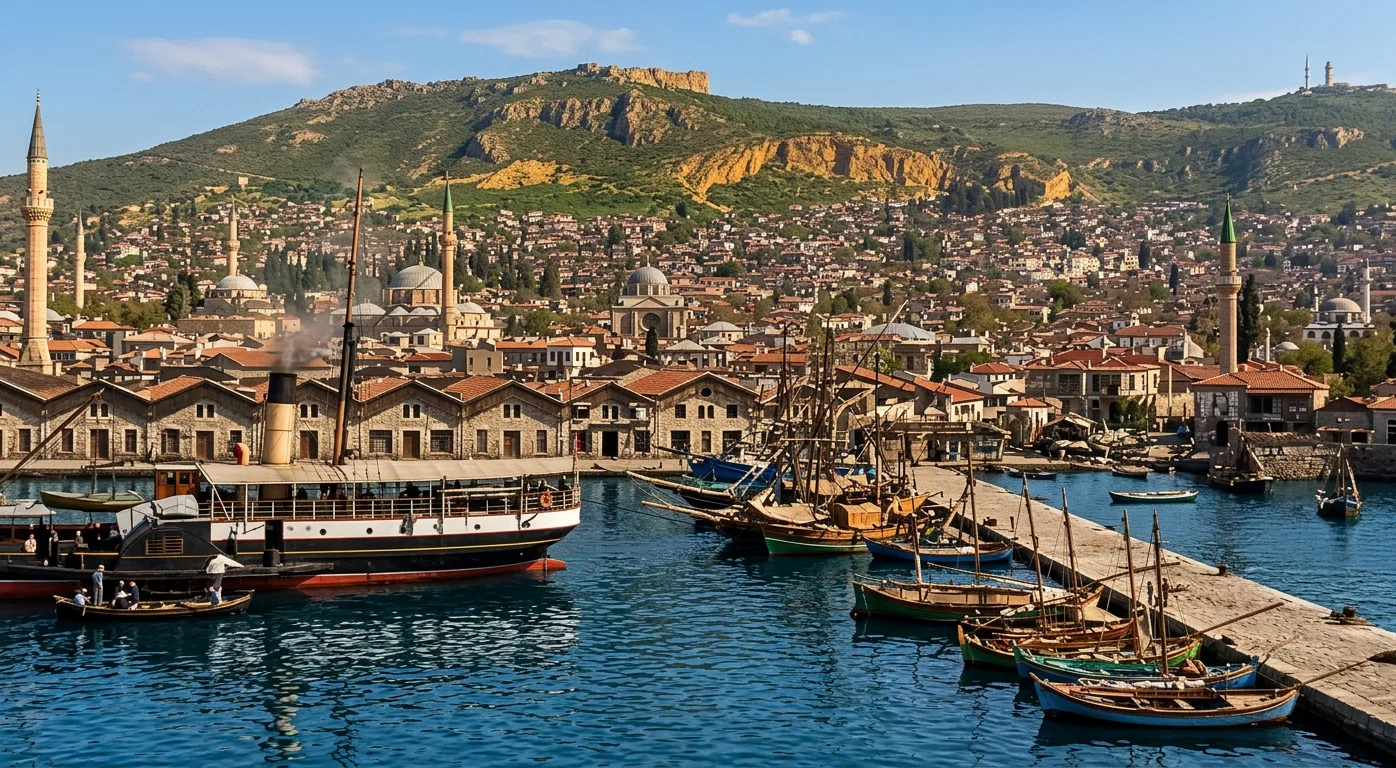
SMYRNA, SHOWING PORT AND MT. PAGUS.
THE TRUTH HAS FOUND ITS WAY TO THIS HISTORIC CITY, AND SEVERAL OF ITS PEOPLE ARE NOW REJOICING IN
THE LIGHT OF THE THIRD ANGEL’S MESSAGE.
SMYRNA, SHOWING PORT AND MT. PAGUS. THE TRUTH HAS FOUND ITS WAY TO THIS HISTORIC CITY, AND SEVERAL OF ITS PEOPLE ARE NOW REJOICING IN THE LIGHT OF THE THIRD ANGEL’S MESSAGE.
About forty years ago I heard my mother and aunt talking about the near coming of the Lord, and mother said, “It may possibly be five years;” but my aunt replied, “How can you put it off so long?”
From my earliest recollection my mother always had family prayers, and during the time that father did not make any profession, he seldom remained during prayers. In our family devotions, mother would pray for my older brother and then for me. I shall never forget one night when father remained during prayers, and that, after we had all taken part and were about to rise, for the first time I listened to my father's voice in prayer. Those who have never passed through similar experiences cannot appreciate the feelings of our household. My dear mother wept for joy, and as soon as brother and I were in bed, we agreed that we would be very careful not to do anything to irritate father, who was now going to live a Christian life. It was indeed a happy time in our home.
Soon after this, our dear Brother White had one of his dreams of fishing, in which he seemed to be very successful, but nearly all were small fish; that dream was fulfilled soon after, for he held a series of meetings in the church on Van Buren Street, and over a dozen young people gave themselves to the Lord,—myself and brother among the number. Of that number some are awaiting the first resurrection, others are preaching the gospel, and working in various lines of the message.
About twenty-five years ago I attended a camp-meeting near Battle Creek, and at that meeting Elder J. B. Frisbie, who had been for some years under discouragement, took his stand once more with the remnant people. It was at this meeting that a delegate from the Seventh-day Baptists arose in the large congregation and said: “You take a sponge that looks dry, but if you squeeze it real hard, you will find that you can wring water from it; and if you squeeze me hard enough, you will find that there is much of the Advent doctrine in me.” That was a meeting long remembered by our older brethren and sisters.
Nearly twenty years ago I attended a camp-meeting at Battle Creek, and my brethren of the Michigan Conference gave me a license to preach the message. Since then I have preached in Michigan, Colorado, Arizona, and Utah, and in all these places I have some dear children in the faith, as the result of my labors.
My parents and my aunt have long been sleeping, and many of the old and faithful workers are waiting the trump of God. Many changes have taken place, and are taking place, but the Third Angel's Message is going to accomplish its work. May those of us who have been long in the way keep pace with the work, and be ready when the Lord comes for His people.
Brethren, the Lord is soon coming; and while some of us have grown gray in this message, yet let us not forsake our post of duty, but let us do all we can to hasten the coming of that grand day. Let us endeavor to acquaint the young with God's dealings with this people in the early days of the message. This people will accomplish the work that was begun so long ago. Let us use all our energies in holding up the hands of those whom God has so signally honored in the past.
GEO. O. STATES.

NEW YORK CITY.

Dear brethren in the ministry: We know that you are deeply interested in the cause of religious liberty—the promulgation of the principles of which makes necessary the existence of The Sentinel of Christian Liberty. But we find that many are not enrolled as subscribers.
Just now is the time you should read regularly each issue of The Sentinel. Why?—Because now, as never before in the history of this country, the Sunday closing movement is being agitated. Here in New York City, it is the talk of every one. The great metropolitan dailies are devoting whole columns to the discussion of the subject. All are waiting with great interest and concern to see what will be the attitude of the “reform” administration which came into power Jan. 1, 1902.
W. T. Jerome, District Attorney elect, has declared that he will enforce every law upon the statute books. If he does, what an era of Sunday closing will be ushered in! What an example this will be for every city and village official all over the land! The friends of Sunday closing everywhere will not be slow to point to New York City, and urge the strict enforcement of the Sunday laws upon their statute books. Thus religious freedom may be restricted, and our own people may be called upon to suffer persecution.
Several years ago, when the advocates of no Sunday opening and no Sunday work were so active in this country, and came so near being successful in their designs, The Sentinel did a grand and noble work in the defeating of their schemes. Even now The Sentinel stands ready to do as large a work. We have able writers to defend right principles,—men who have been through the thick of the fight, and know how to meet the arguments of the enemy; far-seeing men who can detect the first working of these iniquitous plans; Christian men; men who will treat this great subject from the correct standpoint—the liberty in Christ Jesus.
Added to the fact that The Sentinel is so fortunate as to have such contributors, it is published in a form which will recommend itself to the public. Thinking that perhaps you may not have had the privilege of seeing the new Sentinel, we mail you a copy of the December issue.
The January Sentinel will be full to overflowing with good things from such writers as A. T. Jones, A. G. Daniells, M. C. Wilcox, W. N. Glenn, and others. Besides this, it will contain a review of the recent article of Senator Hoar, President of the New England Sabbath Protective League, on “The Civic Basis of Sunday Laws.”
We are doing our best to make The Sentinel just what the Lord would have it to be,—a journal which shall present the true principles of gospel liberty, and which shall win men to these principles by the logic of truth. In this effort we trust that we may have your support and co-operation, first by sending us your own subscription, if you are not already a subscriber, and then by using your influence in favor of The Sentinel wherever you may be. Tell the people of the great cloud now forming, and of the storm which may break at any moment; tell them of the work The Sentinel is doing, and how, by being widely circulated in the little remnant of time which remains, it may help so to educate some that their influence will be on the side of true liberty. Tell them that the price is but one dollar a year for single subscriptions, or in clubs of five or more, 70 cents a copy, per year. Orders may be sent through the State tract societies at the same rate.
Trusting that we may hear from you soon with your subscription, and that we may have your hearty support, we remain,
Sincerely yours,
SENTINEL OF CHRISTIAN LIBERTY.

North Carolina.

WILMINGTON.—Some time ago a small company of women associated themselves together to study the Bible. Soon after, Sister I. E. Kimball, who was engaged in missionary work here, brought them the truth of the Sabbath, which they accepted. Brother Chapman, who was here a short time, also assisted them. We are selling our literature, and have aided them somewhat, instructing them upon different points of truth. We have organized a Sabbath-school of ten members—not including ourselves. These receive the message gladly, and catch its spirit—that of helping others. We observed the week of prayer with them; though many had to come alone some distance at night, the weather often being unfavorable, yet they showed an earnestness by regular attendance that would do well to be copied by many experienced Sabbath-keepers, of whom much more might be expected. It rained hard all day Sabbath, but all were present except two. One of these being sick, she sent her offering by a messenger. Though poor,—some earning a living by washing,—yet all had a part in the offering. Five orders were obtained for the REVIEW; we feel that the week of prayer was a success here. We are glad for this little light set upon a hill, in Wilmington. We also consecrate ourselves anew as workers. MR. AND MRS. E. C. ROGERS.

Leading Events, Dec. 29 to Jan. 4.

—T. Estrada Palma is elected President of Cuba.
—Chicago’s death rate for 1901 was 13.8 per 1,000.
—Italy declines to take part in the St. Louis exposition.
—All hopes of Admiral Sampson’s recovery are now given up.
—Niles, Ohio, will erect a life-size bronze monument of Wm. McKinley.
—A Des Moines, Iowa, metal-worker discovers the secret of welding copper.
—The British Admiralty ordered two new battleships and seven cruisers the 2d inst.
—Secretary Long asks the United States government for $100,000,000 to strengthen the navy.
—Chicago bankers express confidence in great financial prosperity in this country during 1902.
—In his annual message, Governor Hunt, of Porto Rico, reports that the island is prospering.
—Rich deposits of iron ore are found in northern England, which may help the latter’s iron industry.
—M. de Blowitz, Paris correspondent of the London Times, resigns, and is succeeded by an American.
—The Washington officials decide to give out no further information regarding attempts to release Miss Stone.
—The public debt of the United States, Dec. 31, 1901, less cash in the Treasury, amounted to $1,011,628,286.
—General Chaffee declares he will severely punish all Filipinos found guilty of violating their oath of allegiance to the United States.
—Emperor William, of Germany, invites Miss Alice Roosevelt to christen his new racing yacht now being built on Staten Island, N. Y.
—The United States Naval Register just issued shows that there are 225 ships in this country’s navy, sixty-six being under construction.
—The Russian government suppresses three Helsingfors, Finland, newspapers, and suspends seven, “for criticisms of Russian subjugation of Finland.”
—President Castro, of Venezuela, issued a decree, Dec. 31, declaring the revolutionary steamer “Libertador” a pirate, and offering $10,000 for its capture.
—France lays plans to establish a school in this country which will enable Frenchmen to study American business methods. The school will become a part of the University of Chicago.
—The year 1902 was ushered in with the usual amount of noise. In London, England, the usual watch-night services were held in all the churches except St. Paul’s, which “was closed, to prevent disorderly scenes.”
—One great reason why the United States prefers the Nicaragua Canal route to the Panama route, is that Colombia refuses to grant “a perpetual franchise or absolute sovereignty over the canal” to any foreign government.
—The birthday of Jose Rizal, the Filipino poet and patriot, who was executed by the Spanish before the occupation of the Philippines by the Americans, was celebrated at Manila the 30th ult., the spot upon which he died being decorated, and other numerous honors shown.
—A Peking, China, dispatch of the 31st ult. states that “the Russian ambassador has declared that unless the treaty was concluded by the Russian New Year, Russia would break off negotiations with China, and maintain her occupation of Manchuria.” She expects to do that anyway.
—Colonel Partridge, New York City’s new police commissioner, took his office the 1st inst., and appointed Colonel Thurston as “successor to Assistant Commissioner Devery, who reported for duty, but was told there was nothing for him to do.” Many changes are now expected in New York’s municipal government.
—The New York Legislature convened Wednesday, January 1.
—The Chinese emperor resumes his imperial duties in Peking.
—Japan has begun to erect wireless telegraph stations along the Korean coast.
—A New York syndicate negotiates for 180,000 acres of Nova Scotia timber land.
—Booker T. Washington delivered an address at the Second Presbyterian Church of Chicago, Dec. 29.
—The Boers under General De Wet are reported to have lost “250 men in two recent engagements.”
—Consul Brunol, at St. Etienne, France, reports the discovery of rich deposits of gold in Madagascar.
—A Chicago firm (the Crane Co.) distributes $125,000 among its employees, as a New Year’s gift.
—China’s emperor is nearing Peking. On his way he will pass “through twelve miles of kneeling troops.”
—New Zealand decides to purchase from the United States all her material for future steel bridges.
—A Springfield, Ill., street-car, carrying non-union workmen, was blown up with dynamite the 3d inst.
—Government experiments have demonstrated the practicability of raising Egyptian cotton in Arizona.
—England is afraid her interests may be disregarded in case of war between Germany and Venezuela.
—General Reyes, formerly Colombia’s Minister of War, is urged to accept the presidency, “to save the republic.”
—The earnings of the First National Bank during 1901 were $1,118,216, or 22.36 per cent on its capital stock.
—In Germany, the model beer-drinking nation, 15,000 persons annually receive treatment for delirium tremens.
—A bottle thrown into the Mackinaw River near Bloomington, Ill., was found, eighteen months later, in the Pacific Ocean.
—After being made a duke by King Edward at the coming coronation ceremonies, Lord Salisbury will retire to private life.
—Germany sent another note to Venezuela the 3d inst., “fixing a time for the government to comply with the Kaiser’s demands.”
—Denmark proposes to sell her West India possessions to the United States, in spite of the protests of the inhabitants thereof.
—Among the first problems to confront Mr. Shaw, the new Secretary of the Treasury, will be “the disposition of a surplus of $175,000,000.”
—The Atlantic steamship “St. Paul” experienced “the roughest passage in its history” on its last trip from Southampton to New York.
—A Baltimore and Ohio passenger train jumped the track near Cumberland, Md., the 1st inst. Two persons were killed, and seventeen injured.
—The greatest White House reception ever held took place the 1st inst., the total number of persons passing before President Roosevelt being 8,351.
—The Russian government has appropriated $1,000,000 to encourage “the organization of societies for the promotion of temperance habits among the people.”
—The American Steel and Wire Company decides to pension “employees who have rendered long and efficient service.” This will affect about 30,000 workmen.
—Hon. J. L. M. Curry, of Washington, will represent this government at Madrid “on the occasion of the coming to age of the young King Alphonso XIII,” May 17, 1902.
—General Matos sailed from the Island of Martinique the 2d inst. with three hundred men “to start a revolution in Venezuela.” He has an armed vessel and a supply of guns.
—The Canada Central Railway Company will apply to the Dominion parliament for “a charter to build a new transcontinental railway from French River, Lake Huron, to Vancouver, British Columbia.”
—A collision between a passenger and a freight train on the Northwestern Railway, near Malta, Ill., the 29th ult., resulted in the death of four persons and the injury of twenty-two. Cause, misplaced switch.
—A dispatch from Tangier, Morocco, dated the 29th ult., states that “a water-spout at Saffee, Morocco, inundated the lower part of the town for twelve hours, sweeping everything into the sea. Two hundred persons are reported drowned. There are no Europeans among the dead. The damage is enormous.”
—Having now settled the Nicaragua Canal affair, Lord Pauncefote desires to secure “a settlement of the numerous controversies” between England and the United States growing out of “the Alaskan boundary, the Atlantic fisheries, war-ships on the Great Lakes, the regulation of relations along the Canadian boundary, etc.”
—The steamer “Walla Walla” was sunk in a collision with a French iron bark off Mendocino, Cal., the 3d inst. Twenty-seven passengers and crew of the former are missing. The bark was unidentified, and refused to aid the passengers of the “Walla Walla.” The latter sank in thirty-five minutes, her crew and passengers taking to life boats and rafts.
—John S. Pinover, of New York City, leaped from a Brooklyn bridge car, and, before two policemen could catch him, hurled himself into the water, the 29th ult., purely “for the notoriety,” and escaped uninjured. He was well dressed, and had on a heavy overcoat. A passing tug picked him up, and he revived in a half-hour. His income is $6,000 a year. Niagara Falls and the Brooklyn bridge evidently seem to be good experiment stations for the foolhardy.
—Andrew Carnegie’s offer of $10,000,000 to the United States government for the formation of a National University, will doubtless be accepted. Secretary of State Hay and others interested in the project took legal action on the 4th inst., to form “the Carnegie institution.” We wonder whether the new institution, being a national one, will bar out religious questions, or, if not, what will be the dominant religious body in control of the same. The Supreme Court of the nation having already decided (1892) that this is “a Christian nation,” it now remains to decide which denomination has the proper kind of Christianity—which is United States Christianity. A. J. B.

Literary Mention

Literary Mention
Literary Mention

Advanced Geography.

“MORTON’S ADVANCED GEOGRAPHY” is the title of a new book on geography, published by Butler, Sheldon & Co., New York, Chicago, and Boston, a copy of which we have just received. Examining the book, we judge it takes up the science of geography in the most concise and comprehensive way, and would be the book for those to obtain who wish to enter upon this important study, in the most correct and efficient way. The author, Eliza H. Morton, is an experienced author and educator in this study. Our recently started schools have adopted this geography as a text-book; and the publishers write us that it has so far met with gratifying success. Address the publishers, Butler, Sheldon & Co., New York, Philadelphia, or Boston.

Will Make Protestants.

THEY tell the truth. They read like fiction. Once begun, you will finish them at one sitting. The reading of them will water your soul, and would make a Protestant of almost any man. What are we talking about?—Answer: Chapters XXII, XXIII, and XXIV of that recent soul-stirring book, “Ecclesiastical Empire,” which tell all about the great Reformation—in England—in Bohemia—and in Germany. The writer was with the author, Alonzo T. Jones, while the contents of the work were being composed, and, having transcribed and read most of its pages, tells the truth when he states that these three chapters alone are well worth $2.50, the price of the entire book. It contains twenty-four other chapters, 874 pages, and may be obtained of your tract society. It is a complete treatise on the papacy and the struggles of the people of God therewith. B.

Orders for the Manual for Home and Church Schools

ALL orders for the “Manual for Home and Church Schools,” should be sent to the State tract societies, or to any of the publishing houses, and not to the author, Prof. C. C. Lewis. The prices of the book are 35 and 50 cents, postpaid.

Gems of Thought.

Such is the title of a collection of snatches of poetry, and brief sententious expressions in prose, which may well be called “Gems.” 16 pages. Got up after the style of holiday gifts, on thick paper, with title page in gilt, and colors, stamped and embossed. A very neat, presentable affair. Price, 25 cents each; six for $1.00. Address Henry B. Damon, South Lancaster, Mass., or New England Tract Society.

SPECIAL NOTICES

To Conference Officers.

DURING the General Conference Council last November one of the important questions carefully considered was that relating to the handling of our funds. The experience of our Union Conference auditors during the past season has served to emphasize the need of adopting a uniform system of accounts, so simple as to be practical for the use of the inexperienced, and yet so safe as to give assurance that all moneys reach their intended destinations.
Accordingly the council appointed a committee of business men to arrange such a system as present conditions manifestly demand. This committee was composed of the following persons: W. A. Wilcox, business manager of the South Lancaster Sanitarium; C. L. Kilgore, secretary and auditor of the Eastern Union Conference; C. M. Everest, missionary secretary of the Minnesota Conference; W. H. Edwards, secretary and auditor of the Lake Union Conference; Prof. E. E. Gardiner, formerly head of the Commercial Department of Battle Creek College; C. T. Caviness, auditor of the Southwestern Union Conference; and W. O. Palmer, of the Southern Publishing Association. The experience, ability, and consecration of the members of this committee will be recognized by a large portion of the REVIEW readers.
Concerning the value of the blanks and records which these brethren have prepared, it is not here needful to speak. Church treasurers will welcome them, for it will save them from the annoyance of inaccuracies, and will reduce to a minimum the time and labor involved in keeping the accounts of the church funds. This economy will also be extended to every office through which the funds will pass, for the correction of an error in local accounts often involves the accounts of the Conference treasurer. And, moreover, hard-earned means will be saved to the precious cause of truth by thus stopping any leaks now occasioned by a loose and imperfect system.
It is desired to introduce the new system in all the churches as soon as possible; and to this end, all our local Conferences are requested to inform the Review and Herald Publishing Company, without unnecessary delay, the number of record books, etc., desired in their Conference, thus enabling the publishers to produce immediately such an edition as may be required. The price of a treasurer's book of 144 pages has been one dollar, but if all will order at once, thus making possible a large edition, we are assured the price will be less.
Please give this matter early attention. The committee has done its work, and we believe all will agree that it is well done. Realizing the need, they undertook the task in the spirit of prayer and consecration, and received the assurance that God helped them. Now let their effort be supplemented by a general movement in favor of this improved system. Remember that this call did not originate with the council. The principle involved is clearly and concisely stated in the following language from “Testimonies for the Church,” No. 34:—
“God calls for decided improvement to be made in the various branches of the work. The business done in connection with the cause of God must be marked with greater precision and exactness. There has not been firm, decided effort to bring about essential reform.”

Let there be “firm, decided effort,” and let it be put forth now. H. E. OSBORNE, Sec. Gen. Conf.

DONORS TO THE RELIEF OF THE SCHOOLS

The Total Cash received on the Relief of the Schools Fund up to date is $35,408.07.

DONORS TO THE RELIEF OF THE SCHOOLS.

NAME. AMOUNT. NAME. AMOUNT.
W. H. White. $3 00 R. H. Maddox. 5 00
J. B. Mourer. 1 75 A friend. 50
C. B. Rossier. 3 60 E. E. Russell. 5 00
C. T. Lewis. 1 00 H. G. Miller. 1 00
R. W. James. 25 00 James McKay. 1 00
Neb. Tract Society. 85 O. E. Christiansen. 1 00
J. M. Young. 2 50 Laura B. Wheeler. 1 00
Mrs. Spoors. 1 00 John Huntley. 1 00
O. A. Hall. 1 00 Mrs. N. D. Jones. 1 25
H. Major. 10 00 Hattie Dunning. 2 00
J. W. Boynton. 1 25 F. A. Anderson. 3 74
A friend. 5 00 A. M. Thomas. 3 00
Miscellaneous. 3 00 Mrs. S. M. Olson. 5 00
Mary Cornelius. 2 35 Edward Davis. 10 00
Miscellaneous. 1 25 Mrs. Sophronia Wilkinson. 5 00
Mr. & Mrs. Sumney. 50 00 Mrs. S. D. Blackmer. 10 00
A. E. Burgess. 10 00 A. C. Stevens. 50 00
J. C. Middaugh. 10 00 A friend (Auburn, Cal.) 10 00
J. E. Welsh. 10 00 Mrs. N. A. Bowers. 5 00
E. A. C. 5 00 Mrs. A. J. Johnson. 5 00
D. H. Major. 1 00 W. D. Fountain. 10 00
C. C. Christiansen. 25 00 H. W. Vincent. 5 00
Geo. B. Thompson. 500 00 Elizabeth Gaskill. 5 00
Mrs. Alice Zerbe. 1 00 Two sisters. 125 00
Mrs. H. L. Marrion. 1 00 Mrs. Wm. McCollon. 5 00
John Bean. 2 00 Robert Conway. 100 00
James Yarington. 5 00 Mrs. Rinda Cook. 1 00
L. B. Walling. 5 00 Laura C. Hutchins. 10 00
George A. Lagrone. 2 50 Mrs. Elmer L. Town. 1 00
Chris K. Andrew. 17 70 Fritz Guy. 8 50
Josephine F. Mott. 1 00 Mrs. M. R. Burnson. 2 00
Fritz Guy. 4 00 R. P. Harkin. 2 00
C. N. Pike. 1 25 Broux church. 1 25
Mrs. C. Williams. 5 00 Brooklyn church. 1 00
T. S. Parmalee. 1 00 Willington church. 50
Mrs. G. D. Taylor. 1 00 Carrie Giles. 1 00
Miss Ida Baade. 4 00
NAME. AMOUNT. NAME. AMOUNT.
Nellie M. Stevens. 3 00 Ida Simmons. 2 00
B. Julius. 2 00 Mrs. Cathey. 1 00
A friend. 2 00 P. D. Moyers. 3 05
John R. Clark. 5 00 R. M. Kilgore. 25 00
C. N. Nester. 2 00 Mrs. Kate A. Guerrier. 1 00
A friend. 50 Mrs. Martha Ellsworth. 2 00
Otis L. Dart. 1 00 J. D. Meracle. 2 00
Mr. & Mrs. M. J. Miner. 2 00 Mr. L. L. Dye & wife 5 00
L. D. Estes. 25 00 Sarah L. Potts. 5 00
Miss Orpha E. Lewis. 1 00 Henrietta Carr. 1 50
Mr. & Mrs. Chas. L. Smith & son. 15 00 O. C. Nelson. 4 00
Geo. & Abvie Tiefel. 5 00 Mrs. O. C. Nelson. 2 60
Mr. & Mrs. H. B. Tilden. 7 00 Henry Seath. 9 50
C. H. Punches. 50 00 Frank Friend. 2 00
Mrs. Preston Offill. 2 00 Kate Lumley. 10 00
Nancy Palmer. 1 50 John Dirksen & wife 15 00
Fritz Guy. 6 80 R. C. Utt. 5 00
Mamie Smith. 1 00 Marius Christiansen. 5 00
Wm. Penniman. 2 00
Continue reading: Work by Correspondence