INTRIGUES OF BOTH JEWS AND ROMANS — PAUL AGAIN BEFORE NERO, MAKES MIGHTIEST APPEAL
NATIONS WERE SHAKEN, AS MARTYR'S WORDS LIVED ON
By Mrs. E. G. White
THE heroism and faithfulness of Paul as portrayed in this article, will inspire the soul. Nero, the proud tyrant, sated with power and the glory of earth, is made to appear properly insignificant in contrast with the unselfish hero who was seeking to win men for eternal life. The great battles for the cross of Christ are to be fought all over again in these last days, and there will be many opportunities for men and women to do the same valuable service for God that ruled in the life of the exemplary apostle.
EDITOR.
WHILE Paul's labors in Rome were being blessed to the conversion of many souls and the strengthening and encouragement of the believers, clouds were gathering that threatened not only his own safety, but also the prosperity of the church. Before the close of the two years' imprisonment, the Jews became more active than ever in their efforts against Paul, and they found an able helper in the profligate woman whom Nero had made his second wife, and who, being a Jewish proselyte, lent all her influence to aid their murderous designs against the champion of Christianity.
NOTHING TO FEAR WHILE LOYAL
Paul could hope for little justice from the Cæsar to whom he had appealed. Nero was more debased in morals, more frivolous in character, and at the same time capable of more atrocious cruelty, than any ruler who had preceded him. The reins of government could not have been entrusted to a more despotic ruler. From the view-point of human judgment, Paul's condemnation before such a judge was certain. But the apostle felt that so long as he was loyal to God, he had nothing to fear.
KINDNESS FROM THE CRUEL TYRANT
And God did shield His servant. At Paul's examination, the charges against him were not sustained; and contrary to the general expectation, and with a regard for justice wholly at variance with his character, Nero declared the prisoner guiltless. Paul's bonds were removed. He was again a free man.
PERSECUTION CAME TO THE CHURCH
Had his trial been longer deferred, or had he from any cause been detained in Rome until the following year, he would doubtless have perished in the persecution which then took place. During Paul's imprisonment, the converts to Christianity had become so numerous as to attract the attention and arouse the enmity of the authorities. The anger of the emperor was especially excited by the conversion of members of his own household, and he soon found a pretext to make the Christians the objects of his merciless cruelty.
About this time a terrible fire occurred in Rome, by which nearly one half of the city was burned. Nero himself, it was rumored, had caused the flames to be kindled; but to avert suspicion, he made a pretense of great generosity by assisting the homeless and destitute. The people were excited and enraged; and in order to clear himself, and also to rid the city of a class whom he feared and hated, Nero turned the accusation upon the Christians. His device succeeded, and thousands of the followers of Christ — men, women, and children — were cruelly put to death.
CLOSING LIFE-WORK WITH INTENSE EFFORTS
From this cruel persecution, Paul was spared; for soon after his release, he had left
Rome. This last interval of freedom he diligently improved in laboring among the churches. He felt that he was now doing his last work; and as the time of his labor grew shorter, his efforts became more intense. There seemed to be no limit to his zeal. Resolute in purpose, prompt in action, strong in faith, he journeyed from church to church, in many lands, and sought, by every means within his power, to strengthen the hands of the believers, that they might do faithful work in winning souls to Jesus, and that in the trying times upon which they were even then entering, they might remain steadfast
to the gospel, bearing faithful witness for Christ.
PAUL CHARGED WITH BURNING ROME
Paul's work among the churches after his acquittal at Rome, could not escape the observation of his enemies. Since the beginning of the persecution under Nero, the Christians had everywhere been a proscribed sect. After a time, the unbelieving Jews conceived the idea of fastening upon Paul the crime of instigating the burning of Rome. Not one of them thought for a moment that he was guilty; but they knew that such a charge, made with the faintest show of plausibility, would seal his doom. Through their efforts, Paul was again arrested, and hurried away to his final imprisonment. Upon his arrival at Rome, Paul was placed in a gloomy dungeon, there to remain until his course should be finished.
When Paul was summoned to appear before the emperor Nero for trial, it was with the near prospect of certain death. The serious nature of the crime charged against him, and the prevailing animosity toward Christians, left little ground for hope of a favorable issue. No man ventured to act as his counsel or advocate. No friend was at hand even to preserve a record of the charges brought against him, or of the arguments that he urged in his own defense.
The only reliable record of the occasion is given by Paul himself, in his second letter to Timothy. "At my first answer," the apostle wrote, "no man stood with me, but all men forsook me: I pray God that it may not be laid to their charge. Notwithstanding the Lord stood with me, and strengthened me; that by me the preaching might be fully known, and that all the Gentiles might hear: and I was delivered out of the mouth of the lion."
AT TYRANT'S NAME THE WORLD TREMBLED
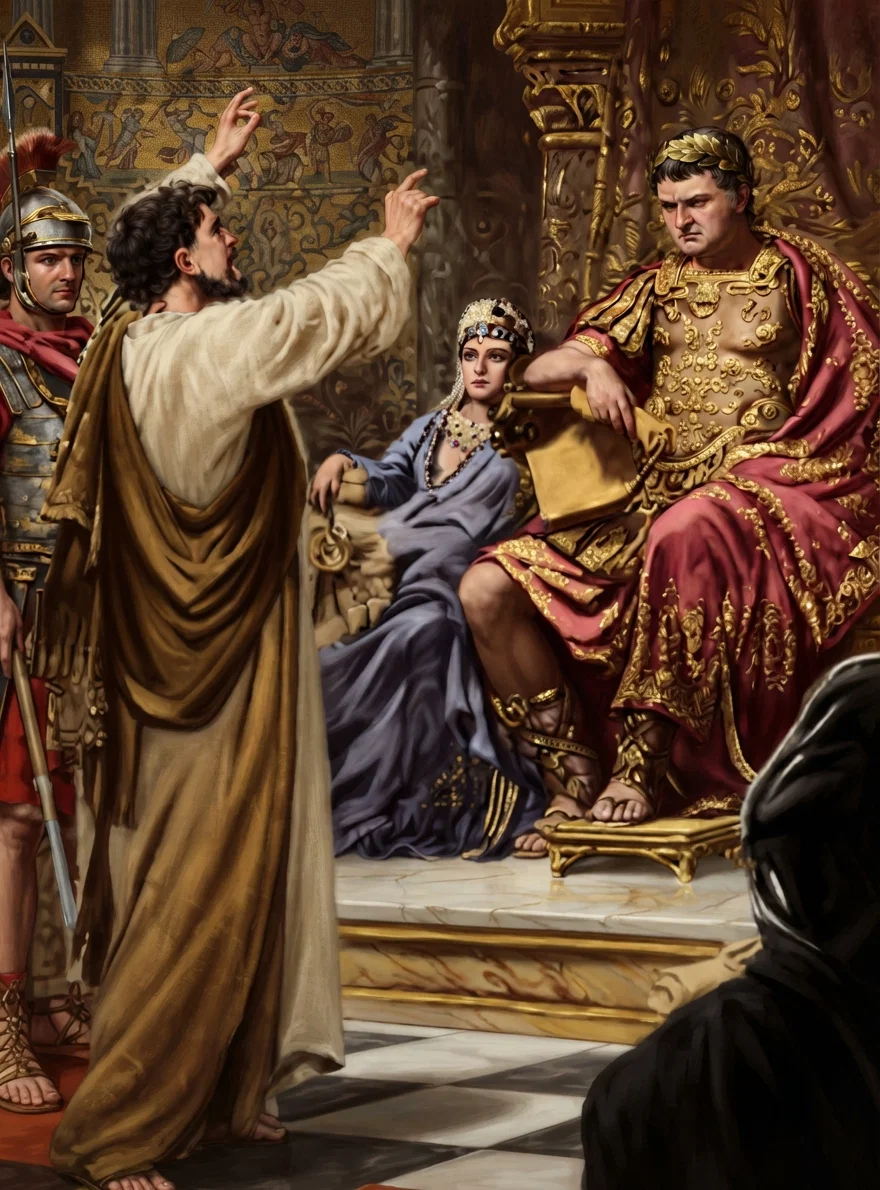
Paul before Nero — how striking the contrast! The haughty monarch before whom the man of God was to answer for his faith, had reached the height of earthly power, authority, and wealth, as well as the lowest depths of crime and iniquity. In power and greatness he stood unrivaled. There were none to question his authority, none to resist his will. Kings laid their crowns at his feet. Powerful armies marched at his command, and the ensigns of his navies betokened victory. His statue was set up in the halls of justice, and the decrees of senators and the decisions of judges were but the echo of his will. Millions bowed in obedience to his mandates. The name of Nero made the world tremble. To incur his displeasure was to lose property, liberty, life; and his frown was more to be dreaded than a pestilence.
Without money, without friends, without counsel, the aged prisoner stood before Nero — the countenance of the emperor bearing the shameful record of the passions that raged within; the face of the accused telling of a heart at peace with God. Paul's experience261had been one of poverty, self-denial, and suffering. Notwithstanding constant misrepresentation, reproach, and abuse, by which his enemies had endeavored to intimidate him, he had fearlessly held aloft the standard of the cross. Like his Master, he had been a homeless wanderer, and like Him, he had lived to bless humanity. How could Nero, a capricious, passionate, licentious tyrant, understand or appreciate the character and motives of this son of God?
BEFORE THE TYRANT AND THE MULTITUDE
The vast hall was thronged by an eager, restless crowd, that surged and pressed to the front to see and hear all that should take place. The high and the low were there, the rich and the poor, the learned and the ignorant, the proud and the humble, all alike destitute of a true knowledge of the way of life and salvation.
NEVER SAW SO CALM A PRISONER
The Jews brought against Paul the old charges of sedition and heresy, and both Jews and Romans accused him of instigating the burning of the city. While these accusations were urged against him, Paul preserved an unbroken serenity. The people and the judges looked at him in surprise. They had been present at many trials, and had looked upon many a criminal; but never had they seen a man wear a look of such holy calmness as did the prisoner before them. The keen eyes of the judges, accustomed to read the countenances of prisoners, searched Paul's face in vain for some evidence of guilt. When he was permitted to speak in his own behalf, all listened with eager interest.
LOST SIGHT OF HIS OWN DANGER
Once more Paul has an opportunity to uplift before a wondering multitude the banner of the cross. As he gazes upon the throng before him,—Jews, Greeks, Romans, with strangers from many lands,—his soul is stirred with an intense desire for their salvation. He loses sight of the occasion, of the perils surrounding him, of the terrible fate that seems so near. He sees only Jesus, the Intercessor, pleading before God in behalf of sinful men.
With more than human eloquence and power, Paul presents the truths of the gospel. He points his hearers to the sacrifice made for the fallen race. He declares that an infinite price has been paid for man's redemption. Provision has been made for him to share the throne of God. By angel messengers, earth is connected with heaven, and all the deeds of men, whether good or evil, are open to the eye of Infinite Justice.
FEARLESS, JOYOUS, AND COURAGEOUS
Thus pleads the advocate of truth. Faithful among the faithless, loyal among the disloyal, he stands as God's representative, and his voice is as a voice from heaven. There is no fear, no sadness, no discouragement, in word or look. Strong in a consciousness of innocence, clothed in the panoply of truth, he rejoices that he is a son of God. His words are as a shout of victory above the roar of battle. He declares the cause to which he has devoted his life, to be the only cause that can never fail. Though he may perish, the gospel will not perish. God lives, and His truth will triumph.
Many who that day looked upon him, "saw his face as it had been the face of an angel."
DESTINED TO SHAKE NATIONS
Never before had that company listened to words like these. They struck a chord that vibrated in the hearts of even the most hardened. Truth, clear and convincing, overthrew error. Light shone into the minds of many who afterward gladly followed its rays. The truths spoken on that day were destined to shake nations, and to live through all time, influencing the hearts of men when the lips that had uttered them should be silent in a martyr's grave.
THE TYRANT TREMBLED IN TERROR
Never before had Nero heard the truth as he heard it on this occasion. Never before had the enormous guilt of his own life been so revealed to him. The light of heaven pierced the sin-polluted chambers of his soul, and he trembled with terror at the thought of a tribunal before which he, the ruler of the world, would finally be arraigned, and his deeds receive their just award. He feared the apostle's God, and he dared not pass sentence upon Paul, against whom no accusation had been sustained. A sense of awe restrained for a time his bloodthirsty spirit.
FOREVER SHUT OUT HIS LIGHT
For a moment, heaven was opened to the guilty and hardened Nero, and its peace and purity seemed desirable. That moment the invitation of mercy was extended even to him. But only for a moment was the thought of pardon welcomed. Then the command was issued that Paul be taken back to his dungeon; and as the door closed upon the messenger of God, the door of repentance closed forever against the emperor of Rome. No ray of light from heaven was ever again to penetrate the darkness that enveloped him. Soon he was to suffer the retributive judgments of God.
Complete in Him
By C. P. Bollman
"And ye are complete in Him"
THE tempter whispers in my ear:
"Your life's all full of sin.
There is no hope laid up for you.
The vict'ry I shall win."
I answer sadly: "I have sinned.
In self no good I see;
But I have hope in Christ my Lord,
Who died, but lives for me.
"I have no virtue of my own,
And oft I've met defeat;
But full I trust my perfect Lord.
In Him I am complete."
C. P. BOLLMAN.
How to Find the Messiah
By William Covert
"Come and See"
PHILIP was telling Nathanael that he had found the Messiah. Nathanael expressed a doubt upon the subject, because the One of whom Philip spoke came from Nazareth. Said he, "Can any good thing come out of Nazareth?" But Philip had been in contact with the Nazarene, and he was so sure He was the Christ, that he did not stop to argue with Nathanael. His confident advice was, "Come and see." He knew that if Nathanael could actually meet Jesus, he would see for himself that the Messiah had come. The acquaintance would settle the question.
Nathanael did as Philip suggested, and the first meeting took away all doubt. Then in delighted confidence he said, "Thou art the Son of God; Thou art the King of Israel."
If Nathanael had refused to see Jesus, because He came from Nazareth, probably he would have remained a stranger to the grace of God. But being a seeker after truth, his eyes were easily opened. His life of prayer helped him to come with Philip, and, too, it enabled him to see when he did come.
THEY WOULD NOT COME
At one time Jesus, speaking to a large class of skeptics, said, "Ye will not come to Me, that ye might have life."
Getting near enough to see is what moves one to believe in Jesus. The Saviour told Nathanael that He saw him under the fig-tree before Philip called him. Nathanael had been under the shade of the fig-tree praying that God would help to find the Messiah. It was the Spirit in Christ that moved Nathanael to pray. The Spirit that was working in him, very readily saw the counterpart of itself when the two came together.
HE HAD INTIMATE EVIDENCE
When Jesus told Nathanael of having seen him praying for light under the fig-tree, Nathanael knew that he was meeting face to face the Son of God. The marvelous ability of Jesus to see the secrets of a penitent heart in the place of secret prayer opened the eyes of Nathanael's heart so he could clearly see who Jesus was when they met face to face.
That same Spirit by which God sees men's hearts and by which the blind eyes of men's hearts are made to see, is working to-day. That Spirit opens their eyes and turns them from darkness to light. They turn from the power of Satan to God, "that they may receive forgiveness of sins, and inheritance among them which are sanctified." Acts 26: 18.
When speaking of the awful condition of darkness that exists in the sinner's mind, Paul says the gospel is "hid to them that are lost: in whom the god of this world hath blinded the minds of them which believe not." 2 Cor. 4: 3, 4. Satan himself is blinding sinners' minds, to keep them from being saved. The devil puts the darkness of unbelief over men's eyes, "lest the light of the glorious gospel of Christ, who is the image of God, should shine unto them."
But those who will pray for light, as Nathanael did under the fig-tree, and then will hear the call of some Philip, as Nathanael did, can "come and see." The way is open. The time is now. Do you hear the call? Will you come?
WILLIAM COVERT.
What of the Day?
By Max Hill
THE night is far spent — the day,
What of the day?
O watcher with eye intent, O say,
What of the day?
The morning comes apace.
For in the east I trace
The first red rays of light
That drive away the night.
But watcher with eye aglow — the day,
What comes with day?
My night-frighted soul would know. O say,
What comes with day?
The day that turns the gloom
Of earth's long night to bloom —
O, far the message rings,
This day salvation brings!
O watcher with vision true — the day,
Who comes with day?
Who comes with the day so new? O say,
Who comes with day?
From heaven's courts, behold,
With power and light untold,
With angels in His train,
Messiah comes to reign!
Max Hill
A Higher and Better Promise
"WHEN you slip up on one promise, you will find a higher and a better one before you."
THE RETURN OF OUR LORD
By MALCOLM N. CAMPBELL
His Promises of Returning Are Definite and Conclusive—Who Will Be Ready to Meet Him?
What Takes Place at His Coming?
By MALCOLM N. CAMPBELL
SOME day, the present order of things will end. The trumpet of the Lord will sound; and as its tremendous notes roll over the earth, marvelous things will take place. The graves will open, and the imprisoned saints of God will come forth in immortal youth and glory. The living believers in Christ will be instantly changed, and every trace of imperfection will disappear. The wicked, terror-stricken, will appeal in vain for that mercy they have so long repelled and derided.
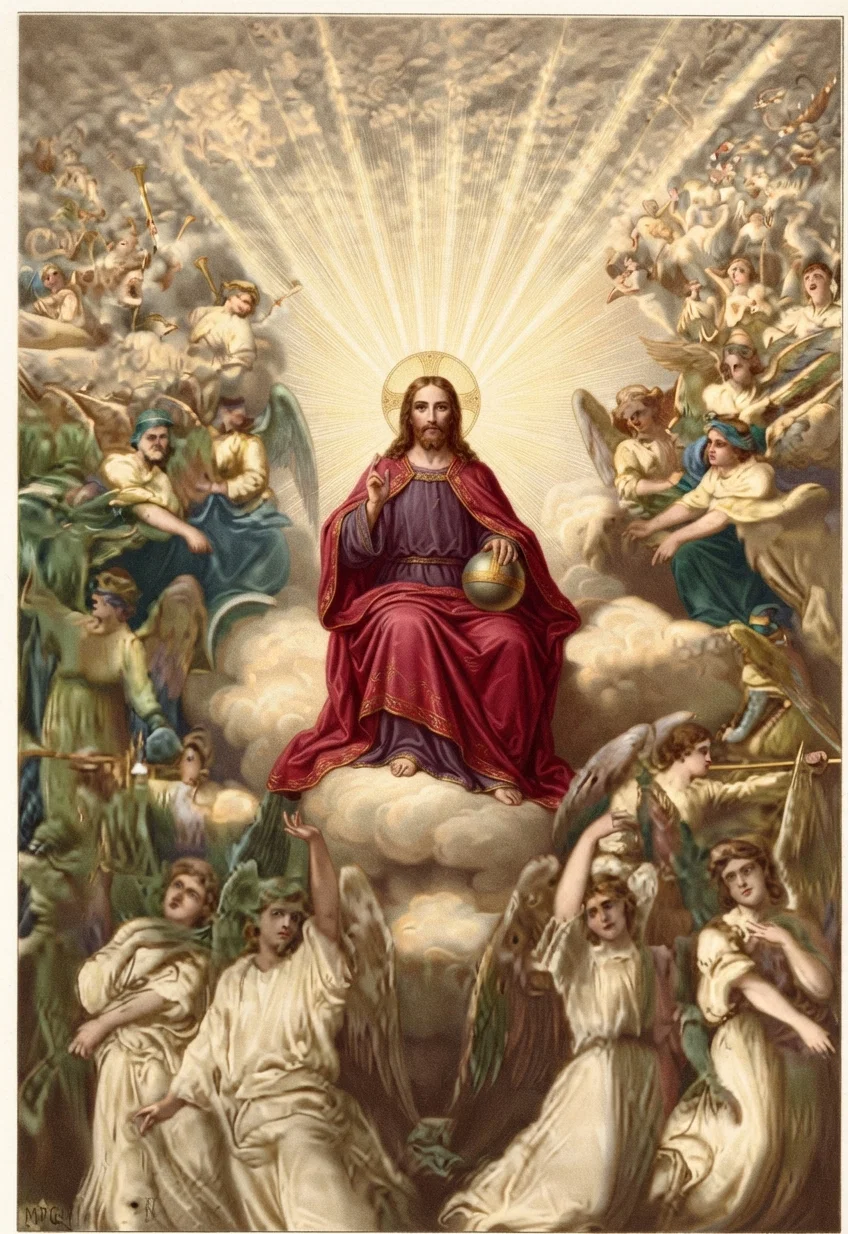
"BEHOLD, HE COMETH WITH CLOUDS; AND EVERY EYE SHALL SEE HIM." REV. I:7.
WILL APPEAR IN WONDROUS GLORY
In short, the world, with its vanities and sins, will end. Christ, the returning King, will appear in wondrous glory, surrounded by shining angels, and will take His rightful place as King of kings and Lord of lords.
For ages, the church of Christ has been looking forward to the time when her divine Lord would return. This hope was not based on superstition nor tradition, but on definite promises of the Saviour Himself, and of the inspired apostles and prophets.
SOME CLEAR, DEFINITE PROMISES
The following scriptures assure us that Christ will return, that His coming will be as personal as His ascension, that it will be a glad event for the righteous and a sad one for the unprepared:
"Let not your heart be troubled: ye believe in God, believe also in Me. In My Father's house are many mansions: if it were not so, I would have told you. I go to prepare a place for you. And if I go and prepare a place for you, I will come again, and receive you unto Myself; that where I am, there ye may be also." John 14:1-3.
"As the lightning cometh out of the east, and shineth even unto the west; so shall also the coming of the Son of man be." Matt. 24:27.
"This same Jesus, which is taken up from you into heaven, shall so come in like manner as ye have seen Him go into heaven." Acts 1:11.
"Behold, He cometh with clouds; and every eye shall see Him, and they also which pierced Him: and all kindreds of the earth shall wail because of Him." Rev. 1:7.
WILL A WARNING BE GIVEN?
The question is frequently raised, in connection with this subject, "Will God send any warning to the inhabitants of the earth to prepare them for the day when Christ shall return?" There is a text that is often quoted to show that no warning of any kind will be given before the day of God bursts upon the world. It reads: "But of the times and the seasons, brethren, ye have no need that I write unto you. For yourselves know perfectly that the day of the Lord so cometh as a thief in the night." 1 Thess. 5:1, 2. However, the fourth verse of this same chapter throws light on this point: "But ye, brethren, are not in darkness, that that day should overtake you as a thief." Those who are walking in the light will not be taken by surprise by the coming of Christ; for at that time they will exclaim, "Lo, this is our God; we have waited for Him, and He will save us." Isa. 25:9. They have been giving heed to the warning signals of the approach of the end, and have been waiting and watching for Him.
WHAT SHALL BE THE SIGN?
The Saviour, in response to the apostles' question, "What shall be the sign of Thy coming, and of the end of the world?" gave a series of signs by which, when they should come to pass, men might know that the world's history was about to close. He said there would be wars and rumors of wars, famines, great earthquakes, pestilences, persecutions, distress of nations, great moral depravity, terrible storms on land and sea, with signs in the sun, the moon, and the stars. Then He added, "So likewise ye, when ye see these things come to pass, know ye that the kingdom of God is nigh at hand." Luke 21:31. Thus we have divine assurance that signs shall be given and a warning sounded before Christ returns.
KNOW IT IS NEAR
While it is quite true that no man knows the day or the hour when Christ shall return, it is equally true that we may "know that it is near, even at the doors." Matt. 24:33. This is in accord with the Lord's dealings with mankind in the past.
Previous to the Flood, Noah, a preacher of righteousness, faithfully warned that wicked generation.
Before Nineveh was to be destroyed, Jonah was sent to proclaim its fate.
John the Baptist was sent as a forerunner to prepare the world for the coming Redeemer.
And in harmony with His usual method of procedure, God promises to give signs before the end of the age takes place: "And there shall be signs in the sun, and in the moon, and in the stars; and upon the earth distress of nations, with perplexity; the sea and the waves roaring; men's hearts failing them for fear, and for looking after those things which are coming on the earth: for the powers of heaven shall be shaken. And then shall they see the Son of man coming in a cloud with power and great glory." Luke 21:25-27.
THE RIGHTEOUS RESURRECTED
What will the second coming of Christ mean to this earth and its inhabitants?
1. It will mean the resurrection of the righteous. "For the Lord Himself shall descend from heaven with a shout, with the voice of the Archangel, and with the trump of God: and the dead in Christ shall rise first." 1 Thess. 4:16. "Behold, I show you a mystery; we shall not all sleep, but we shall all be changed, in a moment, in the twinkling of an eye, at the last trump: for the trumpet shall sound, and the dead shall be raised incorruptible, and we shall be changed." 1 Cor. 15:51, 52. "Blessed and holy is he that hath part in the first resurrection: on such the second death hath no power, but they shall be priests of God and of Christ, and shall reign with Him a thousand years." Rev. 20:6.
ONE THOUSAND YEARS BETWEEN
These texts make it plain that the righteous dead are raised before the wicked dead. We are told in Rev. 20:5 how long a time elapses between the two resurrections: "But the rest of the dead [the wicked dead] lived not again until the thousand years were finished." So the resurrection of the righteous marks the beginning of the millennium, or thousand years; and the resurrection of the lost marks its close.
THE LIVING WILL BE CHANGED
2. The living righteous will be changed to immortality at the coming of Christ. "Behold, I show you a mystery; we shall not all sleep, but we shall all be changed, in a moment, in the twinkling of an eye, at the last trump: for the trumpet shall sound, and the dead shall be raised incorruptible, and we shall be changed. For this corruptible must put on incorruption, and this mortal must put on immortality." 1 Cor. 15:51-53.
TOGETHER THEY MEET THE LORD
3. The resurrected saints and the living righteous will then be caught up to meet their Lord, and go with Him to heaven to spend the millennium. "For this we say unto you by the word of the Lord, that we which are alive and remain unto the coming of the Lord shall not prevent ["precede," R. V.] them which are asleep. For the Lord Himself shall descend from heaven with a shout, with the voice of the Archangel, and with the trump of God: and the dead in Christ shall rise first: then we which are alive and remain shall be caught up together with them in the clouds, to meet the Lord in the air: and so shall we ever be with the Lord." 1 Thess. 4:15-17.263"And if I go and prepare a place for you, I will come again, and receive you unto Myself; that where I am, there ye may be also." John 14:3.
Jesus, at His ascension, went to heaven, and sat down on the right hand of the Father. It was there that the dying Stephen saw Him. Acts 7:55, 56. To Peter’s question, "Whither goest Thou?" He answered, "Whither I go, thou canst not follow Me now; but thou shalt follow Me afterwards." John 13:36. But He distinctly declared that the wicked Jews could not come there.
The promise that Peter should follow Him to heaven was made equally to all His faithful children. There are those who ridicule the idea that the children of God will ever leave this earth and enter heaven. The scriptures already quoted show beyond a peradventure that they will enter the sacred precincts of the heavenly courts. Other texts indicate that the time of their sojourn there will be a thousand years (Rev. 20:6), during which they will be associated with Christ in the work of judging the wicked. Rev. 20:4; 1 Cor. 6:2, 3; Ps. 149:5-9.
THE FAITH OF JESUS
By William Mayhew Healey
IN previous papers, commenting upon this interesting verse in the book of Revelation, Elder Healey has called attention to the fact that those who fulfil this scripture possess the striking characteristics of keeping “the commandments of God,” having “the faith of Jesus” and “the patience of the saints,” and that they live right at the close of time. Last week he dwelt particularly upon “the patience of the saints.”
THE FAITH OF JESUS
This Faith Imparted to Those Prepared for His Coming — Some of Its Articles
By WILLIAM MAYHEW HEALEY
WHEN Christ comes, He will find a company of people who “keep the commandments of God,” and have passed through trials and persecutions until they have developed “the patience of the saints.” The reason why this company keep God’s commandments, and endure so patiently the afflictions that are poured out upon them, is easily seen in the statement that they have “the faith of Jesus.” Rev. 14:12.
THE WORLD’S WEALTH IN COMPARISON
Faith in Jesus is worth more than all the wealth of this world. This faith brings pardon for sin. It brings comfort, peace, and joy, even in the midst of trouble and sorrow; and its final reward is eternal life. But the faith of the Lord’s people when He comes for them is more than faith in Jesus. It is the faith of Jesus.
In the seventeenth chapter of Luke, we have the words of Christ regarding the great wickedness that will be in the world at His coming. Continuing the subject into the eighteenth chapter, He says in verse eight, “Nevertheless when the Son of man cometh, shall He find faith on the earth?”
A FAITH JUST LIKE HIS
The faith of Jesus must be a faith just like His. It must believe just what He believed, and as He believed it.
The faith of Jesus fed thousands of people from a few loaves. It stilled the tempest on raging Galilee. It healed the sick, cast out devils, restored the raving demoniac to his right mind. It even raised the dead. And this is the kind of faith His children will have when He comes.
SOME THINGS JESUS BELIEVED
Consider some of the things Jesus believed, for by them we may know some of the things His people will believe when they have His faith.
Jesus believed that His Father heard Him pray, not merely when He went into the synagogue, but at all times. When praying at the tomb of Lazarus, He said to His Father, “I knew that Thou hearest Me always.” John 11:42.
Jesus looked forward to a time when it would be so with His disciples. “And in that day ye shall ask Me no question. Verily, verily, I say unto you, If ye shall ask anything of the Father, He will give it you in My name. Hitherto have ye asked nothing in My name: ask, and ye shall receive, that your joy may be fulfilled.” John 16:23, 24, A. R. V., margin.
At the beginning of Christ’s ministry, He announced His faith in the law of God; and when setting before His disciples the things in which He believed, and the work He had come to do, He said, in His inaugural address on the mount, “Think not that I am come to destroy the law, or the prophets.” Matt. 5:17.
Here we learn that Christ’s faith was a belief that God’s law as it existed at that time could not be improved. And as it commanded the keeping of the seventh-day Sabbath, the conclusion unavoidably follows that those who have His faith, in the closing of the world’s history, will believe the same thing.
Christ believed in baptism by immersion, for He was baptized by John, in Jordan.
He believed in the gift of the Holy Spirit; and it came upon Him when He, after His baptism, “came up out of the water.”
He believed in the resurrection of the dead, both good and bad. “Marvel not at this: for the hour is coming, in the which all that are in the graves shall hear His voice, and shall come forth; they that have done good, unto the resurrection of life; and they that have done evil, unto the resurrection of damnation.” John 5:28, 29.
He believed that after He should go away to His Father, He would come again for His people. “In My Father’s house are many mansions: if it were not so, I would have told you. I go to prepare a place for you. And if I go and prepare a place for you, I will come again, and receive you unto Myself; that where I am, there ye may be also.” John 14:2, 3.
He believed in the writings of Moses, and reproved those who did not. “Had ye believed Moses, ye would have believed Me: for he wrote of Me.” John 5:46.
He believed Moses’ account of the Flood, and of Noah, and of the ark; for He said that the last days would be like the time of the Flood. “As the days of Noe were, so shall also the coming of the Son of man be. For as in the days that were before the Flood they were eating and drinking, marrying and giving in marriage, until the day that Noe entered into the ark, and knew not until the Flood came, and took them all away; so shall also the coming of the Son of man be.” Matt. 24:37-39.
He believed in the Bible story of Jonah, and all the details of his being swallowed by a monster of the deep, and remaining inside of it for three days. Hear Him about that incident: “As Jonah was three days and three nights in the whale’s belly; so shall the Son of man be three days and three nights in the heart of the earth.” Matt. 12:40.
Unless we believe these and many other things that Jesus believed, we can not truthfully be said to have His faith. If we do not have it, how can we be saved at His coming? For at that time His people will have “the faith of Jesus.”
Virginia and Liquor Traffic
By S. B. Horton
The State That Has Made History in Promoting Freedom, Seeks a Still Higher Freedom
By S. B. HORTON
THE great state of Virginia, which was once the territory of patriotic activities connected with the founding of this government, is to vote on the question of state-wide prohibition in September of the current year. This has been made possible through the passage by the general assembly recently of an enabling act entitled, "A bill to provide for the calling and holding of an election upon the question of prohibiting the manufacture for sale and the sale of intoxicating liquors, to prescribe the qualifications of said voters in said election, and to declare the effect of the vote of such election."
VIRGINIA AND INDEPENDENCE
It was Virginia which laid the foundation for the principles contained in the opening part of the Declaration of Independence. It will be remembered that this great instrument published to the world the fact that "we hold these truths to be self-evident: that all men are created equal; that they are endowed, by their Creator, with certain unalienable rights; that among these are life, liberty, and the pursuit of happiness." And the principles therein apply with equal emphasis when considering the happiness-destroying liquor traffic.
A MENACE TO LIFE, LIBERTY, AND HAPPINESS
A consideration of the terrible toll paid by humanity to perpetuate the traffic in alcohol, shows that it constitutes a continuing menace to "life, liberty, and the pursuit of happiness." Then why not use the lawful means of voting upon the question to destroy the said traffic and thus make for peace and safety, liberty and happiness?
The worn-out assertions that "prohibition does not prohibit" and that "human rights are affected" by this character of legislation, will not suffice as an argument against the elimination264of the liquor traffic. The record of those states enjoying the favor of prohibitory laws, the economic figures and facts of which are obtainable upon application, are all-sufficient answers to the quibbling arguments of the rumseller and the drinker.
If Virginia shall act favorably upon this enabling act next September, it will have great influence upon deciding the question from the national view-point.