By the time the service on Sunday night was to begin, fully twelve hundred persons were in and about the tent. The seating capacity of the tent being insufficient for so large an audience, several hundred were standing. Many brought chairs from their homes, and about forty automobiles, filled with eager listeners, were drawn up around the tent. A most unusual interest in the study of the Word of God had been created by the lectures given.
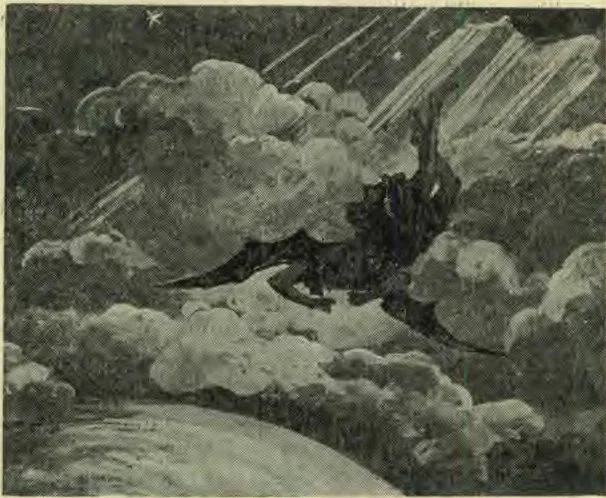
SATAN FALLS FROM HEAVEN
Donald Hunter and many of his young friends were seated on the front row of benches, while his father, mother, and sister were only a few rows back of him. Donald was so desirous to hear this sermon that he came to the tent shortly after six o’clock. In all his life nothing had so interested him as these tent meetings. It was good to watch his eager face as he followed with deep interest every word the minister said.
After the song service, Elder Harris began his address. He referred to the sermon of Friday night, reminding his audience that he had then clearly shown from the Bible that there are other worlds which are inhabited, and that this world is the only one that has fallen. He said that the question, “Why was sin permitted?” is perplexing to the great body of Christian people, but that in the Bible is found a full and satisfactory answer. He used many Scripture passages to explain the subject. The following are some of the things he said that night:
“There was a time when Satan was ‘in the truth.’ But he ‘abode not in the truth.’ John 8:44. That is, he became an apostate, and the leader of a great rebellion against God.
“Satan was once a beautiful angel in heaven, standing in the very court of Jehovah, the King of the entire universe. He is described in Isa. 14:12-17, and is there called Lucifer. He was cast out of heaven because of pride, for we read in 1 Tim. 3:6, which speaks of the qualifications of an elder, ‘Not a novice, lest being lifted up with pride he fall into the condemnation of the devil.’ Such a remark would be without point unless it had been a known and accepted fact that the devil had been condemned for pride.
“Because of the inferiority of his position to that of the Father and the Son, Lucifer permitted thoughts of envy and dissatisfaction to creep into his heart. Instead of banishing these thoughts at once, he cherished them until he became convinced that for such a bright and glorious and wise being as himself to remain in a subordinate position was the height of injustice. Of this the Bible says, ‘Thine heart was lifted up because of thy beauty, thou hast corrupted thy wisdom by reason of thy brightness.’ Eze. 28:17. He began to look upon himself as a rival to God in the universe, and to believe that he had been unjustly deprived of his rights by One stronger than himself. He determined to secure those rights at all hazards.
“His purpose is described in the words, ‘Thou hast said in thine heart, . . . I will exalt my throne above the stars of God: . . . I will be like the most High.’ Isa. 14:13, 14. Having conceived this purpose in his heart , Lucifer did not at once come out openly against God, but silently went about the work of disaffection among the other angels. Heretofore he had sought to make God supreme in the thoughts and the affections of those under his leadership, but he now sought to secure their allegiance and loyalty to himself.
“This revolt against God finally came to an open break. Then ‘there was war in heaven: Michael [Christ] and his angels fought against the dragon [Satan]; and the dragon fought and his angels, and prevailed not; neither was their place found any more in heaven. And the great dragon was cast out, that old serpent, called the Devil, and Satan: . . . he was cast out into the earth, and his angels were cast out with him.’ Rev. 12:7-9.”
Donald was listening with rapt attention. Nothing he had ever read was so fascinating as this. Brother Harris had such power of description, and made things so real, that Donald was not only hearing of this great drama of the ages, but he was seeing it. And so were the others. A tense stillness was over the great crowd, and every eye was on the speaker.
The preacher told in simple words how Satan with his angels was cast out into this earth; how, having beforehand learned that this earth was to be peopled with the human race, he determined to win that race to his standard in rebellion against God, and that he succeeded in this by causing the fall of man in the Garden of Eden. He showed, too, that in this fall more was involved than the inhabitants. The earth itself passed nominally into the control of Satan. The earth had been given to Adam, whom Satan conquered, thus becoming the “god of this world.”9
“Now the question arises, Why did God permit this? Why did God permit Lucifer to sin? In answering this question we must look at it from a broader viewpoint than that of a dweller on this earth. We must look at it from the viewpoint of God. Consider this: The angels knew nothing of sin. They knew nothing but obedience to God. They had never known any other form of government but Jehovah’s. They were free moral agents. After Lucifer permitted himself to rebel, God, in his infinite wisdom, saw that there must be a demonstration of what sin is and its results, and that this demonstration must be made in the sight of the inhabitants of the entire universe, that they might see and know and understand that the principles of the kingdom of God are based upon love and mercy and justice, and that no better form of government is possible.
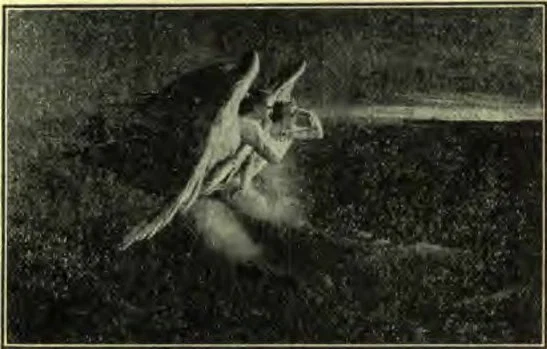
IN THE DISTANCE STANDS THE EMPTY CROSS. JESUS WAS DEAD; BUT NOW HE LIVES!
“Therefore God permitted Satan to come to this one planet, the earth, and to set up here his government, to cause the fall of the human race, and to flood one world with sin and sorrow, in order that all created intelligences, both in heaven and in the other worlds, might see the result sin would work. He provided, however, that even in this world every soul that desired to find a way of escape from sin and its eternal consequences might be saved.
“To do this he sent his own Son into this world to win it back to its allegiance to God, and to take upon himself the punishment for the sins of the entire race. But Satan did not yield the control of this world willingly. At the very beginning of the ministry of Jesus, Satan met him in the wilderness of temptation. After failing in two temptations, he openly avowed himself to be that Lucifer who had fallen from heaven. He declared he knew full well why Christ had come to this earth. He knew he had come to try to regain the world from the power of Satan. He pointed out that to do this Christ would be compelled to die a most ignominious death and to undergo almost unbearable suffering. Then he declared such a course to be entirely unnecessary. Christ need not travel such a blood-stained path and die such a terrible death. The world was in his (Satan’s) power, and he could give it to whomsoever he would. Taking Christ to a high mountain, he caused all the kingdoms of the world to pass before his view in a moment of time, and showed him all the glory of them, and said, If this is what you have come for, if this is what you want, you can have it all. ‘All these things will I give thee, if thou wilt fall down and worship me.’ Matt. 4:9.
“It was a temptation indeed. The world was the very thing for which Christ had come. He is now told that he can have it all and need not endure the shame and ignominy of the cross in order to secure it. But he saw at once that to take it on such terms as were offered by Satan would be to acknowledge all that Satan had contended for in heaven,—his superiority over Christ,—and he must hold the dominion of the earth subject to Satan. Seeing that the great conflict of the ages would be eternally decided in favor of Satan if he accepted his proposition, Christ turned to Satan with the words, ‘Get thee hence, Satan.’ Matt. 4:10. He determined to go on with his work of establishing a kingdom of righteousness and truth, though the decision meant that he must go down into the valley of the shadow of death.
“Satan wreaked his full vengeance upon Jesus. Alone, with none to help or comfort, the Son of God drained the last drop of the fiery cup, the cup that none else could drink. If men were to be saved, there was no other way out for him but to die for them. He determined to meet the full penalty for sin, and no lesser pain could now make him afraid. The priests and rulers might insult him and jeer at him, the whole nation might taunt and gibe, but not one cry would be forced from those lips by pain, or thirst, or glaring noonday heat, or thorns, or nails, or prison chains, or smitings of sin-stained hands. As a sheep before its shearers, so would he be dumb.
“At last they hurried him before Annas and Caiaphas, and then before Pilate, and on to Herod, and back again to Pilate, always in the midst of the vociferating crowd, who buffeted him, smote him with the palms of their hands, and spit in his face, speaking sneeringly of the shame of his birth, and demanding that he perform for them a miracle. Coming the last time from Pilate’s judgment hall after the sentence of crucifixion had been pronounced, they crushed down upon his weary head the cruel crown of thorns, and bowed the knee in mockery, crying, ‘Hail, King of the Jews.’
“With no rest through the long night, hurried from one proud ruler to another, travel-stained, weary, footsore, and bruised and lacerated with the cruel scourging he had received, now in addition to it all he is laden with the weight of the heavy cross, and, with no covering on his head to protect him from the broiling sun, but wearing the crown of thorns which had torn his brow in heavy gashes, he staggers on, the world’s Redeemer, through taunts and jeers and mocking words.
“Reaching the place of Calvary, they stretched him upon the cross, and drove the nails through his quivering flesh. Then raising the cross with the Saviour upon it, they let it drop with a dull thud into the hole they had prepared for it, tearing wider the wounds of the hands and feet where the nails had pierced. With jeers and mockery they watched his dying agonies. Thus the Son of God gave up his life for you.
“In consequence of his victory, Satan was driven out of the courts of heaven for the last time. Satan cannot now appear in the great councils of heaven, for he does not now represent this earth. His dominion has been taken from him by Christ, and now ‘we have an Advocate with the Father, Jesus Christ the righteous.’ 1 John 2:1. We have a Friend at court. And soon, oh, very soon, Jesus will take his people to himself, and will then give them back the dominion of this earth which was wrested from them by Satan.”
As the minister ceased speaking, a sigh broke from the audience like the sound of the wind in the trees. Every person was profoundly stirred. As Donald looked around he saw a gray-haired man with tears running down upon his beard, and his own eyes were wet. For the first time these people had had explained10to them some of the mysteries which had long perplexed them, and shining out above everything else was the great and wonderful love and mercy of their God. Every heart there was strongly drawn to the Lord.
And Donald? From that night Donald was a changed boy. He had seen the Christ as never before, and for the first time knew what his sacrifice meant. He had been interested in moving pictures, but they had never gripped his heart with the breathless interest11which had controlled him throughout this sermon. And this was real! As he retired that night he saw again the figure of Christ in Gethsemane, with the destiny of the world in the balance; and Donald decided that he would rather be the servant of the One who made the sacrifice which Christ made that night, than to occupy the highest place within the gift of this world.
Politeness at Home
By Caroline S. Griffin
OUR home is where we live. In it are those we love most. If there is any place where we should be our best, most thoughtful, kindly, loving selves, it is in our own homes.
We try to appear well in the presence of strangers; far more should we try with father, mother, sister, and brother.
Let us think what good manners are.
We should rise in the morning as soon as we are called or the rising bell rings. It is showing rudeness to the rest of the household for one member of the family to turn over and go to sleep again after rising time, or to require calling more than once. The polite child is strictly obedient.
A gentleman or gentlewoman is always clean, and neatly dressed. This rule applies equally to the boy and girl. Neatness in dress is necessary to self-respect. If a girl owns but one hair ribbon and a single bit of lace, she can launder these herself, so that she may look neat. Work is perfectly respectable; untidiness is a disgrace. Any boy can own a ten-cent box of shoe blacking. He can use it, too, blacking the heels of his shoes as well as the toes.
Before leaving your room after you are dressed, see that everything is in order. Spread the bedclothes over the foot of the bed. Shake up the pillows, and place them on a chair. Then open the window wide. In winter, be sure that the register is closed or the steam turned off, so that no heat may be wasted while the room is being aired.
Give a cheery “Good morning,” to every one you meet. Never mind whether there is sunshine or rain out of doors; carry sunshine with you wherever you go.
Be pleasant at the breakfast table. If you do not care for oatmeal, and mother insists that it is good for you, eat it sensibly, without grumbling. If you do not like what is provided, either eat it or go without. In any case, be good-natured about it. Crossness at the table is the height of bad manners.
The same cheery good nature should be preserved while you are getting ready for school. Do not play out of doors or sit reading a story until it is time to start. Begin your preparations soon enough so that you need not hurry. Your hat, coat, and mittens should be in their proper place, put there when you last entered the house. Your books also should have a place, and be there. If your belongings are where you can find them promptly, you will have no occasion for nervousness, flurry, or unpleasant words. Let mother see you smiling when you leave the house, rather than frowning.
Very likely you will be asked to stop at the grocery store or bakery on your way to school, to leave an order. Your mother has taken care that you have proper clothing to wear, and she makes your home comfortable. Is it any more than fair—not to speak of the etiquette of showing politeness to one’s mother—that you should attend to her errands pleasantly, and as if you really enjoyed helping her in these little ways?
No matter how great your haste or how late you are, never start off in the morning without saying good-by. If while you were away from home, something should happen to one of the family, could you ever forgive yourself for having rushed off without a word of farewell? At noon, and after school has closed for the day, always let mother know when you get home. If you go directly to your room, or remain out of doors at play, she may become anxious about you, fearing that some accident has happened to you. It takes only a minute to find her and let her know you have returned. You will enjoy your play all the more for having thought of her first.
You probably are very hungry when you arrive home from school at noon. Is hunger an excuse for your scolding and making yourself unpleasant because lunch does not happen to be ready when you come in? Remember that other matters besides preparation for your lunch have required attention during the morning. Perhaps you might help to set the table, or serve the luncheon, instead of burying yourself in a book, or playing.
If you take music lessons, have a regular time for practice, and remember the music hour yourself. Have you ever heard unpleasant conversations like this?
“Katie, you must come in now and practice, or you will not be ready for your music lesson tomorrow.”
“Oh, mother, need I go just now? We are having such fun, and I’ll do my practicing tomorrow morning before I go to school.”
“No, you must come at once. You can play later.”
If you have heard such remarks as these, you know how trying they must be to the mother. I hope you, yourself, are too much of a gentlewoman or gentleman to scowl, or say you dislike pianos, or the practicing which is so necessary a part of your education.
Perhaps you are so fortunate as to have a baby brother or sister. Sometimes you may be asked to amuse the little one, or take him out in his carriage. If you only realized how greatly you are blessed in having him, you would never, never object to caring for the little treasure. What if he should be taken from you! And then, suppose you had been neglected when you were a baby. Your mother cares for you by providing you with food, clothing, and the many other things you need. Show that you appreciate what she does for you, by caring for baby when she asks this. Do it cheerfully, willingly, gladly.
Disputes or quarrels between brothers and sisters are not only impolite, they are very wrong. Never strike or hurt anybody, least of all any one whom you love as you do your own dear brother.
Be good to the family dog and cat. Only a coward abuses anything that is weaker than he, or that is too good-natured to bite or scratch in return.11
Always be polite to callers or guests in your own house. If some one with whom you are acquainted is calling on your mother, or has come to your home for a visit, even if the person is older than you, it is polite for you to step up and speak, shaking hands cordially. If the person is engaged in conversation with some one else, it is not necessary to interrupt. Wait until there is a pause, then speak.
A child should not remain seated when an elderly person enters the room. If there are so many chairs that it is unnecessary to offer the one in which you have been sitting, stand by your chair until the older person is seated. This little act of courtesy is too often neglected. It should be performed quietly, without display or show. If the person has occasion to enter and leave the room several times, you need not keep jumping up, but be sure to leave vacant a comfortable chair.
Pass behind, not in front of people. This does not mean that you need make yourself conspicuous. A five-year-old boy had been told by his mother that a little gentleman would pass behind, not in front of people. When he wished to leave the room the next time there were visitors, he crawled under the stove-pipe, because he could see no other way out of the difficulty. That was, of course, unnecessary. If there is no easy way of passing behind the people who are seated, say very quietly to the person before whom you must walk: “Please excuse me if I pass in front of you.”
Remember that when playmates come to see you, the courtesies due to guests from host or hostess should be shown them by you. Play the games they choose, no matter if you would prefer others, and be generous with your playthings. If you have any which you dislike to have your friends use, keep them out of sight.
Never tease a visitor to remain longer than the time set by his parents. If an exact hour for going home was named, be sure that he knows when the time has come.
When bedtime comes, say good night to father and mother, and go quietly to your room. Undress at once, lay your clothes neatly on a chair, say your prayers, open the window, and jump into bed. If you have tried to be polite and kind throughout the day, you will be ready to sleep well, and you will awake the next morning refreshed and happy.—Caroline S. Griffin.
“H. C. L.”
By May Brownell
“Prices are creeping up every twenty-four hours. Si Brown has again raised the price on potatoes fifteen cents a barrel.”
“Well, George,” answered his wife, “I am as saving as I know how. I boil all the potatoes in their jackets, so there will be no waste in paring them. Maybe we could use rice now and then instead of potatoes. It is cheaper.”
The children were eating in silence, listening with long faces to the discussion by mother and father on the high cost of living.
“Really, Mary, I do not see how some families will be able to live this winter. It is hard enough for us, with our twenty-five dollars a week.”
“O mother, can’t we make fudge tonight?” asked Betty, her face brightening; “you see, Dot and Henry are coming over for the evening.”
“Fudge! with sugar at ten cents a pound and butter at forty!” exclaimed her father.
“But, father, it would be such fun, you know, and brother and I can make such good fudge,” said Betty.
Mr. Bennet soon left the table, with a worried expression on his face.
The children talked on about their plans for the evening.
When Mrs. Bennet and Betty were clearing the table, Betty exclaimed:
“Oh, I’m sick of talk about how much everything costs! I don’t see any use of living if we can’t do what other people do.”
“Well, my dear, it is about as father says; we just cannot afford these pleasures as we could once. I am going to the mothers’ meeting this evening, and hope I shall hear some practical suggestions on this subject.”
“Well, mother, it seems as if something must be done soon; none of us are as happy as we were, and I believe it is this everlasting talk of ‘prices.’”
That evening the town hall was crowded with eager, curious women, waiting to hear a talk on household economy. Dr. Lawton began:
“How many of you mothers have begun to feel the increased cost of living — food and clothing?”
Instantly every woman in the audience was alert with interest. His next question was:
“How many of you are beginning to feel the effect of high prices on your health?”
He continued: “Too many of us are worrying our entire family about this situation. You can lie awake nights, but that won’t prevent Si Brown’s raising the price of potatoes fifty cents a barrel, will it?”
Mrs. Bennet leaned forward as if fascinated by the doctor’s words.
“Neither will it reduce the price of butter one cent to talk about it throughout the meal. Instead, it will depress the family and hurt your own digestion, which is more detrimental to your future peace of mind and that of the family circle than is the deprivation caused by the increased cost of food.
“We read to our children and teach them in our schools that the early colonists of Virginia and New England were heroes because they denied themselves luxury in order to found a nation in which they might live up to their principles. And then we set our children a bad example in our own homes by fretting and fuming over the financial problems resulting from this great world war. Why boast of our forefathers if in our own homes today we prove unworthy of our pioneer blood?”
“We lay too much stress on food. We even overestimate its value to our health. If we talked less about the high cost of living and lived more simply, we would draw big interest in domestic happiness.”
Mrs. Bennet was full of enthusiasm when Dr. Lawton’s talk was ended. MAY BROWNELL.
For the Finding-Out Club
By Ethel Hudson
PART I
The answer to each of the following conundrums is the name of a famous author. Give the names.
1. Part of the name is a verb; the other part a weapon.
2. An adjective and a noun, which together describe King Saul.
3. One letter added to this name changes it to a common noun which expresses the author’s genius.
4. An article of food which we get from the animal kingdom.
5. The first syllable is an abbreviation of one of our States; the last is the name of a relative.
6. An article of headdress.
7. A noun, meaning a quick succession of small sounds.
8. This name may be divided so that the first part spells a part of a house; the last part a noun, meaning a very small quantity.
9. Rearrange the letters of the following sentence so that they spell the name of an author: Man will cruelly nab it.
10. An old method of punishment practiced by the Indians and others.
11. The letters of this name have the same pronunciation as the following objects: an insect, a verb, an interjection, a double vowel, a house of lodging, an organ of the human body, a house of lodging again, a command used by the plowman.
ETHEL HUDSON.
PART II
Locate geographically or explain:
1. Elysian Fields.
2. River Styx.
3. Pillars of Hercules.
4. Slough of Despond.
5. Garden of the Gods.
Answers to Questions in “Instructor” of March 6
1. About 277 B. C., a Greek translation of the Old Testament Scriptures was made, or was begun about that time, Greek being the language then generally spoken throughout the Roman world. It is known as the Septuagint or Alexandrian Version. It is said to have been the work of seventy scholars at Alexandria, hence its title.
2. In 1610 the Roman Catholics issued the Douay-Rhemish Bible, so called because the Old Testament was translated at Douay, and the New Testament at Rheims. The translations were made from the Latin Vulgate, and contain errors which cannot possibly be supported by the original Hebrew and Greek.
3. The original Hebrew was written without vowels, and there was no spacing to divide one word from another.
4. In 1250 Cardinal Hugo divided the Bible into chapters for the purpose of a Latin concordance.
5. An arrangement of division into verses—not the same as ours—of the Old Testament Scriptures was made by the Jews in the Hebrew text at a very early date, presumably in the days of Ezra. In 1551 Sir Robert Stephens was the first to bring out an edition of the Greek New Testament into verses. In 1560 an important edition of the Bible appeared, known as the “Geneva Bible,” and translated direct from the original Hebrew and Greek, which was the first whole Bible divided into verses. This was the first Bible also in which italics were used to indicate words that are not in the original.
6. Queen Elizabeth at her public entry into London inaugurated her long and prosperous reign by pressing to her heart and lips a copy of the Bible.
Answers to Questions in “Instructor” of March 13
PART I
1. George Washington was inaugurated President of the United States April 30, 1789, at Federal Hall, Wall Street, New York City.
2. Magna Charta is the name of the famous charter of liberties granted at Runnymede in June, 1215, by King John to the English people. The general causes which led to its adoption were the increasing insularity of the English barons, the substitution of an unpopular for a popular king, an active spur to the rising forces of discontent, and the unprecedented demands for money. The actual crisis may be said to have begun with the quarrel between John and Pope Innocent III regarding the appointment of a new archbishop to the see of Canterbury.
3. The numerals we now generally use are known as Arabic numerals, because they were borrowed in the twelfth century from the Arabic scholars of Spain. The figures themselves are at least some centuries older, being descended from what are known as the Indian cave numerals.
4. Germany as a separate kingdom dates from the treaty of Verdun in 843, when, after a struggle between Louis the German and his brothers for their father’s inheritance, an arrangement was made by which Louis obtained the bulk of the lands east of the Rhine. Although not yet a single people, the German tribes had now for the first time a ruler whose authority was confined to their own lands, and from this time the beginnings of national life may be traced.
5. The Acadians were French settlers in Nova Scotia. They retained the language and customs of France, refusing to take the oath of allegiance to the British king. They numbered about 17,000 and were a simple and industrious people, living apart from all the rest of the world. They were compelled to surrender to the British, and in 1755 a great number of them were deported and dispersed among the English colonies, from Massachusetts to Georgia, many finally reaching Louisiana. The story of their deportation is touchingly told by Longfellow in Evangeline.
6. Pittsburgh owed its origin to the strategic value of its site in the struggle between the English and the French for the possession of the North American continent. A few Frenchmen attempted to establish a settlement here in 1731, but were soon driven away by the Indians. In 1753, after the French had laid claim to this region, Robert Dinwiddie sent George Washington with a letter to “the commandant of the French forces on the Ohio,” asking him to account for his invasion of territory claimed by the English. The next year he dispatched militia to build a fort on the present site of Pittsburgh, but a large force of French and Indians compelled them to withdraw. General Braddock’s attempt to drive out the French13in 1755 resulted in overwhelming defeat. In 1758 General Forbes led a powerful expedition against the fort, which was burned by the French. At Washington’s suggestion, the place was named Pittsburgh, in honor of the British prime minister. A new fort was built, called Fort Pitt. A town was laid out in 1784.
7. The Parthenon probably remained intact until the fifth century, when the temple is said to have been transformed into a church. The alterations involved some damage to the sculptures. In 1456 Athens was captured by the Turks, and the Parthenon was consequently changed into a mosque. In 1687 the Turks used the building as a powder magazine during the bombardment of the Acropolis by a Venetian army, and a shell caused the explosion which blew out the middle of the temple and threw down the columns at the sides. In 1801 Lord Elgin obtained a firman authorizing him to make casts and drawings, and to pull down extant buildings where necessary, and to remove sculpture from these. He caused a certain amount of sculpture that was still on the temple, to be transported to England. Certain other sculptures from the Parthenon are in the Louvre, France; Copenhagen, Denmark; and elsewhere.
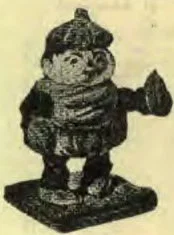
BROWNIES make pleasing favors for children’s parties, because at the feast the children can eat them with enjoyment and with no ill effects. For each brownie you will need two large and two small almonds, two figs, eight raisins, and one marshmallow, with four pieces of fine, stiff wire, and two pieces of stiff cardboard two and one-half inches square, covered with brown crape paper.
To make the base, put two of the wires through one piece of cardboard and turn back the ends; glue the other cardboard to the back of the first.
Push each of the wires through the large end of an almond, and string two raisins on each wire; that makes the legs and feet. Cut a fig in two so that the piece nearest the stem shall be one third the size of the other. Push the two wires through the larger piece with the cut edge uppermost; then pull on a whole fig.
Make the arms by fastening a small almond to the end of each of the other two wires, and then running each wire through two raisins. Join the two arms to the shoulders with the wires, and run them up through the fig so that the free ends shall come well toward the center. If you remember that this process is merely to place the brownie’s arms properly, you will find it much easier than it sounds.
A marshmallow forms the head, and the remaining third of the fig, with the stem end up, makes the hat. With melted chocolate you can paint eyes, nose, mouth, and hair on the white marshmallow.
If the brownies are to be seated, make the legs according to the directions here given for making the arms; run the wires into the cardboard, and up into the fig to fasten the body to the base. Do the rest of the work in the same way as for standing brownies. You can adjust the arms to suit your fancy, and hang a place card upon them.— Selected.
The Master has Come
By Julia Gill
“THE Master has come over Jordan,”
Said Hannah, the mother, one day;
“He is healing the people who throng him
With a touch of his finger, they say.
And now I shall carry the children,
Little Rachel and Samuel and John,
And dear little Esther, the baby,
For the Master to look upon.”
So over the mountains of Judah,
Along with the vines all so green,
With Esther asleep on her bosom,
And Rachel her brothers between,
With the people who hung on his teaching,
Or waited his touch or his word,
Through the row of proud Pharisees hastening,
She pressed to the feet of her Lord.
“Now why shouldst thou hinder the Master,”
Said Peter, “with children like these?
Thou knowest how from morn until evening
He is teaching, and healing disease.”
Said Jesus, “Forbid not the children;
Permit them to come unto me!”
And he took in his arms little Esther,
And Rachel he sat on his knee.
The care-stricken heart of the mother
Was lifted all sorrow above;
His hands kindly laid on the children,
He blessed them with holiest love;
And said of the babes on his bosom,
“Of such is the kingdom of heaven;”
And strength for all duty and trial
That hour to her spirit was given.
— Julia Gill.
Sonnet on a Psalm
By Lawrence Earl Carr
O LORD, hear this my earnest prayer;
My soul cries out, my heart is sore;
I seek thee now, thine aid implore;
For I am weak and in despair.
How frail is life without thy care!
I stagger o’er the rocky shore.
O, lift me up with thee once more!
And grant me of thy light a share.
Show me, O Lord, the end of all,
That I spend not my life in vain,
That I may know how weak I am,
And cling to thee, and never fall.
Make me to see how thou wast slain
Without a sin, a spotless Lamb.
LAWRENCE EARL CARR.
Missionary Volunteer Society Programs for Week Ending May 19
The programs for this date, with notes, illustrations, and other helpful material, will be found in the Church Officers’ Gazette for May.