The best kind of life preserver that young people can have today is an implicit trust in God. The psalmist learned how very indispensable such a preserver is to peace and happiness. All through the Psalms echoes and reëchoes the urgent appeal to trust in God. David knew what it was to be hunted like a wild beast in the wilderness; but he confesses (for our encouragement) that he learned to trust God so fully that he did not fear what men might do to him.
The psalmist trusted God when things looked so serious that he had to do one of two things, trust or worry. “What time I am afraid,” said he, “I will trust in thee.” It is easy to trust, or to think that we trust, when no dangers are seen and things go along smoothly and pleasantly. Such times do not test our trust. But the psalmist’s trust was deep enough to get under the heart’s deepest sorrow and wide enough to cover all the varied experiences of life. When he could see nothing but trouble and danger ahead, and there seemed no possible way of escape, he still could lift up a quiet, trustful heart to God and thank him for the deliverance not yet seen.
For instance, consider the night that David and his men were fugitives out in the wilderness. He was king of Israel, but he had been driven from the palace, and Absalom and his army were pursuing him. Dangers were on every hand; a night attack must have been expected; yet, even under these circumstances, David testifies: “I laid me down and slept; I awaked; for the Lord sustained me.” Yes, even on that night of overwhelming sorrow and inevitable danger, he trusted all to his great Keeper and dropped into peaceful sleep.
In speaking of the result of trusting God, the psalmist says: “I shall not slide.” Trusting God brought him security. God always keeps his trusting children from sliding. Those who trust him implicitly never slide into habits of wrong-doing, and that really is our greatest danger. Those who live close enough to him to trust him fully never form the habit of fretting over things that annoy, of worrying over approaching dangers, or of envying those who seem more fortunate than themselves; for they believe that their God whom they trust will mete out to them those things that are best for them to have.
Many of us desire to learn to trust God that our hearts may enjoy his peace while crossing life’s troubled deep; and we need to learn to trust him for this reason; but there is another reason—a nobler reason—for our learning to trust God. That reason is: “That I may declare all thy works.” God cannot trust those to do his biddings who do not trust him. They cripple their own lives and limit their usefulness in his service. The doubting heart casts a shadow over the life and paralyzes the hand that is stretched out to save others. So every Missionary Volunteer who would, with the psalmist “declare” all God’s works, and be an efficient worker in the Master’s vineyard, must learn to trust God.
Meditation.—I must learn to trust God in all things and for all things that I need. But I am reminded that as I sow so shall I also reap. The psalmist “sowed” Bible study (Ps. 119:11); he “sowed” prayer,—earnest, patient prayer (Ps. 40:1); he “sowed” meditation (Ps. 42:8); and he sought earnestly to become better acquainted with God (Ps. 63:1). To know God is to trust him; so there is nothing I need today more than to know my God.
Special Prayer.—Father, teach me how to commune with thee, that I may learn to know thee and to trust thee as I should.
“Tell me a story,” is a very common request from boys and girls. Even when we get old enough to read stories, we would often rather hear some one tell them to us. But every Junior Missionary Volunteer should learn to read well, for good reading is the key that unlocks to us the whole storehouse of the world’s best stories.
But why do we like stories? When we are mere children it is most often, perhaps, just to learn something new and strange. That is all right, for every boy and girl should thirst for knowledge. But when we come to understand the difference between right and wrong, we should desire to learn from stories the best way to live our lives. We have only one life to live. How important that we should live it right. And every good thing we can learn from the experience of others will help us.
This is why Bible stories are given to us. The Bible says, “Whatsoever things were written aforetime15were written for our learning.” When Jesus was a boy, his mother doubtless told him the wonderful stories which we have been reading. And when he was older, he would take the scrolls and read these stories for himself. Don’t you suppose that the heart of the boy Jesus beat a little faster when he read that story about the boy Josiah, how he tried to follow the Bible that had been lost and was found, and how he destroyed the heathen images and altars? The Lord had a great work for Jesus to do. One of the first things he did was to drive the money changers and merchants out of the sacred temple, and all through his life he preached against wrong.
As you read the story of the fall of Jerusalem and the captivity of the people, try to think why the Lord permitted this great affliction to come upon his people. The prophet Jeremiah foretold this great calamity, and he showed that it was because they had not obeyed the word of the Lord. Jer. 25:8-11. Try to imagine the feelings of these people as they were torn from their homes and driven to a land a thousand miles or more away, with their holy city and temple in ruins.
How long did Jeremiah say they would remain in captivity? What was to happen at the close of those seventy years? Jer. 25:12. The proud kingdom of Babylon was overthrown by the Medo-Persians, and it was this nation that permitted the Jews to return. Through the prophet Isaiah the Lord had foretold the name of the man who would make the first decree. Isa. 44:28.
The story of the return and rebuilding of Jerusalem is a very interesting one. It is told in Ezra and Nehemiah. The Lord put into the hearts of other kings to make proclamations concerning this work. The proclamation of Artaxerxes completed the “commandment to restore and to build Jerusalem,” which the prophet Daniel spoke about as the beginning of an important line of prophecy. Dan. 9:25.
MEMORY VERSE: “Ye shall be brought before governors and kings for my sake.” Matt. 10:18.
Questions
1. After Festus’ speech, what did King Agrippa say to Paul? Acts 26:1. Note 1.
2. What gave Paul great pleasure? Upon what did he propose to speak? Verse 2. Note 2.
3. Why was the apostle pleased to present his case to the king? Verse 3.
4. What did Paul say all the Jews knew? How did he say he had been brought up? Verses 4, 5. Note 3.
5. For what did Paul say he was being judged? For what were all the twelve tribes hoping? Why did the Jews accuse Paul? Verses 6, 7. Note 4.
6. What question did Paul then ask his hearers? What did he say he thought at one time he ought to do? Verses 8, 9. Note 5.
7. What did Paul say he had done in Jerusalem? From whom did he receive authority? How did he vote when the disciples were condemned to death? What does he say further of his way of persecuting God’s people? Verses 10, 11. Note 6.
8. What did he say of his journey to Damascus? What story did he then relate? How many times is this experience recorded in the book of Acts? Verses 12-15.
9. What commission did Jesus at this time give Paul? What promise was given him? Verses 16, 17.
10. What five things does the Lord wish to do for all people? By what are all sanctified? Verse 18.
Questions for Diligent Students
1. How was Acts 9:15 fulfilled in Paul’s experience as related in this lesson?
2. What points in Paul’s defense made on this occasion would appeal to a Jew?
Notes
1. Agrippa was the last king bearing the name of Herod. He was a great-grandson of Herod the Great, and a son of the Herod who killed James and tried to put Peter to death. He ruled the provinces north of Palestine, and also Galilee and Perea. He was appointed by the Roman emperor. At the time of our lesson he was visiting Festus, the governor of Judea.
Festus made all the display possible when Paul was called before Agrippa. There were officials and ladies clad in their grandest robes, and the occasion was one well calculated to inspire the apostle. Dressed in the coarse garb of a prisoner, Paul stood chained to a soldier. Although he had neither wealth nor power and was a humble prisoner, yet angels attended him. If but one angel had appeared in all his glory, the pomp and splendor of that earthly court would have faded away, and every face would have grown pale.
2. Agrippa could understand Paul’s argument better than Festus because he was acquainted with the Scriptures and the customs of the Jews. Paul had been condemned for preaching that the Messiah had come, for whom the Jews were looking.
3. The foundation of Paul’s strong character was laid in childhood. “After the most straitest sect of our religion,” is a good way to be brought up. Of Paul’s parents we know nothing, but we may be sure he was carefully taught, “Precept upon precept; line upon line.” Children sometimes become impatient because they think their parents are too strict. Such should remember Paul’s early training.
4. From the time when Adam was driven from Eden till the day Paul spoke before Agrippa, God’s true people had been looking for deliverance from sin. Every sacrifice pointed to Jesus as the Saviour of the world. All the prophets had spoken of his coming. The hope of salvation depended upon it. This was the blessed hope “made of God unto our fathers.”
5. Paul at one time thought that Jesus had not been raised from the dead, but when he saw him in the vision on the way to Damascus, he was as sure of his resurrection as was Peter or John who had walked and talked with him after that event. While a persecutor, Paul thought he ought to do the things he did. But after he saw Jesus, he was as earnest in preaching him as before he had been in persecuting his witnesses.
6. “Paul related the story of his conversion from stubborn unbelief to faith in Jesus of Nazareth as the world’s Redeemer. He described the heavenly vision that at first had filled him with unspeakable terror, but afterward proved to be a source of the greatest consolation,—a revelation of divine glory, in the midst of which sat enthroned Him whom he had despised and hated, whose followers he was even then seeking to destroy. From that hour Paul had been a new man, a sincere and fervent believer in Jesus, made such by transforming mercy.”—“The Acts of the Apostles,” p. 430.
A Teacher’s Vow
“I WILL see the good in all pupils and lead them on to higher attainments.
“I will be patient and forbearing, confident in the belief that kindness and generosity will ultimately triumph.
“I will scorn error, deceit, and all forms of falsehood, persistently foregoing sarcasm and injustice.
“I will claim all nature as my heritage, and spend a portion of each day quietly in God’s open air.
“I will hold daily communion with my own soul.
“I will accept my remuneration, however small, without envy, complaint, or discouragement, never forgetting that a teacher is a leader into the higher life, and not merely a wage-earner.
“I will work each day in unshaken assurance that peace and power come in full measure to all who are ready for the truth.”
Definite Effort
By Meade MacGuire
We had been neighbors in our boyhood, and had formed one of those very intimate and lasting boyhood friendships. But I had moved away, and had not seen him for fifteen years. One day I learned that he had come to the town where I was staying, and very soon I arranged to meet him.
What a handsome, fine-looking, stalwart man he was—a physical giant. He seemed as glad to see me as I was to see him. I said, “Will, let us go down by the river, and have a good visit.” When we had settled ourselves comfortably in the shade of a tree, I said, “Now tell me all about your life during the past fifteen years. I have thought of you so often, but never heard where you were or what you were doing.”
He then told me how he had spent the years in rough lumber camps and sawmills, associating always with the most godless men, and thinking only to earn money to spend in drink and carousing of the vilest kind. How unspeakably sad it seemed to me that a youth so richly endowed with physical and mental powers should so utterly degrade himself and dishonor his Creator. I thought of all that Will, with his splendid ability and strength, might make if he would turn from sin and serve God.
When the story was finished, I said, “Will, you cannot go on this way. You are throwing away your life. Turn to God, repent of your sins, and become a Christian man and a worker.” He seemed deeply impressed, but to all my appeals he only answered, “No, I am too wicked. I have broken every commandment in the decalogue. I have gone too far in sin. There is no hope for me.”
I felt so great a burden that it seemed to me I must do something, and so I said, “Will, may I pray?” He answered, “Yes, if you wish to.” Closing my eyes, I immediately began to plead with God that he would have mercy on my dear friend and touch his heart. I earnestly requested the Lord to convince Will then and there that he still loved him, and notwithstanding all his terrible sins, was ready at that very moment to forgive the past, to cleanse him from all unrighteousness, and make him a true Christian man. As I finished the simple prayer, which took but a few seconds, I opened my eyes and saw my friend pale, and trembling from head to foot, with tears falling on his cheeks.
When I prayed, I did not know what God would do, but now I said, “Will, has he convinced you that he is really speaking to you, that he loves you, and is willing to save you?” He replied, “Yes, he has.”
The Saviour said, “Follow me, and I will make you fishers of men.” How many of us have professed to follow Christ for years, and yet have never won a single soul to him, have not even made an earnest, definite effort! Friends, let us go to work in the name of Christ; for he will surely respond to our efforts, and work miracles of salvation through us, if we are willing to be unobstructed channels.
MEADE MACGUIRE.
How Long Shall I Give?
Go break to the needy sweet charity's bread;
“For giving is living,” the angel said.
“And must I be giving again and again?”
My peevish and pitiless answer ran.
“Oh, no,” said the angel, piercing me through,
“Just give till the Master stops giving to you.”
— Selected.
Stop, Look, Say
Somme, sôm, not som-mā′
Phonograph, fō′no-grāf, not fon′ō-graf
Khaki, kä′ke, never käk′e
Saith, sēth, not sā′ith
Corps, kōr, not korps
Radiator, rā′di-ā-ter, not rād′i-ā-ter
Belligerent, bel-lij′er-ent, not bel-lig′er-ent
No Chance
By Orison Swett Marden
No chance!
In a country where log-cabin boys and poor boys from the farm go to the White House?
Where even boys from the slums become our legislators, and where the poorest boys become our merchant princes, our great bankers and financiers?
Where so many business houses and institutions are built up by boys with no opportunity except their own energy and integrity?
Where brakemen and even section hands become railroad presidents?
In a land which has proved innumerable times that you cannot keep an energetic boy back after you have once given him the alphabet?
No chance, when history has proved many thousand times the disadvantage of too many advantages?
No chance! This has ever been the excuse of weak men.— Orison Swett Marden.
Elements of a Successful Life
A DEEP look within.
A long look ahead.
A steady look on high.— Selected.
Remembering God's Gifts Strengthens Faith
It is for our own benefit to keep every gift of God fresh in our memory. Thus faith is strengthened to claim and to receive more and more. There is greater encouragement for us in the least blessing we ourselves receive from God than in all the accounts we can read of the faith and experience of others. The soul that responds to the grace of God shall be like a watered garden. His health shall spring forth speedily; his light shall rise in obscurity, and the glory of the Lord shall be seen upon him. Let us then remember the loving-kindness of the Lord, and the multitude of his tender mercies.—“The Desire of Ages,” p. 348.
REMEMBER MOTHERS’ DAY
SATAN FALLS FROM HEAVEN
The Beginning, Work, and End of Sin and Satan
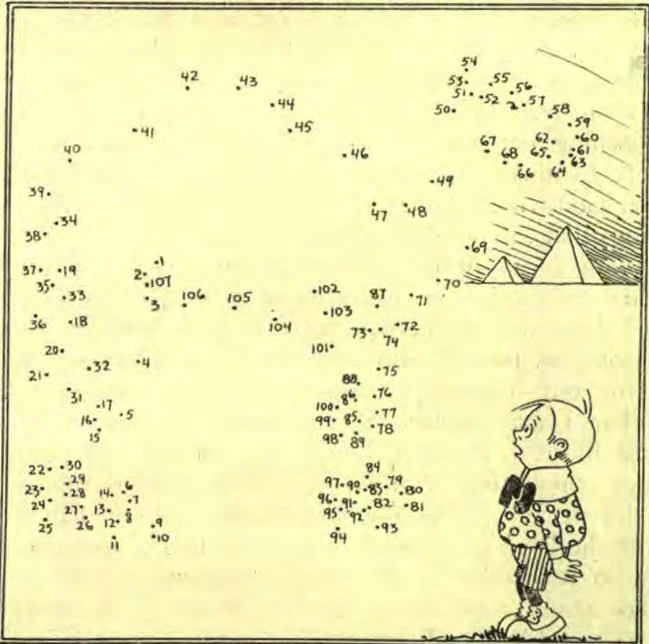
What is it? With a soft pencil start with dot number 1 and draw a straight line to dot 2, then from 2 to 3, and so on.
THE EARLY MORNING OFTEN FOUND JESUS IN SOME SECLUDED PLACE, MEDITATING, SEARCHING THE SCRIPTURES, OR IN PRAYER.