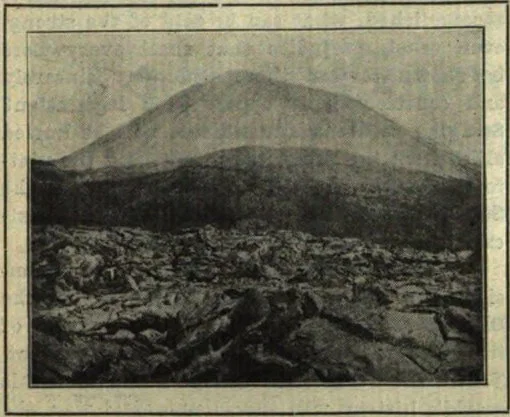
Cone and lava fields of Vesuvius after the eruption of 1872.
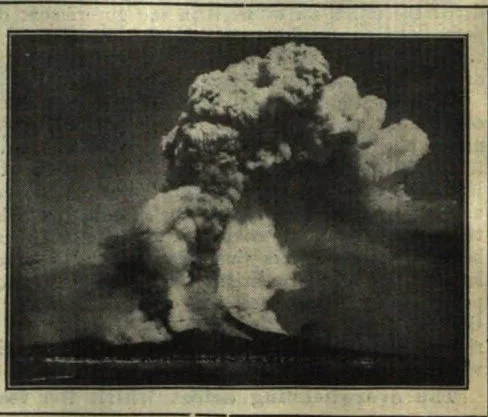
An eruption of Vesuvius, April 26, 1872, at 3:30 P.M. Etna is now belching forth smoke and lava in a similar way, beclouding the sun by day, and illuminating the heavens by night.
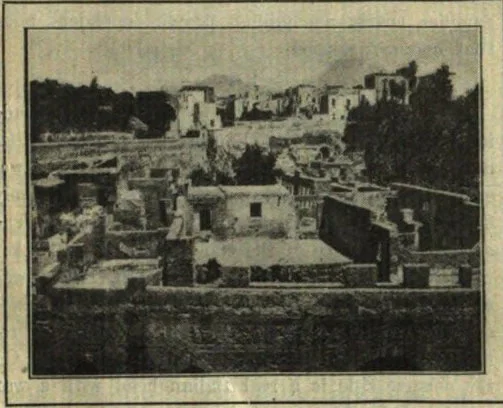
A general view of Herculaneum, buried in an eruption of Vesuvius in A.D. 79. It lies beneath the surface from 30 to 120 feet.
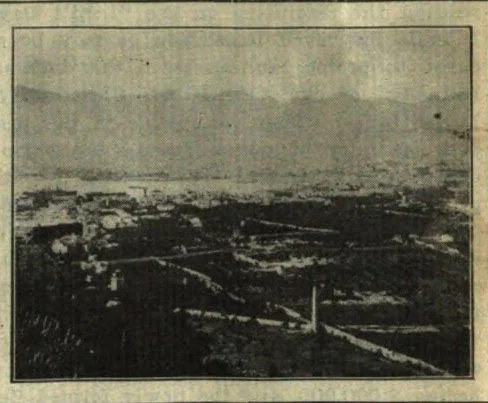
General view of Palermo, the largest town in the north of the island of Sicily, where some damage was done.
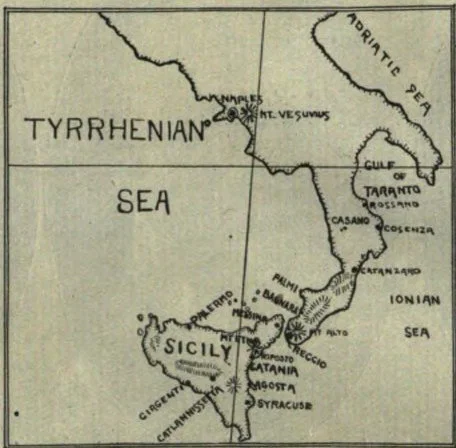
On December 28, at 5 A.M., a most fearful earthquake devastated all Southwestern Italy, indicated on our map, drawn for the purpose. On that day it was stated that probably 20,000 were killed. The next day the report was given as 100,000, and on the morning of December 31 the cable told us that 120,000 were killed in Messina and Reggio alone. The last estimate to reach us is 200,000 dead. One of the refugees from Messina states that 100,000 were killed in that city alone. It will be seen that the center of the earthquake district is the volcano Etna which is in eruption. We do not know that we can add anything to the awful descriptions which will be given by the entire daily press of the United States. We mention some of the towns which are said to be destroyed.
Messina and Reggio have been totally destroyed. Messina is on the Island of Sicily, and Reggio in the Province of Calabria in Italy. Among other towns in Calabria, Palmi with 30,000 inhabitants, Baguare with 10,000, Scylla with 8,000, Villa San Giovanni 10,000, and all the coast villages near Messina. Taormina, where many Americans live, was seriously damaged.
Marine reports are that the coasts of Southern Italy are entirely altered, especially so the Straits of Messina. The famous Cape Pharo has been entirely destroyed and sunk in the sea. The Lipari Islands were reported swallowed up, but later news declared them safe, tho badly shaken.
The distress and suffering beggar description. Many of the people, half-mad, poured into the churches while they were falling; victims are imprisoned in ruins, and starving hordes are fleeing from city to city, and pouring into partially destroyed towns where there is nothing for them to eat. It is said that the death list will reach 300,000. It may be that it will not reach half that sum, and yet every report from the stricken district is more awful than the previous. Among the towns on the Island of Sicily reported destroyed are Catania, Agosta, ancient Syracuse, Caltanissetta, and Girgenti. The territory affected is about 100 miles square, including, of course, the water district as well as the land. In the extent of territory affected it is not very different from that of the California earthquake of 1906, but in violence it seems to have greatly exceeded it. The time during which it lasted is recorded as thirty-two seconds on the seismographs in other parts of the world. It was probably longer than that in the affected district. No language can describe the awful terror which is upon the excitable inhabitants of Southern Italy; and the heart of the whole civilized world will go out in sympathy for those who survive.
At this writing both the king and queen of Italy are in the center of the awful calamity, and are doing all in their power to relieve and palliate the suffering. Subscriptions are pouring in from different parts of the world. Mr. John Pierpont Morgan is reported as having given $10,000. There are not a few wealthy men in America who could, if they would, combine their donations and soon be able to relieve the physical needs of all who could at all be relieved by humanity. The utter destruction of the cities, the crushing out and burning of from one to three hundred thousand persons, the awful agony of separation and fear which has come upon the people, can never be relieved by anything which humanity can do. These will abide with the people still. Such an awful event as this ought to cause thoughtfulness on the part of human beings everywhere. We may think that we ourselves are safe, we may solace ourselves with the thought that we are not living in an earthquake zone. One scientist fifty years ago declared that the United States was not in the earthquake belt, and that the cities of this country had nothing to fear. Since that time, however, Charleston was visited, and also San Francisco. Could we but remember God's word that the earth “shall wax old as doth a garment,” and that as an old garment it is liable to breaks and tearing in different parts, we would not wonder. That same word has also told us of the time when a mightier earthquake than the earth has yet seen will occur, when the cities of the nations shall fall. Could we but appreciate this, there would be a turning to God, and a seeking for that refuge from these calamities which no power of man can give.
The God who made the earth, and who yet reigns notwithstanding the sin which He has suffered for a while to exist, still has a care for the sin-laden planet. And when His great plan has been worked out, when to the entire universe sin will be seen to be sinful, and only sinful, the same creative power of God will renew the earth, make it stable forever, and people it with all those who have had faith in Him.
It is a good thing in times like these to have a faith that reaches beyond the earthquake, beyond all its untold calamities, beyond the many forms of death and distress which grow out of it.
In the meantime all Christian hearts sympathize with the sufferers; and all truly enlightened Christians can answer the messengers of the nation who are enquiring for places of refuge, “that Jehovah hath founded Zion, and in her shall the afflicted of His people take refuge.”
The Great Earthquakes of the Past.
THE district of Italy now afflicted has suffered fearful things in past centuries. There were 15,000 lives lost in Catania in the year 1137; 40,000 in Naples in 1456; 70,000 in Naples in 1626; 6,000 in Palermo in 1726; 30,000 in the Province of Calabria in 1783; 10,000 in Calabria in 1857.
Earthquake records show that there were recorded before A.D. 1, in a period of 1,700 years, 58 earthquakes, or one in 29 years. From that time to the end of the 9th century, a period of 900 years, there were 197 recorded, about one in 4½ years. In the next 600 years there was an average of one a year. The next 300 years an average of 9 a year; the next 50 years an average of 64 a year; the next 18 years, or from 1850 to 1868, an average of 277 in a year. These, of course, include all trembles of the earth recorded.
Of destructive earthquakes, Robert Mallet, the English seismologist, tells us that between B.C. 1700 and A.D. 96, a period of 1,796 years, there were recorded sixteen destructive earthquakes. From A.D. 96 to 1850, 204, or an average of one in 8 years. From 1850 to 1865 an average of one a year, in which more or less life and property were destroyed. From 1865 to 1868, a period of three years, there were 15 destructive earthquakes, or an average of five a year. Since that time we are sure the old earth has kept up its record, and this last awful earthquake in Italy seems to have been the greatest on record since the Deluge.
While doubtless the seismographs have recorded earthquakes in later times which once would not have been noticed at all, this is not true as regards destructive earthquakes. The constant increase in the perturbations of the old earth certainly mean something. Man’s perversions of God’s laws in the beginning brought sin, and sin brought death, and whether we regard His word or not, the great fact is true just the same that a continuation of sin against God will bring continual trouble and calamity. When man whom God made ruler over this earth sinned, all below man was affected. Perversion of spiritual law means perversion of physical law. The earth is suffering for man’s sake.
Map of earthquake district. The transverse lines are longitude 15th degree east, and latitude 40th degree north. The square represents a territory of sea and land 420 by 350 miles square. Mt. Etna is the center of the disturbance. Messina, Catania, Agosta, Syracuse, and Reggio, are among the greatest sufferers. Mt. Vesuvius is at the north of the district.
What Others Think of It
The following extracts from recent letters will give some idea of the enthusiasm with which “Bible Nature Series Number One” has been received by teachers all over the country. It would seem almost impossible to formulate stronger expressions of commendation than are contained in these letters.
From the East comes this straightforward testimony:
“It becomes a pleasure to me to acknowledge the receipt of a copy of ‘Bible Nature Series Number One’ and also the ‘Note Book.’ I am very much pleased with these, and as fast as we can, expect to use them in our school.”—B. F. Machlan, Principal South Lancaster Academy, South Lancaster, Mass.
From the West comes a still stronger word of approval:
“The book that I have been looking for, ‘Bible Nature Series Number One,’ is here. And as I turned from page to page and saw the wealth of illustrations and the lessons so nicely graded and beautifully worded, I said to myself, ‘This is no disappointment.’
“The book as a whole in the matter of printing, binding, drawings, subject-matter, and general arrangement, is most excellent; and in particular fills a long-felt need. The world needs this series that it may learn true science-teaching.”—I. C. Colcord, Ed. Supt. California Conference, Healdsburg, Cal.
From the British Dominion in the far North we have the following:
“I am more than pleased with ‘Bible Nature Series Number One.’” It seems to me that with such school books we have reason to believe that our educational system is destined to become very successful.”—A. C. Anderson, Ed. Sec. Alberta Conference, Harmattan, Alberta, Can.
Now from the South we hear the following:
“I like it very much, and certainly think it will fill a long-felt need in our schools. It is just the book I have long been wanting.”—Kate C. Bickham, Ed. Sec. Louisiana Conference, Shreveport, La.
Then from college presidents, principals of schools, educational secretaries, and leading educators all over the country come similar expressions of approval.
O. J. Graf, President Emmanuel Missionary College, says:
“The copy of ‘Bible Nature Series Number One,’ and also the ‘Note Book’ have reached me. I believe they will be a great help to our teachers in the lower grades.”
Next, from E. D. Sharpe, President of the Western Normal Institute, we have the following:
“I consider the book a little jewel, the best ever sent out by educational departments. I shall be glad to use it in our school.”
C. Sorenson, Principal Keene Industrial Academy, has the following to say:
“The copy of the ‘Bible Nature Series Number One’ came to hand recently. I am much pleased with the general appearance and scope of the same. I think this is exactly what we have needed in our work.”
M. B. Van Kirk, Principal Southern Training School, adds his tribute:
“The sample copy of ‘Bible Nature Series Number One’ has been received. I have given it quite a thorough examination. I want to assure you that I like it very much. I believe it will be a great help to the nature studies in our graded schools.”
Prof. George McCready Price, Secretary Loma Linda College of Evangelists, has this to say:
“If the man who makes two blades of grass grow where only one grew before is a benefactor of the race, surely the one who multiplies a thousandfold the bright and happy thoughts of teachers and children alike is much more deserving of our gratitude and esteem. Professor Cady has done an excellent piece of work in getting up this revised edition, and the publishers have done their part well in getting it ready for the reader. The arrangement of subjects can now be said to be in accord with psychological principles, and the maps and glimpses of physical geography are a very valuable addition. I hope the series will be continued.”
E. L. Neff, Ed. Sec. Oklahoma Conference, says:
“I am sure the book will meet with a hearty welcome from teachers, pupils, and parents. It will fill a long-felt need among us. I like the plan of the book, and am glad we have a work that teaches the great truths of science in harmony with God’s word and one that is free from the errors so common in books treating on these subjects.”
Nellie D. Plugh, Ed. Sec. Northern Illinois Conference, adds her word of commendation, as follows:
“I am well pleased with ‘Bible Nature Series Number One’ and feel free to recommend it to my teachers. For work in the fourth grade I know of nothing that will equal it. I have thought it might be a good substitute for a reader in that grade. The entire book is very suggestive to the wide-awake teacher and will prove a blessing in our schools, I am sure.”
Ethel M. Harris, Ed. Sec. New York Conference, adds her testimony as follows:
“I want to write and let you know how much I appreciate the ‘Nature Series Note Book Number One.’ There is nothing I have found so helpful in years and which the little ones seem to enjoy so well.”
Prof. E. S. Ballenger, Ed. Sec. Southern California Conference, says:
“I am very much pleased with the ‘Nature Study Book,’ and find that our teachers are highly gratified with the success they are meeting with in teaching it. I wish to compliment you also on the very attractive cover that you have put on this book. To my mind it is the most attractive of the school books thus far published.”
Mrs. Alma McKibbin, author of “Bible Lessons,” expresses her satisfaction with the new book as follows:
“I can not refrain from writing to tell you how delighted I am with the new ‘Bible Nature Series No. 1.’”
“When my copy came I was busy at work in the kitchen, but the dishes waited to be washed, and my bread ran over, while I went through the book from cover to cover. Each page was a delight, each lesson a pleasure as I remembered how I used to struggle over those subjects trying to simplify them, and here they are all ready for my use. I felt as if I must show them to some one at once.”
This new series of text-books has received such unqualified indorsement that we urge every teacher not using the book in their fourth grade work to procure a sample copy at once and see what a great help “Bible Nature Series Number One” will be. It is not only a complete text-book for the study of Bible and Nature in the fourth grade, but it combines with this in the most natural manner the study of geography, physiology, botany, and natural science. This arrangement greatly simplifies the work of the teacher, and also relieves the parent of the heavy burden in the purchasing of text-books.
Price, $1.20 postpaid.
A beautiful 16-page booklet has been prepared, containing sample pages of “Bible Nature Series,” one being a map in colors. This booklet will be sent free on request sent to the publishers.
Pacific Press Publishing Association
Mountain View, California
A Conversation in Which Conscience Takes Part.
By An Observer
Sabbath Afternoon.
“What a tedious sermon we had to-day,” remarked Mrs. A. “It must have been an hour long.”
“No,” said her son, a young man, “he preached just forty-five minutes.”
“Well, thirty minutes is long enough,” said the daughter petulantly.
“But he preached good,” said a clear, penetrating, but quiet voice. “Don’t you think he preached good?”
“Perhaps he did,” was the reluctant response; but meetings are too long for these busy days. I think our prayer and missionary-meetings are altogether too long.”
“Why did you stay through the meeting, mama?” inquired a little boy.
“I didn’t. When the leader arose to make his last appeal, I left.”
“Was it not interesting and necessary?” questioned the clear voice again.
“Yes, I suppose it was; but I was weary, and I needed sleep for the hard day’s work to-morrow.”
At a Week-Day Dinner.
“You were not up, my dear, when I went to the office this morning,” remarked the husband as he sat down to dinner. “When did you and the children get in last night?”
“It was nearly midnight.”
“You had a full program, I suppose.”
“Yes; she replied, and it was long; and the hour was late when it closed.”
“But,” said the husband, “I thought that you and the children, all of whom were nearly ill and needed the rest, were not going to stay late. Why did you?”
“Well, it would not look well to march out before others were ready, or to break into the program before it was finished. So we stayed.”
Said the clear voice again: “Think! The sermon seems long when only forty minutes in giving, yet you could stay three hours or more to the pleasure party. The sermon was a message for which both speaker and hearer will be held responsible in the great Judgment-day. The party program added nothing to life; no one felt uplifted or strengthened by it morally or spiritually. At its best it was full of neutral nothings, and its three hours’ time in overcrowded, ill-ventilated rooms left you unfitted for the hard day’s work on the morrow.
“You could leave the prayer- and missionary-meeting, when the very leader you helped to choose wished to plead with you a little longer for the work of God. Your leaving was discouraging to him, and added to his burden. Yet that was in your mind a proper thing to do. But you could not leave the party, because it would be unconventional; it would not look well.”
“Now, listening to a sermon, attending prayer-meeting, donating to church work, will not save a soul. But the fact that you weary so quickly of religious services, that you greatly prefer the party of pleasure, ought to be a great index-finger pointing to a low spiritual condition, a dangerous state of spiritual health, boding fatal disease and death.
“You can read some story for hours upon a stretch, some light inconsequential reading, but it becomes wearisome to read at one time the word of God, to exceed a half-hour. What do these things mean?”
The clear, penetrating voice fell to a sad cadence and ceased. The faces of the children took upon them a more serious, resolute look. The wife and mother bowed her head upon her hand, thoughtful and penitent.
We pass the parable on to others. What do they think of the words of the voice? Will their effect be permanent, we wonder? or will the next evening party sweep them all away as with a flood?
AN OBSERVER.
Fred’s Big Sister.
“DON’T go much on sisters,” Rodney Black was heard to remark, “but I could stand a dozen like Fred’s, she’s O. K. Lucky dog, that Fred Wilkins.”
“Same here,” Tim Welsh added. “She’s better posted on fish bait and baseball than Fred is himself, and as to cookies — O, my!”
Fred Wilkins’ house was the most popular resort for the boys of the neighborhood, but Fred said, good-naturedly, “I’m not chalking up any credit to myself for it; it’s all Sue.”
There never was a girl like her for making mouth-watering tarts and turnovers, doughnuts, and cookies, and she knew enough of a boy’s appetite to make them by the gross and the bushel, instead of paltry dozens and pints. As to skill in bandaging and caring for torn and bruised fingers and toes, even the doctors, so the boys said, had to take a back seat for Sister Sue. Yet, after all, her crowning talent was the wonderful way she had of patching and darning a ragged, jagged tear in coat or trousers, so that even one’s own mother couldn’t discover it.
“Say, she’s going to have a birthday next Wednesday,” confided one of the boys to the other. “Let’s do the handsome thing and get her a present. She’s always loading us up with good things and doing for us generally.”
The group of boys hilariously agreed, and it was decided to ask Fred to learn from Sister Sue what she most desired as a gift. Fred agreed, and promised to report promptly. But two days passed and Fred kept away from the other boys, or gave unsatisfactory answers when approached. Finally the boys cornered him.
“Well, you see,” he said shamefacedly, “Sue ain’t like other girls, always wanting things. If it was Bess, now, she’d tell a dozen things she’d like in one breath.”
“Well, it isn’t Bess, it’s Sue,” cried Will Davis. “What does Sue want?”
Fred took a long breath. “Well, you see,” he began again, “she couldn’t know I was quizzing her for anybody but myself, and she said — pshaw, I ain’t going to tell you,” he broke off impatiently, “it isn’t any of your business, anyway.”
The boys grew indignant. “Well,” said a voice, “I guess it is our business. If you think it is going to cost too much — we’re not a stingy lot. We’re ready to do it up fine. Out with it, Fred!”
Fred straightened up at that, with a “do-or-die” expression on his face. “Maybe you’ll wish I hadn’t. It is something that’ll cost like fun, but I said I’d report, and I’m a man of my word, so here goes. She just said, ‘Frederick Jackson Wilkins, if you want to give me a birthday present that I’d like better than anything else, you take a sheet of blank paper and write on it an iron-clad promise that you’ll stop smoking cigarets, and sign it.’ And that’s all I could get out of her.”
Fred said afterward, when he told Sue about it, “You could have sliced up the silence that fell over the bunch of boys with my jack-knife.” Every boy of them had known that Fred’s sister Sue had no use for cigarets, and they had always been careful to keep them out of sight. It was Fred who finally spoke again.
“Well, I didn’t suppose you’d like it a bit better than I did, but you made me tell.”
“Say, are you going to give Sue what she asked for?” spoke up a boy, dryly.
Fred’s face flushed, but his voice had a manly ring, as he promptly answered, “You just better believe I am. She’s too good a sister to disappoint.”
“That’s what I say,” blurted out Tom Folk. “It would please her mightily to have all us boys do the same thing, too. Let’s do it. All in favor say ‘Aye.’”
“Aye, Aye,” was the firm but quiet response from every boy.
Boys' Birthday Gift Promises to Quit Smoking
By Julia F. Dean
“There’s one of the boys wants to see15you, Sue, out in the yard,” said Fred Wilkins to his sister on the morning of her birthday. “He won’t come in.”
Sue smilingly accommodated herself to a boy’s whim and hurried out into the yard, where she found Rodney Black. He handed her an envelope, bulky and broad. “From us boys, to just start off your birthday cheerful,” he told her.
Fred lingered around when Sue opened the envelope and read the promises written in many boyish hands to stop smoking, and heard a fervent, girlish, “Bless their hearts. How did they ever know how much I wanted them to do this very thing!”
She wouldn’t have been a girl if she hadn’t been wonderfully pleased at the mammoth box of bonbons that came later, labeled in boyish hand, “Bought with the money we didn’t spend on cigs.” But she always insisted that, delicious as it was, it wasn’t to be mentioned in the same breath with the presents that came in the envelope.
— Julia F. Dean.
— Henry Van Dyke
By Henry Van Dyke
Work.
LET me but do my work from day to day
In field or forest, at the desk or loom,
In roaring market-place or tranquil room;
Let me but find it in my heart to say,
When vagrant wishes beckon me astray:
“This is my work; my blessing, not my doom;
Of all who live I am the one by whom
This work can best be done, in the right way.”
Then I shall see it not too great, nor small,
To suit my spirit and to prove my powers;
Then shall I cheerful greet the laboring hours
And cheerful turn when the long shadows fall
At eventide, to play and love and rest,
Because I know for me my life is best.
— Henry Van Dyke
A Little Hero.
RECENTLY a Dublin gentleman proposed to drive with his wife to the beautiful Glasnevin Cemetery. Calling his little son, a bright boy of some four years old, he told him to get ready to accompany them. The child's countenance fell, and the father said, “Don't you want to go, Willie?” The little lip quivered. “Yes, papa, if you wish.”
The child was strangely silent during the drive, and when the carriage reached the entrance he clung to his mother's side and looked up in her face with pathetic wistfulness. The party alighted and walked among the graves and along the tree-shaded avenues, looking at the inscriptions on the last resting places of the dwellers in the beautiful city of the dead.
After an hour or so they returned to the carriage, and the father lifted the little boy to his seat. The child looked surprised, drew a breath of relief and asked, “Why, am I going home with you?” “Of course you are; why not?” “I thought when they took little boys to the cemetery they left them there.”
Would You Like
Nice, clean work, requiring part or all of your time—a work that proves educational and remunerative, and affords unlimited missionary opportunities? Such work is offered in the sale of the Signs of the Times Monthly.
FROM
100 to 200 per cent profit
This magazine sells readily among factory employees, business men, and in residence districts. Women and young people—even boys and girls—can engage in this work, and many are selling from 50 to 500 copies a month. A few agents dispose of 1,000 copies each per month. Territory unlimited. Agents wanted in every city and town.
Write at once for sample copy and further particulars. We furnish all helps. Address, YOUR TRACT SOCIETY, or
SIGNS OF THE TIMES
Mountain View, California
Heroism in the Face of Death
said the child. Many a man does not show the heroism in the face of death that this child evinced in what to him had evidently been a summons to leave the world.—London Telegraph.
On the Farm.
The sun is setting and the toiler halts.
Across the furrows, shadowed by its rays,
The smoke from out his own home chimney curls
In lazy clouds and fades away in air.
His hand drops from his plow; the cool air blows
Across his face a moment, as he stands
Foot deep in stubble, then homeward starting,
Caring for his faithful, weary team,
He onward moves to meet his welcome home.
The cheerful kitchen walls throw back
A kindly glow, and in the gleam he sees
The table with the simple supper spread;
And then his wife, lighting the evening lamp,
After the meal a happy hour goes by
With children prattling gaily on his knees.
And then a prayer unto his Saviour-God,
For mercy and protection through the night.
Later to rest, a peaceful, dreamless sleep
Until the rising sun proclaims the day.
—Adapted.
Notice of Annual Meeting of the Stockholders of the Pacific Press Publishing Company.
By H. W. COTTRELL; H. G. CHILDS
NOTICE is hereby given to all whom it may concern, that the annual meeting of the stockholders of the Pacific Press Publishing Company, a corporation, organized and existing under, and by virtue of, the laws of the State of California, will be held at the office of the Company, on Villa St., in the Town of Mountain View, California, on Monday, the 25th day of January, A. D., 1909, at 10 o'clock A. M.
The election of directors for the ensuing year, the advisability of amending, repealing, or adopting new by-laws, and such other business as may be necessary or proper to be transacted will come before the meeting.
By order of the directors,
H. W. COTTRELL, President,
H. G. CHILDS, Secretary.