A STORY! I will soon be in bed," said Birdie Brown, as her sister promised to tell her a story. Her sister began:—
“There was a king who had a little daughter whom he loved very much. He wanted to make her a beautiful and wise princess; so he sent her to a country where she was to pass through many schools, and learn lessons that would fit her for her father's home. This kind father did not send his little daughter alone. He gave her ten servants to wait upon and care for her.
“Two of these servants were to show her all the beautiful and useful things that she would meet with in her absence, and when she got homesick they were to bid her look up and tell it all to father, and he would hear and comfort her. Two more were to help the little girl to hear sweet music and sounds that would give her joy and pleasure, and that would tell her about what she saw, and bid her always remember her father's love. Two more carried her wherever she went; and poor, indeed, she would have been without these little servants. Another told all she wanted to say to those around her, and sang hymns of praise to her father, the king. Two more helped her to do everything that would give happiness to herself and others about her; but the last servant was only seen by her father and herself. When this one did his bidding, then all the other servants were faithful and true, and the little girl was beautiful and happy. The last servant always told his little mistress to love her father dearly, and not want to guide the other servants to do what would displease him. Sometimes the princess would say to herself, ‘Father is not here, and I will do what I please;’ then in spite of this servant's pleading, she bade him guide the others into forbidden paths, and thus brought upon herself trouble and pain.
“You see that even a little princess, with ten servants to wait upon her, may at times do naughty things.
“At last the loving father gave a command to each of his daughter's servants, calling them by name as he spoke. The names and commands were these:
“Little Eyes, look up to God;
Little Ears, hear his word;
Little Feet, walk his ways;
Little Mouth, sing his praise;
Little Hands, do his will;
Little Heart, love him still.”
“When the little princess heard these commands, she made them into one great message for herself; and when she was tempted to bid her servants to do wrong, she would say, ‘No, no; I will not, for there are—
“Two little eyes to look to God;
Two little ears to hear his word;
Two little feet to walk his ways;
One little mouth to sing his praise;
And one little heart to love him still.”
“Then her whole soul would be filled with love to her kind father, and all wicked thoughts would fly away.”
“O sister, I understand your story. I am the little princess, and God is my heavenly Father. He has given me ten little servants to help me do his will. Isn't it delightful that I am a little princess! I am going to try to remember the King's commands. Will you please teach me them to-morrow?”
“Yes. Now shut your eyes and go to sleep, for the King likes his little princess to be up in time in the morning.”
“Good-night, sister. I guess I will not grumble any more about servants when I have ten of my own. We are going to be little workers to-morrow for the King.”—Morning Star.
SEWING ACHES.
Jessie sat down by her mother to sew. She was making a pillow-case for her own little pillow.
“All this?” she asked in a discontented tone, holding the seam out.
“That is not too much for a little girl who has a work-basket of her own,” said her mother.
“Yes,” thought Jessie, “mother has given me a work-basket, and I ought to be willing to sew,” and she took a few stitches quite diligently.
“I have a dreadful pain in my side,” said Jessie in a few minutes. “My thumb is very sore,” she said in a few minutes more. “Oh, my hand is so tired!” was the next. Next there was something the matter with her foot, and then with her eyes; and so she was full of trouble. At length the sewing was done. Jessie brought it to her mother.
“Should I not first send for a doctor?” said her mother.
“The doctor for me, mother?” cried the little girl, as surprised as she could be.
“Certainly. A little girl so full of pains and aches must be sick, and the sooner we have the doctor, the better.”
“O mother,” said Jessie, laughing, “they were sewing aches. I am well now.”
I have heard of other little girls besides Jessie, who had sewing aches and pains whenever their parents had any work for them to do. This is a disease called “selfishness,” and I hope none of my little girls are afflicted with it.—Baptist Weekly.
Letter Budget.
HERMON PITTON sends a letter from Montcalm Co., Mich. He says: “I am a little boy seven years old. I live with my parents and little brother Arthur, who is five years old. We have a nice pine grove with a swing in it. We have a yoke of steers and one cow. We have a pet bird, two pet cats, and a little fish in a glass can. Mamma gave me a hen. She is sitting on some eggs now. If they hatch, when the chickens get big I will sell them, and have the money for missionary money. We go to school for the first, and I read in second reader. We keep the Sabbath with mamma, but papa does not keep it. We live three miles and a half from Sabbath-school, and as we have no horse, we cannot go very often. I cannot write, so I print this, and mamma copies it for me. I want to be a good boy, and meet you all in the new earth.”
Then we have letters from Essex Co., N. Y., written by LESTER E. and GEO. A. PRATT. Lester writes: “We have taken the INSTRUCTOR a number of years. I like to read the letters in the Budget. I am ten years old. I have one brother and two sisters. We live among the beautiful Adirondac Mountains. A great many people come here from the cities to enjoy the beautiful scenery and to gain health. I attend Sabbath-school in a private home, at Keene Center, three and a half miles from my home. As we do not keep a horse, I cannot go all the time. There are twenty members in the school, and father is superintendent. I ask the prayers of all the readers of the Budget, that I may overcome all my sins.”
George is fourteen years old. He is interested in the Budget too. He says: “My father and mother, brother and sister, and I keep the Sabbath; and we go to Sabbath-school nearly every Sabbath. I study in Book No. 3. My brother and sister go to day school, but I have to stay at home and help father. After reading my INSTRUCTORS, I give them away now. I want you all to pray that I may meet you in the new earth.”
A letter from Cedar Co., Mo., reads: “We are two little boys, WALLAS and GEORGE KINNEY, aged seven and six years. We keep the Sabbath with our mother, brother, and sister. Our papa does not keep it, but we hope he will; for we love him, and want him to be saved. We ask all the INSTRUCTOR family to pray for him. We go to Sabbath-school regularly and study in Book No. 1. Our mamma teaches our class. We have a grandpa and grandma in Oregon who keep the Sabbath. This is our first letter; we hope you will print it.”
DOLLIE HESTAND, of Denton Co., Texas, writes: “I am a little girl seven years old. I have three sisters younger than I am, and my grandma lives with us. She is seventy years old. She keeps the Sabbath with us. I try to do some mission work. This year I mean to give my playmates my INSTRUCTORS. I can’t write, but I want to learn, so I can write to the INSTRUCTOR family. Papa writes this letter for me. We go to Sabbath-school nearly every Sabbath. I study in Book No. 1. I want to meet the little ones in the new earth.”
THE BOY AND THE BUTTERFLY.
By S. I. M.
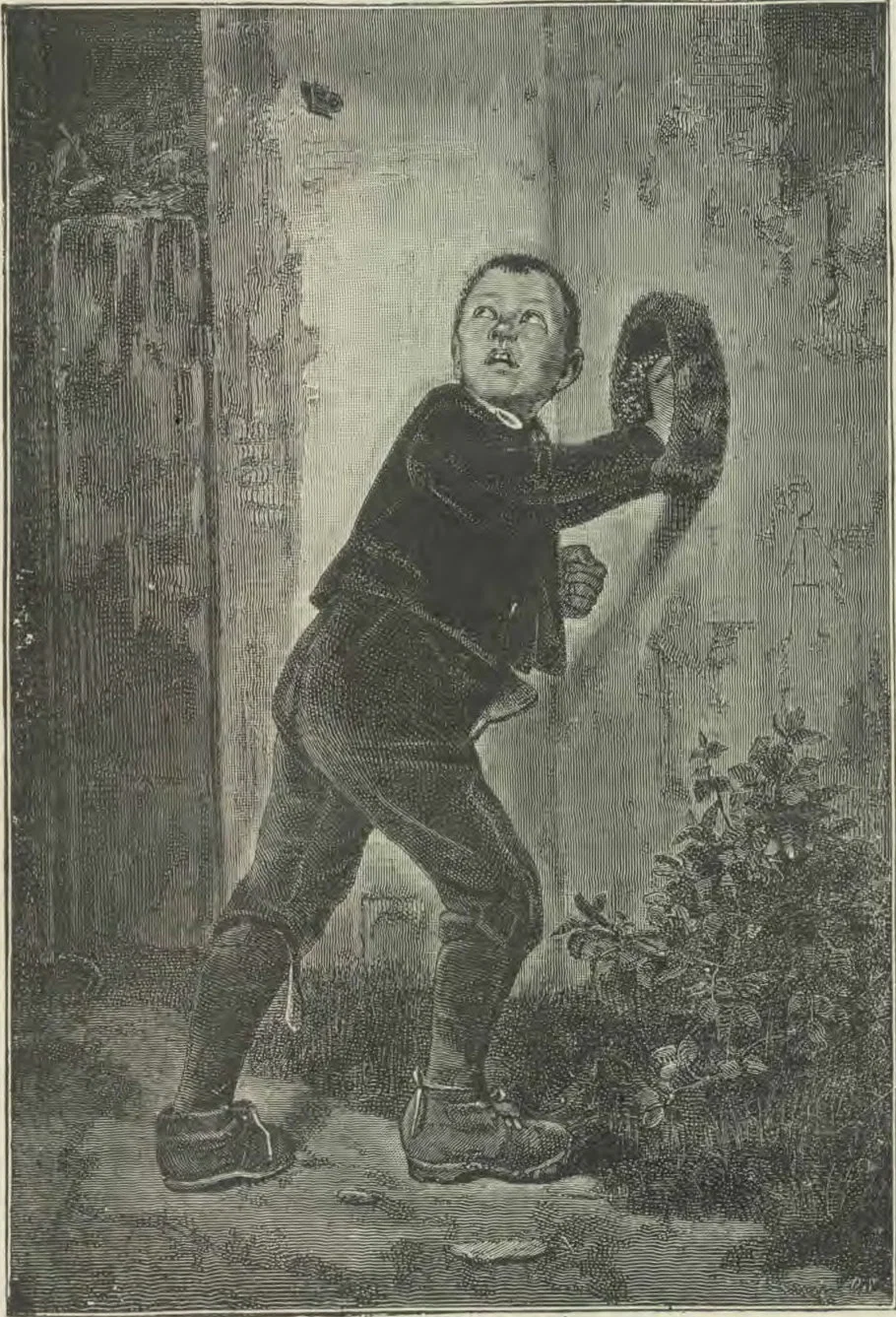
BEAUTIFUL butterfly! wait till I catch you.
Stay but a moment there, poised on the wing;
There's never another, I know, that can match you,—
A bit of the rainbow lost from the string
That threads its bright colors.
Oh, do not flutter by,
Beautiful butterfly,
In my collection I'll shrine you as king!
Impertinent school-boy! I've serious objection
To sporting myself a mark for your aim;
And as for a monarchy in your collection,
I have no ambition for post-mortem fame.
Men may die to win honors.
But life is too new,
Sunshine, pollen, and dew,
Too sweet, for me to forego for a name.
S. I. M.