WHILE scientific investigation has not discovered the real power operating in Spiritualism, the fact has been established that there is a more than human power at work. Trained scientists, skeptical concerning the reported miraculous working of mediums in the séance, have conducted rigid investigations, under circumstances which they claim preclude the possibility of deception. The following extracts from Mr. Gustavus Myers's article in the October number of Van Norden's Magazine give some of the results of their investigation of these phenomena:—
“Cases of automatic writing and talking are numerous enough to fill volumes. William T. Stead, the noted English journalist, asserts that he wrote that remarkable work, ‘Letters from Julia,’ automatically, and produces evidence to prove his claim. As for automatic talking, one of the most remarkable of the many modern examples is that of Laura Edmunds, a daughter of J. W. Edmunds, of New York City, who was for many years on the Supreme Court Bench. Judge Edmunds vouched for the fact that the only language she knew besides English was a school smattering of French. Yet when in a trance state, under the influence of her ‘controls,’ she spoke thirteen languages fluently, including Greek, Polish, Italian, and Indian. ‘This happened,’ says Judge Edmunds, ‘in the presence of eight or ten persons, all educated, intelligent, reasonable, and all as capable as any one of distinguishing between illusion and real fact.’”
“What Lodge and his circle of fellow distinguished scientists regard as a final, incontestable proof of the survival of the life principle and the human personality after death, is the fact publicly announced by him that they have succeeded in communicating with the spirits of Myers, Hodgson, and Edmund Gurney, and that these late terrestrial dwellers have supplied a repeated conclusive proof of their identity. Before he passed away, Myers left a sealed package in the hands of his associates. To eliminate all possibility of fraud on any question of telepathy, it was arranged that this message was to be transmitted in two parts through two mediums. It was to be done in such a manner that, while detached, they would not constitute an intelligible, coherent communication, yet, when joined together, they would form an explicit written message identical with that in the original manuscript. Lodge recently informed the British Society of Psychical Research that this has been accomplished through the mediums, Mrs. Verrall and Mrs. Piper.”
“In his notable work, ‘Miracles and Modern Spiritualism,’ Alfred Russell Wallace deals with various authenticated cases of apparitions. Three persons, driving along an English roadway, saw a woman's figure in white floating above a hedge. If it was a hallucination or a subjective vision on their part, Wallace asks, how was it that the horse suddenly stopped and shook with fright? Dogs have often been known to cower in a state of pitiable terror when apparently no cause existed. Wallace narrates a number of instances.”
“On one occasion, after Home had passed into a trance, Crookes tells, ‘a beautifully formed hand rose up from an opening in the dining-table and gave me a flower. . . . This occurred in the light of my own room while I was holding the medium's hands and feet.’ Crookes frequently saw phantom hands, and sometimes forms and faces. At times these materializations were solid and life-like; at other times they had the appearance of nebulous clouds condensed into corporeal forms.”
“Morselli groups the manifestations of materialization witnessed by him and his colleagues during thirty separate sittings into nine classes and thirty-nine varieties. At these séances, he says touching, feeling, and grasping by invisible hands form very common phenomena; the appearances are seen either in the dark, in a faint light, or a red light.
“‘They are really human hands,’ he goes on, ‘which touch, press, grasp, pull, push, pat lightly, strike, pull the sitters’ beards or hair, take off their spectacles, etc.’ Heads, arms, shoulders, and faces were frequently seen. This, it should be noted, is precisely the same set of phenomena noted long before by Wallace, Lodge, Crookes, and Zollner. Referring to the phantom hands, Morselli says: ‘On grasping them we felt the impression12of hands dissolving away, as if composed of semifluid substance.’”
“Appearances of forms were very numerous. ‘These forms,’ Morselli relates, ‘advance toward the sitters, touch and feel them, embrace, grasp, draw them nearer or push them away, caress and kiss them, with all the movements of living and real persons.’”
“One of the most amazing of the phenomena was the levitation of Eusapia Paladino together with her chair. The combined report of the assembled scientists says: ‘Suddenly Professors Morselli and Porro perceived that Eusapia had been raised along with her chair, and carried up to a level above that of the surface of the table, upon which she descended in such a way that her feet and the two front legs of the chair rested on the surface of the table, which was partially broken. Meanwhile the medium moaned as if intensely frightened, and asked to be put back with her chair on the floor. But almost instantly she was carried up again with the chair, and this levitation lasted for some seconds, so that M. de Albertis and Professor Porro, without preconcerted arrangement and with completely simultaneous thought, succeeded in passing their hands under the feet of the medium and of the chair. Shortly afterward, Eusapia, still seated, redescended onto the table; she was held by those to right and left of her; the chair was pushed or thrown down backward on the floor, and the medium, seized by several of those present, while still moaning, was carried to the floor and seated again in her place.’”
The spread of this great deception which is to gather the whole world into the vortex of ruin, was described by the servant of the Lord many years ago in the following words:—
“I saw the rapidity with which this delusion was spreading. A train of cars was shown me, going with the speed of lightning. The angel bade me look carefully. I fixed my eyes upon the train. It seemed that the whole world was on board. Then he showed me the conductor, a fair, stately person, whom all the passengers looked up to and reverenced. I was perplexed, and asked my attending angel who it was. Said he, ‘It is Satan. He is the conductor in the form of an angel of light. He has taken the world captive. They are given over to strong delusions, to believe a lie, that they may be damned. His agent, the highest in order next to him, is the engineer, and other of his agents are employed in different offices as he may need them, and they are all going with lightning speed to perdition.’”
It is time that the truth concerning the nature of man and his hope of immortality as revealed in the Word of God be everywhere made known, that they may be saved from this satanic deception.
Takoma Park, D. C.
Experiences and Observations in Africa
By Homer C. Olmsted
HOMER C. OLMSTED
DURING our voyage from London to Africa we often wondered whether any one would meet us at Cape Town. But our anxiety was unwarranted, for a number of brethren met us before we left the boat. Our hearts rejoiced because of the welcome they gave us during our few days’ stay with them. We thanked our Father for permitting us to come to this needy field, and renewed our determination to be faithful in his service.
In journeying northward, the sight of many small earthworks and blockhouses reminded us of the British-Boer war. Most of the way from the Cape to Bulawayo we traveled over a grassy plain, or table-land, with a few small bush scattered over it as we neared the latter place. This bush, as well as the grass, becomes taller and taller as one travels on, until around Victoria Falls there are small trees, and the coarse grass is often seven or more feet high. At nearly every station native children come to the train, to get bread or anything which may be thrown to them. Some sold bottles of milk, while others sold little wooden images of animals, which they had rudely carved from soft wood.
The seventh of June we reached the Barotse Mission, some two-hundred miles northeast of the Victoria Falls. There Brother W. H. Anderson met us, and after being given a room in his house, we felt that we were “home” at last. The farm there contains five thousand acres of good land, and is crossed by two streams, which contain large pools even during the dry season. Several large springs also furnish water for irrigation. The land is largely open, and is covered with tall grass, which supports about one hundred cattle and a few goats. These are quite profitable, as butter brings a fancy price. Indian corn, or “mealies,” as it is termed in Africa, is the principal crop, about seventy-five acres being planted last year. This, together with peanuts and sweet potatoes, furnishes food for the native students. The common vegetables of the States may be grown here, as well as many of the fruits. White ants are the great pest, and are the chief hindrance to successful agriculture.
About forty native boys are in attendance at the home school, and about as many others attend the three out-stations now in operation. The Batongas, among whom the mission is situated, are not a bright or progressive tribe. They are slow in movement, and slower in thought, yet they can comprehend the plan of salvation, and be saved through the merits of their Saviour, and our Saviour. Our work is to sow the seed, and even now it is bringing forth fruit.
Twelve days after reaching the mission, I was taken with fever, which, however, lasted but four days. This was repeated the following week, and continued to reappear, usually with increased severity, until the fifth attack, when it kept me in bed for nearly four weeks. This, coming as it did long before the “fever season,” began to convince Brother Anderson that I should not stay there, so he sent us back south as soon as I was strong enough to travel.
We were indeed sorry to leave him alone at the mission, and it was a sad parting as we left. But God knows best, and we were willing to give up our plans to him. This little experience did not discourage us in the least, for “we know that all things work together for good to them that love God.” The dear Lord was indeed good to us through it all, and never for a moment did he permit us to become discouraged. We were as confident that Africa was our appointed place as when we landed.
In returning, we stopped a few days at the Solusi Mission, near Bulawayo. There Brother and Sister J. R. Campbell, who came over with us, are assisting Brother M. C. Sturdevant in the work. They have charge of the school, and are doing well in their new home. All were busy and happy, with only words of courage, which the Spirit of God alone can give to his children.
As the fever left me quite weak, we stayed in Kimberley nearly a month, while I took light treatments. After partially regaining my strength we left Kimberley for Basutoland, October 5. Here, we are assisting Brother M. E. Emmerson in the work, and are only temporarily located. Being in the mountains, the elevation is nearly five thousand feet, the nights are cool, and the climate is quite healthful. Nearly every fruit and grain of temperate climates does well here. The little sixteen-acre mission farm, leased of the Basutos, has a few varieties of these. Lacking the means to build and equip a school, the work must be carried forward by means of public meetings in the villages, by canvassing, and by personal work. We are sure God has some precious souls among this bright, progressive race.
Being young, to the young people I would say: Put all your trust in God. Ask him to help you prepare for service in winning souls for eternity. Never complain of your lot, but do each day what you can for the Master, and as soon as you are fitted for a broader field, be sure there is a place waiting for you. We need means and workers. God is calling for both.
Kolo Mission, Basutoland.
Make Me Usable
“DON’T pray, ‘Lord, use me;’ God is using you to the utmost of his power; pray rather, ‘Lord, make me usable.’”
The Mahrattas of India
By GEO. F. ENOCH
GEO. F. ENOCH
The Western Ghats of India were the cradle of the Mahratta race. These mountains brought forth a hardy people of Aryan descent, who gradually grew in strength until, in the seventeenth century, one Sivaji, a mountain chieftain, cunning and crafty, with a genius for sovereignty, converted the shepherds and cultivators of the Konkan, into loose but organized armies of horsemen. The empire built from this foundation always had its proper dominion in the country indicated by the three great fortresses, Poona, Satara, Kolhapur. From these centers great clouds of Mahratta horsemen spread in every direction the terror of the Mahratta name. At one time the territory from Bombay on the west to the borders of Bengal on the east, from Gujarat and Malwa on the north to Mysore on the south, acknowledged the sovereignty of the Mahratta empire, and to it paid tribute. The Mahrattas have been well called the Parthians of India. At one time they dictated a humiliating treaty to the English, but finally, about 1818, they were completely overthrown by England, and their territory became a part of the British dominions. At the present time the Mahrati-speaking people occupy the territory, roughly speaking, from Surat on the northwest to Nagpur in the Central Provinces on the east, and from thence running in an irregular line to the southwest across the Nizams, of Hyderabad territory, to Goa, the Portuguese colony on the southwest. Within this territory are about nineteen million Mahrati-speaking people.
The Mahrati is an Aryan language, but the territory in which it is spoken is bounded on the south and east by Canarese and Telegu, two Dravidian languages, which have had some influence on it. It is an analytical language, and is said to be the most difficult of the Aryan languages of India. It is a language of grammatical gender, and the verb in the indicative mode has fourteen tenses. A man and a woman speak differently when speaking of the same thing, as pronouns, adjectives, and verbs must all agree with the speaker in both gender and number. Then, as there are no definite general rules by which one can distinguish the gender of a noun, his first attempts to speak cause great bewilderment on the part of the listeners, to whom the proper genders of nouns come naturally. The other day the little daughter of a missionary, born in the country, came running to her mother and said, “Mama, Mr. —— [a beginner] spoke to the nurse just like she was a man.” Mahrati is a bright, vivid, and picturesque language, with a literature, chiefly poetry, running back several centuries. The parent language is Sanskrit, which can not be called a dead language, even now, since it is the daily vehicle of religious thought for living millions.
I have said so much concerning these facts to help our people grasp the idea that India is not one nation, but a group of nations, each with its separate history, and that it is not a country speaking a variety of dialects, but a country of many languages, each with its own literature and history.
A REPRESENTATIVE MAHRATTA
By way of comparison, take the population of all the territory in the United States, west of the Mississippi River, and you will have but two million more than speak the Mahrati language. If you leave out of this reckoning the population of the Southwestern Union Conference, and substitute in its place the population of the Western Canadian Union Conference, you have two million less. Take away from the great majority of these millions their Bibles, their churches, their schools, their centuries of Christian influence, then, perhaps, you will get a faint glimpse of what faces, at the present time, one lone family representing the third angel’s message in this territory.
I most earnestly urge the readers of this article to think again over these facts,—lest we forget, and congratulate ourselves overmuch on the present showing of our denomination in the regions beyond. While attending camp-meetings in the above-mentioned territory in the States, I well remember the plea of conference officers concerning the paucity of their laborers. I would not speak lightly of this real need; but when I think of the comparatively small territory of each conference, of its hundreds of believers, and scores of strong young people, and well-equipped corps of conference laborers, besides a common language and a people with Bibles, schools, and churches; then from that vision turn to the burden of the nineteen million Mahrati-speaking people, with their strange tongue, without Christ, and for the most part in the darkest heathenism, my heart longs for our dear people to see this as it is, and share the burden with us. I am now writing of but one of the many nations of India. When we, in the same way, look out beyond India, to China, Africa, and the islands of the sea, not to mention the Catholic countries, our mind is able, in a small measure, to grasp something of the tremendous task still before us. Surely we can all see that we are now doing but a fraction of the work required of us in the regions beyond.
Your missionaries out in the dark lands feel this most keenly. Put yourself in the place of one family, the only representative of the message among nineteen million people; imagine the long, hard study required before being able to speak to the people, and a longer time still to understand their character and disposition; think of the trying climate, where cholera and plague, not to mention other diseases, are continually sweeping away many all around you, and the conditions under which you work are constantly making large drafts on your vital powers; then ask yourself the question, Is it right, in the midst of all this, to risk so much by having but one family in each of these great nations to represent the solemn responsibilities that are ours through the third angel’s message? Those who stand under these burdens give the negative answer in a most positive way. If after a few years, when one is just getting hold of the work, the health breaks, or the life is laid down under the heavy burden, and no one has been associated with the lone worker, years of labor are lost, and no one can be found who can take up the burden where it is laid down. It, therefore, seems reasonable to us in the field, to plead for companies of strong young men and women, representing the evangelical, educational, and medical branches of our work in each of these great languages of heathenism. We plead that they be sent out hastily, ere the powers from beneath gain such advantage that the work will be a hundredfold more difficult.
To do this our Mission Board must have its resources increased manyfold; for even now it is taxed to support the solitary lamps being lighted among these heathen nations. But our faith is large. We believe that the time has now come for this people to enter the heathen lands. We believe that there is now in preparation an army of young people, who will allow nothing to turn them aside from carrying the banner of Jehovah to earth’s dark corners. We believe that our people are getting ready to put their all upon the altar, so that companies of young people may be planted in the midst of these nations. And when our people have placed their all upon the altar, and it is not sufficient, then, we believe, the wealth of the Gentiles will come to us, that the work may be finished.
And from such a vision, with the prayer that the human co-operation required14on the part of God’s people for its fulfilment, may not be neglected by them through indifference or carelessness, we turn again to our great task, and the heavy burdens awaiting us, and take them up in Jesus’ name with renewed strength and courage.
Poona, India.
In Rumania
By H. F. SCHUBERTH
H. F. SCHUBERTH
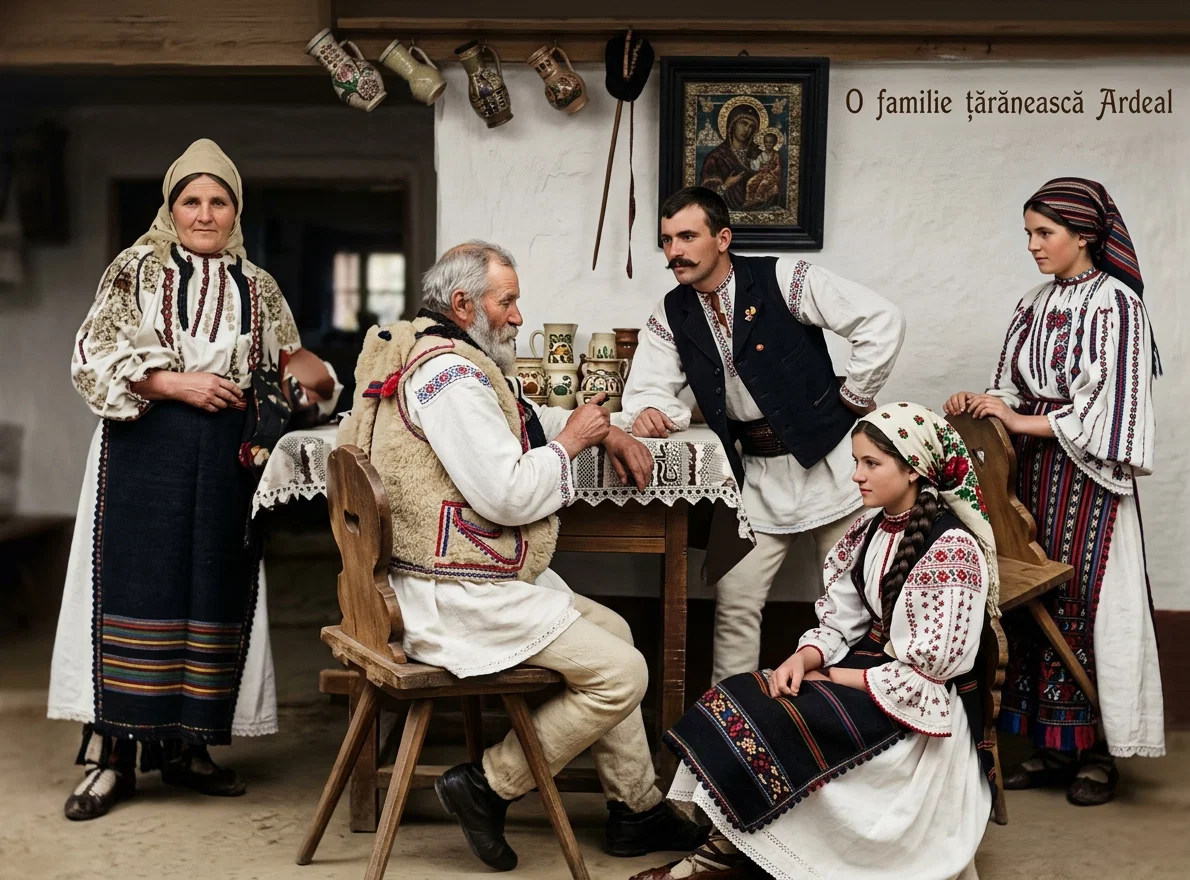
The kingdom of Rumania contains one hundred thirty-one thousand square kilometers, or an area about equal to that of New York State. It is a good mission field, ripe for the harvest. Its population is six million seven hundred thousand. About five and a half million of these are Rumanians, three hundred thousand Jews, one hundred thousand Gypsies, one hundred thousand Bulgarians, one hundred eight thousand originally from Austria and Hungary (Germans, Hungarians, Czechen, Croatians, Ruthenians, Slovakians, Slavonians, etc.), and a number of Turks, Greeks, Russians, French, Italians, Swiss, Servians, and Germans from Germany proper. The larger number of the people profess the Greek Catholic religion. About one hundred twenty thousand are Roman Catholics, and several thousand are Protestants.
A RUMANIAN FARMER FAMILY
There are twenty-four cities ranging from ten to one hundred thousand inhabitants. Bucharest, the capital, is a large modern city, containing three hundred thousand people. Its streets are clean, well paved, and lighted by gas or electricity. There are new streets containing fine public buildings, and large, comfortable dwellings. The city is not closely packed, but is about as large in extent as Vienna, furnishing, on an average, two thousand square feet of space for each inhabitant.
Our church in this city has one hundred six members, representing eleven nationalities — Rumanians, Armenians, Ruthenians, Croatians, Bulgarians, Greeks, Bohemians, Slovakians, Hungarians, Russians, and Germans; hence it is a living demonstration of the power of the gospel message to unite all nationalities in the bond of brotherly love and unity, in Christ Jesus.
Our conference, which was held here in Bucharest, October 28 to November 1, was a season of blessing. We were especially glad to learn that some of our brethren are to engage in the circulation of our publications, of which we have but a few, including our monthly Rumanian paper, Sennele Timpului. Although the law allows us no advertising in the papers, yet the evening lectures were well attended. During the past year thirty-four persons were baptized. The tithe amounted to six thousand six hundred francs. The interest is good, and there are prospects of continued growth. But we need a new and better place for our meetings in Bucharest — the “miniature Paris of the Orient.” We believe the Lord will help us in securing this. Lately the rents have so increased in Bucharest that it is impossible to find a suitable hall at a price within our reach.
Aside from the believers here, we have a church of twenty-three members in Constantza, and some scattered members in Ploesti and Sinaia. Although the established church attempts to prevent the increase of knowledge in this small land, still Rumania is the most promising field in the Balkan States. Calls come from various cities, and Brother J. F. Hinter and J. Mantu have all they can do, while Brother O. Janert, who is studying the Rumanian language, labors among the Germans who have come into this land from Russia.
Brother Hinter was again elected director of the Balkan Mission. Besides the writer, Brother J. F. Huenergardt, of Hungary, was present to help in the meetings.
In this land “the harvest truly is great, but the laborers are few: pray ye therefore the Lord of the harvest, that he would send forth laborers into his harvest.”
Hamburg, Germany.
The Lord’s Providence
By L. R. CONRADI
L. R. CONRADI
WHEN we appointed a general meeting at Beirut for the Levant Union Mission field, to be held September 24-29, we did not dream of the wonderful changes to occur within the few months intervening. At first we expected to see only our American and European workers; but the sudden, quiet change in the Turkish empire made it also possible for our Armenian workers to attend. As our boat entered the port, Elder W. C. Ising came on board; and as we stepped ashore, Brethren Z. G. Baharian, A. Buzugherian, and E. Ayvazian greeted us. No passport was demanded of any, no bakshish was necessary to pass our luggage. As Elder Ising had secured a roomy dwelling at a reasonable rate,—the first location of the American University many years ago,—we had ample room to hold our meetings. All boarded there, and a number of us even lodged there. Brother Hausmann, who conducts a private treatment-room, provided rooms for a number.
Elder C. D. AcMoody was present from Nicomedia, Elder Greaves from Smyrna, Elder Baharian from Aintab, Brethren Buzugherian and Ayvazian from Tarsus and Aleppo, Brother Krug from Jerusalem, Sister Muller from Caifa; Elder A. Abd-Elshaheed from Luxor, Egypt; Brother Keough from Cairo; Sister Brefin and Brother Scholz, lately from Germany, to be located at Joppa and Beirut; and Brother P. N. Lindegren had come all the way from Abyssinia. This was indeed a Levant Union Mission meeting, including representatives from the Bulgarian border to India and Ethiopia, covering parts of Europe, Asia, and Africa.
Our daily program was two Bible studies, two council meetings, and in the evening a sermon or field report.
The Levant field has had rather a hard experience for some years. Some of the promising workers have died, or have had to withdraw from the work on account of ill health; some appointed to the field were called to other important positions; one of the workers apostatized; while in the Turkish empire our native workers were greatly hindered by the government. This meeting marks a brighter era also for this great field; for the encouraging reports of the older workers and the addition of new workers warrants this.
One of our first resolutions was a unanimous expression of gratitude to God, as well as of thanks to the Turkish government and the sultan, for the great change wrought. Then we laid careful plans for the distribution of our workers and the future direction of the work. As Elder AcMoody had never visited the hundred Sabbath-keepers in the southern portion of Asia Minor, it was decided that he, in company with Elder Baharian, should spend about three months in this region, then Elder Baharian should accompany him back to Constantinople, and labor there till summer, while Elder Buzugherian looks after the work in the south. Elder Greaves is getting the work established at Smyrna, and will, with some native workers, press the battle there. We have now three ordained ministers and five Bible workers in European Turkey and Asia Minor, who have to divide their attention between Turks, Armenians, and Greeks. Prof. W. E. Howell will continue his work at Athens.
As to Syria and Egypt, where the Arabic is the chief language, Elder Ising looks after the work there. Brother Scholz follows up the interest at Beirut, and is to study the Arabic. Sister Muller15continues her medical missionary work at Caifa. Sister Brefin goes to Joppa, and Brother Krug and Sister Merkle return to Jerusalem. Some are becoming interested in different parts of Syria. Elder Ising accompanied us to Egypt, to become acquainted with the situation there. Brother Keough locates at Cairo, to labor and study the Arabic. Elder Abd-Elshaheed will cast out the gospel net in Upper Egypt.
Special attention was given to the issuing of new publications, and to the establishment of a depository. Our investigations revealed the fact that, while Beirut is favorably located for a depository, some of the printing would have to be done at Constantinople, especially in the Greek and Armenian languages. The Hamburg Publishing House was invited to establish a branch here at an early date, and provide a suitable person to take charge of it.
The Sabbath was a good day for all the workers. In the afternoon they and the members participated in the ordinances, and the testimonies in the social meeting acknowledged God’s goodness. Much to our regret, Brother Lindegren contracted a severe cold, and we had to leave, September 29, without him. The French liner was so crowded with emigrants that we could hardly secure a place even on deck; and when we reached Port Said the next day, it took hours for the doctors to inspect the crew and the passengers. It was a disappointment to Miss Larsen, the prospective bride of Brother Lindegren, who had arrived from Hamburg with Sister Rohde the day previous, that we came without him. But as their boat for Massaua was not due until October 10, we hope that Brother Lindegren was sufficiently recovered to come. We made all arrangements to meet emergencies.
Our company of laborers spent one forenoon to great profit in looking over the fine campus, school building, hospitals, dormitories, museum, and observatory of the American College at Beirut. Over eight hundred bright young people from all portions of the Levant receive their education here. They have a strong medical department, and their nurses’ training class this year numbers fifty. Their aged ex-president, about eighty-two years old, told us, as we parted, that the wisest step of his life was taken when he resigned, leaving the mantle to drop on his son.
When we consider that this Levant field numbers sixty million people, and realize that our work is barely begun and organized, that large regions have never been entered, that publications are sadly needed in all the different languages, and that God’s providence has so suddenly opened a vast field before us; we feel constrained to call out, ‘Come over . . . and help us.’
Hamburg, Germany.
The Work Among the Jews
By F. C. Gilbert
THE work among these people is attended with many perplexities and obstacles. During the twenty years of our experience in Christian work we can truly say there is no branch of the work that we can compare to this work. It really is without any parallel, because of the attitude of the Jews toward Christianity.
But despite all the hard problems, despite all the trying experiences, we know that God is able to soften the heart of the Jew, and lead him to find Jesus. We can see that where we are sowing the seed, and where we are coming in contact with the Jews, the Holy Spirit is softening their hearts, and they are beginning to regard the gospel we preach in a different light.
Even before we closed the mission in the quarters we occupied in Boston the early part of this year, the Jews were discriminating between us and other Christians. We were known as the Sabbath-keeping Christians, while they called the others the Sunday Christians. At first, it was hard for the Jews to believe that we really kept the Sabbath; but when the truth dawns upon their minds, they begin to see that they are the Gentiles, and we are the Jews. We are sure that these experiences have their effect, and the Holy Spirit will use them to the glory of God.
Many of the Jews who accepted the truth passed through very severe and trying experiences. Some of them suffered hunger. We felt that we ought to have a place of refuge for such persons. The Lord opened the way for us to secure such a place in the old historic town of Concord, Mass. Since the place was opened, we have had over twenty Jews, including children, and we believe that it was a wise thing to secure just such a place.
We have a place of eighty acres, fifty of which are tillable. We have made some improvements, and a number of others ought to be made. We are praying for means for this purpose.
This fall we started a church-school, and at the present time we have seven Jews in the school. I suppose this is the first Jewish Christian school of this kind in the country. The progress these children and young people are making is truly remarkable. The Holy Spirit has come into the school, and hearts have yielded to him. As they learn about the truth, they come to love it as their fathers did in days of old; and we believe, as the Testimonies have said, that many Jews will yet yield to Christ.
At the present time, we have eight in the Home. The assistant matron, Sister Anna Vanderbilt, a Jewess, is doing an excellent work for those whom she has in charge.
A few weeks ago we opened a new mission in another section of Boston, within two blocks of about forty thousand Jews. We have been holding many open-air meetings with them, and they now receive us very cordially. We have an attendance of many hundreds at each meeting, and we can see the workings of the Holy Spirit. We are more and more convinced that this open-air work among the Jews will yet accomplish great good.
The outlook at the new mission quarters is quite encouraging, but we desire to enlarge our borders, and reach many thousands more. We trust our people everywhere will do what they can to give their Jewish friends and neighbors tracts, New Testaments, and other literature. Any wishing a supply should send to Good Tidings Home, Concord, Mass., and they will receive literature for the Jews. Do this, and we know the Lord will bless you.
We are also in need of assistance to finish the work at the Home in Concord. If the Holy Spirit impresses you to assist in this work, please send any remittance for that purpose to H. B. Tucker, Secretary Central New England Conference, stating that it is for the Home for Poor Jews. Pray for the peace of Jerusalem, for “they shall prosper that love thee.” F. C. GILBERT.
Costa Rica
By H. LOUIE MIGNOTT
The evening of March 16, I began a series of meetings at Siquirres, assisted by the members of the young people's society of the Pacuarito church. Siquirres is three miles distant from Pacuarito, and is a growing inland town. Having neither tent nor hall at this place, we had to hold our meetings in the open air; and sometimes in the midst of a discourse, a shower would disperse our audience. Often, on account of inclement weather, we had to retrace our steps without holding a meeting. But neither the rains nor the rough ways discouraged us. We were determined to bring the knowledge of the truth to the residents of that town. The Lord soon opened the way for us by touching the heart of the overseer of a sawmill, who, seeing our difficulty in holding meetings in the open air, gave us permission to hold our lectures in the mill. There, almost every evening for three months, we continued our studies with the people. At the expiration of that time two dear souls were buried with their Lord in baptism. Since then four have begun to walk in all the commandments of God. To him be the praise and the glory. In the month of June eight persons were baptized at Pacuarito. At the present time, one new convert at this place, and four at Siquirres, are preparing for baptism. These will make a considerable addition to the church.
August 9 I began laboring at Puerto Limon. In order to bring the message more forcibly before the inhabitants of this city, the conference has rented a room on Fifth Avenida. In this hall we have started a series of lectures, preaching almost every night. The room is inadequate to accommodate the people, and is crowded almost every night. Being small, it is uncomfortable, especially16in such a warm climate. This is but one of the many places in this country where a tent is a great necessity. If we had one, a goodly number of people would always gather to listen to the last message. We have laid plans to obtain a tent, but as our brethren are mostly poor, it will be some time before they can raise sufficient means to buy one. In many towns there is no possibility of renting a hall in which to hold meetings, and frequently the rains will not permit the open-air services.
At the present time, November 11, there are sixteen who desire baptism, and we hope that several others will soon decide to keep all the commandments of God, and the faith of Jesus.
From August 9 to October 3 I have made four hundred fifty-four missionary visits, held ninety-six Bible readings, and preached ninety-three sermons. During his spare time, Brother E. N. Rogers is helping me in the work. We hope soon to see a strong church at this place.
H. LOUIE MIGNOTT.
Infanticide in China
At least two hundred thousand babies are brutally killed, in various ways, every year in China, to get them out of the way.