CANTON.—Owing to some hindering circumstances, our quarterly meeting in Canton was one week late this fall. As heretofore, all the brethren and sisters from both Fat Shan and Kongmoon met with us. Only one church thus far has been organized in this province, and for that reason we all come together at these quarterly occasions. After Sabbath-school, and a good sermon by Dr. Law in the forenoon, we gathered at three o'clock in the afternoon for the celebration of the ordinances of the church. Thirty-four took part, and the service was spiritual, and very helpful to us all. As is the case in all our Sabbath meetings, only a few non-Christians were present. Our chapel is large enough to seat all our church-members and our inquirers, but that is all; so we do not allow people from the street in our Sabbath meetings. In this connection I may be allowed to add that a new chapel, built and owned by ourselves, is very much needed in Canton.
On the following day, Sunday, it was our privilege to celebrate the ordinance of baptism. A large house-boat, with a capacity sufficient to carry all who wished to go, was secured for about one dollar. These boats are furnished much as a house is, and afford about the same protection and comfort. Thus embarked, we sang hymns as the tide carried us down the river about two miles to the place of baptism. It was an inspiring service, and a helpful object-lesson to all those who witnessed the five young men and one young woman follow the example of the Lord. This rite, like all the other ordinances of our Saviour, solemnly and eloquently sets forth the great truth of the gospel, and leaves its lessons upon the hearts and minds of all who witness it, whether in China or in whatever part of the world, it was a blessed day for us, and we all felt that God witnessed to the service.
Three of these young men were from Fat Shan, the first-fruits from that city, the young woman was from the Bethel Girls' School, while the other two young men were from our Bible school. Several of these give promise of becoming workers in this cause, and so being the means of gathering still others. Counting the five that have been added from Chao Chow Fu, this makes eleven added to our numbers in this province thus far this year. We feel deeply grateful to the Lord for all his workings, and pray that these souls may be steadfast in the truth.
J. N. ANDERSON.
Japan
By W. D. BURDEN
THE town of Fukushima is about two hundred miles north of Tokyo. All the way up from Tokyo we passed through rice-fields. In fact, all over Japan the chief business of the farmer is growing rice. It is the principal food of the Japanese; and when it is lacking, they are as greatly troubled as are Americans when the bread gives out.
The Japanese are very thrifty farmers. No weeds are allowed to grow among the grain. The ground is laid out in small, irregularly shaped patches, and the grain is sowed in rows; so a farm presents a very pleasing appearance.
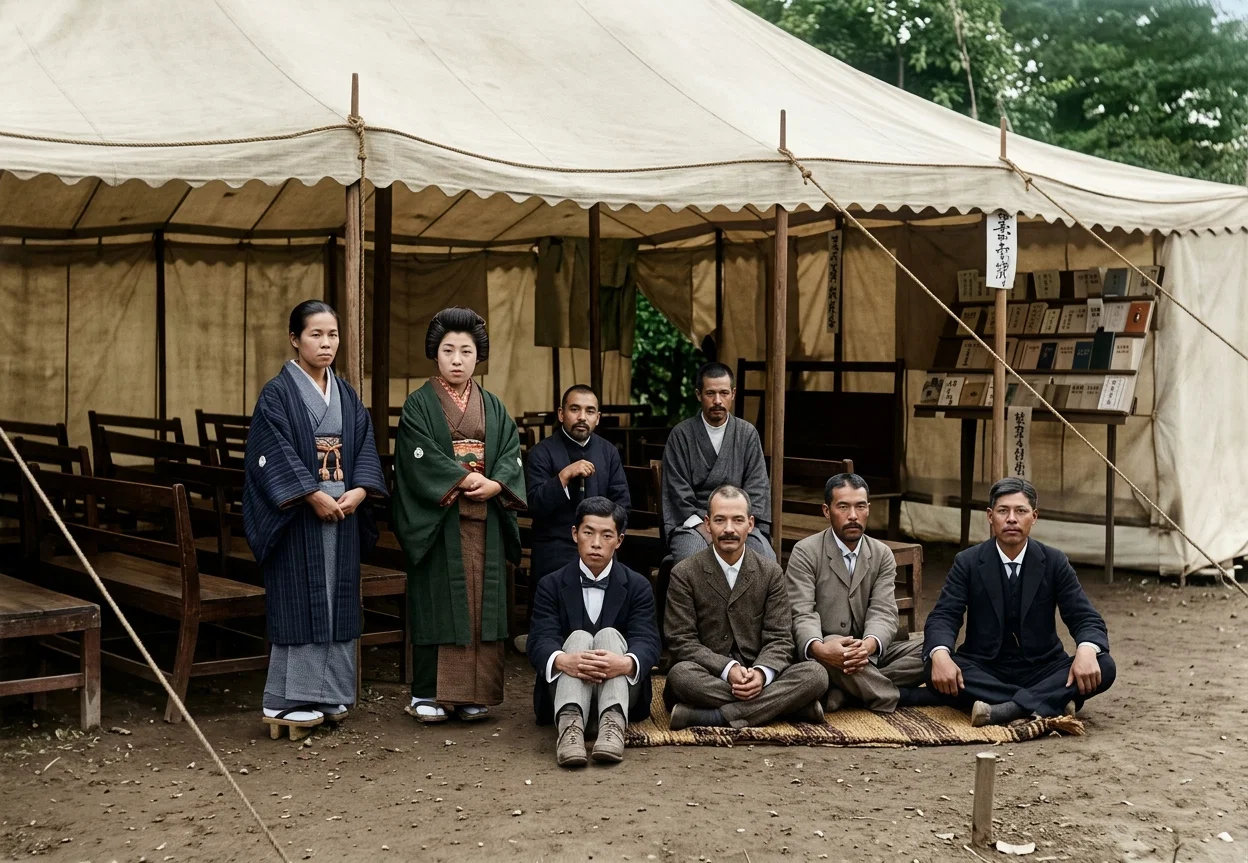
WORKERS AT THE TENT-MEETING IN FUKUSHIMA
As we go north, the broad plain surrounding Tokyo becomes divided into several valleys. The one we follow gradually narrows till at Fukushima it is not more than two miles wide. For several months past some of our Japanese workers have been busy distributing our literature in this place. September 15 we pitched our tent and began meetings. For two weeks we had an average attendance of about seventy-five, then the weather turned cold and rainy, so we were not surprised when the attendance became smaller.
We found some interesting cases during our stay there. One man, who received a small Testament thirty years ago, but was unable to understand it, and yet was impressed that there was something in it for him, came to the meetings. He seemed anxious to understand the book which he had kept so long. He was faithful in attendance, and we left him rejoicing in the truth. Surely God has gone out before us in this section of the country.
There were but four who professed conversion during the meetings, but we secured the names of several interested persons, and Brother Watanabe, who still remains at Fukushima, will continue to work for them. We hope yet to see a strong company raised up there.
One young woman who arose for prayers said she was reading her Bible at home, but had to read it when no one knew; and she could attend meetings only when her parents did not know it, for they hated Christianity.
Another young woman, though always present and listening with deep interest, was very timid, and always sat in the rear of the tent. One other was too timid to enter the tent, but would stay on the outside and listen. Our workers who stood at the door to welcome the people tried to persuade her to come inside, but under no consideration would she enter; yet the questions she asked showed that she was studying her Bible faithfully. She said she would not dare let it be known that she was attending a Christian meeting. May God bless these poor souls, and give them strength to step out on the side of right, even if they have to do so in the face of opposition.
One night toward the close of the meetings, we had a dreadful rain-storm. No one but our workers came, and we were not surprised. We decided to have a prayer-meeting, but the rain was falling so hard that we could scarcely hear one another pray. By and by we were surprised to hear voices in the back of the tent, and on arising were still more astonished to find that two women had entered. They had come from quite a distance. We invited them forward, and had a Bible study on the saints' reward. The Lord blessed by the presence of his Spirit, so that not only they, but we also, were greatly refreshed, and they became constant attendants at our services, and are still studying.
We have long been hoping and praying to see a deeper moving of the Spirit of God in our work, and we are thankful for the evidences that God is now setting his hand to finish this work speedily.
After the Fukushima meeting we spent a few days visiting and encouraging the scattered believers in the surrounding country; then on our way back to Tokyo we had special meetings with the Wakamatsu17church for three days.
The brethren had announced our coming. The house was well filled every night. The presence of God's Spirit was quite manifest, and we trust the words spoken will be treasured by some. We learned that some had come several miles. When asked how it happened, they said that some of their friends who attended the previous evening told them what good meetings we were having, so they, too, had come. One night a local pastor said to us at the close of the meeting, “You are having good meetings, aren’t you? I don’t understand it. We can not get the people to come out this way, even when we advertise the coming of some prominent worker.”
We were sorry we could not remain longer here, but Elder I. H. Evans was in Tokyo waiting our return, so we had to leave the interest to be followed up by the local members. We are thankful for the evidence of God's presence in the work, and we wish to be faithful in the discharge of our duties.
W. D. BURDEN.
Cuba
By E. W. Snyder
It is now about three years since I arrived in this field to begin the work of giving the message to the Cuban people. At first the work went slow, and we can not say it has gone rapidly at any time, but we have seen evidences of the providence of God, and now a good foundation is laid.
During the year ending November 1, thirteen Cubans have been baptized. Altogether, we have baptized fifteen, all of whom, with three exceptions, are faithful to the truth, and in their lives are giving a good testimony. In fact, the numerical feature is not so much a cause for encouragement as are the zeal and missionary spirit manifested in the lives of those who have accepted the message. The first convert, a barber by profession, supports himself by working three days of the week, devoting the rest of his time to the sale of our Spanish papers. Some two hundred fifty of these are being used each month, and we can say that all the interests we are now finding are due to this work. A sister from the native Presbyterian Church, baptized at our last quarterly meeting, is also devoting each Sunday to the periodical work, and is much encouraged by her experience. It was at her own suggestion that she began this work.
One circumstance will serve to illustrate the character of the fruit the truth is bearing in the lives of the Cubans. Unexpectedly the sum of fifty-five dollars came into the possession of a brother here, whereupon he at once began to pay all his little debts, some of which had been standing for years. In this way he gave a good testimony for the truth.
Up to the present, our work has been largely limited to the district between Havana and Marianao, and meetings are being conducted at four different places, in private houses. We were obliged to close all our public meeting-places, and at present the mission is not paying a cent of rent for such purposes. This has worked somewhat to the detriment of the interest, and we trust that the Lord will soon send us the means to place the work on a different basis in this respect.
As a rule, the Cuban people are improvident and given to spendthrift habits, this being true of both the high and the low, the rich and the poor. Of home life the common Cuban knows nothing in the sense that an American enjoys home life, and outside of the time spent in eating and sleeping, he is found at the corner café eating and gambling. This place is also the rendezvous where business matters are talked over. Our Cuban brethren, instead of spending their time and money at these places as formerly, now take delight in attending the meetings, and are liberal in paying their tithes and offerings. Notwithstanding the unprecedented hard times the past year, a few have paid over one hundred thirty dollars tithe, more than thirty dollars of this amount being paid by one brother. Our people here are all poor, and although it is true that some of our brethren from the north are moving here, their income will be very small for some time to come, and their tithe little more than a negligible factor in the work.
In addition to the work in and around Havana, we are glad to say that our three self-supporting mission schools are doing a good work, and exerting an influence for the truth. These schools are located as follows: at San Cristobal, directed by Brother and Sister S. H. Carnahan; at Minas, directed by Brother Guy Holmes; at Nuevitas, by Brother Calvin Kinsman. The spirit of sacrifice manifested by our educational workers is greatly appreciated.
Colporteur work, followed with Bible work and public meetings, seems to give the best immediate results. House-to-house work is indispensable; for the Cuban people, owing to fear and superstition, will not go out at night to a strange place, although they may repeatedly be invited to do so. Their acquaintance must first be made in the home, and their confidence gained, and when once interested, they will be faithful attendants at the meetings.
Good American brethren are greatly needed to settle in every province of Cuba, where they may make homes for colporteurs. With the work of the colporteur well established, we are satisfied that believers would spring up in all parts of this fair land. It is true that not much could be promised in the way of immediate profit or gain in the things of the world, and we would advise that all who are looking to this feature alone would better remain away from Cuba, as they will most likely be disappointed, and leave, as some have already done. There is room for any one to labor here who is not too far along in years to get a working knowledge of the Spanish. No elderly person, dependent wholly on himself, unless he is a person of independent means, should come to Cuba, as it will not be easy for him to adapt himself to the great change. As yet we have only touched the field with the tips of the fingers as it were, and the needs are great. Since the brother whose house has served us for a mission headquarters has returned to the States, it seems imperative that arrangements be made for permanent headquarters.
Owing to the high rents and the scarcity of houses, we are at present obliged to occupy a place that in no sense represents the character of the great message we are giving to the people. We are praying that the Lord may provide means that proper headquarters may be secured.
However, a greater need is that of a laborer for eastern Cuba, where there is one organized church, and where several Cuban Sabbath-keepers await baptism. The journey from Havana, of nearly five hundred miles, is an expensive one, and we have been able to visit that section but once this year. How much longer must the work in that part suffer for the lack of means and a laborer?
Brethren, we trust that you will pray for the work in Cuba, and pray that the Lord may lay the burden of these souls now in superstition and dense darkness on the hearts of those who will come here and make it their life-work to give the message to this people. There is room for all who will come with this object. Who will respond? We shall be glad to correspond with all who have this burden. Address us at Apartado 35, Marianao, Cuba. E. W. SNYDER.
Michigan
By P. G. Stanley
KALAMAZOO.—We are glad to report that the work of the third angel's message is onward in this city. Since taking the pastorate of the church here, the Lord has greatly blessed us in our work, and a goodly number of precious souls have been added to the church, both by baptism and by letter. Our congregation has increased, backsliders have been reclaimed, and sinners converted.
For years our congregation here has been in great need of a more suitable place of worship, to which they could invite those not of our faith. In taking up the work here, the Lord laid it upon our heart to repair the old, dilapidated house of worship, and transform it into an inviting sanctuary, a fitting memorial for the truth in this place. Between five and six hundred dollars has been spent in the work of repairing the18church, nearly all of which has been given by our congregation. In addition to this, a loan, which the congregation has been carrying, has been paid, and the church as it now stands is free from all encumbrance, and is ready for dedication.
Our dedicatory services will take place December 19, the last Sabbath of the week of prayer. Elder A. G. Haughey, president of the conference, with other ministers of the conference, will be present to participate in the exercises. An interesting program has been prepared, and all our isolated and scattered members are invited to be present, also those of near-by churches are invited to come and enjoy the services with us.
P. G. STANLEY.
An Appeal for Workers
By C. F. Parmele
“Resort ye thither unto us,” was the word from Nehemiah to his brethren when their enemies had planned to “cause the work to cease.” Another great work is now being carried on, and unity of action in the closing gospel message is even more imperative than then.
In many of the older conferences the work of placing present truth in the homes of the people is so nearly accomplished that hardly one has not some of our printed matter. Indeed our State has for its aim this present season, “the truth to every home in our State this year.”
We have a most needy field in Tennessee. When one worker here meets another, the conversation quickly turns on how the events occurring about us show that the time for work in our State is short. And yet we have an abundance of unworked territory in which are honest souls, hungry for the truth. Our plea for help is inspired by the sense of danger that souls will be lost if we delay longer to visit the unentered homes all about us. We are to have a canvassers’ institute, beginning January 28. Who will engage in this work? Let us hear from you. Address me at Madison, Tenn.
C. F. PARMELE,
Canvassing Agent.
The Rock City Sanitarium
By D. E. Blake
DOUBTLESS those who knew of the proposed establishment of a sanitarium for the colored people, in Nashville, Tenn., have been watching the columns of the REVIEW for some definite information in reference to it.
Five-rooms are being added to our present building, for bath- and treatment-rooms, which we hope will be finished in about a week; then a few days' plumbing will complete our preparations for regular work. The prospect is encouraging, and we have every reason to believe that the institution will accomplish the purposes for which it was established.
One of the chief reasons for establishing a sanitarium for the colored people, in Nashville, as recommended by the spirit of prophecy, is the opportunity which the city affords of placing the truth before the many students who come here every year to attend the educational institutions for the colored. This we are to do by getting acquainted with the leaders of these institutions, and calling their attention to our work, securing, if possible, their interest and co-operation. We can then visit their institutions and lecture to the students, and invite them to visit our sanitarium.
To this end the Lord has been working even before we came to the city. Last summer the dean of one of these colleges visited two of our sanitariums, and the impressions made upon his mind caused him to become deeply interested in us and our work. In an interview with him recently, he told me that he felt obligated to us for the courteous treatment given him at our sanitariums. He has been taking treatments at the Nashville Sanitarium, and expresses his appreciation of them. This gentleman has kindly consented to my putting copies of our denominational papers in the reading-rooms of the college. This is an excellent opportunity for placing the silent messengers within reach of nearly five hundred students and teachers. Let us improve it.
Will not our brethren of the publishing associations assist us in placing some of our publications in this important institution? As there are several departments, we could use six copies of our weekly periodicals each week, and the same number of monthlies. Life and Health would be especially appropriate, as there is a medical department connected with this institution. It would also be a good thing if our people would subscribe for copies of our papers, and send them to the teachers. The subscriptions might be for six months, and at their expiration, perhaps the teachers would renew them. I would be glad to correspond with any one who would like to assist in this way.
We have not reached the position in our work where we can say that we have no need of financial assistance. We are poor, and we recognize this keenly, too, and ask for your continued interest in us.
The Southern Missionary Society, in addition to its other important and expensive lines of work, has assumed the responsibilities of the sanitarium. The society's zeal, however, exceeds its financial strength, and more than once within the past six months, it has come near “breaking down” under its weight of obligations. There is still danger of this mishap, unless some who are able will offer their assistance. I doubt if it will be able to stand alone, as its financial strength goes as fast as it is received, to help the almost helpless work among the colored people.
Many have responded liberally to the calls for help in this work in the past, and we trust they will continue the good work. We heartily appreciate what has been done. The Lord takes account of these gifts also.
We need one or two trained lady nurses immediately, to connect with our sanitarium work, and we invite correspondence with any one who would like to connect with our institution. Applicants must be thoroughly consecrated, and willing to work for the upbuilding of the cause of truth, with small wages. Our post-office address is 316 Foster St., Nashville, Tenn.
We have also decided to start a small class in nursing, and would be glad to correspond with consecrated young men and women who are interested in this kind of work.
Having something definite of which to write in connection with our sanitarium, we shall henceforward report as regularly as our work will permit. We solicit an interest in your prayers for the success of our sanitarium.
D. E. BLAKE.
Vermont
By H. J. FARMAN
EAST CONCORD, CONCORD, AND ST. JOHNSBURY.—Since camp-meeting it has been my privilege to witness the marvelous workings of the Holy Spirit among the people. At first I was given the free use of the Methodist Episcopal church; but as soon as the Sabbath was mentioned, I was notified to get another place. I then secured the schoolhouse, but as the interest increased, and a few began obeying God, I was notified that I could no longer use the schoolhouse.
For a time it seemed that our company would have to move their services outside of the village, but through the kindness of a family whose sympathy was aroused, we were given the use of a room which was suitably fitted up for holding services. Our Sabbath-school now numbers from twelve to seventeen members, and all interested in the study of the lessons.
Nearly all are taking part in the Thanksgiving offerings, either giving or soliciting. Some very excellent and helpful experiences have been gained.
Last Sabbath a praise service was held. One sister whose home cares prevented her from doing outside work, solicited contributions toward the Thanksgiving fund from those who came into her home. She also sent papers to friends for the same purpose, and received $8.15. She still has four of her twelve papers to dispose of.
Another sister met with marked success in visiting the business section of St. Johnsbury, where more than three hundred papers have been used. Over twenty-five dollars has been raised, and about three hundred papers are yet to be heard from.
This is a glorious work, and will doubtless develop many good canvassers and Bible workers. Why not continue this work until New-year’s, and put into the homes of the people one million or more of these good papers? Personally, I have enjoyed much of the blessing of God in this work, and purpose to do more of it.
In Concord I have given a course of Bible studies on the leading points of our faith to more than thirty persons who have attended regularly. So far as additions to our numbers are concerned, we have as yet nothing to report. We have met with about the same opposition as at East Concord. This, however, is much to be preferred to a “dead calm.” More than fifty have signed the petition against religious legislation. Every advance step awakens a deeper interest. Pray for the work and workers. H. J. FARMAN.
After Thirty-Eight Years
By G. G. Rupert
In 1870, through the sacrifice of Brother Theodore Emmons, who sold the little stack of wheat that he had raised for his own use, to pay the expenses of a minister, Elder I. D. Van Horn came to Mendon, Ohio, to preach present truth. At that time I was twenty-two years old, and through curiosity I attended the meetings, which were held in a schoolhouse in the woods. Prior to this I had united with the Methodist Church, but I had no light on many Bible subjects. At the first meeting I heard an exposition of the second chapter of Daniel. This was interesting to me, and on my arrival home I told my brother and his family the wonderful things I had heard. This caused them to attend these meetings, and my sister-in-law soon began to keep the Sabbath. During the meetings I received a love for the truth which has never left me.
I was married the following spring, and went into business. Six years later, by my invitation, Elder H. A. St. John came to Van Wert, Ohio, and held tent-meetings. In his company were Elders E. H. Gates, R. A. Underwood, and H. S. Guilford, who is now sleeping. Elders Underwood and Gates are among the standard-bearers in the message to-day. One year from this time I was in the work of the ministry.
At the time of these meetings, I was a contractor, employing about thirty men and teams, paving the main street of Van Wert. But during the years of investigation, I had counted the cost, and was now ready to act. The cost proved dear enough financially; but my wife was with me in the truth, and this, with the strong hope in a soon-coming Lord, was sufficient to bear me up through all my difficulties. The Bible was my only help and source of comfort.19Day and night my wife and I studied it; and with the knowledge we received of its teaching came the burden to tell others the wonderful things we found in it. I asked for some tracts to be sent me from Battle Creek, and with these I started out without 'purse' or 'scrip.'
I visited a family of Sabbath-keepers in the forests of Paulding County, and there made my first effort to speak in public. After this I went to another place, and was able to give twelve discourses. At this place I saw my first fruit; and from this time on through the summer I worked through the day harvesting and following the thrasher, and preached at night. In the fall I was invited to attend the camp-meeting, and was given a ministerial license; and in an address by Brother J. H. Waggoner, now sleeping, we were promised two or three dollars a week for our labor.
Courage and perseverance bore their fruit, and the Lord blessed my efforts, and those who accepted the truth during these efforts are workers in the field to-day. Since then I have visited many of the States, South America, and some of the West India Islands. My field of labor is now in Oklahoma. At present, however, I am in Ohio, where I first began my work, in response to an earnest request to labor among old acquaintances and friends and relatives. Prejudice long existing has been broken down by time and continued effort, and the way is open to gather some more sheaves for the heavenly garner from this locality. Three precious souls have taken their stand for the truth, and two of them will soon be baptized.
I have had the pleasure of visiting the first Adventists I ever knew, Brother Theodore Emmons and wife, aged respectively eighty-seven and sixty-five years. I also visited Sisters Elizabeth Taylor, Lyda Stripe, Amie Van Enoms, and Brother and Sister Watts. These aged pilgrims have passed through trials and conflicts, which no doubt have tried their souls, but the truth is still precious to them, and they are looking forward to the fulfilment of their hopes when the conflict is over, and God's children are gathered home. Let us pray that our faith fail not.
G. G. RUPERT.
West Africa
By D. C. BABCOCK
SEPTEMBER 1, I left Freetown to visit Cape Coast and other places along the Gold Coast. We reached Cape Coast on the Sabbath, just as the sun was setting, September 5, and were soon carried ashore by small boats. Brother C. A. Ackah met me about eight o'clock that same evening, and Brother J. D. Hayford came early next morning. We spent most of the day in counsel, considering the needs of the cause on the Gold Coast. Brother Ackah has been carrying on school work in Cape Coast the past year, and has had some very interesting experiences.
On Monday morning fourteen young men, from eight different tribes, came to talk over the educational work. We spent several hours together, and personally it was a great blessing to my own soul.
Who can doubt that we are on the very verge of eternity, when we see the Spirit of God working in the hearts of these young men, representing eight different languages, and all coming at one time to make a plea for training, that they may carry this last message to their heathen homes? Can we say no to them, and thus deny our Saviour?
It was most interesting to note how each one's attention had been called to Brother Ackah's school at Cape Coast. I was especially impressed with one young man who had influenced several to attend the school. He was from the Ashanti tribe, one of the most hostile tribes in West Africa. The Lord has surely used him.
Just recently I received a good letter from these young men, reminding me of their earnest desire to come soon and prepare for the work. To bring them to Freetown and give them a fitting-up for the work of the Lord, means an outlay of means. To bring, say, ten of them to Freetown will cost about one hundred fifty dollars. Then they must be cared for.
On account of the quarantine against the bubonic plague, I was unable to meet the company at Kickman. Brother Ackah gives a very encouraging report of the work at that place. Thirty-four have taken their stand for the Sabbath and kindred truths. Brother Hayford writes me that another young man, a schoolmaster from the Wesleyans, has accepted the message, and will probably enter the school work at Kickman.
As the steamer on which I took passage was a freight boat, I landed at Sekondi, and had a good visit with Brother Grant and family. September 10 I sailed from Sekondi, for Sierra Leone. On Monday morning we landed at Freetown, and found all well.
Mrs. French and Mrs. Babcock are caring for the school, while Professor French and myself are looking after the new school building and church matters in Freetown. The Lord is abundantly blessing in the work.
Sabbath and Sunday, September 26, 27, Mrs. Babcock and I spent at Waterloo. There was a full attendance of our people, and some not of our faith were also present. We celebrated the ordinances of the Lord's house, and it was a time of refreshing. We met in an “upper room.” We learned afterward that many persons were outside, listening, and went away deeply impressed.
The company at Waterloo is gaining a deep experience, and the Lord is blessing the efforts of Brother C. E. F. Thompson.
October 3, 4, the quarterly meeting services were held with the Freetown church. Never can this meeting be forgotten. The attendance was the largest we have ever had on the Sabbath, and yet all our people were not permitted to attend. More than forty took part in the social meeting, and thirty-five participated in the ordinances. Among those in attendance at this meeting were two that accepted the message at Aberdeen, where Brother and Sister R. P. Dauphin are working. Another interesting case is that of a young man who has charge of a mission two hundred fifty miles in the hinterland. His mother is a member of our church, and in the month of June he made a visit home. She was very anxious about him, and prayed earnestly that he might see the truth. Her prayers were answered. He came and spent several hours with me, and returned to his field under deep conviction. Just recently his mother received a good letter, saying he had already begun keeping the Sabbath, and others were with him. He will resign his present position January 1, and cast his lot with this message. He has a good education, and speaks the Mendi language, and with a few months' training will be ready for the work.
Several are preparing for baptism in the near future. Surely God's Spirit is going out before his people. While we have many perplexities, yet our courage is good, and we are preparing for the finishing of the work in West Africa.
D. C. BABCOCK.
Emmanuel Children’s Home
By Mrs. Jessie Ames
As we receive many inquiries about the Emmanuel Children’s Home, at Mountain Grove, Mo., and can not take time to write personal letters to each inquirer, we will take this method of briefly reporting to all.
The prospects for the Home have never been better than at the present time. We have fifteen children, thirteen of whom are in school. Their ages run from six to thirteen years, and grades from primary to sixth. We have our own church-school, and sewing is taught in school in a practical way, the older ones mending their own clothes, as well as doing other plain sewing, and some fancy work. The fancy work is taught out of school hours. The boys do plain sewing, but not fancy work. Their “fancy work” consists of scroll sawing evenings.
This winter we are giving the girls instruction in housekeeping, two working for a week at one kind of work, then changing; for instance, two clean tables, sweep dining-room, halls, stairways, and porches; another two wash and dry the dishes and put them away; and another two care for the sleeping-rooms. Then each Sunday they take turns at getting dinner, and so are learning to cook. In20this way they are taught all the different branches of housekeeping. Breakfast is at half-past six, and by school time, nine o’clock, the house is all in order, and the children are ready for school.
The boys are divided into companies also, and thus far are keeping both furnace and range supplied with wood. They work before and after school, and play at recesses—and how they do work and play! They seldom dally about their work, for all know that when they have finished a certain amount, and have done it well, their time is their own as long as they make proper use of it. All who are old enough are taught to bear responsibility, and they thus learn to take a just pride in their work, and a healthier, rosier company of children would be hard to find.
The Lord has given us most excellent helpers, who take an interest in the children’s welfare, and we are a very happy family.
We have a Sabbath-school of eighteen members in the Home, and the review from week to week tells of lessons well learned. We ask your earnest prayers that the lessons taught to the children while in the Home may be of such a nature that the Lord can bless them, and that these children, who come to us for a time, and then go again, may be as lights to shine for Jesus. The Lord truly is blessing our efforts, and to him be all the praise and glory.
MRS. JESSIE AMES.
Washington, D. C.
By K. C. RUSSELL.
DURING the past summer two tent efforts were conducted in the city of Washington,—one in Georgetown, a suburb of Washington, by Brethren O. F. Butcher and A. N. Allen; and the other in Anacostia, another suburb, by Brethren J. A. Strickland and W. S. Connolly. A number accepted the truth as the result of these efforts. Our Bible workers have also been meeting with success. They find little prejudice, and there are those who are anxious to know more about the work of Seventh-day Adventists.
Regular Sunday evening services are being conducted in the Memorial church, corner Twelfth and M Streets, by Elder J. E. Shultz, the pastor, assisted by some of our ministers here. We would suggest that any of our people who have friends or acquaintances in Washington, write to them, urging them to attend these meetings, which are increasing in attendance and deepening in interest.
Our church-school in Takoma Park employs three regular teachers, and has an enrollment this year of about seventy students.
We are planning to carry on a vigorous campaign this winter against the passage of the Johnston Sunday bill. We shall begin this effort after the Thanksgiving Ingathering campaign is over.
K. C. RUSSELL.