The Youth’s Instructor, Vol. 66, No. 10.

Nursemaids in Japan and Mothers' Care of Babies
Earlier text: To the Top of Old Gray Back

The Testimonies Reading Course

CAN any one who desires take the Testimonies Reading Course?
Yes. There is no age limit. The course is for all who desire a deeper Christian experience, and who long to become more efficient soul-winners.
How shall I enroll in this course?
Send your name and address to your conference Missionary Volunteer secretary, and tell him you desire to join the Testimonies Reading Course.
How long will it take me to finish the course?
You will have to answer this question yourself; however, the Department recommends that you complete it in two years. If you will read eight to ten pages every day of the week except Sabbath, you will complete the nine volumes (now published in four) in two years. Should you fall behind some week you could catch up on Sabbath. Many who enroll will probably finish the course in one year.
Is there an outline which I must follow in this reading course?
No, there is no outline. You are merely asked to sit down with the Testimonies and let them talk to you. These precious volumes contain much help for you, and you can ill afford to delay getting it.
Can you not give me a few suggestions for getting the most out of this course?
Begin today. Allow time on your daily program for this reading. Read carefully and prayerfully. Pray before you read and pray while you read. Pray that you may get definite help from each day's reading. Read with a desire to obey. Have a notebook and pen with the volume you are reading. Mark especially good passages, and in your notebook jot down these special thoughts briefly, giving the reference each time. I have a friend who has just such a notebook, and she finds it indispensable. She often refers to it, and never has to turn many leaves until she finds the help she seeks.
I suggest that you have a loose-leaf notebook, and arrange your quotations under topics. Then when you finish, you will have all your selections on the same subject together. All on prayer will be under “Prayer” in one place; all on criticism under “Criticism” in another place; etc. Such a quotation book will be a key to the list—a key that you will know just how to use; and it will be of inestimable value to you in your work.
I have not a complete set of the Testimonies. Where can I get them?
Order them from your tract society. You can now get the Testimonies (all nine) bound in four beautiful volumes. The four volumes, in cloth, cost $8; in limp leather, $12.
But how will taking this course help me to be a stronger Christian?
Let me ask you a question. Do you know of one person who diligently studies the Testimonies, in order to live in harmony with them, that is drifting away from God and the church? Is this not all the recommendation they need? There is only one better recommendation for you, and that is to study these volumes prayerfully for yourself, that they may help you, as they have helped others, to be true to God and his Word.
O that all our young people years ago had made friends of these precious books! I verily believe that if we all had studied them as we should our Missionary Volunteers would today be ready to “set the world on fire.” M. E.

Our Counsel Corner

Now that so many of our young men have gone into the army, do you not think that a girl would be warranted in marrying a good, upright, moral young man not of our faith? L. R.
Statistics to date for the Allied armies show that only one in thirty is killed; two in one hundred wounded. Now, girls, cannot at least twenty-nine out of thirty of you wait until the war is over? It would be very disappointing to the young men to come home from the service of their country, where they have risked their lives to preserve you and democracy in the world, and find you all married.
Think of the position in which you will place our soldier boys, if you marry outside the faith. There will be none of you left when they return; so what will that compel the young men to do? W. H. ANDERSON.
“Those who profess the truth trample on the will of God in marrying unbelievers; they lose his favor, and make bitter work for repentance. The unbelieving may possess an excellent moral character; but the fact that he or she has not answered to the claims of God, and has neglected so great salvation, is sufficient reason why such a union should not be consummated.” If our young people will take the teachings of the Bible and of the Spirit of prophecy as a guide in deciding the question of matrimony, they cannot be in doubt as to the right course to pursue. Read Volume IV, pages 503-508. E. A. I.
How often should the weekly Missionary Volunteer Society offering go to foreign missions? P. S.
An offering for foreign missions should be taken at each first, second, and third meeting of the month (the fourth meeting—and fifth when there is one—is left open for offerings for local society work). Before taking the offering, always state whether it is to be used for home or foreign missions. One gives more intelligently and often more liberally if he knows for what object he is giving. M. E. K.
What books would you recommend for supplementary reading at the daily devotional hour? K. C.
To those who have never read Sister White’s works covering the Old and New Testament periods, I would recommend “Patriarchs and Prophets;” “The Story of Prophets and Kings;” “The Desire of Ages;” “Thoughts from the Mount of Blessing;” “Steps to Christ;” “Christ’s Object Lessons;” “The Acts of the Apostles;” and “The Great Controversy.” To those who have read these books and desire outside devotional books, I would recommend J. R. Miller’s works; Moody’s Red Library Series; Myers’s Sketches of Bible Characters; Gordon’s Quiet Talks; and Torrey’s and Alexander’s Personal Service Booklets. These are but a few of the many good books that would make splendid supplementary reading in connection with Bible study. C. S. LONGACRE.

Be Not Too Busy With Thy Work

“Be not too busy with thy work and care To look to God, to clasp thy hand in his; Miss thou all else, but fail not thou in this. Thou needst not all alone thy burdens bear; Listen and wait, obey and learn his will, His love and service all thy life shall fill.”

When Mary Visited the Junior Meeting

It was a snowy Wednesday morning. Mary rubbed her eyes sleepily as the clock struck eight, then turned over for just one more little nap. My, how cozy the bed felt this cold winter morning, and how she dreaded to get up!
“Mary Louise,” called her grandmother from the foot of the stairs, “isn’t this the morning you were to visit the Junior society at the church school? Better hurry up, or you’ll be late.”
Mary jumped out of bed in a hurry. She had promised Dorothy Wentworth that she would surely be at the school by ten minutes of nine. There was no time to lose; she mustn’t miss that Junior meeting for anything, for she had told the girls back home in Medford that while away on this visit to grandmother’s, she would find out all she could about Junior societies and tell them when she returned home. “Maybe we can improve our own society by hearing what other folks are doing,” Myrtle Eastman had remarked.
The clock was just striking the hour as Mary, arm in arm with Dorothy, entered the schoolroom. The teacher directed her to a seat, and then called the roll. “I don’t need to tell you that this is the morning for our Junior meeting,” she said, pleasantly, as she laid aside her daily school register. “We will proceed as usual, Ernest.” Then she went to the back of the room and took a seat, just as if she were one of the girls.
Ernest Graham, the leader of the society, was a boy of about thirteen. He went forward, and opening his Bible to Psalm 34:7, read, in a clear voice, “The angel of the Lord encampeth round about them that fear him, and delivereth them.” Then he told how one of our missionaries, W. H. Anderson, had once proved how true this verse is. While in Africa, he and his wife were sleeping on the ground one night, during a long journey which they were making through the country, when he was awakened suddenly by some of the natives who were accompanying them. He arose to find out what the trouble was, and upon investigation discovered that a lion, who with his companion had followed their wagon at some distance during the day, had come to within a few feet of where the missionaries were sleeping. In the sand were the prints of his two feet planted close together as if he had been ready for a spring. But “the angel of the Lord,” which “encampeth round about them that fear him,” had protected God’s servants, and the footprints showed where the wild beast had turned and slipped away.
“Now shall we sing that song, ‘The angel of the Lord encampeth,’ No. 529?” said the leader, when he had finished the story. And you can imagine how earnestly every one sang!
One of the older boys, Mearle Rathbun, had been previously asked to lead in prayer; so he was prepared to respond readily when called upon. It was so still you could have heard a pin drop, as all bowed reverently while he asked God to bless the meeting. He spoke so that all could hear just what he said.
The secretary gave the nicest report of their last Junior meeting. Everybody listened very carefully, because it was so interesting. Then followed reports of work done by the different bands. Some members of the Christian Help Band had been carrying water for a family who had the measles; others had been chopping wood for a poor widow. Two of the girls had done housework for a lady who was unable to work, on account of chronic illness. The one in charge of the Literature Band told how the members had written twenty-five letters and sent out fifty-three papers, besides giving away seventy-five tracts and selling fifteen copies of the Watchman.
The leader said there would be time for other band work to be reported at their next meeting, and called next for the Bible reading, which was given by a boy of twelve. You should have seen how quickly every one found the texts. Nobody knew when his turn would come to read, so every one was alert and ready to be called upon at any moment. Mary thought it was just fine to see how familiar every one seemed to be with the Bible.
A recitation was given by one of the youngest girls. She had been well drilled, for she didn’t make a single mistake — though she did act just the tiniest bit scared.
A three-minute talk on current missions, called “From the Regions Beyond,” was good, too. Then came the critic’s report. Mary had never heard of such a thing, and she waited with ears wide open to hear what was coming.
“Mr. President and fellow students,” said the little critic, stepping to the front of the room, “I was pleased to note that the society sang with the spirit. Those who took part were well prepared, and showed that they had given thought and prayer to their subjects. I should like to suggest that it would be well always to locate on the map any places mentioned in any talks given. I observed the following errors in speech: ‘Don’t’ was used where ‘doesn’t’ was the correct word; ‘seen’ was used for the verb ‘saw;’ and ‘library’ was incorrectly pronounced ‘libary.’”
“Isn’t that a good idea,” thought Mary, as she listened. “I do believe the children in our society would do better if they had a critic’s report each week.”
The offering was taken up by two little boys who were too small to take very much part on the program; and would you believe it? every child there had at least a nickel to put into the basket, and some had more. Mary learned later that nearly every one earned his own offering.
The secretary gave each member three tracts and two papers to give out during the week. Then she called the name of each one, asking for his individual missionary report, which she recorded in her “Memoranda of Attendance and Work.”
“I heard that there was a very poor family living down near the railroad, who were badly in need of clothes,” said the leader, “and I should like to ask the Christian Help Band to look into the matter this week and see what we can do to help. I also wish to call a meeting of the executive committee after school today, to talk over further plans for the society work.”
My, but Mary was learning! Wasn’t that a fine idea to have a committee meeting, and really plan things! “I must tell the girls about that,” was her mental comment.
A bright, cheery song was sung at the close of the Junior meeting; then all stood with bowed heads while they repeated the Junior Missionary Volunteer Pledge: “Loving the Lord Jesus, I promise to take an active part in the work of the Junior Missionary Volunteer Society, doing what I can to help others and to finish the work of the gospel in all the world.”
The meeting had lasted nearly forty-five minutes, but it was so interesting that it didn’t seem more than half that time.
“O grandmother,” said Mary, when she came in at dinner time, “it was the best meeting! I’m going to sit down and write it all out,—what they did, you know, and especially how they did it. I don’t want to forget one single point. I believe we shall have a better Junior meeting back home after this, for I mean to tell the girls everything.” E. I.

XI — Lot Brought Out of Sodom

(March 16)
LESSON SCRIPTURE: Gen. 19: 1-29.
MEMORY VERSE: “Where your treasure is, there will your heart be also.” Matt. 6: 21.
STUDY HELPS: “Patriarchs and Prophets,” pp. 156-170; “Bible Lessons,” McKibbin, Book One, p. 79.
“The warning was spoken; the righteous had gone, And the proud ones of Sodom were feasting alone; All gay was the banquet; the revel was long, With the pouring of wine and the breathing of song.”
“Hark! the growl of the thunder—the quaking of earth! Woe, woe to the worship, and woe to the mirth! The black sky was opened,—there’s flame in the air,— The red arm of vengeance is lifted and bare!”
“Down—down on the fallen the red ruin rained, And the reveler sank with his wine cup undrained; The foot of the dancer, the music’s loud thrill, And the shout and the laughter grew suddenly still.”

Questions

  1. What do scholars tell us concerning the location of Sodom and Gomorrah? Note 1.
  2. Who came to Sodom one evening? How did Lot greet these strangers who he thought were men? Gen. 19: 1.
  3. What invitation did Lot give to them? How did they reply? Verse 2.
  4. What did Lot continue to urge? What did the strangers finally do? Verse 3. Note 2.
  5. How did the men of Sodom show disrespect for Lot’s guests? Verses 4, 5.
  6. When Lot went out to reason with them, how did they treat him? How was Lot protected? Verses 9-11.
  7. What message did the angels then give to Lot? Verses 12, 13.
  8. What did Lot then endeavor to do? How did he seem to his sons-in-law? Verse 14. Note 3.
  9. In the early morning what commands did the angels give? Verse 15.
  10. What became necessary for the angels to do? Verse 16.
  11. When they were out of the city, what command was given? Verse 17.
  12. For what privilege did Lot then plead? Verses 18-20.
  13. What did the angel say concerning this? What did he still urge Lot to do? Verses 21, 22.
  14. As soon as Lot entered Zoar, what did the Lord do? What became of Lot’s wife? Verses 23-26. Note 4.
  15. What did Abraham see in the morning as he looked toward the cities? For whose sake did the Lord spare Lot? Verses 27-29.
  16. When will the experience of this lesson be repeated? What are we told to remember? Luke 17: 28-30, 32.

Can You Imagine

Why Lot “lingered” when the angels were trying to hasten his escape? Why Lot’s sons-in-law “mocked” at his solemn message? Why Lot’s wife looked back? Why Abraham should come out early in the morning to look down the valley?

What to Do While Waiting

As the months and years go by while we are waiting for the coming of Jesus, each day should mark improvement in our condition spiritually and physically. And if perchance the time passes all too rapidly to suit the convenience of him who has multitudinous duties to perform while waiting, he too should be on the alert to perfect a character free from all blemish. His prayers and efforts should be in the direction of the manifestation of more patience with his fellows and less of petulance and severity with servants and other inferiors.
To have overcome the spirit of criticism and fault-finding is a mark of improvement of character, and one which adds greatly to the happiness of associates.
To exercise more mercy and sympathy for others, and less of commiseration for self, will be pleasing to the angels and give the Holy Spirit opportunity effectually to influence the life.
Greater economy in the use of means for self, which might be used for the advancement of the kingdom of the Redeemer, will not narrow but tend to broaden the sphere of usefulness, aside from the direct benefit the means will be to the missionary work.
Numerous small duties and privileges are constantly coming to us, and it is a wise person who attends to them all. They are what make up the sum of human life. He who does only the great things which claim his attention signally fails of doing all that he might do.
MRS. D. A. FITCH.

Be Noble: Verse on Nobleness in Others

Be noble! and the nobleness which lies In other men, sleeping but never dead, Will rise in majesty to meet thine own; Then wilt thou see it gleam in many eyes; Then will pure light around thy path be shed, And thou wilt never more be sad and lone. — Lowell.

Punctuality and Regularity

The smallest division of time has to its credit the making or unmaking of worlds, men, fortunes, and nations. The Giver of time has sought to impress upon us the relation we should sustain to time by the unerring timepieces that he has placed in his created things. The stars run their appointed course and return to their starting-point on the second, after a course of six thousand years. The sun and moon keep to their heaven-appointed schedule. The birds go south or return north year after year at about the same time, or perhaps on the same day of the month. The trees bud and blossom at their appointed time. Seedtime and harvest have been set by the Maker of the world, so we sow in the spring and reap in the fall. Even the blossom of the meadow closes its eyes as the shadow on the dial nears the four-o’clock mark, or the time of sunset. The snows come, the ice melts, the grass grows, the storms roar, the lightnings flash, and thunders roll at their appointed season. Serious tardiness or irregularity in these natural clocks would cause general disturbance and disaster.

God’s Way

Punctuality and regularity characterize God’s ways in spiritual as well as in physical matters. If he wants a eunuch instructed in the way of life, he gets word to a Philip in time for the two to meet at the crossroads. A moment’s delay and the mission is thwarted. If he wants a widow’s property restored to her by a selfish king, he times a conversation between the king and an acquaintance that awakens sympathetic interest in the widow, just as she mounts the palace steps to plead her cause before the king. If he sends his Son into the world to live and die for perishing men, he does it when the fulness of the time has come. When the judgment is set and the books are opened, his angel messenger sounds forth the word, “the hour of his judgment is come.” Probably there is no one here but has had personal experiences that show how God orders circumstances so that two events that must occur to produce a certain condition are timed exactly. This is the basis of our confidence in him who ruleth the worlds. If he sets his hand to a work he never fails to accomplish his purpose because of tardiness on his part to meet engagements.
For six thousand years by example and precept the Lord has endeavored to implant within fallen humanity a sense of time. Now is the time, he reiterates again and again. “Today is the day of salvation.”
Time is made up of minutes. There are 525,600 minutes in a year. Each minute brings to some men thousands of dollars, and to all, important opportunities. The Lackawanna Railroad built a twenty-two-mile cut-off that cost $14,000,000, in order to save twenty minutes in the running of express trains between New York City and Buffalo. To every one the minute has its money value as well as its educational and spiritual value. He who by delay and tardiness robs another of his minutes, robs him of money, knowledge, pleasure, or spiritual profit.

Time to Learn Promptness

Childhood and youth is the time to learn the value of one’s own minutes, as well as the value of another’s time. If teachers and parents fail to require a recognition of the value of minutes, there is small hope that the lesson will ever be learned. Parents with children possessing a reliable time-sense are to be congratulated, while parents with children habitually lacking the time-sense, children who are frequently tardy and absent from day school and Sabbath school, are subjects of profound pity; for it is a habit that is a sure precursor of general dilatoriness.
Persons without an appreciation of the importance of meeting engagements and obligations punctually cannot be trusted with responsibility. They fail at the critical moment. They are also a constant source of irritation to those who do value time.
Teachers who do not insist upon regularity and punctuality in school attendance do great injustice to the pupils, to themselves, and to others. They are also untrue to their trust as servants of those employing them. Parents who do not insist upon these two cardinal school virtues, and see that their children are prompt and regular in attendance, are losing a great opportunity in the proper training of their children, and add greatly to the teacher’s burden.
Good scholarship accompanies regularity and punctuality. The irregular pupil is usually, if not always, poor in scholarship. Punctuality is imperative if good returns from the school work is received. To the teacher tardy pupils are a discouragement, a perplexity, a burden. No teacher who has to contend with habitual tardiness can give pupils as good service. Children and youth should therefore be trained to see that habitual promptness in meeting life’s engagements has a monetary, social, and moral value of infinite worth as a success asset.
A Russian proverb says: “Time does not bow to you; you must bow to time.” This is one of the first lessons to be impressed upon children. Parents and teachers must work hand in hand to burn this idea into the brain tissue of the child. Says Rudyard Kipling:
“If you can fill the unforgiving minute With sixty seconds’ worth of distance run— Yours is the earth, and everything that’s in it.”
But to fill each “minute with sixty seconds’ worth of distance run,” one must be ready to improve the first second of the minute and not begin with the third or the fifteenth. One will not be prompt to answer the Lord’s call to service if one has not learned to meet promptly worldly obligations.

Each Heart Has Its Burden of Sorrow

Each heart has its burden of sorrow, Each soul has its shadow of doubt, 'Tis sunshine we're yearning to borrow— True sunshine within and without. — The Calendar of Sunshine.

Life Viewed as a Single Day

“LIFE at its longest is but like the looking back and reviewing of a single day.”
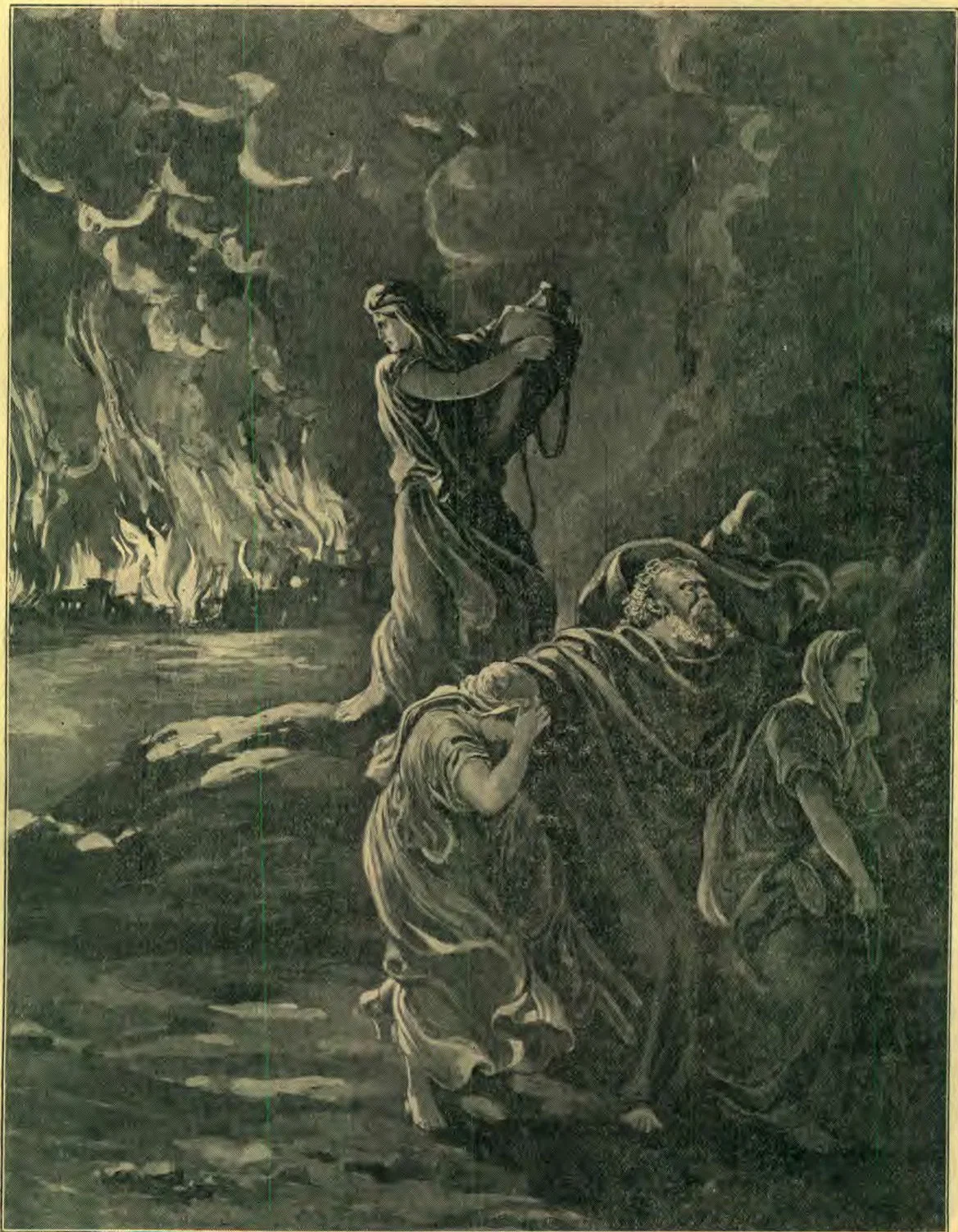
LOT FLEEING FROM SODOM

You have reached the end of this edition.

The Youth’s Instructor · Mar 5, 1918