The Youth’s Instructor, Vol. 66, No. 10.

Nursemaids in Japan and Mothers' Care of Babies

The Youth’s Instructor

Mar 5, 1918

Review and Herald Publishing Assn. · Takoma Park Station, Washington, D. C. · Mar 5, 1918

Nursemaids in Japan and Mothers' Care of Babies

There are no nursemaids in Japan, we are told. No matter how many servants there are, the nursing and care of the baby belong solely to the mother.
Earl Reading, Lord Chief Justice of England, has been appointed British High Commissioner to the United States. He will take over the work of the embassy and of the war mission.
Major C. J. Vincent shares with Major Hall the distinction of creating the famous liberty motor for airships that is expected to prove an important factor in winning the war for Uncle Sam. He declares the liberty motor the most powerful engine ever manufactured.
At an altitude of 3,000 feet the pilot of an aëroplane has from four to five miles' range of vision. A special telescope, with a stabilizing device, enables him to sleuth out camouflage, no matter how wily, and a remarkable pilot compass will guide him safely, even though he is out of sight of earth for several hours.
The British Cunard liner “Tuscania,” with 2,179 American troops on board bound for France, was torpedoed off the Irish coast on February 7. Latest reports show 160 soldiers unaccounted for. Most of the men on board were from Michigan and Wisconsin. The British admiralty reports fifteen other vessels sunk during the week.
The buffalo is not noted for sagacity, alertness, intelligence, or docility; in fact he is regarded as a rather stupid animal. Perhaps his size militates against his mental capabilities. However, a former United States marshal has spent five years in an effort to train a pair of buffaloes, and he has succeeded in training them to trot to wagon and do other unheard-of buffalo stunts. They have no liking for the saddle, yet they have been trained by Major Yokum to race with horses, and they can outdistance their competitors.
When Italy in 1911, during her war with Turkey, militarized the aëroplane, not even the bloodthirsty Ottomans lifted a scimitar against it, because they felt sure that Allah or a defaulting motor would do the business. Engine trouble has been practically overcome in the aëroplane. There is no record of any German aëroplane’s being forced to land within the enemy’s lines because of engine trouble. Nevertheless, the life of a war machine is only two weeks, even though 16,000 men in England are working night and day and Saturday afternoons to reduce the mortality rate.
The crow does eat corn and otherwise makes trouble. But he also follows the plow as closely as he dares, and is death on worms and destructive insects. “A remarkable example of how crows sometimes aid farmers was witnessed near Treesbank, Manitoba, in September, 1915. There was a destructive outbreak of army worms at this time, which, having eaten all the available vegetation in the close vicinity, were marching over a roadway in enormous numbers to attack a field of oats. Here it was that the crows found them, and soon caused a very appreciable reduction in their numbers. This flock of crows, which was estimated at 3,000, had previously been frequenting a locust-infested area, which they speedily forsook for the more palatable army worms. Apart from their value as destroyers of noxious insects, crows also kill mice and young rabbits.”
We make 40,000,000 tons of iron and steel, but one ton in every three is made out of scrap junk!—12,000,000 to 15,000,000 tons of it. About twenty-five per cent of all the scrap is produced by the railroads, and forty per cent by mills and factories in the form of pieces cut off from plates, billets, and rods, and borings and punchings. The other thirty-five per cent comes from the junkman proper; but even half of that is railroad and industrial scrap, leaving only fifteen to twenty per cent collected from farms and houses. You see the junk peddler going through your alley; but there are single waste trade companies doing a business of from $10,000,000 to $50,000,000 a year in scrap iron.

What Freezing Water Does

BOYS in the colder climates of our country are familiar with the fact that, when all the stones on an acre of ground have been cleared away during the summer and there follows a hard winter, there will appear a crop of new stones to contend with on that same acre. This is how it happens: there are rocks just underground that the plow passes over without touching. Below some of these rocks there will be openings of little “pockets,” perhaps dug there by some burrowing animal or formed by the water filtering down to some rocky stratum below, whence it flows along to join a spring on the hillside farther down. When the winter comes on, this hole will be filled with standing water, which, as the cold increases, will turn to ice and increase in bulk one eighth. The power of the swelling ice is so great that it would lift the rock even though it weighed several tons. Suppose the rock is raised six inches, with the one foot of earth above it. When the warmer days come, this earth above the rock gets washed off to some extent. The ice beneath the rock is the last ice to feel the melting rays of the sun, and thus the rain and melting ice above trickle down, carrying the earth with them, which finally packs the hollow below the rock and takes the place of the disappearing ice, forming a new base that holds it up several inches above its original position.
In this way new rocks are continually coming to the surface, and the soil, in being carried away in the rainy weather of summer, is very much changed in a single year. The expansion of freezing water may be ranked with the greatest forces of nature that operate to change the surface of the earth.—Maude Lawrence Westcott, in St. Nicholas.

MRS. D. A. FITCH

If I could get outside myself and listen to my own tones and words, I should soon wish to reform and do much less of nagging, fretting, and scolding. I should wish to return to my former state, and use pleasanter words, thus making others happier as they associate with me. Then would the angels better love to live with me.

MRS. D. A. FITCH

Reverence in the House of God
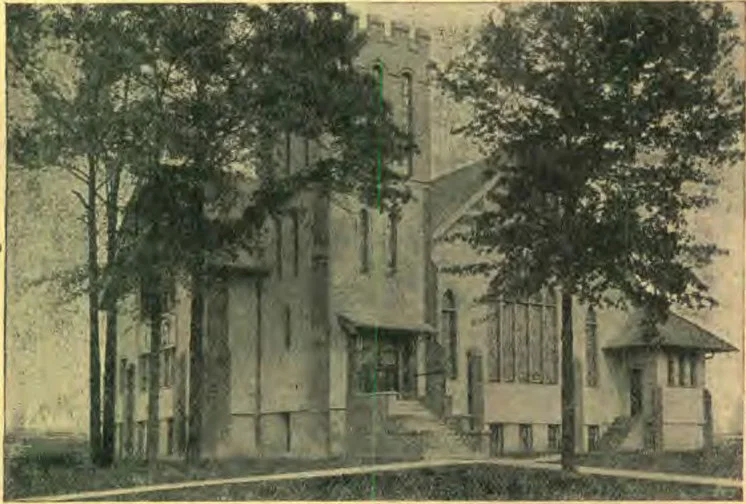
Ye shall keep my Sabbaths, and reverence my sanctuary: I am the Lord." Lev. 19: 30. The chosen people of God are a reverent people. They are distinguished not only by reverence for the true Sabbath, but also by reverence for the sanctuary, or house, of God. The psalmist says: “God is greatly to be feared in the assembly of the saints, and to be had in reverence of all them that are about him.” Ps. 89: 7. And Solomon has handed down to us the caution, “Keep thy foot when thou goest to the house of God, and be more ready to hear, than to give the sacrifice of fools.” Eccl. 5: 1.
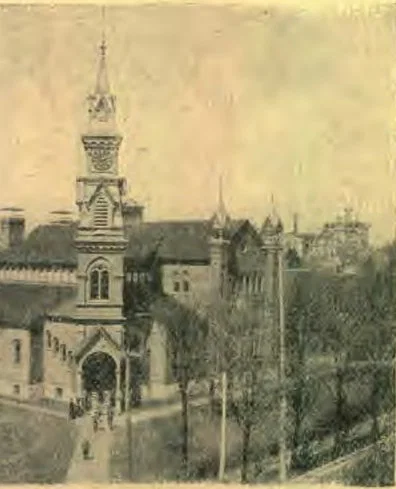
SEVENTH-DAY ADVENTIST CHURCH, TAKOMA PARK, D. C.
That there is a growing tendency on the part of many to regard the house of God with less respect and reverence than formerly is an obvious fact, and we are admonished by the servant of the Lord to read often the “directions given by God himself to the Hebrews, that we who have the light of the glorious truth shining upon us, may imitate their reverence for the house of God.”
We have reason to be even more thoughtful and reverential in our worship than had the Jews, for we are soon to stand in the presence of our God and be at home in his courts. Surely, then, instead of slackness, there should be a most earnest seeking of God for that solemn reverence and faith with which angels come into his presence. But how solemn is the statement: “Because of irreverence in attitude, dress, and deportment, and a lack of a worshipful frame of mind, God has often turned his face away from those assembled for his worship.”
Paul says: “These things write I unto thee, . . . that thou mayest know how thou oughtest to behave thyself in the house of God, which is the church of the living God, the pillar and ground of the truth.” 1 Tim. 3: 14, 15. While this text refers to more than the behavior of a person in the church building, it evidently embraces this also. And again, in the writings of Mrs. E. G. White we read: “Nearly all need to be taught how to conduct themselves in the house of God.” It is therefore appropriate at least to review the explicit instruction which has been given us in this important matter.

Personal Appearance

“I am often pained as I enter the house where God is worshiped, to see the untidy dress of both men and women. If the heart and character were indicated by the outward apparel, then certainly nothing could be heavenly about them. They have no true idea of the order, the neatness, and the refined deportment that God requires of all who come into his presence to worship him. . . .
“Some will enter the place of worship with their hats on, in soiled, dirty clothes. Such do not realize that they are to meet with God and holy angels. There should be a radical change in this matter all through our churches. . . .
“All should be taught to be neat, clean, and orderly in their dress, but not to indulge in that external adorning which is wholly inappropriate for the sanctuary. There should be no display of the apparel, for this encourages irreverence.”

Entering the House of Worship

“When the worshipers enter the place of meeting, they should do so with decorum, passing quietly to their seats. . . . Ardent, active piety should characterize the worshipers.”
“Parents should not only teach, but command, their children to enter the sanctuary with sobriety and reverence.”
Teach them “to understand that when they enter the Lord’s house, it should be with hearts that are softened and subdued by such thoughts as these: ‘God is here; this is his house. I must have pure thoughts and the holiest motives. I must have no pride, envy, jealousy, evil surmising, hatred, or deception in my heart; for I am coming into the presence of the holy God. This is the place where God meets with and blesses his people. The high and holy One who inhabiteth eternity looks upon me, searches my heart, and reads the most secret thoughts and acts of my life.’
TABERNACLE, BATTLE CREEK, MICHIGAN
Let all be reverent.

Waiting for the Service to Begin

“If some have to wait a few minutes before the meeting begins, let them maintain a true spirit of devotion by silent meditation, keeping the heart uplifted to God in prayer that the service may be of special benefit to their own hearts, and lead to the conviction and conversion of other souls. They should remember that heavenly messengers are in the house. . . . If when the people come into the house of worship, they have genuine reverence for the Lord, and bear in mind that they are in his presence, there will be a sweet eloquence in silence.”
“We all lose much sweet communion with God by our restlessness, by not encouraging moments of reflection and prayer. The spiritual condition needs to be often reviewed, and the mind and heart drawn toward the Sun of Righteousness.”

During Intermission

“Common talking, whispering, and laughing should not be permitted in the house of worship, either before or after the service. . . .
“The whispering and laughing and talking which might be without sin in a common business place, should find no sanction in the house where God is worshiped.”
“If there is a stove in the room, it is not proper to crowd about it in an indolent, careless attitude.”
“All the service should be conducted with solemnity and awe, as if in the visible presence of the Master of assemblies.”

When the Minister Enters

“When the minister enters, it should be with dignified, solemn mien. He should bow down in silent prayer as soon as he steps into the pulpit, and earnestly ask help of God. . . . Solemnity rests upon all, and angels of God are brought very near. Every one of the congregation, also, who fears God, should with bowed head unite in silent prayer with him, that God may grace the meeting with his presence, and give power to his truth proclaimed from human lips.”

During Prayer

“When the meeting is opened by prayer, every knee should bow in the presence of the Holy One, and every heart should ascend to God in silent devotion.”

Singing

Sing with heart and voice. Make it a joyful service. “The melody of song, poured forth from many hearts in clear, distinct utterance, is one of God’s instrumentalities in the work of saving souls.”

Be Attentive

God wants attentive hearers. “Listen attentively. Sleep not for one instant, because by this slumber you may lose the very words that you need most,—the very words which, if heeded, would save your feet from straying into wrong paths.”

Disturbing Elements to be Avoided

“Sometimes a little child may so attract the attention of the hearers that the precious seed does not fall into good ground and bring forth fruit.”
While disturbance by children is at times unavoidable, greater care needs to be exercised in keeping them quiet, and they should be quickly removed from the audience when crying.
“Sometimes young men and women have so little reverence for the house and worship of God that they keep up a continual communication with each other during the sermon. Could these see the angels of God looking upon them, and marking their doings, they would be filled with shame, with abhorrence of themselves.”

The Benediction

“When the benediction is pronounced, all should still be quiet, as if fearful of losing the peace of Christ. Let all pass out without jostling or loud talking, feeling that they are in the presence of God, that his eye is resting upon them, and they must act as in his visible presence.”
If favored with a postlude by the organist, all should remain standing and in prayerful attitude until the subdued strains of music are heard, which should be the signal quietly to pass into the aisle and out of the church.

Leaving the Church

“Let there be no stopping in the aisles to visit or gossip, thus blocking them up so that others cannot pass out. The precincts of the church should be invested with a sacred reverence. It should not be made a place to meet old friends, and visit and introduce common thoughts and worldly business transactions. These should be left outside the church. God and angels have been dishonored by the careless, noisy laughing and shuffling of feet heard in some places.”

Those Who Do Not Have Church Privileges

Those who are isolated, and others who do not have the privilege of assembling in a church building dedicated to the Lord, may, like Jacob, establish a Bethel even by the wayside which will be “none other but the house of God,” and “the gate of heaven.”
“Happy are those who have a sanctuary, be it high or low, in the city or among the rugged mountain caves, in the lowly cabin or in the wilderness. If it is the best they can secure for the Master, he will hallow the place with his presence, and it will be holy unto the Lord of hosts.”
How marvelous that the sinner is permitted to worship in the presence of Jehovah, before whom the sinless angels delight to bow in adoration; and how careful should we be to meet his loving requirements, that we may be refreshed by his blessing!

A Few Things to Do and a Few to Avoid

The following suggestions for proper behavior in God’s house should be read often, and put into practice:
“Be on time. No one has a right to disturb a congregation or preacher by being tardy. If from some unavoidable cause you are late, do not pass up the aisle to your accustomed seat during the Scripture reading, prayer, or sermon. Take a seat near the door.”
“Be devout in your attitude. A young girl when asked what led to her conversion, replied that it came as a result of the devout attitude her Sabbath school teacher maintained during the church service.”
“Find the hymn and share the book with your neighbor.”
“Allow no stranger to pass from the church ungreeted and unwelcomed. Cordially invite visitors to return.”
“Listen sympathetically and prayerfully to the discourse. Watch sincerely and interestedly throughout the sermon for some special message sent directly to you by the Father, whose thought is ever toward his children.”
“Do not congregate on the steps or in the vestibule of the church, and thus compel others entering to pass in review, as it were, before you. Such a course occasions embarrassment.”
“Never sit still and allow three or four persons to squeeze past and over you in the church pew rather than rise and pass to the farther end of the seat. If it is important for any reason that you retain the end seat, rise and step out into the aisle, and allow those wishing a seat to pass in.”},{
“Conversing with one another during the Sabbath school recitation is a great discourtesy to the teacher. Such behavior on the part of a pupil is often as a sharp arrow piercing the teacher’s heart.”
“Never put on overcoat, wrap, or overshoes during the closing song of a church service. Leave all such matters until after the benediction.”
M. V. DEPT.

A Visit to One of Japan’s Beauty Spots
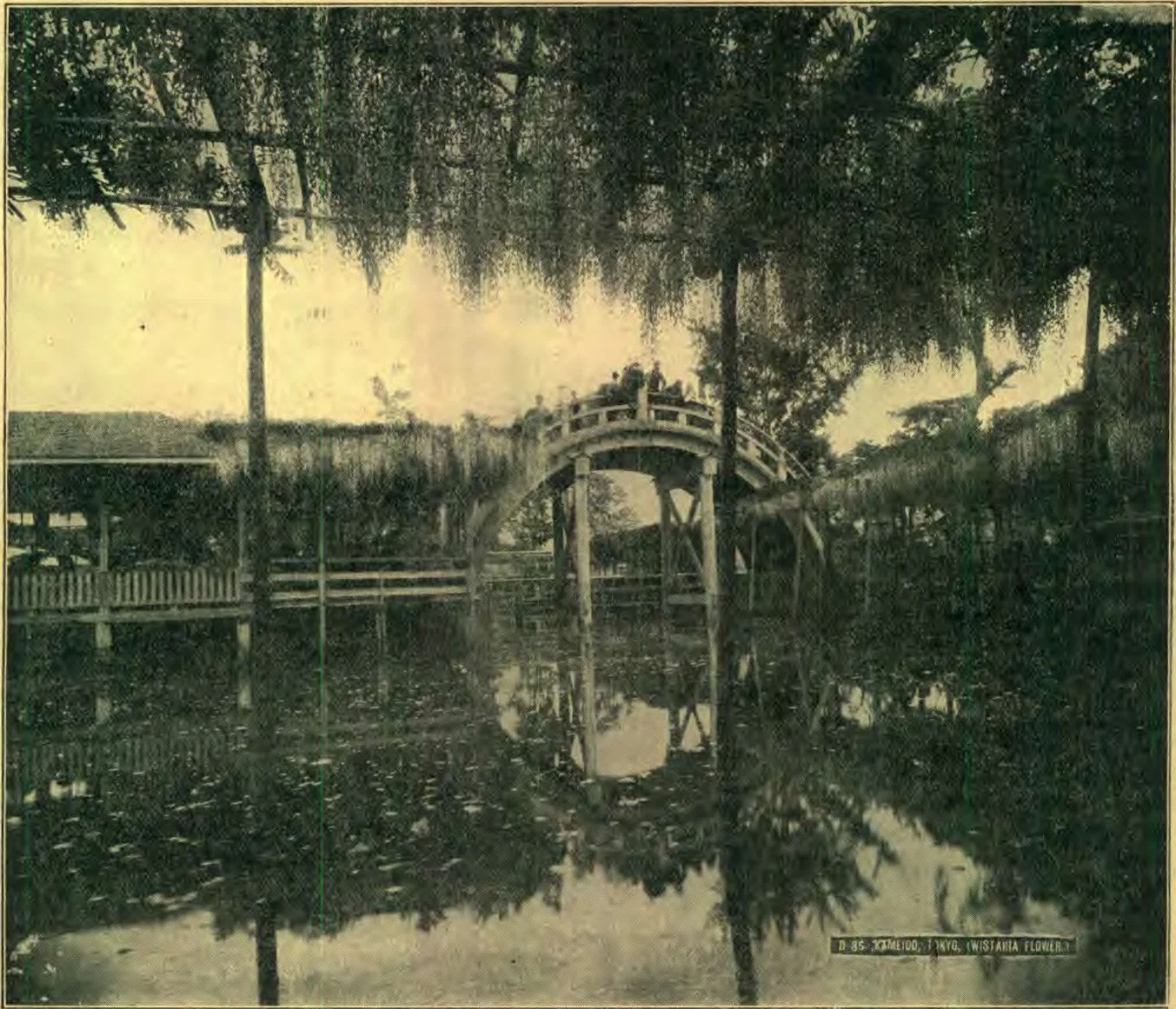
In early August we took a trip to Nikko, about eighty miles north of Tokio, to see something of the wonders of that place. There is a proverb current among the Japanese that “one should call nothing magnificent until one has seen Nikko.” In their language there is a pun on the words “Nikko” and “gekko.” The latter word means magnificent or wonderful. Whatever the proverb may say about the place, I will say that it is about the best thing that I have ever seen in all my little trips. It would take a week to describe the place, and then it would not have had fair treatment.
A SCENE IN TOKIO, WHERE THE WISTARIA ABOUNDS
The first thing that we discovered about it was that we were not perspiring as we had been doing in Tokio. Coming from the city in August was like coming out of a Russian bath into a cool breeze. Nikko is cool most of the time, even in the very hottest weather. Immediately after this discovery we were able to limber up and look around. First and foremost of the wonderful things one can see in Nikko are the trees. These are called cryptomerias and are gigantic things. They are somewhat like cedars in appearance, and grow straight and tall. It is queer that they should be able to grow so close together as they do; in places they simply crowd together. They are the property of the temples, and for this reason are considered sacred.

Water Seen and Heard Everywhere

Nikko is high in the hills and built on the hillsides, so that water runs down each side of the streets. A regular torrent of water runs in what corresponds to our gutters, only these are deeper. These streams make a pleasant sound all the time. They help to keep the place cool and clean, for the people just slop water around all day long. There is no need to be afraid of a wetting here, for it becomes second nature to paddle around in water.
We saw some of the hydroelectric plants that are numerous in this section of the country. It is a pretty sight to see the water running along so fast and yet so quietly until it takes the tumble down the long flumes. There are many streams from the mountains, and about every one is turned into an electric plant for power and light. The only way in which this has marred the natural beauty of the place is in the numerous power lines that are strung everywhere. However, these lines are to be preferred to a lot of smoking chimneys scattered over the otherwise fair landscape.
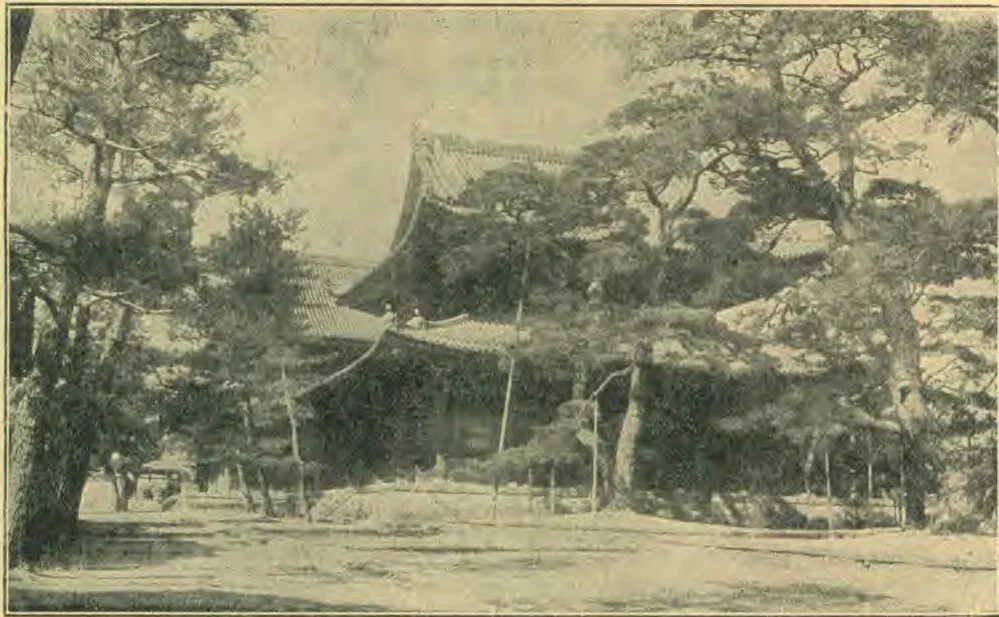
A BUDDHIST TEMPLE IN JAPAN
In the evening of the day of our arrival we took a walk around the place where some of the most famous temples are located. It was restful to be able to walk about and not be bothered by mosquitoes. Although there are plenty of electric lights around, there is no glare. The trees are so thick that the light is largely confined to the ground. The effect is pleasing and much to be desired to the white lights of Broadway. There is something very soothing in the mellow light and in the sound of the water running along the side of the roads.
When it came to sleeping we had a jolly time. Three men occupied the front balcony of the house where we were staying. It was exactly 6 x 12 feet in size. We had separate beds of futones on the mats, and had to square ourselves around so that our heads did not break down the doors. One man was more than six feet tall, and he had to lie diagonally to avoid serious discomfort to his neck. Well, the sleeping was excellent. It got pretty cold before morning, but this was something one could stand after having had such warm weather in Tokio.

Lake Chuzenzi Our Goal

About nine o’clock we started for the real object of our visit to Nikko. This was a place named Lake Chuzenzi, situated away up in the mountains about 5,500 feet. A street car runs part of the way, but the major part of the trip has to be made on foot or in a jinrikisha. We carried our own food, as we are not too fond of the Japanese food that is offered at hotels and lunch houses along the way. We soon decided that the walking looked good, and so took a jinrikisha only for the children.
There is a splendid road up the mountain, but it cannot be used by any kind of carriage except the jinrikisha, as the turns are too sudden. The whole road climbs the face of the mountain by a series of zigzags. At many places one can take a peep over a sheer fall of several hundred feet or more. Naturally there are many picturesque views to be obtained along the way. The number of waterfalls is surprising. Some are small, while others have a tremendous drop.
After about four hours we reached the last fall of the series. This is called the Suicide Fall on account of its being a favorite spot for unfortunate people to make an end of things. It is said that it takes months for their bodies to come to the top of the water at the base of the fall. One could well imagine that they would make a deep dive, for the fall is three hundred fifty feet or more. The water breaks up into a mist before it strikes the bottom; that is, the outer part of the water does. It is possible to get a front view of this fall if one will take the trouble to climb down and up the path provided for viewing it. Recently the officials have erected a fence some distance from the fall so that one cannot get to the top of it without deliberately doing some fence climbing. This is done in the hope of stopping the deadly jumping over the fall.
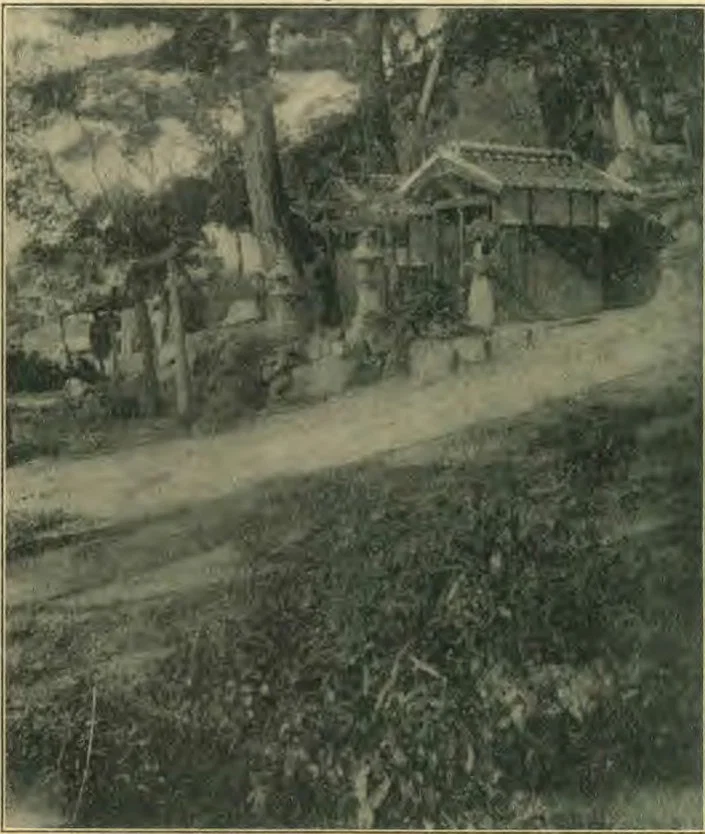
SHINTO SHRINES OF JAPAN
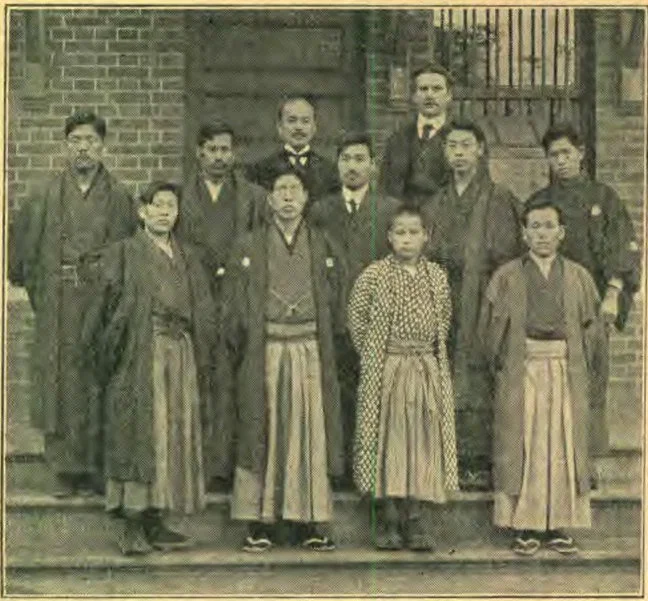
MR. A. B. COLE AND THE OFFICE FORCE
Mr. Cole Has Charge of the Publishing Work in Japan.
MR. A. B. COLE AND THE OFFICE FORCE Mr. Cole Has Charge of the Publishing Work in Japan.
About a mile from this fall one gets the first view of the lake. This is a beautiful sheet of water from which all the power plants get their supply. It is possibly seven miles long and runs very cold. It is said to be well stocked with fish, and makes a good place on which to practice sailing and motor boating. There are many boats for hire, and a trip around the lake would doubtless be a very pleasant experience. On account of fatigue, however, we made no trips of this nature. All we did was to sit around and rest during the afternoon until the sun went down and the temperature dropped like a ball. Then we went to the hotel and got into the bath. This bath was made of wood, and was about 9 x 5 feet in size. It was heated from outside the building, and was so hot that it made the room very warm. When it came time for us to get into it, after sundry washings and scourings outside, we found that it was hot. Here I learned a secret. If one can control one’s emotions when entering very hot water it is possible to get in and stay in as long as one wishes. The secret is to keep as still as a log and think of something that will give you cold chills. After some time we all three got in and had a good bath. If you want a treat, take a bath as hot as this was. By the time we were ready to get out we were warmed for the rest of the day and night. Such things have to be experienced to be believed and enjoyed.
In the morning, after a short look around we started to walk back over the road we had come up the day before. It is a question in my mind as to which part of this trip is the better. Coming down one has no work to do and has more time to see the beauties of nature. Going up one has to work, and gets the exercise that we all need.

Visiting the Temples

After dinner we started out to visit the wonderful temples of Nikko. These have some beautiful work in the way of decoration. Though I should rather see the beauties of nature than any number of heathen temples, at the same time one can hardly go through the world and keep one’s eyes shut to these things.
The better part of this morning trip was the walk through the grounds of the temples. Everything was so very fresh and cool that it reminded me of England in the springtime. The grass was in good condition, and there were plenty of flowers and bushes. Japanese gardens are always pretty, no matter what season of the year one may see them. The only thing that spoiled these beautiful things was the presence of the serpent in two forms. Real snakes were there, as we saw two dead ones. The footprint of the serpent is discernible in all the multitudinous forms of idolatry. A strange thing about these places is that the Buddhists and Shintoists seem to get along well together. The Buddhists worship Buddha and many forms of idols. The Shintoists do not worship idols, and have no form of such in their temples. They have a large disk of bright metal, sometimes silver and other times plated brass or even plain brass. They worship their ancestral spirits and, through the mirror, themselves. After all, they are not alone in self-worship, for many of us often do that very thing.
Our visit over, we came back to the heat and steam of Tokio, a charming city nevertheless. We felt the good effects of even three days in Nikko, and wished for a longer stay.
A. B. COLE.
Continue reading: To the Top of Old Gray Back