DURING our Christmas vacation another medical student at Loma Linda, California, and I felt the need of diversion from our studies. We decided that a trip to the mountains was the surest and pleasantest way of getting a great deal of recreation out of a short time, so we planned to ride our bicycles as far as possible, then push them until the roads got too bad, and finally, discard them, and carry our packs on our backs.
Accordingly 6:45 A. M., Wednesday, Dec. 26, 1917, found us starting on our journey, pedaling bicycles loaded to the limit. Behind our seats we tied our blankets, and to the handlebars secured supposedly enough food for nine meals, a complete repair outfit for our bicycles, and various camp accessories.
Having a good road, although much of the time a steep one, by ten o’clock we had made fifteen miles. Having eaten an early breakfast, we decided to lunch. As enjoyment and recuperation were the primary objects of our trip, after having eaten, we took a nap. Waking much refreshed, we pushed on, getting to a large mountain resort about sundown. Starting for the place where we wished to camp, we were forced, after going only about a mile, to leave our bicycles, carrying our luggage the rest of the way. Of all the roads I have ever seen, the last three miles to camp seemed the longest. The moon was kind enough to shine brightly, but under the tall trees our toes disturbed many a rock from its cozy bed in the middle of the road. Great was our rejoicing when we saw a signpost pointing the way to “Vivian Trail to Summit of Gray Back,” and knew that the place for our camp was only a few rods across the bed of a stream.
It was not long before we were enjoying a savory warm supper by a glowing camp fire. And again it was not long before we had spread our blankets upon a pile of pine needles, put a hot stone to our feet, and were fast going to sleep to the music of Mill Creek as it tumbled over the rocks below. By the way, let me emphasize the value of the stone to our feet: on our return twenty-four hours later it was still warm.
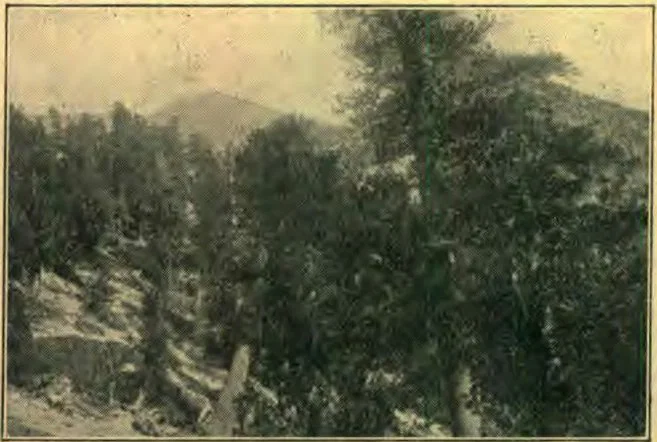
GRAY BACK AS SEEN FROM WHERE WE ATE DINNER
Our bed was in a deep valley with a high range of mountains, the Galenas, to the south, and the lesser hills on the way to Gray Back to the north. After breakfast the next morning we started up these hills, working up what are called “switchbacks.”
The path was exceedingly rocky. We were glad more than once that we had profited by previous experience and had our shoes “hobbed,” for on a previous trip to this same mountain my shoes gave out and I had to walk about twelve miles with a piece of canvas around one shoe.8
Up the path the scenery was always changing. At first the pines and spruce towered high in the air, but they soon got shorter and shorter. The creek along which we traveled for some distance would occasionally disappear and then reappear as it flowed over and under the ground. The most beautiful of views would appear when we rounded a point and saw the valley stretching out for miles and miles before us.
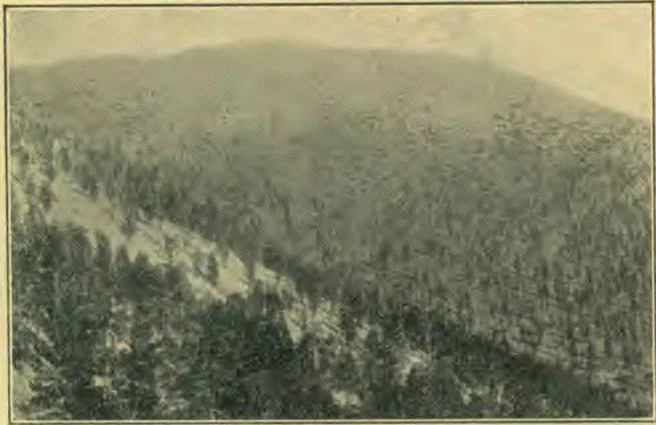
GRAY BACK TIMBER LINE
By eleven o’clock we were so high that our heads began to ache. Notwithstanding this we were hungry; so we stopped and had lunch, and then finding a sunny spot, took a short nap. After this we were able, by resting at brief intervals to get our breath, to reach the summit, where we found a pile of rocks with this sign, “Mount San Gorgonio [that is the geographical name of Gray Back, but the mountain is always called Gray Back], 11,485 feet.” We had climbed up approximately two miles since starting on our journey.
Standing there by that pile of stones, the view over the mountains and valleys was something grand. We could look down on Mt. San Jacinto, San Bernardino, and Baldy, each of which is more than 10,000 feet high, for we were on the highest mountain in Southern California. Away to the west was the Pacific Ocean, and the Santa Catalina Island, probably one hundred twenty-five miles away. To the south was Salton Sea and Imperial Valley. To the east was the desert glistening in the sunshine, and to the north a large lake with range upon range of mountains. And there in the midst of all this grandeur were just we two. Surely there is nothing like this kind of view to reveal one’s insignificance and the grandeur of God’s creation.
But it was afternoon, and as we were twelve miles from camp, we could not tarry. Do the best we could, the sun set when we were only about halfway down; but we had a good moon, and when it would not show the path to advantage, our flash light did good service. Indeed, one of the best views of the day was in store for us. When we were about 1,000 feet above camp, the moon shining on the range south of us brought it into relief as the sun had failed to do. Standing there, a sheer, steep slope probably three to four thousand feet high in the moonlight, it made an indescribably impressive scene.
We reached camp tired, hungry, and sleepy, but happy nevertheless. Our food for nine meals having lasted only six, we had to wait until our early return on the next day to satisfy our hunger; but we proceeded at once to dissipate our other ills by a refreshing sleep of eleven hours. Surely there is nothing better than a mountain hike to make one appreciate the God-given blessings of food, water, and rest.
C. A. HAYSMER.
A Bible Reading in a Mine
By Harry Tippett
The mines of Butte, most of which are on the famous “richest hill on earth,” consist of vertical shafts of varying depths connected on each level by lateral crosscuts and drifts. These levels are from one hundred to two hundred feet apart, and are widened out at each shaft into stations to permit the assembling of the ore cars which are hoisted to the surface to be emptied. Most of these mine shafts have three or four compartments to enable the operation of two or three cages at one time. One compartment is reserved for electric wires, water columns, and manway. The cages consist of three or four decks, upon which a corresponding number of cars may be run and hoisted at a time. In the larger mines from five hundred to one thousand cars are hoisted in each shift of eight hours. In sinking a shaft one compartment only is used to pull rock from the bottom. This is done by means of a large iron bucket swung under the cage. A ton of rock can thus be hoisted at a time. In the mine at which I was employed this rock was dumped into the cars on the 1800 station in order that it might be caged and sent to the surface. The shaft men were working four hundred fifty feet below me.
On the night of which I write I was on what is called the “graveyard” shift, which began at 11 P. M. My partner, the station tender, and I were kept busy the first two or three hours of our shift with the loads. As soon as I had three cars full he would cage them and send them to the surface. Gradually the intervals between the buckets grew longer as the men in the shaft began to tire. We entered into conversation to pass away the time.
THE FIRST MUSIC LESSON
“It must be nearly supper time,” I remarked.
“No, I think not,” Art replied; “Tommy hasn’t gone up yet.” Tommy was our night-shift boss. He went off shift at 2:30 A. M., and we could not eat till 3 o’clock.
“I pity poor old Dick on top tonight,” Art continued. “He won’t have a chance to keep the ‘dog house’ warm if those fellows keep mucking like this.”9
We laughed as we imagined the state of mind Dick, the other station tender, must have been in, for he had chosen the surface work that night for himself, thinking it would be an easy job.
Squawk! Squawk! Our chatter was suddenly interrupted by the squawking of the electric buzzer, a contrivance placed on every level to call the station tender. The signal flashed was 1-5-5.
“That’s Tommy now, on the two thousand,” Art exclaimed. “I suppose he wants to come up.” Stepping over to the buzzer he flashed one squawk in reply to Tommy’s signal, and clearing one deck of the cage, descended for his passenger.
Instead of going through, as we expected him to, he stopped at our station for a few minutes. As he stepped off the cage the light of his carbide lamp was lost in the glare of the station electric globes.
“Hello, Harry, how’s she working?” he asked in his characteristic way.
“Just right,” I answered. “They’ve been keeping us awake tonight.”
Our further banter was cut short by the arrival of a ‘can’ from below. As I closed the shaft doors and climbed on the stand to fill my car, Tommy said, “I see by the paper that this war that we are in is mentioned in the Bible. It says that the kaiser’s number is 666 and that President Wilson is the lamb that is going to overcome him; and after the war is over we shall have no more wars for two thousand years, when we will have a religious war. That will be the end of the world.”
I began to see why he had got off on the eighteen instead of going through. He knows something of my religious convictions.
“Well,” I replied, “if the Bible says so, I certainly will believe it. Where do you find that prophecy?”
“It’s in the Bible, they claim,” he answered.
Seeing how hazy was his understanding, I decided to try to enlighten him. “I think some one must have the thirteenth chapter of Revelation badly twisted. By the way, I have my Bible with me, and I’m especially interested in the prophecies. In fact, I have made a special study of them, because I’ve found that they point forward to the conditions in the earth today.”
Going behind a station post, I brought out my Bible and Johnson’s “Bible Textbook.” This is the first time I remember taking my Bible with me to work, but this time I desired to look up a particular subject for a friend of mine. The lapses of time between cages sometimes afforded an opportunity to read or study.
Both Tommy and Art looked at me curiously when I brought out my Bible, for neither of them were inclined to be religious. Instead of the coarse jest which I expected to hear they merely smiled as I began an explanation of the thirteenth chapter of Revelation. As I briefly hit the high points of the prophecy they were attentive and seemed to be impressed with the truth of the Word. As I tried to show them the futility of private interpretation and the superiority of letting the Bible explain itself, they nodded their heads at each point made, and I closed with a promise to lend them a magazine exposing the fallacy of the newspaper article which they had seen.
Tommy said no more, but stepping on the cage and closing the safety gates, he snapped the engineer signal bell three times and rose to the surface, I trust, a more thoughtful man.
Thus it was that at two o’clock in the morning I came to give a Bible reading under such strange surroundings , a third of a mile below the earth’s surface, amid the dripping of water and the rattling of cages. Surely the Lord through whom all prophecy came was with us to impress the truth.
An interesting sequel to this incident took place the following night. As we were descending the shaft to our work, Art asked me if I had the Bible again, and I told him that I had. “That’s the stuff,” he said; “that’s what I want to read.” He kept his promise.
When the ‘fire bug’ came through he saw the Bible lying on a plank. He remarked that we must be getting very religious, to have our ‘prayer book’ with us. Later on an Austrian miner, coming out to the station for timber, also spied the Bible and “The Bible Textbook.” He picked up the latter, and began to read. His eyes caught sight of something about the Sabbath. He cried, “Vy, dis book say we won’t go to heaven if we work on Saturday.”
I could not but feel the Spirit of God was there to impress his heart, and that this might be the only opportunity he would have to learn of God’s great reform for today in Sabbath-keeping.
Verily it is true that seed must be sown beside all waters, and I am inclined to think that the admonition may include the copper waters of Butte.
HARRY TIPPETT.
Goals of God's Young People
By Bert Rhoads
Goals
In olden times God's young people had goals. A list of these goals is given in Hebrews 11. Subduing kingdoms, working righteousness, obtaining promises, stopping the mouths of lions, quenching the violence of fire, escaping the edge of the sword, being made strong out of weakness, waxing valiant in fight, turning to flight the armies of the aliens,—these are some of the goals. To attain them God's servants had to endure tortures, trials, scourgings, bonds, imprisonments, stonings, temptings, wanderings, destitutions, and afflictions. And in the end there was given the Standard of Attainment Certificate—a good report through faith.
In our Missionary Volunteer work, we are saying much about goals. We plan to raise money for missions, to read the Bible through, to all be reporting members, and to get the Standard of Attainment certificate. The reaching of these goals marks certain progress toward the city of our King. But in our individual experiences, we must subdue the kings of selfishness that would mar our lives; we must stand so true to God that he will stop the mouths of lions to save us; we must reach the goals of Hebrews 11. There will be trials, and scourgings, and imprisonments, destitutions, and afflictions; but soon the blessed result of having a good report through faith will be ours.
The history of God's servants in ages past shows how they reached these goals. Jacob had deceived his father and obtained by fraud the birthright blessing. He was obliged to flee from the wrath of an angry brother. At night, discouraged and alone, with a stone for his pillow, he had in the vision of the ladder with the ministering angels, the assurance of help to win the goals. In later years he walked one day with halting step, for God had touched him. But in the night of wrestling he had got the experience of prevailing with God; and in that prevailing, Jacob could win every goal. Samson was strong to slay many Philistines and to carry away the gates of Gaza. But one day his brethren10bore away from the wreck and ruin of a Philistine pleasure house the bruised and mangled body of a mightier Samson, mightier because that in his closing hours,—though blind, and destitute and afflicted, and a prisoner in a dungeon,—he had come to the place where he prevailed with God, and received the things he asked for.
Time would fail in the recording of the experiences of Gideon, Barak, Samson, Jephthah, David, Samuel, and the prophets to show how weak, sinful men came to the blessed greater goal where they could talk to God and be heard of him. BERT RHOADS.
When Fortune Knocked
By S. G. Mosher
Mrs. Gurney looked with interest at the letter which her son Hugh had handed her.
“It is from Uncle John,” she said. “I have not heard from him for over a year.”
“I can’t understand why he so seldom writes us,” said Hugh. “It seems absurd to have an uncle one has never seen, living in a city only a few hundred miles away.”
Mrs. Gurney looked up from the letter with a sparkle of excitement in her eyes.
“Your uncle is coming to visit us next week,” she said. “It seems he has been working too hard, and as business is rather dull at present, he feels he can leave the office for a time. It is seven years since I saw him last.”
“That was the time you and father went to New York, wasn’t it?” Hugh asked.
“Yes, seven years ago this autumn. Your uncle promised us then that he would visit us soon, but something always seemed to prevent him. He was never able to leave his business for any length of time.”
“Is Uncle John rich?” Hugh asked.
“He must be very well off,” was the reply. “He lives very simply, but his firm does an immense business. Almost every year they open a new branch factory, and in this letter your uncle speaks of a new scheme for capturing some South American trade.”
“I say, mother, it would be fine if uncle were to give one of us boys a chance in his office, wouldn’t it?” Hugh asked.
“I hope, Hugh, you will not hint at such a thing,” Mrs. Gurney said quickly. “I should not like your uncle to feel that we expected favors from him, and in any case I should be sorry to lose one of my boys.”
“But think of the chance a fellow would have in New York,” Hugh rejoined. “There’s no future in this little town.”
“I’m sure your father has always provided well for his family,” Mrs. Gurney replied.
“Oh, yes, father has made a good living, but he will never be rich,” was the answer. “Father’s business will never be larger than it is now; the size of the town won’t admit of expansion. He certainly won’t be able to find places for all three of us boys with his firm.”
Mrs. Gurney sighed; she knew it had always been a sore point with Hugh that his father insisted on his beginning at the bottom of the ladder in a strange office. Hugh had thought that his father might have found an easy place for him in his own business; but Mr. Gurney was rather uneasy at the lad’s careless, indolent disposition, and hoped that the stricter discipline he would be likely to encounter among strangers would help him to overcome these faults. At present Hugh was in the shipping-room of a local factory, where he earned ten dollars a week. His father had promised that when that salary had been increased to fifteen dollars he would make a place for him in his own office. Allan, the second son, was bookkeeper in a general store, while George, the youngest, was office boy, stenographer, and bookkeeper combined for a firm of struggling young lawyers.
Mr. Gurney and his three boys went down to the station to meet Mr. Lindsay, while Mrs. Gurney remained at home to superintend the supper preparations. The evening train had brought more passengers than usual, and the boys were wondering which of the elderly men would prove to be their uncle, when a tall, distinguished-looking man detached himself from the group of young people and hurried toward Mr. Gurney.
“How are you, Fred?” he said, shaking hands cordially. “And these are my nephews? I declare Hugh is as tall as I am.”
“I’m George, uncle,” was the laughing response. “Hugh is the short one.”
Mr. Lindsay turned to his eldest nephew with a word of laughing apology, but that youth looked rather ruffled. His short stature was a sore point.
“A charming little town,” Mr. Lindsay said, as they walked down the street together.
“Why, uncle, this town is awfully dull,” Allan exclaimed. “There are no opportunities here at all. I want father to let me go to the city, but he won’t hear of it.”
“I think your father is wise,” his uncle replied. “It is in just such towns as this that the real opportunities lie nowadays. You have no idea of the fierce competition you would meet in the city.”
Allan was silent, but unconvinced.
A few days after his arrival, Mr. Lindsay planned a picnic. He engaged two automobiles to take his sister’s family and a few of their friends to a famous lake some fifteen miles distant. They had arranged to start at half past one, but when the time came George had not come home.
“I wonder what can be keeping that boy,” Mrs. Gurney said, as the clock pointed to fifteen minutes to two. “Every one else is here.”
“George is too conscientious,” said Allan, as he hastily finished his lunch. “I suppose he has found some work he thinks he has to finish; but I say that since he is entitled to a half holiday he should see that he gets it.”
“Did you have any trouble in getting off?” Hugh asked his brother. The retail stores observed their half holiday on a different day than most other businesses.
“Mr. Tibbetts did try to make some objections, but I reminded him of the overtime he made me do last week,” Allan answered.
“I never work overtime,” said Hugh virtuously. “When they first tried it, I told them that overtime work should be paid for at one and a half times the rate for regular work, and they gave it up. There’s a fellow in our office, though, who is something like George. Whenever any one has to stay after hours, or on holiday afternoons, he is always the victim, and he actually seems to enjoy it. Some people are never happy unless they are slaving for others.”
“But sometimes work after hours is absolutely necessary,” Uncle John said. “A considerate employer will always make it up to his clerks in some way.”11
“How many considerate employers are there?” Allan asked. “I say overtime is the thin edge of the wedge, and I won’t stand for it.”
“But, Allan, surely you are not entitled to this afternoon?” his uncle remonstrated. “As I understand it, you have earned this holiday by some extra work you did last week.”
Before Allan could answer, the telephone rang, and Hugh took down the receiver.
“Not coming? Oh, I say, George, don’t be a donkey,” they heard him say. “Oh, all right, then, we needn’t wait any longer,” he concluded, hanging up the receiver. “George is going to work this afternoon,” he said. “At least, he is going to stay at the office; I don’t suppose there is any work to do. Both his employers have been called out of town, and they don’t want the office closed. I think George is foolish; they would never be the wiser if he locked up and went to the picnic.”
Whatever Mr. Lindsay may have thought of his nephew’s remarks, he only said, ‘Then we had better start at once.’
They all had a very enjoyable afternoon, and Hugh and Allan thought pityingly of George, cooped up in a gloomy law office. When they reached home, in the summer dusk, they found George on the veranda, poring over a book by the waning light.
“Don’t read in this light; you’ll ruin your eyes,” his mother exclaimed. “Did you find anything to eat?”
“Yes, mother, I rummaged through the pantry and did very well,” was the answer.
“Well, old man, you missed the time of your life,” Hugh said. “But I suppose some rich client drifted into your office this afternoon, with a big case for your employers?”
“No,” George admitted, with a good-natured laugh, “nobody called at all except a bill collector.”
“Then you might as well have locked up and come with us,” Allan said triumphantly.
“I’m paid to obey orders,” was George’s only reply.
“It seems to me your employers expect a good deal for eight dollars a week,” Hugh said sarcastically.
“I can’t see that the amount of my salary has anything to do with the matter,” George argued. “I accepted the sum they offered in return for certain specified work. As long as I take their money I must give them faithful service.”
“Oh, you are hopeless,” said Hugh excitedly, as he went indoors.
Mr. Lindsay had heard the dialogue as he paid the drivers, but he said nothing. After this, however, he paid keener attention to the habits of his three nephews, and used often to look at them in a considering way that Hugh, at least, found embarrassing.
“What do you do with your evenings?” he asked them once. “In winter, I mean; of course in summer you want to be outdoors as much as possible.”
“Oh, there are quite a few things going on here in winter,” Allan answered. “We have a skating rink, and then there are a good many parties.”
“But do you not study at all?”
“Oh, my school days are over,” said Hugh, with a superior air. “George is the studying one of the family. All last winter he spent two evenings a week at the Y. M. C. A., studying Spanish, and now that the classes are suspended for the summer, he spends half his evenings talking Spanish with a couple of Cuban youths employed at the machinery factory. They are a rough-looking pair, and if they can’t speak Spanish any better than they can English—” Hugh finished his sentence with an expressive shrug.
“Their Spanish is pretty bad,” George admitted. “But Professor Lanos warned us against learning the language from books only; he said we must also study the idiomatic language of the common people.”
“Your friends look common enough,” Allan laughed.
“Why should you waste your time studying a foreign language?” Hugh demanded. “Isn’t English good enough?”
“I am interested in the language,” George replied. “And I think a knowledge of Spanish will mean increased opportunities. I heard yesterday that the machinery factory is thinking of going into the South American export trade, and if they do they will certainly need a Spanish-speaking clerk.”
“Why should they not employ one of your Cuban friends?” Hugh asked.
“Because neither of the boys is educated,” was the response.
“Well, I’m not going to waste my evenings learning a foreign language,” Allan declared, emphatically.
Mr. Lindsay had listened without remark; he now changed the subject by asking if any of them had ever heard of a famous singer, who was advertised to give a concert in the town the following week.
“I think mother heard her once, in the city,” George answered. “We have never felt able to afford it, the tickets are so expensive.”
“Then will you all be my guests at the concert next week?” Mr. Lindsay asked. “I will telephone now to have seats reserved.”
“Oh, Uncle John, that will be great!” Hugh exclaimed, while the other boys thanked their uncle warmly. A love of music was a taste they all shared.
Suddenly, however, George asked, “What day is the concert to be, Uncle John?”
“On Thursday,” was the reply.
“Oh, uncle, I am so sorry,” George exclaimed regretfully, “but the Y. M. C. A. classes reopen next week, and the Spanish class is held on Monday and Thursday, so I will have to miss the concert.”
“Can’t you miss a class for once?” his uncle asked.
“I’d like to,” George admitted, wistfully, “but you know how it is, uncle. If one once commences to miss classes there are so many temptations. Besides, I mustn’t lose a moment in perfecting my Spanish, or I won’t be ready for the chance with the machinery people if it comes.”
“Perhaps you are right,” was all his uncle said.
Some two weeks after this George came home one evening in high spirits, to find a general atmosphere of gloom pervading the family. In his anxiety his own good news was forgotten.
“What’s the matter with everybody?” he asked. “You look as if you had heard bad news.”
“So we have,” his mother answered. “Your uncle has received a letter which will compel him to go home tomorrow; he is needed in the office.”
“Oh, uncle, you can’t go before we have our athletic sports at the ‘Y’!” George exclaimed.
“I’m afraid I must,” his uncle answered. “I have neglected my business too long as it is.”
“We shall miss you dreadfully, Uncle John,” Hugh said; though privately that young man was thinking that if his uncle were to hand over some of his office worries to one of his young nephews he would be free to take as many holidays as he liked.
“I have some good news, father,” George said, when they were all gathered around the supper table. “I12heard yesterday that the machinery company was about to advertise for a correspondence clerk with a knowledge of Spanish, so I went in to see them at noon today. They have engaged me at a salary of fifteen dollars to start. They said they would increase this to eighteen dollars in six months, if my work was satisfactory. They wanted me to begin at once, but I told them I couldn’t leave my present employers without sufficient notice, so I am to make the change the first of next month.”
“That is great news,” Mr. Gurney said, while Mrs. Gurney smiled proudly at her youngest son. But Uncle John startled them all by saying, “I think you had better not accept this offer, George.”
“Why, John!” Mrs. Gurney exclaimed. “It is a great opportunity for George. He is getting only eight dollars a week now, so that his salary will be about doubled.”
“And there should be a good future with the machinery people,” Mr. Gurney added.
“But I think I can offer George just as good a future,” Mr. Lindsay said. “I need one of your boys in my business,” he explained, turning to his sister. “This visit was made with the intention of choosing one of them. They are all fine boys, but I have decided to offer the chance to George. He is diligent, faithful, and above all his knowledge of Spanish will prove very useful to me. I shall give him fifteen dollars to start, and of course he will live with me. His future lies in his own hands.”
For a moment George was too stunned to speak, then he thanked his uncle warmly.
“Of course I should rather work for you, Uncle John,” he continued. “I shall tell the machinery people tomorrow that I must refuse their offer. But I must give my present employers due notice,” he added.
“I quite understand that,” was his uncle’s response. “I shall expect you the first of next month.”
The other two boys tried to look glad at their brother’s good fortune, but when they talked the matter over with their mother they both agreed that their uncle had taken an unfair advantage of them.
“Why didn’t he say he wanted one of us to work for him?” grumbled Hugh. “I’d have studied Spanish fast enough if I had thought it would mean a position with Uncle John.”
“You had as many chances as George,” his mother pointed out. “You were not ready when fortune knocked at the door, and he was. That is the only difference.”
“Perhaps fortune will knock again some time,” Allan said, more soberly than was his wont. “At any rate, I shall be prepared for her if she does. I mean to join some of the Y. M. C. A. classes this winter and improve my general education.”
“I think I shall too,” Hugh said thoughtfully. “After all, George does deserve all the good fortune that has come to him. He has worked hard for it.”—S. G. Mosher, in the Boy’s Comrade.
A Man's True Greatness
By George Long
A MAN'S true greatness lies in the consciousness of an honest purpose in life, founded on a just estimate of himself and everything else, on frequent self-examination, and a steady obedience to the rule which he knows to be right, without troubling himself about what others may think or say or whether they do or do not do that which he thinks and says and does.—George Long.
The Name of God
A WHITE officer in one of the colored regiments recruited in 1864 long remembered among his soldiers a colored man of fifty-five, with gray hair, wrinkled face, and somewhat feeble in constitution; for he had been a hard-working slave, and his life had not been free from sorrow.
He had a great desire to read, and when the regiment was in camp he procured a primitive old First Reader, and begged one of his officers to teach him the alphabet. This he successfully mastered, and then went on by painful efforts to acquire the words of two letters and the disconnected syllables, “ab,” “ba,” which in those days followed the learning of the alphabet. These, too, he learned with tolerable correctness, and in the process of time advanced to a new section in the book, where words of three letters awaited him.
Among these he found one day a word which halted him somewhat longer than the others, for it was spelled in capitals—GOD. He knew the small letters somewhat better, and so labored longer over this word than those that had gone before.
“That is the name of the Being you sometimes preach about,” said the officer, for the grizzled old Negro was a preacher among his people. The old man dropped his book and held up his hands in surprise, exclaiming with deep emotion: “Is that the name of God? Is that the way it looks when it is printed?”
The officer could not for some time understand the old man’s emotion; then he considered the days of painfully slow progress which had been consumed in the learning of the alphabet and the syllables, and the words of two letters, and that now suddenly he had come upon the first suggestion in the course of his education of the use to which his study might be put; and it came as a kind of revelation, sweeping and wonderful in its suddenness—the name of God in its arbitrary place in the column of words of three letters. Evidently to the old man it was, in one sense, like seeing God himself.
“You can’t understand it, Captain,” said the old Negro. “You’ve always known how to read, but I’ve been preaching about it all the years and all the years, and now, thank God! these old eyes have lived to see and read the name of God.”
It impressed the officer at the time, then dropped into the background of his mind among the many memories of the war, but in the long years afterward it came up again, and among the memories which he cherished in his later years was that of the radiance of the grizzled, wrinkled black face when first he was able to read the name of God he loved.—Youth’s Companion.
Smiling Silence
“Here’s a motto well worth while—
Keep your mouth tight shut and smile!
Makes small difference what may be
In the way of misery,
If you smile and silence keep
Spite of aggravations deep,
You’ll discover ’mid the hum
Of your woes your day will come,
And you’ll never have to eat
Observations indiscreet.
Swallowed silence past all question
Never hurt a man’s digestion.
But a swallowed word or two
Brings an aftermath or rue
That in days that are to be
May impair some victory.”