“A Merry Heart Doeth Good Like a Medicine.” —Prov. 17: 22
OUTSIDE it was raining heavily. Inside—well, inside the weather was threatening, to say the least. One of the nurses, going to the linen room with an armful of fresh towels, shook her head.
“I pity ourselves to-day,” she said.
“I know—it will be difficult to keep the children bright,” the other answered. A nurse was taking the temperatures, and marking the charts that hung at the head of each white bed. She stopped a moment, and looked down at one especially listless face.
“Don’t you want some of the scrapbooks to look over, Jennie?” she asked.
Jennie’s weak voice was utterly uninterested. “No,” she answered. The nurse’s voice kept its brightness in spite of her discouragement. “Then wouldn’t you like one of the puzzles? You could play with it nicely there.”
“No, I don’t want any,” Jennie announced, wearily.
A hand pulled at the nurse’s skirt, and she turned quickly. The thin, pain-sharpened face of the girl in the next bed smiled at her cheerfully.
“Don’t bother about Jennie. I think I can get her to do something,” she said, in a low voice. The nurse bent over her with a swift, caressing touch. “Thank you, little assistant,” she said, tenderly.
Maggie lay thinking for a few minutes. In the room outside, where the patients’ clothes were kept in a case full of large pigeonholes, was one bundle shabbier than the others; this was Maggie’s. In one of the beds were some queer, cruel-looking weights that meant suffering far greater than most of the little invalids there could imagine, and they were Maggie’s too. Perhaps in all the long roomful, she had the fewest things to make her glad; but what of that? God teaches us how to make our happiness, if we will; God and Maggie together made hers.
She opened her eyes when the sharpest pain had passed, and called across to the next bed, “Jennie!”
“What is it?” Jennie asked, listlessly.
“Jennie, let’s ‘see things;’ we haven’t for ever so long. You wanted to the other day, you know.”
“Well,” Jennie answered, doubtfully; “you’ll have to begin.”
“O, yes, I’ll begin. Well, then, I see some great red roses, just as soft and dark as velvet; and they feel all cool when you touch them, and they smell—Oh, how sweet they smell!”
“I know something prettier than that,” Jennie answered. “It’s violets—a lady gave me some once. There isn’t anything like them, velvet nor anything else. I almost cried when they withered. That’s prettier than yours, Maggie!”
LITTLE MIRIAM
“But I see something else,” Maggie went on. “It’s a great green place, and the grass is all nice and thick under your feet, and it’s full of the most beautiful flowers, yellow and white, and all colors, and there isn’t any sign to keep off the grass—you can lie and roll in it all day long. And there are birds in the trees, and you never heard anything sing like them; and you can see the sky, just miles of it, and you can almost taste the air, it’s so pure and sweet.”
Round the ward word sped quickly, “Maggie’s seeing things!” Children who could walk went over to her corner; wheel-chairs rolled there; from some of the cots eager patients sent messages to her, and waited for hers back again. The dull day was forgotten, and the long room was crowded with visions. Flowers bloomed there, and birds sang, and happy girls went to parties or cherished wonderful dolls. The gladness of the world was theirs, as God meant it to be; and all because one girl knew how to keep fresh in her life every bit of beauty she had seen.
The doctor smiled as he went his rounds. “She’s as good medicine as the sunshine,” he said.
“Poor little thing!” the nurse answered, with a loving glance toward the corner.
The doctor corrected her. “It’s the heart that makes one rich or poor—rich little girl!” he said.—Woman’s Journal.
Saved Her Baby
For several weeks the wonder and delight of an English zoological park was a baby hippopotamus, which was named Guy Fawkes, because its birthday fell upon the fifth of November.
The young hippopotamus was about the size of a bacon pig, of a pinkish slate-color, and as playful as a kitten. It was only three days old, when, as the superintendent of the “Zoo” was watching the little fellow’s antics, it dived to the bottom, and did not rise. The grown animals never remain under water longer than three minutes; so, as time went on, and no baby reappeared, the superintendent became alarmed.
When twenty minutes had elapsed, he gave orders that the water be drawn from the tank to recover the body of what he felt sure was a dead baby hippopotamus. As the plug was being removed, young Guy Fawkes appeared, shaking his funny little horse-like ears, and wearing a hippopotamic grin, which seemed to say, “Don’t be frightened; I’m all right. You don’t know all about me yet.” The young animals have great power of remaining under water, which they lose as they increase in years.
The next time baby went to the bottom, however, was not so much of a joke. He tried to climb up the side of the tank in which there were no steps. He fell back again and again, until he sank exhausted. The keepers were gathered about the tank in great anxiety, but unable to help. The mother, however, hurried to her baby with all her clumsy haste. She dived, put her broad nose under Guy Fawkes, shoveled him up, and held him above the surface until he had recovered his breath and was rested.
It was nearly half an hour before the little fellow was able to make another attempt. Then he made a huge effort, mama hippopotamus gave a big shove with her head, and Master Guy Fawkes clambered triumphantly up the side of the tank.—Popular Science Monthly.
The Little Reader
By Arthur Fox
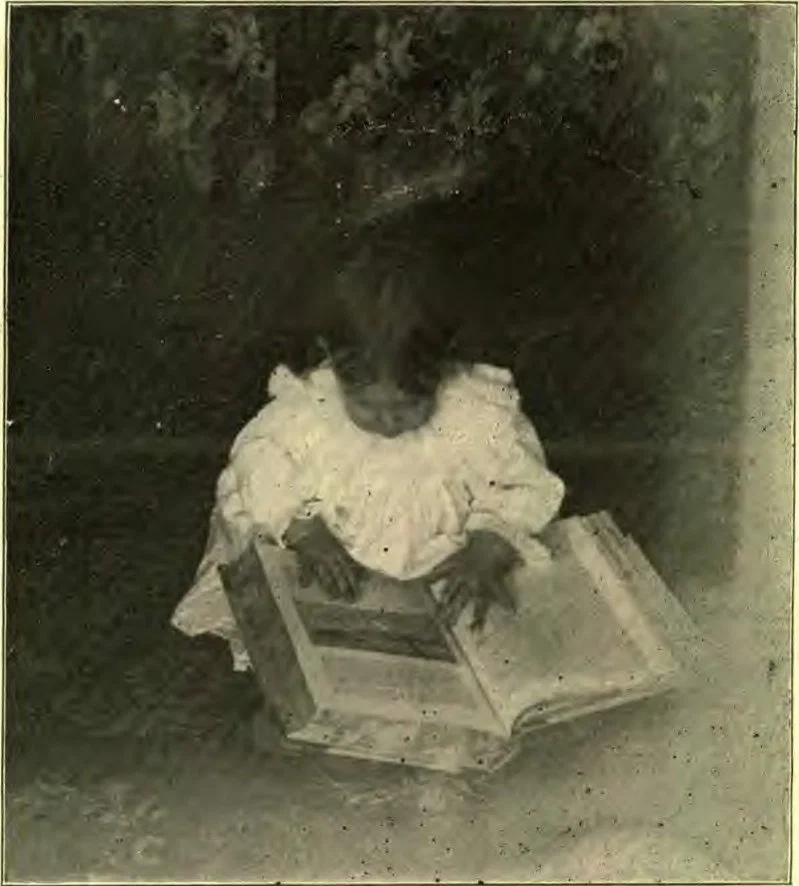
THERE'S a funny little girl who reads to me every day,
The most surprising travels, from a volume torn and gray,
In lands where monkeys buy and sell and talk and go to school,
And where are lions, numerous as fishes in a pool,
And dreadful savage men who build great cities out of stones.
But the book in which she reads about these travelers of renown,
Is the family receipt book, and she holds it upside down.
ARTHUR FOX.
What Has Been Done Can Be Done Again
“WHAT has been done can be done again.”
Great Britain's Sea-Coast Compared With Europe
“GREAT BRITAIN has a longer sea-coast line than any other nation in Europe. It measures 2,755 miles. Italy comes second, with 2,472 miles.”
Refinement Springs from a Gentle, Unselfish Heart
“REFINEMENT is more a spirit than an accomplishment. All the books of etiquette that have been written can not make a person refined. True refinement springs from a gentle, unselfish heart. Without a refined spirit a refined life is impossible.”
Leisure Time Is Unused Capital
Any careful reading of the mechanical achievements of the nineteenth century will reveal that our most important inventions had for their primary object the saving of time. It was the desire to lessen the time and labor of weaving that brought the steam-power loom from the brain of Cartwright. To keep up with the intellectual requirements of man, the hand-press of Gutenberg gave place to the fast-running machinery of Nicholson. To supply the world with cloth, the primitive spinning-wheel, driven by foot or hand, and winding but a single thread, evolved into Hargreave’s jenny, with vertical spindles operating countless threads. To furnish food for the race, the stout arm and scythe of the farmer gave place to the reaping-machine. In a similar manner have come the swift-sailing steamship, the express train, the telegraph, and the telephone. Give this subject any reasonable investigation, and you will discover that the “time element” has played an exceedingly important part in the development of our twentieth century.
One of the most valuable arts that the average person can master is the ability to economize time skilfully by avoiding those harmful by-paths that dissipate the odd half-hours that rightly belong to the day of labor. It is one of the verities of history that the world owes less to the men and women of leisure than to any other class. Of course there are a few noble exceptions; but as a general rule, the more leisure men or women have, the less real work you get out of them. The Bishop of London was standing in the door of his home, when a wealthy gentleman approached him, and said, “I want your advice, my lord: how am I to bring up my son so as to make him get forward in the world?” “I know of but one way,” replied the Bishop; “give him parts and poverty.”
Any young person who has an intelligent estimate of his own value will appreciate what may be accomplished in a few minutes. A single half-hour each evening, devoted to the study of any science or language, would enable a man of average ability to master the one or the other in a few years. One half-hour each evening, devoted to study, would make a man of no education intelligently informed on a wide range of important subjects.
It would surprise the most of men, if they knew how much of what is most valuable in our civilization we owe to the spare quarter- and half-hours saved by men and women who had a purpose in life, and who labored for its perfection. Robert Burns composed many of his sweetest poems while returning from the field after a hard day’s work. To an hour each evening, the world owes the steam locomotive of George Stephenson. Grote, the author of one of the standard histories of Greece, was a busy banker, and history was the recreation of his spare moments. Sir John Lubbock became one of the foremost authorities in prehistoric archeology by using the odd half-hours after his work. Hundreds of men and women have risen into prominence and power, not so much from any special genius, but rather by discovering the value of time and making a wise use of it. Promptness as related to business, friendship, recreation, and study, is a great virtue. It will enable a youth of average ability to win, when that unclassified species, the genius, fails.—The Technical World.
The Girl's Friend and Counselor
By Margaret A. Muir
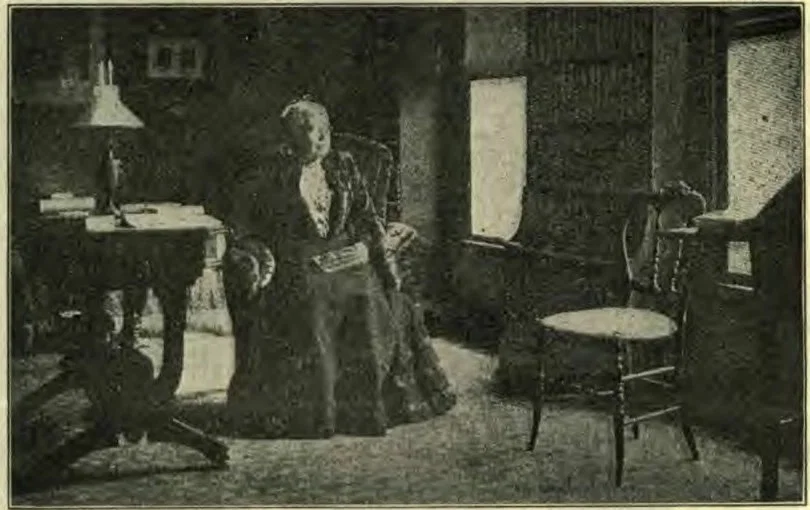
The first time I saw Mrs. Margaret E. Sangster, writer, speaker, and poetess, was not at a literary meeting, nor was she addressing a convention. She was in the act of crossing a mud puddle.
There had been a heavy shower, but the sun had burst forth, rejoicing. All nature was brightened for having had its face freshly washed, and puddles abounded.
Now, a mud puddle is not the most desirable obstacle to encounter when one is in a hurry, even if one stops, by Ruskin's suggestion, to see the cloud-reflection on the principle of finding what one looks for. Yet they resemble many other problems in life which one meets with, and has either to go around or settle by going bravely through or over. Mrs. Sangster chose the latter course. A halt, a closer gathering of the skirts, an energetic, agile movement; and it was done,—gracefully done, too,—and the even tenor of her way resumed.
That was characteristic. Is it the writing of a book or a note? is it singing comfort to saddened hearts by her verses? is she speaking to eager listeners at meetings where girls congregate? or has she met with an obstacle in life? Calmly, deliberately, and graciously it is done.
It may be of interest to the many who know her only through her writings to learn something of her personality, and to have a glimpse into her home life.
When meeting Mrs. Sangster in her home, or in the church porch, or on the streets, and stopping for the cheery greeting one never fails to get, you are at once impressed with her motherliness. Soft, snowy hair becomingly arranged, frames a sweet and yet unwrinkled face (she is now in the prime of life); features not beautiful, perhaps, from an artist's point of view, yet beautiful with soul-expression. When she speaks, a sunny smile lights up her countenance. In stature she is of medium height, with a well-rounded figure, always daintily and appropriately gowned, usually in soft clinging stuffs. The picture is enhanced by her charm of manner, which lies in her perfect naturalness. She is essentially a gentlewoman in the fine sense of that word. Courteous, gracious, responsive, she makes one feel at home in her presence. She is possessed of strong common sense and a keen sense of humor.
Some one has said that the people who influence us most are those that believe in us. Have you never been with people who instinctively appeal to the best that is in you? Our neighbor is of this kind, and you feel her personal interest in you. One does not wonder that her “girls,” the world over, love her, and pour their confidences into her motherly ear, and accept her advice. This gifted writer has a faculty for giving practical suggestions on matters pertaining to the every-day affairs of life.
To illustrate: A little woman from back in the mountains came into the writer's home. Some remark about her shining and abundant hair elicited this reply: “I came near losing all my hair; but I followed Mrs. Margaret Sangster's advice, and rubbed vaseline on the scalp. I do not know Mrs. Sangster, or even where she lives, but whatever she says is absolutely true.” You may imagine the funny look of surprise when my friend was told who our near neighbor was!
MRS. SANGSTER
As a worker one could scarcely find a busier woman or one who accomplishes more, and yet without giving the impression of being busy. In her, always calm and tranquil, it is refreshing in this age of “hustle” to find a practical example of “power through repose.” Yet Mrs. Sangster is in reality an indefatigable worker, seated for hours at her desk, writing manuscript or correcting proof. Interruptions? She has them constantly; yet so controlled is her manner and her greeting so gracious that any one not knowing the value of time to a busy person might be readily deceived. Her superb health is greatly due to regular and systematic habits of living. Rising in the summer-time at daybreak, a refreshing bath, and then an hour's work before the family breakfast; and a busy day is started.
Besides her literary work Mrs. Sangster is a “home-keeper.” In this she is ably assisted by a niece. She attends meetings, and is always ready to enter into the social life of the community in which she lives. She also takes advantage of her church privileges, for she is an earnest and loyal Christian. “Early to bed” must follow the “early to rise” by the rule for health and wisdom; so Mrs. Sangster often seeks her well-earned rest when the town clock is striking nine.—Margaret A. Muir, in Youth's Companion.
Do Something, Do It Soon
“Do something, do it soon with all thy might;
An angel’s wing would droop if long at rest;
And God himself, inactive, were no longer blest.”
The Things Undone
By Margaret E. Sangster
It isn't the thing you do, dear,
It's the thing you leave undone,
Which gives you a bit of heartache
At the setting of the sun.
The tender word forgotten,
The letter you did not write,
The flower you might have sent, dear,
Are your haunting ghosts to-night.
The stone you might have lifted
Out of a brother's way,
The bit of heartsome counsel
You were too hurried to say,
The loving touch of the hand, dear,
The gentle and winsome tone
That you had no time or thought for,
With troubles enough of your own,—
These little acts of kindness,
So easily out of mind,
These chances to be angels
Which even mortals find,—
They come in night and silence,
Each chill, reproachful wraith,
When hope is faint and flagging,
And the blight has dropped on faith.
For life is all too short, dear,
And sorrow is all too great,
To suffer our slow compassion
That tarries until too late.
And it's not the thing you do, dear,
It's the thing you leave undone,
Which gives you the bitter heartache
At the setting of the sun.
MEMORY VERSE: “The Spirit of God hath made me, and the breath of the Almighty hath given me life.” Job 33:4.
A certain woman of the wives of the sons of the prophets cried to Elisha, saying: “Thy servant my husband is dead; and thou knowest that thy servant did fear the Lord: and the creditor is come to take unto him my two sons to be bondmen. And Elisha said unto her, What shall I do for thee? tell me, what hast thou in the house? And she said, Thine handmaid hath not anything in the house, save a pot of oil.”
“Then he said, Go, borrow thee vessels abroad of all thy neighbors, even empty vessels; borrow not a few. And when thou art come in, thou shalt even shut the door upon thee and upon thy sons, and shalt pour out into all those vessels, and thou shalt set aside that which is full.”
“So she went from him, and shut the door upon her and upon her sons, who brought the vessels to her; and she poured out. And it came to pass, when the vessels were full, that she said unto her son, Bring me yet a vessel. And he said unto her, There is not a vessel more. And the oil stayed. Then she came and told the man of God. And he said, Go, sell the oil, and pay thy debt, and live thou and thy children of the rest.”
As Elisha went here and there, he frequently stopped in a certain city called Shunem, and as often as he came, he ate bread with a woman who lived there. This was a good woman, and she said to her husband: “I perceive that this is a holy man of God, which passeth by us continually. Let us make a little chamber, I pray thee, on the wall; and let us set for him there a bed, and a table, and a stool, and a candlestick;” so they made a little room for him to rest in when he came that way, and put in it all the things that he would need.
This man and his wife had one child, a little boy, whom they dearly loved. One day when the child was old enough, “he went out to his father to the reapers. And he said unto his father, My head, my head.” His father had the child carried to his mother, and he lay on her lap till noon, when he died.
When he was dead, his mother laid him in the room they had prepared for Elisha; and when she had closed the door, she saddled an ass, and went quickly to Mount Carmel, where Elisha was. When Elisha knew her trouble, he told Gehazi to go with all haste, not stopping to salute any one on the way, and lay his staff on the face of the child.
But the woman would not go home till the prophet went with her. “And when Elisha was come into the house, behold, the child was dead, and laid upon his bed.” He went into the room, and when he had closed the door, he prayed earnestly, and the Lord restored the child to life. His servant called the woman, and Elisha said, “Take up thy son.” And the woman fell at his feet, so great was her joy because the child's life was restored.
After this Elisha came to Gilgal. And there was a dearth in the land. The sons of the prophets were with him, and he told his servant to make pottage that they might eat. One of the young men who had been sent to gather herbs, had plucked a wild vine, and some of this was put in the pottage. And as they were eating, one cried, “O thou man of God, there is death in the pot.” But Elisha commanded that meal be brought; and when he had cast some of it in, the pottage was healed, and the people ate without danger.
Questions
1. What trouble was a certain woman in? To whom did she tell her trouble? What did Elisha ask her? What did she say was the only thing she had in the house?
2. What did he tell her to borrow? How many? What was she to do then? How did the woman show her faith in what the prophet said?
3. Tell how her faith was rewarded. What did Elisha tell her to do with the oil?
4. To what city did Elisha often come? With whom did he eat bread there? What did this woman and her husband prepare for the man of God?
5. Where did their little boy go one day? When he was in the field, what did he say? Where did the child's father have him taken? What happened to him?
6. Where did his mother put him? Where did she go? What did Elisha tell his servant to do, when he knew her trouble?
7. Where did the woman want Elisha to go? Tell how the child was raised to life. Who is it that has given all men life? Repeat the Memory Verse. When we remember that our life is God's gift, what will it help us to do?
8. When the Shunammite woman received her little son alive, how did she show her joy and gratitude?
9. To what place did Elisha next go? Tell how the pottage was healed at Gilgal. Find the places mentioned in this lesson on your maps.
XII — The Measuring of the Temple, and the Two Witnesses
MEMORY VERSE: “Let us hear the conclusion of the whole matter: Fear God, and keep his commandments: for this is the whole duty of man. For God shall bring every work into judgment, with every secret thing, whether it be good, or whether it be evil.” Eccl. 12:13, 14.
Questions
1. After the bitter disappointment of 1844, what commission was given the church? Rev. 10:11.
2. Since that time, what solemn work has been going forward in heaven? Dan. 8:14; Rev. 14:6.
3. To what place is the faith of Israel directed at this time? Heb. 8:1, 2; Rev. 11:19; note 1.
4. What, then, must be the aim of the gospel message for these days?—To call attention to the work going forward in the temple of God, and to the means of grace by which to meet the standard, or measure, of the judgment.
5. What view in John’s vision shows that this was the very message assigned the church after 1844? Rev. 10:11 and 11:1, together.
“THE purest joy,
Most near to heaven, far from earth’s alloy,
Is bidding clouds give way to sun and shine,
And ’twill be well
If on that day of days the angels tell
Of me: ‘She did her best for one of thine.’”
What an Ingenious and Perseverant Civilization Does with the Odds and Ends
LITTLE things count for more in the year 1904 A. D. than ever before in the history of the world. Nothing is so unimportant as to be without some value in the market of to-day, and much of what was formerly thrown away as worthless is now converted into precious commercial products. The refuse of yesterday is the wealth of to-day.
Mankind no longer depends wholly upon flowers for the perfumes which are required for toilet purposes and in the manufacture of confectionery and fancy soaps. Many of the most delicious scents are procured from more humble and much less attractive sources, such as fusel oil (a waste product of distilleries), from which are obtained oil of apples, oil of grapes, and oil of pears. Putrid cheese is not the kind of substance from which one would expect to get an agreeable odor, and yet it is the principal substance employed in making the commercial oil of pineapple. In the same way oil of bitter almonds, which is utilized so widely by perfumers and candy makers, is derived from gas-tar, a by-product of the gas factory.
Pearl buttons and other articles of mother-of-pearl are cut from various kinds of marine and fresh-water shells, the finest quality of raw material being furnished by the so-called pearl oyster, and until recently the residue of the nacreous valves was thrown away. To-day, however, all remnants of the shells are carefully preserved, and the pearly part of them is ground to a glittering powder, which, under the trade name of “pearl silver,” is used in making artificial flowers, and as a coating for wall-paper. The residue of the shell is separately ground, affording a powder of silky, metallic luster, which, being colorable in any tint or shade, is employed in many ways.—Saturday Evening Post.
Lessons Hard to Learn Are Sweet to Know
“Lessons hard to learn are sweet to know.”
Nothing Is Difficult to a Willing Mind
“NOTHING is difficult to a willing mind.”
President Roosevelt Never Uses Tobacco
PRESIDENT ROOSEVELT never uses tobacco in any form.
An Aim in Life
By Editor
THE second article of the series “An Aim in Life” appears in this number. Let every young man read it.
Successful Automobile Trip Across the Continent
A SUCCESSFUL automobile trip across the continent is recorded. The automobile party left San Francisco in the evening of June 20, and arrived in New York August 21.
Funeral of Henry M. Stanley at Westminster Abbey
The funeral services of Henry M. Stanley, the African explorer, were held in Westminster Abbey, May 17, 1904. King Edward and King Leopold of Belgium attended the services. The body was afterward taken to the London necropolis.
Death of Dr. Samuel Smiles, Author of Self-Help
Dr. SAMUEL SMILES, the author of “Self-Help,” “Duty,” “Thrift,” and “Character,” recently died at the age of ninety-two. His book “Self-Help” has been translated into a score of languages, and hundreds of thousands of copies have been sold. Thousands of persons doubtless still will receive inspiration and help from his books—for he “being dead yet speaketh.”
Criticism of a Children's Page Picture in the Instructor
IN THE INSTRUCTOR dated May 3, 1904, appeared the picture of a little girl on the Children’s Page. The apparel of this little would-be missionary has occasioned some criticism on the part of some readers. The cut was borrowed from a Sunday-school exchange, and the editor of the INSTRUCTOR, on finding it, only observed the thoughtful expression of the child, and wholly failed to see the “jewelry and ribbons”—until it was too late. The picture was not intended even incidentally to countenance unnecessary expenditure of means.
Prohibition World
It is stated that the intoxicating liquor consumed by Americans last year would fill a canal one hundred miles long, one hundred feet wide, and ten feet deep.
It is also said that the total cost of the World's Fair in Chicago in 1893 was $25,000,000. The gate receipts were $10,000,000, and the city of Chicago appropriated $5,000,000. And yet the money annually paid to the Chicago saloonkeepers is nearly twice the combined construction and general expenses of the World's Fair. During the six months of the fair, the saloons of the city received three times the gate receipts, $3,000 going to them for every $1,000 paid to the fair.—Selected.
Washable Books
ONE of the unrecognized terrors of police courts in many lands is the copy of the Bible on which the witnesses are sworn. London officials are seeking a waterproof binding for their court Bibles, so that the soil of filthy fingers can be washed from the sacred volume. It has been suggested that the much-read books of public libraries be bound in the same hygienic fashion, and one person has even gone so far as to hope for a washable paper, so that an entire book may be laundered inside and out, when it becomes soiled.
That is all well enough, but the foulness of some books is far beyond the reach of soap and water. No laundry can purify the typical French novel. The dirtiest Bible in the darkest London police court is purity itself by the side of some books fresh from the press.—Christian Endeavor World.
Think of It!
ONE of the scientists of the Biological Survey, while stopping at a hotel in New Orleans, learned that birds were to be served for dinner. Wandering around to the kitchen, he found to his amazement an assortment of olive-backed thrush, hermit thrush, cardinals, vireos, and thrashers. These little birds came duly to the table in tempting array under the disguise of grasses, but the naturalist had no appetite for them.
“You do not like birds?” asked his host.
“I love them,” replied the scientist, sadly, “but I can not eat these.”
“They are the best birds in the market.”
“The very best, the most priceless,” asserted the ornithologist, “but you might as well invite a lover of the opera to dine on his favorite prima donna as to expect a naturalist to sit down to a meal of warbling vireos.”—Selected.
The Difference
TENNYSON could take a worthless sheet of paper, write a poem on it, and make it worth $65,000—that’s genius. Vanderbilt can write a few words on a sheet of paper, and make it worth $5,000,000—that’s capital. The United States can take an ounce and a quarter of gold, stamp upon it an “eagle bird,” and make it worth $20—that’s money. A mechanic can take material worth $5, and make it into watch-springs worth $1,000—that’s skill. A merchant can take an article worth 75 cents, and sell it for $1—that’s business. A lady can purchase a $5 hat, but she prefers one for $20—that’s foolishness. A ditch digger works ten hours a day and handles several tons of earth for $3—that’s labor. The writer of this could write a check for $100,000,000, but it wouldn’t be worth while—that’s sad. — Selected.
— Maurice Thompson
By Maurice Thompson
Lincoln
He was the North, the South, the East, the West,
The thrall, the master, all of us in one;
There was no section that he held the best;
His love shone as impartial as the sun;
And so revenge appealed to him in vain,
He smiled at it, as at a thing forlorn,
And gently put it from him, rose and stood
A moment’s space in pain,
Remembering the prairies and the corn
And the glad voices of the field and wood.