Your ShelfYour Projects

The Youth's Instructor, Vol. LII, No. 23

The Dominion of Canada

The Youth's Instructor

Jun 7, 1904

Review and Herald Publishing Assn. · Washington, D. C. · Jun 7, 1904

The Dominion of Canada
THE word “Canada” is believed by some to have its origin in the Indian word “Kannatha,” meaning a “collection of huts.”
Of this picturesque northern neighbor many have but a vague understanding concerning its territory and people. The area of this great country has not been realized. The map has unfolded until its dimensions are such as almost to confound the arithmetic of the surveyor. Extending from the Atlantic to the Pacific Oceans, constituting the entire northern boundary of the United States, it reaches north till lost in the snow and ice of the frigid zone. Its greatest length east and west is about 3,800 miles, and north and south over 2,000 miles, making an area about as large as that of the United States, including Alaska. It contains a population of perhaps 6,000,000, and the number of inhabitants is being rapidly increased by immigration, especially into the immense and fertile farming region of the “Northwest,” which may not be improperly spoken of as the “granary of the world.” With the exception of the Province of Quebec, which contains a large French population, the inhabitants are chiefly of English and Scotch descent, a sturdy, intelligent, and enterprising class of citizens. There are perhaps one hundred thousand Indians well cared for on the various government reservations. The country is subject to Great Britain, which is very satisfactory to all. Annexation to the United States finds no expression on this side of the line.
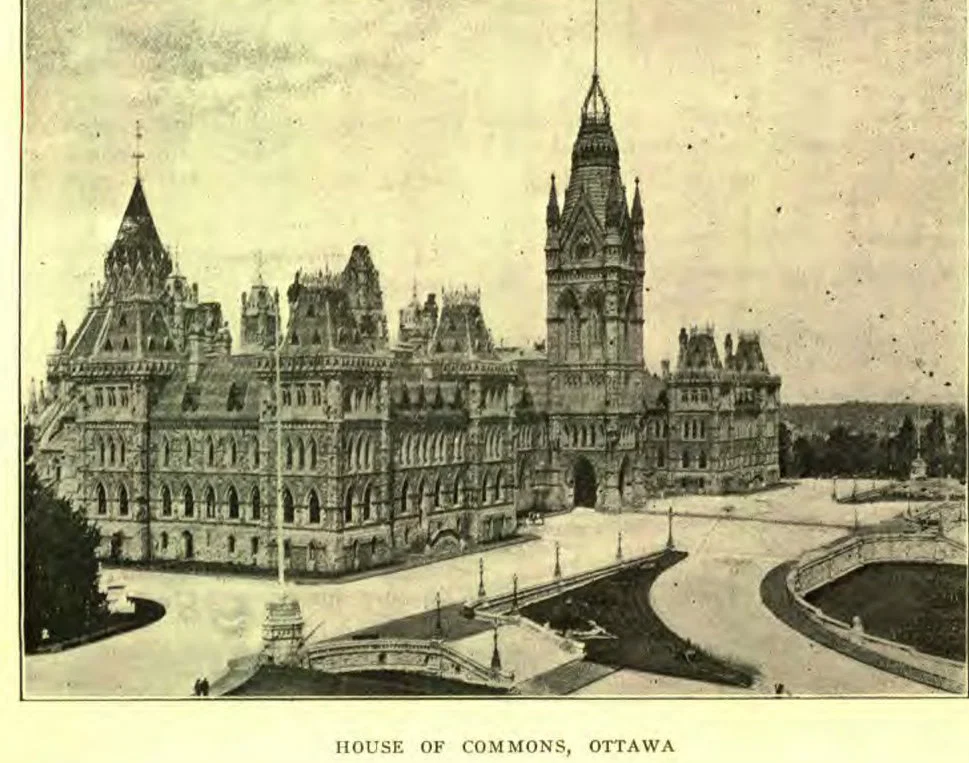
HOUSE OF COMMONS, OTTAWA
To write the history of Canada would be to give the annals of half a continent for four hundred years. Like the history of other lands, many romantic incidents could be given. Through its primeval forests, over its lakes and rivers, echoed the din of war of a revolutionary period between England and France. The discovery of the country is credited to John Cabot, who in 1497 landed at Cape Breton, in Nova Scotia. A French discoverer, Jacques Cartier, in 1534, discovered those portions of the Dominion now called New Brunswick, Prince Edward Island, and Quebec. Captain Cook in 1778 gave the first authentic record of the discovery of Vancouver Island and the Pacific Ocean coast. In 1603 Baron de Poutrincourt established the first European settlement at Port Royal, Nova Scotia. After an obstinate struggle the national duel between France and England ended when General Wolfe, with nine thousand English troops, scaled the Heights of Abraham on Sept. 12, 1759, and successfully stormed the ramparts of Quebec. A notable incident in this battle was that both General Wolfe and General Montcalm were killed. The Treaty of Paris in 1763 closed the struggle, and Canada, with all her dependencies, has ever since been under the flag of Great Britain.
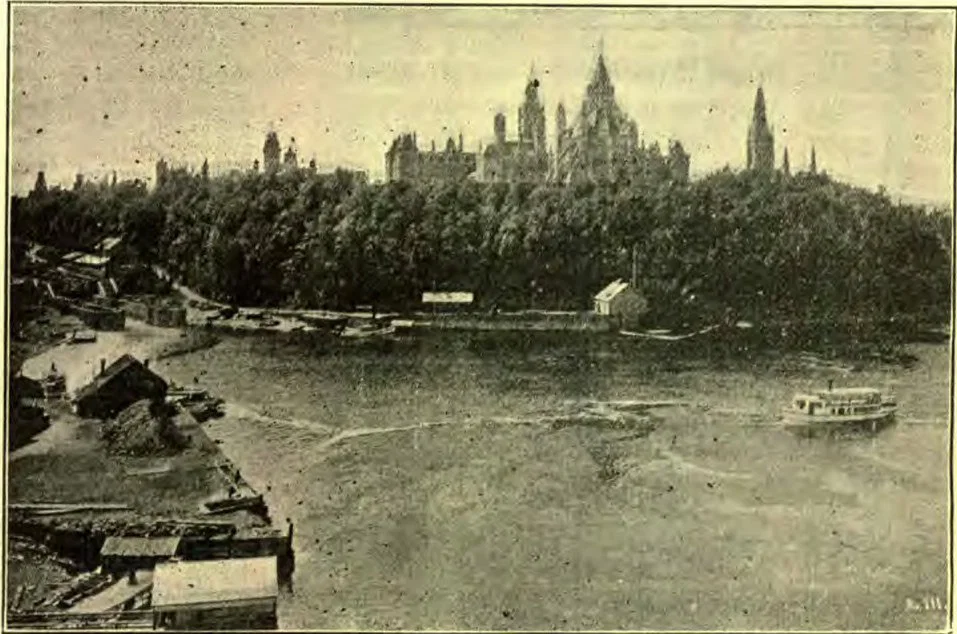
FROM NEPEAN POINT, OTTAWA
The country is rich in resources, and should time continue long, would doubtless have a great future. The surface, generally speaking, is a level plain, broken here and there with hills of no great elevation. Many virgin forests yet remain, and lumbering is a great industry. The agricultural area is well adapted to raising grain, and fruit grows abundantly in some sections. The winters, of course, are cold, but generally speaking, the climate is healthful, some places in the Muskoka Lake region being highly recommended for pulmonary diseases. Much of the country is prosperous, and everywhere the hum of industry and manufacturing is heard. The cities are substantially built, and many of the smaller towns and villages have an aristocratic appearance. Montreal, with a population in 1901 of 267,730, is the largest city. Toronto, called the “Queen City,” is a beautiful place, containing a population of 208,040. Over eighteen hundred miles of railroad is being operated, and other extensive lines are being surveyed. Minerals, such as gold, silver, iron, coal, lead, copper, nickel, and others, are mined, and constitute a considerable revenue. The total amount of mineral products in 1902 was $64,970,732. The religious and educational advantages of the country are excellent. A system of free schools, similar to that of the United States, is maintained.
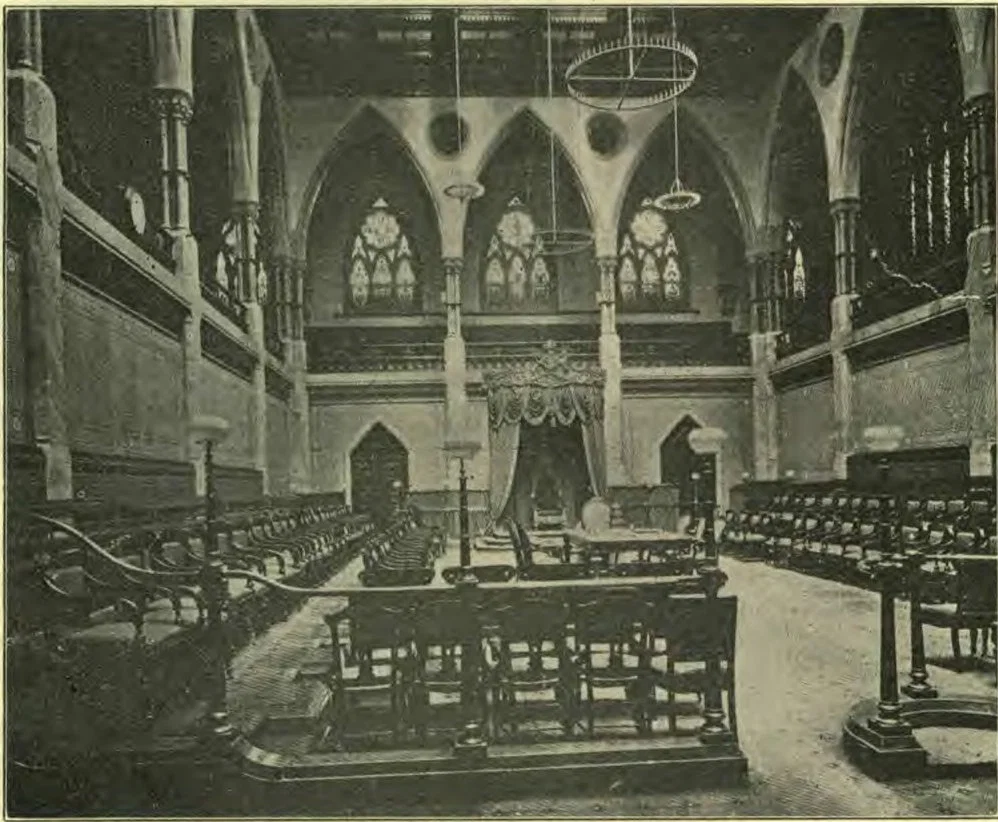
In 1867 the confederation of the provinces, comprising the whole of Canada except Newfoundland, was effected. Lord Monck was the first governor-general, and Sir John Macdonald the first prime minister. The governor-general is appointed by the Crown, and advised by a cabinet chosen from members of the privy council, of Canada, and consisting of fourteen members. The principles of parliamentary government are those of England. The senate is composed of eighty-one members, appointed by the Crown. The House of Commons consists of two hundred thirteen members elected by the people. The provinces and territories each have a lieutenant-governor, appointed by the governor-general in council, with a legislature. The Earl of Minto is the present governor-general, and the Hon. Wilfrid Laurier, a Liberal, is prime minister.
Since 1858 Ottawa has been the capital city; and has a population of over 60,000. Parliament Square, where the government buildings are located is the chief seat of interest, and is harmoniously and artistically laid out. The Houses of Parliament, with their attendant departmental buildings, are beautifully and substantially built of cream-colored sandstone, though not so elaborate as the Capitol at Washington. The buildings as they now stand are said to have cost about $5,000,000. Rideau Hall, the residence of the governor-general, is situated in a pleasant park on the outskirts of the city. It was once the residence of a lumber king, but has been enlarged by successive additions.
The sessions of Parliament usually begin in February or March, and then, like other capital cities, Ottawa is the center of political life, and thronged with politicians, statesmen, “wire pullers,” and lobbyists. Decked in the garb of winter, the city presents a beautiful and romantic appearance. G. B. THOMPSON.

Word Studies

SANGUINE.—When you hear a person described as “sanguine,” you know at once that he is enthusiastic, hopeful, and of a buoyant disposition. The word “sanguine” is from the Latin sanguis, signifying “blood,” and reminds us of an idea held nearly two thousand years ago. According to the ancient school of medicine, a person’s temperament was governed by the excess of certain fluids in the body. If he had an excess of bile, he was choleric, or easily irritated. If he was depressed and morose, it indicated the excess of black bile (melancholy). If phlegm abounded, the person was of a sluggish, heavy disposition. With fulness of blood was supposed to go a cheerful and vivacious spirit. From this fact we have come to use sanguine (the Latin for blood) to indicate a confident, ardent disposition.
INFANT.—It distresses every one to see a little baby ill. It seems sad for the tiny creature to suffer and waste away and be unable to speak to us and tell where the pain is. It may not surprise you that this helplessness struck some one else long ago. The word “infant” itself shows this. It is derived from two Latin words, in, “not,” and fans, from fari, “to speak.” So an infant is literally a little baby that can not talk. What a helpless picture Tennyson’s lines gives us:—
“An infant crying in the night, An infant crying for the light, And with no language but a cry.”
SUSPENSE.—Nothing is more wearing on the nerves than suspense. Even little people know something of this word. They ask mother to let them do a certain thing that they are anxious to do, and she says that she will “think about it,” and tell them to-morrow. They run away, and they think about it, too, until the minutes grow into hours, and the time seems long indeed. They would almost rather have mother say “No” than to endure the suspense any longer. Now recall what the word means, and you can appreciate the etymology of it. The word is from the Latin sub, “under,” and pendere, “to hang;” so it means to be swinging from something above. The uncertainty and restless feeling suspense gives is sometimes almost as painful as the physical torture of being swung up by the thumbs.
PALMY.—When we hear of “palmy days,” we in this region generally think of the days “before the war.” The palm is a symbol of victory, and the expression “palmy days” indicates days of prosperity. We have borrowed the figure from the Eastern custom of celebrating a triumph. The victors, with palms in their hands, formed in a procession, and trumpets sounded the approach of the triumphant army. The people of the East are very fond of the palm tree. It means so much to them, sometimes providing both shelter and food. After traveling through the desert, the Arab takes heart when he sees in the distance a clump of palm trees; for this means that an oasis is not far off, where refreshment and water can be secured. To him the palm is the symbol of everything flourishing and prospering. We need no longer dream of the days “before the war” as the “palmy days” of our land. Many priceless things are gone which can never be redeemed, and a halo of glory rests on the splendid memory of the Old South. But the New South has risen from her ashes, and entered on an era of prosperity in many ways such as our fathers never dreamed of. She is developing as never before her mineral resources, increasing her manufactories, farming more intelligently, and building more schools and libraries.
SENATE, PARLIAMENT BUILDINGS
PERNICIOUS.—Many people have a way of painting things in too glowing colors, or rather of describing things in exaggerated language and expressing themselves in too intense a style. One naturally divides in half the statements of some people to get a fair account of the matter described. Well, some of our English words are as much exaggerations as are the statements of some people. We find that “astonish” means literally “thunderstruck;” “mortified” has mors, “death,” as its root, and “nuisance” is a positive injury. “Pernicious” is in the same class of words, and literally means “deadly,” coming, as it does, from the Latin per and neco, “to kill.” In reality the word is much milder in meaning. We speak of pernicious books, pernicious habits, both of which are harmful but not necessarily destructive to life, not to the physical at least.
CANVASS.—When the candidates for political office begin their campaign, we realize what canvass really means. It is from an old French word which means “to search out,” “to examine,” “to run through a sieve.” The candidates sift out the voters in a community, and try to win their esteem and their votes. The idea of sifting is seen in the root word cannabus, which indicates “hemp.” It soon came to mean coarse cloth made of hemp, and then a strainer made of this cloth. From this came our present use of the word—to sift or examine closely.
BUREAU.—When we are told that our word “bureau” comes remotely from a Greek word (pyr, meaning “fire”), it seems almost incredible. Yet we can trace it through various stages of growth from this root. The Latins borrowed the Greek word, and made from it burrus, “fiery red.” After this we find the French changed the form into buire, meaning “reddish brown.” From this it is but a step to the French word bure, “a drugget,” or “coarse brown woolen cloth.” This material was often used for covering writing tables, and in time these tables and the rooms in which they were kept were both called bureaus. As these writing tables were used by the government officials to keep important documents in, it soon became customary to call the different departments of the government bureaus, as the Bureau of War, the Bureau of Finance. We also use bureau to mean a chest of drawers in which clothing is kept. Both of these senses seem far removed from the original root word, pyr, “fire.”—Kathleen L. Willson.

The Story of a Word

EVERY one is familiar with the little black pictures that we know as “silhouettes;” but few of those who use the word know that they are named in ridicule of a French statesman, Etienne Silhouette. He had charge of the money matters of France at a time when the nation was very deep in debt, and to prevent bankruptcy he tried from the first to be very economical in his policy. But economy is not one of the virtues of the French, and they lost no time in making fun of him. They had their clothes cut in a fashion that took very little material, and called them a la Silhouette, and they introduced, in the place of delicate paintings, a cheap kind of portrait made by drawing around a person’s shadow and filling in the outline with black, and this they called a “silhouette.” At last they succeeded in making life so unendurable to the poor man that he gave up in despair. And now everything else about him is forgotten, and it is only in the joke of his opponents that we keep his name.—Constance Fuller.

Imperfectus: A Poem on Earthly Imperfection

Imperfectus

I WONDER if ever a song was sung But the singer's heart sang sweeter! I wonder if ever a rhyme was rung But the thought surpassed the meter! I wonder if ever a sculptor wrought Till the cold stone echoed his ardent thought! Or if ever a painter, with light and shade, The dream of his inmost heart portrayed!
I wonder if ever a rose was found, And there might not be a fairer! Or if ever a glittering gem was ground, And we dreamed not of a rarer! Ah! never on earth shall we find the best, But it waits for us in the Land of Rest; And a perfect thing we shall never behold Till we pass the portal of shining gold.
—Selected.

What Is Your Aim? the Ministry?

In the days of youth we prepare for work in after years. The Lord has given definite talent to every person, and “to every man his work.”
I can not say that one line of legitimate work is more important than another, since the same God that has the control of the entire work, has distributed the talents according to the needs of the various branches.
Since the Master has given to every man his definite work, and talent to occupy with success that definite field, it is clearly evident that every person, by coming in close touch with Christ, who gave the talent and planned the life-work, can know to what work he has been called. In other words, every youth should have an aim in life. An aimless life is like a rudderless ship adrift on the great ocean. It reaches no destination.
Jesus, the author of life, gave us an example of its purpose. From childhood to death he had a definite aim. He came “to seek and to save that which was lost.” Whether at study, at the carpenter’s bench, or talking with the woman at the well of Samaria, healing the sick, or preaching the gospel, he had but one purpose,—the salvation of the lost. With this aim, his work as a minister preaching the gospel, was no more honorable than his ministry as a carpenter. It was the work of a true minister throughout. He was as devoted to his mission and as truly a missionary when a carpenter, as when preaching the gospel in Jerusalem.
The background for the ministry is laid in the home life. Preaching is but a small part of it. It is a life of self-denial, of earnest, faithful labor. He who engages in it from thoughts of selfish ease, is sure to fail.
The call to the gospel ministry is a call to service, with all power in heaven and earth given for the accomplishment of this purpose: “Go ye therefore, and teach all nations, baptizing them in the name of the Father, and of the Son, and of the Holy Ghost: teaching them to observe all things whatsoever I have commanded you: and, lo, I am with you alway, even unto the end of the world.”
Paul describes the work of the ministry to be the work of carrying a gospel that is able to deliver the receiver from the power of darkness, and translate him into the kingdom of God’s dear Son, “whom we preach, warning every man, and teaching every man in all wisdom; that we may present every man perfect in Christ Jesus.” What more honorable calling can engage our ambition than such opportunity of labor for our fellow men? What can more strongly appeal to us than a call to a life laden with such opportunities,—a call to co-operate with the Master in taking souls from the kingdom of darkness and translating them into the kingdom of Christ, and presenting every man perfect in Christ Jesus?
This call is so worthy that it is accompanied with the exhortation, “Give thyself wholly to them; that thy profiting may appear to all.” “Take heed unto thyself, and unto the doctrine; continue in them: for in doing this thou shalt both save thyself and them that hear thee.” But “the husbandman that laboreth must be first partaker of the fruits.” A call so important that we are instructed that it is worthy of our efforts to the exclusion of every other thing, and one which carries the assurance of saving ourselves and those that hear us,—such a call can not be considered of secondary importance. It stands unsurpassed in opportunities for doing good. It is a call to stand in Christ’s stead and offer the word of life to a dying race. It invites us to labor publicly and from house to house; it draws upon our undivided effort so strongly that it invites us to surrender the financial care of the church affairs to the deacons, that we may not be drawn from the Word of God to serve tables. It leads us into the palaces of kings and the cabins of the lowly. It bids us enter the chariot of the wealthy, and work with the poor in their poverty. It calls us to stand before the bridal pair at the altar, and mingle in the joys of the marriage feast; and it calls us into the chamber of sorrow to “weep with them that weep,” and to “lay hands on the sick” that they may recover. It lays open the entire world as our field, with fathers and mothers and sisters and brethren in every land to welcome our coming. It gives us at last a welcome from Christ our King through those pearly gates into the New Jerusalem, with all the sheaves representing our life-work.
It is a work so intensely interesting that the angels desire to look into its plan of operation; and the Son of God left the throne of the universe for the privilege of sharing its labors and reward. The work was regarded so honorable that Christ felt that no greater honor could be attributed to his Father than to testify that in this world “I and my Father are one.” “He that hath seen me hath seen the Father.”
Is not the call to the gospel ministry, which affords so great opportunities for time and eternity, a most worthy aim for our young people? That the youth are included in this call we are assured: “Let no man despise thy youth.” Who will respond, and till Jesus comes, give himself to reading, to exhortation, and to doctrine, studying to show himself “approved unto God, a workman that needeth not to be ashamed, rightly dividing the word of truth,” ready to “endure afflictions,” to “do the work of an evangelist,” and to “make full proof of thy ministry”? Such a calling makes it possible to close life’s labors with the sweet consolation, “I have fought a good fight, I have finished my course, I have kept the faith: henceforth there is laid up for me a crown of righteousness, which the Lord, the righteous judge, shall give me at that day: and not to me only, but unto all them also that love his appearing.” R. C. PORTER.

All Honor to the Hen

THE hens of the United States produce enough eggs in any two days to give one to every human being from Alaska to Porto Rico, not leaving out the Eskimos of Bering Straits.
Forty-two and one-half millions of eggs a day is the average now. That gigantic one day’s work weighs 2,658 tons, almost as much as the tonnage of a United States cruiser like the “Atlanta.”
While industrial combinations and financial operations have filled the air with their clamorous processes, the hen has scratched along in humble privacy, and she has beaten even the record of King Wheat; for the value of her modest specialty has turned out to be greater than the value of the whole wheat crop of twenty-eight States and Territories in one year.
The gold- and silver-mines of the country aren’t worth mentioning in comparison with the simple bird. Only once in fifty years has the value of the gold and silver of the United States beaten the value of its eggs.
The value in dollars of that noble aggregation of laying talent is $70,000,000.
The wonderful flock of birds laid more than one and one-quarter billion dozens of eggs in one year. These figures are not “estimated;” they are exact statistics collected through the various departments of the government day by day as the eggs were put on the market.
This number would entitle every man, woman, and child in the country, from the Pacific to the Atlantic and from Canada to Mexico, to two hundred three eggs in the year.
Counting the hens of egg-laying age alone, Uncle Sam’s men find that these industrious and non-striking workers have produced almost $137,000,000 in the form of marketable progeny, and a little more than $144,000,000 worth of eggs,—the exact total of their production in dollars is $281,178,247,—and that, on the original valuation of the “plant” of $70,000,000 means, the American hen has produced four hundred per cent on the original investment, with a little bagatelle of $1,178,247 left over for pin-money.
Steers and cows by the thousands stream into ships at wharves in Boston, New York, and Baltimore. Mules and horses in unending procession day after day go into ships in all the ports around the coast from Portland, Maine, to Galveston, Texas. And still more herds go into still more ships on the Pacific shores.
Hogs and sheep and mules and cows and steers and horses—count them, watch them trampling, rushing to the sea, and then turn to the figures gathered by the Census and Treasury Departments, and find that all that jostling, never-ceasing stream of stock from millions of acres of pasture, does not amount in value to one quarter of the value of the eggs laid by the little hen. And if you add the value of the hen herself to the value of the eggs, that whole aggregation does not amount in value to one eighth of what fowls and eggs are worth.
Now sweep your eye over the vast extent of continent from the great ranches under the Rocky Mountains, over the plains of Texas, over the domains of railroad and slaughter-houses from Omaha to Chicago. Take in with it the immense city of Chicago itself, with its duchies and principalities of stock-yards. The combined weight of the products of these do not come within 130,000 tons of the weight of the eggs laid during the year in the United States; for the weight of all those animal products is “only” 846,860 tons; and the weight of the one and a quarter billion dozens of eggs, at the average weight of eight to the pound, is 97,363 tons.
Not so many years ago, in the midst of a battle over tariffs, the whole country was shaken by the fight over wool; and it was well worth while, for the wool product amounts to forty-five and three-quarter millions of dollars annually. But the poultry sold in a year exceeds that by ninety-one millions, and the eggs by ninety-eight and a half millions of dollars.
All the gold and silver that engineers and miners and sluices and dynamite and thundering stamp-mills have wrested from a whole continent do not equal in combined value, year by year, the value of the tiny, white oval that is gathered in aprons and baskets every morning in every hamlet, without a single adventure that is worth the telling. Only in one year—that of 1900—since records were kept by the government, has it happened that the American mines surpassed the hen. In that exceptional year the precious metals were ahead by nine and one-half millions of dollars.
The hens therefore do a prosperous little business, exceeding most banks and speculators in percentage of income.—Evening Star.

Devotion to Duty as Life's Guide

“If one has devotion to duty for the guide of life's daily course, nothing can ultimately go wrong.”

The Chinese New-Year

(Concluded)
Besides the gambling and feasting at New-year, the Chinese find pleasure in driving, especially on the last two days of the two weeks devoted to the New-year celebration.
They have either their own or their hired carriage, which here consists of a two-wheeled cart something like a low “dog-cart,” drawn by a native pony. These small horses are very fast, and the manner in which they go tearing about the principal streets is frightful. The Chinese are fond of racing to see whose pony is the fastest, showing again that depraved tendency so prevalent in the human heart to get ahead of some one. The innate selfishness of the pleasure which consists in another’s defeat is of the same character as gambling. Nor is it confined to Orientals by any means.
It is almost hopeless to try to interest these people in eternal interests; for when you tell them that they must give up gambling, opium-smoking, drinking, and worse indulgences, they regard you as an ascetic, and laugh at you for imagining that they can be fooled into giving up all the pleasure there is in life, becoming the objects of universal hatred and reproach. They can not believe that we are actuated by unselfish motives, therefore they seek for some ulterior object in our efforts to Christianize them.
Timothy, my native helper, who, by the way, is a thoroughly converted and godly young man, set sail for China, in order to study the Chinese language. One day since his departure I was in the Chinese quarter, and I met a man whom I did not recognize, but who knew me. He asked me to employ him in Timothy’s place to preach the gospel, because he knew the Chinese and Malay languages well. But I said, “You are not a Christian; how can you teach a religion you do not believe?” “O, you pay me for it, and I will become a true Christian,” he replied. When I told him what it meant to be a Christian and tried to show him how much it meant, he was not in the least daunted, but affirmed that he would walk straight and lead a holy life. From my familiarity with the Chinese character I knew full well that if I were foolish enough to take him up at his offer, he would not hesitate a moment to assume the most solemn obligations, and all the time be living in sin just as he is now, but trust to his ability to deceive me in regard to his real character. It made me sad to think how mercenary he was, and what little hope there is of saving such men. I can do nothing. If the Holy Spirit does not produce conviction, not a solitary heathen will be saved. There are a great horde of “Christians” that are simply so in name, for the sake of the loaves and fishes in the foreign fields among the different missions. That there are many true disciples of Christ is not to be doubted for a moment, but there are more that are not.
It is the fashion in America, at least for men, to “swear off” their drinks, and to make New-year resolutions, which are broken almost in the making. Now and then, it may be, can be found a man who really means to reform, but as a rule all such resolutions are made with no thought of trusting in God to save from relapsing into sin, and have no higher motive than one’s own advantage.
I have no reason to suppose that the Oriental ever makes any New-year resolves. Nor do the European rulers furnish the native races with any incentive to a higher and nobler life. Indeed, the example and influence of these “Christians” is mischievous and hurtful so far as the question of religion is concerned, nor do they care anything about these things; in fact, they are sorry to see the missionary come into their midst, and are glad when he goes away.
The New-year has come and gone, and the Chinese have settled down to the business of money-making and money-losing for another year.
There are few Chinese, relatively speaking, here in Padang when compared with Samarang, Sourabaya, Batavia, and other towns in the Dutch East Indies.
There is a wide field among them, and in Java very many more have become Christians than even in the Straits Settlements, the English colony lying just to the north of Java.
I am hoping erelong to visit Java, and see what opening there is for a mission in one of these larger centers of Chinese population. Will not the readers of the INSTRUCTOR pray earnestly that God will direct and bless us in this purpose to carry the gospel to the regions beyond?
R. W. MUNSON.

Young People's Society of Kingston, Jamaica

WE have had a Young People's Society here for some time. In 1903 the young people were in a lukewarm condition—indifferent to their highest trust; but the Lord in his goodness did not leave us to go on thus, but kept lovingly, tenderly calling us, and in January, 1904, we reorganized, and to-day we have an active and earnest Society of forty-nine members. Twenty-five of these were added during the past quarter.
We are holding cottage Bible readings, visiting the sick, endeavoring to increase the attendance at our services, giving away and lending tracts and periodicals, and selling small books, also the Caribbean Watchman and Good Health.
We hold our meetings every fortnight, at which time we have Bible readings by two or three members on different subjects. We are studying some of the Bible characters and the lives of some of the Reformers.
Our aim is to hasten the spread of this glorious message.
M. LUTHER TOMLINSON.

For the Student

A YOUNG student was very ambitious to gain a certain rank in his class which would entitle him to a scholarship. A well-known professor was interested in the lad’s success. He instructed him in a part of his studies, and found him a very bright student; so he thought it possible for him to gain his purpose, though it meant perfect marks for him in everything for a whole year.
“Nobody gets perfect marks for everything,” the boy objected.
“That is nothing to the point,” said the teacher. “You are perfect in my recitations. Do as well in others. But I notice that you write poorly. Now begin there. Whenever you form a word, with either the pen or tongue, do it plainly, so that there will be no mistake. This will help you to think clearly and to speak accurately. Let your whole mind be given to the least thing you do while you are about it. Form the habit of excellence.”
The student went resolutely to work. He gained his scholarship, and, more than that, he acquired character that has since won him a shining success.—Selected.

Bitter the Hour: Friendship's Betrayal and Faithlessness

BITTER the hour wherein thou must Thy friend's disloyalty confess; But bitterer still when friendship's trust Is met by thine own faithlessness! — Emma C. Dowd.

News from Arizona

At Nogales, Arizona, is a company of Mexicans who are earnestly and faithfully carrying forward the work of their Young People's Society. Though they have had various obstacles to meet, their interest in the truth, in the Bible studies, and missionary work has not been allowed to wane. They have sold the “Gospel Primer,” distributed tracts, and given away some books.

Young People's Society of Perkins, Oklahoma

Our membership here is only eight; our attendance, however, averages from twelve to fifteen. We meet every Friday evening, taking up the study outlined in the Instructor. That the lessons are appreciated is shown by the intense interest manifested by all present.
Our facilities for active work are few; but we have tried to do our best, and are therefore of good courage. Having given our “mite,” we enjoy the work, and feel sure the Lord is blessing our efforts to interest persons in their soul’s salvation. We took one hundred fifty Signs and fifty Life Boats, to distribute in town, and meet with success in disposing of them. We have a reading-rack in the post-office, and are also sending papers and tracts by mail, and corresponding with those to whom we send them. I know that all have an important part to act in this closing message, and it is my prayer that as young people we shall aid in carrying out our aim—“The Advent Message to All the World in this Generation.”
HATTIE McPHEE, Secretary.

The Light That Is Felt

A TENDER child of summers three, Seeking her little bed at night, Paused on the dark stair timidly. “O mother, take my hand,” said she, “And then the dark will all be light!”
WE older children grope our way From dark behind to dark before; And only when our hands we lay, Dear Lord, in thine, the night is day, And there is darkness nevermore.
Reach downward to the sunless days Wherein our guides are blind as we, And faith is small and hope delays; Take thou the hands of prayer we raise, And let us feel the light of thee! — J. G. Whittier.

THE WEEKLY STUDY

God’s People Delivered

(To be continued)
CHAPTER STUDY: “Great Controversy,” Chapter Forty, the first five and one-half pages.
LESSON TOPICS:—
Formation of the last great “union.”
Object of the union.
Union aided by supernatural forces.
Union methods.
The interposition of God.
The heavenly scene presented to the righteous.
Time of deliverance.
Nature’s part in the conflict.
Breaking of fetters.
Day of God described by the prophets.
The star of hope.
The shield of the righteous—“Those who have sacrificed all for Christ are now secure, hidden as in the secret of the Lord’s pavilion.”
The song of triumph. Ps. 46:1-3.
The vision in the heavens.
Result of the vision.
Continue reading: “A Merry Heart Doeth Good Like a Medicine.” —Prov. 17: 22