The Youth’s Instructor, Vol. 64, No. 46.

Miscellaneous News Items from the War Era

The Youth’s Instructor

Nov 14, 1916

Review and Herald Publishing Assn. · Takoma Park Station, Washington, D. C. · Nov 14, 1916

Miscellaneous News Items from the War Era

Since the war began our exports have realized a net increase of $1,626,419,876.
The war has greatly benefited trade in Iceland, especially shipping, and has created the first millionaires in that country.
Recently a British ship on the way from New Zealand to Liverpool carried a half million rabbits for the use of English soldiers.
Prince Mahildo, brother of the king of Siam, wants to make Siam healthful. He is here to study public health at Harvard as a means to that end.
The “Christian Endeavor World” is enrolling in the Tenth Legion all persons who pledge themselves to pay one tenth of their income to the Lord.
Great Britain and France have spent, since the war began, more than a million dollars for spruce timber from Washington and Oregon to be used in the manufacture of aeroplanes.
The autoped, or foot auto, costs no more than a bicycle used to cost, goes over twenty miles an hour, and is light enough to be carried if one wearies of riding. The one using the autoped stands.
The League to Enforce Peace was born on June 17, 1915, at Philadelphia. Ex-President Taft is president of this league. Viscount Bryce of England now urges that the program of this league be adopted.
The first day of work in the Harvest Ingathering campaign by the faculty and students of South Lancaster Academy, brought in gifts to the sum of $375. Four young women who went to Boston to work came back with seventy dollars for missions.
An incomprehensible and almost unbelievable breach of good form was witnessed in one of our churches on a recent Sabbath,—three persons, one an adult and the other two youths, chewing gum throughout the church service! Rarely are those found who willingly subject the service of God to criticism by such questionable conduct.
On every school day of this year of 1916 more than 600,000 children of all ages storm the schoolhouses of New York City. This school army would make six cities of the size of Albany; would almost duplicate Boston; would make four cities of the size of Omaha, and two of the population of Minneapolis. In it lies the future of the greatest city of America.
More new schoolhouses are now being built in Oregon than ever before in the history of the State; and most of them are designed for the Portland system of teaching. This system is based on a belief that there is no average child, and that individual instruction is better than mass education. In the Portland schools there are eighteen ungraded rooms for pupils who work either too slowly or too rapidly for the regular grades. Fifteen pupils is the limit for each of these rooms, and progress is individual. There are also rooms for pupils who are too slow even for the ungraded rooms. Another feature of the Portland system is that teachers are promoted with pupils, so that one instructor carries the same children through several grades. The National Education Association has recommended the Portland plan as a model.
The United States has not made reply to Japan’s last note, presented to our State Department more than three years ago. Japan has not pressed for an answer, and will not so long as the European war lasts. But the Oriental problem still exists. The mission board secretaries, returned missionaries, and distinguished laymen united in urging the President of the United States to establish a commission to take up Oriental problems. It is suggested that the governments of both Japan and China be invited to appoint similar commissions, and that the American commissions go to both Japan and China to meet these commissions in their respective lands, study the problems separately in the atmosphere of each country, and then report suggestions for action by our government and people.
As early as 1865 sulphur was discovered in Calcasieu, Louisiana, but it was found to lie under a bed of quicksand 500 feet thick, and attempts to mine it were abandoned. Some thirty years later Herman Frasch conceived the ridiculously simple idea of pouring hot water down a driven pipe perforated at its bottom, dissolving the sulphur and pumping it out so pure that it needed no refining. Many such pipes are now in operation there, two firemen and one water tender taking care of the battery of boilers at each well. Stock to the amount of $200,000 is held by the Frasch family and three others, and it is said this earns not less, probably much more, than $2,400,000 annually.
A dry antiseptic shampoo may be popular, but it is not safe. Only recently a woman in a smart New York hotel was being given such a shampoo. As the liquid was being poured upon the hair, it burst into flame. The attendant fainted, and the accident undoubtedly would have resulted fatally had it not been for the woman’s own presence of mind in wrapping a towel about her head, and the timely passing of a man who tore down a wall fire extinguisher and turned it upon her. But the woman was made seriously ill, is yet nervously prostrated, permanently scarred on her face, hands, and body, and totally denuded of an unusually beautiful head of hair.
The new “Harahan” bridge, spanning the Mississippi River at Memphis, said to be the largest structure on the river, is now open for traffic. Including the approaches, it is three miles long, the bridge proper being 2,600 feet. Its cost was approximately $5,000,000. Construction was begun in 1913.

Himself He Cannot Save

ELIZABETH ROSSER
He saved others. The sin-sick world was teeming With human wrecks that groaned toward the grave. The love and pity from his mild eye beaming Sent new life currents through the veins quick-streaming— He saved others. Himself he cannot save.
He saved others. Their want and woe distressed him. The rich, the poor, the free-born, and the slave, The young, the old,—alike they thronged and pressed him; Alike he healed them all. They loved and blessed him. He saved others. Himself he could not save.
He saved others. On Calvary see him dying; For the unjust, the Just, his life he freely gave. “Father, forgive them,” hear the Saviour crying, A ransom for their souls his blood supplying. He saved others. Himself he could not save.
He saved others. Dear Lord, our hearts are broken To see thee going, willing, to thy grave. May this be of thy followers the token, That, as of thee, so of us, be it spoken, He saved others. Himself he could not save.

Antioch on the Orontes

C. C. CRISLER
PROMINENT among the cities of the ancient world so well known by Paul the traveler and missionary evangelist, was Antioch on the Orontes. The student of Bible geography may be interested to learn that this city was named in honor of Antiochus, an associate of Alexander the Great on his Asiatic expeditions. Fifteen other cities, all known as Antioch, were founded in honor of this same Greek general. The name of the wife of Antiochus was immortalized by six Laodiceas, and the name of his son, Seleucus Nicator, by nine Seleucidæ.
Of all these cities, the largest and by far the most important was Antioch on the Orontes; and it is at this place that the interest of Christians naturally centers. Here it was that the followers of Jesus of Nazareth were first called Christians; here Paul and Barnabas made their headquarters. Thus Antioch “became the mother city of Gentile Christianity. . . . According to tradition, Peter was for two years bishop of Antioch.” (See “Standard Bible Dictionary,” art. “Antioch.”)
“The city which was thus the scene of some of the momentous passages of that great drama which we speak of as the rise and progress of Christianity, might well claim our notice,” says Dean Plumptre in “St. Paul in Asia Minor,” chapter 2, “if only as furnishing the background and the surroundings amid which the actors in that drama played their part. At that time, however, it commanded the attention of travelers and historians on quite different grounds. Of all the cities that owned the sovereignty of Rome it occupied all but the highest place, second only to Alexandria in its fame and greatness. Though it could not boast the remote antiquity of Damascus, or of the old imperial cities on the Tigris or the Euphrates, which had been the centers of the Assyrian and Babylonian monarchies, its career up to this time had been one of unchecked prosperity. The beauty of its position, the grandeur of its buildings, the culture for which it was preëminent among the cities of Asia, drew thither visitors even from the remoter West.”
“The choice of the site of Antioch gave proof of a sagacity of the same kind as that which fixed on Alexandria and Constantinople as the seats of empire. Its position in the angle formed by the Syrian and Cilician coasts, and in the valley through which the Orontes flows between the ranges of the Lébanon and the Taurus, made it a natural link connecting the eastern with the western provinces of the kingdom. Its port, Seleucia, opened to it the commerce of the Mediterranean, while the caravans that carried on the land trade with inner Asia came to it from Mesopotamia and Arabia. . . .
“When the dynasty of the Seleucidæ fell before the arms of Pompeius (B. C. 65), the city, as the capital of the Roman province of Syria, entered on a new stage of greatness.
“The name of the victorious rival of Pompeius was perpetuated by an aqueduct and baths, and by the basilica known as the Cæsareum. Agrippa, the minister of Augustus, added a suburb to the prosperous city, and Herod the Great, seeking, there as elsewhere, the favor of the emperor and the praise of the people by the munificence of his gifts, paved the street that ran through the city, and which till then had been comparatively mean and poor in its surroundings, with marble, and erected on either side of it the colonnade which, when Antioch comes before us in Christian history, was the chief place of public resort. Tiberius, as has already been said, built or restored the walls; and even the short reign of Caligula was made memorable by the construction of an aqueduct and public baths.
“No description of Antioch, however, would be complete without some notice of the grove and temple at Daphne, dedicated to Apollo and Artemis. The well-known description given by the historian of the ‘Decline and Fall’ is so vivid and complete, that it will be better to reproduce it than to attempt a paraphrase in words which could hardly fail to be feebler.
“‘At a distance of five miles from Antioch, the Macedonian kings of Syria had consecrated to Apollo one of the most elegant places of devotion in the pagan world. A magnificent temple rose in honor of the god of light, and his colossal figure almost filled the capacious sanctuary, which was enriched with gold and gems and adorned by the skill of the Grecian artists. The deity was represented in a bending attitude, with a golden cup in his hands, pouring out a libation on the earth. . . .
“‘The perpetual resort of pilgrims and spectators insensibly formed, in the neighborhood of the temple, the stately and populous village of Daphne, which emulated the splendor, without acquiring the title, of a provincial city. The temple and the village were deeply bosomed in a thick grove of laurels and cypresses, which reached as far as a circumference of ten miles, and formed in the most sultry summer, a cool and impenetrable shade. A thousand streams of the purest water, issuing from every hill, preserved the verdure of the earth and the temperature of the air; the senses were gratified with harmonious sounds and aromatic odors, and the peaceful grove was consecrated to health and joy, to luxury and love.’
“The population of Antioch, like that of most Eastern cities of the empire, included many heterogeneous elements. ‘He who sits in our market place,’ said Libanius, in the fourth century, ‘may study the customs of all cities in the world.’ . . .
“What has been said will have been enough to indicate the general aspect of the city in its moral and social relations. The vices which made it a byword of reproach, even at Rome, were dark and flagrant. When Roman generals issued orders that any soldier found within the precincts of the groves of Daphne should be punished with immediate dismissal, we may well believe they looked on the orgies that were held within the precincts of the sanctuary as fatal alike to discipline and manliness. . . .
“The private life of such a city was sure to be on a level with its public profligacy. As at Corinth, so here, the preachers of a new faith would be encountered by a fathomless impurity. . . . The work which lay before the missionaries of the gospel and the preacher of repentance must have been at Antioch much as it was at Corinth. . . .
“It would be a labor at once of love and of surpassing interest to trace the working of the new leaven, operating, not to corrupt, but to purify, on this seething mass of corruption; to put one’s finger on the precise moment when the name of Jesus as the Christ, the Redeemer, and the Saviour, was heard there as a new element of life. This, however, lies almost, if not altogether, beyond the record of the apostolic work.”

The Perfume of the Soul

INFLUENCE is the essence of character, which we exhale as the perfume of flowers, its delicate odor and sweetness being determined by the qualities which we possess. There are many flowers having odors. Each kind has its own peculiar fragrance. Some flowers have an obnoxious, poisonous odor. We shun such plants as we would an enemy. Thus it is with the human flower plants. There are many who radiate an obnoxious influence, which is to others poisonous and beguiling. We should avoid association with those having such an influence as certainly as we would poisonous plants, for the effects might prove as fatal.
Surely no one would knowingly inhale the perfume of a poisonous flower. Why then should one be less particular about having one's mind poisoned by dangerous influences? Unless the sweet perfume of our soul can overbalance evil influence, we should avoid placing ourselves within a poisoned atmosphere.
The spices and most of the sweet-scented flowers belong to the warmer climates. Their sweetness is partially due to their prolonged contact with the sunlight and its drying heat. The essential oils of fragrance are thereby evaporated into the air, and their sweetness may be inhaled far and near. Breezes blowing from the spice islands waft the rich perfumes for miles around, and ships are aware of them long before reaching the harbors.
The sweet fragrance of our lives may also be intensified and evaporated as we prolong our contact with the Sun of Righteousness through prayer, and endure the drying heat of trials which are to evaporate our essential oils of grace, that others may thereby be blessed as they come within the sphere of our influence.
Poisonous plants and flowers are generally found growing in dark, shaded or low, swampy places. So do evil influences thrive best and make their rankest growth under the shadow of sin or in the sloughs of despond.
Let us therefore live in the sunshine of Christ's righteousness, and imbibe from him the rich, fragrant oils of grace, which will fill our souls with the sweetest of perfumes. MARY M. CRAWFORD.

The Reformation of a Republic

The Need of a Nation

THE first necessity in pioneer work is to awaken public opinion to the need of a reformation, and this was accomplished in Montevideo, the capital city of the republic of Uruguay, by means of a lecture given by Dr. Joaquin De Salterain, for twenty-five years official statistician in charge of the national archives.
According to the report presented in the Academy of Medicine in Paris, February, 1915, by Prof. Gilbert Ballet, France alone surpasses Uruguay in the number of saloons in proportion to the inhabitants, having one saloon for each 82 inhabitants.
Uruguay stands next, with one saloon for each 246 inhabitants; the United States has one for each 380 inhabitants; England has one for each 430 inhabitants; and Sweden has one for each 5,000 inhabitants.
The total number of drunkards in Montevideo reaches the maximum, especially among those in the period of adolescence. The number of licenses amounts to 10,000: 3,000 in Montevideo, and 7,000 in the departments of the interior. During the year 1913, 10,240 persons passed through the police courts of Montevideo for drunkenness, more than two and one-half per cent of the entire population, or 9,769 men and 471 women.
The director of the national asylum demonstrated that alcohol was the cause of twenty per cent of our lunacy. The latest figures available, those for 1911, give an increase in proportion of insane persons on December 31, as 1,506, in 361 of whom the insanity was entirely due to alcohol.
Added to these sad victims, the judge of crime of the second grade states that from 1900 to 1911 he had pronounced 653 sentences, of which 184 were for drunkenness. The judge of correction states that fifty per cent, or exactly half of his definite sentences, were caused by alcohol.
The judge of instruction of the third grade estimated that ninety per cent, almost the total number of cases of homicide, wounding, and attacks of personal violence, were due to alcohol.
The judge of crime of the first grade shows that for three years in succession the proportion of alcoholic delinquents rose from 24 to 32 and 36 per cent respectively.
More of these convincing figures might be added, but sufficient had been placed before the highly intelligent and patriotic people of Uruguay to awaken their determination to enforce a revolution in these matters in their cherished capital.

Revolutionary Measures

At the close of the lecture given by Dr. Joaquin de Salterain, and attended by the Ministers of the Interior and of Public Education, by the doctors and professors of the university, and many gentlemen holding high positions in the public service and bearing the highest recommendations in private life, together with their wives and daughters, more than 300 names were inscribed as members of the Anti-Alcoholic League.
A few days later, on the tenth of June, 1915, a meeting was called by the Señora Manuela de H. de Salterain, one of the most distinguished ladies of the capital, to hear a lecture by Miss Hardynia K. Norville, delegate of the World’s W. C. T. U., entitled, “Our World-wide Work.”
In the beginning of July, 1915, the president called a meeting in the Atheneum, in which the constitution and regulations were read and accepted, forming the committee of the National Anti-Alcoholic League of Uruguay. At this meeting Dr. Baltasar Brum, the Minister of the Interior, gave the opening address, “assuring the women and children that he was sure of the success of the association, since they were at the head of it.”
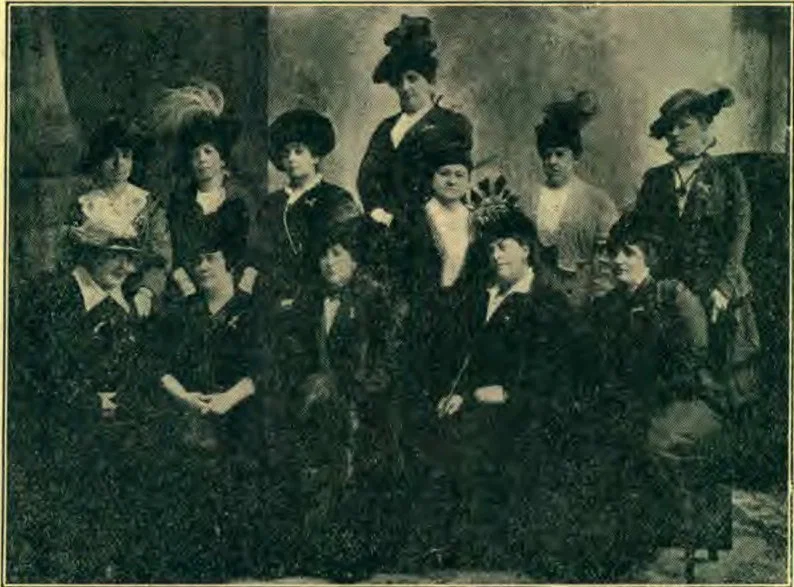
SOME OF URUGUAY'S LEADING TEMPERANCE WORKERS
The constitution consisted of nine articles, with the object, according to Article II, “of educating public opinion in favor of total abstinence, especially for the children, saving the drunkard, and endeavoring to arrive at the legal prohibition and complete destruction of the sale of alcoholic liquors.”
The pledge employed is the following: “I promise to abstain from the use of all intoxicating liquor, and to use every possible means to prevent its sale and use.” This pledge conveys all the privileges of active membership and confers the right to vote in all official meetings.
The organization of the society was further defined in twenty-one departments, beginning with the Cradle Section for babies and children under seven years of age. In this section all the mothers are total abstainers for the period of lactation, an immense gain over popular opinion and practice. Each baby is decorated with a tiny white ribbon bracelet, and each mother receives a certificate.
Of the Loyal Temperance Legion for children from seven to sixteen years of age, Dr. Jose Espalter, Minister of Public Education, is the honorary president. The Señorita Enriqueta Compte y Riqué, active president, enlisted the aid of twenty-five of the most prominent teachers of the public schools, organized temperance fêtes in the largest halls and theaters of the city, and prepared programs for the Gold Medal Contest, in which one pupil from each school took part.
The Young Women’s Department under the able presidency of the Señora Berta de Maria de Pratt, organized the young people of the city to take an active part in the struggle against alcohol throughout the whole country.
A Food Reform Department was included in one branch of the work, with the object of recommending a diet based on cereals, fresh and preserved fruits, and fresh vegetables, with a view to allaying thirst and proving that alcoholic liquors are unnecessary.
The department that attracted the most enthusiastic support was that of the mothers, presided over by the Señora Carmen Cuestas de Nery, the daughter of the ex-president of the republic. This devoted lady gathered round her a circle of sixty ladies, divided into five committees, and meetings for mothers were held in the largest theaters and halls of the city, for scientific instruction and social intercourse. The greatest triumph of all was when, in the public banquets and social gatherings, at which ladies of the highest rank were present, it became the fashion to turn down the wine glasses and decline champagne and wine of all kinds. To gain this vantage ground required the greatest tact, but inch by inch the idea of sacrifice for the sake of others grew and strengthened in the minds and lives of these noble women.

Liberty to the Captive

For the first time in the annals of this republic, prison doors were opened by special concession of the council of penitentiaries, jails, and correctional schools. The doors of the state prison opened to the messengers of good tidings, to admit as bearers of the good news the little children of the city. The young and innocent were admitted to bear witness by their bright young lives and happy faces as harbingers of hope to the captives of sin. A Christmas tree was decorated and lighted, and a program was given by the children, after which the six hundred inmates marched past to receive from the hands of little children their gifts of fruit and candies. Many tears were shed, and the pledge of total abstinence for life was taken by nearly all present. The director of the prison gave a short address, and aided in securing signatures to the pledge cards.
All the ministers of the government and their wives gladly gave their names as honorary members of this department.
The wife of the minister of war, the Señora Margarita de S. de Sanchez, one of the most active members of the central committee, is president of the Department for Work in the Army and Navy, and is untiring in her effort on behalf of the soldiers and sailors of the republic.

Temperance and the Produce of the Country

The government has already taken measures to convert the produce of the vineyards of the country from their present use to a more wholesome purpose. Ten years is allotted to the task of converting the wine industry into a temperance industry, such as the producing of dried grapes or raisins, and canning or preserving the grape juice. Generous concessions are made by the government to bring about this industrial reformation.
Meetings continue to be held in all these departments, with medal contests, which are greatly appreciated, and the influence of the Anti-Alcoholic League of Uruguay is already making an impression on all classes of society in the republic, demonstrating the fact that when the national government of a country awakes to its responsibilities, and unitedly combats this immeasurable evil of drink, a loyal and willing people will gladly follow its lead. It is our hope and aim that the larger republic of Argentina will soon follow the footsteps of her younger sister republic, and raise the flag of temperance in her vast domain.
Dear boys and girls, do not forget your brothers and sisters of the republics of the great southern continent,—the dark-eyed boys and girls whose hearts beat high with hope and patriotism for a brighter future for their well-loved land. Through many centuries of despotism and depression these people have fought their way to a recognition of their individual rights, and now they are fighting the harder battle of the right to refuse to accept the despotism and despoiling of the ruthless foe—alcohol. Send us your sympathy, remember us in your prayers, and let us feel, as we rejoice over each addition to the dry States of North America, that the goal of dry republics is not an unattainable ambition, but may soon be a glorious reality.
May the Stars and Stripes point the way for the Blue and White to wave over many a gallant band of loyal legions, loyal to God and home and native land.
HELEN M. STEWART.

How I Decided to be a Christian

When I was fifteen years of age, Elder R. arranged for a husking bee at his home shortly after the corn had been harvested. My brother and sister and I, with James and Alfred, neighbor boys, planned to attend. James and Alfred rode out with me in an open buggy, while my brother and sister started a half hour or more after we did, and drove out in the carriage.
The road to Elder R.’s took us within a mile and a half of town, before we turned west into the country again. As we neared this point my two companions began to talk about going to town. I did not like the idea, but James said, “I have to get something.”
Alfred argued, “We have a long start of them, and we will get there too early.”
“The earlier we get there the longer we shall have to enjoy the evening,” I said.
Then James insisted, “We can just as well go to town. We won’t stop long, and then we will get to Mr. R.’s about the same time the others do.”
At this I consented, and we went to town. After tying the horse, we walked up the street. James and Alfred were good-hearted boys, but they liked wine and whisky. When we came to the first saloon, they were determined to enter. Rather than remain on the street alone, I entered with them. Here it was warm and cozy. James did not wait to ask any questions, but ordered a beer for each of us, and I drank one with them. Alfred ordered another treat, but I would not take any more. So after they had drunk this we left the saloon and walked up the street till we came to another. Here I would not go in. I said, “I will go and wait for you in the buggy till you get through.”
James replied, “Come along; a little never hurts any one.”
Alfred followed with, “You cannot have a good time any younger, so you might as well start now.”
“I’ll wait for you in the buggy,” was my answer to these petitions, and went to the buggy. I untied the horse and drove up within a few rods of the saloon they were in. They soon came out, but only to enter another, which was the last; they had drunk enough to feel quite content. James, however, had a flask of whisky in his pocket and Alfred a bottle of wine. and it was by these that I was tempted again, and fell.
When we got back on the country road, they began to exchange drinks, and entreated me to join them. Soon I thought a little wouldn’t hurt, as they said, and took a few drinks from each. It was not that I drank more than they, nor half as much, that I played the part of a drunken debauch, but that I was not accustomed to liquor of any sort, and did not know its dreadful effects.
By the time we reached Elder R.’s, I was in a condition to act the clown, and to the few that were there who were cheap enough to take advantage of me, I was a laughing stock till lunch. When lunch was over, I attempted to go from where I was sitting to another place, but was not able. I staggered to my feet and fell to the floor, after which some of the boys carried me out, and the evening was over for me.
There were several at the bee who had never expected to see me in the condition I was in that evening, but they afterward treated me with respect, which was more than I deserved.
The next morning, I did not think of the preceding evening with the joy and pleasure I had anticipated, but rather with sadness and regret. My thoughts were busy. What did those present the evening before think of me? My sister merely mentioned to me how it grieved her to see me under the influence of liquor. I realized how it must have saddened her, and in the presence of so many other people, too, the majority of whom had high ideals.
The course of my brother meant more than if he had attempted to rebuke me. He left me to settle things for myself, and his silence led me to think more deeply than if he had come to me and told me what he very likely thought.
But my most serious thoughts were of my mother. I knew she was praying for me, although she was not at home. The question that came to me was whether I should remain in the associations of the world, or place myself on record with those who are looking for a home whose builder and maker is God. I knew that my mother would not cease to pray for me till her gray hairs should be laid in the grave. I knew her heart would be broken to see me in the pathway to destruction. These thoughts led me to decide that with the help of God and mother’s prayers, I would not be found in such a condition again; and to this day, which is several years later, I have not broken my pledge. Since then I have taken Christ as my leader, and I tell this experience only with the hope of helping some one else. P. C.

A Boy’s Day of Decision

It was a day in spring, a Saturday, and the mill hands in the New England village stopped work at noon. Forth from the stocking mill where he labored came Charley Jordan, happy to be out in the spring air with a half holiday at his disposal. Halfway down the street, he met his Sunday-school teacher, who stopped him for a moment, spoke pleasantly of the fine spring weather, asked him a question about his work, inquired if he would be in Sunday school next day, and passed on. Then, wavering a moment in her own mind, she turned with sudden impulse and faced him again.
“Charley,” she said, “don’t you think it is time for you to take a stand for the best things—I mean, you know, the things of the Christian life?”
He had heard sermons all his life, and was not unmoved by them, but this simple, direct word of his teacher touched a sudden chord in his heart. He was fifteen, more than two thirds of twenty-one. Life was pleasant to look forward to; the thing he was asked to do was a pleasant and beautiful one. He thought a moment, and then said:—
“Yes, Mrs. Beale, I think it is time. I will do it.”
He went to his home, as he had often gone before, and yet not the same. He had made a great decision, and had something to live up to. He had always been a clean boy and a thoughtful boy. He had few bad habits to unlearn or serious faults to forsake. What had he promised to do, and how was he to go about it, and what did it all amount to, anyway? When a man has been thoroughly bad, and makes such a decision, his course is reasonably clear; but what about a boy who has always been a good boy?
As to his outer conduct, it was not greatly different from before. But more resolutely he sought association with the better things about him. New and larger aspirations took possession of him, and found new impulse from within. He drew better books from the library, and sought the fellowship of the best young people.
He is still a young man, relatively speaking; but he has reached a position of influence and usefulness second to that of no man in the city where he now resides. Very recently, to a close friend, he told the story to the moment when, a care-free boy, whistling his way home from the factory, he paused to meet the simple question of his Sunday-school teacher, a question which she had asked with fluttering heart, and almost forbore to ask at all.
“It was the very opportune moment,” said he, “and although I was in no serious danger of going to the bad, it kindled within me a new aspiration, born of a new ideal.”—Condensed from the Youth’s Companion.

The Bible That was Chopped in Two

FAR away, in one of the Western States, a man used to go about selling Bibles and Testaments. Sometimes he was warmly welcomed at the lonely farms and homesteads; at others he was told that books of his sort were not wanted there.
One day a farmer asked him if he knew a settler near by, who delighted to talk against the Bible and those who believed in it. The colporteur took down the name and address, and before long, called at the settlement. He found the wife busy hanging out clothes, and she seemed pleased to chat with him. After a little conversation, he offered her a nicely bound Bible, telling her not to trouble about paying for it, if she would like to have it. She received it with pleasure, saying that if her husband would allow her, she would be delighted to keep it.
At this her husband came from the back of the log house, carrying a large ax over his shoulder. He saw the Bible in his wife's hand, and asked roughly, “Whatever do you mean by bringing such rubbish here?”
God's servant answered gently, and John Mason grew angry. The former spoke in such a frank and manly way that the settler did not return the book, but scowled as the man went off. Directly his back was turned, John seized the Bible from his wife's hand, saying, “Up to now we've had everything in common, so we'll share this, too.” And opening the Bible, and placing it on a block, he chopped it into two parts with one blow of his ax, giving his wife one piece, and he put the other part in his pocket and walked off.
Several days afterward he was in the forest hewing timber. At noon he sat on a log to eat his dinner, and feeling for a knife in one of his pockets, his hand struck on the book. He took it out, and before he knew what he was doing, he was deep in the fifteenth chapter of St. Luke.
Ah, he couldn't tell what happened then, though he longed to know, for just at that point the story had been cut in two by the angry blow of his ax, and he could read no further. When he returned home, he determined not to let his wife know how he was longing for her portion of the Bible. They had supper, and while she was washing the dishes, he said carelessly, “I say, wife, if you've got your part of the Bible handy I shouldn't mind having a look at it; I have nothing to read.” Mrs. Mason was a wise woman, so she said nothing, but quietly handed him her portion and went to bed early. The next evening he said to her, “This is the best book I ever read.”
Day after day passed, and still John seemed to be reading as for his life. At last one evening he put down his patched Bible, and said: “I give in at last! By God's help I'm going to try to live by that book. I've despised it; I've sworn at it; I've insulted it; but now the sword of God's Word has pierced my heart. It has taught me what a sinner I am. But it has also given me hope that there is pardon even for me.” His wife quietly clasped his hand, whispering: “I, too, long to know more about it all.”
Her husband smiled at her as he had rarely done even in their courting days, as he said: “We'll take it, won't we, Kitty, both of us together, from this day forward, as the guide of our lives? And pray God to help us that we may live by it.”
“We will,” answered his wife. “O John, this is a glad night!”
“Aye, it is,” he said, “and I believe it will be the beginning of brighter days to us. I've read things the last three weeks in that book that have amazed me.”
“What about?” asked his wife.
“About all that the Lord says he will do for those who serve him. I couldn't believe such things could ever be for the like of me, till he seemed to keep pointing me to the bits that told so plainly that he began it all by giving us the Lord Jesus as our own Saviour.”
“And to think you found it all in the book you chopped in two!” said his wife.
“Oh, shame I ever did such a thing!” replied her husband. “The very first day I can rightly leave, I'll ride over to the town and get it mended the best way money can do.”
“Would you like a new one better?” suggested his wife.
(Concluded on page sixteen)

The Bible That was Chopped in Two

(Concluded from page seven)
“No, let's keep this, Kitty, if you don't mind; no other could be to me what this has already become, and it will help me to keep humble to remember what I dared to do with my ax.”
“And I'd rather keep it too,” said his wife. “But, John, when you go to town, you get us two nice strong Testaments, that we can carry in our pockets, just to read at odd times, while you are in the woods and I about my work.”
“Grand idea, Kitty,” said her husband, “and I must bring a few bits of ribbon for markers. That Bible has at least twenty pages turned down at the corners, where I've found verses to study out again.”
For many years John and Katherine Mason lived, and the lives of those about them were richly blessed by the truths learned out of the Bible that was chopped in two by an ax.—Selected.
Continue reading: Learning to Swim