SWIMMING is one of the most helpful and effective of exercises, bringing almost every muscle of the body into wholesome play. Some go so far as to say that the teaching of swimming should be made compulsory in every school. As a life-saving device and disease preventive, it challenges wide attention.
The season for outdoor swimming is past, except for those fortunate enough to be living in the Southland; but some of our readers may have access to indoor swimming pools, and since the instructions may be preserved for future use, some rules for aiding one to acquire most readily the art of swimming are herewith given. Future issues of the paper may contain further lessons. Mr. J. H. P. Brown, in his book, “Modern Swimming,” gives the following suggestions and rules:—
“First learn how to float, and ascertain the buoyancy of your body. This knowledge will give you confidence to start the different strokes, for these are all taken from one or the other of the three floating positions.
“Breathe properly. The nose, not the mouth, is made to breathe with.
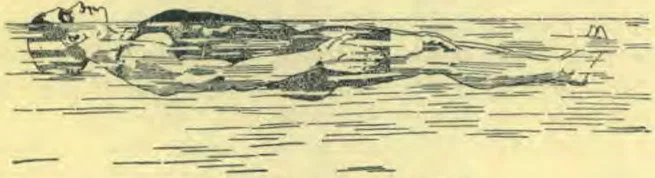
BACK-FLOATING POSITION
“Relax thoroughly. This is the whole secret of healthy, competent, and pleasant natatorial pastime. Tension tires, arrests progress, and injures the system.
“You cannot float unless you relax. Relaxation may be termed the keynote to all forms of buoyancy and propulsion in the water.
“Back-floating. This is the easiest form of floating, and will be the subject of our first lesson.
“Do not hesitate, go right at it. Walk out into the water up to the waistline, squat down slightly upon the legs, and facing the open, fall backward so as to lie upon the water. The head must hang loosely and sink to the opening of the ears; the arms should lie by the sides. Do not bother about the legs; if they are kept relaxed, they will take care of themselves. If upon the first impact with the water the head should sink so as to submerge the face, keep relaxed and remain perfectly quiet, and the body will balance itself so as to make you feel at ease.
“Fill the lungs as you drop to the surface; exhale when you are comfortably positioned upon it, after which you should breathe naturally. By practicing deep breathing in this manner you will dispel much of the nervousness the first attempt to float generally causes.
“As soon as you feel perfectly at ease in the back-floating position, alternate the positions of the arms as follows: First, extend them to right angles with the sides; second, clasp the hands together, fingers interlaced, and place them under the head, with the elbows flat upon the water; third, fold the arms over the chest; fourth, lay the hands across the abdomen; fifth, cross the arms under the back; sixth, bring the forearms to right angles with the upper; seventh, hold the arms straight above you.
Synopsis
Lie upon the back in the water.
Relax thoroughly.
Allow the head to drop so as to cover the ears.
Breathe slowly and through the nose.
Inhale as you fall upon the back, and exhale as soon as you are comfortably positioned.
Keep the arms by the sides and under the surface.
The legs will take care of themselves, if relaxed.
The top of the head should point to the shore.
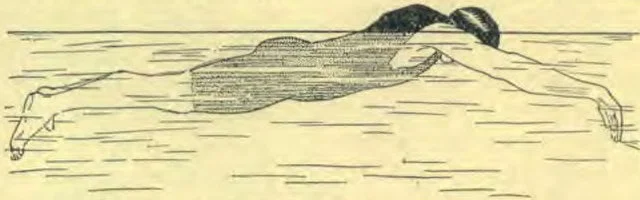
“Stomach-floating. Step out into the water up to the waistline, and fall forward onto the stomach, facing the shore. The face should be submerged up to the backs of the ears. Breathe in deeply as you fall forward, and exhale under the water. Keep all parts thoroughly relaxed. As soon as you feel obliged to breathe in, raise the head to do so, when it should again be immediately dropped so as to exhale as before.
Synopsis
Face the shore and fall forward.
Breathe in as you drop to position.
Exhale under the water.
Keep well relaxed.
Raise the head to inhale, and drop it back quickly to exhale.
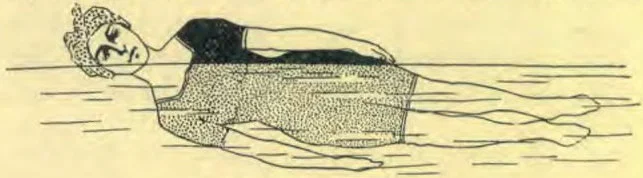
“Side-floating. This is the most difficult manner of sustaining oneself above the surface and in correct position because of the difficulty experienced in keeping the body balanced.
STOMACH FLOATING, OR “DEAD MAN’S FLOAT”
SIDE-FLOATING POSITION
“Take the back-floating position. Turn the head so as to have either side of the face on the water. Bring the arm and leg of the opposite side to which it lies upon, over in front of the body. As soon as you have turned sufficiently, balance by moving the arm or leg backward or forward. When you have the proper position, straighten out the upper leg so as to lie directly over the under one and the upper arm to repose upon the side. Be sure to avoid tension. The lower corner of the mouth should be laved by the water, and no tension of the neck muscles permitted. Breathe in as you turn; exhale when you are properly positioned.
Synopsis
Start to turn from the back-floating position by first turning the head.
Bring the arm and leg over.
Balance by either the forward or backward movement of either the upper leg or arm.
“As the various positions in floating are the initial steps to all forms of propulsion in the water, they should be thoroughly mastered. A disregard for proper poise and relaxation will cause much annoyance in your efforts to become graceful and efficient in the different strokes.
“To rise from either the back- or the stomach-floating position it should always be borne in mind that the9head leads the body. If you are upon the back, raise the head and allow the knees to flex so as to be able to kick backward under the body and thus assist it to an upright position. If you are in the stomach-floating position, simply allow the legs to sink; at the same time draw them toward the abdomen so as to be able to kick downward as the head is raised from the water and stretched back between the shoulders.”
Plants That Get Hot and Plants That Keep Cool
WE do not, as a rule, think of plants as giving out heat, yet at certain times some flowers show an astonishing rise of temperature. Most remarkable in this respect are certain kinds of Arum. Just at the opening of the flower, in these cases, there is a great liberation of heat, due to the fact that the respiration, or breathing, is at such times very vigorous.
Some very interesting experiments have been carried out in connection with these Arums by placing a thermometer just inside the spathe. One of the most remarkable cases was that of a species growing on the Mediterranean coast, and known as Arum Italicum. The temperature of the air was 60° at the time of the experiment; that inside the spathe was 110°! At that time the blossoms, which when expanded are practically scentless, gave out a fragrance suggestive of wine.
Among all the charming plants to be found in the lower Alps there are few more interesting than the Soldanellas, described in Nature and Science for April, 1914. These have pretty, bell-shaped flowers, purple in color, and of a very delicate appearance. Few would think that these fragile blossoms are able to bore their way up through a hard crust of snow and ice. Yet this is what they actually do by means of the large amount of heat which the developing buds liberate. It is a most singular sight to see the flower stalks standing up out of the snow, very much as if they had been stuck into the white crust. Where the snow covering is very deep, and the flower stalks are not able to reach the surface, a strange thing often happens. The warmth produced by the growing bud thaws a rounded cavity under the snow, and in this the flower will often expand perfectly. Kerner says that these blooms perfect their pollen just as if they were in the open above. There is no stranger flower story than that of the Alpine Soldanellas.
After reading about these flowers with high temperatures, it is interesting to study some of the plants which have hard work to keep cool. Most people can imagine the conditions under which the cactuses of the desert have to live. Quite often, in Mexico, the stones and rock surrounding the plants are so hot that it is quite impossible to touch them with the hand. Yet if we were to cut a cactus open and insert the bulb of a thermometer, we should find that it was comparatively cool—perhaps 30° less than the temperature of the air. How is this accomplished? Partly because the thick, leathery skin, often covered with hairs or multitudes of spines, helps to keep the heat out. But there is no doubt that the living plant has a way of keeping down its temperature in a manner that we cannot quite understand. An experiment was carried out with a gourd. The day was very hot, and the temperature of the outside air was above 100° F., yet inside the gourd it was only about 60°. After the gourd was cut it soon became hot. It was only while it was attached to the living plant that the temperature was kept down.— St. Nicholas.
Tilefish: A Newly Discovered Fish Off Nantucket
Tilefish
ONE May morning of 1879 Captain Kirby, cruising for cod off Nantucket Island, drew in his lines and found his hooks generously hung with a kind of fish that, in all his extended experience, he had never seen before. Knowing the ways of fish markets and venders, he promptly threw most of his two-thousand-pound catch back into the sea. He reasoned that trying to make a market take a fish with which it was not acquainted was a labor of love best left to less successful fishermen.
But the creatures were so attractive that he saved a few of them. A trial of one at his own table moved him to pronounce it the finest fish he had ever tasted. He upbraided himself for throwing away those he had caught, and resolved that he would never make this mistake again. After sending a specimen from his first catch to the United States National Museum, he returned to the same grounds, and again took some two thousand pounds of these strange beauties.
They were sold in Gloucester, but retail fish markets and venders were slow to push this untried candidate for favor. Other fishermen continued to catch them, but the barriers of tradition made the progress of the tilefish in the direction of general acceptance decidedly slow.
Then, in 1882, transatlantic steamers entering New York brought the news that along the northern border of the Gulf Stream the surface of the ocean was thickly covered with millions of dead fish. They were reported to be of one variety and of extreme beauty.
The Bureau of Fisheries made prompt and careful investigation of this strange phenomenon, and found that they were of the kind caught by Captain Kirby, to which the name “tilefish” had been given. This monster display of dead fish covered a water area one hundred and seventy miles long and twenty-five miles wide. In short, these mysterious strangers of the deep had been suddenly wiped out to the number, so it was estimated, of nearly a billion and a half at one stroke. It is supposed that some great oceanic disturbance or storm brought them suddenly into a current much colder than that to which they were accustomed, and this caused the wholesale slaughter.
For some years thereafter no tilefish were seen, and the theory became generally accepted that they had suffered an extinction as complete as that which suddenly wiped out the wild pigeon at a time when its tribe was thought to be innumerable. But in 1892 the capture of a few specimens proved that the tilefish was not literally extinct. Now it appears to be fully reëstablished.
What this may mean in terms of added food supply is suggested by the fact that when the dead fish were surveyed in 1882, the experts announced that there were enough dead tilefish floating on the bosom of the Gulf Stream at that moment to give every man, woman, and child in the country two hundred and eighty-eight pounds of fish.
Further proof that the tilefish is back in full force to swell our national food supply, is found in the fact that the Bureau of Fisheries lately placed eight thousand pounds of freshly caught tilefish on the Fulton market. This was the first fare of the season; the second totaled about twelve thousand pounds, and two later fares aggregated approximately eighteen thousand five hundred pounds.—National Magazine.
Known by His Doings
EVEN a child is known by his doings, whether his work be pure, and whether it be right.—Solomon.
Bulbs for Winter
For those who like to have blooming bulbs in the house during the late fall and winter months, there is a simple method that requires little time and no skill. Paper-white narcissuses, Dutch-Roman hyacinths, and daffodils are most easily grown, although tulips, crocuses, and other bulbs that are capable of being forced can be grown without difficulty.
Use shallow six- or eight-inch pots and any loose, sandy soil that you can get. Do the planting any time in October. If you do it later than that, the results are not likely to be so satisfactory. Fill the pots partly full of soil and place the bulbs so that there shall be some space between them; then cover them with soil to the depth of perhaps an inch, water them freely, bury the pots in the ground outside, and cover them with soil to the depth of three inches. Mark the spot so that you will know where each variety of bulbs is buried. When the top of the ground begins to freeze, cover the buried bulbs with leaves to keep them from freezing. The buried bulbs will at once begin to grow, and will need no attention until they are ready to bring into the house.
Paper-white narcissuses develop most rapidly, but should be allowed to remain buried for at least five weeks. If you plant them about the first of October, you may dig them up by the tenth of November. When dug up, they should be watered and left in the cellar or some other dark, cool place for a few days before they are brought into the full light. If placed in a cool, sunshiny window and watered freely, they will bloom by Thanksgiving. Other pots of narcissus may be brought in at intervals of a few days, to replace those that have finished blooming.
Dutch-Roman hyacinths will be ready to bring in by the middle of December, and other kinds of hyacinths later. Daffodils, crocuses, and tulips should remain in the ground until about the first of February, and should be brought in at intervals until the first of March.
In that way, with little trouble and experience, one can have bulbs in bloom from November to April. There need be no fear of failure if, after the bulbs have been brought into the house, they get plenty of sunshine and plenty of water.—Youth's Companion.
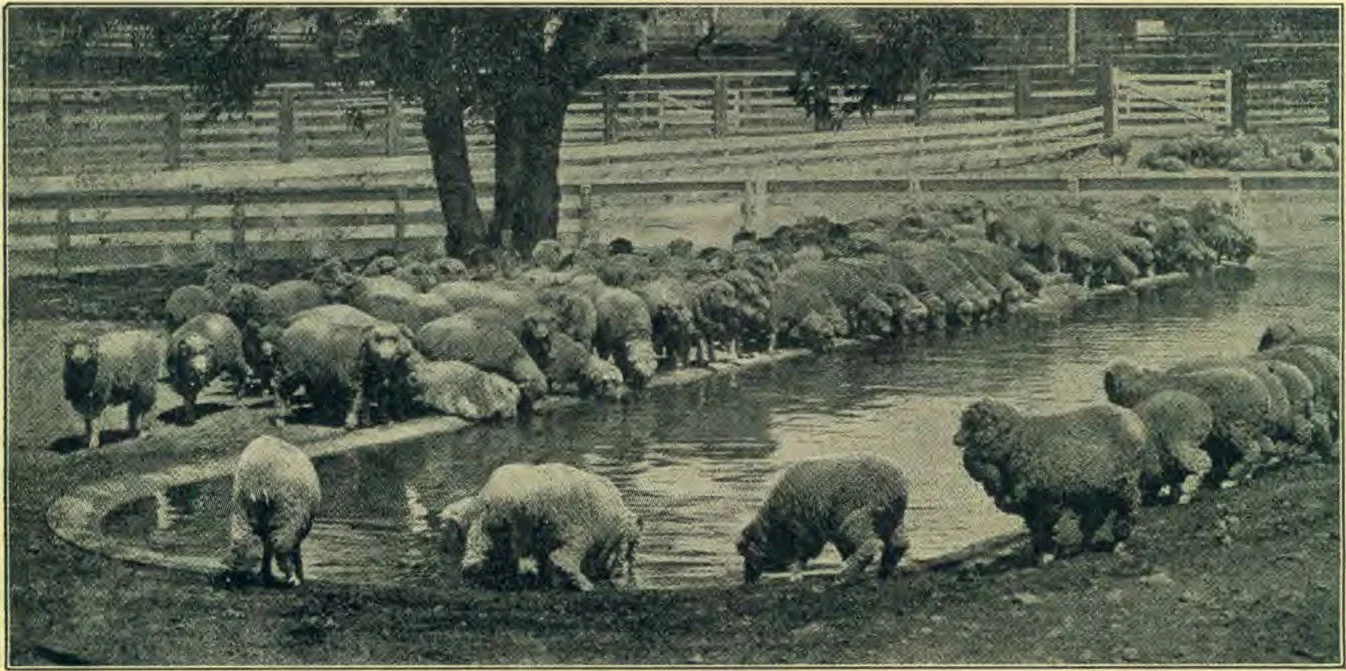
THE WAY AUSTRALIA CARES FOR HER SHEEP
Zone Therapy
DR. WILLIAM H. FITZGERALD, of Hartford, Connecticut, claims to have discovered an effective system of healing, which he names zone therapy. This treatment purports to be able to cure goiter, sciatica, lumbago, eyestrain, throat trouble, headache, toothache, and earache without the use of medicines or water treatment, simply by exerting pressure at the proper place. The body is divided into ten zones, five on either side of a line drawn up the center of the body. The first, second, third, fourth, and fifth zones begin in the toes and end in the thumbs and fingers, or begin in the thumbs and fingers and end in the toes. For instance, the first zone extends from the great toe, up the entire height of the body, including the chest and back and down the arm into the thumb. The other toes and fingers are related to their particular zones in like manner.
Firm pressure over the joints of the big toe or the thumb, or upon the proper areas in the mouth and throat, will tend to overcome pain or any condition relievable by zone therapy, in the entire first zone; and similar results follow squeezing the fingers and toes, or upon making pressure over the areas corresponding to the other zones.
But it is necessary to press the proper zone in the proper way and for the proper length of time in order to secure results.
—Frank Walcott Hutt
By Frank Walcott Hutt
Eloquence
ONE rose up in his pulpit, and he spoke
To me.
Good news it was that morning that he broke
To me.
Was the day fair? Were many hearers there?
I cannot tell you. I can only share
The word of peace God's servant did declare
To me.
—Frank Walcott Hutt
Heeding Reproof Brings Understanding
He that refuseth instruction despiseth his own soul: but he that heareth reproof getteth understanding.— Solomon.
Teaching Through Simple Speech
“He knows the truest way to teach Who puts great thoughts in simple speech.”
Thanksgiving
THE ripe, rosy apples are all gathered in;
They wait for the winter in barrel and bin;
And nuts for the children, a plentiful store,
Are spread out to dry on the brown attic floor;
The great, golden pumpkins that grow such a size,
Are ready to make into Thanksgiving pies;
And all the good times that the children hold dear
Have come round again with the bountiful year.
Now what shall we do in our bright happy homes
To welcome this time of good times as it comes?
And what do you say is the very best way
To show we are thankful on Thanksgiving Day?
The best thing that hearts that are thankful can do
Is this: To make thankful some other hearts, too;
For lives that are grateful and sunny and glad,
To carry their sunshine to lives that are sad;
For children that have all they need and to spare,
Their good things with poor little children to share;
For this will bring blessing, and this is the way
To show we are thankful on Thanksgiving Day.
— Selected.
The Little Round Cakes
By Elizabeth K. Hall
A Thanksgiving Story for the Children
SHE'S the queerest old woman you ever see,” said Tim, “but we gits our dime all the same.” “When does she give them?” asked the little fellow sitting beside him on the curbstone.
Both boys were evidently the children of poverty, but there was a difference. Rob Mason’s clothes were old and patched, but there was an attempt at respectability and cleanliness that the other lacked. Tim was wholly a boy of the street.
“The day before Thanksgiving—that’s tomorrer, you know. Say, Rob, did you ever taste turkey?” queried Tim, with interest.
“Yes, a long time ago. Before we lived here.”
There was a sober, far-away look on the boyish face that made even rough little Tim hasten to change the subject.
“Say, Rob, will you go with us and git the cake?”
“My mother wouldn’t let me beg.”
“’Tain’t beggin’! It’s a Thanksgiving present. The old lady says so. You’d better come.”
“I’ll ask mother,” and Rob jumped up and ran down the street toward the shabby tenement house that was home to him.
Mrs. Mason was bending over her sewing machine when Rob burst into the room, but she stopped its busy whir at sight of his eager face.
“Mother, mother, I want to tell you something. There’s the queerest old lady lives up on Lafayette Street; and every year, the day before Thanksgiving, she gives away a lot of little round cakes, frosted cakes, mother, and what do you think! In each one is a shiny little silver ten-cent piece. The boys here on Harbour Street have had them several years, and they’re going tomorrow. May I, oh, may I go and get one, mother?”
Mrs. Mason hesitated. Cakes given away at the back door sounded a good deal like begging, and that was not to be thought of. But dimes were rare things with poor little Rob; and this afternoon she was feeling more discouraged than usual. It had been a cruel disappointment that some money due her for work had not been paid. And now it would be impossible to carry out her little plan for celebrating Thanksgiving in a modest way. So when Rob hastened to add,— “She says it’s her Thanksgiving present to the boys—she’s done it ever so many years,” his mother replied:—
“Yes, you may go. If there is anything that will make the day a little brighter, I don’t want to say a word against it. I must sew, sew, all day. We are owing ten dollars on the rent, you know, and unless it is paid next month, we must find a cheaper place than this before the new year.”
“Mother,” the boy cried, throwing his arm about the thin shoulders, “there’s lots of things I could do to earn money, if you would let me come out of school.”
“No, no, Rob. You do help wonderfully for a boy of your age, but it must be school at any cost.”
The next morning, at the back door of an old brick house on Lafayette Street, might have been seen a procession of small and shabby boys who knocked, and were met by a white-haired old lady with a basket in her hand. From this she produced, one after another, little cakes nicely wrapped in paraffin paper. She spoke a few words to each boy, and looked him over keenly. To one she spoke sharply:—
“Tom Nichols, what are you here for? These cakes are not intended for boys who have all they want at home.”
And although Tom muttered, “Guess I could spend a dime as well as those boys down on Harbour Street,” he was promptly put out of line, and ordered off the premises.
She was a queer old lady, as Tim had said, bent in figure, dressed in old-fashioned clothes, but with eyes as keen as live coals, and a most disconcerting way of looking one over. She scrutinized Rob sharply, asked him several questions, but finally dived down deep in her basket and gave him his package.
Most of the boys broke open their cakes and secured the dime at once, but Rob ran away, carrying his as it had been given him. It would be nicer to open it with mother, so that she could discover the silver piece with him. And, indeed, Mrs. Mason seemed almost as eager as her boy over this ceremony. Carefully was the pink ribbon untied.12
“I wonder,” said Rob, “why my ribbon is pink. All the others were white.”
Carefully was the paraffin paper unwrapped, and the cake disclosed to view.
“It looks most too good to eat, doesn’t it?” sighed Rob. “Would you wait and have it for a Thanksgiving dessert? You are to share it with me, you know. But I guess I’ll open it now, because I do so want the ten cents to spend for something for tomorrow. Give me a knife, mother, and I’ll cut it exactly in halves.”
“I’ve hit it!” he exclaimed with excitement as the knife stuck halfway. “Here it is! O mother!” For the knife had dropped to the floor, and in the boy’s hand lay—not the expected silver, but a gold piece—a ten-dollar gold piece!
Two frightened faces gazed at each other, and then Rob dropped the gold piece to clasp his arms around his mother’s neck.
“It’s for the rent, mother. We’re safe, we’re safe!”
And then, checked by the look in his mother’s eye, he cried: “O mother, don’t you think she meant to give it? She couldn’t have made a mistake?”
“That’s not for us to say,” said Mrs. Mason, taking up the money and carefully wrapping it in the paper. “We only know what you ought to do, Rob.”
“Of course, mother, I’ll take it back. But how could she make such a mistake?”
“It may have been accidentally left among the dimes, and some servant who did not know its value have done the baking.”
Rob walked slowly back with the precious money that meant so much to him, clasped tightly in his hand. This time he went to the front door of the house on Lafayette Street and rang the bell.
“Yes, Mrs. Ainslie was in,” and Rob was ushered into a fine library, and told to wait there.
Mrs. Ainslie soon appeared, and again the keen eyes looked the boy over.
“Well, well! Aren’t you one of the boys who came this morning? And what is it now? Was the dime left out of your cake?”
“No, marm. Yes, marm, it was; but this was in it instead.” And Rob held up the gold piece.
The old lady held up both hands in well-feigned astonishment, “Well, well, well! Now whoever could have been so careless? But I suppose you feel that ‘havings is keepings,’ as I’ve heard boys say?”
“No, marm,” decidedly. “It was a mistake, of course, and I don’t expect to keep it.”
At the same time, poor little Rob could not keep the wistful tone out of his voice, nor the suspicious moisture from his eyes.
“What would you do with it if it were yours?”
Rob hesitated a moment; then he said, “I’d rather not tell.”
The old lady looked both disappointed and suspicious.
“Very well,” she said, and opening a small bag that hung at her side she dropped the money into it.
Then, as Rob turned to go, “Tell me where you live.”
Rob told her; and then he said: “Good-by, Mrs. Ainslie. I’m much obliged for the cake. I haven’t eaten it yet, but it looks very nice.” And he was out of the room fortunately before the tears came.
There is no denying that Rob was cruelly disappointed, but before home was reached he managed to put on a brave face, and when they sat down to dinner, mother and son were in quite a cheerful mood.
As they shared the little cake, Rob gave his mother a graphic account of his call on the queer old lady.
“I didn’t like to tell her it would go for the rent, mother, for I was afraid she’d think I was just saying it to make her let me keep it. Don’t you see?”
Yes, Mrs. Mason did see and understand. Rob was always sure of his mother in this respect. And she did her best that afternoon to make her boy forget his disappointment. She succeeded so well that when, some hours later, Rob started to take home some work for her and encountered Tim on the street, he was able to answer that young man’s query, “How you goin’ to spend yer dime, Rob?” with a calm “I don’t know yet.”
This errand for his mother took him to quite a distance, so that dusk was falling when he reached home again. As he turned the corner of Harbour Street, a most unusual sight met his eyes. Before the entrance to the tenement house was a private coupé, with a colored driver on the box. A crowd of urchins were gathered about the carriage, and Tim’s voice rose above the others: “The Prisidint’s come to call on yer, Rob.”
When Rob opened the door of his home, he nearly fell down the rickety stairs in astonishment, for there sat Mrs. Ainslie beside his mother on the sofa, talking as if they had known each other for years. The old lady beckoned the boy to her side.
“There!” she said, putting the gold piece into his hand, “take it. It’s yours. Yes, I meant it for you all the time. Only, it’s not to go for rent. Your mother will tell you all about it. Good-by, Helen, dear. I’ll see you soon again.” And with a pat on the boy’s shoulder, she was gone.
“Helen, dear!” repeated Rob. “What does it mean, mother?”
“It means that your ‘queer old lady’ and my mother—your grandmother, Rob—were dear friends in their girlhood. I didn’t know her by the name of Ainslie. Had I known her name was formerly Margaret North, I should have guessed at once. When we met, she saw such a resemblance to my mother that she at once demanded my maiden name, and so it all came out. She may be a queer old lady, Rob, but she’s dear as well as queer, and I think we’ve found a friend.”
Later, Mrs. Mason told Rob the story of the cakes. Mrs. Ainslie was a rich woman, but a very lonely one, for her husband had died years before, and their only child, when a boy of twelve years, had been drowned while swimming. Left alone and with great wealth, she had lived to make that wealth a blessing to many; but above all she dearly loved to make boys the objects of her bounty.
She was a little eccentric, as the story of the cakes showed. For fifteen years she had baked her little cakes, and put the dimes in them; but every third year, in one she put a ten-dollar gold piece. She marked it differently from the others, and selected with care the boy to whom she gave it. And she told with triumph that never had she been mistaken in her boy. He had never failed to bring it back. Three of these boys who had been thus favored, she had befriended and helped along, and had never lost sight of; they were “her boys” still. She admitted that when Rob declined to tell for what he would use the money, she was inclined to doubt the wisdom of her choice; but she liked his face. She determined to look him up, to meet his mother; and you can imagine her delight when that mother proved to be the daughter of her old friend.13
The hard times of the Mason family were over. Not that they became dependent upon this new friend; but she helped them to help themselves. And to Rob she came to stand, next to his mother, as his best earthly friend.— Elizabeth K. Hall.
A Story of Two Beggars
By Elizabeth J. Roberts
In a beautiful palace within a walled city, there once lived a very good king. Each day this king, surrounded by his followers, rode forth from the walled city to see that all was well in his realm. As the great gates swung open to let him pass, there always stood waiting, on either side of the road, a beggar; and always the good king paused long enough to give them some gift to carry home. In this way the beggars had received houses, lands, food, and clothing, yet still they waited each day for more.
One of the beggars was big and strong, with a selfish, discontented face; he received his many gifts without one word or sign of gratitude. The other beggar was small and weak, with a pale, timid face; but whenever he looked at the good king, his eyes were full of love, and daily he thanked him for his gifts.
At last there came a sad time when an enemy brought a terrible disease into the country of the good king. The disease was so contagious that it swept through the length and breadth of the land, and every soul, except the king himself, was sick of the pestilence. Some were touched so lightly by the disease that they hardly knew they had it; some were sick unto death; while still others did not die, but were left so crippled and weak that they grew weary of life, and envied those that could die.
As the good king went to and fro on his errands of mercy, always the two beggars waited on either side of the city gate, and daily he gave them gifts from his store.
At last the king heard that in a far country they had found a cure for this terrible plague, and at once he set forth alone to find it. The way was long, and beset by many dangers, but the king did not stay because of that. Often he had no food or drink, he was cold, he was wounded, he was put in prison as a spy, he suffered in every way, but never, for one moment, did he falter.
At last the king found the cure for which he searched, and quickly, without rest or pause, he started back to carry it to the people he loved. After many weary days he reached the gate of his own city again, and there, as of old, he saw the two beggars.
The beggars were crippled and weak from the dread disease, and as the king looked on them, his face shone with the love and pity he felt.
“Friend,” said he, speaking first to the big beggar. “Friend, I have suffered much, but I did it gladly, for I have found the cure for thy sickness. I give it to thee freely, asking only that for my sake thou pass it on to some fellow sufferer, that he also may be cured.”
And then a strange thing happened, for the big beggar’s face grew red with anger, while he answered rudely, “I came here to receive gifts, not to serve others,” and he strode away in haste.
A shadow came over the face of the king, but he turned toward the little beggar.
“Do you, too, refuse my gift because I ask thee to pass it on?” he questioned softly.
But the little beggar knelt weeping at the good king’s feet while he answered, “I thank and praise thee, O king, that thou hast given me the privilege of doing something to show my love for thee.”
Then immediately the little beggar was healed, and all his days he joyfully carried the king’s cure to others who suffered from the dread disease.
Each day we stand at the gate of mercy, receiving gifts from the King of heaven, who only has the cure for the disease of sin. Are we like the big beggar, or are we like the little beggar?