Your ShelfYour Projects

Signs of the Times, Vol. 22, No. 33.

What It Means
Earlier text: Harmony of Paul and James on Faith and Works

SLEEPING AND WAKING IN HIM.

BY MRS. M. E. DURKEE.
Beautiful beings, transcendent in brightness, God’s holy messengers, wait for his word, To visit the sick and to comfort the dying, Bringing good cheer and joy in the Lord.
Thus, with the visions of heaven unfolded, The dying one speaks of the glories made known, While fond waiting friends catch the accents of heaven, And then, when the spirit forever has flown, They think that their loved one has gone straight to heaven, Entered at once on his final reward, Forgetting the Scriptures to us mortals given, That death is a sleep—we awake at his word.
Like as a child falls asleep in the evening, Listing its mother’s last sweet lullaby, Then it awakes at her voice in the morning, Thus shall we wake—for thus Christians die.
Battle Creek, Mich.

HIS BEGINNING.

Idleness is productive of mischief. Those whose minds and hands are busy with useful work have no time to think of evil and are not easily tempted. That Satan finds work for idle hands is proved by the various reformatories in the land.
A convict sentenced to the penitentiary for life, was interviewed by a visitor, who asked him this question:—
“To what do you attribute your early wrong-doing?”
After a moment’s reflection the man replied in a single word:—
“Idleness.”
“Didn’t you have anything to do?”
“Yes, but I wouldn’t do it. My parents were poor people, who tried to give me an education, but I simply wasted my time. I played truant more than half the time.”
“And you got into mischief while you were playing truant?”
“Yes, the first theft I ever committed was when I was a little fellow playing truant from school. Another boy of about my age was with me. We were going off to the woods to spend the day, and both of us stole some cakes at a baker’s for our dinner. After that we stole things right along.”
“And it grew easier each time, didn’t it?”
“O, yes; it wasn’t very long before it was as natural for us to steal as to eat. We hardly ever played truant without stealing something.”
“Then truancy was really your first step in wrong-doing?”
“Yes; truancy and its consequent idleness. I don’t believe that any habitual truant can keep out of mischief, and the same may be said of the habitually idle.”
“I am sure of it,” said the visitor. “It is the beginning of many a man’s criminal career.”
“Yes, it is,” said the convict, simply, but soberly. “Hard, honest work is good for folks.”
So it is. God never intended that any one should spend his time in idleness, and sin is sure to result from the wasting of his time.—Young People’s Paper.

The Growing Wealth Inequality

In a speech delivered in the United States Senate in 1891, Mr. John J. Ingalls drew this truthful picture of the financial situation in this country:—
“By some means, some device, some machination, some incantation, honest or otherwise, some process that can not be defined, less than the two-thousandth part of our population have obtained possession—and have kept out of the penitentiary, in spite of the means they have adopted to acquire it—of more than one-half of the entire accumulated wealth of the country. That is not the worst, Mr. President. It has chiefly been acquired by men who have contributed little to the material welfare of the country, and by processes I do not care in appropriate terms to describe. A financial system under which more than one-half of the enormous wealth of the country, derived from the bounty of nature and the labor of all, is owned by a little more than 30,000 people, while 1,000,000 American citizens, able and willing to toil, are homeless tramps, starving for bread, requires adjustment. A social system which offers to tender virtuous and dependent women the alternative between beggary, prostitution, and suicide, is organized crime, for which some day unrelenting justice will demand atonement and expiation.”
It is also true that from the day of that utterance to the present time, the situation has been growing worse and worse, notwithstanding the fact that the government has been making more and more religious pretension. Within that period we have had the “Christian nation” pretension uttered by the Supreme Court; we have had the Sunday closing of the Chicago Exposition pretension by Congress; we have had the declaration by Congress that Sunday is the Sabbath of the fourth commandment; and we have had the Supreme Court’s decision that the most tyrannical of all the state Sunday laws is constitutional. In this last act especially we have the direct refusal of the government to sustain its citizens in their religious rights. In all these things we see it demonstrated that the more religious pretension there is on the part of the government, the more tyranny and oppression prevail in every walk of life, and “evil men and seducers wax worse and worse.” W. N. G.

Raising Church Funds

Speaking at the annual meeting of the East London Church Fund last week, Lord Salisbury rebuked the scandalous methods resorted to nowadays to get people to give. They were taught, he said, that they must eat a bad dinner, or attend a ball or garden party, before they could be charitable.
“So it goes on. There must always be some secondary machinery. The largest effort a Christian makes he makes in response to an organization, by which he is invited to purchase worthless articles at ridiculous prices. . . . It was a strange contrast to what happened in the earlier days of Christianity. When they read of what happened when Paul exhorted the Corinthians to send relief to their suffering fellow-Christians in Jerusalem, they did not read that it was found necessary to have a bazaar, or a public dinner, or even a public meeting with a Roman magistrate to make a speech.”
Lord Salisbury’s speech is a crushing rebuke of that spirit which is so rampant. When people refuse to give of their means to the Lord’s work, it is not entertaining that they need, but converting. It ought to make the organizers of these devices pause and think when the premier and statesman is forced to rebuke this resort to worldly methods of money-getting. Statesmen have also to pass laws to keep some of these same elements from establishing lotteries and gambling for church purposes, and even then we now and then read of raffles at church bazaars patronized by the highest in the land. Let all keep separate from these things. If a man believes the truth, he will freely give to send it to others. If he does not believe it, the Lord does not need his funds.—Present Truth (London, England).

MARTHA

“Yes, Lord—yet some must serve. Not all, with tranquil heart, Even at thy dear feet, Wrapped in devotion sweet, May sit apart.
“Yes, Lord—yet some must bear The burden of the day, Its labor and its heat, While others at thy feet, May muse and pray.
“Yes, Lord—yet some must do Life’s daily task-work; some, Who fain would sing, must toil Amid earth’s dust and moil, While lips are dumb.
“Yes, Lord—yet man must earn And woman bake the bread; And some must watch, and wake Early, for others’ sake, Who pray instead.
“Yes, Lord—yet even thou Hast need of earthly care; I bring the bread and wine To thee, a guest divine— Be this my prayer.”
—Julia C. R. Dorr.

THE SINNER’S NEED SUPPLIED.

MOVED was the great eternal God To pity my distress; He willed in his deep, boundless love To help my wretchedness; He spoke to his beloved Son: Sweet mercy’s hour draws nigh; O sharer of my heavenly throne, The sinner’s need supply! Help him from sin’s distress and stain, Destroy his death, the victory gain, And let him live with thee. —Luther.

HINTS TO HOUSEKEEPERS.

Mix stove blacking with spirits of turpentine. It will take off the rust, polish easier, and stay glossy longer than when water is used.
A simple cough remedy is made of an ounce of flaxseed boiled in a pint of water, a little honey added, an ounce of rock candy, and the juice of three lemons, the whole mixed and boiled well.
If jelly does not “form” the next day after being made, it is useless to cook it over. If it does not become firm when first cooled, standing it in the sun before covering it will sometimes assist in hardening it. Jelly should be well covered and kept in a cool, dry place.
Always sift all kinds of meal and flour, taking a wire sieve, as a hair sieve is too fine, measuring before sifting, unless otherwise directed. It makes a great difference for corn bread what kind of meal is used. Always use the yellow bolted meal for brown bread, and for any recipe for corn bread, unless white meal is specified.
A cement which will adhere perfectly to glazed surfaces, repair broken minerals, or, in fact, stick to anything, is made by taking 2 ounces of clear gum arabic, 1½ ounces of fine starch, ½ ounce of white sugar. Pulverize the gum arabic, and dissolve it in as much water as the laundress would use for the quantity of the starch indicated. Dissolve the starch and the sugar in the gum solution. Then cook the mixture in a vessel suspended in boiling water, until the starch becomes clear. The cement should be as thick as tar and kept so. It can be kept from spoiling by dropping in a lump of gum camphor, or a little oil of cloves or sassafras.—Selected.

POOR BOYS.

HERE are some encouraging facts for poor boys, culled by some enterprising scribbler:—
John Adams, second President, was the son of a farmer of very moderate means. The only start he had was an education.
Andrew Jackson was born in a log hut in North Carolina, and was raised in the pine woods, for which the state is famous.
James K. Polk spent the earlier years of his life helping to dig a living out of a farm in North Carolina. He was afterward clerk in a country store.
Millard Fillmore was the son of a New York farmer, and his house was a very humble one. He learned the business of a clothier.
James Buchanan was born in a small town among the Alleghany Mountains. His father cut the logs and built his own house in what was then a wilderness.
Abraham Lincoln was the son of a very poor Kentucky farmer, and lived in a log cabin until he was 21 years of age.
Andrew Jackson was apprenticed to a tailor at the age of ten years by his widowed mother. He was never able to attend school, and picked up all the education he ever got.
General Grant lived the life of a common boy, in a common house on the banks of the Ohio River, until he was seventeen years of age.
James A. Garfield was born in a log cabin. He worked on a farm until the time he was strong enough to use carpenter tools, when he learned the trade. He afterward worked on the canal.

THE TRUE STORY OF MARY'S LITTLE LAMB.
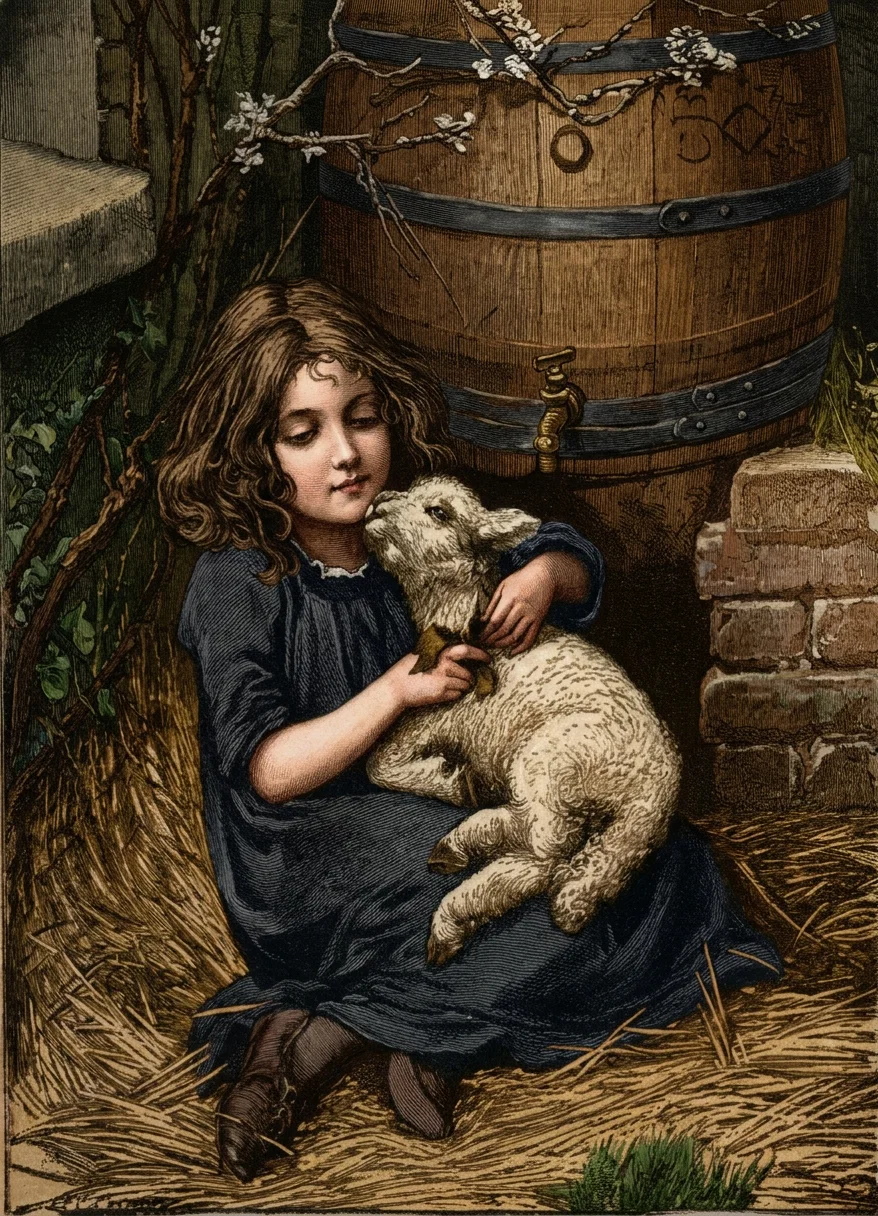
MARY E. SAWYER, afterward Mrs. Columbus Tyler, was born in Sterling, a quiet place near Worcester, Mass. It was here that she grew up and went to school. The little newborn lamb, found almost dead, she nursed devotedly, sitting up all night to keep it warm. In the morning it could stand and swallow a little. Then it began to improve rapidly. It grew fast, and its fleece was of the finest and whitest. She would comb it every day, and tie the wool with bright ribbons. The lamb was almost her only playmate; and, not having many dolls, Mary used to dress up the lamb in pantalets and a shawl.
It was her brother Nate who suggested taking the lamb to school one day. They had hard work to get her over a high stone wall they had to climb, but finally succeeded. When the schoolhouse was reached, the teacher had not arrived, and but few scholars were there. Mary wondered what she should do with the lamb. They had high, boarded-up seats then, and Mary put the lamb under her seat, having put on her shawl—not the pantalets, however—and the lamb lay down and kept very quiet. By and by Mary had to go out of the seat to recite, and left the lamb all right, but in a moment there was a clatter, clatter, on the floor, and she knew it was the pattering of the hoofs of her pet. She was greatly mortified.
The teacher was Miss Polly Kimball, who was the mother of Mr. Loring, the circulating literary man of Boston. She laughed outright, and the children all giggled; but Mary felt too much ashamed to even smile. She led the lamb out-of-doors, and put her in a shed until she went home at noon. Visiting the school that forenoon was a young man named John Roulstone, a nephew of Rev. Lemuel, who was then settled in Sterling, and the son of Mary's dancing-master. He was fitting for college. He was greatly pleased at the school incident; and the next day he came across the fields on horseback, came to the schoolhouse, and handed Mary a slip of paper containing three stanzas he had composed. Two stanzas have since been added by a Mrs. Townsend.
From the fleece sheared from this ewe, Mary's mother knit two pairs of stockings, which Mary kept until she was about eighty years old. When the ladies of Boston were raising money for the preservation of the Old South Church, some ten or more years ago, she contributed one pair of these stockings for the benefit of the fund. The yarn was raveled out, and small pieces attached to cards having her autograph; and these were sold for quite a sum, realizing about $100. Then Mary consented to raveling out the other pair of stockings, and went herself to the fair and sold the wool. All she kept was two little pieces pasted on cards. Mary taught school in Fitchburg after leaving Sterling. She was afterward married, and for thirty-five years held the position of matron of the McLean Insane Asylum at Somerville, Mass., where for forty years her husband was steward of the institution. After leaving this place, they built and occupied one of the finest residences in the city, and for many years were most highly esteemed as generous, noble, useful, public-spirited people. They left no children.
—Selected.

LUNGS

How is it that the lungs can increase through athletic exercise? By a mechanism well known in physiology, by filling out of certain air-cells ordinarily inactive, which only come into play during forced inspiration. The expansion of the pulmonary vesicles is complete in proportion to the quantity of the air introduced. The atmospheric air, drawn into the lungs by a very powerful inspiration, seeks out the most obscure corners and inflates the air-cells of certain regions which ordinarily have no part in the respiratory function. A definite increase in the volume of the lungs is the consequence of frequent repetition of this supplemental respiration,—Medical Gleaner.

BAD HABITS AMONG THE KARENS.

BY MRS. JENNIE BIXBY JOHNSON.
Our Karen churches and schools are a strong army against intemperance; therefore we have not needed special organizations to combat that evil. But we find two other vices harder to overcome than intemperance, against which we must exert organized warfare. These habits, common to every man, woman, and child in Burma, are the smoking and chewing of tobacco, and the chewing of betel-nut. I have seen a little nursing baby turn from its natural nutriment to take the cigar from its mother’s mouth and put it into its own. Often have I knelt on the floor beside a very sick boy or girl, to give a dose of medicine, and waited for the patient to remove a quid of tobacco. Even worse is the chewing of betel-nut. Every man and woman carries about a small lacquered bamboo box, fitted up with green leaves from the piper-betel vine, several of the betel or areca nuts, a little tin box full of slacked lime, a piece of cutch, a little tobacco, and a few cloves. Many times a day the box is drawn out of the bag hung from the shoulder. Two of the leaves are taken and smeared with a good pinch of the lime; a tiny piece of cutch, a little tobacco, a couple of cloves, with half or more of a betel-nut, are all wrapped in the leaves, and then the morsel is put in the mouth to be enjoyed. Whenever they sit down to chat with a friend, whether in a house or by the wayside, the betel box is at once brought forth. The red juice stains the mouth and lips, the teeth become red, and in an old chewer are black. The odor is strong, and the expectoration profuse, staining everything it touches a deep red. A missionary party, staying for the night in a Karen village, left their ponies tied under the chapel. Some betel chewers, as usual, spent the evening spitting through the cracks of the bamboo floor. Intense disgust was pictured on the woman’s face when, in the morning, her white pony was led forth covered with blood-red stains.
The immediate effect of betel chewing is stimulating, but its continued use is stupefying to the brain. Teachers who have given up the habit have told me that they could think more vigorously than when constantly under the influence of the betel-nut.
Our town training school numbers from one hundred and fifty to one hundred and eighty pupils, preparing to be preachers and teachers among their people. Our rules are strict that no girl shall use tobacco while in our school, or be seen in any of our buildings chewing betel-nut. The boys are not to be seen with either tobacco or betel-nut outside of the boys’ dormitory. A Blue Ribbon Society has long been organized, whose pledge binds against liquor, tobacco, betel-nut, and profanity. In the past two or three years there has been a great advance in this movement. The young men and women have become very earnest, and about eighty of the pupils have become members. The great struggle is over betel chewing. They love it. Many fear to sign the pledge, because others who have kept it while in school, break it when they return to their villages, where the betel box is always before their faces.
Our young men have organized several Blue Ribbon Societies among the children and youth in the mountain villages. Grown people rarely give up the habit, and our hope is to rescue the young.
Some of the native Christians rebel in heart against our betel-nut crusade, because, in many instances, their sole income is derived from the culture and sale of betel-nut. Their beautiful gardens of betel-nut palms—they can not part with them. Many people here would say that they do not need to part with them, as the nuts are an important article of export, and are used in tanning leather. But the country is first supplied with nuts for chewing. Owners of these gardens are inveterate chewers. They can not resist temptation when the nuts are in their hands.
Follow me down a steep hillside, and we shall find a long, narrow valley of softest green. A gentle mountain stream flows through, and its banks are lined with ferns and flowers. The whole valley is full of betel palms, their slender, cylindrical stems rising fifty or sixty feet upward, and at the top cluster long, waving green leaves and fragrant flowers, or the prized betel-nut.
“Thus winds our path through many a bower Of fragrant tree and giant flower, While o’er the brake, so wild and fair, The betel waves his crest in air.”
A lovelier spot would be hard to find. At one end we see a few bamboo houses, where the people stay while harvesting the nuts. The men become very expert in climbing these tall palms, with nothing but their hands and feet to aid them. After gathering the nuts from one tree, they cause the slender trunk to sway back and forth, nearer and nearer to the next tree, till, with a spring like a monkey, they light upon it. Wild, free, self-indulgent life! Why must they give it up? Why renounce this industry, which is the best way they know of earning money? Even in this Christian land business engagements and schemes sometimes rise between men and spiritual power, or the development of their highest nature.—The Examiner.

A CHINESE SAUL.

We call special attention to a brief extract from the Chinese Recorder, with comments by Dr. Griffith John, to be found among the Notes from the Wide Field. It certainly is a time of great hopefulness in connection with evangelical missions within the Chinese empire. Dr. John has also made a remarkable statement in reference to Chou Han, the notorious author of the multitudinous books and tracts and placards against Christianity and foreigners, which have been so widely scattered and have had such a powerful influence in China, especially throughout the province of Hunan. We have heretofore referred to the gross and blasphemous character of these publications, and to their effect in inciting the people of Hunan to bitter opposition to all Christians. They are unreportably vile, so that the Chinese authorities have denounced them; it has seemed impossible to prevent the circulation of these publications of Chou Han. But Dr. John now reports that a great change has come over this man, and that he is reading Christian books, has given up worshiping idols, and has severed his connection with his former anti-foreign and anti-Christian associates. Two brave Christian Chinese are preaching and selling books in the province of Hunan, and one of them reports that nothing but fear keeps Chou Han from going to Hangkow to visit the missionaries. Dr. John has written several times to Chou Han, sending him books, religious and scientific, and he asks others to pray in hope with him that this Saul may be changed into a Paul.—Missionary Herald.

Changes in Madagascar Under French Rule

REV. MR. SIBREE, in the Chronicle of the London Missionary Society, speaks of the great changes which have taken place since the French occupation of Madagascar. The roads are being repaired, stone gutters are placed at the sides of the roads, and massive timber bridges are constructed in many places. Soldiers are met everywhere.—Frenchmen, Algerians, and negroes from the Kongo or Soudan. Miners are coming to prospect for gold, and French money is coming into use. There is great increase of drinking among the Malagasy, and much Sunday trade at the capital, a thing which has not been known there during the past twenty-five years. Mr. Sibree, however, can say that the resident general has “already struck a blow at one of the chief blots on the Malagasy civilization, and has stopped the public selling of slaves in the markets.”—Missionary Herald.

I CAN TRUST.

God holds the future in his hand. O heart of mine, be still! His love will plan the best for thee, The best, or light or dark it be— Then rest thee in his will.
God holds the future in his hand, Why should I shrink or fear? Through every dark and cloudy day— Yea, all along my pilgrim way— His love will bless and cheer.
God holds the future in his hand, And I can trust his love. The past declares his faithfulness; His eye will guide, his heart will bless, Till I am safe above.
God holds the future in his hand, I leave it all with him, I know one day he will explain The “wherefore” of each grief and pain, Though reasons now are dim.
—Selected.

Dutch Guiana.

Dutch Guiana is hemmed in between British and French Guiana, and covers a territory of some sixty thousand square miles, of which all but one-fifteenth part is an unexplored and impenetrable wilderness. The sources of the Surinam are still veiled in mystery, and explorers are deterred by the deadly malaria of the upper-river regions. The mixed population of Dutch Guiana is estimated at about sixty thousand, exclusive of some eighteen thousand bush negroes and an uncertain number of Indians.
These bush negroes are the descendants of runaway slaves, and they inhabit the dense jungles of the interior. There are three tribes of them—the Aukanians, the Saramaccans, and the Bekon, or Moesinga. All have lapsed into complete heathenism, but there are some traces of a former connection with Christianity. As chief god they worship Gran-Gado (great God), whose wife is Maria, and whose son is Jesi Kist. They are, however, polytheists, and worship forest-gods, water-gods, air-gods, etc. The country they inhabit is called by themselves the land of the shadow of death. The climate, especially in the rainy season, is pestilential, and the swift and turbulent rivers are practically unnavigable.
In the heart of the maiden forest, on the banks of the Saramacca, lies the village of Maripastoon, and here the first missionaries (Moravian), Calker and Bramberg, began their labors, in 1863. There they found that a work of reformation was being carried on by a negro man, who had come to the country with his parents from Paramaribo, when but thirteen years of age. He had not known anything about Christianity, and his parents were heathen. But in his own mysterious way God gave him light, and led him to labor, amid many trials and much tribulation, for the rescue of the people from heathenism. When the missionaries arrived, they met a cordial welcome, and found that John King's influence had extended far beyond his home village. John King is the name he assumed on being baptized.—Prof. H. E. Dosker, D.D.

LESSON X.—SABBATH, SEPTEMBER 5, 1896

CHRIST AND THE IMPOTENT MAN.

Lesson Scripture, John 5:1-18, R. V.
“AFTER these things there was a feast of the Jews; and Jesus went up to Jerusalem. 2 Now there is in Jerusalem by the sheep gate a pool, which is called in Hebrew Bethesda, having five porches. 3 In these lay a multitude of them that were sick, blind, halt, withered. 4 For an angel of the Lord went down at certain seasons into the pool, and troubled the water; whosoever then first after the troubling of the water stepped in was made whole, with whatsoever disease he was holden. 5 And a certain man was there, which had been thirty and eight years in his infirmity. 6 When Jesus saw him lying, and knew that he had been now a long time in that case, he saith unto him, 7 Wouldest thou be made whole? The sick man answered him, Sir, I have no man, when the water is troubled, to put me into the pool; but while I am coming, another steppeth down before me. 8 Jesus saith unto him, Arise, take up thy bed, and walk. 9 And straightway the man was made whole, and took up his bed and walked. 10 Now it was the Sabbath on that day. So the Jews said unto him that was cured, It is the Sabbath, and it is not lawful for thee to take up thy bed. 11 But he answered them, He that made me whole, the same said unto me, Take up thy bed, and walk. 12 They asked him, Who is the man that said unto thee, Take up thy bed, and walk? 13 But he that was healed wist not who it was; for Jesus had conveyed himself away, a multitude being in the place. 14 Afterward Jesus findeth him in the temple, and said unto him, Behold, thou art made whole; sin no more, lest a worse thing befall thee. 15 The man went away, and told the Jews that it was Jesus which had made him whole. 16 And for this cause did the Jews persecute Jesus, because he did these things on the Sabbath. 17 But Jesus answered them, My Father worketh even until now, and I work. 18 For this cause therefore the Jews sought the more to kill him, because he not only brake the Sabbath, but also called God his own Father, making himself equal with God.”

QUESTIONS.

1. To what city did Jesus next go? What was the occasion of his visit?
2. What noted pool is mentioned? How many entrances did it have?
3. Who were gathered in these entrances?
4. What special case is described?
5. Did Jesus know it was a chronic case?
6. What question did he put to the man?
7. What reply was given?
8. What did Jesus tell him to do?
9. What was the effect upon the man? What did he do? What day was it?
10. How did the Jews exhibit their devotion to ceremonialism?
11. What defense did the man make of his action?
12. What inquiry did the Jews make?
13. Could the man answer it? Where was Jesus?
14. Where did Jesus and the man meet again?
15. What instruction did he give to him?
16. What information did the man then give to the Jews?
17. What course did they pursue toward Jesus? What was their charge against him?
18. How did Jesus justify his Sabbath miracle?
19. What influence had this upon the Jews?
20. What additional charge did they now bring against him?

NOTES.

1. “Jesus did not ask this wretched sufferer to exercise faith in him. He simply inquired, ‘Desirest thou to become whole?’ But, on hearing the voice of command, he believed Christ’s word, believed that he was made whole, and he made the effort at once. He willed to walk, and he walked. He acted on the word of God, and God gave the power. Would that the same simple trusting faith were exercised by every soul in need of spiritual healing. We are stricken, diseased through sin. By transgression man has been severed from the life of God. His soul is palsied. Only through the vivifying influence of the grace of Christ is it possible for us to be restored. Many have long been waiting and vainly striving to obtain by their own efforts that spiritual life which will bring them into communion and harmony with God, but in vain. They find themselves weak in moral power, in slavery to doubt, and controlled by the habits of their life of sin. O weary, struggling ones, look up! The Saviour is bending over the purchase of his blood, saying with inexpressible tenderness, pity, and love, ‘Wilt thou be made whole?’ If you believe Christ’s promise, believe that you do receive life from him, and will to serve him, you will receive strength.”
2. Christ commanded the man to do three things: “Rise,” “take,” “walk.” The power for rising was in the word “rise;” for taking, in the word “take;” for walking, in the word “walk.” Apply the principle in other scriptures: Isa. 60:1; Matt. 11:29; Col. 2:6. The fruit of the man’s faith was seen in what he did. He did it all by faith. He lived by faith (Rom. 1:17), and he walked by faith (2 Cor. 5:8). The words accomplished what they commanded. The man “was made whole,” “took,” and “walked.”
3. The whole controversy between Christ and the Jews gathered around three miracles, of which this is the first. The other two will be considered in the study of chapters 9 and 11. A new element,—the question of what constitutes proper Sabbath-keeping,—is now introduced. “Jesus had purposely chosen the Sabbath day upon which to perform the miracle at the pool. . . . A wise purpose underlay every act of Christ’s life on earth; everything he did was important in itself and in its teaching. . . . The Sabbath, instead of being the blessing it was designed to be, had become a curse through the added requirements of the Jews. Jesus wished to rid it of these encumbrances, and leave it standing upon its own holy dignity. Therefore he chose the Sabbath for this special work. . . . This would raise the question of what it was lawful to do on the Sabbath day, and would give him an opportunity to denounce the narrow prejudice and restrictions of the Jews in regard to the Lord’s day, and declare their bigotry and traditions void.”—Spirit of Prophecy, pp. 161, 162.
4. “Jesus sought to impress upon the narrow minds of the Jews a sense of the folly of their view of the Sabbath. He showed them that God’s work never ceases. It is even greater upon the Sabbath than upon ordinary occasions; for at that time his people leave their usual employments and spend their time in prayerful meditation and worship. They ask more favors of him upon the Sabbath than upon other days; they demand his special attention; they crave his choicest blessings; they offer importunate prayers for special favors. God does not wait for the Sabbath to pass before he grants those requests, but he deals to the petitioners, with judicious wisdom, whatever is best for them to have. Heaven’s work never ceases for a moment, and men should never rest from doing good.” It should be remembered that “the Son of man is Lord also of the Sabbath,” and that what he did on that day was in itself Sabbath-keeping.
5. Christ was persecuted by the Jews, who would have put him to death at once if they could have had their way, because he would not keep the Sabbath according to their ideas of Sabbath-keeping. Cain persisted in making an offering to God according to his own mind, and slew Abel because he would not join him in his way of worshiping God. The contest always has been, and still is, between God’s way and man’s way. Now a controversy about the Sabbath question has been entered upon, which will end only in the effort to put to death those who will not yield to the demand to keep the Sabbath according to man’s command (Rev. 13:15); but God will work deliverance for his people. Read the whole book of Esther upon this subject, but especially chapters 3, 8, and 9.

Suggestions for Further Study.

1. Was there any controversy between Christ and the Jews at any time as to which day was the Sabbath?
2. Bigotry does not hesitate to break one of the commandments in its efforts to sustain its interpretation of another.
3. Notice the effect upon his work of Christ’s first public declaration of his equality with God.
4. Here is another lesson of “life only in Christ.” What class is represented by the impotent man?

OUR WORK AND WORKERS.

The Iowa conference now has nine tents in the field.
Brother Martin Stuckrath reports two families added to our ranks at Ackley, Iowa.
A church of seventeen members was recently organized near Powhatan, Ark., by Elder J. Divelbiss.
At Belmond, Iowa, a church of sixteen members was recently organized by Elder C. Santee, president of the conference.
Elder E. W. Farnsworth and wife sailed from Victoria, B. C., on the steamer Warrimoo, for Australia, on the 8th inst.
At Cobden, Ill., eight persons recently took a stand for the truth, under the labors of Brethren C. L. Taggart and J. T. Sweatt.
At Goldfield, Colo., Brother G. H. Smith was recently offered the free use of a Presbyterian tent, which he accepted and held ten meetings.
A new church building has been erected in Hobart, Tasmania. The first Tasmanian camp-meeting was held near Hobart the present year.
June 13 two Chinese were baptized and united with the church at Honolulu, H. I. Sister Sadie Brand reports the Chinese school in a prosperous condition.
As the result of meetings held at Tonawanda, N. Y., by Elder J. P. Lorenz and Brother G. R. Lesh, they report the baptism of six persons, and that fifteen are now ready for church organization.
In connection with the recent session of the Danish conference, seventeen candidates were baptized. The conference was attended by Elders J. N. Loughborough, H. P. Holser, and E. J. Waggoner.
Tent meetings now being held in Erie, Pa., by Elder E. J. Hibbard and Brother L. S. Wheeler, are drawing large audiences, altho at the beginning the attendance was small. The prospect, therefore, is that good results will follow.
At the recent local camp-meeting held at Crawford, in the northwestern part of Nebraska, fifteen persons were baptized, and others received delayed going forward in the ordinance until after going to their homes. Brother Frank Armitage, who has done good service in that region as a licentiate, was ordained to the ministry.
The Home School at Paterson, N. J., will reopen September 15. This school has been in operation two years, and has been quite successful. Those who have patronized the institution are unanimous in its commendation. Good board, room, laundrying, tuition, and a mother's care are furnished for $3.00 a week. Address Helen Cowles, 201 Hamilton Avenue, Paterson, N. J.
Elder E. E. Franke reports that his tent at 94th and Boulevard Streets, New York City, which seats over five hundred people, will not accommodate his Sunday night attendance. At the beginning of his meetings, the audiences were very small, but gradually increased until they are uniformly large. Meetings are held every night, with every indication of raising up a large, permanent company.
Elder H. W. Decker reports a prosperous year for Texas conference, as follows: “A large school building has been erected [at Keene] and nearly completed. Four new churches have been organized, with a membership of 56. There have been added to the old churches, 45; there are 107 in unorganized companies brought out during the year, and 57 were baptized at the camp-meeting that has just closed.”
Under date of July 17, Elder W. G. Kneeland reports the organization of a church of eleven members at New Amsterdam, British Guiana. Since that date Brother P. Giddings reports an addition of seven more, and an increase of interest. They are making an effort to purchase the Wesleyan meeting-house, which they now rent; and as they are poor and seem to be full of faith, of course they will succeed.
Elder W. F. Martin baptized six persons at Roslyn, Wash., July 31, and organized a Sabbath school. He also reports the addition of five members to the church at North Yakima. Also the organization of a Sabbath school at Shoshone, Idaho, with twenty-one members.
Continue reading: Publications on the Sabbath