Pacific Press Publishing Company · New York · Nov 26, 1896
National Atheism and the French Revolution
The one leading characteristic of the French Revolution was atheism. Not the atheism of men as individuals, but the atheism of men in organized, representative, governmental, capacity.
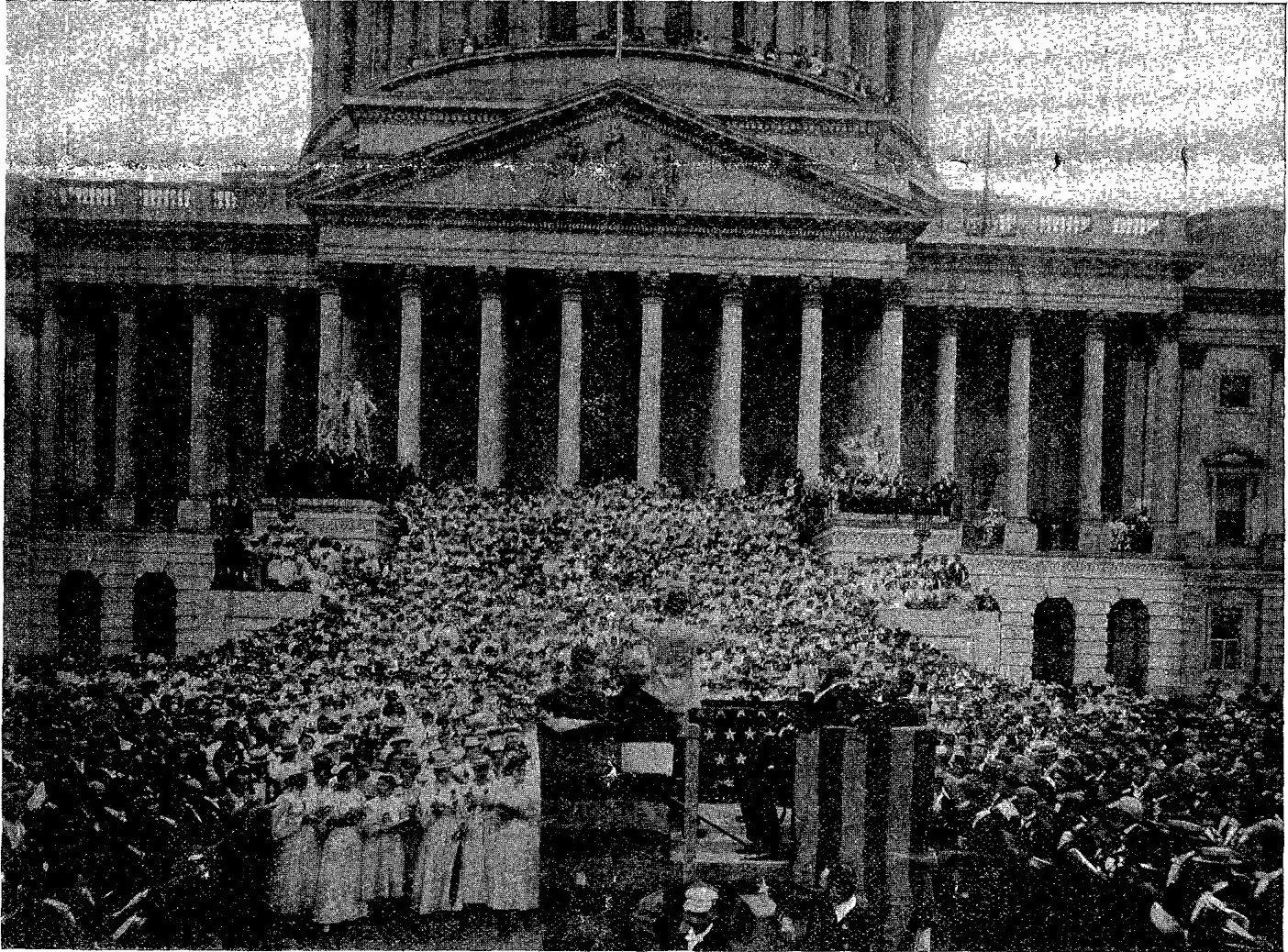
NATIONAL REFORM; AT THE NATIONAL CAPITOL. (See page 370.)
This national atheism was not a sudden wild break of men, in an effort to present to the world a novel spectacle: it was the direct, logical, result of a system that had formerly dominated the country.
There had been fastened upon France, through the governmental authority, a religion professedly Christian. It was not Christian; yet it was adopted and ever held by the national authority, as Christian. All national favors were for this religion; the national authority forced it upon all; the national power rigidly excluded all other forms of worship.
When the Reformation of the sixteenth century came, and therein Christianity was offered to the people of France, it was tabooed, denounced, warred upon, and at last, by the revocation of the Edict of Nantes, was excluded. Then the nation was left under the crushing weight of the old false religion; and it was not very long before the people of France found themselves under the necessity of relieving themselves of the incubus that was upon them.
This religion had been adopted and maintained for the supposed good of the State. It was proposed always to the State by “the Church” under the pretense that it was essential to the welfare of the State. It was found at last to be the greatest evil that afflicted the State. Instead of being for the good of the State, it was found to be only a continued and increasing curse. And in order for the State to find relief, it was essential to repudiate this national religion.
Now note: this religion, though not Christianity, was held by the people of France to be Christianity. The nation had been trained for ages in the opinion that it only was Christianity. They knew nothing else as Christianity. And to them, in repudiating it they were repudiating Christianity. In repudiating it, they did not pretend to be doing anything else than repudiating Christianity; for it was all that they knew as Christianity, and it must be repudiated. And when men intentionally repudiate Christianity, even though it be in something that is mistaken for Christianity, they commit themselves only to atheism. Thus it was that France attained to national atheism.
This too was nothing else than carrying to their legitimately logical conclusion the proposition and arguments, by which the country had been held under the power of that national370religion. In arriving at national atheism, every step that was taken in the National Assembly, was logically derived from propositions that had been laid down by the church. Every argument offered was but the legitimate extension of the arguments already in print on behalf of the national religion.
For instance, it had always been argued, and was then argued, by the church, that the exclusive establishment and maintenance of that particular religion as the only Christianity, was essential to the welfare of the State: and that it was the province of the State, of its own motion by an official act to establish this religion for its own good. The church had long declared in behalf of the exclusive establishment of that religion, that “it cannot be doubted that it belongs to the prince to require of full right that which is necessary to the State.”
Upon this it was argued in the Revolution that, As this religion had been established and maintained for the good of the State, and the event had demonstrated that it was the greatest evil of the State; as it undoubtedly belonged to the State itself to require of full right that which is necessary to the State; as it was now undoubtedly necessary to the State that it be relieved of this great evil; it followed conclusively that the State had full right to repudiate the whole religious establishment. The full right to establish religion, or to do any other thing, for the welfare of the State, remains the full right to repudiate that religion, or to undo whatever may have been done, when it is found to be working evil instead of good to the State. There was no escape from this conclusion.
Holding what had been taught to them by the church, that “The church is in the State, the State is not in the church,” they declared, “We are a National Convention: we have assuredly the right to change religion”—meaning the religion of the State. “The State used its right to suppress a corporation which had no longer a place in the new society.”
Bear in mind that this national religion was held by all there to be Christianity, and when this was repudiated, it was intended to be the repudiation of Christianity; and when that was repudiated there was nothing left to them but national atheism. The only religion they had then to guide them was the religion of reason; the only god the god of reason.
Thus, “The boldest measures of the French Revolution in regard to the church, were justified beforehand from the point of view of the purest monarchical tradition.” It “was only a rigorous application of the maxims of the ancient monarchy. It was simply Gallicanism to the utmost.”
“It is well to remind the detractors of the French Revolution, that the National Assembly in this radical measure only imbibed the principles of the ancient French Monarchy.” (De Pressensé, “The Church and the French Revolution.”) And these principles of the ancient French monarchy were derived altogether from the national religion. “The representatives of the ancient society . . . imagined that the very foundations had been removed, whereas the maxims of their fathers were being turned against them.”
National Religion Threatens Ruin of the Nation
And now, just now, there is a national combination of religionists, determined to fasten upon the United States their religion as the national religion. It is proposed by them that the State needs this, and must do it by national acts for its own good. As certainly as they succeed in this, so certainly it will soon be found that instead of being for the good of the nation it is the greatest evil that ever befell the nation, and inevitably threatens only the ruin of the nation. Then a demand will be made that for the good of the nation this religion shall be officially repudiated by the nation as such.
Bear in mind also that this religion is now proposed to the nation for adoption as Christianity. It is not Christianity, but it is proposed as essentially and only Christianity. When adopted it will be adopted as Christianity; and when found necessary to be repudiated it will be treated still as Christianity. And intentionally to repudiate Christianity, even though this be brought about through apostate and false Christianity, is to land in atheism. And for the national authority to do this, is to land in national atheism. This is as certain now as it was before. And thus this nation, by encouraging this proposed national religion will throw itself, as did France, into the terrible strait between the curse of a religious despotism working only certain ruin, and the curse of a national atheism which can work nothing less. Will the people, will Congress, will the nation, take warning in time? And by keeping themselves clear of all semblance of recognition of a national religion, will they do all in their power to enable this nation to escape the ruin which is but the logical result of the establishment of an exclusive national religion?
NATIONAL REFORM AT THE NATIONAL CAPITOL.
By A. F. B.
The American Sentinel was established in 1886 to expose the danger of there being fastened upon the country the papal principle of the union of Church and State. Previous to its establishment there had been organized within the Reformed Presbyterian Church a society, called the National Reform Association. This association declared that the national Constitution was an “infidel document.” In order to convert this “infidel document,” it was advocated “that in the written Constitution of the United States there should be unequivocal acknowledgment of Almighty God as the ultimate source of civil power and authority, the avowal of allegiance to his Son, the Lord Jesus Christ, as the ruler of nations, and the acceptance of the recorded will of God [the Bible] as the supreme rule of national action.”
When the American Sentinel first appeared, the religious and secular press of the country was opposed to the National Reform movement. It was thought to be merely a Covenanter idea that would never get beyond the Reformed Presbyterian Church, which the Independent, in speaking of the matter, called “the smallest of the split P’s.”
The American Sentinel, drawing its views from the Sure Word, declared that these principles of Church and State union would eventually pervade all the popular denominations, and through that would seize the national power. It predicted that they would unite to force from legislators laws enforcing certain religious dogmas, especially Sunday observance, upon all the people.
It is the purpose of this article to show that this destructive principle has gained a controlling influence in the councils of that gigantic federation of church forces, known as the United Societies of Christian Endeavor; and “Christian Endeavor,” it is well known, is leading the church elements of the nation. Quotations from the “Official Report” of the Fifteenth International Christian Endeavor convention held at Washington, D. C., July 8–13, 1896, are here submitted, which certainly make this so plain, as to be undeniable by any one. First, is the official Christian Endeavor description of the National Reform scene at the National Capitol on “Banner Day” of their convention:—
Fifty Thousand Strong.
“What a spectacle! The wide space enclosed by the East and West wings of the National Capitol was one sea of human beings, a flowing sea, with currents and tides, with streams of humanity pouring into it from all avenues, with great bays stretching out along East Capitol Street and Delaware and Maryland Avenues, and with three mighty waves breaking upon and covering the flights of Capitol steps.”
“The Capitol windows were crowded, and the crowd overflowed onto the Library grounds, and surged up on the pedestals of statues and bases of fountains; and pushed hard on the full areas allotted to carriages.
. . . And the white figure of George Washington rose serene from the midst of it all. Was the spirit of the great patriot there, rejoicing over this, the mightiest gathering of young patriots ever seen in the country he loved, or in this wide world? Never before has our Government permitted the area around the Capitol, the very heart of the nation, to be used for other than governmental purposes. And, indeed, a governmental purpose was that since the fifty thousand represent371nearly three million of young people whose force of character will make them the country’s governors before many a moon has passed. That grand exhibition of young manhood and womanhood is the clearest omen yet seen of the coming time when Christ, whose right it is to reign, shall be supreme on Capitol Hill.”
The foregoing is taken from pages 286 and 289 of the Society’s “Official Report.” The reader may ask, Why call it a “National Reformers” scene? The answer will be made plain. Let the description of the scene continue.
“The trustees of the United Societies filled one stone outpost. Justice Harlan’s strong face and giant form was conspicuous in the fair setting of the topmost row of the chorus. The speaker’s stand was filled with Dr. Clark, Secretary Baer, Chairman Smith, Director Foster, Dr. McCrory, of Pennsylvania [Dr. McCrory is one of the Directors of the National Reform Association, a contributing editor of the Christian Statesman, and President of the Pennsylvania Christian Endeavor Society], and Dr. J. Z. Tyler, of Ohio.
“‘Holy, holy, holy!’ fit opening chorus that! And how the over four thousand young voices bore that glorious hymn to heaven. Dr. McCrory offered prayer, and then Dr. Clark made a brief address.”
Presenting the Banner.
Dr. Clark is the founder and President of the Christian Endeavor Society, and the occasion is the presentation of the “Christian Citizenship Banner,” which is presented annually to the local society that has been the most active in the modern church movement known as “Christian Citizenship.” One of the principal objects of this movement is the enforcement of Sunday laws. In presenting this banner Dr. Clark said in part:—
Just a word before I present the banner to the Local Union that has reported the best work in promoting Christian Citizenship. What a glorious spectacle is this—these tens of thousands! I think this scene will be photographed upon our minds as long as we live. We shall never forget the night at the Capitol of the nation. It means that Christian Endeavor stands for Christian Citizenship. That is the significance of this meeting. Many cities have done excellently, but Cleveland excelled them all. . . . In the name of the United Societies I present this banner to the representative of Cleveland, Rev. J. Z. Tyler, D. D., who will accept it in the name of the fair city by the lake.
Dr. Tyler, in his speech accepting the banner, said:—
No clearer demonstration of the divine touch upon the heart of him who has led us in this movement, can be found anywhere than in the suggestion that Christian Endeavor shall give special attention to Christian Citizenship.
Following Dr. Tyler’s speech, the “Official Report” gives this description of the scene in its next phase:—
After these stirring exercises came the praise service. Of course the Marine Band made matchless music. Of course the regiments of Endeavorers faithfully applauded every patriotic piece, gayly swinging flags and hats and umbrellas to the more sprightly tunes, such as “Yankee Doodle.” And of course Mr. Foster’s tremendous chorus took hold on the very heavens. The international hymn, “America,” “There is a Royal Banner,” Dr. S. F. Smith’s “The Cross and Victory,” and Mr. Foster’s own “Loyal Soldiers,”—those were the songs they sung.
Finally came the march down historic Pennsylvania Avenue. The Marine Band led the way with inspiring strains. There followed the trustees of the United Societies. Dr. Tyler (one of the trustees) bore his Christian Citizenship banner. In the center were the officers of the United Society. Very appropriately there followed the noble Committee of ’96, and then came the mighty army of Endeavorers, pouring down Capitol Hill in an endless stream.
“What a spectacle!” What momentous meaning in these marching thousands with the millions they represent. Marching behind a banner which embodies the blighting principles of National Reform, of State-churchism, of Roman Catholicism, of the “image of the beast.”
What a scene for the vision of the student of prophecy is this mighty arm of twenty-five federated churches, fifty thousand strong, the representatives of many millions more, with crusader enthusiasm, marching in confident expectation that through “Christian Citizenship,” through human law, they are to bring Christ to reign as king on Capitol Hill!
“Christian Citizenship.”
Thursday evening preceding the scenes here described was devoted to the subject of “Christian Citizenship.” Fifty-three pages of the “Official Report” are devoted to a report of the addresses on this theme, with the following introduction:—
Under two mammoth tents, in half a dozen churches, and within one great hall of the city, thousands of Christian Endeavorers gathered to raise songs of praise to God, and to listen to addresses by distinguished speakers on the duties of Christian Citizenship.
A few quotations from the speeches will convince the reader that this movement embodies the principles of National Reform which the Sentinel has been exposing from its first number:—
If we are praying for the preservation of our Sabbath, we must demand the nomination and election of men who will uphold its sanctity.—Official Report, p. 105.
The trouble at the garden of Eden was that Adam and Eve went out and Satan stayed in. Here we must stay in and put Satan out, and we will have Paradise regained. What are some of those evils which threaten to spoil the Almighty’s design in America? What are some of the devils which Christian Citizenship should cast out? . . . The second great evil which on account of its direful effect may be called a devil is Sabbath desecration. Upon our national sky are clouds as black and threatening as ever threw their shadows or rolled their thunders over a people. Place your ear to the ground and you will hear voices that bode no good to our country. . . . Let it [“Christian Citizenship”] stand for the Sabbath. Let it apply the gospel, and all of it, to the faith of the nation.—Pp. 107, 108.
Taking an interest in politics does not mean that the minister of the gospel should bring politics into the pulpit, but it does mean that he should take his pulpit into politics. It does not mean that he should bring politics into church, but it does mean, most emphatically, that the church should be translated into political power.—P. 109.
Any Endeavorer may be as much a missionary of God in American politics as in the forests of Africa.—P. 117.
To the Christian Endeavorer, politics means an instrument of righteousness, and party but the scaffolding around the rising kingdom of God.—P. 111.
To whom should our country look to give us these [“a new conception of patriotism, a comprehension of civic duty”] but to us, her Christian young people? . . . With our sisters we will strike hands that this country shall cast out her devils, and, sitting at the feet of Jesus, be clothed and in her right mind. We will no longer be silence-keepers to hell, but we will live for God; we will fight for God. And when we can no longer fight we will pray for the mildew of God’s wrath on “whosoever worketh abomination,” or would delay the coming of the kingdom of God. . . . We will force respect for the Sabbath.—P. 123.
A Great Change Has Come.
The next recorded speech is that delivered by Dr. J. T. McCrory, one of the directors of the National Reform Association, a contributing editor of the Christian Statesman, its official organ, and president of the Pennsylvania Christian Endeavor Association. This speaker saw everything to encourage the heart of a National Reformer. A great change had come over the Christian Endeavor movement. This change was noted by Chairman Page, who presided at the Christian Citizenship meeting held in Central Hall. He said that—
A few years ago it might have been necessary to apologize for introducing the subject, “Christian Citizenship,” into a Christian Endeavor meeting, but it was now a timely topic.—P. 129.
Dr. McCrory, referring to this same change in sentiment, said:—
Let me call your attention to the fact that the aspect of the cross is undergoing a great change in this regard. There was a time, not so long ago either, when the cross was viewed almost exclusively in reference to the salvation of the individual. . . . Now, if I understand it aright, it is one purpose of this great Endeavor movement to enthrone Christ in our national life. . . . Over yonder in Scotland they have just been engaged in doing honor to the memory of the martyrs of former centuries. Who are these men? They are the men who sought in their day to get Christ into national life, and they lost their heads for it. They stood, in their day, for what they called “the crown rights of King Jesus.” The same thing precisely that the Christian Citizenship movement of Christian Endeavor stands for in this country to day.—P. 127.
From the same official report, we find others speaking as follows:—
It will only be when Christian men, whose thought has been quickened by the divine life and energized by the Holy Spirit, are elevated to the places of trust and honor and lauded as heroes by the patriotic sentiment of the Republic that Christian Citizenship will have reached the apex of its claims, and the government will become in fact as well as in name a Christian government.—P. 139.
Stand by every business man who closes store or factory on Sunday. Patronize him as far as possible. Bring all possible pressure to bear upon any who refuse to close.—P. 303.
We have a right to make and enforce human statutes that call for the observance of the laws of God. As a matter of fact, we have in every State in the Union but one, what might be called fairly good Sabbath laws. . . . Let us see to it that laws now in existence are enforced. . . . The home mission problem in all the denominations will be largely solved as soon as Sabbath laws are enforced.—Pp. 304, 305.
The foregoing quotations are sufficient to sustain the assertion that the “Christian Endeavor Society” has been transformed into a great “National Reform” Endeavor Society, engaged in disseminating with startling rapidity among the rank and file of the twenty-five confederate churches which it represents, the cruel, persecuting principles of State-enforced religion.
No one who has not attended these “Christian Citizenship” meetings can begin to realize the zeal and enthusiasm manifested. These gatherings are composed largely of young people between the ages of twenty and forty who are thoroughly persuaded that their organization is destined to usher in the kingdom of God, a millennium of righteousness, when He whose right it is will come and reign. This strong incentive, together with the fact that they have coupled with this movement some worthy objects such as temperance reform, etc., make of them a zealous host hardly second in misdirected enthusiasm to the Crusaders of the Middle Ages. The National Reform movement, in this new form, is as much more dangerous than the original National Reform Association, as the influence of this powerful federation exceeds that of the old National Reform organization.
The words of the Author of Liberty should arouse every friend of true Christianity and of human freedom. “Can ye not discern the signs of the times?” A. F. B.
Two Nations, Two Lessons: 1789 and Religious Liberty
The French Revolution and the United States Government began in the same year.
In the year 1789, and because of genuine respect to Christianity, the United States rejected all semblance of national religion, holding that no national religion is Christianity. Thus in the Constitution of the United States was embodied the very principle announced by Jesus Christ for earthly government, when he said, “My kingdom is not of this world;” “Render unto Cæsar the things that are Cæsar’s, and unto God the things that are God’s;” “If any man hear my words, and believe not, I judge him not.”
In the year 1789, began the French Revolution—the inevitable logic of an exclusive national religion—an attempt of the French nation to relieve itself of the unbearable curse which had been put upon it in the exclusive establishment of a national religion. This religion was held to be Christianity, and because of its abominable practices and unbearable oppression, was hated and repudiated, and the nation was plunged into national atheism as the only escape.
Thus in these two nations in the same year God set before the world those two all-important lessons as to the right way and the wrong way. These lessons have been before the nations ever since for their instruction. By the example of the United States the other nations were led gradually but constantly in the right way. But now, against Scripture, against the Constitution and every fundamental principle of the United States, against blessed experience, and in the very face of the terrible warning of the French Revolution, the allied religious forces of the United States are determined to accomplish here the establishment of an exclusive national religion.
Is it possible that the American people will allow themselves and the national power thus to be carried captive to error that cannot possibly mean anything but ruin!
The Problem Entered Upon in 1789
“To this day the problem entered upon in 1789 is still before us.”—De Pressensé.
Complete Independence of the Religious Conscience
“To defend the complete independence of the religious conscience is one of the first duties of religion.”—De Pressensé.
WHO IS WARRING AGAINST THE GOVERNMENT?
The Christian Endeavorer says that the Seventh-day Adventists are “carrying on a guerilla warfare against the United States Government.” That paper is just as near the truth in this, as it is in some other of its prominent theories: as for instance that Sunday is the Sabbath, and that “the only preparation for heavenly citizenship is conspicuous and persevering fidelity to the duties pertaining to our earthly citizenship.”
The trouble with the National Reform-Christian Endeavorers is, that they have become so powerful that they begin to think that they are the government, and consequently that whoever is opposed to their evil designs is against the United States Government. This is a mistake—just yet at least.
The principle of total separation of religion and the State, which is the fundamental principle of the Constitution and Government of the United States, as our fathers ordained the Constitution and established the Government, is the genuine principle that Christ announced with respect to governments on earth. And to this principle all genuine Seventh-day Adventists are not only friendly, but absolutely wedded—or, if you please, consecrated.
The men who ordained and established the United States Constitution and Government, totally separate from religion in general and from the Christian religion in particular, said, and with them the Seventh-day Adventists say:—
There is no argument in favor of establishing the Christian religion but may be pleaded with equal propriety for establishing the tenets of Mohammed by those who believe the Alcoran.
They said:—
It is impossible for the magistrate to adjudge the right of preference among the various sects that profess the Christian faith, without erecting a claim to infallibility, which would lead us back to the church of Rome.
They said:—
When our Blessed Saviour declares his kingdom is not of this world, he renounces all dependence upon State power; and as his weapons are spiritual, and were only designed to have influence on the judgment and heart of man, we are persuaded that if mankind were left in quiet possession of their inalienable religious privileges, Christianity, as in the days of the apostles, would continue to prevail and flourish in the greatest purity by its own native excellence, and under the all-disposing providence of God.
They said:—
To judge for ourselves, and to engage in the exercise of religion agreeably to the dictates of our own consciences, is an unalienable right, which, upon the principles on which the gospel was first propagated and the Reformation from popery carried on, can never be transferred to another.
They said:—
As every good Christian believes that Christ has ordained a complete system of laws for the government of his kingdom, so we are persuaded that by his providence he will support it to its final consummation.
They said that—
Almighty God hath created the mind free. All attempts to influence it by temporal punishments or burdens, or by civil incapacitations, tend only to beget habits of hypocrisy and meanness; and are a departure from the plan of the holy Author of our religion, who, being Lord both of body and mind, yet chose not to propagate it by coercions on either as was in his almighty power to do. The impious presumption of legislators and rulers, civil as well as ecclesiastical, who, being themselves but fallible and uninspired men, have assumed dominion over the faith of others, setting up their own opinions as the only true and infallible, and as such endeavoring to impose them on others, hath established and maintained false religions over the greatest part of the world and through all time.
They said that—
We hold it for a fundamental and undeniable truth that “religion or the duty which we owe to our Creator and the manner of discharging it, can be directed only by reason and conviction, not by force or violence.” The religion, then, of every man must be left to the conviction and conscience of every man; and it is the right of every man to exercise it as these may dictate. This right is in its nature an unalienable right: it is unalienable because the opinions of men, depending only on the evidence contemplated in their own minds, cannot follow the dictates of other men; it is unalienable also, because what is here a right towards men is a duty towards the Creator. It is the duty of every man to render to the Creator such homage, and such only, as he believes to be acceptable to him. This duty is precedent, both in order of time and in degree of obligation, to the claims of civil society.
They said:—
Experience witnesseth that ecclesiastical establishments, instead of maintaining the purity and efficacy of religion, have had a contrary operation. During almost fifteen centuries has the legal establishment of Christianity been on trial. What have been its fruits? More or less in all places, pride and indolence in the clergy; ignorance and servility in the laity; in both, superstition, bigotry, and persecution.
Further, and as to the effect of governmental recognition of religion upon the State itself, these same noble men said:—
Religious establishments are highly injurious to the temporal interests of any community.
Again they said:—
The establishment in question is not necessary to civil government. If religion be not within the cognizance of civil government, how can its legal establishment be necessary to civil government? What influence, in fact, have ecclesiastical establishments had on civil society? In some instances they have been seen to erect a spiritual tyranny on the ruins of civil authority; in many instances they have been seen upholding the thrones of political tyranny; IN NO INSTANCE have they been seen the guardians of the liberties of the people. Rulers who wished to subvert the public liberty may have found in established clergy, convenient auxiliaries. A just government, instituted to secure and perpetuate it, needs them not.
And again they said:—
Attempts to enforce, by legal sanctions, acts obnoxious to so great a proportion of citizens, tend to enervate the laws in general, and to slacken the bonds of society. If it be difficult to execute any law which is not generally deemed necessary or salutary, what must be the case where it is deemed invalid and dangerous? And what may be the effect of so striking an example of impotency in the government, on its general authority?
All this was said in that day by the men who ordained and established the Constitution and Government of the United States, with the total separation of religion and the nation. And all this is said to-day by the Seventh-day Adventists. All this was said by those noble men in that day in uncompromising opposition to any sort of governmental recognition of religion, in the interests of religious and civil liberty, in sincere respect to Christianity, and for the best possible security of the State. And all this is said to-day, in the same way and for the same reasons, by the Seventh-day Adventists and the AMERICAN SENTINEL.
And by these same tokens it is demonstrated that the Seventh-day Adventists and the AMERICAN SENTINEL are among the best possible friends that the United States Government has to-day; and that the best possible way for any man really to befriend the United States Government to-day is to stand with the Seventh-day Adventists and the AMERICAN SENTINEL in their uncompromising opposition to the encroachments of a national religion, as did the noble men who created the United States Government.
NATIONAL REFORM BEFORE THE FRENCH REVOLUTION.
“The church was as though incrusted in an order of things which wounded the public conscience; the altar was the strongest support of the ancient social edifice. Every aspiration towards reform, every tendency to progress, meeting it from its first start, as an obstacle and a barrier, beat against it with rage. The result was that generosity of mind speedily became irreligious. All that was young in heart, and burning to vindicate right and liberty, was thereby even predisposed to repel Christianity at the outset.”
“The eighteenth century has seized a great idea, which is a daughter of the gospel: it is the idea of humanity; the idea of human right, claimed in the face of privileges which are its negation. And it is found that the church has taken part beforehand against this human right which she ought to have been the first to proclaim, since she had in her hands the Book which, in a society profoundly divided, had caused those immortal words, the charter of equality and of true liberty, to resound: ‘Before Christ there are neither slaves nor freemen.’Gal. 3 : 28. Thus by the fault of her representatives, the religion which, with the divine idea, brought into the world the grand idea of humanity and of its rights, is considered by generous minds as the enemy which it is necessary to strike down, and that in order to realize their own programme. . . .”
“The seventeenth century . . . had even formulated the theory of its practice in a book due to its greatest orator [Bossuet] who had graven for posterity, in an immortal style, the maxims of the double despotism, destined to raise so much indignation some years later—‘La Politique tirée de l’Ecriture Sainte’ (Politics drawn from the Holy Scriptures) that learned catechism in which royalty without control, and a clergy without restraint, are taught how, by uniting, they may entirely enslave a nation, may be considered as the testament of the seventeenth century.”
“The book of Bossuet is the apotheosis of the ancient régime, and of its worst abuses. The king appears in it as a god, whose countenance rejoices his people like the sun, and whose indisputable caprices ought to be received on their knees. . . . There is no right in the face of the royal right—I am mistaken—there is the right of the priest, for whom alone Bossuet causes to be heard a haughty claim. All the property of the nation belongs to the king, except that of the Levites with which he ought to concern himself only to increase it.
“A king who well understands his duties, does not rest contented with opening his treasures to the church in order to enrich her; remembering that she has a horror of blood, but that she, nevertheless, has need of it, he lends to her his sword, or, rather, he turns it against her enemies, pursues them, and sacrifices them to the greater glory of God, as at the revocation of the Edict of Nantes. Heresy is not tolerated in the happy country that he governs. ‘Those who do not wish to suffer the prince to use severity in the matter of religion, because religion ought to be free, are in impious error.’ Bossuet recalls the oath taken by the very Christian king on the day of his coronation, and the solemn engagement that he takes to exterminate heresy.
“All these beautiful theories are supported by passages of Holy Scripture, the true sense373of which is completely disfigured, despite the beauty of the translation, because the learned bishop applied to modern societies that which was suitable only to the theocracy of Israel, essentially transitory like the whole of Judaism. He arrives thus at this double result, of causing hatred altogether both towards monarchy and Christianity, and of surely preparing the most dangerous revolution.”—De Pressensé, “The Church, and the French Revolution,” pp. 5–8.