Confederation is a principle upon which success is commonly sought in business enterprises. Especially is it a marked feature of successful business policy at the present time. “In union there is strength;” and men who excel in business acumen have discovered how to apply the principle with the greatest profit to themselves in business transactions. The result is vast monopolies and trusts, which gradually absorb to themselves the whole or a large part of the field of the business in which they engage; and become oppressive to the people and dangerous to the nation.
But what is especially significant in this connection is that the same principle is being employed as the basis of important operations by the church.
But it is worldly policy, and, because it is such, has no proper place in the church. The church’s strength is to be derived in a different way. For the work to which she is ordained, her strength must come alone from God. The unity which is designed to be hers is altogether superior in kind to any that can be possible in a worldly enterprise.
No one will question this who believes the testimony of Scripture upon this point. It will be necessary only to call to mind a few texts bearing on the relation of the church to Christ, to see the nature of Christian unity, and that upon which it depends.
The Christian church is united to Christ. He is the “true vine,” and Christians are the branches. John 14:1. He is the head; his church is the body. Col. 1:18; Eph. 5:23. Just prior to his ascension the Saviour said to his followers, “All power is given unto me in heaven and in earth” (Matt. 28:18), and this was made the basis of his great commission to them, “Go ye therefore into all the world, and preach the gospel to every creature.” United to Christ, the invisible head, the church is to be pervaded by that harmony which exists between the various members of the human body in doing that which is dictated by the head, and endowed with all power to perform the mission with which she has been entrusted. The means by which this connection with the visible head is maintained, is faith in the word of God. The agency which works in the body to manifest the divine power and wisdom of the Head, is the Holy Spirit. Such an arrangement leaves nothing to be desired.
This is God’s plan of work for his church. There is another plan of church work, which embodies the wisdom and power of man. Under the latter plan unity is to a certain degree secured by confederation and the spiritual subordination of man to his fellow-man. When the former system is abandoned the inevitable tendency is toward the latter. Without the unity of the Spirit, which makes the individuals whom it leads one in heart and purpose with Jesus Christ, and thus in harmony with one another, there must come an attempt at unity by binding men together through means that are merely human. By such means only the outward semblance of Christian unity is produced, and not the unity itself. A visible confederacy, with a visible earthly head, takes the place of the invisible organization whose head is that of the Spirit, united to the invisible head—Christ. It is but a very poor counterfeit of the divine system, yet it suffices to deceive many souls.
This is the light in which must be viewed the present marked movement within the church toward confederation. The divine unity has been lost. The power which the Saviour declared to be given unto him for his church, is not in the professedly Christian church to-day. The church realizes this fact, and realizes that she is not making headway against the world. And now she is seeking for greater power by the means and methods which are in vogue among worldly organizations.
The church has set herself to the task of improving upon the methods designed by God. “There is,” it has been truthfully observed, “a constant tendency among men to say, or at any rate to feel, that the church, as God has left it to us, leaves something to be desired; and so men set themselves to supply this want. They get up schemes, associations, doctrines, which are confessedly without direct authority of Scripture.” The church does not realize that, as she is to-day, she is not the church as designed and placed in the world by God.
The natural result of the effort to supply what the church feels to be lacking to her effectiveness in religious work, is the adoption of worldly methods and the seizure of worldly power. The worldly method subordinates man to his fellowman, and the worldly power, which is the power of the State, is employed to make this subordination effective. Out of this system arose the papacy in earlier times, and out of it nothing less than the living likeness of the papacy can come to-day.
We live in a time of multiplying organizations; and nowhere is this phenomenon more marked than in the field of religion. It would be needless to enumerate the many religious societies which have sprung, not only into existence but into prominence within the last decade. They are societies which unite the members of antagonistic sects, and seem to present to the church the long-sought basis of Christian union. These societies have found in the movement for “Christian Citizenship” a common basis for action. In this movement therefore lies the greatest danger now, to the nation. Through this they are determined to seize the temporal power. Thus another mighty papal power is rising in this professedly Christian land.
In view of this remarkable movement, as of every marked development in the religious world, it is well to inquire, What saith the Scripture? The answer is to be found in the language of Isa. 8:12, 13: “Say ye not, A confederacy, to all them to whom this people shall say, A confederacy; neither fear ye their fear, nor be afraid. Sanctify the Lord of hosts himself; and let him be your fear, and let him be your dread.” The Lord will not conduct his work through confederacies. He will oppose these agencies, and work now as he ever has worked with that people, be they many or few, who are bound to him and to one another in the unity which he himself has instituted for his followers—the unity of the Spirit.
WHAT NATIONAL REFORM REALLY MEANS.
Having shown in another column that “National Reform” principles have been espoused by the great Christian Endeavor Society, some reader who has not studied the “Reform” movement may inquire what is the ultimate object of the movement.
The following quotations from the official report of the “Hearing before the Committee on the Judiciary, House of Representatives, March 11, 1896, on H. Res. 28,” will show what the movement really means. The dialogue quoted is between the chairman of the committee having the resolution in charge, (Congressman Ray of New York), and Dr. David McAllister, editor of the Christian Statesman, the official organ of the National Reform Association:—
THE CHAIRMAN—I want to get at exactly what you mean here. I read from your proposed amendment—
We, the people of the United States (acknowledging Almighty God as the source of all power and authority in civil government, the Lord Jesus Christ as the ruler of nations, and his revealed will as supreme authority in civil affairs)—
In civil affairs. That is the point. What do you refer to by his revealed will?
DR. MCALLISTER—The Bible.
THE CHAIRMAN—Then you wish the Constitution to recognize the Bible as supreme authority in civil affairs, do you not?
DR. MCALLISTER—Yes, sir.
THE CHAIRMAN—Then the supreme authority—that is, law—in civil affairs must be construed and enforced by the courts, must it not?
DR. MCALLISTER—Certainly.
THE CHAIRMAN—Then the next step would be that the construction of the Bible would be thrown into the courts, and you would have conflicting decisions, and instead of leaving men to determine the meaning of the Bible in these affairs according to the dictates of their own intelligence and conscience, you would have judicial decisions, would you not?
DR. MCALLISTER.—I will answer your question as soon as you get through.
THE CHAIRMAN.—You deny that?
DR. MCALLISTER.—I deny it as you put it, and I will explain.
THE CHAIRMAN.—Well, do you think if this amendment were adopted that the construction of the Bible and its meaning would be open to the courts at all?374
THE CHAIRMAN.—Do you intend it at all?
DR. MCALLISTER.—I will tell you if you will give me the opportunity. I will give you a full answer.
THE CHAIRMAN.—I want to know whether you intend at all to subject the true meaning of the Bible itself to the construction of the courts?
DR. MCALLISTER.—No, sir; it cannot come in that way.
THE CHAIRMAN.—It is not a question of whether it would or would not. I ask you what you intend.
DR. MCALLISTER.—This is what is intended. Let me give you an illustration. You had the question in Congress as to whether the gates of the World’s Fair should be kept open on Sabbath or not. That was a practical question, and that was a question on which the lawmaking power had to decide. Now, Congress must take into consideration, as it did then, what the word of God says. The Senator from Pennsylvania sent up to the Clerk’s desk a copy of the Bible with the page marked on which was “Remember the Sabbath day to keep it holy.”
A VOICE.—That is the seventh day.
DR. MCALLISTER.—It is not the seventh day. “Remember the Sabbath day to keep it holy.” That is what it says. There was a case of Congress having to decide whether the gates would be open on a particular day or not, and the appeal was made to the authority of the Divine Word. The Congress, having the lawmaking power, having thus decided, the courts should be bound by the lawmaking power, for it is not the business of the courts to make laws.
MR. BURTON.—Now, suppose we adopt this amendment, and a party should be arrested for breaking the Sabbath, the first day of the week, commonly called Sunday; that he should be convicted, and he should appeal to the Supreme Court of the United States, and say, “You have adopted the Bible as the standard in civil affairs,” claiming that the Sabbath day is Saturday, and that the Supreme Court of the United States should decide that it was Saturday?
DR. MCALLISTER.—The Supreme Court of the United States would have to go by the law.
MR. BURTON.—Very well; but when they did go by it that is the end of it.
DR. MCALLISTER.—Certainly.
MR. BURTON.—Now, do you want to put into the Constitution of the United States a clause which will permit the Supreme Court of the United States to say that you must keep Saturday or else you violate the law of the land?
DR. MCALLISTER.—No, sir.
MR. BURTON.—That is just what you are trying to do.
DR. MCALLISTER.—Not at all.
MR. BURTON.—Every lawyer here will tell you that.
MR. BURTON—Is not this the theory: Each man regards the day he believes to be the Sabbath and the Government protects him in his worship from disturbance or interference?
DR. MCALLISTER—Not only must this be the case in regard to every man, but the State and the nation must decide for themselves whether they will keep one day or not.
MR. CONNOLLY—Suppose the Bible has already settled that question, how could any act of Congress interfere with it if that is to be in the Constitution.
DR. MCALLISTER.—Because we must interpret the Bible. [Laughter.]
The committee thus drew out, and Dr. McAllister was forced to confess, exactly what the National Reform Association lately reinforced by the Christian Endeavor Society, and the National Christian Citizenship League, really means.
Reader, are you in favor of this movement? If not, have you the courage of your convictions to oppose it in the interests of pure Christianity and just civil government?
“WE TOLD YOU SO.”
By Editor
THE AMERICAN SENTINEL recently called attention to the fact that the principle of the “National Christian Citizenship League,” which has grown so marvelously, are identical with those of National Reform. At that time we did not know of any coöperation between the two bodies, but we did know that they were “birds of a feather” and would soon “flock together.”
The following editorial from the Christian Statesman of November 14, shows that they have already begun to “flock:” —
Dr. H. H. George (General Field Secretary of the National Reform Association) reports from Chicago that the way seems open for a fine convention in that city. He has already met with a most cordial reception in many quarters, and particularly from members and officers of the National Christian Citizenship League. The first great purpose for which this league exists is as the official document states it “to reveal Jesus Christ as the Saviour of the State and nation as well as the individual.” This league will coöperate most heartily and vigorously in the work of the coming convention.
Reader, what will be your attitude toward the tremendous federation of forces combined to overthrow the fundamental American principle of separation of Church and State, as exposed in this issue of the AMERICAN SENTINEL? If you are not stirred by these signs of the times we wonder what would stir you. May the Author of liberty arouse the people before it is too late!
NEWS AND NOTES.
THE allusion to a divine Mediator in the Thanksgiving proclamation of President Cleveland, has produced no small stir in religious circles, especially among the Jews, many of whom see in it a direct insult to their religion. From this it may be imagined what the effect would be of an attempt to establish a national religion, as is demanded by the party who want God in the Constitution.
THE Greek Church seems to be as little reconciled to Roman Catholic heresy as to the doctrines of the Stundists, notwithstanding the efforts of Pope Leo for reconciliation. Recently a Russian priest named Tolstoi was sentenced to seven years’ banishment from St. Petersburg and Moscow and to twenty years’ deprivation of the right to hold any office, because of a refusal to clear himself of the charge of having become a Catholic.
AMONG various reasons that are urged nowadays in support of Sunday laws, we see it stated that employés of bake-shops and confectionery stores ask for the enactment of such a law to “regulate their sanitary conditions.” The idea seems to be that without a Sunday law, unsanitary conditions in such places are unavoidable. We have always supposed that unsanitary conditions in a place of business were a disgrace and never justifiable under any circumstances. That is the principle upon which modern sanitary science proceeds, and we believe it is sound doctrine. If people do not maintain sanitary conditions about them it is because they do not have a proper regard for cleanliness.
AMONG press dispatches of the 16th inst., we note the following:—
CHICAGO, Nov. 16.—Playing football on Thanksgiving day was denounced by the Methodist ministers of Chicago at their regular weekly meeting to day. It was contended that if the game of that day were persisted in, the original spirit of the day would become lost. Resolutions were adopted deprecating the custom, requesting those in authority to “fix such hours for the games on the coming Thanksgiving day, if they must be played, as shall not conflict with the hours of divine services in the churches,” and requesting that no arrangements for games on that day be made hereafter.
Coupling this with the fact of the sectarian character of the current national Thanksgiving proclamation, it becomes evident that this institution is playing quite a part in the movement to establish a national religion.
THE following item from the New York Morning Advertiser, of November 16, shows how the agitation for Sunday observance is having its effect upon the ranks of organized labor:—
There was a well attended meeting of the Central Labor Union in Clarendon Hall yesterday. Delegate William J. O’Brien, of the Granite Cutters’ Union, presided, with Delegate Lawrence as vice-chairman.
There was great excitement when Delegate Henry, of the Wood Carvers’ Union, reported a startling violation of the Sunday law. “Several members of our union,” he said, “were passing through Elizabeth Street this morning when they noticed a wood carving factory in full blast. The machinery was all humming, and every workman was at his bench. It was simply scandalous.”
“Our members promptly went on to the Elizabeth Street police station, and informed the sergeant behind the desk. That official called out the reserves, who got into the factory, turned out the workmen, and closed it up for the day. Right across the street a tin pail factory was also going, but as it was not in our line of business we didn’t interfere with it.”
Up to the present time the labor unions have not been actively identified with the movement for Sunday enforcement. In some instances they have resented the attempts of Sunday-law agitators to make use of their organizations to further the Sunday cause. It seems now, however, that they are beginning to fall into line with the various church and religious societies, to swell the mighty procession that is moving to erect the standard of religion upon the citadel of national government.
THE idea that Sunday laws possess value from a sanitary standpoint is closely related to the doctrine so much in evidence that such laws are necessary to prevent people from doing too much work. This doctrine is persistently urged, notwithstanding that the great cry of workingmen for years has been for legislation that will enable them to do work enough. The greatest trouble with the workingmen to-day, and the greatest menace, probably, to prosperity and peace in our land, lies in the fact that so many thousands in all parts find themselves without anything to do at all. It certainly will not help this situation to reduce the amount of work and the number of workers by means of Sunday laws.
THE park commissioners of Boston, Mass., have been petitioned by the “New England Sabbath Protective League” to grant open parks on Sundays “for sacred songs and preaching the gospel,” and the organ of the League says that if they do not grant the petition, “the legislature of Massachusetts should be requested to limit their powers in the interests of the best citizenship. The religious element of the community,” it adds, “have rights which cannot be denied them.” But nobody is disposed to deny their rights. The whole trouble is that a zealous but misguided part of the religious element want the civil power to grant them favors which are denied to other classes of the community, or which would be denied if the religious element had their way.
THE Mormon church in Utah is attempting to exercise a controlling influence in the Utah legislature, and justifies her action upon the very orthodox ground that she constitutes the most numerous religious body in the State. The occasion of this Mormon manifestation is the contumacious action of “apostle” Moses Thatcher, in refusing recently to sign a manifesto issued by the church authorities, requiring all church officers to obtain the consent of the first presidency before becoming candidates for political office. Mr. Thatcher is now a candidate for the office of United States senator, and the church is opposing his election. The Mormon official organ, the Deseret News, says in its issue of the 17th inst:—
It is yet to be shown that the members of the legislature desire to cast their votes in a manner calculated to wound a vital principle of the discipline of the most numerous religious body in this State. Does the political party which will so absolutely control the next legislature desire to array itself in pronounced and distinctly defined opposition to that religious body? Is it to be expected that a church thus assailed and antagonized will not try to protect itself, and strive to maintain its organic principles?
In reply, the Salt Lake Tribune, (“Gentile”) says:—
If Moses Thatcher has broken his priestly covenants375and with him there is a question of church discipline to be settled, with that we have nothing to do. It is a matter which does not concern the people at large in the least. But when the Mormon or any other church directly threatens that it will interpose all its church power to influence a legislature to defeat for office a citizen because he has dared to assert his independence, even in the face of the church, then we beg to say that this people will not stand that sort of tyranny, and if it is attempted, then the old fight will be opened all at once.
It seems quite easy for people to distinguish the boundary lines which separate between the proper spheres of church and State, in the case of the Mormon church. But we would call attention to the fact that the Mormon church takes the same attitude with respect to legislation that is taken by orthodoxy in general, in defense of the demand for Sunday legislation. For it is a “vital principle” in the creed of the “most numerous religious body” in the land, that Sunday should be observed as the Sabbath, and it “wounds” this principle deeply when legislation is so shaped as not to prohibit the profanation of the day. The church is so grieved over this matter that she is getting ready to retire from office such of our legislators as will not defer to her demands.
The “most numerous religious body” in the land assumes the right to make demands upon legislatures which, in the case of the smaller bodies, would be promptly denounced as involving a union of church and State.
CONFIDENCE in the virtue of that much-trusted religious guide, “the public conscience,” has recently in this vicinity received a rude shock. About a year ago a number of States and Territories were vying with each other in an exhibition of morality, by measures taken to keep out of their borders two well-known pugilists who were seeking some place for a prize fight. There was not a State or Territory in the Union that would permit such a thing; not even though it might be necessary to call a special session of the legislature to prevent it. Now, behold, one of those same pugilists, with a companion of almost equal renown, engages in such a fight in the very heart of New York City, under the approving eye of the city’s most prominent police commissioner, and with approving comment from a number of prominent clergymen! The “public conscience” is a thing of queer freaks.
Good Citizenship and Religious Liberty
Good citizenship is a popular theme in the vast army of Christian Endeavorers of late. The theme with its correct interpretation and application is right, and deservedly popular; but all who have aspirations for good citizenship should be taught from the first that religious liberty is a cardinal principle in good government. Religious intolerance is a crime against citizens. Good citizenship always recognizes the rights of conscience and will neither make nor enforce laws for the oppression of men who innocently and harmlessly “worship God according to the dictates of their own consciences.”—The Sabbath Recorder
WE WILL HELP YOU.
By Editor
“How I wish all my friends could read this SENTINEL,” is a sentiment that will be expressed by many of our readers on receiving this number of the paper; but as it costs one cent each to mail the SENTINEL, many have, for this reason, used but a limited number of papers in this way. Here are offers which will enable you to send this issue of the SENTINEL to scores, yes, hundreds of your friends for the first cost of the paper, without the additional postage:—
First, send a list of the names and addresses of your friends, plainly written, and we will send one or more copies of this important issue to any number of names for one and a quarter cents each. Where more than one copy is desired sent in the same wrapper, send at the rate of one cent for each paper, and a quarter of a cent for addressing and wrapping.
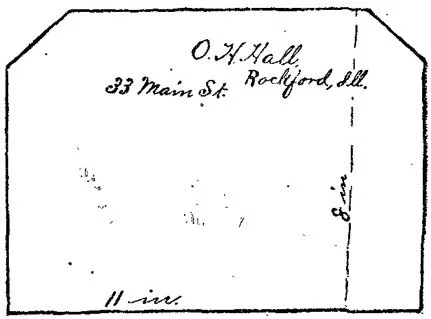
Second, send wrappers, shaped and addressed similarly to the following cut, and we will send this SENTINEL to one hundred names for one dollar.
Wrappers of thin manilla paper are the best. Be careful to write the names and addresses plainly, and write them about an inch or an inch and a half from the edge. The wrappers should be about eight by eleven inches; with the corners clipped, as in cut. In mailing the wrappers to us, don’t fold them but roll them.
Stamps will be acceptable for small remittances.
BIBLES
I. B. L. E. S.
A LARGE AND VARIED STOCK.
A NEW LINE.
With new and unique combination of Old and New Versions. Special Terms to any one who will sell two or more of them. Send for Circular and Terms.
PACIFIC PRESS PUBLISHING CO.,
39 Bond St., New York.
Oakland, Cal. Kansas City; Mo.
The Good Shepherd:
The Life of the Saviour for Children.
Beautifully Illuminated Covers!
Fifty-three Illustrations!
Interesting Reading!
Ninety-six pages,
Large print,
Good paper,
Strong binding.
This book, which is 8x10½ inches and ½ inch in thickness, tells the story of the life of Christ in a way that cannot fail to interest the little folks. It is exceptionally free from doctrinal errors, and should be in every family where there are children to be taught a Saviour’s love. The illustrations add very much to its educational value. Price, only 50 cents.
PACIFIC PRESS PUB. CO.,
39 BOND STREET, NEW YORK CITY
WOULD YOU Cure Your Catarrh?
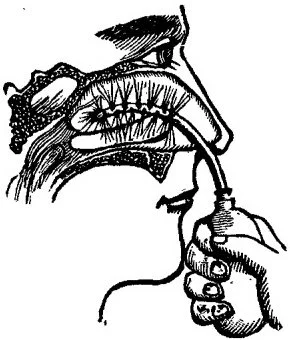
If so, apply the medicine to the Nasal Cavity with the “Success” Nasal Syringe.
The best Syringe on the market for Nasal Catarrh.
The regular price of this Syringe is $1.
Sent postpaid on receipt of 75c.
Address, A. Mallett, 39 Bond St., New York.
THE CYCLONE STILL WHIRLS.
Be Sure You Don't Miss the Whirl this Fall and Winter,
For if you do you will miss a chance of a lifetime to make fine wages at a time of the year when nothing else can be accomplished. It will win you friends, and hold its trade as no other article that is now on the market will do.
Give it a trial and your success is certain
See what others say:
Battle Creek, Mich., Sept. 11, 1896.
THIS is to certify that I have in use in my home one of the Cyclone Washers, manufactured by Coon Bros., of this city, and it gives the best of satisfaction.
M. E. KELLOGG,
Chicago, Ill., Oct. 31, 1896.
COON BROS., Battle Creek, Mich.,
Gentlemen: It is now already a long time since I received the Cyclone Washer you sent me, and now I am ready to tell you how I like it. My wife used it good many times before she could agree with all the testimonies that you have in your circulars, but now she believes them all. She says the Cyclone Washer is not praised too much. Everything that is said about its excellent working is true. The more I use it the more I like it.
Wishing you success, I am,
Yours truly,
ZACH SHERRIG,
Agents wanted in every county.
Address,
COON BROTHERS,
18-20 Hanover St., Battle Creek, Mich.
BOOKS FOR THE CHILDREN.
We offer the following three books as the best of their kind we have been able to find. They are profusely illustrated, and the stories are told in a very simple yet highly entertaining manner. The books cannot fail to be exceedingly helpful to children in an educational way, and should be found in every home:—
LITTLE FOLKS’ BIBLE GALLERY
Has nearly 100 pages, and contains 43 Bible stories, each illustrated with a full-page picture. Size, 7x9 inches, bound in board lithograph covers. Price, by mail, post-paid, $1.00
BIBLE PICTURES AND STORIES
Has 45 full-page illustrations and an equal number of well-told Bible stories. Same style and size as “LITTLE FOLKS’ BIBLE GALLERY,” and is really a companion volume to it. Price, post-paid, $1.00
A mother, than whom none can be more careful and particular as to what her children have to read and study, speaking of these two little books, says: “Really it is a pity that any little child should not have the privilege of seeing these beautiful full-page pictures and hearing the well-told stories.”
Both “LITTLE FOLKS’ BIBLE GALLERY” and “BIBLE PICTURES AND STORIES” will be sent to one address, post-paid, for $1.75
THE NATIONAL SUNDAY LAW.
Arguments in behalf of the rights of American citizens, presented by A. T. Jones in opposition to the Blair Sunday Rest Bill. A thorough catechism upon the subject of Church and State. 192 pages. Price, 25 cents. Send for Spring Catalog of Publications.
PACIFIC PRESS PUBLISHING CO.,
39 Bond Street, New York City.
Oakland, Cal.
Kansas City, Mo.
National Reformers Launch Congressional Campaign for Religious Amendment
By Editor
The National Reformers have already begun their movement upon Congress at its coming session. Two weeks ago they sent throughout the country, all at one mailing, 60,000 memorials and blank petitions to be filled up and sent to the secretary of the National Reform Association, at Allegheny, Pa., to be taken by the National Reformers to Washington and presented to Congress, calling for the establishment of their religion as the national religion. The directions accompanying the blanks are to “Put them in the hands of some active young men or women in your congregation or vicinity, the W. C. T. U., the Christian Endeavor or other young people's society committees, or any party who will energetically circulate them.” Further, that “twenty or more men or women in your vicinity shall without fail write a brief letter to Hon. Geo. F. Hoar, chairman of the Judiciary Committee of the Senate, and Hon. David B. Henderson, chairman of the Judiciary Committee of the House of Representatives, urging this amendment, and when the matter comes up before the Committee or in Congress, will you not make sure to have a half dozen telegrams sent to the same persons urging the submission of the amendment.” The managers of this move say that it “is expected to attract much attention.” We shall do all we can to keep the country informed on the question. Therefore every reader of this should subscribe for the AMERICAN SENTINEL, and get his neighbors to subscribe. This is of great importance to you.
Methodist Organ Praises Presidential Thanksgiving Proclamation's Evangelical Ton
AMONG the utterances which have been called forth from various quarters by the peculiar nature of the President’s Thanksgiving proclamation, the following from the New York Christian Advocate, the leading Methodist organ in this country, is very significant. Having remarked upon the “extreme evangelical orthodoxy” of the proclamation, it says:—
This is significant. No doubt atheists, anarchists, and the coarser class of infidels will make it the text for such ebullitions of blasphemy as are as natural to them and as necessary to their happiness—if such a word as happiness can be applied to persons “without God and without hope in the world”—as its peculiar laughter is to a hyena.
Thus does the leading organ of the great Methodist denomination give its sanction to this un-American proceeding of the chief executive, and manifest its regard for those classes of our citizens whom the President, in his official capacity as their representative, has ignored. It is significant, but it is not strange. For it has ever been the case that when a religious body was in a condition to view with joy the prospect of distinctive recognition from the State, it was ready to treat as hyenas not only the irreligious classes, but other church bodies as well.
What would the Christian Advocate have said if the President had gone a step further and put into his proclamation not only an allusion to Jesus Christ, but to the Virgin Mary and a few of the Catholic “saints”? Does not the Advocate know that there are other steps yet to be taken in the process of making such documents definitely “Christian”? And when it has been decided who are “Christians” in the eye of the Government, the Advocate may find itself in a position to receive sympathy from those whom it now derides.
From the words of the Advocate, it is evident that the consequences which Jefferson foresaw must follow such proclamations are now upon the country: “It must be meant that this recommendation is to carry some authority, and to be sanctioned by some penalty on those who disregard it: not, indeed, of fine and imprisonment, but of some degree of proscription, perhaps in public opinion.” That penalty of proscription is to-day inflicted, and that in no small degree.
National Reformers Seek Convention Ratification, Avoiding Popular Vote
The proposition of the National Reformers, for the ratification of the religious amendment which they propose, is that it shall be by “conventions in the States,” not by a vote of the people. They know that they stand a chance to manipulate the choosing of members of conventions, and the organization of such conventions, much more than they possibly could the vote of the people. Therefore they purpose to make it sure that the people shall have no chance to vote on the question. There is nothing these managers dread more than to have this thing freely and fairly presented to the people. But is it not time that the people awake?