The Youth’s Instructor, Vol. 27, No. 20.

THE DEADLY SERPENT

The Youth’s Instructor

May 21, 1879

S. D. A. Publishing Association · Battle Creek, Mich. · May 21, 1879

THE DEADLY SERPENT.

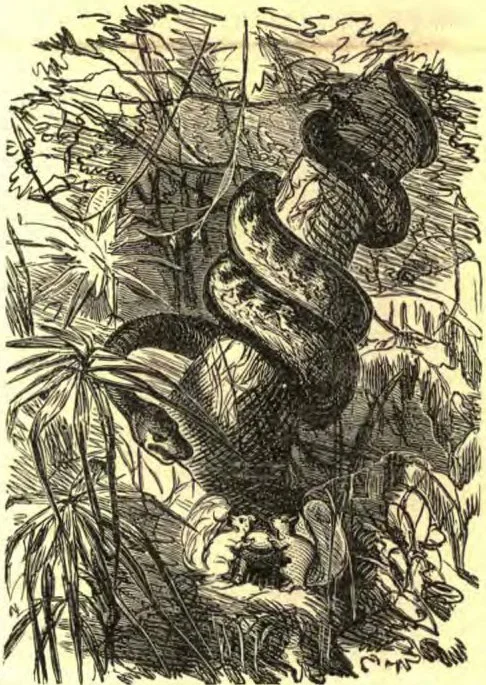
In the East Indies there is one of the most dangerous serpents known in the world. It is called the Cobra de Cappella. It is not so large as some other serpents, but its poison is most deadly. Everything bitten by it dies in a very little while. They increase and multiply so rapidly that it would be almost impossible for people to live in the countries infested by them, if it were not that God has provided an enemy to the cobra, which destroys them in great numbers. This enemy is a little animal, called in India the Gentoos. It is something like the weasel. It is as active as the monkey, as cunning as the fox, and yet as fierce as the tiger. There seems to be nothing in the world which the little creature likes better than to fight the cobra.
The moment a gentoos sees a cobra, he flies at him like lightning, and then a terrible battle takes place. The gentoos fastens its sharp teeth in the neck of the cobra; and the cobra writhes and twists itself about, and tries to bite its enemy with its deadly poisonous fangs. Presently it gets a chance to do this, and darts its fatal venom into the body of its tormentor. As soon as the gentoos finds itself bitten, it loosens its hold upon the cobra, and runs into the woods close by, where it finds a plant, the leaves of which have the power of acting as an antidote, or healing medicine, to the poison of this serpent. He eats one of these leaves; this corrects the poison, or renders it harmless; and then, like a brave little soldier, he rushes at his enemy again, and never stops till he has killed him.
How wonderful it is that God should have provided this healing plant to help the gentoos in its conflicts with the cobra! And yet God has done something more wonderful still for us. Sin is a dreadful serpent, which we all have to fight. Its poison is of the most deadly kind. It will destroy our souls forever, unless it be corrected. But we have a healing Tree, and the leaves of that tree have power to heal our souls when they have been bitten by the serpent, sin.
Children, who is this healing Tree?

From Sea to Sea: Evidence of Ancient Nevada Waters

From Sea to Sea.—No. 8.

The supposition that the Carson Valley was once a lake, and became what it is now by some great eruption, is not improbable, as history informs us that such changes are not unfrequently wrought in the earth.
As the result of earthquakes, mountains and islands sometimes suddenly disappear, and new ones are as suddenly formed. In a work called, “Recreative Science,” we learn that “in 1797 the crater of Tunguragna [a volcano], one of the peaks of the Andes, flung out torrents of mud, which dammed up rivers, and opened new lakes.” Again it says that in 1879 Mt. Etna, in the island of Sicily, “poured forth a flood which covered eighty-four square miles of surface, and measured nearly one hundred million cubic feet. On this occasion the sand and scoria from the volcano formed the Monte Rossi, near Nicholosa, a cone two miles in circumference, and four thousand feet high.”
The best of evidences are found all through these Nevada mountains that they were once under water. We not only see round, smooth stones, and sand like that by the sea-shore, but petrified oyster and clam shells. These are found on points of land several thousand feet higher than the sea. And thus we can account for many strange things which we behold in nature. What are now high, towering mountains, in some cases, may once have been the bottom of the sea; and what is now the bed of the sea may once have been lofty mountains. The psalmist seems to have contemplated some such terrific convulsions, either in the past or future, when he penned the following: “God is our refuge and strength, a very present help in trouble. Therefore will not we fear, though the earth be removed, and though the mountains be carried into the midst of the sea; though the waters thereof roar and be troubled, though the mountains shake with the swelling thereof.” Ps. 46:1–3.
God that made the earth and all that is therein is almighty in power. It is a small thing with him to produce these changes, for “He looketh on the earth and it trembleth; he toucheth the hills and they smoke.” Ps. 104:32. When we think of the changes thus wrought by God’s power, and what desolations he has made in the earth, it should awaken in all our hearts a desire to “hide under the shadow of his wing;” and to do this we must make “his truth our shield and buckler.”
But as we are being hurried rapidly on our journey eastward, we cease our musings on what we have passed, and hasten to view the wonders of the dreary sage brush plains. At first sight, one would think that these plains were totally destitute of anything interesting; but as we approach them, and look to the right about two miles, and up and down the railroad several miles, we see the ground as white as snow, and exclaim, What! Is this snow in mid summer? The conductor kindly informs us that what we see on the ground is salt and alkali, and that we have arrived at the salt wells.
As our train halts, we see great bins filled with salt by the roadside, and men with teams hauling still more up to the bins, while others are loading it into the cars. Away in the distance are vats something like those made for soda, in the Carson Valley. These vats are filled with water, and as it dries away, the salt forms in layers on the bottom.
The water once overflowed a low portion of this land, where it gradually dried away, leaving a thick layer of salt on the ground. This is what led to the discovery of these salt springs.
But on goes our train; and as we leave these mineral curiosities behind, it is with the reflection that the formations of alkali, soda, salt, and borax, found in Nevada, are very nearly associated together; and this seems to confirm the statement made by the inhabitants, “that all these minerals are of the same class.”
J. N. Loughborough.
The abundance of the miser is but poverty to him.

TALKING WITH JESUS.

A LITTLE talk with Jesus, How it smooths the rugged road; How it seems to help me onward, When I faint beneath my load! When my heart is crushed with sorrow, And my eyes with tears are dim, There is naught can yield me comfort Like a little talk with him.
I tell him I am weary, And I fain would be at rest— That I'm daily, hourly longing For a home upon his breast; And he answers me so sweetly In tones of tenderest love, “I am coming soon to take thee With all my saints above.”
Ah! this is what I'm wanting, His lovely face to see; And I'm not afraid to say it, I know he's wanting me. He gave his life a ransom To make me all his own, And he can't forget his promise To me his purchased one.
I know the way is dreary To yonder far-off clime, But a little talk with Jesus Will while away the time; And yet the more I know him, And all his grace explore, It only sets me longing To know him more and more.
I cannot live without him, Nor would I if I could; He is my daily portion, My medicine and food. He's altogether lovely, None can with him compare— The chief among ten thousand, The fairest of the fair.
So I'll wait a little longer Till his appointed time, And glory in the knowledge That such a hope is mine. Then in my Father's dwelling, Where “many mansions” be, I'll sweetly talk with Jesus, And he will talk with me.
—Methodist Home Journal.

Accountability for Idle Words and Silence

As we must render to God an account of every idle word, so we must likewise of our idle silence.

CURIOSITIES IN FIGURES.

A CORRESPONDENT of the INSTRUCTOR once pointed out a peculiarity of the figure 9, that it is never lost by multiplication; multiply any number of nines, and the figures of the product added together will make nines.
A singular uniformity of result is found in multiplying the nine digits by certain numbers. Thus, 123456789 x 27, and the product is 3,333,333,303,—all 3’s except a cipher next to the last. Reverse the multiplier, thus, 123456789 x 72, and the result is 8,888,888,808,—all 8’s except the cipher again next to the last.
Reverse the digits, using the same multiplier, 987654321 x 27, the product is 26,666,666,667,—all 6’s except the first and last, which together are the multiplier. Again reverse the multiplier, thus, 987654321 x 72, the product is 71,111,111,112,—all 1’s except the first and last, which again are the multiplier.
The same uniformity results if we use 4 and 5 for the multiplier. Thus, 123456789 x 45, the product is 5,555,555,505,—all 5’s except the cipher next to the last. Reversing the multiplier, 123456789 x 54, gives 6,666,666,606,—all 6’s except the cipher again in the same position. Then reversing the digits, 987654321 x 45 we produce 4,444,444,445; all 4’s except the last, which, with the first, gives the multiplier. Reversing the multiplier, 987654321 x 54, the product is 53,333,333,334, all 3’s except the first and last, which again are the multiplier.
The same result follows the multiplication of the digits in the same manner by 9, or any two figures which added together make 9. And the figures in the product, in all cases, added together, make even nines. Notice also that the digits themselves added together make 45, or just five nines. It will probably never be known how many such co-incidences might be formed with figures.
I presume all the readers of the INSTRUCTOR remember the short article recently published under the head, “Singular Combination of Figures.” It said the number 142,857, multiplied by 1, 2, 3, 4, 5, or 6, gives the same figures in the same order, beginning at a different point, but if multiplied by 7, gives all nines. But that is only a part of the singularity of this number. No matter how far you extend the multiplication, you can never lose the same figures; and multiplying by any number of sevens you still find the nines.
But you will soon think you find a difficulty in the trial, as multiplying these figures by figures higher than 7 brings more than six figures in the product; thus, 142,857 x 8=1,142,856. Now strike off the first figure, leaving six, and add the one struck off to the last one, and you have the original number. And this will hold good for all multiplications, no matter how high. Thus, for example, 142,857 x 32; the product is 4,571,424. Strike off the first 4, and add it to the last, and all is right. Or, higher still, 142,857 x 99, gives 14,142,843. Here are eight figures; strike off the first two, 14, and add to the last, 43, and you have the original number. And so on indefinitely.
And so with the sevens or any number of sevens. Thus, 7 x 7=49. Then 142,857 x 49, gives 6,999,993. The first, 6, added to the last, 3, gives six nines. Or, 142,857 x 777; the product is 110,999,889; add 110 to 889, and the six nines remain. The last figure or figures will always lack just enough to receive all over six, at the beginning. And again, each of the products contains even nines.
I cannot say that there is any real use in tracing these singular combinations; but they are as interesting as they are curious, and it affords a pleasant pastime to those who love to work in figures.
J. H. WAGGONER.
Oakland, Cal.

THE BEAUTIFUL EARTH!

Ah! “the fresh, sweet smell of the green things growing.” Our eyes are delighted with their beauties, and our ears ravished with the notes of the feathered songsters as they warble forth their hymns of praise. As the earth is freed from her icy fetters, and dons her gala dress, she appears so lovely and attractive we almost forget that she is groaning to be delivered from her dreadful curse.
For six thousand years sin has existed upon this planet, the effects of which are blight and mildew, pestilence and famine, wars and bloodshed; in fact, every evil under the sun is an outgrowth of sin. That we can see so much yet to admire in this old, worn out earth, is probably an evidence that we have but faint conceptions of the truly beautiful.
We read, “Eye hath not seen, nor ear heard, neither have entered into the heart of man, the things which God has prepared for them that love him.” When the saints receive their reward, the earth will have been redeemed from the curse, and those who are saved will never again experience sickness nor sorrow, anxiety, tears, nor death. In their beautiful home they will dwell forever, and feel that eternity is none too long in which to ascribe praise to God and the Lamb. Shall our voices help swell the chorus?
It is right to admire the beauties of Nature, but, dear reader, we must not be satisfied with earth in its present imperfect condition; rather let us draw inspiration from the beauties which remain, to make sure of a title to a home in the beautiful new earth.
M. J. C.

Thy Works, O Lord, Interpret Thee

THY works, O Lord, interpret thee, And through them all thy love is shown; Flowing about us like a sea, Yet steadfast as the eternal throne. —Alice Cary.

BIBLE LESSONS FOR YOUTH.

LESSON XLVI.—PRESUMPTUOUS SINS.

  1. How were the people affected when Moses told them what the Lord said? Num. 14:39.
  2. What did they do in the morning?
  3. What did they say?
  4. What question did Moses ask them? Vs. 41.
  5. What warning did he give them? Verses 42, 43.
  6. How did they heed this warning? Vs. 44.
  7. Who remained in the camp?
  8. How were the people punished for their rashness?
  9. What does Moses say about this? Deut. 1:44.
  10. What was the law in regard to any one who had sinned ignorantly? Num. 15:27, 28.
  11. What in regard to any one who had sinned presumptuously? Verses 30, 31.
  12. What example is recorded to show what is meant by presumptuous sins? Vs. 32.
  13. Why did Moses and Aaron put the man in ward?
  14. What instruction did the Lord give them?
  15. What instruction was given to the people in regard to their dress?
  16. For what purpose were they to wear these fringes and ribbands of blue?
  17. By what solemn words did the Lord try to impress upon their minds the thought that he was to be their only object of worship?

SYNOPSIS.

When Moses told the people the words of the Lord, they mourned greatly; and they rose up early in the morning, and went up into the top of the mountain, saying, “Lo, we be here, and will go up unto the place which the Lord hath promised; for we have sinned.”
But Moses told them not to transgress the commandment of the Lord by going, for if they did go, they would be smitten before their enemies. He told them that they had turned away from the Lord, therefore the Lord would not be with them.
They would not hearken to Moses, but went out; nevertheless the ark of the covenant of the Lord and Moses went not out of the camp. The results were as Moses had told them. “Then the Amalekites came down, and the Canaanites which dwelt in that hill, and smote them, and discomfited them, even unto Hormah.” Moses says their enemies chased them as bees do. Then they returned, and wept before the Lord, but he would not hearken to their voice. So they abode in Kadesh many days.
According to the laws which the Lord gave the people, any one who sinned ignorantly was to bring a sin-offering to the priest. The priest then offered the sin-offering as an atonement, and the sinner was forgiven. But whoever sinned presumptuously, was to be cut off; for by taking such a course he showed that he despised the word of the Lord.
To show what is meant by presumptuous sin, an example is recorded. While the children of Israel were in the wilderness, a man was found gathering sticks on the Sabbath day; and when he was brought to Moses and Aaron, they put him in ward, for it was not declared what should be done to him. “And the Lord said unto Moses, The man shall be surely put to death: all the congregation shall stone him with stones without the camp. And all the congregation brought him without the camp, and stoned him with stones, and he died.”
And the Lord, by Moses, instructed the people to put fringes, and ribbands of blue, in the borders of their garments, so that when they looked upon them, they might remember all the commandments of the Lord, and do them, not following the desires of their own heart, nor the lusts of their own eyes, but keeping themselves holy unto their God.
Then, to further guard them against idolatry, he spake these solemn words: “I am the Lord your God, which brought you out of the land of Egypt, to be your God: I am the Lord your God.”
G. H. BELL.

GET THE CORK OUT.

To you I want to tell a secret. You can't fill a bottle with the cork in. Let the fountain be ever so abundant, and the pump be plied with ever so much vigor and persistence, it is all in vain. Do you know what I mean? The philosopher puts it on this wise: “Curiosity is the parent of knowledge.” Your first business, then, is to awaken a desire to know. It is what, a few years ago, we used to hear lectured about so much, under the phrase, “waking up mind.” A large part of the failure among Sabbath-school teachers comes from the neglect of this principle. They know something to teach; they actually say excellent things and do excellent things; but their pupils don't care a fig for the wares they are asked to buy.
Now, my friend, you may go on in this way till you teach your class to death. You may pour your stream of knowledge upon them till you drown them, or till they run away, and never get a drop of it into them, because their mouths are shut. You see the point, do you? Oh, yes! I hear you ask, “How can I open their mouths? How can I get the cork out?” That's the rub, I confess. It is just here that the teacher “shines out.” Anybody can teach those who want to learn. The genius for teaching shows itself in teaching those who don't want to learn; in begetting a desire to know, where such a desire does not exist.—Prof. E. Olney.

THE SABBATH-SCHOOL.

FIRST Sabbath in June.

LESSONS FOR CHILDREN.

LESSON XX.—REVIEW.

  1. By whom were the children of Israel led out of Egypt?
  2. By whom were they led into the land of Canaan?
  3. At what time of year did they come to the Jordan?
  4. How were they enabled to cross it when the water was so high?
  5. How was this great miracle kept in memory?
  6. What was the first city taken?
  7. How did they gain an entrance to the city?
  8. Why did they have so much trouble in taking Ai?
  9. Who deceived Joshua and the elders of Israel?
  10. In what way?
  11. How did Joshua come to be so easily deceived?
  12. How did the Lord help his people at the battle of Gideon?
  13. What wonderful miracle was performed by Joshua?
  14. Who was conquered at Lake Merom?
  15. How great an army had the king of Hazor?
  16. After the land was subdued, who divided it among the people?
  17. How was the land ruled after the death of Joshua?
  18. Who was the first judge? The second? The third?
  19. Who judged Israel next after Deborah?
  20. How was Gideon called to deliver his people?
  21. What did the angel do with the present that Gideon brought him?
  22. How did Gideon feel when he found that he had been talking with an angel?
  23. What did the Lord instruct Gideon to do that night?
  24. What did Joash say to the men of the city when they came the next morning to kill Gideon?
  25. What did the Midianites do then?
  26. How did Gideon raise an army?
  27. What signs did the Lord give Gideon to show that he would give him victory over his enemies?
  28. How large an army did Gideon raise?
  29. How was it reduced to ten thousand?
  30. How were the ten thousand reduced to three hundred?
  31. Why did the Lord want Gideon and his servant to go down to the host of Midian at night?
  32. What did they overhear?
  33. How numerous were the Midianites?
  34. Describe Gideon’s attack.
  35. Describe his victory.

PRINCIPLES OF TEACHING.

TEACHERS may gather some good hints from the following lines which have come across our path:—
Would you a child attempt to teach? Study his nature, habits, speech. Ere you begin his mind to guide, Master your subject and self beside, Make him to tell you all he can, Then from this knowledge form your plan; Begin at the end of what he doth know, Tell him but little, and tell that slow. Use words that he will know and feel; Repeat, call back, draw out at will; Consult his tastes, help him to climb, And keep him working all the time; Be firm, be gentle—love is strong; To Jesus look, you'll not go wrong.

HOW TO TEACH THE LITTLE ONES.

THE manner of conducting a recitation with little children should be very different from what would be proper with a class of youth or adults. When you have a class of little ones, ask a great many questions. Ask questions that will admit of very short answers. Let the questions come in natural order. Let them come in quick succession. The teacher should ask many more questions than are found in the paper.
Do not be afraid of repetition. “Line upon line; here a little and there a little.” But be careful not to weary your pupils. Do not talk till you cannot get their attention any longer, but stop when their interest is good. Seek variety, not by going to new themes, but by going over the same subject in many different ways, asking the questions in different form and order. Never take up more than one subject at a lesson, unless it be in reviewing something that has been well understood before. After you have thoroughly impressed the main idea of the lesson, be satisfied. Let it have time to take root. A little food well digested will give more nourishment and strength to the body than the large quantity that overloads the stomach, clogs the system, and brings on disease. There are many dyspeptic minds, made so by the cramming process.
Review what they have been over time after time, till the children are perfectly familiar with all the important points. The little ones will not lose their interest unless the teacher does. The teacher who really instructs children, will have to please and interest them; and whoever does this, will have to be familiar, and full of vivacity. No cold, dull, formal, indifferent teacher can win the heart of a child, or improve his mind. You need not be silly, need not talk “baby-talk;” but you must abandon all stiffness, all large words and long-drawn sentences, and come right down to the simplicity of childhood, and to plain, every-day words and expressions. Your language may be plain, and yet not vulgar; simple, and yet pure.
But above all, the heart of the teacher should overflow with the love of God, and with genuine love for the children. This will put into every look and tone an inspiration that will be irresistible. The children will never love the teacher who does not love them. This love must take an active, definite form. It must not be a principle so lofty and general that it cannot condescend to watch and care for the wants of each child individually. It must be the tender solicitude that warms the heart of the true Christian mother.
Oh, may the Lord raise up teachers who have the true missionary spirit! G. H. BELL.

“THE CLAM-SHELL PREACHER.”

There was a mission school in Hartford, in a garret room of a rickety building, in the earlier days of such schools in this country. It was what the English would call a “ragged-school,” made up of boys and girls in the community, out of homes of squalor and of vice along the river banks in one of the poorer quarters of that city. It was not an easy matter to catch and hold the attention of that motley assemblage. There was rarely a visitor who was equal to the emergency. But Dr. Beadle won the eyes and ears of all who were there, when he first came to that school. Standing in front of the Superintendent’s desk, before the school closed for the day, he held up a common fresh-water clam-shell, and called out, “Boys, what is that?”
“A clam-shell,” cried a hundred voices. “Yes, it’s a clam-shell,—a rough, coarse clam-shell; just such a shell as you could pick up any day by the bank of a river, or back in the country by a brook in the woods.”
Then turning the shell quickly in his hand, he showed the other side, beautifully polished, and reflecting the colors of the rainbow.
“And what’s that, boys?”
“That’s a clam-shell, too,” was the answer.
“Yes; but see how much prettier this side is. What makes the difference?”
“It’s been rubbed down,” said one. “It’s been smoothed off,” said another. “It’s been polished up,” said a third.
“Yes, that’s it. And, boys, do you know that’s just what we are trying to do with you in this Sabbath-school? We’ve brought some of you in here as rough as the other side of the clam-shell, and now we are trying to smooth you off, to polish you up, so that you’ll shine like this side of the shell. This polishing business is hard work, boys, and it takes time, but it pays.”—S. S. Times.

WILD FLOWERS.

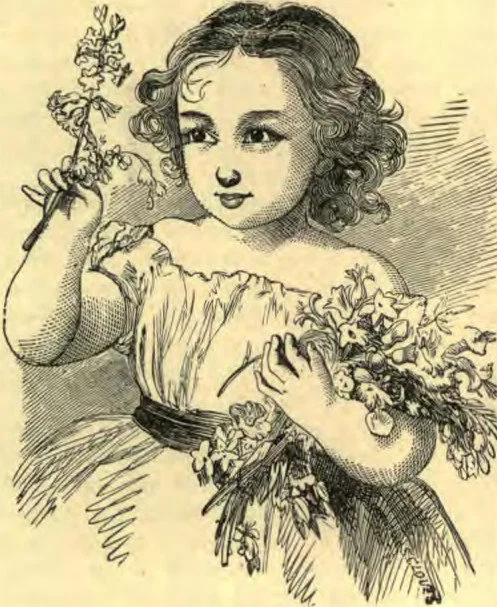
“MOTHER, see what beautiful flowers, and all of them grew in the field by themselves without any tending or watching.”
“I think you can’t mean just that, my dear. No flower ever grew without tending or watching!”
“Well, these did, mother, for I got them away down by the west woods, in a field where no one has been plowing or hoeing all this spring.”
“Yes, my dear, I do not doubt that. I did not say that the flowers had been watched or tended by man, but God has been in the field, watching by night and by day. All the hours that you have been playing and sleeping, he has been at work on these lovely flowers, molding them into graceful forms, and painting them with all these beautiful colors. And he it was who sheltered them through the long, cold winter, and kept them from dying. Did you ever wonder how the world out of doors is kept warm?”
“O yes, mother, a great many times. Do tell me how it is.”
“Well, you remember the horse-chestnut tree that stands in your Uncle Albert’s front yard. In winter the buds on that tree look as if they were covered with a sort of varnish. This is the water-proof of the little leaves, given them to keep out the snow and rain. Towards spring, these outside leaves drop off, because they are not needed, and on the inside are found the little leaves, nicely folded in wool. I do not believe my little girl was ever wrapped up more warmly than God has wrapped these leaves.”
“Then there is the ‘pussy-willow’ whose blossoms are carefully wrapped in a coat of fur. And there are many other flowers which God has clothed in very much the same manner. But the buds and flowers of summer have only thin coats, just enough to protect them from the cool nights.”
“Well, mother, I never thought before that God did really clothe the grass and flowers as Jesus has said.”

“BROTHER JONATHAN.”

THE origin of this term, as applied to the United States, is as follows: When General Washington, after being appointed commander of the army of the revolutionary war, went to Massachusetts to organize it, he found a great want of ammunition and other means for its defense; and on one occasion it seemed that no means could be devised for the necessary safety. Jonathan Trumbull, the elder, was then governor of the State of Connecticut; and the general, placing the greatest reliance on his excellency’s judgment, remarked, “We must consult Brother Jonathan on the subject.” The general did so; and the governor was successful in supplying many of the wants of the army; and thenceforth, when difficulties arose, and the army was spread over the country, it became a by-phrase, “We must consult Brother Jonathan;” and the name has now become a designation for the whole country, as John Bull has for England.—Young Reaper.

LETTER BUDGET.

We have room for but two letters this week, first, one from Georgia, where Eld. C. O. Taylor is laboring.
DEAR EDITORS: I go to Sabbath-school. Mrs. Taylor is my teacher. I wanted the YOUTH'S INSTRUCTOR very much, but I could not get it. Wonder at my surprise the other day when a large package of them came to me, with the Child's Poems. Mary A. Remley's name is on it, but how did she find out I wanted it? I am very much pleased with it, and thank her for it very much. SALLIE I. STUCKEY.
Dear child, there are always some good people who traverse sea and land, if not in person, with the pen, to ascertain the wants of others. In this way we think M. A. Remley has learned your wants. Your gratitude will amply reward her, and we hope her gift may prove a blessing to you.
Here is a little letter from a little Swedish girl in Minnesota:—
DEAR EDITORS: I have been keeping the Sabbath about nine months. I get the Instructor every week, and love it very much. I attend Sunday-school every Sunday, if the weather is not too bad. We have no meeting on the Sabbath day. There are only two persons at Eyota besides myself who keep the Sabbath,—Hermon Hansen and my mother. We feel very lonely since Soren Nielsen and family went West. Perhaps we will attend their camp-meeting next summer. I will send you 25 cents to help support the Scandinavian Press. I will try to be a good girl, and cling to our Saviour.
Yours truly, MILIA SVANSON.
The inhabitants of the new earth will never feel lonely, for they will never be separated, and there will be nothing to cause feelings of discontent or unhappiness there. We hope your donation to the cause will awaken an interest in some mind to gain eternal life.

CHILDREN'S CORNER.

'TIS COMING.

'Tis coming, 't is coming, The beautiful summer, The world will be soon all in tune; Each bird, bee, and blossom, Each leaf, and all grasses Will grow in the sunshine of June.
'Tis coming, 't is coming, The heart of the children Will feel the soft touch of its breath, And wake with the spell That rouses the daisy From out of her chamber of death. —Myrtle.

You have reached the end of this edition.

The Youth’s Instructor · May 21, 1879