The Youth’s Instructor, Vol. 36, No. 38.

SEPTEMBER DAYS

The Youth’s Instructor

Sep 19, 1888

S. D. A. Publishing Association · Battle Creek, Mich. · Sep 19, 1888

SEPTEMBER DAYS.

Oh, soft and dreamy is the topaz air Above the fields and uplands far away; And there are faintest whispers everywhere That tell us of the joys that fade away! The cricket's chirp, beneath the shrivelled vine That tangled lies along the wayside wall, Falls like a vague regret; a silver line, The brook with softer murmur seems to call, In these September days.
Oh, is it fancy that the birds' sweet trill Breathes out the accents of a sad farewell? Or that the flowers on hazy vale and hill Seem to the eye their loneliness to tell? The thistle's downy snow floats dreamily, The locust wakes the silence of the moon, And chatters loud and louder from the tree, Whose leaves soon muffle up its dwindling tune, In these September days.
The grain—a golden sea—sweeps to its shore, The woods, as yet unclad in purple pride, Yes, leaf and flower say summer's reign is o'er, And murmurs speak it from the uplands wide, So, in the heart, a whisper of farewell, A nameless sadness lingers, tho' we know That joys as fair the heart again shall tell, That skies of spring again shall softly glow, Past these September days! —George Cooper.

“LAND OF THE BRAZIL WOOD.”

Were you asked which is the first country of importance in the Western world, who is there but would say, “The United States”? Would you know the second, you have but to look on the map of South America. It occupies the greater part of the eastern portion of that peninsula, and is said to be thirty-five times the size of Great Britain. For reasons which we shall tell you by and by, it was named Brazil. Not for its size alone is it distinguished, but Nature has heaped treasures of every description within her borders. Besides the bright gems and rich minerals imbedded in the earth, she has a generous supply of lofty mountains and majestic rivers, which, combined with her luxuriant tropical vegetation, cool breezes, and refreshing showers, make it a desirable land to dwell in. What adds to its attractiveness as a tropical climate, is that it has no deserts, with their scorching winds; neither is it, like the western coast of South America, visited by earthquakes. While Brazil is so well watered and fertile, on the country west of it, beyond the Andes Mountains, rain never falls. It would take volumes to describe the varied productions of this prolific soil and climate. As proof of this, when Professor Agassiz was in Brazil in 1866, he saw a collection of Amazonian products which had been prepared to send to the World's Fair at Paris, in which there were “no less than one hundred and seventeen different kinds of highly valued woods, cut from a piece of land less than half a mile square.” Many of these were “dark-colored veined woods, susceptible of a high polish, as beautiful as rosewood or ebony.” He remarks, that “an empire might esteem itself rich in any one of the sources of industry which abound in this valley, and yet the greater part of its vast growth rots upon the ground.”
Speaking of the palms, he says “their name is legion, and the variety of their forms, of their foliage, fruits, and flowers, is perfectly bewildering.” And the same might be said of almost every other species of vegetation in this climate.
Brazil was first discovered by Vincent Yanez Pinzon, a companion of Columbus when he made his first voyage which resulted in the discovery of the new world. He set sail again from Palos in 1499. Crossing the equator, he first landed on the green promontory just south of Pernambuco, which he named Cape Consolation, now known as Cape St. Augustine. In the “name of Castile” he took possession of this newly found land; but before he reached Spain on his return, a Portuguese expedition, under Pedro Alvaraz Cabral, claimed it for Portugal. Cabral named it Vera Cruz, meaning the true cross, and set up a large cross as a reminder of his discovery.
In those days the Pope of Rome took upon himself the right to settle disputed claims of newly found land, and he decided this in favor of Portugal. The king of Portugal sent out another expedition, and among those who set sail for the new territory was Americus Vespucius, after whom the whole Western continent was named.
And now for the origin of “Brazil.” A modern author says, “The most valuable part of the cargo which Vespucius carried back to Europe, on his second expedition to Brazil, was the well-known dye wood, Cæsalpinia Brazilensis,—called, in the Portuguese language, pan brazil, on account of its resemblance to brazas, “coals of fire;” the land whence it came was termed the ‘Land of the Brazil Wood.’” The name was finally shortened to Brazil, and took the place of Vera Cruz, or Santa Cruz, which Cabral named it.
Brazil remained a colony, governed by viceroys from Portugal until 1815, when it “was elevated to the dignity of a kingdom;” and finally, in 1822, after a comparatively bloodless war, the court of Lisbon declared it independent. In the meantime, Dom Pedro I. was crowned emperor, and by the liberal constitution framed in 1824, the empire is still governed. In 1831 Dom Pedro abdicated the throne in favor of his son, Dom Pedro II., who is the good emperor of whom you sometimes read in the INSTRUCTOR.
The principal city of the empire is Rio de Janeiro, the capital, situated on a bay of the same name. Tradition says that one of the first Europeans to discover the bay, De Souza, supposed he had entered a mighty river, and named it as above, the name signifying the “River of January,” after the month of January, 1531, in which he first entered the bay. Whether this is or is not the origin of the name, the same appellation has been given to the bay, and the capital, and the province in which these are situated.
The beauty and sublimity of the scenery, as you enter the bay, seems to inspire even the dullest observer. One writer has said, “I have seen the most rude and ignorant Russian sailor, the immoral and unreflecting Australian adventurer, as well as the cultivated and refined European gentleman, stand silent upon the deck, naturally admiring the gigantic avenue of mountains and palm-covered isles, which, like the granite pillars before the temple of Luxor, form a fitting colonnade to the portal of the finest bay in the world.”
Rio de Janeiro has many charmingly picturesque environs, which the traveler for pleasure should not fail to visit. Besides what Nature has done for these surroundings, gardens, walks, and avenues of exquisite beauty have been carefully prepared, adding enchantment to their original loveliness.
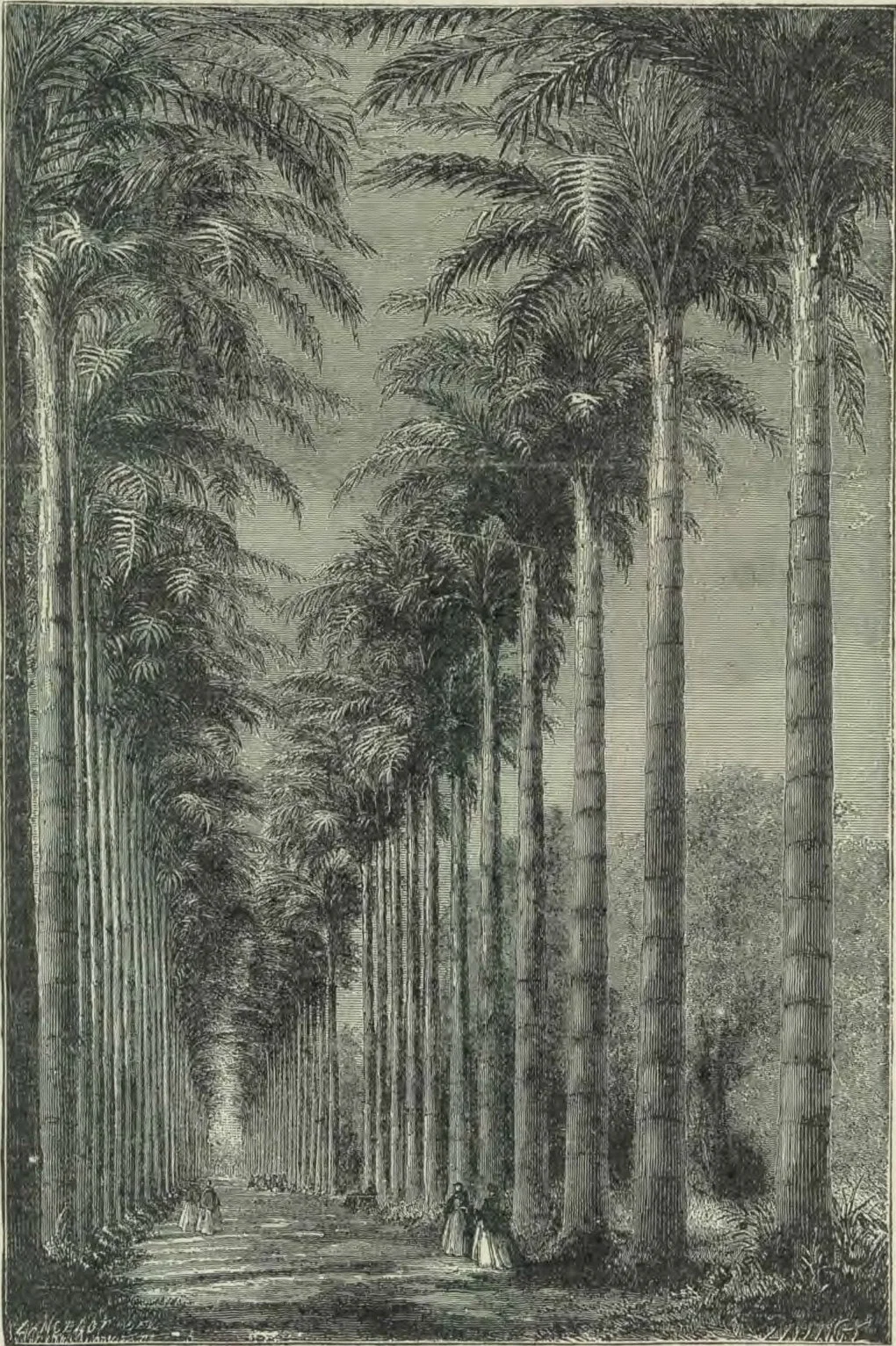
The Botanical Garden, some eight miles out of the city, is well situated for pleasantness, and although not so well kept as it should be, is remarkable for its beauty. One attractive feature of this garden is its long avenue of palms, some eighty feet in height, represented in the picture on the preceding page.
Professor Agassiz writes, after viewing these palms, “I wish it were possible to give in words the faintest idea of the architectural beauty of this colonnade of palms, with their green crowns meeting to form the roof. Straight, firm, and as smooth as stone columns, a dim vision of colonnades in some ancient Egyptian temple rises to the imagination as one looks down the long vista.”
Another visitor to Rio de Janeiro says, “I thought I should never see anything in the whole world that charmed me as the Bay of Rio de Janeiro. It is even more beautiful than the renowned Bay of Naples, or the Golden Horn of Constantinople.” After describing the bay as it appeared to him in all its loveliness, he adds: “but I brought another picture to remember best. It rests me to recall it, and I can close my eyes, and see at will that stately avenue—that grand old avenue of palms in the city of Rio de Janeiro. Your books tell you much about the Brazilian forests. Well, their magnificence is awe-inspiring, with their foliage showing every tint of green, and birds of glittering plumage flitting through giant boughs, and flowers of rainbow beauty everywhere. They are worth talking about, but this palm avenue is too exquisitely beautiful for words to picture. You must see that for yourself.”
With a ruler so liberal, learned, and accomplished as the present emperor, Dom Pedro II., it would seem as if the only great drawback to Brazil's rapidly coming to the front among the nations,—now that slavery is abolished,—is its State religion, which is Catholic. But those who understand the situation see hope for Brazil; for “the intelligent population are ready for the light of the gospel. The more the priests oppose the Bible, the more the people welcome it.”
We must leave for another time to tell you how nearly this empire, upon its rise, came to being a great Protestant nation. In the meantime let us not cease our efforts in trying to get the true Protestant religion before them and every other people who are destitute of the truth. M. J. C.

THE ASTRONOMER AND THE ATHEIST.

Athanasius Kircher, the celebrated German astronomer, had an acquaintance whom he much esteemed, but who was unfortunately infected by atheistical principles, and denied the very existence of a God. Kircher, sincerely desirous to rescue his friend from his mistaken and criminal prejudice, determined to try to convince him of his error upon his own principles of reasoning. He first procured a globe of the heavens, handsomely decorated and of conspicuous size, and placed it in a situation in his study where it would be immediately observed.
He then called upon his friend with an invitation to visit him, which was readily responded to, and on his arrival he was shown into the study. It happened exactly as Kircher had planned. His friend no sooner observed it than he inquired whence it came and to whom it belonged.
“Shall I tell you, my friend,” said Kircher, “that it belongs to no one; that it was never made by any one, but came here by mere chance?”
“That,” replied the atheist, “is impossible: you jest.”
This was Kircher’s golden opportunity, and he promptly and wisely availed himself of it.
“You will not, with good reason, believe that this small globe which you see before you originated in mere chance, and yet you will contend that those vast heavenly bodies, of which this is but a faint, diminutive resemblance, came into existence without either order, or design, or a creation!”
His friend was first confounded, then convinced, and, ultimately abandoning all his former skepticism, he gladly united with all who reverence and love God in acknowledging the glory and adoring the majesty of the great Creator of the heavens and earth and all their host.
This was the conviction to which the renowned physician Galen was conducted by his researches. He at one time of his career had been disposed to atheism. But when he examined the human body, when he perceived the wonderful adaptation of its members, and the utility of every muscle, of every bone, of every fiber, and of every vein, he rose up from his investigations in a rapture of praise, and composed a hymn in honor of his Creator and Preserver.—S. S. Classmate.

A DAY AND NIGHT IN A LUMBER CAMP.

“So you want to see how we manage the lumbering business in this camp? Very well. We’ll first go into the woods where the men are cutting timber, and inspect the camps afterward.” These were the words of the foreman of one of the large lumbering establishments in northern Michigan.
A walk of nearly a mile among the pine trees and over a rough road, brought us to the place where the men were at work. On about forty acres nearly one hundred men were cutting and handling timber. They were divided into three divisions: one to cut down the trees; one to “ross” the tree, that is to cut off the bark and limbs; and the third to make roads and help load the timber. There were also men to drive the horses and help at the “skidway,” the place where the timber is loaded on to the cars.
The timber cut in this camp is used mostly for ship-building, therefore the trees were not cut into logs. It is carried on the railroad to Lake Huron, where it is rafted to the ship-yards.
We saw two men begin to cut down a huge tree. In a few minutes it had been felled, and the men who cut it down went away to fell another tree. Several other men then came and “rossed” it, and what, a short time before, was a beautiful green tree, lay before us a piece of white timber.
Three teams were then driven up, and, after the end of the log next to the stump had been rolled on to a dray, they were hitched on. They drew it alongside another tree that had been prepared in the same manner, and after it had been loaded, started for the “skidway.” It was an interesting sight to see these trees handled. Being so long, about 60 feet, much skill was required to draw them through the woods. But the drivers and horses had become so used to the work that it seemed easy.
The men working in the woods are in constant danger from the falling of trees and the moving of such heavy timber. We were more than once cautioned to “watch out,” and found that the old proverb “every man for himself” is exemplified here if anywhere.
By the time the “skidway” was reached, it was dark, and as soon as all were seated on the backs of the horses, we started for the “camps.” The “camps” consist of four log buildings: an office, “cook’s shanty,” “men’s shanty,” and stable. The office is a small building, but the rest are about 60 feet long by 25 feet wide.
“Come, come,” said the foreman, “hurry and see the men come in to eat their supper, it’s a sight, I can tell you.” So into the “cook’s shanty” we went. At the farther end from where we entered, a partition made a room where the cooking is done. On either side of the room was a long board table covered with oil-cloth. Long wooden benches served as seats.
But our observations were interrupted by the supper-horn. Long before its echoes had died away, the men were in their places, and the clatter of knives, forks, and plates filled the room. We had heard it said that working in the pineries would give a man an appetite, and there now seemed no occasion to dispute the statement.
In the “men’s shanty,” beds, or “bunks” as they are called, are built on three sides of the room. In these the men sleep, but we thought the bed and pillow of Jacob much healthier, and more preferable in every way.
As in the majority of the “camps” in northern Michigan, so here, the greater part of the working-men were foreigners. Dancing, card-playing, story-telling, and similar amusements, seemed to be the order of the evening. Nearly every man smoked, and those who did not might as well have done so. We could see no place for fresh air to get in except one window, which was kept closed, and the door, which was closed too. Lumbering may be a useful occupation; but it is certainly not a desirable life to lead.
Many people, having noticed the great amount of pine timber that Michigan has placed upon the market, have been led to think that its supply was nearly exhausted. It is true that it is rapidly being stripped of its pine timber, but one does not need to take a very extended trip through its pine lands to become convinced that its resources in this direction are still great, and that the lumbering interests are among the foremost industries of the State. Indeed, one of Michigan’s senators, Mr. Palmer, recently made the statement that “Michigan has enough pine timber to build four board fences, fifteen boards high, around the world, every year for ten years to come.”
FRED GIMSON.

PURSUIT OF KNOWLEDGE UNDER DIFFICULTIES.

THE Rev. Arthur H. Smith narrates the following incident in the Chinese Recorder:—
A most remarkable case of the pursuit of knowledge under difficulties came under our notice in a village in the prefecture of I Chow-fu. A man named Fu, formerly a fortune-teller, was in the habit of going about among the well-to-do classes in his district and reciting stories. About seven years ago he embraced Christianity. He has been blind for thirty years. A few miles distant lives a sister, also for many years blind. When Mr. Fu became a Christian, he wished to learn the Bible, but this he could only do by having his daughter, a girl of fifteen, describe to him the characters which she met, when he told her the names and signification of them. In this wearisome way he learned the New Testament, and his daughter learned to read. Not only so, but from this small beginning the blind sister of Mr. Fu has learned the greater part of the Gospel of Matthew, which she has repeated character by character to her invalid sister-in-law, who in turn can now repeat it. Mr. Fu and his sister were examined in our hearing on a great variety of passages in Matthew, John, Acts, Romans, and Revelation, his fine and almost classic face beaming with intelligence, and his thoughtful replies and remarks showing that to him that hath shall be given. Mr. Fu is now an elder, and is frequently sent out by the churches in his district, with a companion, for about two months twice a year, as an evangelist to the regions beyond.

NEVER HUNCH WHEN OTHERS CROWD.

ONE very warm afternoon in July, I visited a school in Boston. There were about sixty children, from four to eight years old. The schoolroom was small, and the children looked much oppressed by the heat, especially the youngest.
I stood before them and asked, “Children, can you tell me what peace-children will do?”
One said, “Love your enemies;” another, “Forgive your enemies;” another, “When others strike one cheek, turn the other;” another, “Overcome evil with good.”
All these were good answers. At length a little girl on the middle of a seat directly before me, looking very uncomfortable,—she was so crowded that she could not move her elbows,—looked up, and in a plaintive tone said, “Peace-children don’t hunch when others crowd.”
The little crowded, suffering child gave the best definition of “peace,” I ever heard. “Never hunch when others crowd.” She drew it directly from her own personal experience, and said what she felt. There the little girl was crowded up; her arms squeezed down to her sides, she could hardly move or breathe; yet there was no anger, no quarreling, simply because she did not “hunch.”—Happy Days.

What Am I Going to Be? Aim for Christian Manhood

WHEN a boy enters his “teens,” the question begins to come up in his mind, “What am I going to be?” Sometimes it takes a long time to answer that question, because there are two points to be considered: first, to be something; second, what? A sensible man doesn’t set a boat adrift when he wants to make a journey in her. He starts for some particular place, and rows toward it; and before he starts, he decides to what place he wants to go. Then every stroke of the oar brings him nearer his journey’s end.
Like the man at the oars, make every stroke tell. God didn’t send you into the world to drift aimlessly about, like a boat without oars or rudder. Take each duty and do it faithfully as a preparation for something beyond.
And, with all the rest, do not forget that a noble Christian manhood is the highest aim for which you can possibly strive.—Sel.

THE THIRD ANGEL'S MESSAGE.

LESSON 14.—THE WRATH OF THE DRAGON.

1. Just after what notable working will the Saviour come? 2 Thess. 2: 9, 10.
2. How great will be these signs and wonders? Matt. 24: 24.
3. Why is it they deceive them that perish? 2 Thess. 2: 10, last part.
4. What special manifestation of the truth have we found that there will be just before the coming of the Lord? Rev. 14: 9, 14.
5. Are the commandments of God and the faith of Jesus the truth? Ps. 119: 151; John 14: 6.
6. Are the commandments of God and the faith of Jesus righteousness? Ps. 119: 172; Gal. 5: 5, 6.
7. What is the object of Satan's deceiving, lying miracles and wonders? Rev. 13: 14.
8. What is the object of the third angel's message? Ans.—To save men from the worship of the beast and his image.
9. Then with what will be Satan's last conflict before the coming of the Lord? Ans.—With the third angel's message and with those who receive the love of it.
10. What does this message lead men to do? Rev. 14: 12.
11. In what manner does the second beast of Rev. 13 speak? Verse 11.
12. What power, and seat, and authority, has the first beast? Verse 2.
13. What is the great dragon above all? Rev. 12: 9.
14. What, then, is the source of the dragon spirit?
15. Through what power did he manifest his wrath when the Saviour was on the earth? Ans.—Pagan Rome. Verses 4, 5; Matt. 2: 1, 2, 8, 16; John 18: 31; 19: 12, 15, 16.
16. Through what power did he manifest his wrath in the Dark Ages? Ans.—The beast. Rev. 13: 2, 5–7; 12: 14–16; Dan. 11: 33, 34; Matt. 24: 21, 22.
17. Through what power will his wrath be poured out against the last of the church? Ans.—The image of the beast in association with the beast. Rev. 13: 12, 14.
18. What will specially excite his wrath against the poor remnant in this last effort? Rev. 13: 17.
19. What will the third angel's message do just at this time? Ans.—It will go to every nation, and people, urging them to keep the commandments of God and the faith of Jesus.
20. What is it then that will cause the Devil to be so particularly wrathful, and to put forth all his power? Ans.—The third angel's message.
21. Which side will get the victory? Rev. 15: 2.

A PECULIAR TRAP.

In parts of Southern Africa the farmers, or “boers” as they are termed by the Cape Dutch, are greatly annoyed by frequent visits of large droves of monkeys, that enter the corn-fields, vegetable gardens, etc., and spare nothing that they consider palatable.
Often the farmer, at the setting of the sun, prides himself in looking over his ripening field of corn, or fine garden of pumpkins, melons, etc., and wakes in the morning only to find that his hard labor has been in vain. During the night a drove of monkeys has destroyed the fruits of his summer’s work.
The farmer, in viewing his ruined garden, is astonished to find that not all the destructive intruders have escaped. Here and there he finds a monkey struggling hard to get away from a pumpkin! The pumpkin is holding him fast!
Coming up to one of the little prisoners, the farmer is compelled, in spite of the circumstances, to laugh; for upon examination he finds that the thief has made his own hand-cuffs, and imprisoned himself with them. Monkeys are particularly fond of pumpkin seeds, so much so that they will often hazard their lives for a mouthful. In order to get at the seeds, they must first make a hole in the side of the pumpkin. When the hole is barely large enough to admit his hand, or paw, he at once thrusts it in, and filling it with seeds, tries to get it out again; but the hole was only large enough to allow his hand to enter empty, now when filled with seeds, he cannot pull it out. Strange and laughable as it may seem, either through excitement or stupidity he holds fast to the seeds, and tries hard to free himself! Sometimes dozens are caught in one night in this way.
I have always thought the monkey a clever animal; but since learning this, my confidence in his ingenuity has been a little shaken. R. S. ANTHONY.
South Africa.

THE HARVEST-MOON.

WHY THE FULL MOON OF SEPTEMBER IS SO CALLED.

“It is the harvest-moon! On gilded eaves And roofs of villages, on woodland crests, And their aerial neighborhoods of nests Deserted, on the curtained window-panes Of rooms where children sleep, on country lanes And harvest fields, its mystic splendor rests.” —Longfellow.
The full moon of September which falls nearest the 23d day of the month, is popularly known as the harvest-moon. Sometimes it may happen that the moon “falls” twice in the month, and sometimes it “falls” on the 2d or 3d day of September, and again on October 1st; in which case the latter would be the harvest-moon.
The middle of the month is the period when the farmers are busy gathering their harvests, and the moon’s rising at nearly the same time on several successive evenings at that period enables them to continue their labors without interruption into the night. In the earlier ages, the simple-minded agriculturists of England believed that this was a special dispensation of Providence for their benefit. Hence the name “harvest-moon.”
We know now that the harvest-moon is a natural phenomenon. It still continues, however, to be the most charming feature of the early autumn evenings, as it completely bridges for several successive nights the interval between the setting of the sun and the subsequent rising of the same. The moon rises when the sun sets, as the other full moons of the year do. The peculiarity about the harvest-moon is that it appears to rise at nearly the same hours for several consecutive evenings, instead of rising later and later by from forty-five to sixty minutes, as at other times during the year. There is, indeed, an interval of over twenty-four hours between the successive appearances of the moon above the eastern horizon, but that interval is smaller than in any other week of the fifty-two.
At the equator, the time which elapses between the risings of the moon is about the same in September as in March. There is practically no change in this respect throughout the year. In the countries 10° or 12° north of that line, however, the change is noticeable, while it increases according to the distance north of the equatorial line. In the latitude of Washington, Louisville, St. Louis, and San Francisco, the difference is thirty minutes, and the change is of course greater as we go north. In the latitude of St. Petersburg, for instance, the greatest interval between successive risings, in excess of the twenty-four hour limit, is about one hour and twenty minutes, and the least is about nine minutes.
The greatest change in all these places occurs in March each year. All this is for that region of the globe north of the equator. South of that line the opposite conditions prevail.
The cause of the apparent change in the moon’s movement is this:—
The angle between the plane of our horizon and that of the ecliptic (the path which the earth travels in going around the sun) is smaller about the time of the autumnal equinox than at any other period during the year. The path traversed by the moon in its journey around the earth, which it completes every twenty-nine days, forms an angle with the path traversed by the earth around the sun, completed every year, and also with our horizon.
If a luminous line were drawn across the firmament representing the earth’s orbit, and another representing the earth’s horizon, it would be found that the two form a smaller angle at one time in the year than they do at the other, six months later or six months earlier, as the case may be. The earth and moon are nearer the former or smaller angle in September each year, and near the latter angle in March. The full moon in September in our latitude rises later each successive night by an interval ranging from about twelve minutes to a little over half an hour, being dependent upon the moon’s distance from the earth at that time. The full moon of March rises later on consecutive nights by an interval ranging from an hour and ten minutes to an hour and a half.
The harvest-moon is invested with pleasing associations, and has given a theme to innumerable poets, both in England and the United States. On its arrival,—
“There’s merry laughter in the field, And harmless jest and frolic rout, And the last harvest-wain goes by With its rustling load so pleasantly, To the glad and clamorous harvest shout.”
The waning of the harvest-moon usually marks the close of the more urgent tasks of the husbandman. The pressing labors of the year are over, for—
“The harvest treasures are all Now gathered in beyond the rage of storms, Sure to the swain; the circling fence shut up, And instant winter’s rage defied.” —Golden Days.

BEETLE PHOTOGRAPHY.

A most interesting experiment has recently been made, in taking a photograph by the light of the Cuban fire-fly. The species of this insect belonging to the United States is well known, but its light-producing powers are very feeble compared with those of its relatives, the lantern-flies or cucuyos, of Cuba, Brazil, and Mexico. It is said that persons traveling by night in the tropical forest are accustomed to place these fire beetles on their boats, to light the way, and that Cuban ladies mount the cucuyos as gems for their hair and clothing.
A living specimen of these tropical insects, says the Scientific American, was recently presented to the Bridgeport Scientific Society. It is about an inch and a half long, and bears upon each side of its body oval spots, resembling eyes. In the dark, these spots emit a greenish light, resembling that of tiny electric lamps in full glow.
If the cucuyo is placed on a watch dial, its light will enable one to tell the time of night, and it also clearly illuminates a small printed page. Its radiance seems to be in a measure under the control of the will; for, when a gas jet is rapidly turned on and off, the insect, whether from rivalry or some other motive, is sure to do his best.
After various trials of the insect’s power, the experiment of photographing by its light was successfully carried out. A copy of a family portrait was made, the insect being held within an inch of the original, and in such a way that the rays fell perpendicularly on the negative. The time of exposure to bug light was thirty seconds.
It is believed to be possible to photograph the beetle by its own light, but this has not yet been attempted.— Youth’s Companion.

WHAT'S IN A NAME?

THE name by which we know an article sometimes gives very little idea of its character. Take the following list as an illustration:—
“Oil of turpentine” is not an oil, neither is “oil of vitriol,” nor “coal oil,” nor kerosene. “Copperas” is an iron compound, and contains no copper. “Salts of lemon” have nothing to do with the fruit of the Citrus limonum, but is the extremely poisonous oxalic acid.
“Carbolic acid” is not an acid, but a phenol. “Cobalt” contains none of that metal, but arsenic. “Soda water” has no trace of soda, nor does “sulphuric ether” contain any sulphur. “Sugar of lead” has no sugar, “cream of tartar” has nothing of cream, nor “milk of lime” any milk.
“Oxygen means “the acid-makers,” but hydrogen is the essential element of all acids, and many acids contain no oxygen. “German silver” contains no silver, and “black lead” no lead. “Mosaic gold” is simply a sulphide of tin.
This list might readily be extended, both in chemistry and other natural sciences, and it is only fair to state that these terms all come from the older writers, and are giving way to a more scientific nomenclature.
—Companion.

WHERE POOR INDIAN THEN?

In the “History of Madison County, New York,” we find the following incident in relation to the purchase of the large tract of land known as the “Twenty Towns.” This land was purchased of the Oneida Indians by Governor George Clinton in 1788. The sum paid for the land was not ungenerous, and included many things needed by the Indians, but some of the wise old Sachems foresaw the end.
After the sale had been duly ratified, and Governor Clinton was sitting upon a log, one of the Oneida chiefs came and seated himself very close to the governor.
Out of courtesy, the governor moved along, when the Indian moved also, crowding still closer.
The governor then made another move; the Indian hitched along again close to him, and thus the moves were several times repeated, when at last Governor Clinton found himself off the log! Being considerably nonplussed, he requested the meaning of this curious operation.
The chief sagaciously replied, “Just so white man crowd poor Indian; keep crowding; keep crowding; by and by crowd him clear off! Where poor Indian then?”—Selected.

BANDANAS

Now that we are hearing so much about the bandana handkerchief, perhaps the boys and girls may like to know what the term means. Most people think that it means a red handkerchief of cotton or silk, but that is a mistake. “Bandana” refers to the figure and not to the goods, color, size, or quality of the handkerchief.
The bandana figure is an arrangement of white blocks about a quarter of an inch square, each with a round or square hole in the center, upon a background of solid color. The blocks are grouped in diamonds, squares, circles, and other geometrical figures, scattered over the handkerchief in any fashion that pleases. A border of white lines, dots, bars, or bands surrounds the whole.
They are made of either cotton or silk, and come chiefly in yellow, red, and chocolate colors, with occasionally a lot of blue ones. The colors are always very deep and vivid.

A DIASTROUS RIDE.

SOME little drops of water Whose home was in the sea, To go upon a journey Once happened to agree.
A cloud they had for carriage, They drove a playful breeze And over town and country They rode along at ease.
But oh! there were so many At last the carriage broke, And to the ground came tumbling These frightened little folk.
And through the moss and grasses, They were compelled to roam, Until a brooklet found them And carried them all home.
—Independent.
Continue reading: SHETLAND PONIES