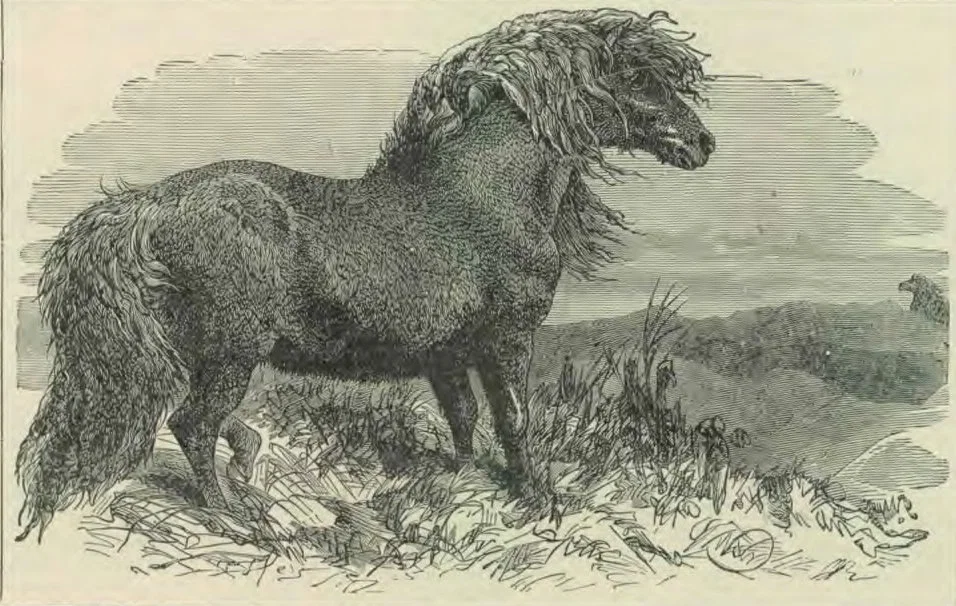
Far north from Scotland, and but seldom visited by southern travelers, are the Shetland Islands. From these rock-bound, treeless islands come the Shetland ponies that we so often see at the circus, or pulling little phaetons patiently along. A Shetland pony is almost a child's first desire, unless, perhaps, it may be to own a monkey. To have a pony to ride, or to drive, and especially a real Shetland, long-haired, short-legged pony is a dream of perfect happiness, indeed.
But have the readers of this little sketch ever thought about the home of these ponies? If you never have, then take a map of the British Isles, and in the far North you will see the small group of islands called the Shetlands, and from there the ponies came; and to-day they are raised there in great numbers.
Shetland is a very different country than many see. There are no green fields and trees, and the children living there hardly believe it when you tell them that in England or Scotland there are green lanes, and that birds build nests among the trees. . . . The people of the Shetland Islands are very quiet, orderly, and industrious. They live by many means. . . . One class of people make a living by raising ponies and sheep to send to England and even to America. We will imagine ourselves in the town of Lerwick, and all ready for a start to Noss Island, where a man lives who has a large herd of real Shetland ponies.
I remember the morning perfectly. The bay was all dotted with the white sails of the fishing boats. The town was all awake carrying dried fish to the boats at anchor, and on the corners of the streets were gathered women and young girls selling potatoes they had just brought in from the distant field. We took a row boat and rowed across Bressay Sound to Bressay Island, and then walking across it, and after looking back at the town and out at sea, we came to a small strait, and had to hire another boat to take us across the water to Noss Island. This island is not very large, but has more green grass than any other of the Shetland group. One end of it almost buries itself in the sea, and then it gradually rises higher and higher, until the opposite end rises a thousand feet right up from the sea. There is only one house on the island, and in that lives the keeper of the ponies and his two children. I wish you could have seen these children when they saw us coming in the boat. They hardly ever leave the island themselves, and so when any strangers come to see their ponies, how happy it makes them! They were very pretty and bright children, too. They had light hair, and bright blue eyes, and cheeks as red as roses. Running down with them was their pet dog, who seemed just as glad as any of the rest to see strangers. The house the man lived in was very lonely-looking to us. It was built of stone, and then painted white, and stood on a little knoll overlooking the blue waters of the cold North Sea.
After a short rest, we walked out to explore the island and see the ponies. Here was their home, and we should see them here in their real life. . . . There must have been fully two hundred of the shaggy-maned little fellows. Some were eating, some biting one another, some running as though having a race, and others stood still, looking at us. When we came nearer, the whole herd pricked up their ears, gave little snorts of anger, and galloped away as fast as their short legs could carry them.
The keeper told us that when one wishes a pony, to ride or sell, he must take the one he keeps near his house, mount him, and then riding out to the herd, lasso one at a time until you obtain all you wish. In winter, the ponies of Noss Island have rather a hard time of it. Though there is not much snow on the island, still the winds often blow very fiercely, and poor pony has no barn to go to. Sometimes the keeper builds a wall about a square piece of ground, and pony can go into the inclosure, and so be somewhat sheltered. But usually he must face the wind and storm, no matter what the weather. . . .
A pony in the Shetland Islands, even, has often hard work to perform. If a poor person is possessed of a pony, then, indeed, he feels rich. Now on certain days in the week, there are market days at Lerwick. From all about come the people bringing things to sell. Some walk to the town, some sail, and others come riding on their ponies. Just inside of Lerwick is a narrow path leading over the hills. I have often seen, coming along this narrow way, a long line of ponies and women. And such a curious appearance they present! The ponies seem only legs. They have no bridle, only a cord about the neck, and each follows the one in front. You can't make them go at the side of one another. On either side of each one are two immense saddle-bags filled with peat or potatoes; on his back are piled other goods, and even his neck has a cloth or other saddle-bags strapped, so that seen from a short distance it seems just as though the bags had legs, and poor pony seems buried out of sight. Sometimes, too, if there is room to keep seated, his mistress, with shoeless feet and short dress and white cap, seats herself in great state, and away goes pony, bags, and woman, off to Lerwick.
Sometimes, when on these pilgrimages, pony will watch his chance, and if his mistress should be absent, will dart away down the steep hill-side, to nibble a bit of something good he has seen; and then when his mistress sees him, such a pounding as pony gets as she leads him back to his proper place! But he only looks meek, and will no doubt do the same thing again when he gets a chance.
Shetland ponies are very sure-footed. They will walk along the very edge of a high cliff, and before putting a foot down, will carefully feel if the ground is firm or not. Some of them are driven by their riders down steep passes where one misstep would send both rider and pony down to the depths below. . . .
A Shetland pony on his native heath is extremely willful. If he dislikes a rider, he will spare no pains to unseat him. I rode one once who expended a great deal of unnecessary strength in this manner. He would sit down suddenly, and rise up more so. He would bite, shake himself, and roll over, if allowed. As he was almost small enough to be carried by his rider, these antics were more amusing than dangerous.
And so the ponies of the Shetland Islands live and wait for masters in the South. In the cold winter of fog and rain, when there is almost no day, or in the summer time, when the sun does not set, they run wild about the Noss, take burdens to Lerwick, or carry the stranger over the bogs and dreary hills.—Wonder Stories of Travel.
Letter Budget.
CORA A. SOULLARD sends a letter from Clark Co., Wis. She writes: “I like to read the INSTRUCTOR. I wrote a letter to the Budget some time ago, but it was not printed, so I thought I would write again. I have two brothers. Neither they nor my parents keep the Sabbath. I pray that they may see the light and walk in it sometime. I am trying to keep the commandments of God, and I want to set a good example for all my associates, and do something for my Saviour. I take the Signs and INSTRUCTOR, and wish to make good use of them. I think the lessons are excellent. I have no relation in this State that I know of. None of my relatives keep the Sabbath. I left my parents and all when I was seven years old. I have seen none of them for several years. I would feel very lonely were it not for my Saviour. I have stayed at a great many places, but the Lord always provides for me a good home and many kind friends, and seems always willing to answer my prayers, though sometimes not as I expected. Pray for me, that I may be an overcomer, and meet my parents in the new earth, if not before. I hope E. Woodworth will write soon and tell us more of the interesting things he saw in Kansas.”
The next letter comes from Marshall Co., Ind. It is written by VOLA M. ALBERT. She says: “It has been some time since I have written to the Budget. I am a little girl ten years old. My parents have kept the Sabbath almost fourteen years, so that I was always taught to keep it. I have three brothers living. My oldest brother, Charlie, and I are twins. Owen is seven, and Harvey is five. I was baptized at the Warsaw camp-meeting. It was a real good meeting. There were fourteen baptized. Six were little girls. There was such good order on the camp-ground that the owners of the Park invited them to come back next year. I want you to pray that I may be saved with you all when the Lord comes.”
The next are two letters from Guthrie Co., Iowa, written by MYRTLE and CHARLES F. WILCOX. Myrtle says: “I enjoy reading the letters in your paper very much, and have often wished I could see one from our country; but as I have not, I will write, making one at least. We live on a nice, large farm, where birds sing all day, and in the night too, sometimes. I think it is so nice to live in the country, where one can see so many of God’s works. My oldest brother, Albie, has been going to school in Battle Creek, and he thinks it is the best place in the world. I think I would like to go there too, and may be I shall sometime. In our Sabbath-school at home, two of us study the lessons in the INSTRUCTOR, and my youngest brother and sister study in Book No. 2. I was baptized two years ago next October, and I have been trying to do right ever since. The Lord has helped me very much. I want your prayers, that I may love and serve him better, and be prepared to meet him when he comes.”
Charles writes: “You have many a letter which I like to read, so I will try to write something for the little people to read. I live on a farm, and we have a large grove around our house, and it is so nice to lie in the hammock and read. Sometimes we have our meetings in the grove. We all keep the Sabbath, and ours is the only family that does within three miles of us. We have Sabbath-school every week at home. I shall be in Lesson Book No. 3 in a week or two. I have read the New Testament through, and can repeat the ten commandments. I love the Lord, and try to do right. I have not been baptized yet, but I think I will be sometime. I want you all to pray that I may be faithful. We have two of the prettiest spotted horses you ever saw. I wish you could see them. If ever you are near our home, I want you to be sure to come and see us; but let us all be sure to meet in heaven.”