Seventh-day Adventist Publishing Association · Battle Creek, Mich. · Sep 1872
BRAVERY
By George I. Butler
ADMIRATION of bravery is a characteristic of children and youth. They like to read stories where they have an account of persons who have shown it. And nothing will interest them more than to read of battles where soldiers fought and died for their country, of narrow escapes of sailors or hunters of wild beasts; and sometimes they carry it so far as to greatly delight in reading of those who have cursed the world with their selfish lives of blood-shed and conquest, if they have only manifested great personal daring and prowess.
I do not wish to find fault with those who manifest interest in this trait of character; for I think courage is a noble thing, and admire it as well as the children when it is properly directed. No doubt God has planted it within us for some wise purpose; but it has been perverted to a bad use the same as many of the other good gifts of God which he has given for the purpose of making us noble.
I wish the children to distinguish between the right use of this trait of character and the wrong use of it. To show you what I mean, I will try to illustrate it. If you should see a large, strong boy knock down and whip a small, weak one, and nearly kill him, you would not think that was anything to admire, would you? Even if he did run a great deal of risk himself in doing it, of being whipped by somebody else. But if you saw a boy risk his own life to save a child from drowning or from a ferocious wild beast, you would think it a noble act, and admire the one who did it. Why would you do so? Simply because the courage shown was to do good in the one case and evil in the other.
The same principle can be seen when some great general or emperor who, by means of birth or ability, gets the control of great armies of men and by this means is the cause of destroying myriads of lives and leaving behind him a track of carnage and death, of burning homes and wasted fields, of desolation, misery, and ruin, for the object of gratifying his selfish greed of power. He may show bravery and wonderful courage; but we should not allow ourselves to approbate his course any more for that reason. The action is just as much worse than that of the big boy who abuses the small one as the misery caused is greater. Who can estimate the terrible suffering experienced by the wars of a Cæsar, an Alexander, or a Napoleon? Let not the glitter and pomp of war blind our eyes to the wickedness of killing people for selfish gratification.
But courage is a noble thing when put to a good use—when exerted in behalf of the weak, the unfortunate, or suffering. It becomes then closely related to benevolence, because it risks injury to self in order to do others good. Especially is moral courage a beautiful trait of character. By this I mean that courage which dares to do right without regard to consequences. Some people have courage to fight and die in battle when they can have the applause of their fellow-soldiers, but would not dare to stand up for right principles, if some one should laugh or sneer at them. This shows lack of moral courage, and is one of the meanest kinds of cowardice. There is no kind of heroism so great as daring to do right, which a great many sing about, but few are willing to do. One great reason why fashion is such a tyrant in our age, is because there is such a lack of moral courage. Do you suppose people could be persuaded to wear such a ridiculous and uncomfortable dress as many do in this age, had they courage to do different from others?
It may be that some of those who read this article know from experience what I mean when I speak about dressing. Do the girls, when their dresses are plain, neat, and comfortable, feel ashamed because they have not as many artificials as worldlings have, or because their dress is cut a little different style from some of them, but more comfortable and well calculated to preserve health? If so, you need more moral courage. You should think how cowardly it is just to want to do what others do when there is no good reason for it, but merely against it. You like to sing, “Dare to do right, dare to be true.” Now would be a good time to do it. You should despise this feeling that rises up in your heart and makes you feel so bad when you are doing that which your own judgment and conscience tells you is best. Now is the time to be brave and not to be a slave of fashion. Rouse your heart right up against such feelings of shame when there is nothing to be ashamed of, and it will be easier for you as you grow older to exercise moral courage. If you begin when you are young, there will be some grounds to hope you will finally be found among that company of moral heroes who have dared to obey God in spite of persecution, shame, and death. Despise everything that is mean, low, and selfish, and everything that is cruel, whether other people do or not.
I will give you one fact, of which I hope you are now familiar, that will help your courage to do right when tempted. The great God has his eye upon you at such times especially, to see whether you regard right as of more consequence than anything else, or desire to please him more than you do the wicked people around you. Every time we do wrong and feel ashamed of the right way in little things or great things, we show we fear poor, weak, sinful man more than we do the great and holy Being who has made the universe and given us life and every blessing. It is a sin to do this. Here we want courage, and here is the right place to show it. The time will come when all the good who have ever lived will be gathered together in the city of God. There will be none there but those who have dared to do right. Among them will be seen men and women who have died at the stake, been burned up alive rather than to do wrong. Crowds stood by jeering and yelling, and trying in every way to frighten them from the path of duty. But they knew God beheld them, and they feared him more than all the world besides. And he supported them by his blessing so that even the fierce flames did not daunt them. Can we suppose for a moment God will take us to dwell with such a company of noble spirits when we are ashamed to do right in such little things as we have to meet? We know he will not. Let us not only sing, “Dare to do right,” but let us really do it, in all things, then we will be found on the right side at last.
GEO. I. BUTLER.
Mt. Pleasant, Iowa.
CHILDHOOD
By Myrtle
CHILDHOOD! happy childhood!
Once again I stand,
In my silent dreaming,
On thy sunny strand;
To mine eyes the laughter
Comes in place of tears,
To my lip the music
Learned in cloudless years.
Once again the morning
Rosy red is born,
And the yellow sunshine
Slants across the corn;
Clearly pipes the blackbird,
In the orchard trees,
In the ruddy clover
Hum the drowsy bees.
On the sloping hillsides
Daisies whitely blow,
While above them softly
Shade and sunshine go,
Violets in the meadows
Blossom all untold,
And the cowslips cluster
With their cups of gold.
Through the tender grasses
Barefoot children run,
Fanned by summer breezes,
Kissed by summer sun;
All their pulses throbbing
To one blissful tune;
All their days at dawning,
All their months are June!
—Myrtle.
LITTLE THINGS.
The preciousness of little things was never more beautifully expressed than by B. F. Taylor, in the following: “Little words are the sweetest to hear; little charities fly the farthest, and stay longest on the wing; little lakes are the stillest; little hearts are the fullest, and little farms are the best tilled. Little books are the most read, and little songs the most loved. And when nature would make anything especially rare and beautiful, she makes it little—little pearls, little diamonds, little dews. Everybody calls that little which he loves the best on earth.”
THE STARRY CROWNS.
By Young Pilgrim
A DREAM.
One evening, after having been engaged in reading and meditating until a late hour, I retired to rest, being singularly impressed, but feeling calm and peaceful. In this state of mind I fell asleep and dreamed the following dream:
I seemed to be traveling alone through a strange, and to me unknown, country. After proceeding onward for some time in this manner, I became conscious of some one at my side, who now seemed to be my guide, keeping constantly near me. As I was thus traveling, I saw in the distance what appeared, as I came nearer it, a broad and lofty edifice, exceeding in greatness anything I had ever beheld. My course was directly toward this magnificent and towering building, and soon I found myself standing at its place of entrance.
My guide now stepped forward, and raising his hand to the golden knob, said to me, “Let us enter here.” Instantly the massive door receded, and we entered. We were at once in the midst of a flood of dazzling light, but although most brilliant, it seemed soft and pure. This light filled and illuminated the entire building as far as my vision could extend; but I was unable to discover from whence the light proceeded. My guide conducted me farther in toward the center of the vast building, and there paused, giving me an opportunity to view this inexpressibly glorious scene, to which I had been so unexpectedly admitted. With feelings of awe and amazement I gazed around me, and observed that the interior of this building was one vast apartment; the walls and roof extending far, far above our heads. The walls of this vast room were filled with casements containing numberless shelves, and, as far as I could see, these casements extended. From the shining pavement upon which we stood, upward to the dome of the building, and far away to right and left, these casements were seen. And not only were the walls covered with these casements, but the entire apartment was fitted up with this arrangement of shelves, the casements rising to the same hight as the walls, and were placed at short intervals from each other, extending from wall to wall, intersected with numerous aisles, reaching as far as my sight could extend.
These casements I saw were filled with crowns of surpassing beauty, they being made of pure gold. They were all wrought after the same pattern, and seemingly fashioned by the hand. They all presented the same appearance, unsullied and without blemish. Each crown was illuminated with one or more stars, which shone with transcending brightness. These stars appeared to be inlaid, and shining as it were through transparent glass. The glittering gems were of the same size and shone with the same brilliancy. The crowns differed only in the number of the stars which they contained, some crowns containing more than others, and so shone more brilliantly. Each star seemed to be a gem, flashing and sparkling with inexpressible brightness.
While I was contemplating this sublime and glorious scene, my guide beckoned to me, and said, “Let us go farther.” We then proceeded on far into the interior of the building, surrounded as we went, on every side, by thousands of these golden, starry diadems, the beauty and brightness of which it is impossible to describe. At length my guide halted in front of one of these casements filled with crowns, and waving his hand around him said to me, “These are the crowns which are laid up for the just, and the stars in each crown denote the number who are saved through the instrumentality of those who shall wear them.” Then pointing to a group of crowns in the casement before us, he said, “Those crowns belong to your father’s family, and that,” pointing to a particular one, “is your crown.” Instantly my eyes were fixed upon the beautiful treasure, and with emotion I counted the number, six. My eyes then fell upon a crown that lay beside it. This was thickly studded with those emblems of faithfulness and devotion in the Master’s service. Words are utterly inadequate to express the emotion then of my heart. Such a deep feeling of solemn joy and humiliation, mingled with heartfelt sorrow and regret, I had never before experienced. Humbled in the dust at the thought that one so utterly unworthy as I should be counted worthy to receive a crown so costly and so transcendently beautiful, caused a feeling of joy in my heart before unknown to me, mingled with such sorrowful regrets at the recollection of my remissness in duty and inactivity in the Master’s service, thereby failing to secure a greater number of those glittering stars in the crown pointed out as my own, so overwhelmed me with emotion that I wept aloud like a child, while my guide stood smiling solemnly upon me. To such a degree of intensity were my feelings wrought up that I was awakened from my slumbers, and found myself in a flood of tears, weeping with uncontrollable emotion.
It was a long time before I could compose myself. Ofttimes since, in my waking hours, have I wept at the recollection of that inexpressibly beautiful and glorious scene. Even now while I am trying to picture it, tears will unbidden flow, and the emotions which I had in viewing those crowns rush over me.
The thought that the narration of this dream (which seemed to me almost a real thing) may be the means of leading one of the dear readers of this paper to the Saviour, and thereby add one more of those glittering gems to the crown which I humbly trust I shall be permitted to wear, is my reason for attempting to write out the most heart-thrilling scenes my mind could ever conceive.
My dear young friends, is it not the greatest desire of your heart to have the King of glory place upon your head one of those beautiful crowns, radiant with stars—crowns such as monarchs never wear? If so, say now, in the name and strength of the dear Redeemer, “It shall be mine,” and it will be given you. If you will do this, and are faithful in his service, many of those glittering stars will be inlaid therein.
May the Lord grant his blessing and enable you now to decide for Jesus and the beautiful crown of life.—Young Pilgrim.
Earnest Simplicity in Prayer
God loves to have us pray with earnest simplicity. Better in God's sight are the broken and heartfelt lispings of a child than the high-flown utterances of some who think themselves wonderful in prayer.
The Noblest Thing on Earth
THE noblest thing on earth is the man who rises to the dignity of self-mastery.
BENISONS
Give a tear for the wretched, a smile for the glad, For the weary applause, and excuse for the sad; Some help for the needy, some pity for those Who stray from the path where true happiness flows. Have a laugh for the child in her play at thy feet; Have respect for the aged, and pleasantly greet The stranger that seeketh a shelter from thee; Have a covering to spare if he naked should be. Have a hope in thy sorrow, a calm in thy joy; Have a work that is worthy thy life to employ. And ah! above all things on this side the sod, Have peace with thy conscience and peace with thy God.
CHRIST LOVES THE YOUNG.
By Josephine Mott
Do you not hear the words “Suffer little children to come unto me, and forbid them not”? Blessed words of the Saviour! With what soothing sound they came to us from far-off Judea. Yes; let the children come; let them bury their sins and sorrows in a Saviour’s love. He was once a little child, and he knows their temptations and trials.
Then, dear children, come to Jesus. You who are thoughtless and careless, come. There is a terrible storm coming upon the world before long, and you will need a hiding-place when it comes, and Jesus has promised to be a covert for those that put their trust in him. And you who are burdened, whose hearts yearn to come to him, but are kept back by the thought of your sins which, when you look at them in the light of God’s holy law, seem to become mighty mountains, come. He will forgive you, and take you to be his own.
Come just as you are. Tell all to the dear Saviour. Do not put it off until you are better; for you can never make yourself any better. Jesus only can make you good. He will give you grace and strength to overcome if you will come to him humbly, asking him to forgive and receive you, resolving that, with his help, you will forsake your sins, and live as he would have you.
Do not let past sins weigh you down, thinking you have sinned beyond forgiveness. It is true your sins are great; but He is able to save to the uttermost such as come unto him. Then, dear children, come and cast yourselves into the arms of the loving Saviour and find peace and happiness. It is the only place where you will find abiding pleasure. You will soon become weary of all else. Nothing that the world can give is to be compared one moment with the Pearl of great price.
You will indeed find many things to suffer here—many discouragements and trials, and perhaps suffer persecution for the truth’s sake; but think of the martyrs of past years; think of John Hus, who was burned to death because he loved the Lord, leaving a dear wife and seven little children in the hands of his murderers, yet he rejoiced in his dying moments in the love of Christ. Remember that if we suffer with him here, we shall reign with him in glory.
JOSEPHINE MOTT.
THE PYRAMIDS
By J. E. WHITE
Wonderful Sights and Ruins. No. 1.
THE PYRAMIDS.
MANY strange sights and wonderful ruins are to be seen in the Eastern countries, prominent among which are the pyramids of central Egypt. There are five groups in all, numbering forty structures. Most of them are quite small, but some of them are of such dimensions as to entitle them to a place among the wonders of the world. They all stand upon the brow of hills looking back into the great Libyan desert.
The one we shall describe is of a group of three, called the group of Gizah, situated in central Egypt, about eight miles from Cairo, and between five and six miles west of the Nile. It is called Cheops, and is supposed to have been built by a king of that name.
The foundation of this pyramid is a limestone rock. It stands on the very edge of the desert, and is in form an exact square, facing the four points of the compass. The length of each side is 764 feet. It covers an area of 571,536 square feet. The solid contents have been estimated at 85,000,000 cubic feet. Its original hight was 480 feet, but the upper twenty feet have been removed for building purposes, leaving a level top of about thirty feet. Perhaps you do not realize how high this really was. Eighty feet is considered very high for a tree to grow, but six trees eighty feet high placed one on the top of the other would only reach the hight of this pyramid. It covers an area of thirteen acres. Think of that! Thirteen acres is considered quite a farm.
Now for a description of this pyramid. It is built of solid rock, hewn from a quarry in the mountains on the opposite side of the valley of the Nile. Herodotus, who traveled through this country 455 B. C. says it took 100,000 men ten years simply to grade the road on which the stones were to be conveyed from the quarry for building. Then the rocky hill on which the pyramid stands had to be leveled, the blocks of stone cut from the quarry, and brought to the place where they were to be used. To do this and build the structure it took 360,000 men twenty years. It was built by laying one layer of stones on the ground prepared for it, then another layer on the top of this, followed by another, and another, each layer drawn in a little as it goes up, just enough to make good steps. This work was continued, layer following layer, and the top growing smaller and smaller, till at last it became so small that no more stones could be added. Then the pyramid was finished.
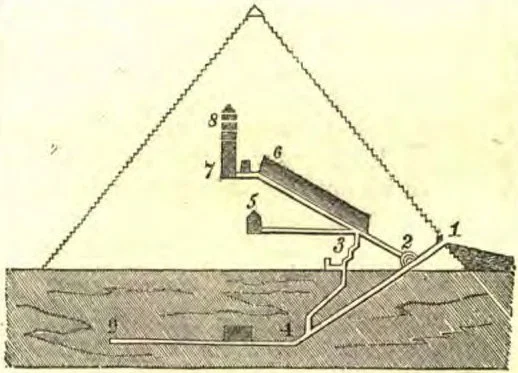
On the inside of this structure are passage ways and two chambers. The following diagram will show their location.
The shaded portion shows the native bed of limestone rock on which the pyramid is built. The passage-way from 1 to 2 is eighty feet long. From 2 to 4 is 225 feet. From 4 to 9 is 105 feet. Ascending from 2 to 3 you strike two passages. One leading to 5, the queen’s chamber, which is entirely empty. The other leads to 7, the king’s chamber—a room thirty-four feet long, seventeen feet wide, and nineteen feet high. This is no doubt the room for which this astonishing structure was built. The only article of furniture which it contains, is a granite sarcophagus, a chest of red granite chiseled from a solid block. It is seven feet and five inches long, three feet and two inches broad, and three feet and three inches deep. This is the only tomb found in the pyramid.
What a tale of suffering and wrong this pile tells. Think of the 100,000 slaves compelled to work ten years in building a road. And think of the 360,000 compelled to work twenty years in building the pyramid—and what for? To gratify the ambition of a king in having such a burial place. But did he succeed? The old granite sarcophagus standing in the king’s chamber is empty. No traces of his remains are to be found. Some think he never was buried there. Others think that his remains have been removed. Whichever way it is, did it pay? J. E. WHITE.
No. 1. Entrance on the north side. 2. Queen's chamber. 7. King's chamber. 8. Smaller chambers above the king's chamber to relieve the roof from so great weight.
SOON!
I KNOW not if He come at eve,
Or night, or morn, or noon;
I know the breeze of twilight gray,
That fans the cheek of dying day,
Doth ever whisper—Soon!
I know not why our souls should doubt
His promise to appear,
When every flower’s opening eye
Looks up into the changing sky,
And seems to murmur—Near!
I know not round his blessed feet
What peerless glories throng;
I only know from rending tomb
The good shall burst, in beauty’s bloom;
And faith assures—Not long!
I know not if his chariot wheels
Yet near or distant are;
I only know each thunder-roll
Doth wake an echo in my soul
That saith—Not very far!
I know not if we long must wait
The summer of his smile;
I only know that hope doth sweep
With thrilling touch my heart-strings deep,
And sings—A little while!
I know not on this glorious theme
Why lips so oft are dumb;
I only know the saddened earth
Will flush with beauty and with mirth
At sound of “Lo, I come!”
The Memory of the Dead and Tender Feeling
It is an exquisite and beautiful thing in our nature, that when the heart is touched and softened by some tranquil happiness or affectionate feeling the memory of the dead comes over it most powerfully and irresistibly. It would almost seem as if our better thoughts and sympathies were charms by virtue of which the soul is enabled to hold some vague and mysterious intercourse with those we have dearly loved in life.
A STORY ABOUT A RAISIN SEED.
When I was a very little child, perhaps five years old, I sat next another girl who brought a raisin seed to school. Lucy showed me the seed, and when she was called up to read, she laid the seed on the bench between us. A raisin was a great prize in those days, and I thought the seed would taste good; so, thinking nobody would see me, I took it and put it into my mouth. I was disappointed to find it both hard and tasteless. When Lucy came back, she missed the seed, and accused me of taking it, and I denied the charge. The seed was of no value, but see how many of God’s commands it led me to break: 1. Thou shalt not covet. 2. Thou shalt not steal. 3. Thou shalt not lie, or bear false witness. Nothing is small which can induce us to commit such sins as these. More than half a century has passed since this happened, and if I live to be a hundred years old, I shall not forget it. I think God has forgiven me, but how am I to forget or forgive myself? I wounded my conscience, and the scar often aches. If I had only remembered “Thou, God, seest me,” I should have been saved both sin and shame.—Sel.
YOUNG SCOFFERS.
By H. A. St. John
Peter said there would be scoffers in the last days. Now the last days have come, and scoffers are numerous. We hear them all around us, almost every day, making sport of Jesus' coming and the end of the world. And what is very sad to think of, among this company of latter-day scoffers are many children and youth. I hope none who read the INSTRUCTOR will ever make fun of the soon coming of the blessed Jesus. He will soon come for those that look for him; but those who make light of his coming can never go with him to Heaven. They can never walk the golden streets above.
A few weeks ago, we heard such scoffing from the youth as we never had heard before. We were pitching the Ohio tent when quite a number of boys, from about seven to fifteen years of age, came upon the ground. They had very much to say, lightly and jestingly, about Jesus' coming and the end of the world. When the center pole was raised, they said that was to go up to Heaven on. One boy started to climb the pole when others cried out, “He is going to see when Jesus is coming; ask God when you get up there, when he is going to burn the world!” and when he came down, they said that Jesus had come. Many other things were said, even worse than these; but it would make you sad to mention them, and we will not. Indeed they were so bold and wicked that we had to reprove them several times before they left us.
Now, my young readers, what do you think of this? You remember the fate of the children that mocked Elijah, and you know that very soon the scoffers of these last days will come to a terrible end. Do you love Jesus? Do you love to think that he is coming soon? Are you getting ready to meet him with joy? If you are, then in a little while angels will take you to meet him in the air, and with all the good you will ascend to the heavenly city, where scoffers will never come. H. A. ST. JOHN.
THE INFLUENCE OF LOVE.
By A. P. Van Horn
HAVE just been reading about a little orphan girl, whom a kind Christian lady found in poverty and destitution, and took to her own home. The little stranger did not feel at home, at first; and the children of the house could not persuade her to leave the hall and come into the parlor.
Said the lady, “There is a way by which you can bring her in where you like—it is a secret in four letters.” The children began to search among their playthings, and the eldest sister said, “I know what it is, it is, d-o-ll!” But the trial proved a failure; it did not bring her in. The next in age thought that as muff was spelled with four letters, it might accomplish their object, so she made the little orphan a present of a muff. But the child would scarcely notice the muff.
At length little Grace, the youngest of the three sisters, who had been looking on, when she could not think of anything more to offer, went and sat down beside the little stranger and cried too, and soon took her by the hand, put her arm around her neck and imprinted a kiss upon her cheek. Nothing was said, but little Grace soon led her captive into the parlor.
“Well, girls,” said their mother, “Grace has found out the secret, and the four letters are, l-o-v-e.”
We are indebted to Kind Words for this simple narrative, and to the sacred word of God, from whence this principle is first taught. There is a great power in this influence of love when practiced in the family, the school, and the church. When we can extend feelings of sympathy toward those who need such help, it may be a means of their salvation. Jesus loved us, and gave his life for a world of sinners. And shall we not love and try to help those for whom Christ died?
A. P. VAN HORN.
Battle Creek, Mich.
LOST
By S. H. Lane
THIS word occurs many times in the Bible. The term, as brought to view by the sacred writers, has several significations. It sometimes expresses utter hopelessness of moral condition. Such will be the condition of the sinner when our dear Saviour shall cease to plead our cases before God; when probation shall close, and the sweet voice of mercy shall be heard no more. Then the sinner will be constrained to say: “The harvest is past, the summer is ended, and we are not saved.” I am lost! Dreadful condition! one in which, I trust, we are not at the present moment, and one which we may escape by living near to the bleeding side of our Saviour, and keeping the tablet of our heart free from evil thoughts, and wrong doing. By thus living, we may at last be numbered among that class of whom our Saviour says: “Blessed are the pure in heart, for they shall see God.”
The term “lost” in the Bible does not always convey the idea of utter hopelessness of moral condition. In speaking of a wild beast of the forest, we never speak of it as being lost; but when one strays from the domestic fold we say, It is lost. The expression used, however, implies to our minds ownership and care—a fold, a shepherd, to whom the lost or wandering one belongs. Dear youthful reader, we are all wanderers from God, from the fold of Christ; we are lost in the wilderness of sin, yet we are objects of God’s love, of his care. Often when we realize our lost and undone condition, we are bewildered and become discouraged, and are tempted to depart farther from the fold; at such times God in mercy sends his Spirit to convince us of our sin and folly; and then, if we listen, we hear the loving Shepherd, our Saviour, saying: I am the way, the truth, and the life: no man cometh unto the Father but by me.” When we turn our face toward our Father’s house, he, like the father of the prodigal son, meets us on the way. We do not have to accomplish the journey in our own strength. Blessed thought! one which should cheer us under each and every trial of life. If faithful a little longer, our Saviour will come again, to take us to those mansions which he has gone to prepare; and when he shall present us to our Heavenly Father, it can truly be said of us, This my son was lost, and is found. Should not such a bright prospect cause us to gird on the whole armor and work faithfully in the Lord’s vineyard? If lost in the dark wilderness of sin, let us not become discouraged, but ever remember the Lord has a care for us, a fold to which he is calling us; and when the good Spirit of God softens and subdues our hearts, and we are inclined to return, let us ever realize that
“When we turn to God and leave the path of sin,
When the heart repenting feels the need of him;
Then our gentle, loving Father, full of pardoning grace,
Comes to meet us with a kind embrace.”
“He will guide our feet where quiet waters flow,
He will lead us onward through the vale below;
With his loving arm around us, we shall hear him say:
I have come to meet you on the way.”