“I HAVE learned, in whatsoever state I am, therewith to be content.” Phil. 4:11.
The word rendered “content” in the text means, in the original, “to find one’s resources in one’s self.” It is in this sense that we wish to think of it this morning. Thus understood, the verse becomes, “I have learned, in whatsoever state I am, therewith to find my resources in myself.” The words are the words of Paul, and are addressed to the Philippians, for whom he had a special affection. The Philippians had proved themselves friends indeed to Paul; for they had shown their friendship in his time of need. Such friends we do not forget, and Paul was like us in simple gratitude and love.
The people of the church in Philippi had apparently for a little time forgotten their former pastor and faithful friend; for, in the verse preceding the text, Paul speaks of the joy he feels in knowing that his old friends have revived their thought of him. Then he quickly excuses their seeming neglect by saying that they really had taken thought of him, but they lacked opportunity. The manly independence of the heroic preacher then finds voice in a remarkable expression. We can almost see the flush of honest pride in his cheek, as, fearing that they may look upon him as asking for alms, he says: “Not that I speak in respect of want: for I have learned, in whatsoever state I am, therewith to find my resources in myself.”
Paul was no pauper, and he proposed that there should be no doubt about that point in the minds of his friends. He was made glad by their kindness and their love, but he was dependent only upon himself. He had a profound self-respect, and such a man always commands the respect of other people. He was ready to minimize his own wants, and even his necessities, rather than to allow his needs to be brought to the notice of others in such a way as to seem to ask for their assistance.
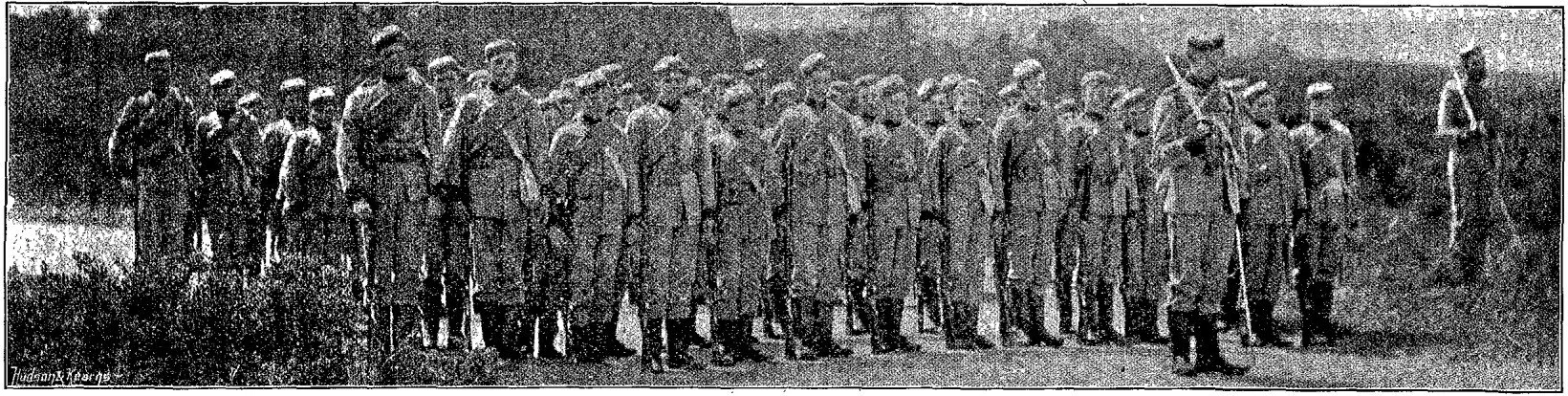
HARROW CADETS.
I feel safe in saying that we all understand exactly his feeling; for we all have at some time passed through such an experience as this, and have spoken similar words. Let one come to us in our need, and, with an air of condescension, offer to give to us a pauper’s dole, and instantly the icicles form in our blood, our poverty springs into opulence, and we answer, “No, I thank you; I have an abundance of everything.” I am not speaking of material things alone. It is just as true of knowledge, of love, of all spiritual possessions. We prefer to remain in ignorance rather than learn from one who knows too much. It is pleasanter to be a sinner than to be made pious by one who is too good. We consent to nothing which robs us of our self-respecting manhood.
We can listen with all good feeling to the words of Paul; for he knew what he was talking about. He says: “I know both how to be abased, and I know how to abound.” Those are two wonderful lessons, and any one who has learned them has a right to speak. He had been a favored student, sitting at the feet of Gamaliel; he had been condemned as a dangerous teacher, dragged from the city, stoned, and left for dead. He had been honored as a learned rabbi, a wise teacher of the law; he had been haled before an unjust tribunal, accused of stirring up sedition and disturbing the peace. He had been in prison, shipwrecked, beaten with many stripes; yet he says, “I have learned, in whatsoever state I am, therewith to find my resources in myself.”
Most of us are not conscious of the extent to which we are dependent upon externals for our comfort, our happiness, and our success. There is often comparatively little difference between the rich man and the poor man in this respect. The rich man looks upon his houses and lands, his stores and factories, his stocks and bonds, and finds in these the highest happiness that he knows. The loss of a single piece of property is to him the loss of a part of himself. As he sees his possessions going from him, one by one, it seems to him that everything is going. With every loss of property, life itself becomes of less and less worth, until, when everything has gone, life is an empty vase, a withered flower, to be utterly and ruthlessly destroyed.
There is, in many quarters in our day, a startling outcry against rich men. There are certain men who seem to hate certain other men simply because these other men are rich. We see something of this in the papers or in life, almost every day. We are alarmed at it, and need some wise seer to remind us that the number of irrational haters of their fellow men is, after all, very small. The real outcry is against the rich men who do not know how to be rich, in whose scales dollars outweigh human souls. That outcry is destined to increase in force and volume until it is answered by a change of mind and heart in these soulless traffickers in human flesh.
But the same spirit that we condemn in his rich neighbor is often found to exist in the poor man. The poor man is just as dependent upon the comforts of his cottage as the rich man is upon the luxuries of his mansion. We do not realize how largely we are dependent upon the mere externals of life until we are taught by some striking experience. When some terrifying blizzard piles the snow against our doors and windows, and makes us prisoners, shutting out from us the supplies which are daily brought to our homes, then we realize that many things which we had simply taken as a matter of course were really essential to our happiness and comfort.
There are certain things in the home which we always want to find in their own places and no other. There are certain other things which are distasteful to us, which annoy us every time they are seen. We wish them replaced by something more to our liking, and are unhappy because this cannot be. We are thus forever giving our happiness into the keeping of an article of furniture or of diet.
When a man says, in the face of all these facts of life, “I have learned, in whatsoever state I am, therewith to find my resources in myself,” there are two or three questions, at least, that we wish to ask about the man: Is he honest and truthful, so that we may believe that he means what he says? Is he intelligent, so that he knows exactly what he is saying, and is not self-deceived? Has he had experience in the glad and the sad, the sweet and the bitter, the easy and the difficult, things in life, to give real value to his words? The name of Paul gives a most emphatic “yes” to all these questions. He was truthful and intelligent, and had a wide experience in the joys and sorrows that flesh is heir to.
Paul is thoroughly competent to teach the divinity of contentment and self-dependence. We must remember that these are not the words of conceit, of overweening confidence in himself and in his wonderful powers. We should entirely mistake his meaning if we did not remember that this is the man who said, “Christ in you the hope of glory,” and, “I am crucified with Christ: nevertheless I live; yet not I, but Christ liveth in me.” It is the divine Christ living in Paul, in whom he finds his resources, in whatever state he is.
(Concluded next week.)
CHILDHOOD FEARS.
By Frederick Griggs
FREDERICK GRIGGS.
(Battle Creek College.)
FEAR is an emotion which originates in the instinct of self-protection. It is common to all animate nature. Generally, if not always, fear results from a lack of knowledge. Any new object to which our attention is called will usually arouse either our fear or our curiosity, and often both. But as curiosity and fear are opposed to each other, one of them will eventually obtain the mastery. Curiosity draws to an object, while fear repels.
There are certain conditions of mind and body which are conducive to fears. In general, a nervous child is more timid than a child of phlegmatic disposition. A child who is healthy, and who lives in a home in which the atmosphere is one of love and trustfulness, will generally be fearless, frank, and open-hearted. It may be said that the conditions necessary to produce a fearless and trusting disposition in a child are health and a social atmosphere of confidence. These two things the majority of children do not have. Babyhood and childhood are periods of many little physical disabilities which cause fears, or which, at least, if not the direct cause, place the mind of the little one in a condition favorable to fears. Often, in sleep, he cries out from fright. He has seen something in his dreams which causes him great alarm. It is said that the effect of dreams upon the mind and nervous system is not so different from the results of actual experiences as has been very commonly supposed. While there is a difference, it is possible for a child to have dreams which will affect him for days afterward. These may result from nothing more than a disordered stomach. The mother and nurse recognize the physical inconvenience to the child from such disabilities, but the mental effects, which may be great enough to last a lifetime, are often overlooked.
The eye, ear, and nose are fruitful sources of physical ailments which, directly or indirectly, cause fears. Probably, nearly every person who reads this can call to mind children who, for some seemingly unaccountable reason, have been retarded in their development. They have been weak, puny, joyless, and fearful. Children should be possessed of vivacity and life. If a child does not possess these qualities, a thorough examination of his physical senses, and, for that matter, of his whole organism, should be made by a competent physician; for there are many pathological conditions which may lead to these ill effects. A writer in Babyhood sometime ago gave the following account of a case coming under his care: “A little girl was brought to me suffering from ‘nervousness,’ shortness of breath, a slight cough, and general malnutrition. She complained of a booming noise in her ears, that frightened her to the verge of hysteria. At times, when she was most thoroughly affected, she had an uncontrollable fear of darkness, while, when she was stronger, she would go all over the house in the blackest night without the least tremor or thought of fear. A careful examination disclosed a weak and nervous heart action and nothing else. Under appropriate treatment she rapidly recovered, and has since been without her customary attacks of oppressing fright.”
As I have previously said, anything which produces nervousness should be avoided, not only for the sake of the disagreeable physical effects which necessarily follow, but for the235mental effects which place the child in such an attitude that he will submit to his fears. We sometimes hear the remark that the children in crowded cities have no fears, or at least appear to have none. It may be that they appear calm and unconcerned amid all the noisy bustle of these cities, but aside from the common incidents of their city life, they are far more excitable and easily frightened than are the children of rural districts. Children who are nervous and inclined to fears should be given an environment of quiet; in fact, all children should have such an environment. Children who are particularly susceptible to fears may often overcome them by a change to more quiet surroundings for even a few months.
The fears of children should not be lightly regarded. Fear will lead to all kinds of dishonesty and deceit, and produce a cowardly and craven disposition where there should be a brave and noble one. It does not matter much what is the nature of the fear; for fears all have about the same effect upon the disposition of the child. And it should be ever borne in mind that one of the first points to be observed in assisting a child to overcome a tendency to fear is to see that he is provided with all the conditions necessary to produce perfect health.
SABBATH OBSERVANCE FOR CHILDREN.
By S. M. I. Henry
MRS. S. M. I. HENRY.
(Sanitarium.)
I quote one of several questions which touch the same point of difficulty: “What would you do with a boy of seven years, on the Sabbath, who wants to do something all the time? Suppose you should find him fixing his ball, whittling out a sword, or playing with his cars, what would you say to him?”
If I had not helped him, on the preparation day, to prepare for the Sabbath, I do not think that I should feel that I had anything to say to him; and as to the fact that he “wants to do something all the time,” that is right; the only question is, What shall he do?
The child should be taught the true principles of Sabbath-keeping. It is not keeping the Sabbath to stop “doing something.” Idleness is not holiness, neither did it ever hallow any day, but it is, in itself, a desecration of holy time.
God rested from his work on the seventh day, and, later on, in the person of Christ, he taught us what constituted that rest. True Sabbath observance, as the Lord of the Sabbath revealed it, is to rest from our own work in doing good to others. In everything that constitutes true Sabbath-keeping, the little ones in the home will be very quick to co-operate if you give them half a chance. They will co-operate in Sabbath-keeping to any extent, but if left to keep it alone, they will doubtless run counter to your understanding of what it involves.
First, as to the preparation. On Friday afternoon everything that belongs to the play, as well as to the work, of the week should be put away, in places provided for the purpose. Even the little children should help in this putting away. Mother’s work-basket, with the shears, thimble, and thread, which are often left standing on the table or window-sill, should be put out of sight; the sewing-machine should be covered and rolled into a closet, or, if left in the room, a vase of flowers or a neat pile of books should be placed on it, to show that it is retired from duty for the holy day; the writing-desk should be closed; pens, paper, ink, school-books, and the every-day clothing should all be put away before the Sabbath begins; and in their places should be something different, even if it can be no better.
There must always be changes of clothing, so let the new suits be for the Sabbath, and let them be put on before sunset on Friday. For the little ones, in place of the ball, the cars, the blocks, let there be brought out things which are never seen during the week. The doll should not be sequestered until the child becomes old enough to reason, and to understand that it is only a doll. Just as long as it is a “baby” to the little mother, the instinct that makes the doll a necessity would be outraged by putting it or its belongings away in a closet. Its cradle and wardrobe should be considered in the preparation for the Sabbath, if nothing more can be done than to provide a clean square of calico for a shawl, and a clean cover for the little bed. Let the toy cattle and horses be treated by the little folks as father treats the live stock; but, after that, let all things that are to be used by the children on Sabbath be as different as possible from the week-day supplies, and let this change be such as to make the Sabbath a delight. When all this has been done, let the children be free to follow their best understanding of your example in keeping the day holy.
Father and mother should give themselves to the children so completely on Sabbath that the ball and cars would be tabooed, even if they were left lying about. They should, however, never be left about; that would be to throw such temptation into the very path of the children as older folks would find it difficult to overcome.
Go out into the fields, as Sister White has taught this people so long ago, and study the growing things with the children. Take up some line of Bible study which will make the Book as fascinating as a story. Tell the children what you have learned by the experiences of the week, that have made you know God and your own self as never before.
Visit the unfortunate ones in the community, the lonely, and aged; gather flowers and press leaves for the sick and shut-in. Make scrap-books of pictures, poems, and stories, to send to a mission in some city, or for hospital uses.
If you think and talk about the needs of others to the children, and plan how best to help the mission work, how best to do what Christ would do for the poor and needy, the day, with the Sabbath services to fill so large a part of it, will be all too short for the things which you will have to do to make your blessed resting all complete.
Perhaps some one is saying, “But we are poor people; we live away out in the country; we cannot do anything for anybody.” No family can be so isolated that they cannot do something for others; and in this lonely Sabbath-keeping let each member of the family rest from his own selfish pleasure, and try to do something to make the day especially blessed to all the rest. Teach the children to do for father and mother and one another those things which will make the hours pass happily away. Let father and mother set the example, and the children will follow.
Do not fail to observe the beginning and close of the day with a vesper service of song, Bible study, conversation, and prayer, in which all shall have an appropriate share.
A Sabbath truly hallowed in the hearts of the parents will bring with it a Sabbath-keeping power which the children will recognize and respect, and which they will never forget.
MY LITTLE HERO.
Earth’s bravest and truest heroes
Fight with an unseen foe,
And win a victory grander
Than you or I can know.
We little dream of the conflict
Fought in each human soul,
And earth knows not of her heroes
Upon God’s honor roll.
One of earth’s little heroes
Right proud am I to know;
His name for me is “mother,”
My name for him is Joe.
At thought of a ten-year-old hero
Many have thoughtlessly smiled;
But a battle-field’s a battle-field,
In the heart of man or child.
There were plans of mischief brewing,—
I saw, but gave no sign;
For I wanted to test the mettle
Of this little knight of mine.
“Of course you must come and help us,
For we all depend on Joe,”
The boys said; and I waited
For his answer—yes or no.
He stood and thought for a moment.
I read his heart like a book;
For the battle that he was fighting
Was told in his earnest look.
Then to his waiting playmates
Outspoke my loyal knight:
“No, boys; I cannot go with you,
For I know it wouldn’t be right.”
How proud I was of my hero,
As I knelt by his little bed,
And gave him the bedtime kisses,
And the good-night words were said!
True to his Lord and manhood,
May he stand in the world’s fierce fight,
And shun each unworthy action,
Because it “wouldn’t be right.”
—Selected.
GIRLS WANTED.
It was only the other day that I heard a worried mother say: “Oh, dear! I do wish that girls would be girls again!”
“Why, what do you mean?” I asked.
“Well,” she replied, “it does seem to me that many of our girls nowadays are rather boyish and mannish, and it is bad enough to have to put up with the ‘new woman,’ without having any ‘new girls,’ with all their scorn of some of the things that give to girlhood its greatest charm. My daughters act as if the ordinary duties of home life, such as sweeping, and dusting, and washing dishes, and making home neat and clean and sweet, were beneath the notice of a ‘progressive’ girl,—as if it were ‘narrowing’ to engage in occupations of that kind. Not one of them has any desire to become a good housewife; they think it mere drudgery to perform the household tasks that must be performed by some one if the house is to be made a neat, clean, attractive, and restful place for their fathers and brothers. Don’t you think that too many girls have that feeling?”
“I am afraid so.”
“Well, now, the other day I met a company of ‘progressive’ girls out on their ‘bikes,’ as they called them. Every girl had a boy’s cap on the back of her head, and several of them wore trousers, and mannish-looking jackets, and men’s collars and neckties, and they were wheeling along at a neck-breaking pace, trying to make ‘a record’ for the ‘bike club’ of which they were members. Of course there was ‘no harm in it,’ and I suppose that I am very ‘narrow,’ and ‘old-fashioned,’ but I watched them out of sight with a distinct pain in my heart, and a longing for the old-fashioned, quiet, modest, womanly girl, who was willing to relegate boys’ clothing and boys’ manners to boys. They say I am ‘behind the age.’ The modern girl does not hesitate to say things of that sort to her parents. Respect for her elders has, in many cases, taken flight along with her modesty. She does not hesitate to set her father and mother right a dozen times a day. I heard a girl tell her father the other day that he was not ‘up to date,’ because he said that it hurt him to have her do a great many things that she did. He said, as I often say, that he longed to see a generation of real girls again.”
A good many of us have that feeling. We would like to see a generation of real, modest, womanly girls, who have no desire to ape boys in dress or manners. We would like to have a generation of girls who would feel that in all this “progressive” age there is no crown a woman can wear more honorable and beautiful than the crown of a pure, modest, and noble womanhood, spent in discharging the ordinary, humble duties of home life. When we hear young girls and young women talking about the “limited sphere” of the old-fashioned girl, we feel like quoting this verse for their profit:—
“They talk about a woman’s sphere,
As if it had a limit:
There’s not a place in earth or heaven,
There’s not a task to mankind given,
There’s not a blessing or a woe,
There’s not a whispered yes or no,
There’s not a life, or death, or birth,
That has a feather’s weight of worth,
Without a woman in it.”
— Our Young People.
Guarding Children's Eyes and Ears From Corruption
LET nothing foul to either eye or ear reach those doors within which dwells a boy.
WAXING THE FLOOR.
Every worthy housewife likes to have her floors neat and inviting, whether they are carpeted or exposed. In many cases covering the entire floor is impracticable, and it is sometimes a problem how best to treat the naked wood. Touching upon this point, a writer gives the following suggestions: There are various ways of treating wood floors, but the best way is to wax them. Many preparations are sold ready for use, but if one happens to be in a neighborhood where they are not readily procurable,—in the wilds of the country, for instance,—the following polish makes a good substitute: Cut common white beeswax into thin shavings, and cover well with turpentine. Let the preparation stand overnight, by which time the beeswax will be soft. Stir it into a smooth paste, and add turpentine until it is the consistency of thin cream; it is then ready for use.
Before applying the wax, wipe the floor perfectly clean with a dry cloth, and if there are any spots on it, take them off with turpentine or benzine. Never, under any circumstances, use water on a floor that is to be polished. Apply the wax with a flannel cloth, being careful to put on but little at a time, in order to avoid a surfeit of stickiness. Rub the polish well into the wood with a rough piece of flannel, or a piece of Brussels carpet, until it shines like furniture. Unless the floor suffers rough usage, it will remain bright for six months. Dust it by putting a piece of flannel over the broom and sweeping. Keep a piece of flannel on hand to rub up any little spot where the polish may have become dimmed. If, after long use and many waxings, the floor should seem sticky and dirty, clean it with turpentine.
Some people prefer simply to oil a floor. While this does not yield as high a polish as wax, it is satisfactory for a time. An oiled floor should be gone over every week or two; even then the dust sticks to it, and it soon becomes dull. If anything other than wax is desired, it is better to oil and then varnish the floor. Another means of polishing is to apply a coating of size, followed by one of walnut or oak stain, and subsequently by a third coating of varnish. In any case, let the polish harden for twenty-four hours before the floor is used.—Good Housekeeping.
THE OLD FOLKS’ LONGINGS.
Don’t go to the theater, lecture, or ball,
But stay in your room to-night;
Deny yourself to the friends that call,
And a good, long letter write.
Write to the lonely old folks at home,
Who sit, when the day is done,
With folded hands and downcast eyes,
And think of the absent one.
Don’t selfishly scribble, “Excuse my haste,
I’ve scarcely time to write,”
Lest brooding thoughts go wand’ring back
To many a bygone night,
When they lost their needed sleep and rest,
And every breath was a prayer
That God would leave their little one
To their tender love and care.
Don’t think the young and giddy friends,
Who make your pastime gay,
Have half the anxious thoughts for you
That the old folks have to-day.
The duty of writing do not put off,
Let sleep and pleasure wait,
Lest that for which they wait and long
Be a day or an hour too late!
— Prairie Witness.
THE MORNING TOILET.
The finest compliment we ever heard paid to a woman was by her husband, who said, in speaking of her: “We always think of her as a morning-glory, because she looks so bright and cheery and pretty at the breakfast table.”
How many breakfast tables are presided over by women who make no effort to be dainty! The claim that household duties keep women from looking well in the morning is easily disproved; for in many a household where the wife gives a helping hand in the kitchen, a big apron will thoroughly protect her dress; and then, too, cooking, unless one makes it so, is never dirty work. That woman commits an error who looks uncared-for and badly dressed in the morning. The other woman, who wears “any old thing” to the breakfast table, is also making a mistake; for that is the time when the men of the household ought to see a woman at her best, and not have to rely on her appearance in the evening, when the soft and charitable light of the gas will hide many defects.—Household.
GOOD HOUSEKEEPING AND HEALTH.
When housekeeping and cooking are viewed in their true light, there will be better housekeeping and better cooks. Though housekeeping has been regarded as menial service, and is still so looked upon by many, the day is not far distant when all women will be proud to be considered good cooks and model housekeepers. Then, and not till then, will our homes be models of perfection.
Housekeeping intelligently conducted will save labor, and when you save labor, you save strength. This means the preservation of health and the husbanding of energy, patience, and good nature, all of which tend to the promotion of happiness and good will in the home. Then, too, when our food is selected and prepared from a hygienic point of view, much of the rich, highly seasoned food will be discarded, and a plain and nourishing bill of fare will take its place.
When this plan is adopted, there will be less sickness in your home. Your children will be happy and well, and you will hear less complaint of headache. Children who, under favorable circumstances, are always full of life and love, will not be peevish and irritable, as is now so frequently the case.—Reflector.
Woman Imprisoned at Mt. Vernon for Unclean Children
It is said that a woman was sentenced to three months' imprisonment recently at Mt. Vernon, N. Y., because she did not keep her children clean. This is the first case of the kind ever reported.
The Grave and Fragrant Memory
“THE grave is often flowered when the occupant was unappreciated, if not neglected, in life. The reparation came too late to be enjoyed, but it is a cheering thought that real worth leaves behind a fragrant memory.”
Sabbath Keeping as a Sign of Sanctification
“REMEMBER the Sabbath day, to keep it holy.”
“Verily my Sabbaths ye shall keep: for it is a sign between me and you throughout your generations; that ye may know that I am the Lord that doth sanctify you.”
There is no genuine Christianity without sanctification.
There is no genuine sanctification but that which is accomplished by the Lord himself.
And the genuine keeping of the Sabbath is a sign that the Lord does sanctify the believer, and that he may know that the Lord does sanctify him.
To profess sanctification without the keeping of the Sabbath is to come short. To profess to keep the Sabbath without sanctification is a contradiction.
Sanctification is perfected in keeping the Sabbath. Keeping the Sabbath attains its perfect aim in sanctification.
“I gave them my Sabbaths, to be a sign between me and them, that they might know that I am the Lord that sanctify them.”
Verily, therefore, “my Sabbaths ye shall keep.” And “the seventh day is the Sabbath.”