Your ShelfYour Projects

Review and Herald, Vol. 75, No. 15.

WAITING AND WORKING FOR CHRIST

Review and Herald

Apr 12, 1898

Seventh-day Adventist Publishing Association · Battle Creek, Mich. · Apr 12, 1898

WAITING AND WORKING FOR CHRIST.

MRS. E. G. WHITE.
“Brethren, I count not myself to have apprehended: but this one thing I do, forgetting those things which are behind, and reaching forth unto those things which are before, I press forward to the mark for the prize of the high calling of God in Christ Jesus. Let us therefore, as many as be perfect, be thus minded: and if in anything ye be otherwise minded, God shall reveal even this unto you. Nevertheless, whereto we have already attained, let us walk by the same rule, let us mind the same thing. Brethren, be followers together of me, and mark them which walk so as ye have us for an ensample. For many walk, of whom I have told you often, and now tell you even weeping, that they are the enemies of the cross of Christ.”
This warning in regard to the perils of the people of God is given by one who knew. The enemies of the cross of Christ will put on the garments of light. This they did in Paul’s day. As the apostle saw the power of their influence for wrong, he warned the people with weeping not to give them encouragement. They were enemies of Christ, “whose end is destruction, . . . who mind earthly things.”
“For our conversation is in heaven,” Paul continues, “from whence also we look for the Saviour, the Lord Jesus Christ: who shall change our vile body, that it may be fashioned like unto his glorious body, according to the working whereby he is able even to subdue all things unto himself. Therefore, my brethren dearly beloved and longed for, my joy and crown, so stand fast in the Lord, my dearly beloved.” “Watch therefore: for ye know not what hour your Lord doth come. But know this, that if the goodman of the house had known in what watch the thief would come, he would have watched, and would not have suffered his house to be broken up. Therefore be ye also ready: for in such an hour as ye think not the Son of man cometh.”
Is Christ soon to come in the clouds of heaven, with power and great glory? Is the end of all things at hand? If so, those who claim to be followers of Christ must work in proportion to their faith. Our part is not to wait in idle expectancy, but to act in accordance with our faith in the word of God. Vigilant waiting is to be combined with earnest watching. In view of the solemn events soon to take place, every soul who has been privileged to hear the truth is to work earnestly.
No one who is in Christ’s service can rest content with doing nothing. The Christian life is not alone a life of waiting and meditation, not alone a life of prayer, but a life also of work. We are to wait, and watch, and work for Christ. Thus only can we attain to the full stature of men and women in Christ.
“We are laborers together with God,” is the inspired declaration. While we search the Scriptures to learn God’s plan, we are to strive to carry out that plan, praying for strength to do the work that God has given us. Not only are we to seek for strength from God, in order to know his will, but to do that will. As his earthly agents, we are to co-operate with divine intelligences in carrying out God’s plan for the salvation of those for whom Christ has died. As we work under the Captain of our salvation, faithfully obeying his orders, our characters are developed. Through his merits we are enabled to work in harmony with God’s great plan.
While we are to guard against all hurry and bustle that would lead us to neglect to form characters after the divine Pattern, we are also to heed the admonition, “Not slothful in business; fervent in spirit; serving the Lord.” We are to guard against the devices which lead to spiritual declension, that the day of the Lord may not come upon us as a thief. Those who merely profess to be Christians,—the subjective part of religion,—who do not do faithful service for Christ, will fail of obtaining that experience that will make them of value in God’s sight. But those who realize the necessity of working for the Master, communicating to others the light and knowledge that he has given them, will be growing Christians. Waiting, praying, watching, and working, they are prepared to witness to the truth.
Heart-work reveals itself in actions. Those who appreciate truth and righteousness will show their zeal by their efforts to give the light to others. Those who are chosen vessels must reflect the character of Christ. Through these the grace of Christ from the river of the water of life flows in rich, pure streams, enabling them to bless all with whom they come in contact.
Golden instruction is given us in the fourth chapter of Zechariah. “The angel that talked with me,” the prophet writes, “came again, and waked me, as a man that is wakened out of his sleep, and said unto me, What seest thou? And I said, I have looked, and behold a candlestick all of gold, with a bowl upon the top of it, and his seven lamps thereon, and seven pipes to the seven lamps, which are upon the top thereof: and two olive-trees by it, one upon the right side of the bowl, and the other upon the left side thereof. So I answered and spake to the angel that talked with me, saying, What are these, my lord? Then the angel that talked with me answered and said unto me, Knowest thou not what these be? And I said, No, my lord. Then he answered and spake unto me, saying, This is the word of the Lord unto Zerubbabel, saying, Not by might, nor by power, but by my Spirit, saith the Lord of hosts. . . . And I answered again, and said unto him, What be these two olive branches which through the two golden pipes empty the golden oil out of themselves? And he answered me and said, Knowest thou not what these be? And I said, No, my lord. Then said he, These are the two anointed ones, that stand by the Lord of the whole earth.”
There is a work for all to do for the Master. Every human being who has a vital connection with Christ will earnestly strive to carry forward the work committed to him. But no selfishness can enter God’s work. The most splendid service, if it originates with self, is useless. Unless the root is holy, no fruit can be borne to God’s glory.
God calls upon every true worker to be an ambassador of love. The Lord is at the door, and all the manhood and womanhood of our spiritual being is to be called into activity. We are to be justified by faith and judged by works. God’s law claims obedience from all, and condemns disobedience. All are tested and proved, to see if they will keep the law of the heavenly courts. At this time, when universal contempt is shown by the professed Christian world to the royal law of Jehovah, God’s witnesses are to arise and show their loyalty by keeping his law. Their prayer will be, “It is time for thee, Lord, to work: for they have made void thy law.”
“Ye are my friends,” Christ said, “if ye do whatsoever I command you. Henceforth I call you not servants; for the servant knoweth not what his lord doeth: but I have called you friends; for all things that I have heard of my Father I have made known unto you.” For what purpose?—That they might make it known to others. “When the Comforter is come, whom I will send unto you from the Father, even the Spirit of truth, which proceedeth from the Father, he shall testify of me: and ye also shall bear witness, because ye have been with me from the beginning.”
God has said, Remember, do not forget, that thou keep holy the Sabbath day. If we are loyal to God’s commandments, we shall hold as sacred the day he has sanctified and blessed as commemorative of his work of creation. He has set the Sabbath as a sign between us and him throughout all our generations forever, and we honor him when we reverence his Sabbath.
“He that hath my commandments, and keepeth them, he it is that loveth me: and he that loveth me shall be loved of my Father, and I will love him, and will manifest myself to him. Judas saith unto him, not Iscariot, Lord, how is it that thou wilt manifest thyself unto us, and not unto the world? Jesus answered and said unto him, If a man love me, he will keep my words: and my Father will love him, and we will come unto him, and make our abode with him.” Precious assurance, to be realized as true by those who are obedient.
“He that loveth me not keepeth not my sayings: and the word which ye hear is not mine, but the Father’s which sent me.” “As the Father hath loved me, so have I loved you: continue ye in my love.” Shall we not continue in God’s love by obeying implicitly all his commandments? “If ye keep my commandments, ye shall abide in my love; even as I have kept my Father’s commandments, and abide in his love. These things have I spoken unto you, that my joy might remain in you, and that your joy might be full.” Full and entire obedience brings joy, not mourning, doubt, and uncertainty.
All who stand under the blood-stained banner of Prince Emmanuel, working out his commands as loyal subjects, can claim the words: “Hereby we do know that we know him, if we keep his commandments. He that saith, I know him, and keepeth not his commandments, is a liar, and the truth is not in him. But whoso keepeth his word, in him verily is the love of God perfected: hereby know we that we are in him. . . . Brethren, I write no new commandment unto you, but an old commandment which ye had from the beginning. The old commandment is the word which ye have heard from the beginning.” Here it is definitely stated that it is the law given in Eden to which John refers, and that this law has binding claims upon all mankind.
We are not in a dreamland of inaction. We are soldiers of Christ, enlisted in the work of showing our loyalty to him who has redeemed us. What we are in the heavenly home, when saved, eternally saved, will be the reflection of what we now are in character and holy service. Shall we not show our loyalty by keeping God’s commandments here, in this our place of probation? Shall we not raise the standard of loyalty to the God of heaven, irrespective of consequences, unheeding the reviling and hatred of the churches that have apostatized from the service of their Creator?
The Lord has a people on the earth, who follow the Lamb whithersoever he goeth. He has his thousands who have not bowed the knee to Baal. Such will stand with him on Mount Zion. But they must stand on this earth, girded with the whole armor, ready to engage in the work of saving those who are ready to perish. Heavenly angels conduct this search, and spiritual activity is demanded of all who believe present truth, that they may join the angels in their work.
We need not wait till we are translated to follow Christ. God’s people may do this here below. We shall follow the Lamb of God in the courts above only if we follow him here. Following him in heaven depends on our keeping his commandments now. We are not to follow Christ fitfully or capriciously, only when it is for our advantage. We must choose to follow him. In daily life we must follow his example, as a flock trustfully follows its shepherd. We are to follow him by suffering for his sake, saying, at every step, “Though he slay me, yet will I trust in him.” His life practise must be our life practise. And as we thus seek to be like him, and to bring our wills into conformity to his will, we shall reveal him.
Are we following Christ with unswerving loyalty, keeping his life of perfect obedience, of purity and self-sacrifice, ever before us, that, by beholding, we may become changed into his image? Do we strive to imitate his fidelity? If we educate ourselves to say, Be thou my Pattern; if by the eye of faith we see him as a living Saviour, we shall be strengthened to follow him. Then with the undefiled we shall follow him in the future life. As eye- and heart-witnesses, we can bear testimony to his majesty; for by faith we have been with him in the holy mount.

REST

Dear Lord, thy loving greatness ever lies Outside us, like a boundless sea; We cannot lose ourselves where all is home, Nor drift away from thee.
Thus shall thy grandeur make us grand ourselves, 'Tis goodness always bids us fear; Thy greatness makes us brave as children are When those they love are near.
Then on thy grandeur I will lay me down; Already life is heaven for me; No cradled child more softly lies than I: Come soon, eternity!
— Faber.

HOW TO DO GOOD.

W. W. PALMER.
(Springdale, Ark.)
To ENGAGE successfully in doing good, we must possess the spirit of Him who “went about doing good.” His was the spirit of love, humiliation, and sacrifice.
His love for the souls of men was ardent. Such was the affection that glowed in his breast, that he “laid down his life” for his enemies.
His love was sincere. He was without dissimulation. He used no feigned lips, and in his life were seen no actions varnished over with the appearance of love.
His love was uniform. It was like himself,—the same yesterday, to-day, and forever.
His love was practical and laborious. It was seen in all his actions and deportment, in all his abundant labors for the good of man.
His humiliation was great. “He humbled himself, and became obedient unto death, even the death of the cross.” Such was his spirit of sacrifice, that he “gave himself a ransom for all, to be testified in due time.” He “was rich, yet for your sakes he became poor, that ye through his poverty might be rich.”
His was the spirit of forbearance, benevolence, and zeal. His forbearing spirit was often seen in his conduct toward those who injured him. “Who, when he was reviled, reviled not again; when he suffered, he threatened not; but committed himself to him that judgeth righteously.” His benevolence was always manifest. Indeed, his whole life was a life of benevolence. He “went about doing good.”
Such was his zeal, that he was never unemployed. No idleness was ever seen in his life. He performed with his might the labor given him to do. Such is the spirit all must possess who would be eminently useful.
His was the spirit of holiness. He was “without sin.” To do good, we must possess the same spirit. He was not only holy himself, but he has made ample provision whereby all his people may be made holy. He “gave himself for us, that he might redeem us from all iniquity, and purify unto himself a peculiar people, zealous of good works.” “The blood of Jesus Christ, his Son, cleanseth us from all sin.” Christians should constantly aspire after this high attainment in Christian experience; they should seek for it with great earnestness. It is only by its possession, that they can be the instruments of extensive good to others.
With this spirit of Christ, no part of our work becomes irksome; all is performed with readiness and delight. With this, we can visit the poor, the sick, and the distressed, sympathize with the afflicted and sorrowing, and devise and execute plans for ameliorating the condition of man.
With this spirit, no hardships, toils, privations, sacrifices, ignominy, reproach, nor suffering can deter us from our labors in the cause of God. All our energies and talents will be directed for the good of the race. Such was the spirit of Elder James White, J. N. Andrews, William Miller, and a host of others, whose praise is in the church, and whose “record is on high.” Theirs was not the spirit of worldly ambition, nor subserviency to worldly opinions,—not the spirit of the demagogue and political aspirant, but the independent, noble, elevated spirit of the Christian, whose heart is fixed on a more enduring substance, and who earnestly desires the salvation of his fellow men.
Let Christians thus go to their work, and what would they not accomplish? They would love to do good. Without this spirit, little, if anything, can be accomplished. With it, though our means may be limited, we may do much for the good of man. When we are filled with such love, how gladly shall we devote ourselves to every useful enterprise! Though it may be unpopular, we shall readily identify ourselves with it. No Christian duty will be considered burdensome, but all will be cheerfully performed. It will become our meat and drink to do our Master's will. Loving the work, we shall prosecute it with constancy and success.

DID THE APOSTLES CHANGE THE SABBATH?

J. C. CANNON.
(Delaplaine, Ark.)
Inasmuch as many men claim that the first day of the week was the day that the apostles kept, and that it was called the Lord’s day by the apostles, I will set forth some of my reasons for not keeping the first day of the week, and for keeping the last day of the week.
Saint Luke wrote two books after the first work of the church was accomplished, and he tells of certain women who rested on the Sabbath day (the last day of the week) “according to the commandment,” and who went to work on the first day of the week. Luke 24:56.
“All scripture is given by inspiration of God, and is profitable for doctrine, for reproof, for correction, for instruction in righteousness: that the man of God may be perfect, thoroughly furnished unto all good works.” Consequently, I must conclude that the seventh day is the day to keep, not the first.
Jesus said, “Therefore every scribe which is instructed unto the kingdom of heaven is like unto a man that is an householder, which bringeth forth out of his treasure things new and old.” Matt. 13:52. Thus if the Old Testament teaches the observance of the seventh day of the week, and the New Testament teaches the same, this is true treasure. We find that Jesus claimed to be “Lord of the Sabbath,” and that when he said he was “Lord even of the Sabbath,” he referred to the seventh day of the week, not the first.
If the apostles had made any change, or taught anybody to keep the first day of the week, there would have been trouble about it at the time: the Jews who did not believe in Jesus would have tried the disciples as they did Jesus, for not keeping the seventh day; for Moses had taught that “whosoever doeth any work in the Sabbath day, he shall surely be put to death,” and as it was a perpetual covenant (Ex. 31:15), that was the law then. See Matt. 12:1-4.
We find no charge against Stephen for teaching to keep the first day. If he had so taught, there would have been plenty of witnesses against him without suborning men to bear false witness. If he had taught that the Sabbath was changed from the seventh to the first day, they need not have lied; it would have been enough to tell the truth. If we read on to the fifteenth chapter of Acts, we shall find that no charge is brought concerning a change of the day to the first of the week. Is it reasonable to suppose that those who found fault about circumcision would not also have found fault with such a change? If there had been any change of the Sabbath to the first day of the week, the Jews would have had Paul put to death as surely as they had put Jesus to death. They did do all they could to have Paul put to death, yet no charge of this kind was ever brought against him. Felix was willing to give Paul’s accusers all the benefit of their law. He had been governor many years, and had a good knowledge of the Jews’ law, yet Tertullus did not charge anything of that kind against Paul. Therefore we know that there was no ground for such a charge. If there had been, the Jews would certainly have made it; for they were wise enough to use against him everything that could have any weight in any way. Acts 25:7. If Paul had changed the day, the Pharisees would not have said, “We find no evil in this man” (Acts 23:9); for the Pharisees were very strict in keeping the Sabbath, and no change could have been made without their expressing dissent, and finding fault with the man as well as with the change.
Again: when Paul was brought before Felix, the Jews had no crime to bring against him, so Felix gave them two years in which to hunt up a charge. Now all reason teaches that if there had been a possibility of bringing the accusation of overthrowing the Sabbath against Paul, they would have improved the opportunity. But nothing of the kind was ever mentioned, because it could not be found; it could not be found, because it did not exist.
When Paul had appealed to Augustus and had come to Rome, he called the chief of the Jews together to speak to them of the hope of Israel. If he had taught the change of the Sabbath, the Jews there would have had cause to find fault with him. But they declared to him that none of their brethren of the Jews “that came, showed or spake any harm of thee.” Acts 28:21. He simply could not possibly have taught the change of the Sabbath for years, and then have the Jews who knew him saying no harm of him.
But Paul did say to the Ephesian brethren: “I know this, that after my departing shall grievous wolves enter in among you, not sparing the flock. Also of your own selves shall men arise, speaking perverse things, to draw away disciples after them.” Acts 20:29, 30. Paul knew that after his day, men would go astray from the truth. Having found in the testimony of those who loved and taught the truth, no mark nor hint of any change of the Sabbath from the seventh day of the week, I think it best to follow in the way of those who loved the Lord Jesus, and rested on the Sabbath day, according to the commandment. He says, “If ye love me, keep my commandments.”
I have given a reason for the hope I have within me, trusting that it may lead others to see the true way of serving Him who is above all and knows all things, and to watch and wait for him to come to take us to his kingdom.

HOPE AND LIFE.

MARIE S. FRY.
(Battle Creek, Mich.)
The peace of God that beams so free Has shed its gentle light on me,— A sinner without hope, and lost, On waves of doubt and trouble tossed.
Through hours of conflict, tears, and pain, There came to me a glad refrain,— A still, small voice that seemed to say, “Come unto Me; this is the way.”
Wildly I peered into the night To catch some feeble gleam of light; And o’er the tossing sea that voice Still bade my fainting heart rejoice.
Then hope within my heart found room; A light came twinkling through the gloom, Then, flashing brighter, seemed to wave A signal o’er the billowy grave.
On that pure light I kept my eyes; Above the waves it helped me rise, Till, lifted from the sinking wreck, I stood upon the good ship’s deck.
O glorious ship, that on the waves Of sin and strife seeks out and saves Souls shipwrecked by the cruel foe, And bearing down on rocks of woe!

AN ITEM OF IMPORTANCE.

MRS. M. D. MCKEE.
(Battle Creek, Mich.)
THERE has been, and is now, much criticism of Seventh-day Adventists respecting their views of the prophecies. They are charged with interpreting prophecy to suit themselves, and reference is made to their exposition of Revelation 17. It is said that making the “woman” symbolize the Roman Catholic Church, is purely a figment of their own imagination, greatly in error, and without foundation sufficient to warrant its acceptance.
To Bible workers and others who meet this accusation, it may be interesting to notice that during the sixteenth century, one of England’s most celebrated poets, Edmund Spenser, in his “Faerie Queene,” portrayed a woman—Duessa—who is understood to typify the Roman Catholic Church. This circumstance gives force to the belief that, centuries ago, it was well understood by intelligent persons that the woman sitting on the beast having seven heads and ten horns, is a symbol of the papal power.
Macaulay, in one of his essays, refers to Duessa in the following passage, in which the student of prophecy will recognize a striking analogy to Scripture:—
Duessa (that is, double-minded), a foul witch in Spenser’s “Faerie Queene,” who, under the assumed name of Fidessa, and the assumed character of a distressed and lovely woman, entices the Red Cross Knight into the House of Pride, where, enervated by self-indulgence, he is attacked, defeated, and imprisoned by the giant Orgoglio. Duessa becomes the paramour of the giant, who decks her in gorgeous ornaments, gives her a gold and purple robe to wear, puts a triple crown on her head, and sets her on a monstrous beast, having seven heads; from which circumstance the fact is supposed to typify the Roman Catholic Church.
Surely God has revealed to his people much that will be a defense against their enemies. This historical statement may be new to some; yet it will be of value in dispelling the objection that Seventh-day Adventists follow inventions of their own minds, made to suit their own ideas of prophetic meaning.

BIBLE OR CATECHISM—WHICH?

J. S. MOORE.
(Springdale, Ark.)
There lately appeared, in the London Telegraph, an account of the anniversary of the presentation of the Shorter Catechism to the English House of Commons, Nov. 25, 1647, which anniversary was held at the Marylebone Presbyterian church in London. Sir George Barclay Bruce presided. Addresses were made by Rev. S. R. McPhail, of Liverpool, Rev. Robert Taylor, Mr. Wm. Caruthers, the Rev. Peter Carmichael, and others.
The catechism was highly eulogized by the president as being “the book next to the Bible.” He said, “Therefore the occasion well deserves commemoration. It [the catechism] furnished the stuff that caused the robust character of the Scottish people,” etc.
Having been brought up a Presbyterian, I well recollect how, on Sundays, my sisters and I were appointed a task of several questions to commit. To this day I can recite many of them verbatim. There was much in them which, at that time, I could not comprehend, though there is much that is Bible truth. But even then, though a child, I found one thing that caused me some anxiety for a time, as I was taught to reverence the Bible as the book of all books, sacred and holy, God’s word to us, the truth for all time.
The part of the catechism to which I refer is found in No. 57, and reads as follows:—
Question.—“Which day of the seven hath God appointed to be the weekly Sabbath?”
Answer.—“From the beginning of the world to the resurrection of Christ, God appointed the seventh day of the week to be the weekly Sabbath, and ever since, the first day of the week, to continue to the end of the world, which is the Christian Sabbath.”
Question 51 gives the fourth commandment as it is in Exodus 20. All the other commandments are also given correctly, in their places in the catechism. I used to wonder why one could be changed, and not the others. I asked my mother about the matter, and she said it was done by the church. As I was taught that the church was composed of God’s people, I thought they had good reason for making the change,—that they would do nothing wrong, and could not be in error. So, like many others, I did not let the matter trouble me.
Some years ago, however, I read “Marvel of Nations.” This led me to investigate the matter carefully, and I found, by reading from “History of the Sabbath,” “Fathers of the Catholic Church,” “Two Republics,” etc., etc., that there was an apostasy soon after the days of the apostles. “The mystery of iniquity,” of which Paul spoke as already beginning to work in his time, made the change, or thought to do so. And in many places in the New Testament the apostles warn us to beware of “false doctrines,” so-called philosophy, etc.
I learned also, by reading the Bible, that the Sabbath was not changed and could not be changed; and that the Sabbath which was from the beginning of the creation to the resurrection of Christ, is also the Sabbath from the resurrection of Christ till now, and is so to continue to the end of the world, and from then onward, world without end. Isa. 66:22, 23. Then I knew that as certainly as I would follow the Lord rather than the apostasy, I must test the catechism by the Bible, and, accordingly, must keep not the first day of the week, but the seventh day; for the commandment reads: “The seventh day is the Sabbath of the Lord thy God: in it thou shalt not do any work.”

“HE PURGETH IT.”

MRS. L. D. AVERY-STUTTLE.
  • (Battle Creek, Mich.) *
I had, within my garden fair, A tree of wondrous beauty rare; Its leaves were green; its grateful shade A cool and beauteous arbor made; And many a stranger, many a guest, Sat ’neath its sheltering limbs to rest.
I looked one day. The gardener stood With pruning-knife so keen and good, And cut those branches, one by one, Which made sweet shade from sweltering sun. “Hold, gardener! hold! dost thou not know Thou’lt mar my tree? Why dost thou so? ’Tis beautiful, and fair, and high; It spreads its branches toward the sky In wondrous beauty. Dost thou dare To purge what seemeth now so fair?”
“Ah, well,” the gardener answered me, “Where is the fruit upon thy tree? ’Tis fair and beautiful, I know; God in his goodness formed it so: But ah! he meant that fruit most rare Should grow upon its branches fair. And if I prune it not,” he said, “’Twill be a barren tree instead.”
And then I looked; his words were true; Nothing but foliage met my view, Except, among the branches fair, A stunted cluster here and there. And then in shame I bowed my head; “O gardener! prune my tree,” I said.
A year passed by, when at my side The gardener stood. “Behold!” he cried. My beauteous tree I scarce did know: It stood with branches bending low ’Neath loads of luscious fruit it bore, More beautiful than e’er before.
The lesson learned, I bent my knee: “O mighty Gardener! prune thy tree; Hew down the branches, one by one, Until the blessed work is done: Strip off the leaves till none are left,— Till, of my beauty all bereft, I stand a purged and well-trimmed tree,— But let me yield much fruit for thee.”

How the Waldenses Preserved the Bible

In reading the history of the Waldenses, it is wonderful to notice how these persecuted people preserved the Bible. We who have a Bible to read from at any time, can hardly imagine what struggles “the Israel of the Alps,” as one writer calls them, had to worship God according to the teachings of his word. Amid the terrible persecutions and destitutions of their life in the Alpine Mountains, they taught their children to memorize chapters, so that whatever might befall the written copies of the Bible, large portions of it might be secure in the memories of their youths and maidens. In secret meetings, when they went by night barefooted, or with shoes bound with rags, so that they might not be heard in passing, it was their custom to listen to the Gospels recited in turn by the young, each one responsible for a certain portion.—Selected.

Accompaniments of Power Mistaken for Power Itself

ACCOMPANIMENTS of power are sometimes mistaken for power itself. A boy sees the majestic movements of a steamship, and thinks the black clouds which the funnel belches forth are the secret of its power. He fancies that his raft must also move when he has made the smoke to issue from a joint of stovepipe set up on it. The eloquent fulminations of the would-be reformer are too often mistaken for actual progress in reform. The emotional outbursts of shallow regret are hastily accepted for true repentance. We are, in many things, apt to judge the tree by its blossoms instead of its fruits. But smoke represents actual loss instead of power; and frothy agitation and showy sentiment are elements of weakness instead of strength.—Sunday-School Times.

WAR SPIRIT IN THE YOUTH.

A. O. TAIT.
(Oakland, Cal.)
What is being done among the adult portion of the world to prepare men for war has been fully set forth in previous articles; but there is a more serious problem for Seventh-day Adventists to consider.
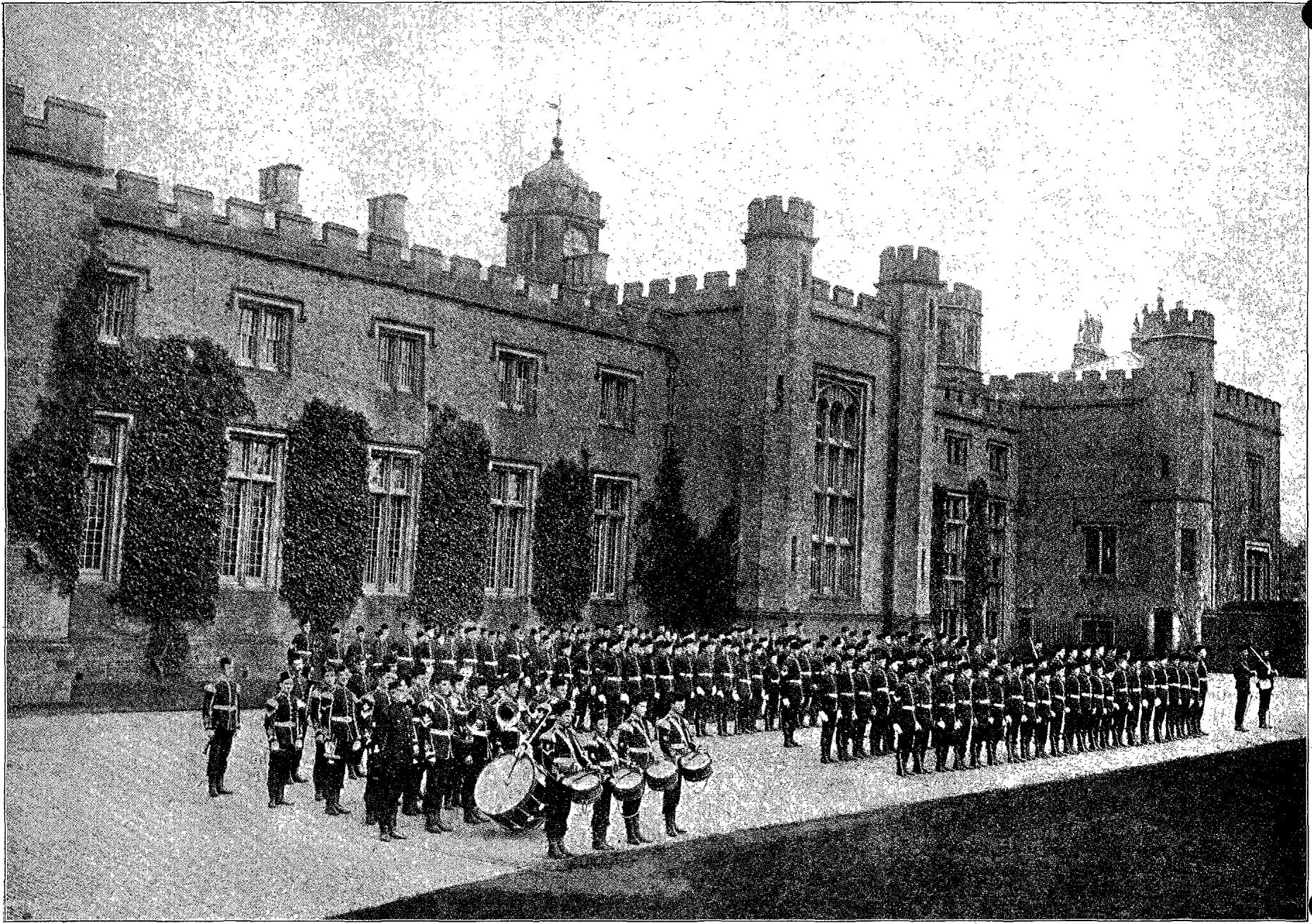
RUGBY (ENGLAND) HIGH SCHOOL.
How much have you thought about what the military drill in the public schools means for your children, should it suddenly become universal? And the rapidity with which the “flag salute,” with all that it involves, has been brought to the front, is a clear indication of how soon regular military training may be made a part of the course in the schools. For while it is claimed that this flag salute is intended to cultivate patriotism, in reality it cultivates militarism. And with the “spirits of devils” working to anger the whole world for war, and in the presence of the mighty war spirit that has already been stirred up, how long may we reasonably expect it will be before our children will be wanted for the purpose of taking the drill at arms? You may think that it will not be necessary for you to send your children to the schools where this military training is given. But only another step is needed to do in this country what has already been done in most of the countries of the Old World,—that is, make attendance at the schools and participation in the drills compulsory.
Have you ever thought of these things, brethren? Already in many of the schools the children are put through regular military drills. And there can be no doubt that the evil spirits are exhausting all their diabolical powers in their efforts to make this soldier spirit universal among the children. For not only in this country, but in other countries even more than here, great pains is taken to instruct the children in the maneuvers and tactics of war. The illustration on this page shows some classes of school children in England receiving their military drills. While these little boys look pretty in their uniforms, how awful is the thought of filling their young minds and hearts with a thirst for war and bloodshed!
The times are truly ominous. It is not simply one thing, nor two, that shows us that we are in the midst of threatening dangers; but the very air is surcharged with forebodings of peril on every hand. The dark part of the picture is that things are growing worse and worse. As we love the children that God has committed to our care,—yea, as we cherish the love that the Master puts into our hearts for fallen humanity in general,—we should awake to the situation, and return every talent to the Lord in faithful, devoted service.
Long ago the Spirit of prophecy warned us that what we failed to do in times of peace, we would have to do amid the greatest dangers. And how clearly are these dangers appearing all around us! None are forgotten by Satan in his work of deception and destruction. Even our children are closely taken into account by the enemy, and he has his plans well laid to make it so hard for them that he can accomplish their overthrow.
Everything bids us hasten. God has warned us, and is calling us. He has told us what all these things mean. He bids us, “Get ready, get ready, get ready.” Some are getting ready. Are you? Some are doing all they can to carry the message to fallen men before Satan gets a deeper hold upon them. Are you? Some are striving with all their ransomed powers to present the soon-coming Saviour to the world, so that the work may close up before Satan makes it more difficult for our children as well as ourselves to escape the perils set to entangle our feet. Are you? “The spirits of devils” are doing all they can to drill soldiers for the carnal warfare and cruel bloodshed into which the nations of earth are hastening. Are you a faithful soldier of the Prince of Peace, seeking to rescue the jewels of his grace from this thraldom of sin?
“To-day if ye will hear his voice, harden not your hearts.” The issues of this world are soon to be forever closed, and stormy times are around us. Let us be sure that our feet are firmly fixed on the Rock.
Continue reading: THE CHRISTIAN'S RESOURCES