The Youth’s Instructor, Vol. LII, No. 41

The Interior of South America

The Youth’s Instructor

October 11, 1904

Review and Herald Publishing Assn. · Washington, D. C. · October 11, 1904

The Interior of South America
The interior of South America is chiefly inhabited by Indians and half Spanish tribes; they speak a mixture of Spanish and Indian. They have dark, copper-colored skin; their hair is straight and black, and their features clear cut. In the town of Esquina, Correntes (about eight hundred miles from Buenos Ayres), where we lived for a time, the natives are very ignorant, hardly knowing anything outside of their own town. To them a stranger is a great curiosity, especially at the half savage school which we attended. They were very kind, however, and brought us presents and flowers many times. Esquina is very sandy, and it is not an uncommon occurrence to be caught in a sand-storm.
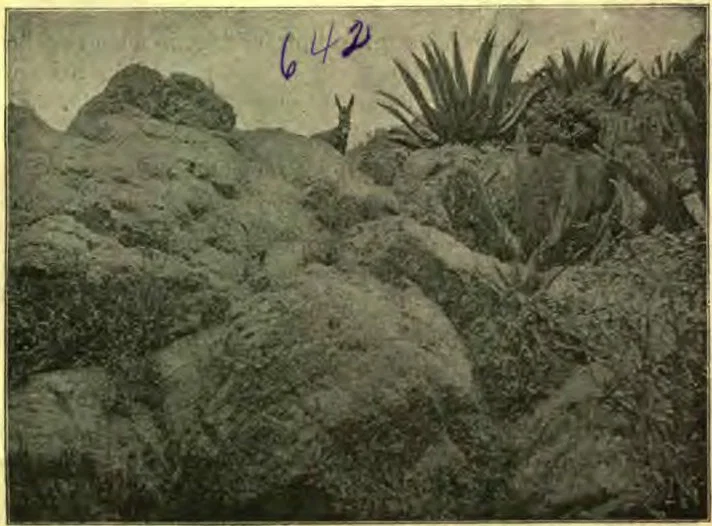
A PATHLESS PASS
A PATHLESS PASS
These storms rise without a moment’s notice, and often prove very dangerous, if encountered unawares, for they fill the eyes and ears with sand. The only safe way is to lie with the face down, until the tempest is passed.
One of the oldest customs is the drinking of mate, which is similar to herb tea. A large spoonful of this mate is put into a gourd with a small hole in the top, boiling water is poured on it, and sugar added if needed. A long silver tube, with small holes in the bottom, is used to draw the liquid to the mouth, the way a straw is used in drinking soda-water. All this combined is called a bombesa.
The South Americans are great wine drinkers; in fact, wine largely takes the place of water, which is very poor. A dinner without wine (vino) of some kind would seem very strange. Coffee, strong and black, is always taken after dinner, tiny after-dinner cups, almost half filled with sugar, being used. The men are great smokers, beginning when quite little boys. This accounts for their small stature; for it stunts their growth.
About three miles from Esquina, may be found cannibal tribes, who come to Esquina occasionally to trade; they are copper colored and very fierce looking, almost like wild animals. Some missionaries, who have gone among them hoping to convert them, have fallen prey to them, being devoured. These cannibals worship nature and its forces, and think missionaries are provided for their benefit no doubt.
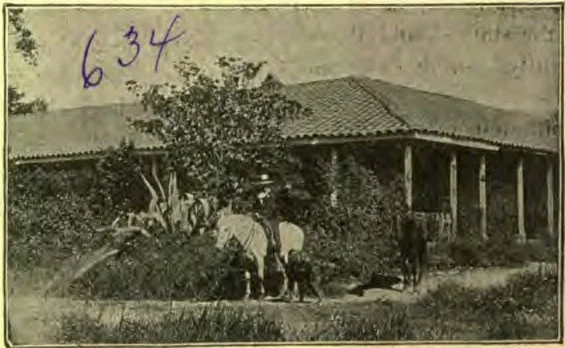
A SOUTH AMERICAN FARMHOUSE
The native homes outside of the town are made of mud, and sometimes old tin cans are used, which have been flattened out. Filete lace making is a great art among the women; it is made by knotting thread on a small board, and is very fine and delicate when finished. They are fond of music, and generally have a band playing every evening in the praca (park); when all the senoritas and senoras promenade, keeping time to the music.
Wild animals are found in abundance along the Rio Correntes (Running River). The large wildcats often peeped out from the banks and snarled at us as we passed in our boat. Beautiful birds gazed shyly at us, but did not seem to fear. The heron, from which the dainty aigrets are taken and used in the millinery stores of other countries, is found here. Some of these herons are bright pink, with long, slender bill and legs; others are snow white, with yellow bill and legs. Here the grebe is also found. It is similar to the duck in size and shape, and has a heavy covering of feathers, shaded from silver to brown. The birds are prized highly on account of their valuable skin, which is sold to fur makers for different purposes.
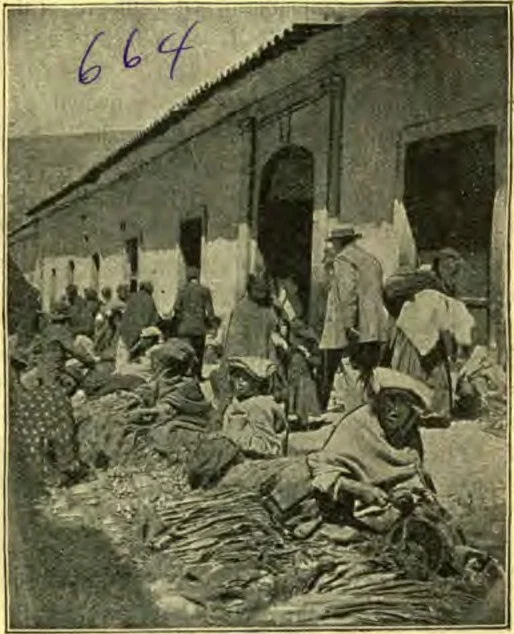
MARKET DAY IN LA PAZ
In the tropics the twilights are very long, and this is the time the people awake to the knowledge that life is worth living. They do not go out in the streets very much during the afternoon, but take a siesta (sleep). A common expression with them is mananha (to-morrow), that is their way of putting things off.
If a little girl is dead, about a dozen of her playmates follow the coffin, which is carried by four or five, the only covering being the drapery. Sometimes the coffins are draped in red, but white is generally used for a young person.
I hope this people may hear the truth we love.
VIOLET G. HAWKESWORTH.

Thoughts

RESTLESS as the waves of the ocean, Broken as each ripple there, Shifting one way, then another, Our thoughts are like birds in the air.
In each instant ever changing, Changing to the good and true, As each act is closely guarded, So must then each thought be, too.
Each sincere life strives to win Souls for heaven, saved from sin; But the thoughts each action guide, And must first be sanctified.
May our thoughts be found each day Far above the heaven’s blue, And along the Christian way Prove each life as good and true. LENA B. TAYLOR.

A Few Things in Which South America Excels

1. It has the densest and most extensive forests in the world.
2. It is richer in birds and insects than any other continent.
3. It has the largest river in the world.
4. It has the fiercest volcano in the world.
5. It has the loftiest mountain in the western hemisphere.
6. It has more volcanoes than any other continent.
7. It has a volcano which has the deepest crater in the world.
8. It has more wild cattle and horses than any other continent.
9. It has the highest lake of any considerable size in the world.
10. It produces more coffee than any other continent in the world.
11. It has the loftiest volcano in the world.
12. It is probably the richest mineral region in the world.—A. Flanagan.

Correct Speaking and Writing

I FIND it somewhat surprising to be told that, when in a recent number of The Journal I said, “No blunder is, perhaps, more common . . . than that to which a correspondent calls my attention,” I myself made the very blunder I was condemning—the blunder that appears in the sentences, “No book I ever wrote gave me so much satisfaction as this one” [by “this one” the author of the sentence means one book that he wrote], “No one, since the foundation of the world, was so wise as he.” If those of my correspondents who could see no difference between my sentence and those quoted will consider the sentences again, they may possibly perceive that the difference between “more” and “so” is, in this case, a difference between correct and incorrect. I may say, “No one is wiser than he;” but if I say, “No one is so wise as he,” some one may justly retort, “Oh, yes, one person is: he is.”

The Plural of Some Compound Nouns

Will you please give the correct plural of “court-martial,” “knight-errant,” and “handful”? P. E. I.
The plural of “court martial” (better written as two words) is “courts martial;” of “knight-errants” “knights-errant;” of “handful,” “handfuls.” Webster’s International Dictionary gives the plural of “knight-errant” as “knight-errants” or “knights-errant;” but the weight of authority is with the form in which the plural termination is added to “knight,” the fundamental part of the compound, rather than to “errant,” the attributive part.

“Those Sort”

In a conversation on page 281 of “Sir Richard Calmady”—a book I have lately read—the following sentence occurs: “It is all very well for you to say those sort of things.” Is this correct? or should it be “those sorts of things” or “that sort of thing”? N. H.
“Those sort of things” is not correct: the adjective should, of course, agree in number with the noun which it modifies. “Those sorts of things” is grammatical, but clumsy; “that sort of thing” or “things of that sort” is preferable.
“Those sort” is so common in conversation that the author of “Sir Richard Calmady” may have used the phrase purposely, in order to make the speech in which it occurs “true to life.”

“All Who”

Will you kindly tell me whether the use of “who” would be sanctioned in the following sentence, or whether it should be “that”? “All citizens of Monroe who favor the principles of the Republican party are requested to meet in the town hall.” I. M. F.
“All who” is unobjectionable when, as in the sentence quoted, “all” refers to persons.

The Meaning of R. s. v. p.

Kindly tell me the meaning of the letters R. s. v. p. I find them below an invitation. D. G.
They mean that an answer is requested: they stand for the French expression Répondez, s’il vous plaît (Reply, if you please).

A Plural Subject

Please let me know whether the following sentence is correct: “The charge for material and the charge for labor in the enclosed statement are correct.” Or should it read “is correct”? Mo.
“Are correct” is the proper form: “the charge for material” and “the charge for labor” are two things, and, taken together, they make a plural subject.

Not a Slip of the Pen

I have noticed that, in writing “all right,” many persons make one word of it—“alright.” I can not find “alright” in the dictionary, and therefore do not understand what authority there can be for it. TOPEKA.
There is no authority for it. But for the fact that more than one reader of The Journal has asked about it, I should suppose such a spelling to be a slip of the pen.

Some Names Pronounced

I wish that you would give the correct pronunciation of the following names: Gounod, Chopin, Labouchere, Pasteur, Tissot, Lorrequer, Pindar. A. F.
“Gounod” is pronounced goo-no; “Chopin,” sho-pan; “Labouchere,” la-boo-share; “Pasteur,” pas-ter; “Tissot,” tes-so; “Lorrequer,” lor reker; “Pindar,” pin-dar.

An Improper Salutation

Kindly tell me which of the following forms is preferable at the beginning of a business letter:— Miss Mary Brown, New York, N. Y. Miss Brown:— or Miss Mary Brown, New York, N. Y. Dear Madam:— P. R. I.
The second form is preferable; in what is called the “salutation” of a letter, “Miss Brown” should not be used without “Dear” or “My dear” before it.

“Being” for “Since”

Recently I used the expression “Being it is here, I will cut it now.” A controversy arose as to the propriety of the word “being.” Will you kindly inform me whether it was improper or not? J. E. D.
This use of “being,” like a similar use of “being that,” is no longer correct; the proper word is “since.”

A Case of Tense-Attraction

Suppose that I should pick up a pencil and find it very short; would it be correct to say, “I did not know that this pencil is so short”? N. A.
“I did not know that this pencil was so short” is the correct form.—Margaret A. Sangster.

In Many Lands

BASKET-MAKING employs half a million persons in Germany.
In Valparaiso the conductors on the trolley-cars are women.
In Cairo, Egypt, the proportion of blind people to the population is one to twenty.
In Japan it is considered very disgraceful to have a bad child. All Japanese children are taught to honor their parents.
Europe and Asia are to be connected by a bridge over the Bosporus, where the Persian king, Darius, crossed with his army in 513 B. C.
The higher class women in Korea do not go out on the street except in closed chairs. The poorer class women have green cloaks, which they hold tightly in front of their faces, with just a crack for the eyes.
The Chinese wheelbarrow is larger and heavier than ours. The wheel comes up through the center of the bed, instead of being at the front end. There is a framework over the wheel, and the passenger sits, with no support for his back, on the ledge on one side of the framework, facing the front.
In Siam, when the people go to eat, they squat on their heels on the floor about a little table not more than a foot high. Their meal consists of pickles and rice. The rice is brought to the table in the kettle in which it has been cooked. All eat with their fingers. Each sticks his own hand into the kettle, and takes out all it can hold.
Think of wearing a suit of clothes without a single button! Well, that is what thousands of Koreans do. In Korea everything connected with a person’s dress is tied up with a girdle, or with some form of band with one end sewed to the cloth. There are no buttons, and there are no pins.—Selected.

The King of Metals

I WAS recently asked the question, “What is the most valuable metal?” the questioner evidently having in mind gold, silver, or even platinum, as being usually called the most precious metals. These we might dispense with, because they minister principally to luxury; but iron is said to be worth more to the world than all other metals combined. It is called the symbol of civilization, because in its adaptations it has kept pace with all scientific discoveries, and its worth therefore can be estimated only by the progress of the age. This metal is as well fitted for the manufacture of a screw so small that it can be seen only with a microscope, as it is for the largest engine.
I found a bit of verse the other day, which, in a few words, tells many of the uses to which iron is put:—
“Iron vessels cross the ocean; Iron engines give them motion; Iron pens are used for writing, Iron needles northward veering; Iron tillers vessels steering; Iron pipe our gas delivers; Iron bridges span our rivers; Iron ink our thoughts inditing; Iron stoves for cooking victuals; Iron ovens, pots, and kettles; Iron horses draw our loads; Iron rails compose our roads; Iron anchors hold in sands; Iron bolts, and rods, and bands; Iron houses, iron walls, Iron cannon, iron balls, Iron axes, knives, and chains, Iron augers, saws, and planes; Iron globules in our blood, Iron particles in food, Iron lightning-rods on spires, Iron telegraphic wires, Iron hammers, nails, and screws— Iron everything we use.” — Selected.

When Postage Stamps Were New

“WHEN postage-stamps first came into use,” said a veteran postal clerk, “the public didn’t know how to handle them. You remember how, when tea and coffee first appeared among us, the people fried the tea berries and the coffee berries, and served them with salt and pepper? Well, the people treated their stamps as absurdly in 1854.”
“Some would put the stamps inside their letters, out of sight. Here is the official notice that we used to stop that practise.”
The clerk took from the drawer an aged bulletin that said:—
“The stamps upon all letters and packages must be affixed upon the outside thereof, and above the address thereon.”
He put back this bulletin, and drew forth another one.
“Persons would pin the stamps on their letters, instead of gumming them,” he said, “and when they did gum them, they would not do it right. Hence this second bulletin,” and he read:—
“Persons posting letters should affix the requisite number of stamps previous to depositing them in the letter receivers, as when posted in a damp state; the stamps are liable to rub off, and thereby cause the letters to be treated as unpaid. Do not pin on the stamps.”
“Still,” said the clerk, “the public didn’t understand. Think of it—it didn’t understand the simple matter of sticking a postage-stamp on a letter. So we got out a third bulletin, this one.”
The third bulletin, in big, impatient letters, said:—
“The simplest and most effectual method of causing stamps to adhere firmly is, first, to moisten well the outside of the stamps, and afterward the gummed side slightly, taking care not to remove the gum.”
The clerk said that a philatelist had offered him twelve dollars apiece for these three queer bulletins.—Selected.

God's Gift

O, faith so very simple That all may believe, And so very plenteous That all may receive,
God gives for the asking From his bounteous store; There's always been plenty, And will be evermore.
O, sinner, accept it— This wonderful gift! It comes from the Father, Our trials to lift.
Have faith in the Lord, Your trials will cease, And all will be light, And all will be peace. B. A. WRIGHT.

The Duty of Acknowledgment

THERE is no need to put in a plea for criticism. We are all adepts at the critic’s work, and find it congenial employment. If a man has faults, all eyes are quick to note them, and all tongues eager to speak of them. But not all are so quick to appreciate, and few even of those who do appreciate have the frankness and generosity to give expression to their appreciation. And so, I repeat, I am going to venture to put in a plea for appreciation and the expression of it.

Hearts that Hunger for Appreciation

We want appreciation and the expression of it in our intercourse with friends and acquaintances. When a man has done us a kindness, let us not be ashamed to speak of it. If a man does us a wrong, we talk of it fast enough. Why should we not be equally ready to speak of benefits received? Hearts hunger for appreciation, and there are men and women in the world for whom the whole aspect of things would change, whose sky, from being dull and gray, would blaze out into crimson and gold if we would but tell them what we feel.
Thousands of persons—writers, preachers, friends—go through life discouraged and depressed, thinking they and their work are unappreciated, when they might go on their way singing if we only told them what was in our hearts. Appreciation and the expression of it will change the world’s climate for many who are living in the cold to-day, and will make perpetual summer in their souls.

“Love Me, and Tell Me So”

Then we want appreciation and the expression of it in our family life. The condition of happiness in the home is love; but love needs to be uttered and expressed. We have no right to take it for granted that our dear ones know how we feel, and therefore need not be told.
Even if they do know, they are all the better for having the old story repeated.
When Dr. Dale was in Australia, speaking about this reserve of ours, he said he felt inclined to give to English people this motto: “Love me, and tell me so.” And deep down in many a heart—wife’s heart, husband’s heart, parent’s heart, child’s heart—there is that same wistful desire, “Love me, and tell me so.” That is why so many homes are so cheerless. It is not that husband and wife and children do not love one another, but they never say so—they never tell what they feel.
In this connection one naturally recalls the miserable story of the Chelsea philosopher’s home. He married a woman of brilliant gifts. She devoted herself to Carlyle’s interests, gave up her favorite authors to read his notes, relieved him of the drudgery and detail of his work—in a sense laid herself a sacrifice on the altar of her husband’s fame. And Carlyle took it all as a matter of course, and uttered no word of gratitude or love. Jane Welsh Carlyle was of all women in London the most miserable. She hungered for love, and died a broken-hearted woman for lack of it.
After her death Carlyle read her journal, and realized at last that the woman he had married had been starving all her days for want of affection. Then the old man took that pathetic pilgrimage to her grave, where Froude found him murmuring, “If I had only known! If I had only known!”
Let us beware of committing the same tragic mistake. Fools may sneer at what they term “gush” and “sentiment,” but let us not forget that “Love me, and tell me so,” is one of the secrets of the happiness of a home.

Acknowledge the Goodness of God

And we need appreciation and the expression of it in our religious life. “Let the redeemed of the Lord say so!” sings one of the psalmists. Redemption and all implied in it is surely a gift that demands acknowledgment! God has done great things for us, whereof we are glad.
But how few there are of us who bear frank testimony to God’s goodness, and say with that other psalmist: “I will declare what God hath done for my soul”! We have been silent and dumb when we ought to have spoken. We have hidden God’s righteousness within our hearts. We have accepted the gift, and said nothing about it.
I want to plead with all Christian people to be honest and brave enough to make frank acknowledgment of God’s goodness to them in Jesus Christ. “Let the redeemed of the Lord say so”! and that for at least two reasons:—
1. Out of pure gratitude. If you were in the grip of some mysterious or deadly disease, and at last you found a doctor who understood your case, conquered the disease, and set you in perfect health again, what would you do? I will tell you what you would do: you would blazon that doctor’s name abroad; you would tell everybody of his skill; you would speak of yourself as a living illustration of his healing power.
There is a story told of a poor soldier who was wounded in one of the numerous battles of the American Civil War, and who was slowly bleeding to death, when in the nick of time a doctor came up and bound the bleeding limb. As he rose to go, the poor fellow said, “What’s your name, doctor?”
“O, never mind my name!” was the doctor’s reply.
“But I want to know,” pleaded the wounded man; “I want to be able to tell my friends at home the name of the man who saved me.”
Does Jesus deserve less at our hands? He died that we might be forgiven; he loosed us from our sins; he delivered us from death. Ought we not to be anxious to tell the name of him who saved us?

Tell the Good Tidings

2. Out of consideration for the needs of our fellow men. What is the first and pressing duty that rests upon a man who has in his possession a secret of vital importance, not only to himself, but also to the whole world? Is it not this: the duty of communicating it?
Four lepers outside Samaria’s gate discovered a secret one day. This was the secret, that the tents of the Syrian army which had been besieging Samaria were all empty, that the Syrians had fled, panic-stricken, in the night, leaving abundance of provisions behind them. That was the secret the lepers had discovered: there was abundance of food in the tents of the Syrians to be had for the taking.
For a moment they thought only of their own intolerable hunger; then they thought of the starving town near by. They felt they had no right to rejoice in plenty themselves while within call there was a city full of gaunt and starving folk. “This,” they said to one another, “is a day of good tidings. Let us go and tell.”
We, too, are in possession of a great and blessed secret. We know that Christ can redeem men from the pain and power of sin. Have we a right to keep that good news to ourselves? All around us there is a world-full of people, groaning, fainting, dying, because of sin. We dare not be silent in face of it. “This is a day of good tidings. Let us go and tell.”
Speak for the love of God, Speak for the love of man; The words of truth love sheds abroad Can never be in vain. — J. D. Jones.

What Makes Friends for a Boy?

WHAT makes a boy loved?—Surely it is manliness. During the war how many schools and colleges followed popular boys? These young leaders were the manly boys whose hearts could be trusted. The boy who respects his mother has leadership in him. The boy who is careful of his sister is a knight. The boy who will never violate his word, and who will pledge his honor to his own hurt and change not, will have the confidence of his fellows. The boy who defends the weak will some day be strong. The boy who will never hurt the feelings of any one will one day find himself possessing all sympathy. If you want friends, be the soul of honor; love others better than yourself, and people will give you their hearts, and try to make you happy. This is what makes friends for a boy.—The Young Evangelist.

C. Vanderbilt — Millionaire Mechanic

It has been said of our American millionaires that “from shirt sleeves to shirt sleeves is three generations.” That applies to Cornelius Vanderbilt in a way, although shirt sleeves with him do not come from necessity, but choice. He has money enough to live on comfortably, and could afford to pass his life in elegant ease, but he has a healthful dissatisfaction with idleness and lack of vigor. His mind is serious, industrious, inventive. Mechanical genius is a native element in him. After being graduated with honors from Yale, he went directly into the shops of the New York Central at Mott Haven, and worked just as the men about him worked, mastering from the beginning all the mechanical details. He has twenty-three patents to his credit.
Cornelius Vanderbilt is thirty-two years old, and his income, exclusive of income from patents, is three million dollars a year, but he works as hard as a day-laborer.—Selected.

THE WEEKLY STUDY

Paul's First Missionary Journey

(Concluded)
LESSON SCRIPTURE: Acts 14: 19-28.
HISTORICAL STUDY: Give sketch of Pamphylia, Pisidia, and Lycaonia; also habits and customs of the people.
REFERENCE STUDY: “Sketches from the Life of Paul,” pages 62, 63.
OUTLINE OF TOPICS:—
Departs from Derbe.
Result of labor.
Return to Lystra.
To Iconium.
To Antioch.
Object.
Exhortation.
Elders ordained.
Pass through Pisidia.
Preach in Perga.
Reach Attalia.
Depart for Antioch in Syria.

Notes

This first missionary tour is supposed to have covered a period of about two years, probably A. D. 46-48.
Elders were not ordained at the first visit. Note that it is through “much tribulation” that we enter into the kingdom.
This journey had clearly demonstrated that the door was open among the Gentile nations to receive the gospel. And with the hour had arrived the man.
“The next day after the stoning of Paul, the apostles left the city. . . . They departed for Derbe, where their labors were blessed, and many souls were led to embrace the truth. But both Paul and Barnabas returned again to visit Antioch, Iconium, and Lystra, the fields of labor where they had met such opposition and persecution. In all those places were many that believed the truth; and the apostles felt it their duty to strengthen and encourage their brethren who were exposed to reproach and bitter opposition. They were determined to securely bind off the work which they had done, that it might not ravel out.”—“Sketches from the Life of Paul.”
“Paul and Barnabas soon after returned to Antioch in Syria, where they again labored for some time; and many Gentiles there embraced the doctrine of Christ.”—Id.
“Certain passages, in which the movements of the crusaders and apostles may be compared with each other, are among the striking contrasts of history. Conrad and Louis, each with an army consisting at first of seventy thousand men, marched through part of the same districts which were traversed by Paul and Barnabas alone and unprotected. The shattered remains of the French host had come down to Attalia through the abrupt mountain passes and the deep valleys which are so well described by the contemporary historian. They came to fight the battle of the cross with a great multitude, and with the armor of human power; their journey was encompassed with defeat and death; their arrival at Attalia was disastrous and disgraceful; and they sailed to Antioch a broken and dispirited army. But the crusaders of the first century, the apostles of Christ, though they too passed through much tribulation, advanced from victory to victory. Their return to the place ‘whence they had been recommended to the grace of God for the work which they fulfilled,’ was triumphant and joyful; for the weapons of their warfare were not carnal. The Lord himself was their tower and their shield.”—Conybeare and Howson.
It is worthy of note that the experiences encountered in each place visited were different, but the Lord mightily wrought with his servants, and some were converted. Churches were established, and a lasting work accomplished. It is the privilege of all who labor for the Lord to-day, to see success crown their efforts. G. B. T.

Working for Love of God's Son

“I WOULD not work my soul to save; That work my Lord has done; But I will work like any slave, For love of God’s dear Son.”
Continue reading: Wrights, Pennsylvania