The Youth’s Instructor, Vol. 33, No. 20.

Ludlow Castle
Earlier text: Ludlow Castle

HOW THEY BEGAN.

THE firm named Harper & Brothers is so well known that a short sketch of the early business habits of those who first composed the firm may serve as an example of what energy, perseverance, and carefulness have to do with prosperity. Other firms have established themselves upon the same rock bottom, and grown to vast proportions. We give you this example because just such business habits are necessary to success in any undertaking. A writer in a late magazine says:—
“James Harper was born in Newtown, Long Island, about eighty years ago. He lived on the farm, and helped his father until fifteen years of age; during this time he got what instruction he could from the district school. At this age he made up his mind to be a printer. He came to New York, and went into a printing office as apprentice. Of course he had to do all the dirty chores, cleaning the rollers and presses, sweeping, and running errands. In this sort of work the face as well as hands usually get daubed and blackened, and give such an appearance to a young apprentice that the name of “printer’s devil” seems quite appropriate. He didn’t shirk his work on this account, for he had sense enough to know that it was honorable dirt. He stuck to it and worked hard, and in time earned the name of being a first-class pressman.
“His brother John also came to the city to learn the printer’s trade at another office. As they often worked extra hours, they could only see each other occasionally evenings, and on Sundays. They carefully saved their small earnings, and when their long apprenticeship was ended, they started in for themselves, investing their few hundred dollars in a few fonts of type and a press, and hired an office on Dover street. Here they worked industriously with their own hands, printing small editions of books for different publishers, but not taking any risks themselves. They took great care that their work, though on a small scale, should be done in the best manner, and thus they got a reputation and built up a business. They began to print small editions of books on their own account, but proceeded very cautiously, and took no risks. As their business grew greater, they were obliged to move from time to time into larger buildings. They took their two younger brothers into business with them, and when James was thirty years old, they adopted the firm name of Harper & Brothers.
“The business went on increasing, and in due season, as the brothers grew to be old men, it was handed down to their sons. It is now one of the greatest publishing concerns in the world, the simple catalogue of their works occupying nearly four hundred closely printed pages, including every variety of literature.”

CHINAMEN AND ANIMALS.

One who knows something about the Chinese says: “They never punish animals; hence a mule which to a foreigner would not only be useless, but dangerous to every one about it, becomes in the possession of a Chinaman, as quiet as a lamb and tractable as a dog. We never behold a runaway, a jibbing, or a vicious mule or pony in a Chinaman’s employment; but found the same rattling, cheerful pace maintained over heavy or light roads, by means of a turn or click, the beast running to the right or left, and stopped with but a hint from the reins. This treatment is extended to all the animals they press into their service. Often have I admired the tact exhibited in getting a large drove of sheep through narrow, crowded streets and alleys, by merely having a little boy to lead one of the quietest of the flock in the front; the others steadily followed without the aid either from a yelping cur or a cruel goad. Cattle, pigs, and birds are equally cared for.” Is there not yet considerable to be learned from the Chinaman?

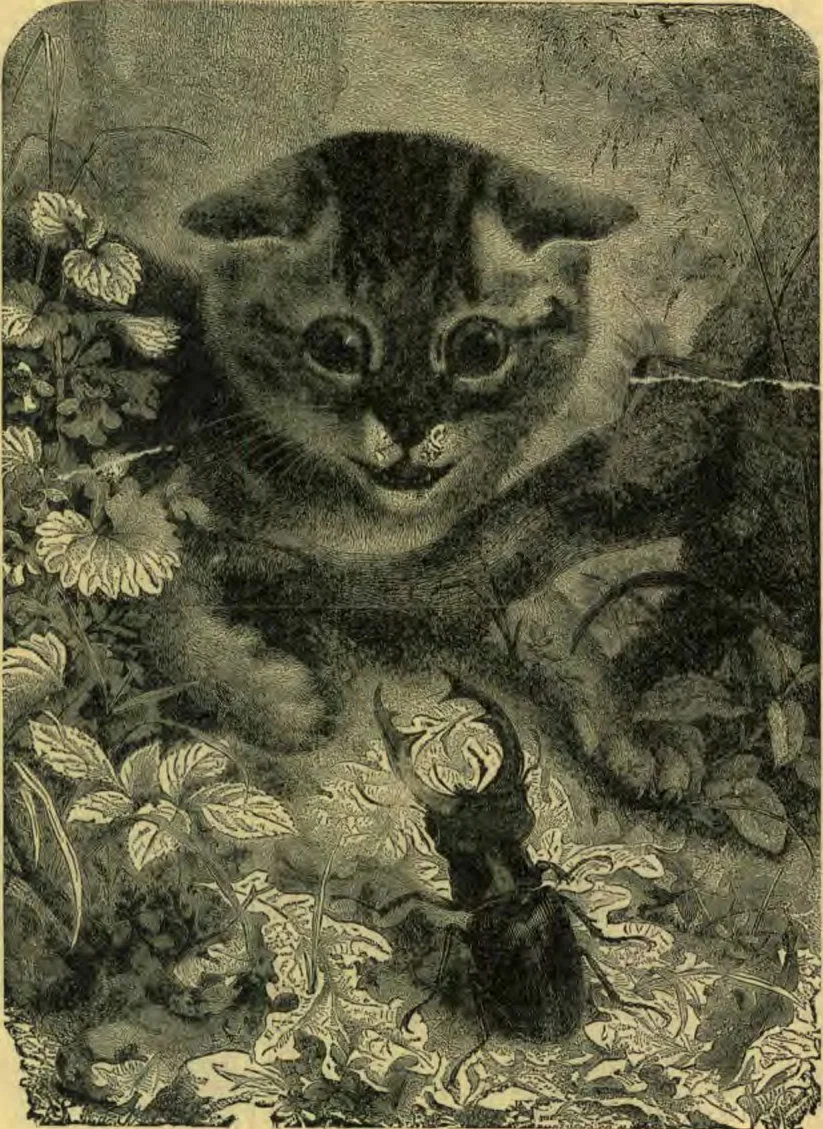
THE DISOBEDIENT KITTY

Written for the Instructor.

THE DISOBEDIENT KITTY.

“I GUESS I'd better take a walk,” Meowed little Kitty Gray; “My brothers all are fast asleep, And mother is away. 'Tis true she told me not to go Beyond the big barn door, But I'm so tired of dusty mows, And this old hay-strewn floor.
“I'm sure I'm old enough to know What's best for me to do; And what I want to do is best, And now I'll prove it, too. How soft this grass is to my feet! Much better than that hay: How foolish 'tis to stay in-doors On such a pleasant day!
“Ah! here is something slim and tall; I s'pose it is a tree; And these are flowers, and these are leaves; But what is this? Dear me! I never heard my mother tell Of such queer birds or mice; What a fine meal I'll have to eat! It looks so very nice.
“O dear! The thing has bit my nose; 'Twill make a meal of me. What shall I do? I've lost my way; But what is that I see? 'Tis mother. Oh, how glad I am! Of walking I am sick; I'm sorry that I ran away, I'll go and tell her quick.”
S. ISADORE MINER.

TALK AMONG THE TOOLS.

“Yes,” said the carpenter, looking at the plane in his hand, “that will make a very pretty cabinet, and I’ll begin it at once.”
So saying, he drew open a drawer, wherein lay a row of shining new tools. No sooner was the drawer opened, than the tools began to talk:
“There!” said the plane, “I’m afraid I shall be wanted to smooth that wood, and I know I cannot do it. It is a thing I have never done, and I shrink from beginning. Oh, will you not do it for me?” it said to an old, worn-out plane, that lay on the bench.
“Ah! my working days are over,” said the old plane, “or I would gladly be used. But you need not think so much of yourself, my young friend; you will find you have only to leave the work to the carpenter; you have nothing to do, but be willing he should use you.”
Hardly were the words spoken, when the carpenter put out his hands, and seizing the trembling plane, began to remove all the roughness from a fine piece of ash wood.
This finished, the plane was put down beside its old friend, and at once burst into a fit of weeping.
“Why! what is wrong?” said the old plane.
“Oh, dear! I cannot do that kind of work at all,” cried the plane.
“Well! you do surprise me,” said the old plane. “I cannot see what you had to do with it. I don’t believe the carpenter made a botch of it; he is far too skilled a workman to do that.”
Their voices were here drowned by harsh sounds; and looking up, they saw the carpenter sawing the wood in two. This done, the saw was placed beside the planes on the bench, and began at once to give an account of what it had been doing.
“Well, I declare! I went as cleanly as a knife through that wood! It was a capital job! I quite enjoy this work! Did you hear how some of the tools praised me?”
“As you are so clever,” said the old plane, “perhaps you will saw through this piece of waste wood here? We should like to see you try.”
The saw tried to rise; it tried again, and then gave it up, looking so ashamed at its utter failure.
Before any one had time to speak, the saw was again taken up by the carpenter, and sent cleanly and swiftly through another plank.
While this was being done, the door opened, and a sunny-faced little girl ran in, saying, “I have learned my text, father; may I say it now to you?” And slowly the little one said: “Without Me, ye can do nothing.”
“Right,” said the father. “Would you like me now to tell you what it means?”
He showed her the drawer of tools, and asked her how much work they could do by themselves.
“Oh, father!” said the child, “of course the tools cannot move, they are not alive.”
“Then how did that wood become so smooth?”
“Why, you did it, father,” said the child.
“Will you not give the plane any credit?” said the father, smiling.
“Oh! now you are making fun of me, father. Why do you ask me such strange questions?”
“My child,” said the father, “it is because I want you to understand that we are helpless in ourselves as these tools. I want you to give yourself to the Lord Jesus, that he may work through you; and you need never feel sad, nor feel proud, over any work, for, like these tools, you can do nothing good unless he helps you.
“Now, run away, and never forget the text learned to-day: ‘Without Me, ye can do nothing.’”—Our Own Gazette.

GOOD FOR NOTHING.

A GENTLEMAN, while talking to some children, took out his watch and asked them what it was for.
“To keep time,” the children answered.
“Well, suppose it won’t keep time, and can’t be made to keep time, what is it good for?”
“It is good for nothing,” they replied.
He then took out a lead pencil, and asked what it was for.
“It is to mark with,” was the answer.
“But suppose the lead is out, and it won’t mark, what is it good for?”
“It is good for nothing.”
He then took out a pocket-knife, and asked what was its use.
“To whittle with,” said some. “To cut,” said the others.
“Suppose that it has no blade, and then what is it good for?”
“Good for nothing.”
“Then a watch, or pencil, or knife is good for nothing unless it can do the thing for which it was made?”
“No, sir,” the children all answered.
“Well, children, what is a boy or girl made for?”
The children hesitated.
“What is the answer to the question, ‘What is the chief end of man?’” asked the gentleman.
“To glorify God and enjoy him forever,” replied the children, remembering what they had learned in their Sabbath-school lesson.
“Now, then, if a boy or girl does not do what he or she is made for, and glorify God, what is he or she good for?”
And the children all answered, without seeming to think how it would sound:
“Good for nothing.”
“Well, if children are made to glorify God, and they don’t do it, are they good for anything? If they fail to do this, it is as though they failed in everything. Without love to God, all other things are as nothing.”—Selected.

DICK'S LESSON.

Dick was bending over his atlas, with a puzzled face. Where was that river? He could find every other river he had ever heard of, but the Tagus was not to be found.
He called Mamie, and she looked too. But the children could not discover the river. Aunt Sue, who was sitting in the parlor, might have assisted them, but they did not ask her. Papa would have given his help, but he preferred not to offer it. I would be ashamed to tell it to you, only that I fear Johnnie and Jerry and Pansy and Jane may have been as foolish in their day. He said,—
“I'll let that question go.”
“Oh,” said Mamie, “I wouldn't, Dick.”
“Yes, I will,” said the boy. “I don't believe it will come to me in the class.”
“Did you know your geography lesson to-day, Dick?” said papa the next evening.
Dick flushed, and said, “No, papa. I had learned it all perfectly except just one question, and Miss Trumbull asked me that the very first thing. Was it not strange?”
“I'm glad it so happened, my son,” said papa. “It will teach you, I hope, to be thorough. It is never safe to leave one question unlearned.
“If we would succeed in anything, we must not neglect a single detail, no matter how small. Your failure to-day spoils your week's record, and all because you gave up looking for a river which was on the map, with the idea that may be that question would go to somebody else.”—Child's Paper.

Letter Budget.

AND now what does the Budget bring? First, comes a letter from LEWIS M. WHITE, of Wisconsin. He is twelve years old, and with his little sister six years old, reads the INSTRUCTOR, which they like very much. Their father is sick all the time at the Soldier’s Home, in Milwaukee, Wis., so his mother has to work hard to take care of them.
You have our sympathies and prayers, Lewis.
DORA LUDINGTON, writing from Boone Co., Ind., says she wrote some time ago for the INSTRUCTOR, but her letter was not printed; so she writes again. She is ten years old. The family all attend Sabbath-school at Thorntown. She and one of her sisters learn lessons in Book No. 2. She was baptized at the Logansport camp-meeting last year. There are about forty scholars in their day school, which was to close in three weeks when she wrote. After school closed, she and her sister were going to canvass for the INSTRUCTOR, and her father for the “Sunshine at Home.” Her grandma, who is seventy-three years of age, is staying with them. She has one brother and three sisters.
MARY E. WILSON, of Compton Co., Quebec, writes: “I am twelve years old. We have kept the Sabbath four years, and have taken the Signs and INSTRUCTOR all that time, and the Review the last three years. I go to day school, and take music lessons evenings. I have two brothers and two sisters. My baby brother is only nine months old; he is a little darling. I tell you, Papa bought a book called ‘Sunshine at Home,’ for which I have been canvassing. In one evening I obtained two subscriptions. Hope I shall get more soon. We have a little Sabbath-school of about nineteen members, which meets every week; but we seldom have any preaching, as the nearest church is thirteen miles away. A minister was here two weeks ago, and we had a good meeting. I want to live so I may have right to the tree of life. I send love to the INSTRUCTOR family.”
BURTON L. FRINK, of Berkshire Co., Mass., writes: “I am eleven years old, and have one brother, seventeen years old, who is attending the So. Lancaster Academy. I am reading the ‘Temptation of Christ in the Wilderness,’ by Mrs. White. We live so far from Sabbath-school I cannot go all the time in the winter; but I go most of the time in the summer. Papa is teacher of the class in the INSTRUCTOR, so he goes sometimes in the winter when it is so cold and rough that mamma and I stay at home. I go a mile and a half to day school. We think we could not get along without the INSTRUCTOR. I hope I may so live that I can meet the INSTRUCTOR family on the new earth. I send love to all, especially the editors.”
W. J. R., of Multnomah Co., Oregon, writes: “Seeing no letters in the Budget from this part of the Sabbath-school field, I will say a few words in behalf of the East Portland school, hoping thereby to induce some of the younger members to write. Four years ago a family Sabbath-school was started here; now we have a school of ninety-three members, with bright prospects for the future. What has been accomplished has been the result of earnest, persistent labor, with the blessing of God; and we can say for the encouragement of new schools, ‘Be not weary in well doing,’ you ‘shall reap, if you faint not.’ I have been a reader of the INSTRUCTOR seven years, and I can truly say it is the best paper for children I have ever read. The INSTRUCTOR family ought to be thankful for the pains that is taken in preparing this nice paper for them.”

You have reached the end of this edition.

The Youth’s Instructor · Jun 3, 1885