THE recent publication of the statistical report of our church work has elicited some comment on the part of several of our exchanges. The Lutheran for January 14, says:—
Seventh-day Adventists believe in tithing; and if religion were to be measured by the amount of money men are willing to part with under some particular system of giving, then Adventists are more religious than most people. Their gifts to foreign missions alone averaged $6.95 per member in 1913. Presbyterians and Methodists North together gave over three million dollars to the same cause, or about fifty-eight cents per member. That seems to speak volumes in favor of the tithing system, does it not?
The editor questions whether this larger average of gifts to missions on the part of the Seventh-day Adventist Church indicates a greater spirituality in that church. He is inclined to give the credit to the system rather than to the real love for mission work. Similarly, the editor of the Northwestern Christian Advocate for January 15, refers to the large gifts among Seventh-day Adventists, and suggests what might be done by the Presbyterian and Methodist Churches if their8contributions for foreign missions were as liberal as those made by the members of the Seventh-day Adventist Church:—
The total membership of the Methodist and Presbyterian denominations, as given in their official yearbooks for the year 1913, is 5,215,593. Their combined offerings for foreign missions for the same year were $3,045,328.18, an average of fifty-eight cents per annum for each member; a little more than one cent a week. The official statistical report for 1913 of the Seventh-day Adventists, who believe that God's law of the tenth of income is of the same binding force as his other law of the seventh of time, gives the total membership of their church in North America as 71,863. Their contributions to foreign missions for the year 1913 amounted to $499,713.65, an average of $6.95 per annum for each member, or not quite fourteen cents a week. If the combined membership of the Presbyterian and Methodist Churches had given as much per capita as the members of the Seventh-day Adventist Church, $6.95 each, their combined contributions to foreign missions in 1913 would have amounted to over $36,540,000, instead of a little more than $3,045,000.
The publication of our statistical report evidently afforded inspiration for an article on “The Financial Side of Tithing,” by Thomas Kane, in the Christian Observer (Presbyterian) for December 6. Speaking of the benefits which come from the payment of tithes, and citing examples of some who have illustrated this principle in their experience, he says of Seventh-day Adventists:—
A much fairer as well as more relevant illustration of what tithing will accomplish in and for a denomination is afforded by the Seventh-day Adventists. There is nothing specially attractive, no special drawing power, in observing the seventh instead of the first day of the week as the Sabbath of rest and worship. The Adventists are neither alone nor singular in their belief in the second coming of Christ. Mr. Moody and the late Dr. Gordon, of Boston, devoutly believed that Christ would come again. So do thousands of Christians in all our churches.
Except by their faith in and practice of tithing, how can we account for the remarkable showing made by the Seventh-day Adventists as a denomination? They regard the law of the tithe, the tenth of income, as equally binding with the law of the Sabbath, the seventh of time. Their official reports state that in 1870 they had a membership of 5,440. In 1910 it was 104,526. Their annual tithe in 1870 was $2,182.46; in 1910, $1,338,689.65. In 1913 it was $1,771,989.60. In 1870 the church controlled one sanitarium with 35 employees. In 1910 they had 74 sanitariums with 1,989 employees, with assets of $3,368,000. In 1880 their total contributions to missions and other benevolent causes was $5.39 per capita; in 1910 it was $21.27; in 1913, $23.42. This included the membership in foreign countries. In North America alone it was $28.93 per capita for 71,863 communicants. These figures certainly do not show that they had grown poor by tithing during the thirty-three years from 1880 to 1913.
As we have suggested before, the standard of comparison of our benevolence is not that erected by our fellows. It is the standard exemplified in the ministry and sacrifice of our Lord Jesus Christ. He laid aside the riches and glory of heaven and sacrificed even his own life for the salvation of lost mankind. The very essence of the gospel is summed up in the one word, Give. And to the extent that Christ dwells in us and we partake of his spirit will we exemplify, even as he did, this gospel principle in our lives. F. M. W.
God’s Innumerable Thoughts Toward Us
God yearns over his children with the pitying love of a tender father. “Like as a father pitieth his children, so the Lord pitieth them that fear him. For he knoweth our frame; he remembereth that we are dust.” This infinite love on his part awakens innumerable thoughts toward his children. Declares the psalmist:—
“Many, O Lord my God, are thy wonderful works which thou hast done, and thy thoughts which are to usward: they cannot be reckoned up in order unto thee: if I would declare and speak of them, they are more than can be numbered.” Ps. 40: 5.
Again the sweet singer of Israel, in contemplation of God’s wonderful mercy, exclaims:—
“How precious also are thy thoughts unto me, O God! how great is the sum of them! If I should count them, they are more in number than the sand: when I awake, I am still with thee.” Ps. 139: 17, 18.
The Lord himself declares the character of the thoughts which he has for his loved ones. They are thoughts not of evil, but of good:—
“For I know the thoughts that I think toward you, saith the Lord, thoughts of peace, and not of evil, to give you an expected end.” Jer. 29: 11.
In view of this attitude which he sustains continually toward his children, he extends to them the gracious invitation found in Jer. 29: 12, 13:—
“Then shall ye call upon me, and ye shall go and pray unto me, and I will hearken unto you. And ye shall seek me, and find me, when ye shall search for me with all your heart.”
Poor, lonely, discouraged soul, are you stumbling along in darkness, feeling that no one cares for you? O, look up and rejoice! Remember that the infinite Father bears you continually upon his heart. He holds you continually in his mind, and his thoughts for you are thoughts of peace, and not of evil. Though you may feel that you have been forsaken by all your fellows, remember that you have an advocate in the heavens, Jesus Christ the righteous, the God-man, who by participation therein has become acquainted with the experiences of his children.
“In that he himself hath suffered being tempted, he is able to succor them that are tempted.” Heb. 2: 18. He declares: “Him that cometh unto me I will in no wise cast out.” Today cast your soul on him, and take hold of his strength.
When the Time Came
By W. A. S.
FOLLOWING the days of tribulation to the church, foretold in prophecy,—the persecutions of the days of papal power,—Christ declared that the signs of the latter days would begin to appear.
True to the divine word, when the days of tribulation were cut short, about the middle of the eighteenth century, the signs of the approaching end began to appear.
The latter days had come, the time when the Lord was to do a special work in enlightening the world with gospel truth, according to the angel's word to Daniel the prophet:—
“But thou, O Daniel, shut up the words, and seal the book, even to the time of the end: many shall run to and fro, and knowledge shall be increased.” Dan. 12:4.
Just in these times was born the great movement of modern missions, which has changed the face of the earth and prepared the way for a quick work in this last generation of the judgment hour.
In speaking the word of courage and making appeal for missionary advance, even in the serious times of this present war, British missionary leaders have been frequently referring to the fact that the modern missionary movement began amid times of war and distress. The Chinese Recorder makes a good statement of the facts:—
It was at a time of acute and widespread distress that the present Protestant missionary movement had its birth. In 1793 the French Revolutionary government declared war upon Great Britain, involving finally Holland, Prussia, Spain, Sardinia, and Austria. . . . The Treaty of Amiens (1802) secured peace for fifteen months, and then (1803) commenced the gigantic struggle against Napoleon, which lasted twelve years. Every country in Europe passed through the havoc of this prolonged war.
Britain, with one or two brief intervals, had been at war for over twenty years, and had piled up a huge debt of six hundred million pounds. The condition of the people was miserable in the extreme, and the land was full of discontent. Yet this was the period that gave birth to the,—
Baptist Missionary Society (1792)
London Missionary Society (1795)
Church Missionary Society (1799)
Religious Tract Society (1799)
Sunday School Union (1803)
British and Foreign Bible Society (1804)
Nothing could stay the dawn of the new era of world-wide enlightenment and increased knowledge. The time had come, and the agencies for the beginning of the work were raised up by Providence.
This may well give us courage for increased missionary activity in our own world-wide work. The time has come for the finishing of the work. Many lands and many tongues lie still beyond us. The third angel's message must be carried to all. The work will be done though amid a world in arms. The sure word of prophecy promises it; and the Lord's people will be strengthened and blessed and energized to do it.
W. A. S.
The “Sacrifice of the Mass”
By C. M. S.
“Rome Never Changes”—No. 11
The “Sacrifice of the Mass”
(Concluded)
How important the Roman clergy considers the “sacrifice of the mass” may be judged by the following extracts from a sermon delivered at the eucharistic conference held in Montreal in September, 1910:—
The sacrifice of the mass is the one honor that is worthy of God.
The mass is Calvary over again. The mass is the tree of life that stands in the paradise of God. We are glad to have the mass, for we would not forfeit eternal life. What the light and air and sunshine are to the mortal body, that the mass is to our soul.
In view of such declarations, and in view of what the Council of Trent has decreed on the subject, we cannot be accused of injustice or exaggeration when we declare that the mass is the true center of Roman Catholic worship. How important the hierarchy considers the mass may be judged by the fact that a great international congress is held in its honor each year in some part of the world, costing hundreds of thousands of dollars in the aggregate, and honored by the Pope through the attendance of his personal representative. In view of the importance which Rome attaches to the mass, we are warranted in expecting very plain and explicit authority for the institution of such a service. If any such authority exists, we should expect to find it cited in the decree of the council which authorized the establishment of the mass. We search that decree, and in it find that Rome has given her authority for the establishment of the mass. It is contained in the last sentence of chapter 2, session 22, of the Council of Trent, and reads:—
Wherefore, not only for the sins, punishments, satisfactions, and other necessities of the faithful who are living, but also for those who are departed in Christ, and who are not as yet fully purified, is it rightly offered, agreeably to a tradition of the apostles.—“Dogmatic Canons and Decrees of the Council of Trent,” page 136, authorized translations.
What, then, is Rome’s authority for the mass, which is “Calvary over again,” which is “the tree of life that stands in the paradise of God,” without which we would “forfeit eternal life,” which is so important that an international congress is held each year in its honor,—what is the authority upon which it rests?—Tradition; so says the Council of Trent. The council quotes no Scripture for its authorization; it does not quote even the saints, whose writings are at least prolific. There is good reason, of course, why the council did not quote from either of these sources. It could not do so; both are against the idea, as pointed out in previous articles. Upon tradition, and tradition only, rests that service to which all other features of the Roman system are now subsidiary. But could the apostles themselves speak upon this question, they would deny the allegation in emphatic language, as contrary to the most fundamental and most vital principles of the gospel to whose promulgation they gave their lives.
Whence did Rome derive the mass, the worship of the wafer? It is not difficult to determine it, for the wafer worship has in it features that explain its origin. In speaking over the wafer the words hoc est enim corpus meum, the priest is believed to create God, and every separate wafer and every separate particle of each wafer is believed to be God. In other words, the creature creates his Creator. In the heathen religion of India we may witness a similar procedure. Concerning this we read:—
In India there is a striking analogy in the consecration of their images. On days sacred to a deity, temporary images are provided for use at the festival. These are made of mud from a sacred stream. While in the hands of the workman, they possess no sacred character. When finished, they are taken to the house where the ceremony is to be held, and up to a certain moment are regarded as gayly decorated lumps of mud. On the eve of the festival, the act of life-giving is performed. A priest recites texts, by which an invitation is given to the deity to visit the house and inhabit the image as his temporary dwelling. The eyes, nose, ears, mouth, hands, feet, of the idol are touched in turn, by which, and the repetition of special texts, a notable miracle has been wrought; the image is now supposed to be a living god. Only Brahmans may approach it; and their services are necessary to present the gifts which the family wish to offer. When the worship is over, a reverse process is gone through. The deity is thanked for his presence, and dismissed, and the image is thrown into the river from which it came. The noticeable feature of the transaction is that by the repetition of a formula, and the performance of a certain ritual, the mud is made divine and becomes a proper object of adoration. Legends are not lacking to show how want of faith in the supposed miracle has been punished. Some are said to have been struck blind, others killed, for presuming to treat the image as if it were not divine.—“Paganism in the Papal Church,” W. J. Wilkinson, pages 118, 119.9
In a previous article (No. 8) the derivation of the “unbloody” feature of the “sacrifice of the mass” was clearly shown. It was a distinct feature of Babylonian, Egyptian, and Hindu worship. The thin, round wafer was also shown to be a characteristic of heathen religions. The thin, round cake was on all Egyptian altars. “The round disk, so frequent in the sacred emblems of Egypt, symbolized the sun,” says Hislop (“Two Babylons,” page 160). On the “thin, round wafer” used in the “sacrifice of the mass” are three letters “I. H. S.” What do they signify? The priest will tell you they stand for Iesus Hominem Salvator, Jesus the Saviour of men. In the days of the early Christian church, there were many worshippers of Isis in Rome. Let them look upon the thin, round wafer with its three initials, and what do they see there, and how would they read it?—“Isis, Horus, Seb,” which means, “The Mother, the Child, and the Father of the gods;” that is, the Egyptian trinity. Concerning this, Hislop says:—
Can the reader imagine that this double sense is accidental?—Surely not. The very same spirit that converted the festival of the pagan Oannes into the feast of the Christian Joannes, retaining at the same time all its ancient paganism, has skillfully planned the initials I. H. S. to pay the semblance of a tribute to Christianity, while paganism in reality has all the substance of the homage bestowed upon it.
When the women of Arabia began to adopt this wafer and offer the “unbloody sacrifice,” all genuine Christians saw at once the real character of their sacrifice. They were treated as heretics, and branded with the name of Collyridians, from the Greek name for the cake which they employed. But Rome saw that the heresy might be turned to account; and therefore, though condemned by the sound portion of the church, the practice of offering and eating this “unbloody sacrifice” was patronized by the Papacy; and now throughout the whole bounds of the Roman communion, it has superseded the simple but most precious sacrament of the supper instituted by our Lord himself.—“Two Babylons,” page 164.
These characteristics leave no doubt as to the pagan origin of the mass. If there could be any doubt, it ought to be dispelled upon the instant that one witnesses what is called “the elevation of the host.” In that ceremony there is used a receptacle for the wafer known as the monstrance. It is constructed somewhat in the form of a large candlestick, with a base to keep it upright when unsupported, and a pillar or standard which is grasped by the priest when he “elevates” it before the congregation. Above this pillar is a circular opening covered with glass at the front. The wafer is placed in this receptacle, and there may be seen by the congregation. Around this circular receptacle are many golden rays, radiating apparently from the wafer, as light rays radiate from the sun. When the monstrance containing the wafer (or “host”) is “elevated,” the congregation worship it. This likeness of sun worship is too apparent to be mistaken. The wafer represents the sun, and the encircling halo of rays represent the rays of the sun; and when the people worship that arrangement, they are perpetuating the sun worship of Babylon and of Egypt.
There still exists in Upper Egypt, near the small town of Babain, in a grotto, a representation of a sacrifice to the sun. Two priests before the altar are represented in the act of worshiping the blazing sun image. This image is composed of a round face surrounded by sun rays, practically an exact counterpart of the upper portion of the Roman Catholic monstrance with the wafer as the center of the radiating rays. There can be no mistaking the similarity of the two.
That which makes the mass particularly repellent to the Christian who understands its origin is the fact that the wafer is declared to be Jesus Christ himself, body, soul, and divinity. Therefore when the wafer is placed within the monstrance and is held up for the adoration of the “faithful,” Jesus Christ is there represented as the center of sun worship; and to him who is acquainted with what sun worship stood for and permitted and encouraged through the centuries, the thought is in the highest degree abhorrent. Sun worship was the very antithesis of all that the Word of God and Jesus Christ stood for. It contradicted God, and put a halo of divinity around that which was most repugnant to God and most destructive to morality. No form of heathen religion was a more revolting insult to the Creator of the heavens and the earth. Yet in the service of the mass the Roman Church puts the modern expression of that ancient idolatry before her congregations as the center and substance of all that is Christian in our day. The mass is made necessary to the complete efficiency of the sacrifice on Calvary, thus making the sacrifice of Christ on Calvary nothing without it; and that wafer, made by human hands, and bearing the initials of the gods of Egypt, and the semblance of the sun image, is made the most present and most potent god of Christendom, to be adored with the highest form of worship. “There is no room left to doubt,” say the Fathers of Trent, “that all the faithful of Christ may, according to the custom ever received in the Catholic Church, render in veneration the worship of latria, which is due to the true God, to this most holy sacrament.”—“Dogmatic Canons and Decrees of the Council of Trent,” sess. 13, chap. 5, authorized translations.
We therefore hold that the “sacrifice of the mass” is founded on tradition, heathen in its origin, contrary to the Scriptures, subversive of the gospel, a human substitution for the divine plan of salvation, a denial of the efficacy of Christ’s atonement, and a rehabilitation of paganism under Christian names; and that, in giving to the wafer the worship which is due to Almighty God, the Roman Church establishes an idolatrous worship in every church dedicated to her services. In adopting that service, which was unknown to the apostles, or the early Fathers of the Roman Church, and against whose incipient manifestation her canonized saints protested, Rome has changed, and the change amounts to a complete transformation. So great is the change that she denies, even with a curse, what she stood for in the earlier centuries. How true is this to the characteristic of Peter before his conversion, when he denied his Lord with a curse. In like manner declares the Council of Trent:—
If any one denieth that, in the sacrament of the most holy Eucharist are contained truly, really, and substantially the body and blood, together with the soul and divinity of our Lord Jesus Christ, and consequently the whole Christ; but saith that he is only there as in a sign, or in figure, or virtue; let him be anathema [accursed].
If any one saith that, in the holy sacrament of the Eucharist, Christ, the only begotten Son of God, is not to be adored with the worship, even external, of latria; . . . or is not to be proposed publicly to the people to be adored, and that the adorers thereof are idolaters; let him be anathema [accursed].—Id., chap. 8, canons 1 and 6, authorized translations.
Rome first declares the wafer to be the Lord Jesus Christ himself, and curses him who denies it; and then declares that that wafer is to be worshiped as Christ himself, and curses him who denies that. Her curse must therefore rest upon the Fathers of the church and upon the saints of the church, both of whom have denied every principle involved in the “sacrifice of the mass.” So Rome has not only changed, but has enforced that change with a curse that involves her own spiritual leaders. C. M. S.
The Observance of Church Comity Arrangements
By Francis M. Wilcox
SEVENTH-DAY ADVENTISTS are sometimes criticized because they are unwilling to submit to the comity arrangements in respect to territory which are agreed to by many of the church missionary societies. They are, however, not alone in refusing to become a party to this plan. According to the Western Recorder for Dec. 31, 1914, trouble has recently arisen between the Baptists and Presbyterians over this matter. For some years the Presbyterians have been10operating a mission in Madison, Ill. Recently the Baptists opened a mission in Granite City, a town adjoining Madison. This brought to the Southern Baptist Convention a strong protest from the minister in charge of the Presbyterian mission. In this he declares that “the field belongs to the Presbyterians by right of priority and occupation,” and also that the presence of a Baptist mission is in violation of the comity arrangements respecting the territory of other denominations agreed upon by the several great Protestant churches during the home missionary council. Among other things it is charged that the congregation of the Baptist mission, with the exception of one family, is made up wholly of the former attendants at the Presbyterian mission. Commenting upon this protest, the editor of the Recorder says:—
As will be noted, our friend says that these comity arrangements have been made between Protestants, and as Baptists are not Protestants they are not bound by such arrangements. It is with shame, however, that we must admit that our Northern Baptist leaders have entered this amalgamation for the elimination of the Baptist gospel. . . . The great commission commands us to preach the gospel to every creature regardless of anything or anybody, and this Baptists will continue to do till called upon to give an account of their stewardship.
In this is expressed the true principle of gospel liberty. Had this principle of church comity been observed in the ages of the past, it would have kept Noah from the preaching of the message of the coming flood; it would have held Jonah to persist in his early determination not to proclaim to Nineveh the message of its coming destruction; it would have sealed the lips of our blessed Lord; under the carping criticism of the leaders of a national church, it would have kept Paul out of every synagogue of the Jews; it would have held Luther within the pale of the Church of Rome, and smothered the impulses of Wesley and Whitefield in their desires for a more spiritual gospel.
The truth for these last days, constituting the foundation of this movement, cannot be confined to localities or peoples. The message of the Lord’s soon coming must go to all the world. But in the preaching of the truth of God we believe that kindly considerations should be given to the gospel messenger of every church. It is not for us ruthlessly to enter upon the labors of other men and seek to tear down that which they have endeavored to build up. We must recognize the noble work that has been done by scores of missionaries operating under various church missionary boards, men who have pioneered the way into the great regions beyond. It is not for us to count these men enemies, but rather our brothers; and while we must respond to every Macedonian call and to the extent of our ability give to all the world the gospel of the soon-coming kingdom, let us endeavor to do it with the spirit of wisdom and the meekness and humility of the Master, that our work of ministry will be one of love and good will even to those who may differ with us in the message which we proclaim.
F. M. W.
In Australia Again
By A. G. DANIELLS
As our steamer, “Manuganui,” pulled up to its landing place in Sydney harbor, we found awaiting us a company of old friends to give us a real Australian welcome back to their sunny land. That was a glad hour to us. We had been gone fourteen years. We had about despaired of ever returning, but here we were face to face with our Australian brethren and sisters. No faces ever looked better, and no hand-shaking ever gave us greater pleasure. It seemed like home-coming after a long absence.
Then came the program for Australia. We were to leave that day for Hobart, Tasmania, 988 miles away. After a week in Tasmania we were to go to Adelaide, South Australia, a journey of 899 miles. A week later we were to go to Victoria, a distance of 483 miles, for a ten days’ meeting in Melbourne and Warburton. Then we were to go to Brisbane, 1,307 miles north, to attend the Queensland camp meeting. At the close of this meeting we were to go to Sydney, 725 miles south, for the Australasian Union conference and ministerial institute.
Appointments had been made for general meetings in all these centers. The brethren and sisters came together from the suburban churches and the surrounding country in such large numbers that when our whole tour of Australia was finished, we had met a very large majority of our five thousand members. In Tasmania five or six wagonloads of brethren and sisters came from Bismarck to Hobart, a distance of fifteen miles, for the Sabbath and Sunday services.
In all these places we had the pleasure of meeting scores of dear friends whom we had known while living here. And we had also the pleasure of making the acquaintance of as many more who have embraced the message during our absence.
I had traveled over all this territory while working in this field in the early days, and was quite familiar with the experiences we had in starting the work in most of the places named. It was certainly most encouraging to find that our cause had not retreated from a single place in which it had once been established. In all Australia I did not hear of one of our church buildings standing empty and idle. In a very few places the membership may not have grown much. but in most places it has far outgrown the capacity of the buildings provided in the early days.
Brethren Haskell, Corliss, and Israel, the pioneers in this field, and many others who came out and for various reasons returned, will be glad to know that their work stands as solid as a rock.
In Melbourne and its suburbs there are a dozen churches now. The same is true of Sydney. And the little companies established in South Australia, Queensland, and West Australia have grown into well-organized, self-supporting conferences. There has been no backward motion — no retreat anywhere. Our people seem to be like the bugle boy whose captain, believing that his men were exhausted, ordered him to sound the retreat. The boy put the bugle to his lips and sounded a vigorous charge. The men rallied, rushed on the enemy, and won the battle. When it was all over, the captain asked the boy why he blew a charge when he was asked to sound a retreat. “O, sir,” said the boy, “I never learned to sound the retreat!” Our brethren in Australia have never learned how to retreat. Every advance step taken has been held. Every plant set out has grown. Nothing has withered or died. This has been a source of great joy and encouragement to us.
One feature of the present situation that impressed us as we traveled over the field was the entire change of leadership in the work. The management of conferences, institutions, and departments of work, is in new hands. Elder W. L. H. Baker and Sister Baker are the only pioneers of Australia left in the field. Brother Baker is the Bible teacher in the Avondale Missionary College. Sister Hindson, who was Anna L. Ingles when she came here, although hardly a pioneer as to time, may justly be counted a pioneer in the tract society and general office work. She is still in the field doing efficient work. Brethren Gates, Fulton, Butz, and Cole were pioneers in the island work, and came to Australia at a later date. Brother Lukens came to the field only four years ago. The great majority of the workers of all classes are brethren and sisters who have embraced the truth in the field, and later have entered the work. These brethren and sisters have become experienced and efficient preachers, leaders in conference administration, heads of departments, writers, managers of institutions, teachers, physicians, nurses, secretaries, stenographers, etc. They accept the whole message, and work as intelligently and untiringly for its advancement as any class of leaders in the world. The whole plan of our organization and methods of procedure keeps all the avenues of opportunity and service open to all. The consecrated, self-sacrificing, energetic workers11enter these avenues and meet with success.
Another thing that deeply impressed us as we visited the different conferences was the large number of young men and young women connected with our cause. And these young people want to give their lives to the work of this message. There is no difficulty in securing volunteers for either the home or the foreign field. While this is a most encouraging situation, yet it has its serious side; namely, how we are going to press all these young people into service. While they do not want to connect with the business enterprises of the world, yet they must do something. If we cannot let them enter the organized work, they must devote their energies and activities to private interests. As I came in contact with these bright, energetic, accomplished young people, it seemed to me that this field might be drawn upon for workers in the British countries throughout the world. May not this be one of the purposes for which the Lord hastened the development of the work in this field? It is surely most encouraging to see how these young people come into our ranks and stay by. While some become discouraged and turn away, the great majority remain faithful.
As I met our people in different parts of the field, I endeavored to encourage them to hold on, and to consecrate all to the definite effort of quickly finishing the work of God. To this end I tried to make it clear to them what had to be done when our movement started, how much has already been accomplished, what still remains to be done, and what definite line of action must now be pursued by God’s people to finish his work in this our day. I felt the blessed presence and approval of the Master as I went over this ground. The Holy Spirit stirred and softened the hearts of the people. Many times they were in tears. With great earnestness they united in sacred, solemn covenant to do and to give all for the finishing of this work. Quite a number who for various reasons had fallen out, took their stand again for the truth. Altogether between fifteen and twenty were persuaded to come back to the Lord. To me this was one of the best and most comforting features of my work.
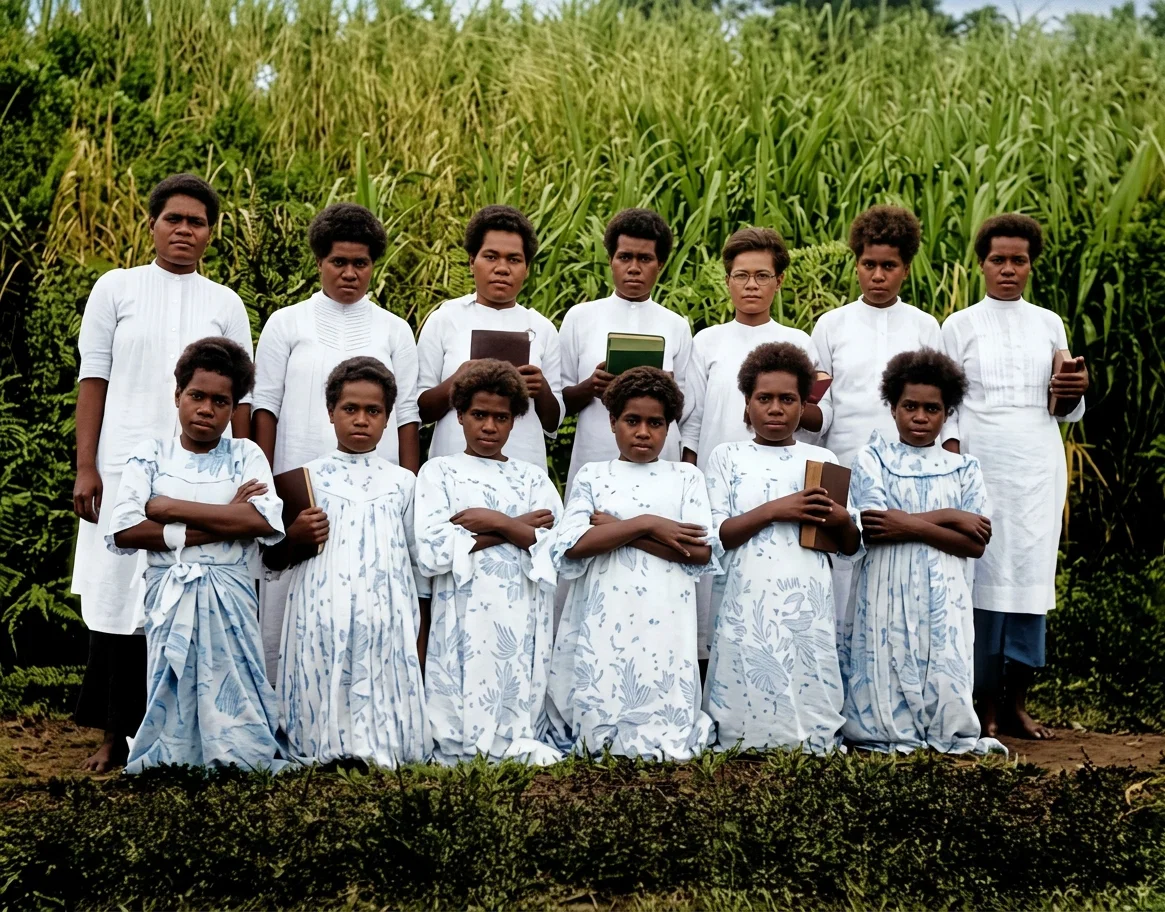
GIRLS AT OUR SCHOOL IN FIJI
The presidents of the conferences who planned my tour arranged for me to give one or more addresses in large halls in the principal cities. In Auckland two addresses were given on Sunday in the city hall. One of these was on prohibition, and the other on the world-wide foreign missionary movement of the last century. In this latter address I was able to give the public some idea of our foreign mission operations. When the war broke out, the Eastern Question and Armageddon were presented. The papers were full of references to both of these questions, but did not make it clear just what either one was. Our announcements to deal with them from the standpoint of the Scriptures, brought large audiences eager for light. Altogether I gave twelve of these addresses in town halls, theaters, mechanics’ institutes, and temperance halls, besides a number in our churches and in tents at camp meetings.
In all my ministry I had never had such opportunities for reaching the public as opened to me in New Zealand and Australia. Somehow the people seemed to feel that we could tell them what all these things mean. Many came to our people for an explanation. As soon as the war broke out, we began to sell a pamphlet, written by Elder Teasdale, on Armageddon. A large number was disposed of in a short time. This experience shows what quick, earnest efforts we may be called upon to make in the closing days of our work.
Our visit to Melbourne was most encouraging. It was in this city that Elders Haskell, Corliss, and Israel first located when they came to Australia in 1885. It was here that the first sermon was preached by our people south of the equator. It was here we printed the first line of literature in the Southern Hemisphere. It was here I had the privilege of making the first public appeal to Seventh-day Adventists in this field, for gifts to establish our printing house in Melbourne. It was here we organized our first conference in this hemisphere, and later organized the first union conference in our denomination. The labor, anxiety, and struggles that go with pioneer work help to make the place where the work is done, and the people who are associated together, very dear to pioneers.
Now in all these experiences we had the association and helpful cooperation of many brethren and sisters who embraced the message at the very beginning of our work in Melbourne. We had learned their value and loyalty, and had come to love them very dearly. When we stepped from the train in Melbourne, we found a number of these dear old friends waiting to greet us. And later, when we had gathered in the large hall in the city for our general meeting, we were rejoiced to see the faces of so many of the pioneers. In our conversation with those we met we found that some of the old believers had passed away, and that a very few had become discouraged and given up the battle; but the great majority were still firm and pressing on.
Our visit to Warburton, where the printing house is located, gave us the privilege of meeting a large number who were but children in those early days, but who are now in charge of the various departments of the printing house. Our public meetings in these places were blessed occasions. Of the printing work I shall speak in another report.
A. G. DANIELLS.
Borrowing Heaven's Livery
THE extent to which worldly sport is willing to go in its effort to minister to the desires of its devotees was recently illustrated in an incident which occurred in Atlantic City, N. J. The authorities prohibited beach dances on Sunday, and ordered that the bands should play only sacred music in the concerts which they gave on that day. Arrangements were made whereby several of the dances were adapted to the tunes of Old Hundred, Rock of Ages, Sweet By and By, etc., and groups of merrymakers danced the tango to these tunes. This verily is borrowing the livery of heaven in which to serve the devil.
The Fear of God
“AMONG the children of God,” said Ruskin, “there is always that fearful and bowed apprehension of his majesty, which is called the fear of God; yet of real and essential fear there is not any, but clinging of confidence to him as their Rock, Fortress, and Deliverer; and perfect love and casting out of fear; so it is not possible that, while the mind is rightly bent on him, there should be dread of anything earthly or supernatural; and the more dreadful seems the height of his majesty, the less fear they feel that dwell in the shadow of it. ‘Of whom shall I be afraid?’”