Your ShelfYour Projects

Review and Herald, Vol. 92, No. 5.

THE INSTRUCTOR
Earlier text: Seventh-Day Adventists and Tithing

The Tanganyika Plateau

One Strategic Point in Central Africa
J. C. ROGERS
It is said by one of the first missionaries from the London Missionary Society to the Lake Tanganyika regions, that this is the center of Africa. He brings a good array of evidence to show that his contention is well sustained. Ethnologically and geographically, he concluded Lake Tanganyika to be the continent’s center. The author of a recent book, “The Great Plateau of Northern Rhodesia,” contends that the center is in the hills some hundred miles south of the lake, where are the sources of the Kongo and the Zambesi.
Recently, while traveling over the hills just mentioned, it seemed to me that here, among these deep, cool watercourses, where, in the early morning, frost is found in July, might well be the middle of the African wilds. On my last trip, ten miles distant, I forded another one of these streams. It runs through what in the wet season would be an impenetrable jungle. In places its depth is surprising; in others, such as my crossing place, it is easily forded in the dry season by removing boots and wading over the rocky reaches in its bottom. Its euphonious name is Mutatoshi. It is a branch of the Kalungwishi, a tributary of Lake Moero and the Kongo. I spent two days along this splendid stream, camping overnight by its banks, and did not hesitate to drink freely of its pure, cool water. I would not do so during the rains, however, without boiling it.
The plateau embraces almost all of Northern Rhodesia, the area of which is not less than one hundred and twenty thousand square miles. Within this, and almost encircled by four lakes, lies the high plateau of forty thousand square miles. The latter appears to me a strategic point for Central African mission work.
At present it is the most difficult place to reach in all Africa. Before the completion of the German East African railway, this difficulty was greatly enhanced. If I say that, except for the new railway, a man requires three months and a thousand dollars to reach Mporokoso with his baggage and some small housekeeping conveniences, you can understand its isolation. In our outfit there was no stove, furniture, nor musical instrument. Our present stove is a few stones, on top of which rests a square of sheet iron obtained here. On this is the big cooking pot, out of which come our boiled and baked articles of food, even pie and cake, when there are sugar and flour to make them. We sent sixty-five miles last week for provisions. A pound of oatmeal costs fifty-five cents, and a tin of dried peaches one dollar.
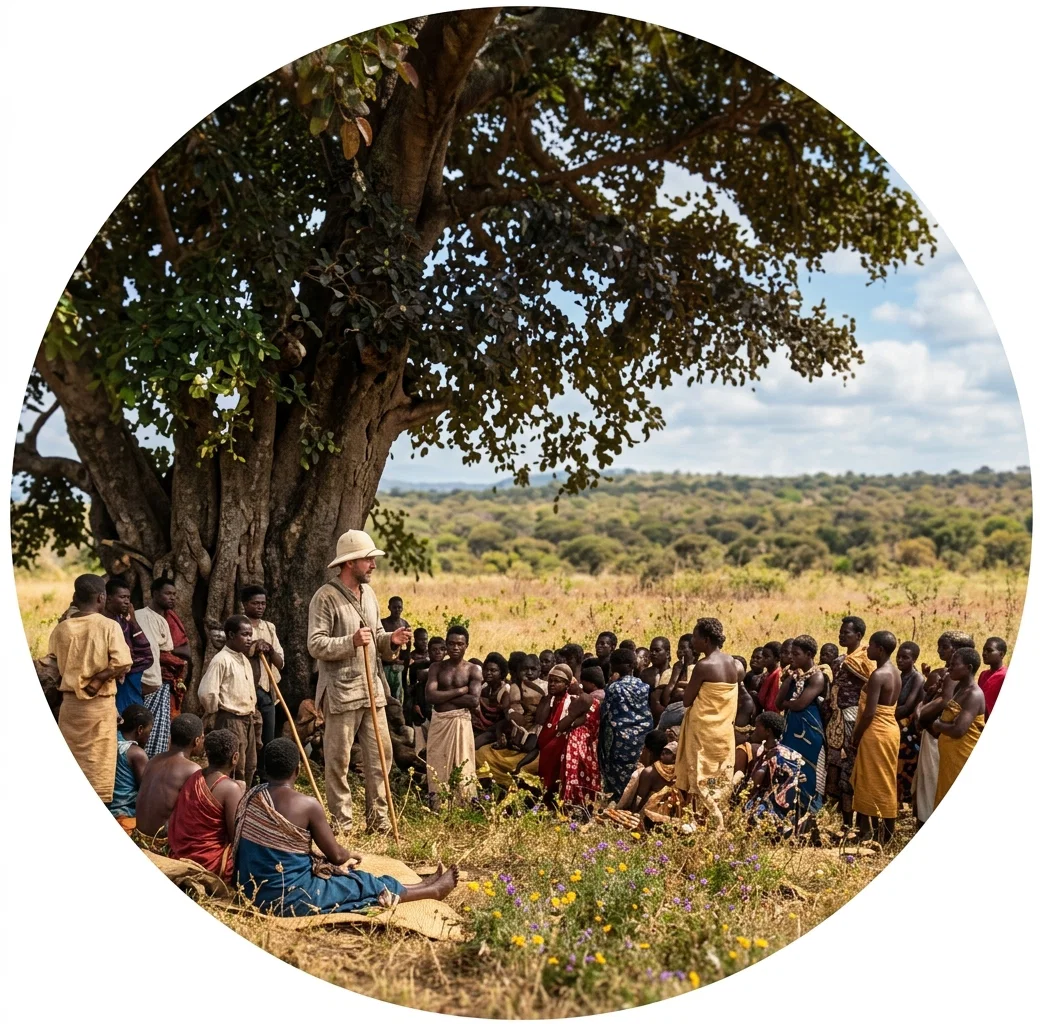
STARTING A SCHOOL UNDER A TREE NEAR MORO-KORO, CENTRAL AFRICA, BY LONDON MISSIONARY SOCIETY
The plateau is the home of many tribes who are only now beginning to “scent” modern civilization and to travel. Some of the venturesome braves go to Johannesburg, Bulawayo, and Salisbury, on the south, and to Elizabethville, in the Kongo State, or to German East Africa, away to the northwest. What they learn of this message they will tell where they go. The means of travel is likely to be rapidly increased. This will also serve to spread the message.
“The climate, in most parts of the plateau, is absurdly healthful for Central Africa.” In this respect it is very favorable for a central station from which the truth can be carried by trained native evangelists. There should be one station well staffed and equipped to give natives a thorough training in the common branches and the simplest methods of caring for the sick. It should have a normally trained teacher, a graduate nurse, a doctor, and a minister. Of course all these cannot be had at once, but this must be the plan. And how small a staff is this compared with, say, an academy at home.
THE LONDON MISSIONARY SOCIETY HOSPITAL AT KAWIMBE,
TANGANYIKA PLATEAU REGION
THE LONDON MISSIONARY SOCIETY HOSPITAL AT KAWIMBE, TANGANYIKA PLATEAU REGION
We are locating near the western boundary of the great paramount Awemba tribe, who were powerful and populous in the days of Livingstone. “We passed through the inner stockage and then on to an enormous hut, where sat Chitapankwa, the Wemba king, with three drummers and ten or more men with rattles in their hands. . . . I declined to sit on the ground, and an enormous tusk was brought to me. The chief saluted courteously.” Livingstone adds later that the tusk on which he sat was sent after him, in addition to his present of a cow, “because he had sat on it.” Giraud passed through the Wemba country twenty years later. He mentioned his inability to return a suitable present, on account of the insufficiency of his goods, for the magnificent presents of the king, Chitimukulu. The interpreter came back with the following message: “Chitimukulu is a great chief, and gives of his bounty without thought of recompense,” which words, so unique from the lips of an African chief, “are worthy,” says the enthusiastic Giraud, “of being inscribed in letters of gold.” The above items are from the book mentioned in my first paragraph.
Two other important tribes are not far from our proposed site, the Alungu and the Washinga. I have seen the local chiefs of these three tribes. They are quite friendly, though they know but little of our faith as yet. One of them called at our home yesterday, with two other local headmen. While we are waiting to select our definite mission site, on account of the military situation, we are becoming acquainted with the people, and with their language, which we are studying. As the grammar is practically the same as the Chinyanja, which we know, and the new dialect will not be so difficult.

A New Group of Mission Fields

N. Z. TOWN
At the recent autumn council of the General Conference, A. J. Haysmer presented a request from the Central American Conference and the Guatemala Mission, which include the republics of Guatemala, British and Spanish Honduras, and Salvador, that they be separated from the West Indian Union Conference and placed under the direct supervision of the General Conference. This request was made principally because there is a much more direct and quicker communication between these fields and the States than with the West Indian Union headquarters. After considering this question the General Conference Council took the following action:—
“Voted, That we concur in the suggestion from the West Indian Union, and grant the request of the Central American Conference and the Guatemala and Salvador Missions, taking these fields under the direct supervision of the General Conference until some plan of organization of the Northern Gulf Spanish fields may be perfected.”
By a former recommendation of the General Conference Committee the islands of Cuba, Haiti, Santo Domingo, and Porto Rico also came under the direct administration of the General Conference. This separation was accepted by the West Indian Union Committee at its last meeting in May; and these detached fields, together with Mexico, are now grouped together as follows:—
POPULATION
Mexico ........................ 15,063,207 Guatemala ..................... 1,992,000 Honduras ...................... 745,136 Salvador ...................... 1,710,000 Cuba .......................... 2,150,112 Haiti ......................... 2,500,000 Santo Domingo ................. 610,000 Porto Rico .................... 1,118,012 Total ........................ 25,888,467
At the end of 1913 these fields had a total of 876 Sabbath keepers, divided among the fields as follows:—
Mexican Mission ................ 285 Guatemala Mission ............... 18 Central American Conference ..... 147 Cuban Mission ................... 113 Haitian Mission ................ 275 Porto Rican Mission ............. 38
The total tithe paid during 1913 amounted to $7,411, and the total literature sales during the year to $19,800. There are in these fields nine ordained ministers, six licentiates, eighteen licensed missionaries, and twenty-three colporteurs, making a total of fifty-six laborers.
We are hoping that the uniting of these fields will result in a more rapid progress of the message among the 25,000,000 people within their borders. As Spanish is the language used in all this group except in Haiti, special efforts will be made to reach those of this tongue, both with our literature and through more direct evangelistic efforts.
If the following quotations from Frederick Palmer’s book entitled “Central America and Its Problems,” published in 1910, are true, the needs of these fields should appeal strongly to our young people who are preparing for work in mission fields. Mr. Palmer says:—
“Why do so many missionaries go to Japan, China, India, Turkey, and Korea, and so few to Central America? They are as inconspicuous in the country between the Guatemalan border and Panama as they are conspicuous elsewhere.
“Mention Central America to the missionary in Mexico and he looks blank. You almost expect him to ask where Central America is. It seems a wilderness to the missionary, and the absence of missionaries in numbers is deplorable. . . . For every one in Japan, that learned progress for itself, and in China, that is learning for itself, there ought to be a hundred in this field at our door, that cannot learn for itself. . . .
“Of late the American Bible Society has shown some interest. In 1908 its colporteurs distributed 2,425 Bibles in Central America and Panama, exclusive of Nicaragua, from which they were barred by Zelaya. On the Nicaraguan coast the German Moravians combined evangelization and rubber trading in such a way that Zelaya allowed them to remain. . . .
“In Guatemala, Honduras, and Nicaragua the priesthood has fallen into the lowest state of any countries in Christendom not in the Caribbean region. It has neither political power nor religious power of any account. All the glowing reports of progress which are sent to the United States indicate a desire to be in style. When the dictator tells you that school attendance is compulsory, he is being polite.
“Meanwhile, the missionaries look past the fields thick with ignorance and unbelief [where at least 80 per cent are unable to read a line of print], to China and India and Africa, where the missionary teaches everything from hygiene to morals—everything that Central America lacks.”
We believe that the harvest is ripe among these people. In Mexico, Cuba, and Porto Rico our colporteurs have found very fruitful fields for our literature. Some of the best records ever made by any of our colporteurs have been made in these fields. We believe that the same experiences await the colporteurs who are willing to enter the unworked fields of Central America. We shall be glad to correspond with any of our young people who feel drawn toward this neglected portion of our great world field.

Australia

J. E. FULTON
Our union conference in September, 1914, was by far the largest gathering ever held by Seventh-day Adventists in Australasia. About 250 tents were pitched for the accommodation of our people, and as no more tents could be procured, many took rooms; a number of brethren who lived near also attended.
A ministerial institute was held prior to the union conference. This was well attended, and was appreciated by our workers and others who were present.
We were highly privileged in having Brother A. G. Daniells with us. He labored incessantly throughout the institute and conference. God certainly gave his servant sustaining grace. His labors were greatly blessed to the help of all. We were glad also to have Sister Daniells with us. She has many friends in Australia. We are sure some credit is due her for the success of our meetings, because of her tact in arranging periods of much needed rest for Brother Daniells, without which it is certain he could not have stood the strain.
Most of our ministerial force from all the conferences attended both the institute and the conference. While our conferences felt the loss of the workers for the time, and the expense was great, yet this will no doubt be more than made up by the increased efficiency of the laborers which will result from the substantial help and inspiration obtained while in attendance at the meetings.
Missionaries were present from New Guinea, New Hebrides, Norfolk Island, Fiji, Tonga, the Cook Islands, and the Society Islands. The Australian aborigines and the Maoris of New Zealand were also represented.
Reports have come to us from Brother and Sister G. F. Jones, who recently opened work in the Solomon Islands. They have made good progress with the language, and calls are coming in from the natives for work to begin among them. This is indeed very encouraging.
The war had recently broken out, and it was feared that some of our missionaries might be detained on their journey to the conference, but all arrived on time and in good health.
For some time we had received no word from Brother Howse, of Samoa; but finally a steamer risked calling there, and brought word that our missionaries were well, and that Samoa is now a British possession.
The war has created a deep impression upon the minds of the people of this country. Many are volunteering for active service at the front,—the very best and strongest of the country's young men. Troop ships, convoyed by Australian and Japanese war vessels, have taken thousands to the seat of war, and large numbers are still eagerly offering themselves for enlistment.
In business and financial circles a wave of depression has swept over the country, and many have been thrown out of employment.
A rising tide of missionary enthusiasm characterizes God's people throughout the field. A keener realization of the nearness of the end has come upon us, and I feel sure there is a disposition on the part of all to arise and finish the work.

Make Housework Easy by Making It Simple

THERE are two principal objects in housekeeping, or home making: First, to supply a place in which the necessities and comforts of life may be enjoyed; and second, to furnish a school in which the inmates obtain a training and preparation for a future home of splendor with heavenly beings. It is here that character is formed.
Leaving out of the question the stamp given to character in prenatal life, the atmosphere of the home exerts the greatest influence upon the child’s life, the school coming next in importance.
The building of a character has been very beautifully compared to that of a house, each act and thought of daily life to the bricks which are placed one by one upon the wall of the rising structure.
While the first object mentioned is necessary, the second is no less important. Then, since time for this work is the chief obstacle, it appears that a study should be made by the mothers of how they may simplify their work so as to gain this time. Therefore, the subject of how to simplify housework may properly be considered an important topic for mothers to discuss.
Physicians who treat disease by the rational methods, tell us that in many cases of illness, instead of urging the patient to eat more he is advised to eat less, and a smaller variety of food, because the overwork of the digestive organs is what has brought on the illness.
Now let us think for a moment what it is that has caused us to overwork. This may not be true of all, but is it not dress that causes most mothers to be so busy? Was there ever a time in the history of the world when dress and the changing fashions absorbed more time among the masses than now?
There are many other things equally superfluous in housekeeping that will appear when we compare the simple mode of living in the early days to that of the present; or the simple life today among the people of the East with our own complicated customs. In the present generation housekeeping has become so intricate that the mother of two or three children must constantly have her nerve and muscle on the stretch to meet the demands of the family needs.—Selected.

“School of Mothercraft Offers New Profession for Women”

MRS. C. C. LEWIS
The above is the title of an article which recently appeared in the Washington Times. While we are thankful for philanthropic men and women who seek to improve conditions and to uplift humanity, we recognize with regret the cause for such a school as this. In this and other omens we see the home is failing to do its God-given work. It is failing to create in the rising generation a love for the home and the home duties.
Miss Mary L. Reed, of New York City, the founder of this new school, was recently in Washington, conferring with the officials of the Bureau of Education. She succeeded in convincing the physicians and educators of the practicability of such a school, and in getting it into successful operation, so says the Times.
Miss Reed very fittingly reasoned, if universities can appropriate money to educate men to feed pigs and raise corn, why not establish an institution to train girls to feed and care for children, and properly perform other home-making duties?
The following from the Times gives the course of study, and describes more fully the requirements of the school:—

“Has Resident Nursery”

“A resident nursery affords the opportunity, a fundamental part of the school, to live with and study children. Girls must be eighteen years old and have a high school course or its equivalent. They spend eight hours in class work, and fifteen hours in doing the things that are taught from books or lectures. They prepare the food for the children, they are told how to entertain them with games and stories, how to walk with them, to talk to them, and to discipline them.
“Education about the child, with the home as a background.
“Preparation for the profession of the unexpected, which housekeeping is above all else.
“Acquisition of skill by doing.
“These are epigrams which describe the school.
“It is not a school of home economics, because home economics deals specifically with the mechanics of the home.
“It is not a modern kindergarten which is formal and artificial, but it goes back to the original Froebel idea of learning directly about the things close to everyday life.
“Three women teachers are resident,—the director, a kindergarten assistant, and a school physician. The others are trained instructors and lecturers who come from the outside. The special subjects of study include the following:—
“The Family; Its Psychology, Sociology, Ethics.
“Biology; Eugenics.
“Physical Care of Infants and Young Children.
“Child Hygiene and Physical Development.
“Dietetics, Children's Cooking, Laundry, Sewing.
“Marketing, Housewifery, Accounts, Management.
“Home Care of Sick Children, Emergencies.
“Hygiene for Mothers.
“Child Psychology and Mental Hygiene.
“Principles of Child Training and of the Kindergarten.
“Children's Stories, Games, Songs, Handwork, Nature Study.”
Not only does Miss Reed provide training for the girls, but she has other courses for busy mothers who did not have the benefits of good home training before these responsibilities were thrust upon them in their own homes. She says: “Girls of today have no opportunity to get any instruction in home problems, because they are away at school until they are graduated, and then they either put in a period at work, if they are poor, or if they do not have to work, society robs them of any chance to become trained in the lore of the mother.”
Every Christian woman should seek in her own home to emulate the noble example of Miss Reed, and make her home a real school for home makers. There are many new professions open to women today, but in none of them can she shine brighter, or serve God and humanity better, than in the old profession of home making.
Speaking of a home maker, the wise man says: “Many daughters have done virtuously, but thou excellest them all.”
“Her children arise up, and call her blessed; her husband also, and he praiseth her.”

The Flight of the Years

TIME speeds away, away, away. Another hour, another day, Another month, another year, Drops from us like the leaflet sear, Drops like the lifeblood from the heart. The rose bloom from the cheeks depart, The tresses from the temples fall, The eyes grow dim and strange to all.
Time speeds away, away, away. Like torrents in a stormy day, He undermines the stately tower, Uproots the trees, and blasts the flower. He tears from our distracted breast The friends we love, the friends that blessed, And leaves us weeping on the shore, To which they can return no more.
Time speeds away, away, away. No eagle through the sky of day, No winds along the hills, can flee So swiftly or so smooth as he. Like fiery steeds, from stage to stage, He bears us on from youth to age, Then plunges in the shoreless sea Of fathomless eternity.
— Selected.

Conducted by Mrs. C. C. Lewis, Takoma Park, Washington, D. C

Through the columns of this department, hints will be given on all matters pertaining to the home life. Short articles and letters are solicited from home makers, telling of their everyday experiences,—their joys and sorrows, their failures and successes.

MRS. VINA SHERWOOD-ADAMS

Our Little Table, and How It Solves Some Home Problems—No. 4

MRS. VINA SHERWOOD-ADAMS

I HAVE planned to give our mothers some more work to do for their children; not because I feel they have too many idle moments on hand, but because all that we can do for our children is so little in the fleeting years of childhood. Yet how deep is the influence of what seems to us only a jot here and a tittle there, when all is summed up in the man, the woman!
I wonder how many mothers had the happy privilege of making mud pies when they were children. I remember the mud marbles, birds' nests, etc., I used to form out of clayey mud, and how mother would sometimes let me bake them in her real oven. But I think she would have hailed with joy “modeline,” the perfect substitute for mud, without the accompanying soiled clothes.
It is of some of the educative uses of modeline that I wish to write. It is a pliable substance, nonpoisonous, antiseptic, so that no germs can exist in it. It may be used several years. Should it become dry, work a little vaseline into it, and it will be ready for use again. It may be obtained from the Novitas Sales Company, Waltham, Mass. Write them for catalogue.
Once again, mothers, come with me and surround our little table with the children. You may take position by folding your hands, while I tell you a story about the dearest little baby boy. He lived in a little cabin by the river-side, with his father, mother, brother, and little sister Miriam. It was a secret known only to the family that a boy baby was in their home. The brother Aaron and sister Miriam were very wise and trusty children; for they never once told any of the neighbor children the secret in their home. How should we feel if we had a little boy baby in our home? Yes, we should want every one to know the happy news. But suppose some one had told us that all the boy babies were to be thrown into the near-by river, how should we feel then? Such word had been brought to this little cabin home by the river. A cruel king, who did not love God but worshiped the great round sun, praying to it each day, had sent out word that all boy babies belonging to families loving the true God should be taken away from them. Now, can you tell me why Miriam and Aaron guarded their secret?
Three long months they had hid the baby, never daring to take him out in the warm sunshine; yet the baby grew, and was now so large they feared they could hide him no longer. The family were very sad. As the mother looked in the dark eyes of her baby, she felt impressed that God would somehow care for her child. It seemed to her that God might need her boy to do a great work for him some day. Who do you think caused her to have these comforting thoughts? As she thought and prayed about her baby, she decided to put him wholly under the Lord's care. So she began weaving a little basket. Then she plastered some pitchy mud all over the outside until every little opening was covered. Inside, she put a soft lining. When all was finished, she tenderly clasped her baby in her arms a moment, then laid him in the basket.
Can you think with what interest the little sister Miriam watched her mother? The mother and little sister walked down to the river's brink, and, parting the tall, grass-like reeds that grew in the water, the mother placed the tiny basket boat right down in the water. Can you tell me why the mother covered the basket so carefully with pitch? The mother told Miriam to stay near by and watch what would happen to the baby. She was not to go to the baby; for the mother wanted him left out there under God's care. The mother then returned to the house. Miriam watched for some time. Though she grew tired crouching there among the reeds, she did not complain nor run away to her play. At last faithful Miriam saw some one coming down to the river. It was the daughter of the cruel king, with her two maids. Will this woman see the basket? If she does, will she tell her father, the cruel king? Such thoughts may have been in Miriam's mind; and tomorrow we shall learn what really happened to the baby boy.
You have been very quiet children, and now you may stand a few moments, while I pass you some materials. (A thin molding board, eight by ten inches; two liberal lumps of modeline, and a molding tool are passed to each.) A mirror is then placed in the center of the table. You may now be seated and take position.
From the modeline we mold the little thatched cabin where the babe lived. Then the reeds, which almost hid the cottage from the river, are made. Next we model the mother, Miriam, Aaron, and the babe. The father is away making brick. Now the little basket is formed, ready to be carried by the mother and Miriam, who will place it among the reeds, and the sister will hide near by to watch. The one having the best basket is allowed to place it on the mirror, which is our river, and each child contributes enough of her best-modeled reeds to form the marshy appearance of the river. The reflections in the glass make it all seem very real to the children.
“It is all very well for one who is an artist to teach children how to mold from modeline,” you say; but just let me whisper to you that it really does not require an artist to teach children how to model. They will be their own artists. Do you remember how with a few hints from mother you let your imagination run far ahead of her suggestions in making mud pies, cakes, etc.? Just so will the imagination of children outdistance the best hints even an adult artist can give, while molding with modeline. There are a few general rules to follow that must be left until another time. Send for some modeline, and be ready to carry them out.

The Lonely Child

I LIVE with auntie on the farm. She's nice as she can be; She says she means to do as well as she knows how by me. She bids me think if I've been good, she bids me say my prayers; And then she takes the light away, and leaves me here upstairs. She does not tuck the covers in, nor pat me on the head, The way my mother used to do before that she was dead.
And auntie says she never dreamed of bringing up a child; She hasn't any of her own, and children drive her wild. I try to be as still as still, and help her do the chores; And when I really have to cry, I slip away outdoors, Then wash my eyes out in the brook to take away the red: They never used to get that way when mother wasn't dead.
I think of how we used to go and take the loveliest walks, And just before I went to bed we had the sweetest talks. It was so dear to cuddle in the hollow of her arm, I never used to be afraid, nor think of any harm; And O, the songs she loved to sing, the stories that she knew— I wonder if God needs the mothers more than children do?
—Emma A. Lente.

Follow Christ

WOULD you follow Christ? Then follow him in self-denial, in humility, in patience, and in readiness for every good work. Follow him with a daily cross upon your back, and look to his cross to make your burden light. Follow him as your guide and guard, and learn to see with his eyes and to trust in his arm for defense. Follow him as the friend of sinners, who healeth the broken in heart, and giveth rest to the weary souls, and casteth out none that come unto him. Follow him with faith, resting your whole acceptance with God, and your title to heaven, on his meritorious blood and righteousness. Lastly, follow him with much prayer. For, though he is full of compassion, he loves much to be entreated; and when he is determined to give a blessing, you must yet wrestle with him for it. Thus follow Jesus, and he will lead you to glory.—Bogatzky's Treasury.

“El Atalaya” and the Colegio Adventista del Plata

The name of our missionary paper is El Atalaya (The Watchman). Shortly after the outbreak of the war in Europe, special war numbers of this paper were published.
The school and the sanitarium decided to dispose of ten thousand copies. As we live in the country, nine miles from the nearest village and thirty from the nearest city of any size, sufficient territory for an extensive campaign of this nature is not easily accessible. For this reason it seemed necessary to spend a whole week in the effort. Miss Meda Kerr, our preceptress, and four of the girl students, with a similar company from the sanitarium, went to Santa Fe, the capital of an adjoining province, where they disposed of about three thousand papers. Another company, consisting of three boys and the writer, went to Victoria, a city of considerable size in the province of Entre Rios, where over five hundred papers were disposed of in about one and one-half days. A little later a much larger company canvassed Paraná, the capital of the province of Entre Rios. In all, the school disposed of nearly four thousand copies. The people were found to be intensely interested in the war, and were ready to listen to what we had to say.
Many of the pupils received their first experience in this effort, and some entered the canvassing work this summer. The accompanying picture is a group of all those from the school who took part in the campaign. Although the effort cost some sacrifice, we feel that it was a grand experience for our pupils, and we want to try it again sometime. H. U. STEVENS.
STUDENT CANVASSERS IN ARGENTINA

Wisconsin

ANOTHER year has passed, and its records are closed. We have entered upon a new year of opportunities and privileges. Great events occurred during the year 1914, and it has gone down in history as the eventful year of the nations. Continued progress has been made in gospel work, and the opportunities were never more favorable for a forward movement than at the present time. We know not what a year may bring forth, but the record will be made of progress or failure as one by one the days pass by. However, we do not expect failure, and therefore make no provision for it.
Wisconsin is one of our oldest conferences , being among the first that were organized by Seventh-day Adventists. The conference has passed through varied experiences, rising at times to the pinnacle of prosperity, then reversing to the verge of insolvency. Still the Lord has not cast off his people, but bears with them, leading them out of mistakes into the right way as they follow on to know and to do his will more perfectly. We are now in one of the convalescent periods of the conference, and the symptoms indicate complete recovery. The process has been moderate but sure. During the last four years the sanitarium debt has been reduced from $64,000 to about $50,000, and now $30,000 has been raised in pledges to apply on the debt, and nearly half of this amount has been paid, and the remainder is forthcoming. The tract society indebtedness, which was about $3,000, has all been paid, the last remittance having been made last month; and if any one person deserves more credit for this than another, it is Miss Mabel Cutler, a former secretary and treasurer. Other debts have been paid, and payments will be continued until all indebtedness is liquidated.
The Bethel Academy has fallen behind considerably, but definite plans will be formulated at the annual meeting of the auditing committee, to raise the money this year to clear away that encumbrance.
The students who are back on tuition from one to five or more years, would help very materially if they would settle their accounts this year. We shall be advantaged several thousand dollars by the payment of a will to the conference this year, and that will be appreciated in this time of need.
We have not raised the amount requested for missions, but the amount paid in for 1914 is considerably more than that of former years, and over $5,000 has been pledged on this fund to be paid during the first half of 1915. The tithes and offerings are increasing, for which we all are thankful, and hope for larger amounts as the months go by and others are brought into the fold.
A large number of workers have gone forth to different fields from Wisconsin since the organization of the conference, and a great many have been brought into the truth who are remaining by the “stuff.” The reports show 148 new Sabbath keepers and 55 baptisms for the year ended Dec. 31, 1914. Two churches were organized, and one large company of believers. The publishing work compares very well with former years, and is much better than some years. All departments of work are prospering, and the people are of good courage. More home missionary work is being done by our churches than ever before, and results are encouraging. The prosperity which we are able to record is not due to any one person, nor to committees and boards alone, but to the activity and cooperation of all the believers in study, work, and prayer, and to the blessing of God. The Lord’s people sow the seed, but he gives the increase. When the debts of the Wisconsin Conference are all paid,—and they should be in one or two years more,—more work can be done both at home and abroad to advance the cause of the third angel’s message and help to finish the work.
I have enjoyed my work in Wisconsin during the past four and a half years, and the association with the members of this conference has been pleasant. Mistakes have been made, but we have endeavored to do what we believed was for the best interests of the Lord’s cause, and he has blessed our efforts, for which we are thankful. No doubt more might have been accomplished, but to the Lord be all the praise for the progress made. The circumstances make it advisable for me now to take up work in the Upper Columbia Conference, but I shall not lose my interest in my old home conference. I appreciate the counsel and support the workers and the churches have given me in this conference, and I trust the same may be given my successor, Elder P. A. Hanson, from the Upper Columbia Conference.
The work is one the world over, and it matters not where we are, only that we are laborers together with God. So may it ever be with us all is my hope and prayer.
W. H. THURSTON.
Continue reading: The General Meeting at Albany, N. Y