I THINK that no one can place too high an estimate upon the value of well-organized and constantly continued efforts for our young people. We have already taken steps in this direction with the young people in Paris, and the results are immediately visible. They attend our meetings, assist us in bringing souls under the preaching of the Word, and are putting themselves in line for self-discipline. Last summer, following our camp-meeting, I was called to try to perfect a reconciliation in a church of about seventy members in French Switzerland, where only three or four attended Sabbath worship, so deeply had Satan done his work. I began through the young people, and after a week the Spirit of God had made a complete reconciliation, and as a result the impetus given to the young people continued, they organizing a Young People's Society. The news spread to the other churches, and immediately Young People's Societies were formed in almost all the French-Swiss churches. The only thing I regret is that I can not untie myself long enough from the union affairs and from the local evangelization in Paris to give the young people the help they should have.
As to Plans
A very encouraging thing about work with the young people is that it does not take long to form them into line and to get them to work. In my experience I have found that even a week or two in a church is sufficient to get them in favor of the movement, and organized to continue faithfully in it, with the help of the church officers. On account of this I think that your central committee ought to have a man who occupies himself entirely in supervising and urging forward this work. He could see that the States are organized, or assist them in doing so, and help them along when organized. He or the State officer could visit the churches lacking in this organization, and after a time, indeed a short visit with such churches, set them in running order. When I was connected with the Young Men's Christian Association, I realized how great was the value of the general or State man in the local work; and also the same thing in the Young People's Society of Christian Endeavor. Perhaps you have just such an arrangement, and so my remarks here are not in season. The general secretary asks me for plans of missionary work, and also for supplementary exercises for the meetings of the Societies. I will suggest the following, having participated in their successful operation either in America or in this country:—
Plans of Missionary Work
Activity is the keynote of ideal Societies. As I will suggest in the supplementary exercises, if the meetings of the Society are themselves well conducted, they will serve as a great means in bringing the message to the world in this generation. To this end let good committees be formed in the Society, such as an Invitation Committee, to invite and bring in people to the Society's meetings; and a good Reception Committee, to receive and look after all visitors. These committees should be trained to do personal work with the strangers.
Let the Societies put aside certain days to visit the hospital in their neighborhood, perhaps once in two weeks, once a month, or once a week, according to the circumstances. Let them on this day bring flowers to the sick, which is always permitted, sing if that is permitted, and then select certain favorable cases to follow up with visits in reading the Bible, or even more serious Bible studies. We had a remarkable case of conversion, and later full acceptance of the truth, in our field from this line of work.
In cities or localities where we have a hygienic restaurant or mission let the Society choose a certain night, Saturday night I have found preferable, in which to arrange a missionary raid. That is to say, prepare a little feast of hot coffee and sandwiches, and visit the saloons or hotels to invite men to a lunch and Bible study. Then let personal work be done after the meeting has been held. I have seen and assisted in the doing of this with and without the lunch. Great care, however, in this plan is necessary, especially when the lunch plan is added.
Supplementary Exercises
In churches where the material at disposal is solid, let the elder sometimes turn over to the Young People's Society the morning worship on the Sabbath. Then let a text be given to three young people, who are to develop this text in spiritual edification to the church, the elder taking good surveillance all the time of the proceedings. Say, for example, the text is, “Now all these things happened to them for ensamples; and they are written for our admonition upon whom the ends of the world are come.” I Cor. 10:11. Let the speakers each develop one division of the subject as given below:—
Sins of the Israelites, and the lessons therefrom.
The relation of these events to the time of the end.
Special lessons that the ensamples should give to God's people living in the “time of the end.”
Let these three talks be interspersed with prayers and hymns; and let those who pray be asked previously to do so, that no time be lost. I thank God for the successful operation of this plan in building up the spiritual life of the church and developing spiritual and capable young people. But if there is not a good elder to guide this plan, it is better to have it carried out in a meeting of the young people direct.
The assignment of papers on a given subject to the young people is a well-known plan. In this case the study of the lives of missionaries who have laid down their lives for the cause of God in foreign fields is an excellent course of study, and one much needed.
If the Society can choose a critic competent enough, then let the young ladies for one time prepare a Bible reading on a subject, say Faith. Let these readings be placed on a blackboard in the public assembly of the Society, and let the leader chosen draw out the lessons from the readings, at the same time comparing them and pointing out the possible places of improvement. This I personally have found a never-failing source of interest and instruction. The young men can prepare the reading for the next time.
In some of the Societies in this field much benefit to the work has been secured in the education of the Society in musical lines. If a person capable of taking charge can be found, let the Society meet to learn sacred music. Especially where public meetings are carried on, this is a great help; but care must be taken not to allow a worldly element to enter in.
An unfailing source of interest and spiritual growth to the young people is the study of surrounding objects in the light of the Bible. Let, for instance, the Society choose for the study of the week following, the subject of “trees.” When the hour comes, if it is good weather, let the Society go out under the trees. Here let the leader call for texts and thoughts. What a revelation is here!—the tree, the place where Adam took what was not his own, thus becoming a thief and making necessary the plan of atonement for us who are his children,—the tree, where our Saviour was crucified,—the tree, around which we shall all assemble in the kingdom of God to eat of its fruit.
Of course all recognize from experience that the best of plans miss their mark if the “man behind the gun” is not a good gunner. But I am thoroughly convinced that the Young People's Societies of the United States is the soil where a great and mighty movement can be developed to do work for the spread of the message. I believe that in these Societies in the local church a development can be given in some practical lines much better even than in the schools. And a little thought will show that if much effort is expended on the young children in the Sabbath-school work, the children now grown older should not be neglected at the critical moment when they are in the deciding period of their life. If I was convinced of this when I left America, I have been doubly convinced of it since I have been on the mission field, and have recognized the facilities and material which are at the disposition of those who “remain by the stuff.”
B. G. WILKINSON.
It Would Bring a Second Pentecost
This is what Elder W. C. Wales, who is using the Family Bible Teacher in his work at Knoxville, Tennessee, says:—
“Dear Brother: I was very glad to get your encouraging letter. . . . With two churches and seven hundred families to look after, I am much pressed for time. I am of excellent courage in the work. It is a grand work. Hundreds seem to be interested. Many say these readings make the truths of the Bible plainer than anything they have seen before. O that all would arouse and use these seeds of truth! It would bring a second Pentecost. We use about one thousand or more here a week. It wakes everybody up. I am glad that this work is now on a broad basis.
“Yours at work,
“W. C. Wales.”
We are sure that all will agree that Elder Wales is certainly “at work.” But is this not as it should be? Think, brethren, of what might be accomplished if every worker and church would take hold of this plan of work with a corresponding degree of energy. All who give the Family Bible Teacher a fair trial are unanimous in its praise, as being the grandest method ever adopted for teaching the third angel’s message to the masses. The Lord has pronounced this house-to-house work the grandest missionary work in which we can engage. Brother, sister, would you like to experience a second Pentecost in your own soul, as well as to bring the truth to your friends and neighbors? If so, try this house-to-house work with the Family Bible Teacher. For plans of work, or discount in quantities, address your State tract society, or the Southern Publishing Association, Nashville, Tennessee.5
Comrades, True
Dear little boy, with eyes of blue,
Sweet little laddie, with locks of gold,
Deep is the love that I have for you,—
Deep is the love that for you I hold.
What would this world mean to me, my sweet,—
What would it mean if no sunny light
Shone from your eyes, and no dimpled feet
Wandered beside me, through vistas bright?
You and I, little one,—comrades true,
I am your teacher, but you are my guide;
Thus may we wander ’neath skies of blue,
Onward together, love, side by side.
When, with your trusting hand clasped in mine,
We two go faring o’er life’s rough strand,
Then does my heart fill with joy divine,
Led by the strength of a little hand.
Cause of the trouble as indicated in the prophetic woe.
The words of the text are so well chosen, and carry with them such force, that it might be best to urge all members to bring “Great Controversy” to the meeting, so that each one may follow carefully the study as one, previously appointed, reads the lesson aloud.
“Handsome Is That Handsome Does”
SUSIE GREY, a bright, pretty girl of ten years, came running in from school full of excitement, and said: “O mama, mama! what do you think I heard to-day in school? The very funniest thing!”
Mama expressed curiosity, of course, and Susie went on to tell of an old gentleman who had called at the school with one of the trustees, and made the children laugh with funny stories of his foreign travels.
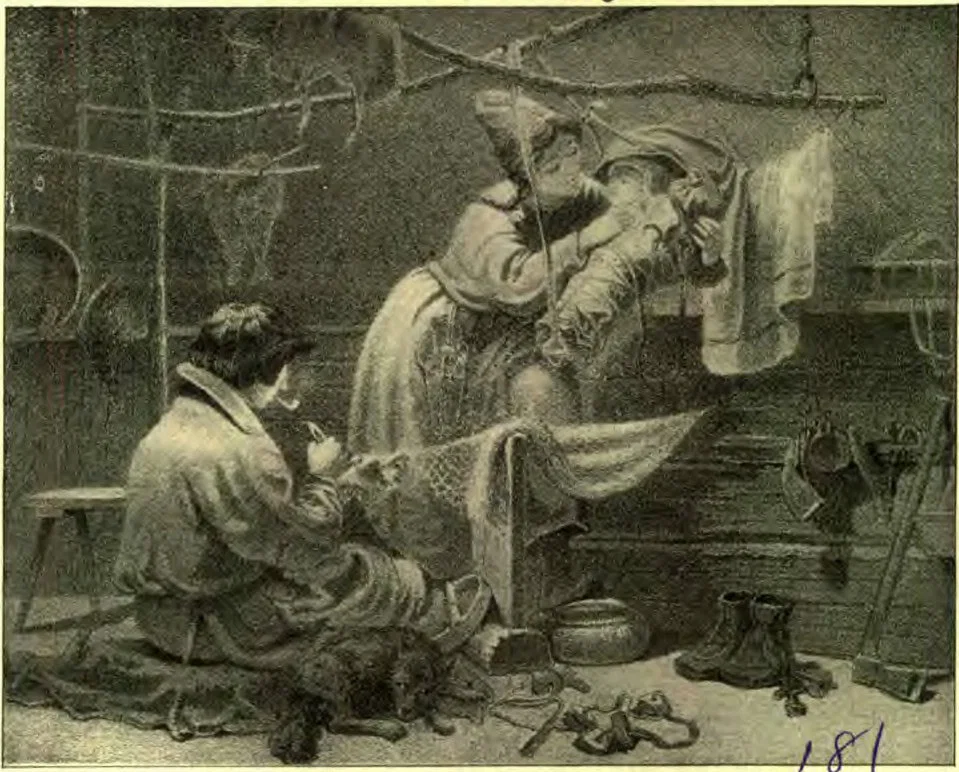
A HOME IN LAPLAND
“And then,” continued Susie, “he said the oddest thing: that he was to remain in this village one month, and before he went away, he meant to make a present to the handsomest girl in school. He said he had known people to grow very handsome in a month, no matter how plain they might have been before, and he would give us all an equal chance. Isn’t it an odd thing to do, mama? But, dear me,” thought Susie, complacently, “I know I’m the prettiest girl in this place, and I don’t believe a month or a year will start any girl ahead of me.”
Susie walked to the mirror as she spoke, and viewed her reflection with evident satisfaction. Mrs. Grey’s eyes lingered long and lovingly upon the little daughter who was indeed the prettiest of all the village children. But she lacked the brightest and best jewel of all, the “ornament of a meek and lowly spirit,” and it would have been hard to find a vainer, more thoughtless little girl than Susie, though neither her mother nor she seemed conscious of the fact.
Of course the old gentleman, of whom Susie had told her mother, was the subject of much eager discussion among the young and old of the village.
It was laughable to see the various arts which some of those little schoolgirls resorted to in their endeavors to improve their complexions and increase the growth of their hair. Vain mothers encouraged vainer children to such efforts, while parents of the wise sort reproved and restrained the nonsense as well as was possible under the pressure of the promised prize.
Susie Grey, however, save that she devoted more time to brushing out her beautiful hair, and to the contemplation of her still more beautiful little face, did not give herself any trouble concerning the winning of the prize.
But one little girl, whose parents were poor, Madge Nuderwood, knew well enough that a prize given for beauty would never be placed within her hand; for the small glass over mama’s little bureau told her every day in the plainest of language, “Madge, you are a very plain little maid! Your skin is rough, your complexion muddy, your eyes are not like stars, and your hair, instead of hanging below your waist in beautiful profusion, is only short and disorderly like a boy’s, flying about over your forehead, and often looking as though a brush had never touched it.”
Madge’s father was ill, and most of the time confined to his bed. Her mother was feeble, and two little ones, of four and six years, claimed attention from Madge when home from school. She was an affectionate, earnest-hearted little girl, doing the best she could to help her mother and father, and amuse and take care of the “baby.” If the prize had been offered for study, possibly Madge might have felt encouraged to try to win it; for all the school knew her to be a bright, ready scholar. But for beauty! Ah, no! no chance for little Madge Nuderwood.
The month was rapidly passing away. To Susie Grey, however, it seemed to drag, and to Madge—studying hard at school, and working busily at home, with no time for the play and sport which are the right of childhood—it seemed to fly; to the other children it was proving a season of disquiet and worry, and at last the mothers wished heartily that the queer old man and his queerer proposal had been in the Rocky Mountains instead of this village.
“The month is nearly up, Madge Nuderwood; the month is nearly up,” said Susie one afternoon as school was dismissed. “Are you prepared for the prize?” The question was sneeringly put, and caused a rude laugh from the girls around. Susie was unkind, and Madge felt it, but she smiled and said: “I am prepared to congratulate you, Miss Susie Grey, if you receive it, and I know you will.” A toss of the golden head, which sent the wealth of bright hair all over Susie’s shoulders, and the reply, “Lucky you don’t expect it, Madge,” followed Madge’s pleasant words.
There were two or three sick old ladies of the village whose comfort depended mainly upon the kindness and attention of their neighbors, and these old women considered Madge’s plain little face the sweetest in the world, and the drawing near of the plainly clad little figure was to them like sudden sunshine.
On this very afternoon, while Susie and her companions were taking a walk to pass away the time, Madge, having finished some home duties, went to fulfil a promise to an old blind and sick woman at the farther end of the village.
Erelong there was a pretty picture to be seen through the open door of Granny Brown’s cottage, and the minister and a gentleman with him stopped in passing by to look upon it.
A white-haired woman (from whose eyes the light of day had fled forever) bowed her cheek on the head of a little girl, who sat on a stool at her knee. Across the child’s knees lay a large old-fashioned Bible, and while the woman’s tremulous hands held within their clasp the little brown fingers of the child, a young clear voice read slowly and distinctly from the pages of the book the aged hearer loved best in the world.
“Blessed are the pure in heart, for they shall see God,” read Madge, and the woman interrupted affectionately with, “Yes, dear child, that’s what you are, and Madgie, I do sometimes wonder why the dear Lord didn’t make more like you. But, go on, dearie, I didn’t mean to interrupt.”
And Madge, blushing at the kind praise, read on and on, while the minister and friend, unseen, listened, and watched to their hearts’ content.
“God bless that dear little girl!” at last whispered the minister, wiping a suspicious tear from his eyes; “she isn’t a pretty child, but if handsome is as handsome does, why she’s certainly the beauty of this village,” he continued, walking on with his friend.
At last the day arrived, the important day which was to crown Susie Grey with honors, or fill her little vain soul with vexation.
There were many visitors present, and conspicuous among them were Susie’s parents. The little maid herself was very handsomely gowned, and looked her brightest and prettiest as she sat among the children, and thought of the gift so soon to be hers.
“The trustees will be here in a moment, children,” the teacher said. “Are all present? The old gentleman who kindly offers the prize will not care to wait for a tardy pupil.”
All were found to be present save little Madge Nuderwood. Presently Madge entered.
Then the old gentleman, with a merry smile on his good-natured face, came to the edge of the platform.
“Dear children,” said he, “it does my old eyes good to see such a host of bright, pretty faces here to-day, and I hardly know how to make a speech worthy of my young audience. I won’t attempt, therefore, to detain you with my prosy old tongue longer than to hope that you all understood me when I promised, one month ago, a present to the handsomest girl among you. But,” here the old man glanced around with a comical smile, “I am afraid you have paid more attention to your faces than to your hearts, and you know, my children, that true beauty is worth of character,6which can never be defaced by time.”
Then, to the amazement of all, the gentleman called out distinctly, “Miss Madge Nuderwood, please come forward and receive the prize which is due not for beauty of flesh, which will perish so easily, but for that true beauty of the soul, which, from all I have heard, abides always in your loving, unselfish heart.”
He lifted up before the school a well-filled purse of gold, and held it, while a smile rippled over the faces of all on the platform, as little Madge, bewildered and perplexed, was being actually pushed out of her seat by her companions, and bidden in loud whispers to “go when the gentleman calls you.”
Poor Susie! She turned cold and then hot. “It isn’t possible!” she thought. “It is a mistake!” And the blue eyes she turned to her mother were running over with tears.
As for Madge, she lifted her amazed eyes to the gentleman, and with burning cheeks, cried, “O, sir, you have made a mistake in the name!”
“There is no mistake,” said the gentleman, “not the least error, my dear, and I congratulate your mother on the possession of a little daughter like you. I hope you will enjoy your gift, though I know it to be as unexpected to you—as to some others present.”
Then he addressed the school wisely and kindly, and pointed out certain truths many had not learned before. And certainly some better understood the meaning of the old adage, “Handsome is that handsome does.”—Selected.
The “Blacksmith Nation”
By W. S. Harwood
_Or the Story of a Bar of Iron_
It is said that when Solomon offered a premium to the most important among the builders of the temple, the blacksmith claimed the prize and won it, because without his work nothing else could have been done.
What was true of the man in time became true of the nations, until it seems as though the best “blacksmith nation”—the one that can make the most and the best iron and steel—is the one upon which others depend; the one that takes the prize of supremacy. Many years ago it was Russia. No country could equal her in making iron and steel. Even so great a country as England was compelled to say that only Russian iron should be used in her navy. Naturally, Russia profited by her skill. She demanded double prices, and obtained them. In other words, the “blacksmith” won the prize again.
This continued until a man named Henry Cort did with the iron industry of England about what Mr. Edison and Professor Bell in this country did with the incandescent lights and telephones; that is, topped off and rounded out the work of other men, and made what was before an incomplete success a lasting and permanent one. At all events, this Mr. Cort succeeded so well that England discontinued the use of Russia’s iron, and used her own.
From that time on England began laying the foundations of her own iron and steel supremacy. Other nations, such as Norway and Sweden, Germany, Russia, and, later, the United States, continued to improve; but none could compare with England in point of quantity and quality of the iron produced. She became, and until recent years continued to be, the “master blacksmith” of the world. The prize she won and the tribute paid her have been truly enormous.
It will not do to say that the one and only thing needful in establishing a nation is ability to excel in making iron and steel. Still, so long as the material needs of the world depend helplessly upon iron and steel, just so long will that nation making the most, the best, and the cheapest be a leader among the peoples of the earth.
If it is true that such vital importance attaches to the mastership in iron and steel making, then every American, young and old, will feel an interest and pride in knowing that within the past few years leadership in this important industry has passed from England, and now belongs to the United States. It is hardly likely she will ever again equal us.
Three principal things caused this change. The first two happened at about the same time, and caused the growth of the third.
First, the constantly increasing demand, custom, and habit of making things of iron and steel, in recent years, to an extent never known in the history of mankind.
Second, the discovery that there were in this country, especially in Michigan, Minnesota, and the South, deposits of iron so easily reached, so gigantic in size, and so surrounded with all needed conveniences that there has not yet been found the round world over anything to surpass, if indeed to equal, them.
With this supply on the one hand, and urgent need for its use on the other, there came,—
Third, the expenditure of millions of dollars, and the efforts of armies of men in building, pulling down, and rebuilding furnaces and mills, to make the best iron and steel in the best way.
It is this last cause in which every American man and boy should take a just and reasonable pride—not in the mere existence of our mines, but because of the splendid use we have made of them. No amount of effort and money has been too great to expend. The result has been that in skill and quality of their work American engineers and workmen are unexcelled, while the perfection and performance of our iron and steel machinery are equaled nowhere.
We, then, have become the “blacksmith nation” of the world, and it will remain to be seen what the full measure of our prize will be.
If, then, this industry is of such commanding importance, if leadership in it has always carried so great a prestige and power, and the possession of that leadership now lies with us, it would seem to be a matter of some interest to every American boy to have a clear outline idea of just what iron and steel are, where they come from, and how they are made.
To trace a bar of iron or steel from start to finish would necessitate going back to the original iron deposits. The iron in them is mixed with all sorts of things, and is called ore.
Geology
In whatever way it was done, iron has been distributed practically everywhere over the surface of the globe; sometimes by itself, sometimes with other things; near the surface, and at depths below it; heaped in quantities in one place, and finely scattered and divided in others.
It has been said that the characteristic tone and coloring of rocks and soil are due to the presence of iron, and that if by some miracle every atom of iron could be destroyed, the earth would present a dazzling whiteness. However that may be, it is certainly one of the few metals that are in greatest abundance, most generally distributed, most easily obtained, and that in all times mankind has most urgently needed.
Ore and Ore-Deposits
The way in which iron ore has been tossed about and deposited on the earth has of itself made varieties enough, but nothing as compared with the endless differences caused by the iron combining and uniting with other things. In school we are taught that when pepper and salt are shaken up together, the salt remains salt and the pepper pepper, but that oxygen and hydrogen properly joined cease to be oxygen and hydrogen, and form practically a new substance—water.
The difference is that one is a mechanical mixture, and the other a chemical combination. But iron has been both chemically and mechanically mixed up and combined with almost everything that happened to be in its immediate neighborhood when the final deposits were being made. It can be taken to be almost literally true that, as found in nature, pure iron—that is, the iron separate and distinct from every other known substance—is a thing unknown. Iron is iron all the world over, but as found in the form of ore the different deposits bear not the slightest resemblance to one another. Some are red, others black; some hard, others soft. Ores from one place are rich in iron, from another lean. Some deposits contain phosphorus, others sulphur, others silicon, manganese, etc. So, throughout an endless variety, the ores of one place differ from those of another. Those of Norway and Sweden are unlike those of England and Scotland, while those of Spain and Cuba are unlike either. All are different, yet all are exceedingly useful in mixing and blending to produce the particular kind of iron or steel required.
United States Ores
Generally speaking,—though not always so,—iron has been found in rocky, mountainous places, and often at a considerable distance below the surface of the ground, requiring the drilling, digging, and blasting usually associated with mining. The ore, as mined, is usually a big lump that looks like a rusty stone. Such is the character of the ore that comes, for instance, from Pennsylvania, Missouri, and Alabama.
In certain regions of the United States there have been discovered, comparatively recently, deposits of iron ore so utterly unlike this, and so unusual in every way, that particular reference to them may be of special interest. The most important of these deposits are located in northern Michigan and Minnesota, in what are known as the Messaba and Vermillion ranges. It is not a particularly mountainous country. There is nothing about the place to suggest the presence of iron ore. Indeed, nobody suspected that any was there until one day an uprooted tree revealed the ore beneath it.
It is only a commonplace and ordinary piece of woodland, not at all such as would be expected to yield iron ore. Yet beneath those woods is mineral wealth the vastness and value of which are yet unknown. For twenty-five years or more prospectors have been investigating, yet how broad and deep and far it goes can not with certainty be told. This “find” has been one of the most momentous events in the history of iron and steel making, and, in connection with other resources, will probably fix for generations the center of the industry in this land. And important as these deposits are, the United States is not dependent upon them. Aside from the mines of the Middle States, those of the far West, Alabama, and even Alaska, hold possibilities only beginning to be known.
But as showing what is being done, these northern mines furnish a startling object-lesson.
Properly speaking, the Messaba and Vermillion deposits are not mines—not in the usual sense of the term. They are great masses of ore forming the outer surface of the earth only a little distance beneath the thin top soil.
A huge bank of the richest ore lies stripped and ready for shipment. Would you call this a mine? No miners, cramped and stooping, work here with pick and drill, but, instead, a great steam shovel. No sunken shafts and narrow tunnels, but one great, wide, open out-of-doors. No smoking lamps and gloomy night, no deadly gas and forced drafts, but, instead, the noonday sun to work by, and the winds from the Michigan woods to breathe.
Of course there have been species of open mines elsewhere, but even they are rare, and nowhere of the complete, open character of these.
The vastness of the Michigan iron deposits tempts one into seemingly immoderate language; and yet it is hard to describe in ordinary terms deposits two thousand feet in length and five or six hundred feet wide, containing millions upon millions of tons of ore.—W. S. Harwood, in St. Nicholas.
MEMORY VERSE: “Believe in the Lord your God, so shall ye be established; believe his prophets, so shall ye prosper.” 2 Chron. 20:20.
For three years there was no war between Syria and Israel. Then Jehoshaphat, king of Judah, asked Ahab to help him take from the Syrians the city of Ramoth-gilead, which had once belonged to Israel. Before the two kings went out to battle, they asked counsel of the Lord, through his prophet Micaiah. The prophet told the king that the armies of Israel would be scattered, and that he himself would fall. Then Ahab was angry, and said, “Put this fellow in prison, and feed him with bread of affliction, and with water of affliction, until I come in peace.” And the prophet answered, “If thou return at all in peace, the Lord hath not spoken by me.”
When the king went out in battle, he was wounded, and died at even. “And the blood ran out of the wound into the midst of the chariot. . . . And one washed the chariot in the pool of Samaria; and the dogs licked up his blood.” Thus was fulfilled the word of the Lord to Ahab: “In the place where dogs licked the blood of Naboth shall dogs lick thy blood.”
After Ahab was dead, his son, Ahaziah, took the kingdom. He was a very wicked king, and walked in the evil way of his father and mother, serving Baal, and leading Israel to sin.
Now one day Ahaziah fell down through a lattice in his upper chamber, and was sick. And he sent messengers to inquire of Baal-zebub, the god of Ekron, whether he would get well. But the angel of the Lord told Elijah to go and meet the messengers, and say unto them: “Is it not because there is not a God in Israel, that ye go to inquire of Baal-zebub the god of Ekron? Now therefore thus saith the Lord, Thou shalt not come down from that bed on which thou art gone up, but shalt surely die.”
Then the messengers turned back, and brought this message to the king. Ahaziah asked the messengers what kind of man it was who had spoken these words; and they answered: “He was an hairy man, and girt with a girdle of leather about his loins.” Then the king said, “It is Elijah the Tishbite.”
The king sent a captain with fifty men to take the prophet, and they found him sitting at the top of a hill. Then the captain commanded, “Thou man of God, the king hath said, Come down.”
And Elijah answered: “If I be a man of God, then let fire come down from heaven, and consume thee and thy fifty.” And it was so. Again the king sent another captain with his fifty, who said, “O man of God, thus hath the king said, Come down quickly.” “And Elijah answered and said unto them, If I be a man of God, let fire come down from heaven, and consume thee and thy fifty. And the fire of God came down from heaven, and consumed him and his fifty.”
“And he sent again a captain of the third fifty with his fifty. And the third captain of fifty went up, and came and fell on his knees before Elijah, and besought him, and said unto him, O man of God, I pray thee, let my life, and the life of these fifty thy servants, be precious in thy sight.”
“And the angel of the Lord said unto Elijah, Go down with him: be not afraid of him. And he arose, and went down with him unto the king.” Elijah told Ahaziah that because he had sent to inquire of Baal-zebub, and had not asked help of the God of Israel, therefore he should surely die.
Not long after this King Ahaziah died, and Jehoram, his brother, reigned in his stead, because Ahaziah had no son.
Questions
1. How long was there peace between Israel and Syria? Who asked Ahab to help him take the city of Ramoth-gilead? What counsel did the two kings seek before they went out to battle?
2. What did the prophet tell Ahab would be the result if he went out to fight against Syria at this time? What command did Ahab then give? What solemn words did the prophet speak? Whom does the Lord say will be established? Who will prosper? See Memory Verse.
3. What was the result of the battle with the king of Syria? Tell how Ahab died. How was the word of the Lord concerning Ahab fulfilled?
4. Who was the next king of Israel? What kind of man was he?
5. What accident did this king have? To whom did he send messengers? What did he want to know?
6. Who met these messengers? What question did he ask them? What did he say about the king?
7. How did the messengers describe Elijah to the king? What did he at once say? How many men did he send to take the prophet?
8. Where did the first captain of fifty find Elijah? What did he command him to do? How did Elijah answer? What happened then that showed the weakness of men to harm one who is protected by the Lord?
9. Tell what occurred when the captain of the second fifty came to take the prophet?
10. Whom did the king again send? When this man came near Elijah, what did he do? What did he ask?
11. What did the angel of the Lord tell Elijah to do? What message did the prophet give to the king? When Ahaziah died, who took the kingdom?