Review and Herald Publishing Assn. · Washington, D. C. · May 17, 1904
Jottings from the Life of John Greenleaf Whittier
By Carrie E. Robie
(Concluded)
Whittier taught school a short time, but fortunately did not long follow this calling. His talents were not in that line, neither was he an orator. Through his pen he was to reach and influence hearts. Quite early in life he served as editor of various papers, including the New England Weekly Review, published in Hartford, Connecticut. From this time on, Whittier’s life becomes intensely interesting, as he mingles in the strife of those stirring times from eighteen hundred thirty-two to eighteen sixty-five.
At about this time a strong character was coming to the front, who was destined to influence and be influenced by Whittier. This very interesting person was William Lloyd Garrison, who had just started that fearless paper, The Liberator, which he, with one negro boy as assistant, was publishing. Garrison’s watchword was, “Unconditional emancipation is the immediate duty of the master, and the immediate right of the slave.” For this the stanch editor proclaimed: “I will be as hard as truth and as uncompromising as justice. I am in earnest. I will not excuse. I will not retreat a single inch, and I will be heard.” Garrison stood like Luther after he had nailed his theses on the church at Wittemberg. From Luther’s courage came Protestantism. From Garrison’s stand came the liberation of four millions of slaves.
At this time, however, ministers, lawyers, and prominent citizens of all classes vilified, mobbed, and persecuted generally this stanchest of heroes.
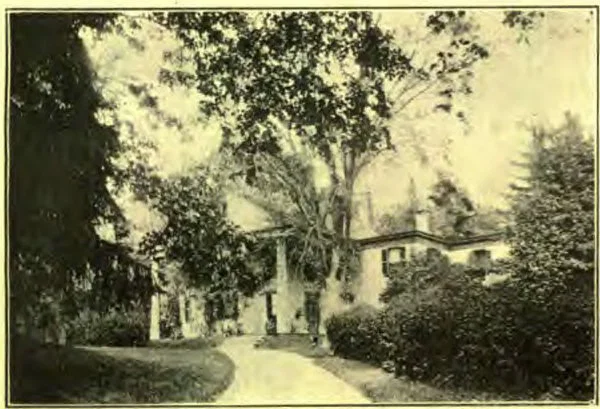
“OAK KNOLL,” DANVERS
A few years later they accepted gratefully his blood-bought boon, and now acknowledge him as one of our country’s noblest sons.
Such is the fickleness of public sentiment. Happy indeed is he who, regardless of the smiles or frowns of a changeful world, stands true to principle, come what may. It is true that every reform movement has come up through tribulation and persecution. Let us then dare own our dear cause when it so much needs us. Let us be ready to recognize Truth in her rags as quickly as in her velvet slippers. Then, and only then, may we rest in hope that He who is the Truth will own us when he comes with the Father and all the holy angels.
Whittier now saw two paths before him. In one lay worldly fame, ease, and the association of literary people. In the other path were Garrison and his negro boy, working in an obscure hole for the right. But to one who had accustomed himself to hear quickly Duty’s call, the choice was a natural, if not an easy one.
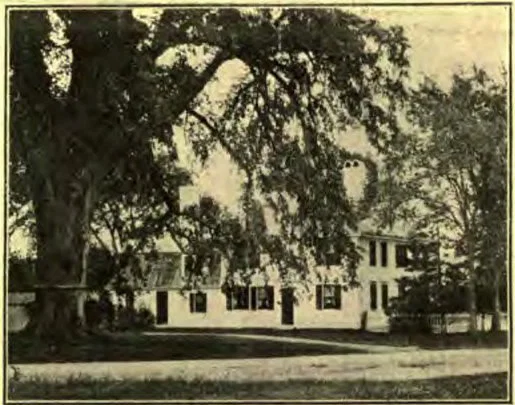
WHITTIER'S HOME, AMESBURY
From now on, his pen was seldom idle, and most of his poems at this time were, in truth, “Voices of Freedom.” In those days the name Abolitionist was regarded by many only as another name for fool or fanatic. His appearance on the public platform was the occasion for brutal insult, and that not from the so-called baser sort only, but with the approval of the fashionable, wealthy, and learned classes.
As we read of meetings of Abolitionists being broken up by mobs, we wonder whether we shall be so true to principle that we too may be accounted worthy to suffer for the truths so dear to us.
Though Whittier was not a great orator like Garrison, yet by his pen he became identified with the despised party, and shared their persecution. He was a frequent visitor at the office of The Liberator; and it was his painful privilege to be present on that well-known occasion when Garrison was dragged through the streets of Boston with a rope around his neck, at the mercy of a heartless mob, until seized for safety by friends, and lodged in jail. As we think of these associations, what wonder that his poems rang with protest against this crying evil. Very few magazines would publish a line bearing his signature. Hence there was little money to be had from his writings, and we find the faithful lover of right, toiling for bread in the meanwhile on the little home farm in East Haverhill until it was sold in 1840, leaving him entirely dependent for support upon his own resources. At about this time he moved to Amesbury, and here, with renewed vigor, he took up his work for humanity.
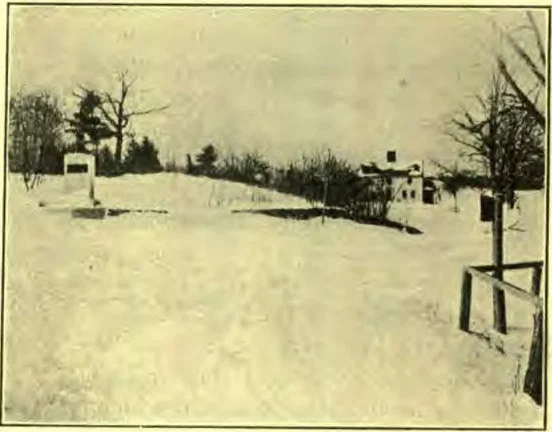
WHITTIER'S CHILDHOOD HOME
As one has aptly said: “His aim has been to reach the hearts of men, and poetic diction has only been the feathering of his arrows.” The same writer further says: “Whatever he has done or has failed to do, there is no uncertain sound in his verse.”
Among the most outspoken of his poems is “Massachusetts to Virginia.” We can not forbear quoting from this most interesting poem:—
“We hunt your bondmen, flying from Slavery’s hateful hell;
Our voices, at your bidding, take up the blood-hound’s yell;
We gather, at your summons, above our fathers’ graves,
From Freedom’s holy altar-horns to tear your wretched slaves!
Thank God! not yet so vilely can Massachusetts bow;
The spirit of her early time is with her even now;
Dream not because her Pilgrim blood moves slow,
and calm, and cool,
She thus can stoop her chainless neck, a sister’s slave and tool!
“But for us and for our children, the vow which we have given
For freedom and humanity is registered in heaven;
No slave-hunt in our borders,—no pirates on our strand!No fetters in the Bay State,—no slave upon our land!”
Did not space forbid, I would gladly record the entire poem, as it is grandly worthy of our study.
It is to Whittier’s credit that he has not sought out the world’s heroes, but has devoted his eulogies and tributes of affection to the neglected and despised ones, the poor Indian and unfortunate debtor, as well as the outcast in general, coming in for their share.
When in course of time the clash of arms sounded in our land, we can imagine how abhorrent all this was to the Quaker poet, who regarded war as murder. His strictly war poems are neither as numerous nor as striking as his2antislavery poems. The pomp of war did not inspire his muse. “Barbara Frietchie” is the only romantic poem founded on this period, I think.
Perhaps a little description of our poet by himself will add a few thoughts concerning his mission. In “The Tent on the Beach,” after making pen sketches of his two friends, Bayard Taylor and James T. Field, who were camping with him near Salisbury Beach, he thus describes himself:—
“And one there was, a dreamer born,
Who, with a mission to fulfil,
Had left the Muses’ haunts to turn
The crank of an opinion-mill,
Making his rustic reed of song
A weapon in the war with wrong.”
Whittier wrote much excellent prose as well as verse. The following is perhaps a fair sample of his prose: “What a monster Napoleon is! Was he born without moral sense? The prayers of all the priests of Rome are with him, but the cry of innocent blood rising to Heaven will drown them. I think he is rushing upon his fate.”
I have purposely dwelt at some length on Whittier’s life as connected with those stirring times, which so much demanded his talent. Since his death he is so much better known as the popular poet, that I love best to linger over the faithful days, the loyal days, the trying days, the triumphant days, of our poet. Of his later quiet life much has been written. His time was divided between his “Oak Knoll” home in Danvers, Massachusetts, and his home in Amesbury, about an hour’s ride by rail from Danvers. After the turmoil of the troublous times in which he took so active a part, it would seem as though his quiet old age was a well-deserved rest.
All along, in addition to his antislavery poems, Whittier had been giving the world other very beautiful poems, many of which are closely associated with numerous local scenes. Our New England beaches, mountains, rivers, lakes, and points of interest in general, are Whittier-hallowed. From Mount Wachusett in Massachusetts to Mount Agamenticus in Maine, and on to our northern New Hampshire lakes and mountains, his memorials have been set.
Besides these local descriptive poems, which in most cases can be readily found from the index of any of his complete works, by the proper names which usually appear in the title, I can not forbear giving a list of my own favorites. “In School-Days,” “Annie and Rhoda,” “The Witch’s Daughter,” “Barefoot Boy,” and “Snow-Bound,” I early learned to love. Later I have enjoyed “Massachusetts to Virginia” (prime favorite), “Eternal Goodness,” “The Meeting,” “The Captain’s Well,” “The Lumbermen,” “The Pumpkin,” and “The Friends’ Burial.”
Whittier was on very friendly terms with Lowell, Emerson, Longfellow, Holmes, and Bryant. Of his association with his more immediate literary neighbors, Gail Hamilton (Abigail Dodge), of Hamilton, Massachusetts; Harriet Prescott Spofford, of Newburyport, Massachusetts; Lucy Larcom, of Beverly, and numerous other literary lights, much has been written in the magazines of the day. Of his home life with his pets and his flowers, school-books have given us much of interest. A touching view of Whittier’s old age, which is also typical of old age in general, is aptly given by one of his biographers: “It is the fate of age to be saddened by the departure of friends. As the long day draws near its close, the blithe companions of morning and the stout-hearted workers of midday begin to fall by the way. The man of seventy years might almost pass his time at funerals of his comrades. Poems at this time are mostly elegies, tributes, and sorrowful memories.”
I think that the writer of the above might have brightened his sad picture with the Christian’s strong hope, that “blessed hope” that almost spans these sad scenes, and lights the way to the city of God.
Whittier, now the aged poet, was called upon to bid good-by to Bayard Taylor, Garrison, Longfellow, Lowell, and others equally as dear but less widely known. Nearly all these sadnesses have found expression in some of his poems.
At length, Sept. 7, 1892, he who had thus mourned for loved friends, himself the last of his family, was laid to rest in the little cemetery at Amesbury—the circle complete once more.
As we have many times visited the quiet spot, these words from his own “Snow-Bound” come involuntarily to mind:—
“Yet Love will dream, and Faith will trust,
(Since He who knows our need is just)
That somehow, somewhere, meet we must.
Alas for him who never sees
The stars shine through his cypress trees!
Who, hopeless, lays his dead away,
Nor looks to see the breaking day
Across the mournful marble play!
Who hath not learned, in hours of faith,
The truth to flesh and sense unknown,
That Life is ever lord of Death,
And Love can never lose its own!”
CARRIE E. ROBIE.
The Trailing Arbutus
By J. G. Whittier
I WANDERED lonely where the pine trees made
Against the bitter east their barricade,
And, guided by its sweet
Perfume, I found, within a narrow dell,
The trailing spring flower tinted like a shell
Amid dry leaves and mosses at my feet.
As, pausing, o’er the lonely flower I bent,
I thought of lives thus lowly, clogged and pent,
Which yet find room,
Through care and cumber, coldness and decay,
To lend a sweetness to the ungenial day,
And make the sad earth happier for their bloom.
— J. G. Whittier.
The Fate of Tomato Cans and Sawdust
Old rags and paper are gathered up by the women on the ash dump, and sold to the junk-man. All sorts of rags there are, from silk to calico, and all kinds of paper, from cream-laid note to waste stuff that has been taken from under carpets and thrown away. The junk-men buy it all; there is nothing they will not pay something for. And in the spring contractors come and dig in the great heap for ashes, of which they cart away vast quantities for use, in a mixture with asphalt and water, in cementing cellar and basement floors.
The tin cans consigned to the ash dumps in such great numbers are collected, and rolled out into sheets for roofing shanties. This, however, is only one of the many ways in which they are utilized. Great quantities of cans are converted into sheet tin for covering parts of trunks, the inside of them usually retaining the original polish. Not a few factories devote their entire attention to the conversion of old tin cans, which are heated until the solder that holds them together runs into a separate receptacle, to be afterward sold for twelve cents a pound — the profit from this source alone almost paying for the gathering and handling of the raw material. The tops and bottoms are melted for sash-weights. Nothing is lost except the labels, which are removed by soaking, as a preliminary to rolling the cylinders flat, and thus it is that a two-horse load of old cans has a market value of six to eight dollars.
When an old shoe has got beyond the point where it can possibly be of any use for wearing, whether whole or in part, it is still valuable as scrap leather. All leather scraps, such as come in large quantities from the shoe factories, are chopped fine and converted into artificial leather. Sometimes, for this purpose, they are mixed with paper pulp and molded for the counters and insoles of boots and shoes, the material thus utilized being treated with a mixture of oil, rubber, and glycerine. The glycerine softens it, and the oil and rubber render it waterproof. Then it is cut into the required shapes. Much material of this kind, in the shape of what is known as “leather-board,” is employed in the manufacture of traveling-bags.
There is always a market for waste paper, and even old newspapers, which represent the lowest and least desirable grade, are worth fifteen cents a hundred pounds. The uses to which such material is put are almost innumerable, extending even to the manufacture of car-wheels and coffins. In the making of trunks and valises, as a substitute for leather, there is commonly used a sort of paper board, composed of layers of paper which has previously been subjected to a chemical treatment that renders it extremely hard and tough. All the paper money issued by the United States government is eventually, after being redeemed, ground up and reduced to a pulp, which, being of the finest linen stock, is eagerly purchased by paper-makers.
Sawdust, which was formerly a waste product, is put to a multitude of uses in these modern days. Mixed with tar and compressed into bricks, it is employed for gas-making, a ton of the bricks yielding from 30,000 to 40,000 cubic feet of gas. Bricks of clay and sawdust mixed are considered very superior for building purposes, being only half the weight of ordinary bricks, and taking plaster direct without the intervention of laths. Sawdust is also employed instead of sand for mortar, and it is utilized quite commonly for filling the walls and floors of apartment houses to deaden sound. In cold-storage houses and market ice-boxes sawdust serves as a non-conductor, and hardwood sawdust is said to be excellent for smoking hams. Wood alcohol is also derived from sawdust by distillation.
Mixed with a glue solution and bichromate of potash, sawdust is now converted into an artificial wood, which is very durable and takes a high polish. It is shaped in molds, and many handsome articles are made out of it. The bichromate is to render it waterproof. In France great success has been obtained in the manufacture of wood pastes, as they are called, from sawdust, with an admixture of dyewoods for color. Not to be forgotten are the bottle stoppers, which, made from sawdust, serve quite satisfactorily in place of corks for certain purposes, holding the corkscrew well.—Saturday Evening Post.
A Reminder
By Mrs. M. A. Loper
HAVE you thought you yourself have both brothers
And sisters in darkness and sin,
Who are waiting for you, not for others,
To help Christian life to begin?
So long with the wanderers erring,
So far from the heavenly home,
While you, precious light and truth sharing—
Have you thought of the dear ones who roam?
Christ came not to call to repentance
The righteous, but souls who are lost;
Have you thought, only sinners find entrance
To heaven, at infinite cost?
But, O, the great price has been given;
Christ died that poor sinners might live,
He opened the portals of heaven,
His wandering ones to receive.
O you who have heard the sweet story,
Repeat the glad news o’er and o’er;
For soon Christ will come in his glory,
Probation forever be o’er;
Awake, Christian, rouse from thy slumber
To rescue the perishing one,
If thou would’st be one of the number
To hear from the Master, “Well done.”
—Mrs. M. A. Loper.
Lost Time Is Never Found Again
“Lost time is never found again.”
Nothing Good Bursts Forth All at Once
“NOTHING good bursts forth all at once.”
Wisdom and the Knowledge of One's Own Ignorance
“If thou art wise, thou knowest thine own ignorance.”
Ignorance Shuts Its Eye
“IGNORANCE shuts its eye, and believes it is right.”
Experience Is a Good Teacher
“EXPERIENCE is a good teacher, but charges like a specialist.”
Strength in Weakness
By I. A. Reed
Wild Bergamot
or Horse mint
In this work of the leaves there is for us a lesson. God can do whatever he wills in whatever he will. In yon burning building the mighty force of fire is at work; but in the watery cells of the delicate leaf the Creator has placed a power, silent, effective, that, being stronger and more powerful, can outdo and undo the work of the fire.
Here, at least, the Creator’s power is made perfect in weakness. And this is but a type of the work to be wrought in human lives. As we behold the great things God seeks to work in us, we cry out because of our weakness. But we are not more weak than the watery cells of the delicate leaf.
Their might is the might of the fire, but made manifest and “made perfect in weakness.” In leaves and tender blades of grass, God does a work that is equal to the might revealed in the convulsions of nature.
And so in your weakness God can do, yes, seeks to do, a work more mighty than that of all the combined powers of the kingdom of hell. In weak instruments of earth, God can do the almighty work of heaven. He pours the treasure into earthen vessels that the sufficiency may be of him.
“Weak as water,” is a very common expression. “Unstable as water,” is a Scriptural expression.
The two sayings have very similar meanings. The instability of water is the cause of its weakness. And yet weak and unstable as it is, if it can but unite in the right way with something that will make up for this instability, it is one of the strongest, yes, one of the most unyielding, things we know.
Water yields so readily to the hand that we might think it could be easily squeezed into a smaller space. But this is not the case. About two hundred seventy years ago, Lord Bacon proved that water under certain conditions is most decidedly unyielding. He filled a hollow globe of lead with water, and, soldering up the aperture, tried to flatten the globe by the blows of a heavy hammer. He continued to hammer until the water, under the heavy pressure, oozed through the lead like fine dew.
The shell of metal made up for the instability of the water, and in this condition it offered an immense resistance to compression. Man may be “unstable as water;” but surrounded by Christ his instability is made up, and he can withstand the mighty pressure of evil which otherwise would sweep him before it.
There have been men as weak as their fellows, who through faith, “out of weakness were made strong, waxed valiant in fight, turned to flight the armies of the aliens.” Heb. 11:34.
God’s strength was made perfect in weakness in Gideon and his handful of followers, and they smote the countless hosts of the Ismaelites as one man, driving them in utter rout across the Jordan.
There are no Ishmaelitish hordes for us to fight; but we have an enemy before whose attacks we must flee discomfited, unless we have God’s might within to hold us “steadfast, unmovable.”
“All flesh is as grass, and all the goodliness thereof is as the flower of the field;” but even so God’s almighty power may there be perfected, even as in nature it is forever glorified by the insufficiency of the instrument.
Our weakness, bless God, is no hindrance. It is the all-enduring assurance that God will work. It is in instruments of weakness that he especially chooses to work; for there, and there only, his “strength is made perfect in weakness.” The leaf and the blade of grass are weak, but God’s power is made perfect in their weakness. We, too, are weak, but we are not weaker than the leaf or the blade of grass. Since his strength for them is made perfect in their weakness, we are sure that his strength may be—God help us to say, is—made perfect in our weakness.
In fact, in the example of the plant, it is the weakness of the instrument that teaches us that it must be God who works. We see that the instrument is adapted to the work, but we know that weak as it is, out of its weakness can not come this almost almighty power; the sufficiency must be of God.
And so our weakness is to teach us that it is not we who do the work of righteousness. Weak as we are, and full of sin, out of our weakness and sinfulness can not come this almighty might that makes and keeps men righteous. The might, the righteousness, the sufficiency, is of God.
Our weakness is thus the witness which proclaims God at work. Shall we therefore lament this which reveals him? Let us rather say with Paul, “Most gladly therefore will I rather glory in my infirmities, that the power of Christ may rest upon me. Therefore I take pleasure in infirmities, in reproaches, in necessities, in persecutions, in distresses for Christ’s sake; for when I am weak, then am I strong.”
When once we fully realize our weakness, we shall cease attempting all self-work, for this is but for us to reveal our utter weakness and accomplish nothing; we shall rather rest forever in the all-sufficient might of God. It is he that must work in us “both to will and to do of his good pleasure.” I. A. Reed.
Go Work in My Vineyard
NEVER put off that which can be done now. God’s day of salvation is “now,” “to-day.” Reader, are there not souls in your neighborhood or city who have not yet heard the last message of mercy? Who is responsible for these souls? Are you waiting for the conference to send workers into your neighborhood? Do you not think it would be much more pleasing to the Lord if you would do this work yourself, and thus leave the workers free to carry the message to new fields? Have you thought what you might do if you were to adopt a systematic use of the Family Bible Teacher? Just think, by the use of this little messenger you can place practically the entire truth, in a clear, concise manner, in the hands of your friends and neighbors at the small cost of about seven cents for each family. This plan is so simple that even the weakest of the Lord’s children may successfully engage in it.
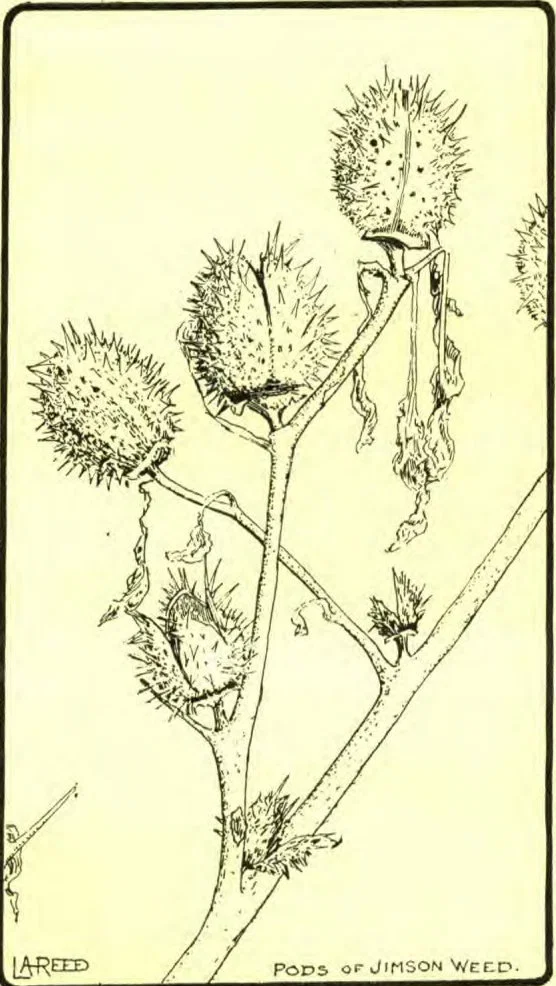
PODS OF JIMSON WEED.
The plan of work is this: The first week visit the homes of the people, tell them about the course of study, and invite them to become regular readers; with those who accept, leave Lesson No. 1, promising to bring them one lesson each week thereafter until the entire course is completed. Any one who is willing to spend a few minutes each week can easily teach from ten to fifty families by this method. For further information regarding plans of work, send for free booklet entitled “The Family Bible Teacher and Suggestions for Its Use.” This also tells how to make the work self-supporting. Ascertain the number of lessons each member of your company is willing to distribute weekly, add the totals together, and place the order with your State tract society.
If you have not yet read this important course of lessons yourself, send ten cents, and a full course will be sent you, postpaid.
The Family Bible Teacher was formerly published at Cincinnati, Ohio, but has recently been sold to the Southern Publishing Association, so that now this publication is owned by the denomination, and should receive the hearty support of our people.
Scatter the Gems of Beauty
“SCATTER the gems of the beautiful
In the depths of the human soul;
They will bud and blossom and bear fruit
While the endless ages roll.”